9 Best Customer Query Automation Software Tools in 2026
This guide evaluates nine leading customer query automation software tools in 2026, comparing them on automation depth, integration breadth, deployment ease, and B2B scalability. Whether you're looking for an AI-first platform like Halo AI or a solution tailored to a specific use case, this breakdown helps support teams find the right fit before ticket volume becomes a crisis.
 Grant CooperFounder14 min read
Every support team hits a breaking point. Ticket volume climbs, response times slip, and customers start quietly exploring alternatives. Customer query automation software addresses this directly by handling routine inquiries without human intervention, freeing your team to focus on the complex issues that genuinely require judgment and expertise.
But not all automation tools are built the same. Some bolt AI onto legacy helpdesk infrastructure. Others are designed AI-first from the ground up. Some stop at deflection; others integrate with your entire business stack and surface intelligence that goes well beyond support. The difference matters more than vendors typically admit.
This list covers nine tools worth serious consideration in 2026, evaluated on automation depth, integration breadth, deployment ease, and how well they scale with growing B2B teams. We've placed Halo AI at the top because it's genuinely the most capable AI-first option for B2B SaaS teams, but every tool here earns its place for the right use case.
1. Halo AI
Best for: B2B SaaS teams wanting autonomous, AI-first support with deep business stack integration.
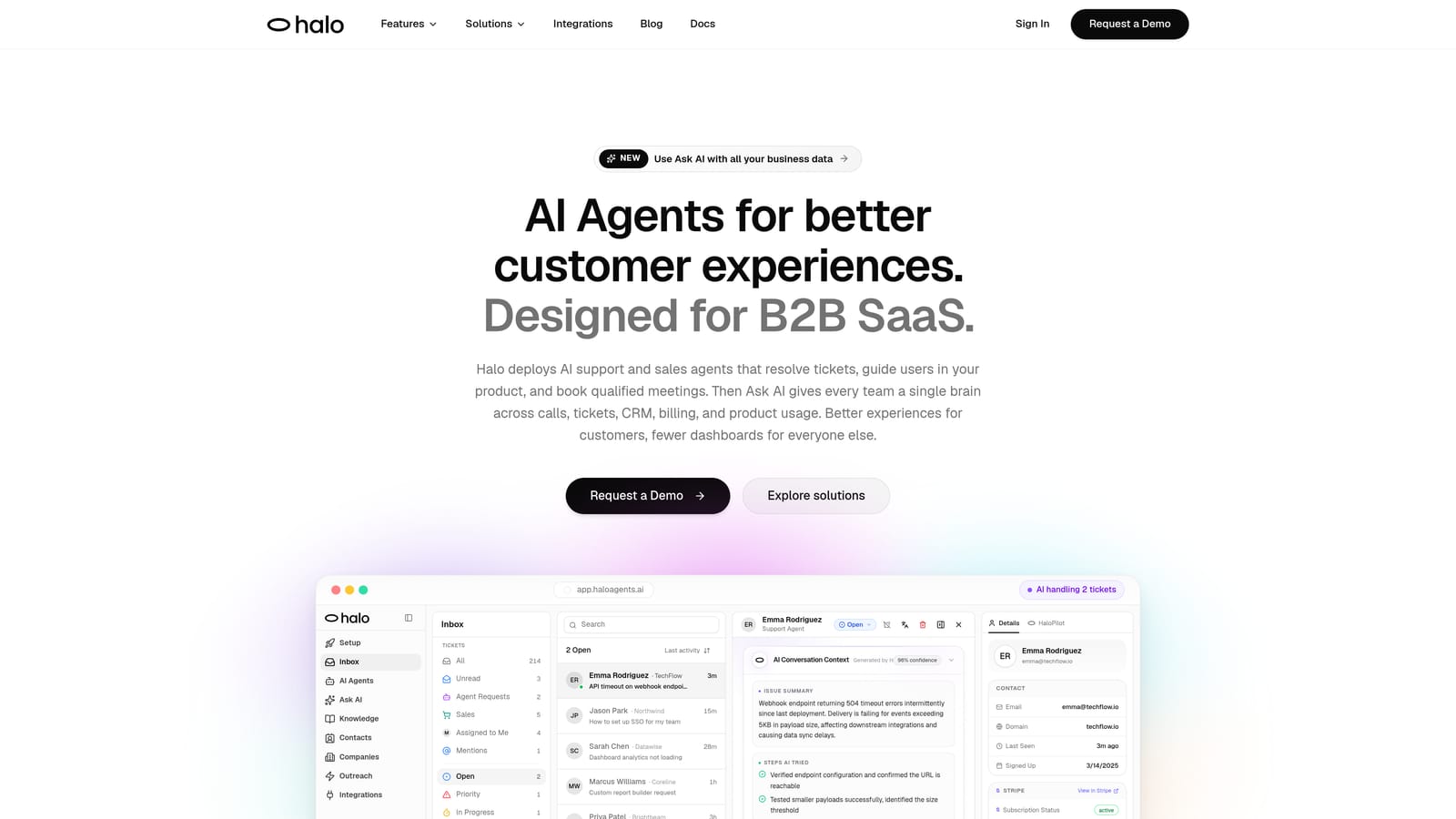
Halo AI is an AI-first customer support platform that resolves tickets autonomously, guides users through your product with page-aware context, and surfaces business intelligence from every support interaction.
Where This Tool Shines
Halo AI isn't AI layered onto an existing helpdesk. It's built from the ground up around autonomous agents that actually resolve tickets end-to-end, not just suggest responses for a human to approve. That distinction matters enormously when you're trying to reduce ticket volume rather than just speed up agent workflows.
The page-aware chat widget is genuinely differentiated. It sees what the user sees in your product and provides visual UI guidance in context, which means users get relevant help precisely where they're stuck rather than generic documentation links. Combined with continuous learning from every resolved interaction, the system gets meaningfully smarter over time without manual retraining.
Key Features
Autonomous Ticket Resolution: AI agents resolve support tickets end-to-end, not just surface suggested replies for agents to edit and send.
Page-Aware Chat Widget: The chat widget understands which page and UI element the user is on, delivering contextually accurate guidance and visual walkthroughs.
Auto Bug Ticket Creation: When users report bugs, Halo automatically creates structured bug tickets and routes them to Linear or your preferred project management tool.
Smart Inbox with Business Intelligence: The inbox surfaces customer health signals, revenue anomalies, and churn indicators derived from support interaction patterns, turning support data into actionable business insight.
Native Integration Stack: Connects natively with Linear, Slack, HubSpot, Intercom, Stripe, Zoom, PandaDoc, and Fathom, giving it full visibility across your business operations.
Graceful Live Agent Handoff: When a conversation exceeds AI scope, it escalates cleanly to a human agent with full context preserved.
Best For
B2B SaaS product teams that want AI to genuinely own ticket resolution rather than assist agents, particularly those who need support intelligence connected to their CRM, billing, and project management systems. Teams scaling past the point where linear headcount growth is sustainable will find the most value here.
Pricing
Contact Halo AI directly for pricing. Given the enterprise-grade integration depth and autonomous resolution capabilities, pricing is customized based on team size and usage.
2. Intercom
Best for: Teams wanting a mature communications platform with capable AI query deflection built in.
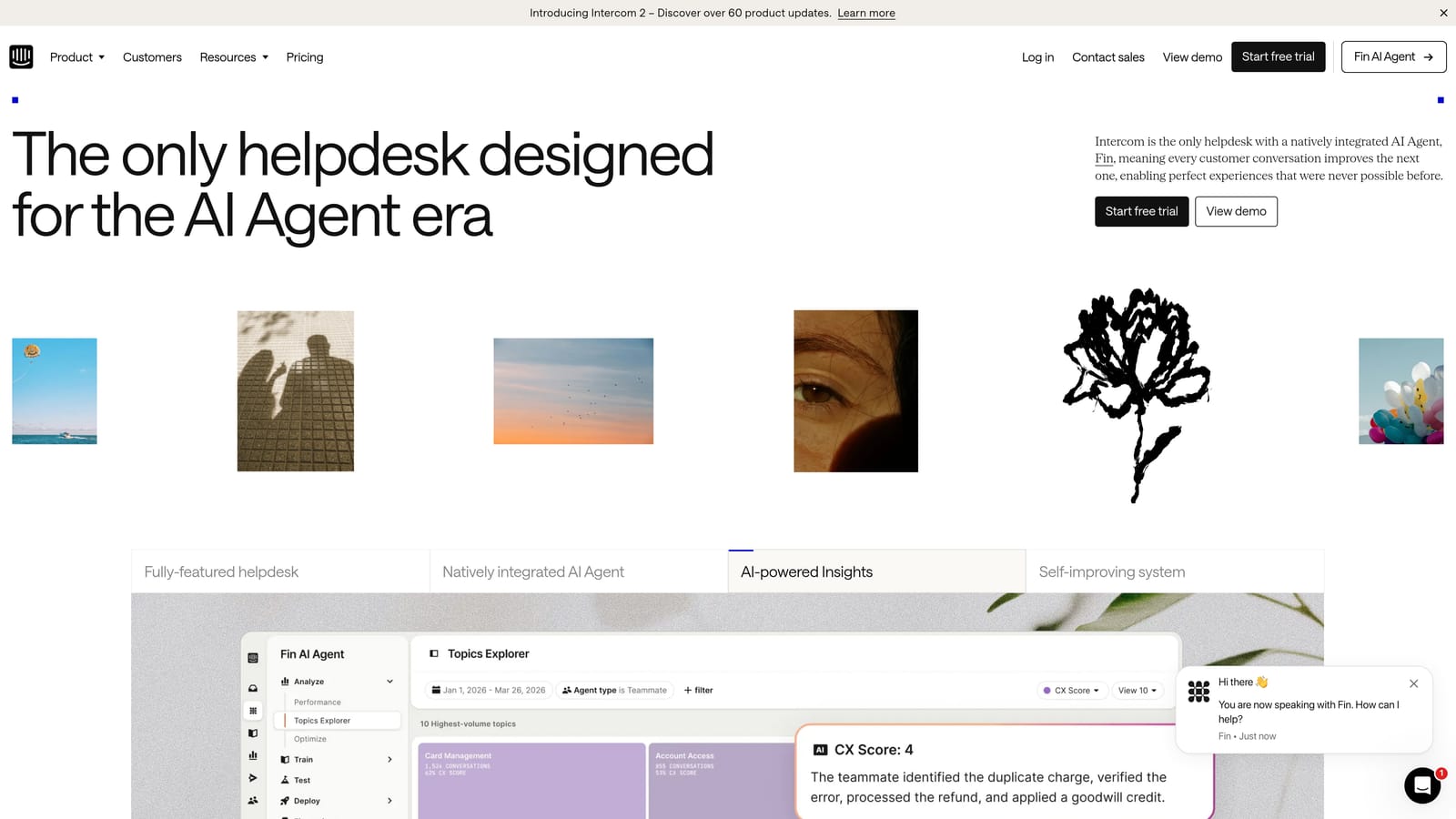
Intercom is a customer communications platform featuring Fin, its GPT-4-powered AI agent, handling query deflection across chat, email, and in-app channels.
Where This Tool Shines
Intercom has spent years building one of the most polished in-app messaging experiences available, and Fin AI sits on top of that mature foundation. For teams already using Intercom for customer communications, adding AI deflection is a natural extension rather than a platform migration.
Fin draws on your existing help content to answer queries autonomously, which means deployment is relatively fast if your knowledge base is already in good shape. The unified inbox combining chat, email, and in-app messages is genuinely useful for smaller support teams managing multiple channels simultaneously.
Key Features
Fin AI Agent: GPT-4-powered agent that resolves queries autonomously using your existing help content and documentation.
Unified Inbox: Combines chat, email, and in-app messages into a single workspace for agents managing multiple channels.
300+ App Marketplace: Extensive integration library covering CRM, billing, analytics, and productivity tools.
Proactive Messaging and Product Tours: Supports onboarding workflows with targeted messages and guided product tours.
AI-Assisted Reply Suggestions: Surfaces suggested responses to human agents for queries that reach the inbox.
Best For
Teams already invested in the Intercom ecosystem who want to add AI deflection without switching platforms. Also well-suited to product-led growth companies where in-app messaging and onboarding support are central to the customer experience.
Pricing
Base plans start at approximately $39 per seat per month. Fin AI is billed separately on a per-resolution basis, so costs scale with usage volume. Verify current pricing on the Intercom website before committing.
3. Zendesk
Best for: Enterprises needing mature ticketing infrastructure with AI layered on top for triage and routing.
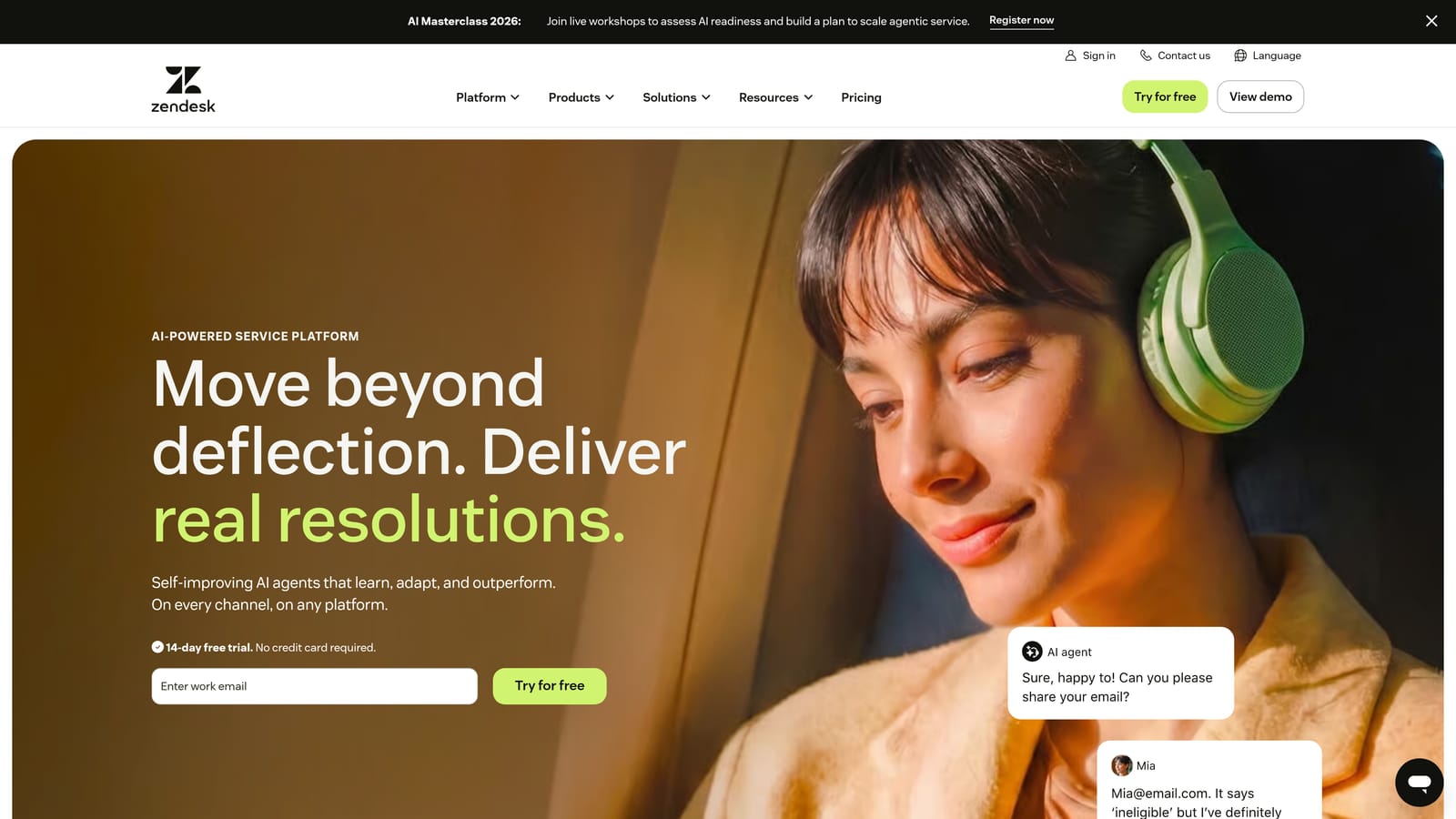
Zendesk is the market-leading helpdesk platform with Zendesk AI providing intelligent triage, suggested responses, and automated routing built onto its established ticketing infrastructure.
Where This Tool Shines
Zendesk's core strength is its depth of ticketing infrastructure: SLA management, reporting, compliance features, and an integration ecosystem built over many years. For enterprises that have standardized on Zendesk, the AI features extend existing workflows rather than requiring new ones.
Zendesk AI handles triage and routing intelligently, classifying tickets by intent and sentiment before they reach an agent. Answer Bot provides self-service deflection at the front end, reducing the volume that creates tickets in the first place. The tradeoff is that AI here is additive to a traditional helpdesk model rather than architecturally central.
Key Features
AI-Powered Triage and Routing: Automatically categorizes and routes tickets based on detected intent, sentiment, and priority signals.
Intelligent Macro and Reply Suggestions: Surfaces relevant macros and suggested responses to agents handling tickets in the queue.
Advanced SLA Management and Reporting: Industry-leading tools for tracking response times, resolution rates, and team performance against service agreements.
Answer Bot: Deflects common queries with self-service responses before a ticket is created, reducing inbound volume.
Enterprise Compliance and Security: Extensive compliance certifications and security controls suited to regulated industries.
Best For
Mid-market to enterprise teams with established Zendesk infrastructure who want to add AI capabilities without migrating platforms. Also a strong fit for industries with strict compliance requirements where Zendesk's security certifications matter.
Pricing
Suite plans start at approximately $55 per agent per month. AI features are priced as add-ons rather than included in base plans. Confirm current add-on pricing directly with Zendesk.
4. Freshdesk
Best for: Growing teams wanting affordable helpdesk software with AI capabilities at competitive price points.
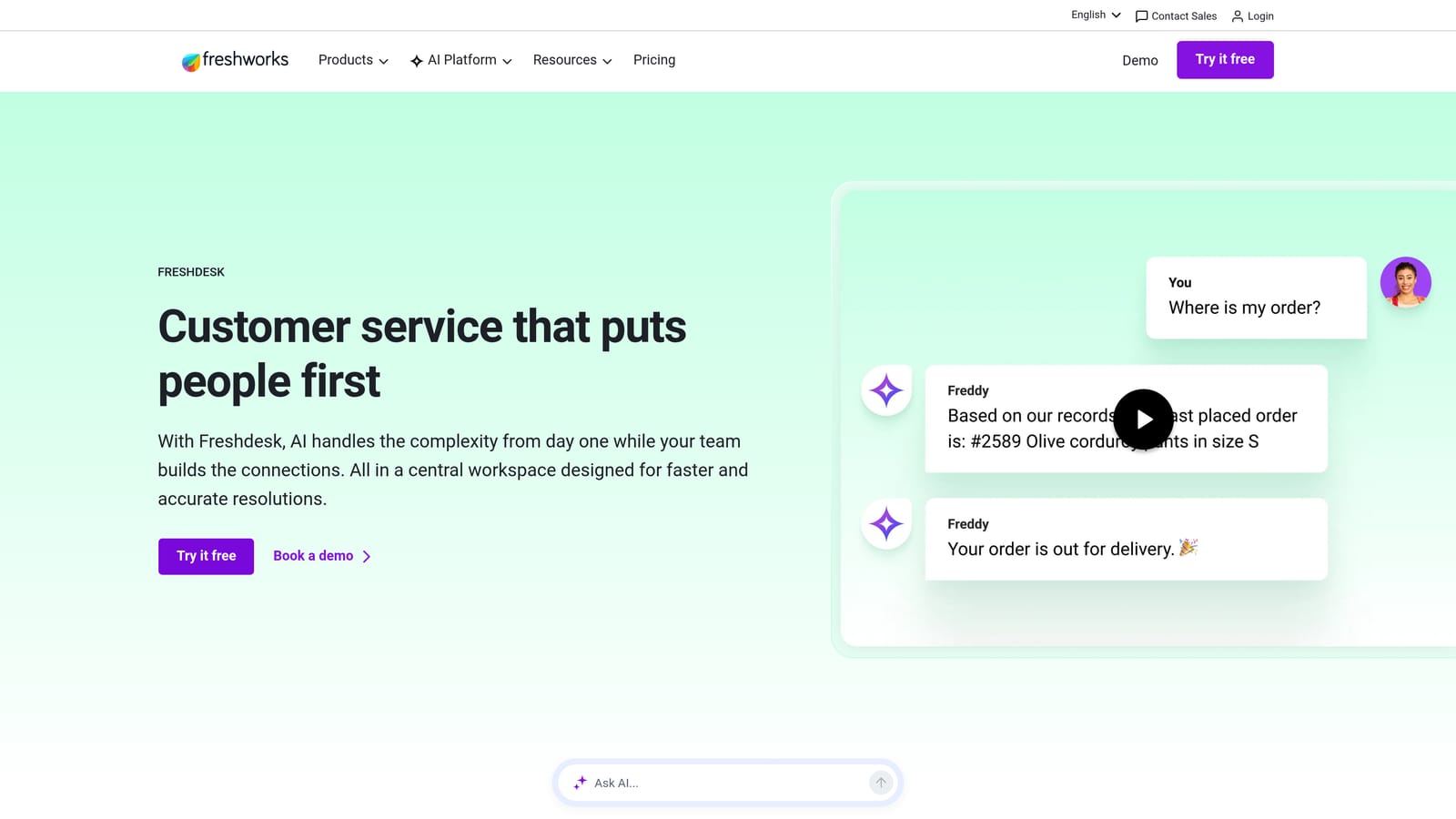
Freshdesk is a Freshworks helpdesk product with Freddy AI providing automated triage, self-service bots, and agent assist features across tiered pricing plans that suit teams at different growth stages.
Where This Tool Shines
Freshdesk's primary advantage over Zendesk is pricing accessibility. Teams that need solid helpdesk fundamentals with AI assistance, but aren't ready to commit to enterprise-tier budgets, often find Freshdesk hits the right balance. The free tier makes it genuinely approachable for early-stage teams.
Freddy AI handles the core automation tasks: auto-triage, categorization, priority assignment, and self-service deflection. Freddy Copilot adds AI-assisted response drafting for agents. The omnichannel support across email, chat, phone, and social keeps workflows consolidated without requiring multiple tools.
Key Features
Freddy AI Triage: Automatically categorizes tickets, assigns priority, and routes to the right team or agent based on content analysis.
Freddy Self Service Bot: Deflects common queries before they reach the agent queue using your knowledge base content.
Freddy Copilot: Generates AI-assisted response drafts and conversation summaries to speed up agent handling time.
Omnichannel Support: Consolidates email, chat, phone, and social conversations into a unified agent workspace.
Affordable Tiered Pricing: Free tier for small teams with paid plans scaling gradually as team size and feature needs grow.
Best For
Growing SMB and mid-market teams that need solid helpdesk fundamentals with AI assistance at a price point below Zendesk. Also a practical choice for teams migrating off spreadsheets or basic email-based support for the first time.
Pricing
Free tier available for small teams. Growth plans start at approximately $15 per agent per month. AI features are available on higher tiers. Check Freshdesk's current pricing page for the latest plan structure.
5. Tidio
Best for: E-commerce and SMB teams wanting fast-deploying AI chat with native Shopify and WooCommerce integration.
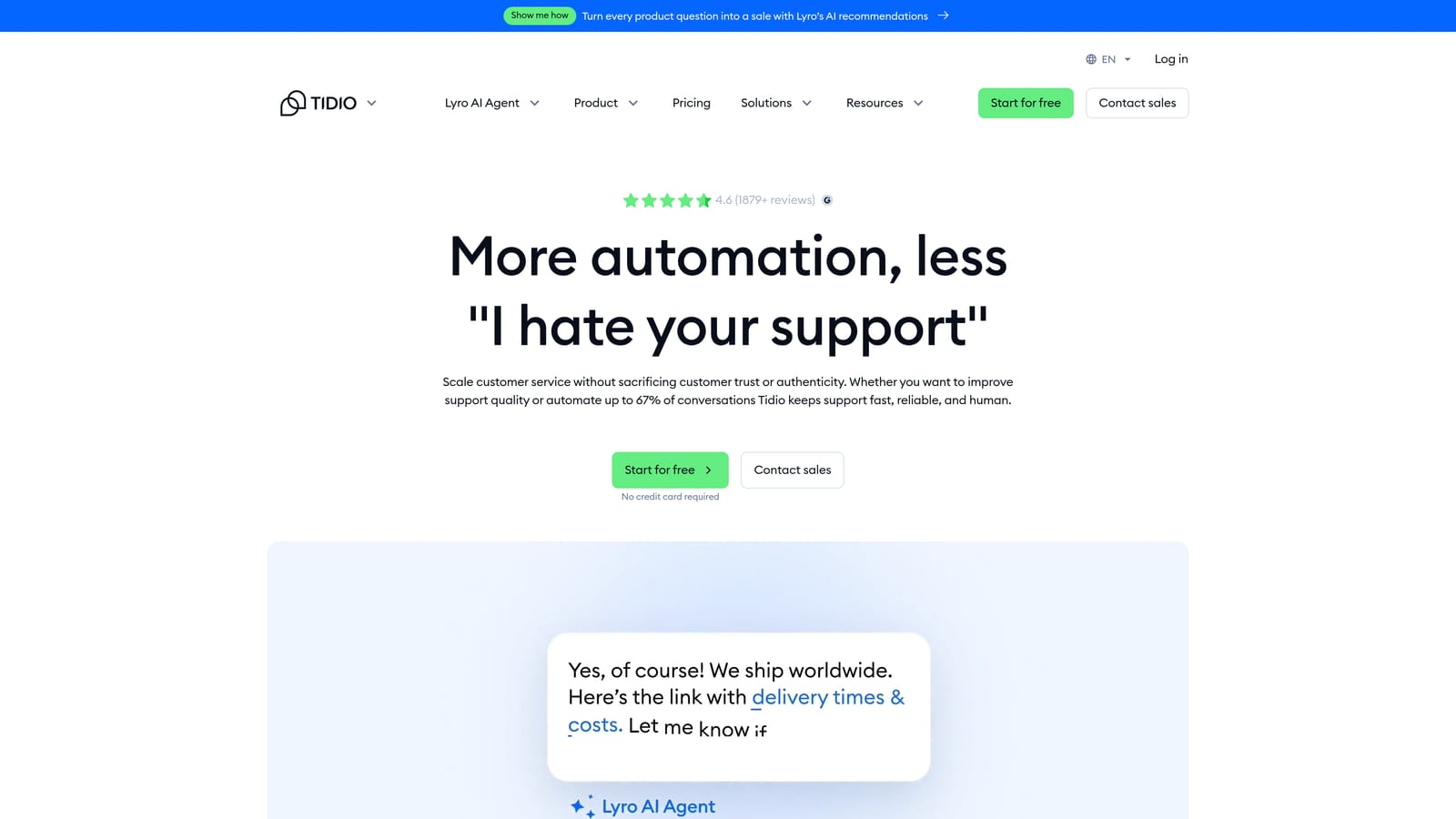
Tidio is a live chat and AI chatbot platform featuring Lyro AI for autonomous query handling, built for quick deployment with minimal configuration and strong native e-commerce integrations.
Where This Tool Shines
Tidio's defining characteristic is speed to value. Most teams can deploy Lyro AI and have it handling common queries within hours rather than weeks. For e-commerce businesses where support queries cluster around orders, returns, and shipping status, this fast deployment is a genuine advantage.
The native Shopify and WooCommerce integrations give Lyro AI access to order data, enabling it to answer order-specific queries without routing to a human agent. The visual chatbot builder makes it accessible for non-technical teams that need to customize conversation flows without developer involvement.
Key Features
Lyro AI Chatbot: Autonomous query resolution trained on your support content, handling common questions without human involvement.
Quick Deployment: Minimal configuration required to go live, with most teams operational within a day.
Native E-Commerce Integrations: Direct connections to Shopify and WooCommerce for order-aware customer support.
Live Chat with Agent Takeover: Seamlessly escalates to a human agent when Lyro reaches the limits of its knowledge.
Visual Chatbot Builder: Drag-and-drop interface for building custom conversation flows without coding.
Best For
E-commerce businesses and SMBs with high volumes of repetitive, predictable queries. Less suited to complex B2B SaaS support workflows where queries require deep product knowledge or multi-system context to resolve.
Pricing
Free tier available. Paid plans start at approximately $29 per month. Lyro AI is priced on a per-conversation basis. Verify current pricing on the Tidio website.
6. Drift (Salesloft)
Best for: B2B revenue teams where support and sales conversations overlap in a single customer journey.
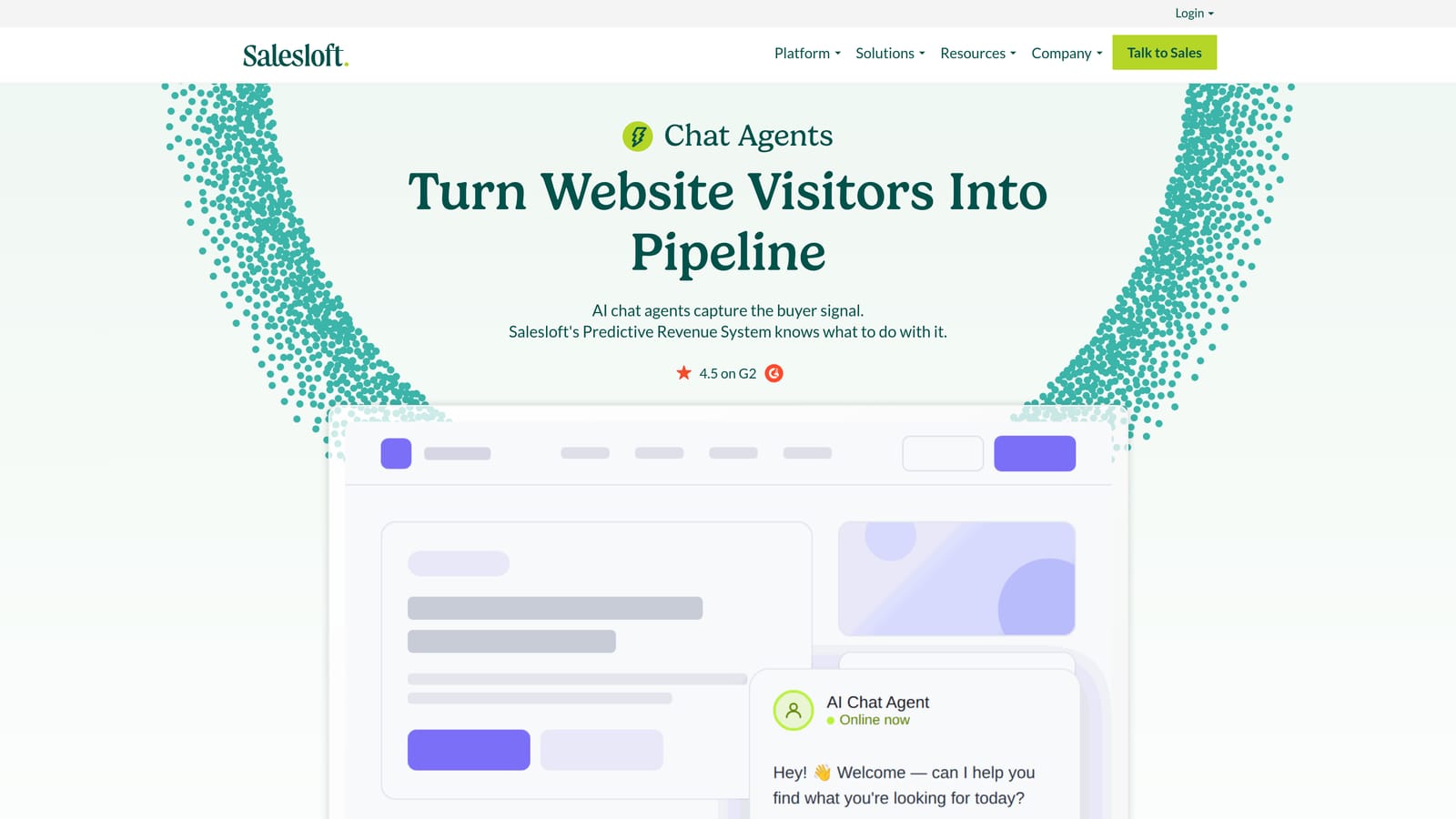
Drift, now part of Salesloft, is a conversational platform that blends AI-powered support and sales routing in a single interface, designed for revenue teams where the line between support and sales is intentionally blurred.
Where This Tool Shines
Drift occupies a unique position in this list: it's as much a sales tool as a support tool. For B2B companies where inbound chat conversations can quickly pivot from a support question to a renewal discussion or an upsell opportunity, having support and sales workflows in the same platform creates genuine efficiency.
The integration with Salesloft brings unified revenue team operations, connecting chat conversations to sales sequences and account activity. Real-time visitor intelligence enables personalized routing based on account tier, intent signals, or CRM data, which is particularly valuable for account-based B2B operations.
Key Features
AI Chatbot with Support and Sales Routing: Routes conversations intelligently between support resolution and sales engagement based on visitor signals and conversation context.
Salesloft Integration: Connects chat activity to sales workflows, sequences, and account data for unified revenue team operations.
Real-Time Visitor Intelligence: Identifies and personalizes routing based on account identity, CRM data, and behavioral signals.
Meeting Scheduling and Lead Qualification: Built-in calendar booking and qualification flows embedded directly in chat conversations.
Account-Based Targeting: Targets specific accounts with personalized chat experiences based on firmographic and intent data.
Best For
B2B revenue teams at mid-market to enterprise scale where support and sales conversations frequently intersect, particularly those already using Salesloft for sales engagement and wanting a unified platform.
Pricing
Enterprise pricing model; contact Drift's sales team for a quote. Pricing is not publicly listed and varies based on team size and feature requirements.
7. Ada
Best for: Enterprise teams needing a no-code AI agent builder with strong multilingual support and deep API integrations.
Ada is an enterprise no-code AI agent platform that enables non-technical teams to build, customize, and deploy AI-powered support experiences with extensive multilingual capabilities and flexible API integrations.
Where This Tool Shines
Ada's core value proposition is control without code. Non-technical support and operations teams can build sophisticated AI agent behaviors, define brand voice and persona, and customize resolution logic without involving engineering. For enterprises where the support team needs ownership of the AI experience, this matters significantly.
The multilingual capabilities are genuinely strong, supporting dozens of languages with consistent quality. For global consumer brands managing support across multiple regions, this reduces the complexity of deploying AI at scale. Deep API integrations allow Ada to pull live data into conversations, enabling dynamic responses based on account status, order history, or other real-time data sources.
Key Features
No-Code AI Agent Builder: Visual interface for building AI agent behaviors, conversation flows, and brand-controlled persona without developer involvement.
Multilingual Support: Handles customer queries in dozens of languages with consistent resolution quality across regions.
Deep API Integrations: Connects to external data sources to pull live customer and account data into conversations dynamically.
Omnichannel Automated Resolution: Resolves queries across web, mobile, and messaging channels from a single platform.
Enterprise Analytics and Reporting: Detailed conversation analytics and resolution reporting for performance tracking and continuous improvement.
Best For
Large enterprises with global customer bases needing multilingual AI support, and organizations where non-technical teams need ownership of AI agent configuration without engineering dependency.
Pricing
Enterprise pricing only; contact Ada for a quote. Not suitable for small teams or those with limited budgets.
8. Forethought
Best for: Enterprises with significant existing helpdesk investment wanting AI capabilities without platform migration.
Forethought is an AI middleware layer that sits on top of existing helpdesks, including Zendesk, Salesforce Service Cloud, and Freshdesk, adding intelligent triage, routing, and autonomous resolution without requiring teams to change their core infrastructure.
Where This Tool Shines
Forethought solves a real problem for enterprises that have invested heavily in existing helpdesk infrastructure and aren't in a position to migrate. Rather than replacing Zendesk or Salesforce, it adds an AI intelligence layer on top, improving triage accuracy, routing efficiency, and first-contact resolution without disrupting established workflows.
The Solve product handles autonomous resolution for common query types. Triage handles intelligent categorization and priority scoring. Assist generates reply drafts and surfaces knowledge suggestions for agents handling complex tickets. Together, these create a meaningful AI upgrade to existing infrastructure without the disruption of a full platform switch.
Key Features
Solve: Autonomous resolution for common query types, deflecting tickets before they reach the agent queue.
Triage: Intelligent ticket categorization, priority scoring, and routing layered onto your existing helpdesk.
Assist: AI-generated reply drafts and knowledge base suggestions surfaced to agents within their existing helpdesk interface.
Native Helpdesk Compatibility: Works directly with Zendesk, Salesforce Service Cloud, and Freshdesk without requiring workflow changes.
AI Without Migration: Adds intelligence to existing infrastructure, protecting prior helpdesk investment while improving automation depth.
Best For
Enterprises deeply committed to existing helpdesk platforms that want meaningful AI improvements without the cost and disruption of a full migration. Particularly relevant for Zendesk and Salesforce Service Cloud shops evaluating AI add-ons.
Pricing
Contact Forethought's sales team for pricing. Not publicly listed; pricing varies based on helpdesk platform, team size, and feature scope.
9. Kustomer
Best for: High-volume consumer support operations needing CRM-native automation with full customer timeline visibility.
Kustomer, owned by Meta, is a CRM-native customer service platform with AI automation built into a unified customer timeline view, designed for high-volume consumer support operations.
Where This Tool Shines
Kustomer's architectural difference is that customer data is the center of every conversation, not the ticket. Every interaction across every channel appears in a single customer timeline, giving agents complete context without switching between systems. For high-volume consumer support where customers contact across email, chat, SMS, social, and voice, this unified view reduces handling time meaningfully.
The AI automation handles routing, tagging, and response suggestions with the full customer history as context, which improves relevance compared to systems that treat each ticket in isolation. The workflow automation tools support complex multi-step processes that go beyond simple routing, useful for support operations with intricate escalation logic.
Key Features
Full Customer Timeline View: All interactions across every channel consolidated into a single chronological view for complete agent context.
AI-Powered Automation: Intelligent routing, tagging, and response suggestions informed by full customer history rather than individual ticket content.
CRM-Native Architecture: Customer data is structurally central, not bolted on, enabling more contextually relevant automation.
Omnichannel Support: Manages email, chat, SMS, social, and voice from a single unified platform.
Complex Workflow Automation: Supports multi-step support processes and sophisticated escalation logic beyond basic routing rules.
Best For
High-volume consumer support operations, particularly those managing customers across many channels simultaneously. Less common in pure B2B SaaS contexts; the CRM-native model is most valuable where customer history depth and omnichannel volume are primary challenges.
Pricing
Enterprise plans range from approximately $89 to $139 per user per month. Confirm current pricing directly with Kustomer, as Meta's ownership has influenced pricing structure over time.
Which Tool Is Right for Your Team
The right choice here depends less on feature lists and more on where you are as a team and what you're actually trying to solve.
For SMB and growing teams: Freshdesk offers the most accessible entry point with solid AI fundamentals. Tidio is the right call specifically for e-commerce businesses with predictable, high-volume query patterns. Both get you operational quickly without enterprise-level investment.
For enterprise teams on existing infrastructure: If you're deeply committed to Zendesk or Salesforce, Forethought is the pragmatic choice. It adds real AI intelligence without the disruption of migration. Zendesk AI itself is worth evaluating if you're already on the Suite plan. Kustomer fits high-volume consumer operations where omnichannel timeline visibility is the core need.
For B2B revenue teams: Drift makes sense when support and sales conversations overlap in a single customer journey. Ada is worth evaluating for global enterprises needing multilingual no-code AI agent control.
For B2B SaaS teams wanting genuine AI-first automation: Halo AI is the standout option. The difference between AI that assists agents and AI that resolves tickets autonomously is significant at scale. Bolt-on AI can improve agent efficiency; AI-first architecture actually reduces ticket volume. That distinction becomes more consequential as your customer base grows.
Your support team shouldn't scale linearly with your customer base. Let AI agents handle routine tickets, guide users through your product, and surface business intelligence while your team focuses on complex issues that need a human touch. See Halo in action and discover how continuous learning transforms every interaction into smarter, faster support.