9 Best Customer Satisfaction Automation Tools in 2026
This guide reviews nine of the best customer satisfaction automation tools in 2026, evaluated on automation depth, integration ecosystems, and B2B SaaS fit. Whether your goal is deflecting repetitive tickets, capturing CSAT feedback at scale, or converting support data into business intelligence, it covers a solution built for your workflow.
 Matt PattoliFounder13 min read
Customer satisfaction doesn't happen by accident. It's engineered. As support volumes grow and customer expectations rise, teams that rely on manual processes alone struggle to keep pace. The good news: a new generation of customer satisfaction automation tools can handle everything from ticket resolution to CSAT surveys, freeing your team to focus on the interactions that actually require a human touch.
This list covers nine tools worth evaluating in 2026, selected based on automation depth, integration ecosystem, ease of deployment, and fit for B2B SaaS teams. Whether you're looking to deflect repetitive tickets, capture satisfaction signals at scale, or turn support data into business intelligence, there's a tool here built for your workflow.
1. Halo AI
Best for: B2B SaaS teams that want AI-native support automation with deep business intelligence
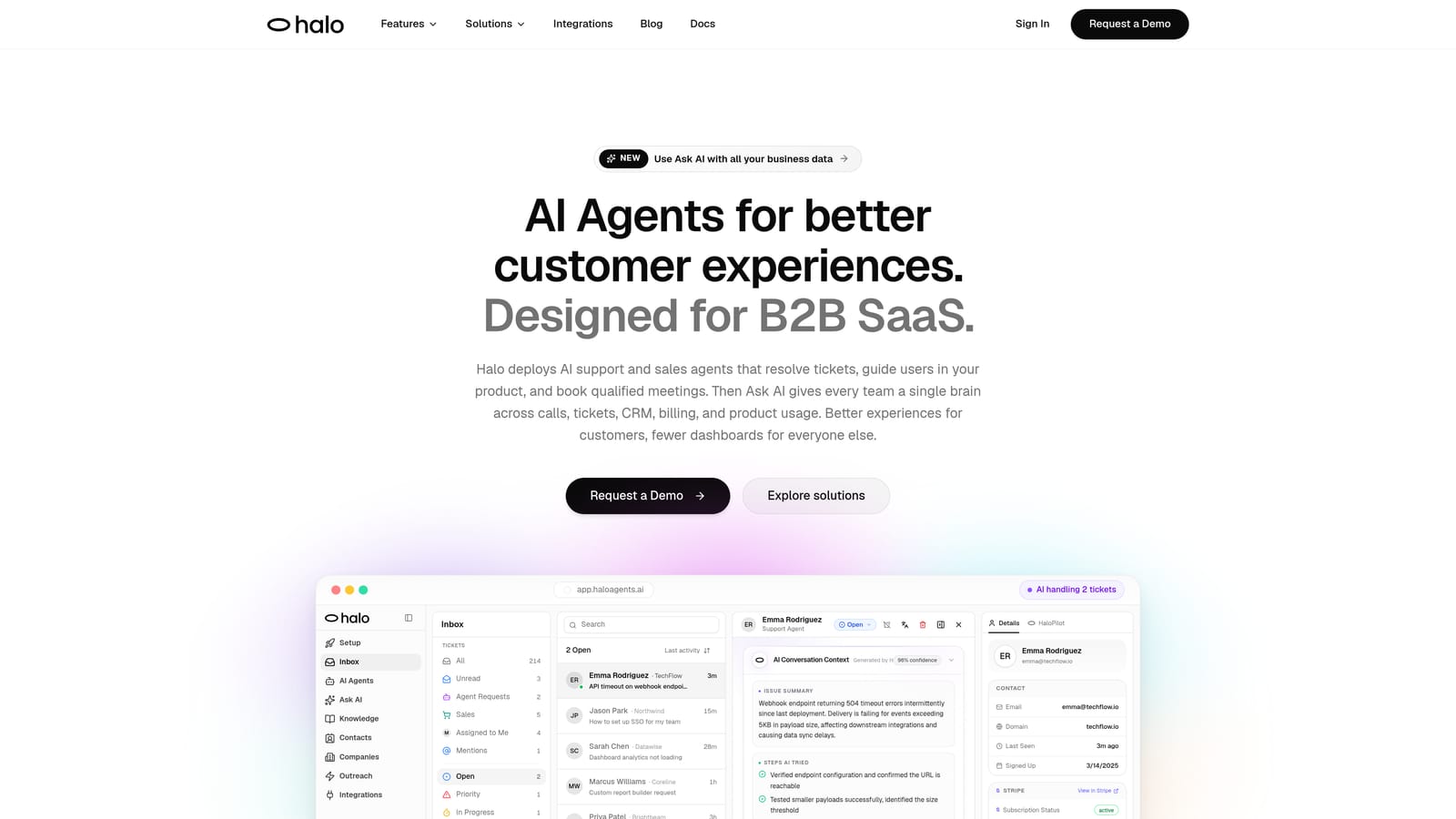
Halo AI is an AI-first customer support platform built from the ground up around intelligent agents, not retrofitted onto a legacy helpdesk.
Where This Tool Shines
The architectural difference between AI-native and AI-layered platforms becomes obvious quickly. Halo wasn't built as a ticketing system with AI added later. The entire platform is designed around continuous learning: every resolved ticket, every user interaction, every escalation makes the system smarter over time.
What sets Halo apart from most tools on this list is its page-aware chat widget. Rather than responding to text queries in isolation, Halo's AI agent can see what a user is looking at in real time and deliver visual UI guidance within the product itself. For SaaS teams dealing with onboarding friction or feature adoption gaps, this is a meaningful capability that generic chatbots simply can't replicate.
Key Features
Intelligent AI Agents: Resolve support tickets autonomously and learn from every interaction, improving deflection quality over time without manual retraining.
Page-Aware Chat Widget: Understands the user's current context within your product and delivers targeted, visual guidance rather than generic responses.
Smart Inbox with Business Intelligence: Goes beyond ticket management to surface customer health signals, anomaly detection, and revenue intelligence directly from support data.
Auto Bug Ticket Creation: Automatically identifies and routes bug reports to Linear or your project management tool, closing the loop between support and engineering.
Live Agent Handoff: Escalates complex issues to human agents with full conversation context preserved, so customers never have to repeat themselves.
Integration Ecosystem: Connects to Slack, HubSpot, Intercom, Stripe, Zoom, PandaDoc, Fathom, and more, making it a genuine hub rather than a silo.
Best For
B2B SaaS companies that want more than ticket deflection. Halo is particularly well-suited to product-led growth teams where support data can inform retention, expansion, and product decisions. If you're outgrowing a basic helpdesk and want your support platform to contribute business intelligence, this is where the conversation starts.
Pricing
Check haloagents.ai for current plan pricing. Plans are designed to scale with your support volume and team size.
2. Intercom
Best for: Teams that want customer messaging and AI-powered support in a single, mature platform
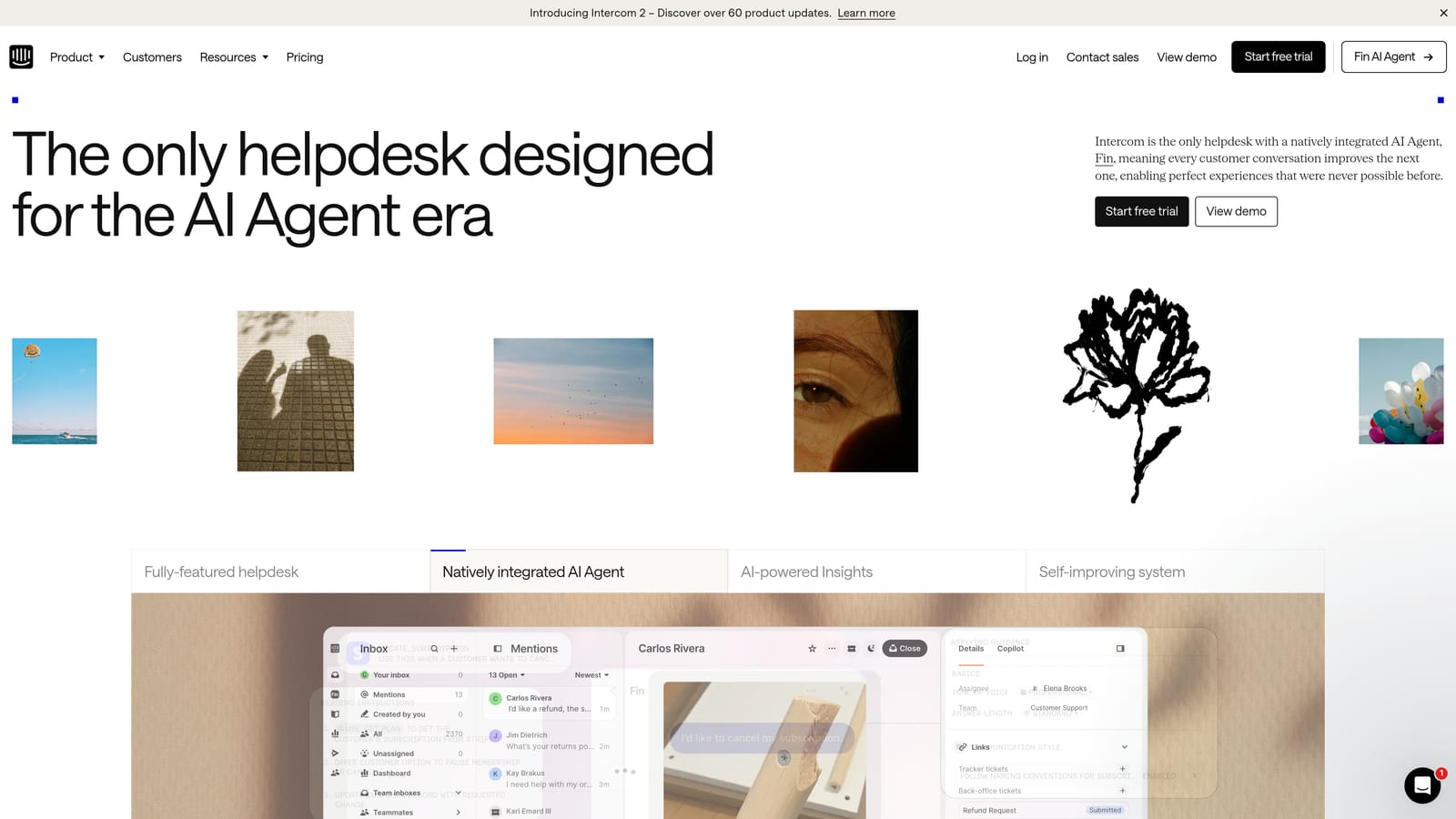
Intercom is a customer messaging platform with a well-established AI agent (Fin) capable of handling a meaningful portion of support queries without human involvement.
Where This Tool Shines
Intercom's Fin AI agent has matured significantly since its launch and now handles a broad range of query types with reasonable accuracy. What makes Intercom particularly strong is the combination: proactive messaging, segmentation, and automated support all live in one platform, which simplifies the stack for teams that don't want to stitch multiple tools together.
The unified inbox, which combines chat, email, and social channels, is a practical advantage for teams managing high inbound volume across touchpoints. Reporting on resolution rates and team performance is solid, though teams with complex BI needs may find it limiting.
Key Features
Fin AI Agent: Handles autonomous query resolution across common support topics, with escalation paths to human agents.
Proactive Messaging: Triggers targeted messages based on user behavior and segmentation, useful for reducing inbound before it happens.
Unified Inbox: Consolidates chat, email, and social support into one workspace for agent efficiency.
CRM and Product Integrations: Connects to Salesforce, HubSpot, and other tools in the GTM stack.
Resolution Rate Reporting: Tracks AI and agent performance with dashboards focused on efficiency metrics.
Best For
Mid-market to enterprise teams that want messaging and support automation under one roof. Intercom works especially well for teams already invested in its ecosystem. If you're starting fresh and prioritizing AI depth over messaging breadth, compare closely with AI-native options.
Pricing
Starts at $39 per seat per month; Fin AI usage is billed separately based on resolution volume. Check Intercom's pricing page for current tier details.
3. Zendesk
Best for: Enterprise teams that need a proven, compliance-ready helpdesk with layered AI capabilities
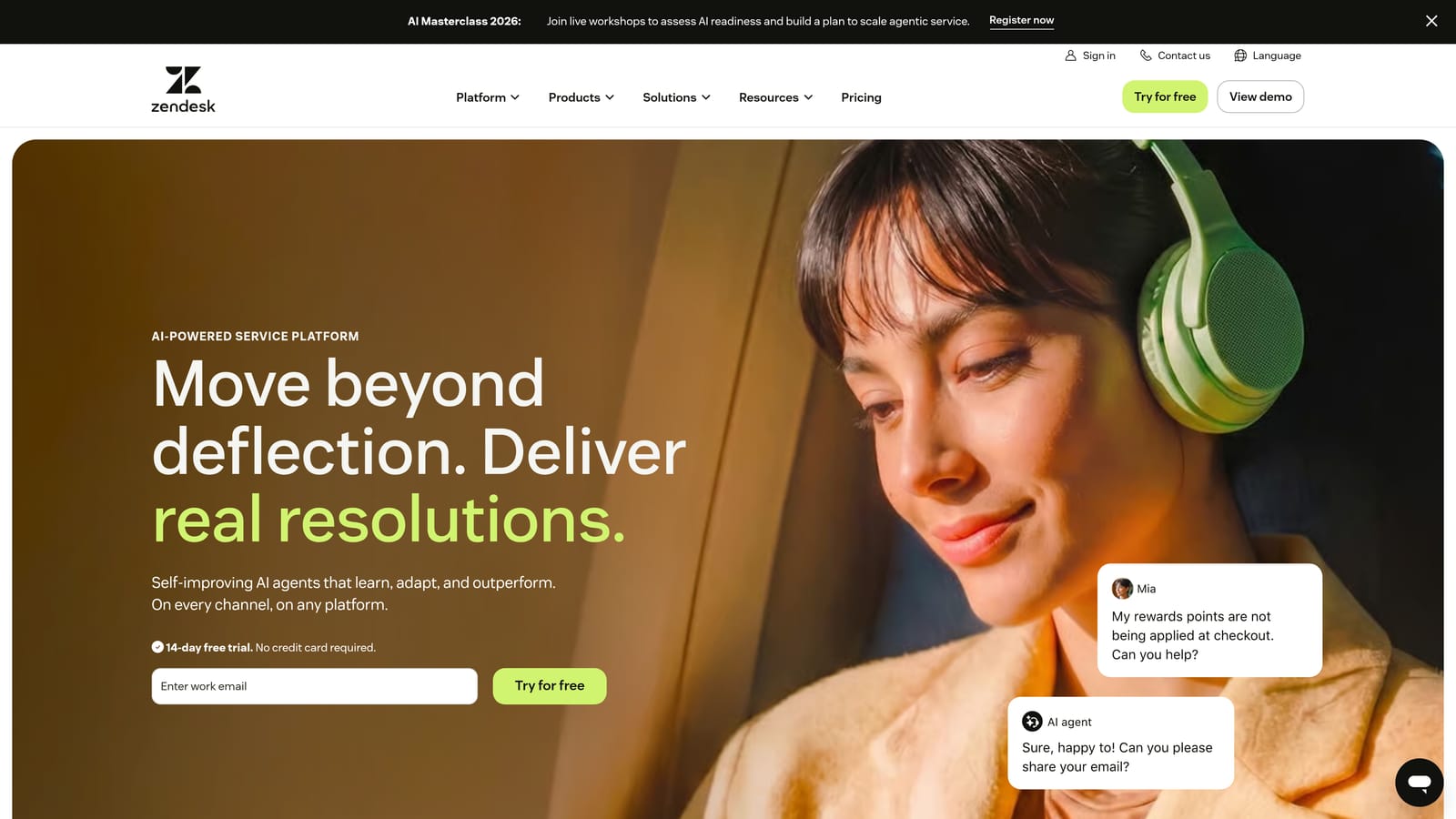
Zendesk is the market-leading helpdesk platform, now with substantially upgraded AI features for triage, suggested responses, and autonomous ticket deflection.
Where This Tool Shines
Zendesk's scale is its strongest asset. The app marketplace includes over 1,000 integrations, and the platform's compliance and security posture makes it the default choice for regulated industries and large enterprises. If your organization already runs on Zendesk, the AI features added in recent years represent a meaningful upgrade over the original Answer Bot.
That said, Zendesk can be complex to configure, and teams that want AI-first simplicity may find the layered approach frustrating. The platform rewards investment: teams that configure it well get significant value, but out-of-the-box AI performance is less impressive than purpose-built alternatives.
Key Features
AI-Powered Triage: Automatically classifies and routes incoming tickets based on intent, priority, and content.
Zendesk AI Agent: Handles autonomous deflection for common queries, with a more capable foundation than earlier versions.
Macro and Trigger Automation: Workflow automation for routing, SLA management, and escalation rules.
App Marketplace: 1,000+ integrations covering CRM, analytics, billing, and communication tools.
Enterprise Compliance: SOC 2, GDPR, HIPAA-ready configurations for security-conscious organizations.
Best For
Enterprise support teams with complex workflows, compliance requirements, and existing Zendesk investments. Also a strong choice for teams that need a wide integration surface. Less ideal for small teams or those prioritizing AI-native architecture over breadth.
Pricing
Suite plans start at $55 per agent per month; advanced AI features are available on higher tiers. Visit Zendesk's pricing page for current plan details.
4. Freshdesk
Best for: SMB and mid-market teams that want solid helpdesk automation at an accessible price point
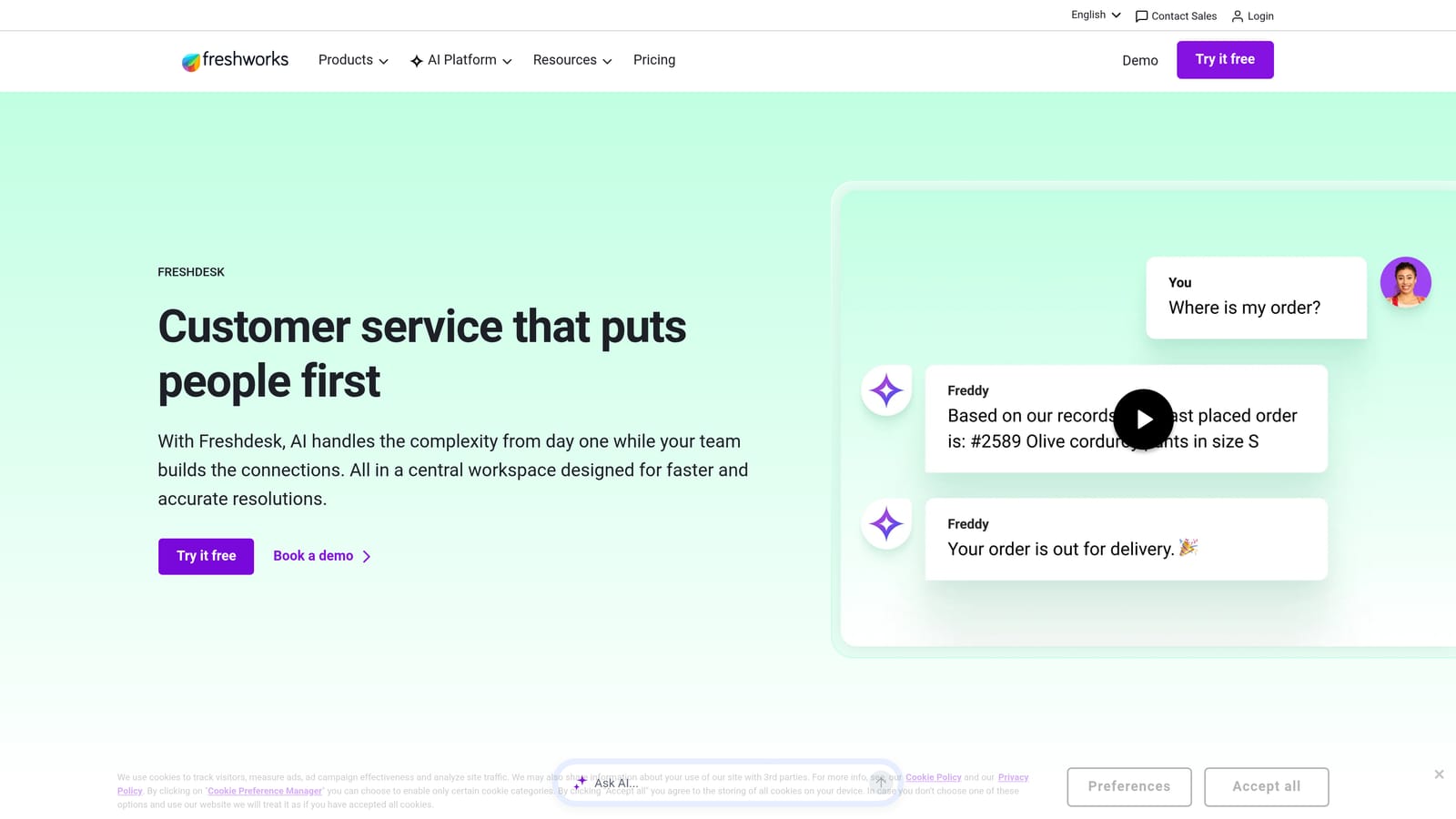
Freshdesk is an affordable helpdesk platform from Freshworks, with Freddy AI providing auto-triage, suggested replies, and agent assist for growing support teams.
Where This Tool Shines
Freshdesk's value proposition is straightforward: comparable core helpdesk functionality to Zendesk at a lower per-seat cost. For teams that are scaling support but working within budget constraints, this matters. The free tier also makes it genuinely accessible for small teams just getting started with structured support workflows.
Freddy AI handles the fundamentals well: auto-triage, suggested responses, and knowledge base surfacing for agents. Teams with more sophisticated AI requirements may find Freddy's capabilities limited compared to purpose-built AI platforms, but for straightforward deflection and agent assist, it delivers solid value.
Key Features
Freddy AI: Provides auto-triage, suggested responses, and agent assist with knowledge base recommendations.
Automated Ticket Routing: Routes and prioritizes tickets based on content, source, and configured rules.
Omnichannel Support: Handles email, chat, phone, and social channels from a unified workspace.
Knowledge Base Integration: Surfaces relevant articles for agents and customers during interactions.
Free Tier: Available for small teams with basic helpdesk needs, with a clear upgrade path.
Best For
SMB and mid-market teams that need a reliable helpdesk with AI assist features and don't want to pay enterprise-level pricing. Also a good fit for teams already using other Freshworks products like Freshsales or Freshservice.
Pricing
Free plan available; paid plans from $15 per agent per month. Freddy AI features are gated to higher-tier plans. Check Freshdesk's pricing page for current details.
5. Delighted
Best for: Teams that need dedicated, automated satisfaction survey delivery without building it themselves
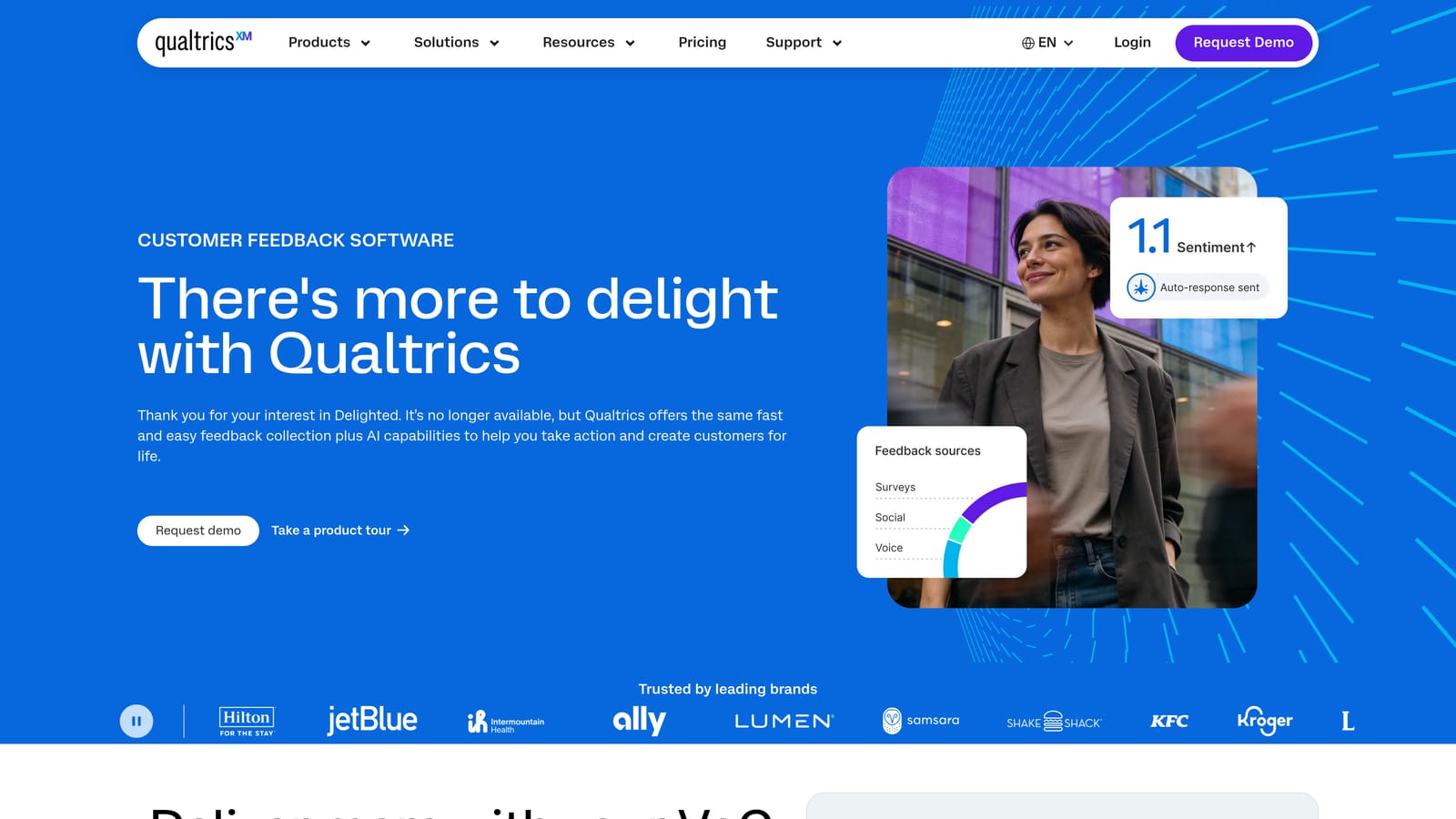
Delighted is a purpose-built survey automation tool for capturing CSAT, NPS, and CES feedback at scale, with smart send logic and real-time dashboards.
Where This Tool Shines
Delighted does one thing extremely well: it automates the collection of satisfaction signals without requiring your team to manually manage survey campaigns. The smart send logic is particularly valuable, preventing survey fatigue by controlling send frequency based on recent customer interactions. This matters more than it sounds: oversurveys customers tune out, and tuned-out customers give you garbage data.
Now part of the Qualtrics family, Delighted benefits from enterprise-grade infrastructure while maintaining an accessible interface. Real-time dashboards make it easy to spot trends as they emerge rather than waiting for weekly reports.
Key Features
Automated Survey Delivery: Sends CSAT, NPS, CES, and 5-star surveys triggered by support interactions or customer milestones.
Smart Send Logic: Controls survey frequency to prevent fatigue and protect response quality.
Real-Time Dashboards: Surfaces satisfaction trends and score breakdowns as data comes in.
Multi-Channel Delivery: Distributes surveys via email, in-app, SMS, and shareable links.
Integrations: Connects to Zendesk, HubSpot, Salesforce, and Slack for workflow automation around survey results.
Best For
Support and CX teams that want to automate satisfaction measurement without building a survey tool from scratch. Delighted is a complement to a helpdesk stack, not a replacement. It works best when paired with a support platform that can act on the signals it surfaces.
Pricing
Free plan available; paid plans from $17 per month. Check Delighted's pricing page for current tier details.
6. Survicate
Best for: SaaS product teams measuring satisfaction at specific moments in the user journey
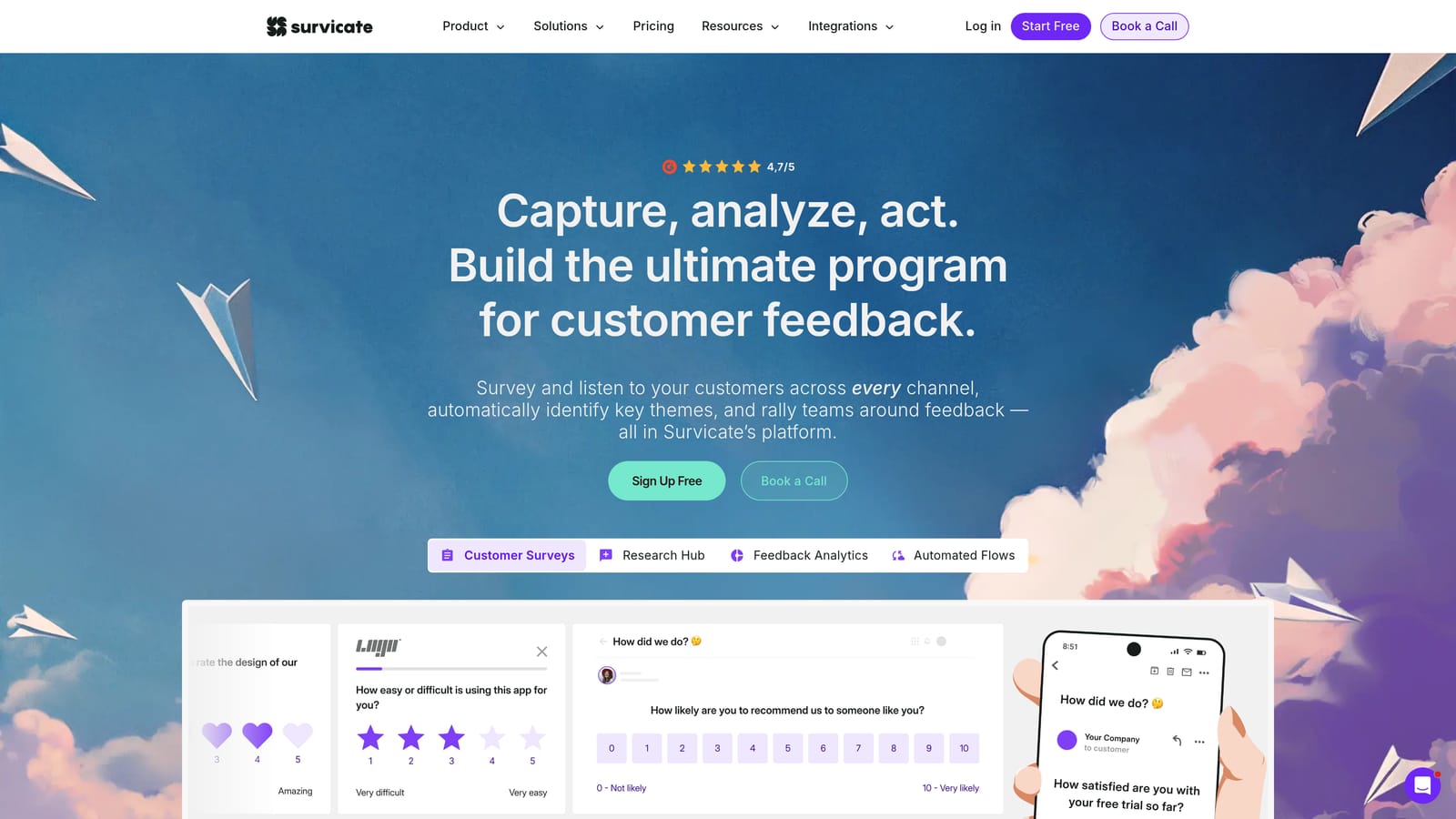
Survicate is a behavior-triggered survey platform that captures satisfaction signals at precise moments in the product and customer journey, with strong integrations into product analytics and CRM tools.
Where This Tool Shines
Where Delighted focuses on post-interaction surveys, Survicate leans into product-moment triggers. You can fire a survey when a user completes a specific action, reaches a milestone, or exhibits a behavior that suggests friction or delight. This granularity makes it particularly useful for SaaS teams that want satisfaction data tied to specific features or onboarding steps rather than just support interactions.
The integration with tools like Amplitude and Segment means survey responses can be connected to behavioral data, giving product teams richer context for prioritization decisions.
Key Features
Behavior-Triggered Surveys: Fire surveys based on user actions, product events, or time-based conditions within your application.
In-App and Email Delivery: Reaches users where they are, with consistent branding and mobile-responsive design.
AI-Assisted Analysis: Tags and categorizes open-text responses to surface themes at scale without manual review.
Product Analytics Integrations: Connects to HubSpot, Intercom, Segment, and Amplitude for behavioral context alongside survey data.
SaaS Survey Templates: Pre-built templates for common SaaS use cases including onboarding, feature feedback, and churn risk.
Best For
SaaS product and CX teams that want satisfaction measurement tied to specific product moments rather than just support touchpoints. Works well alongside a helpdesk for teams that want a complete satisfaction signal picture.
7. Tidio
Best for: SMBs and early-stage teams that need fast, affordable AI chat with minimal setup
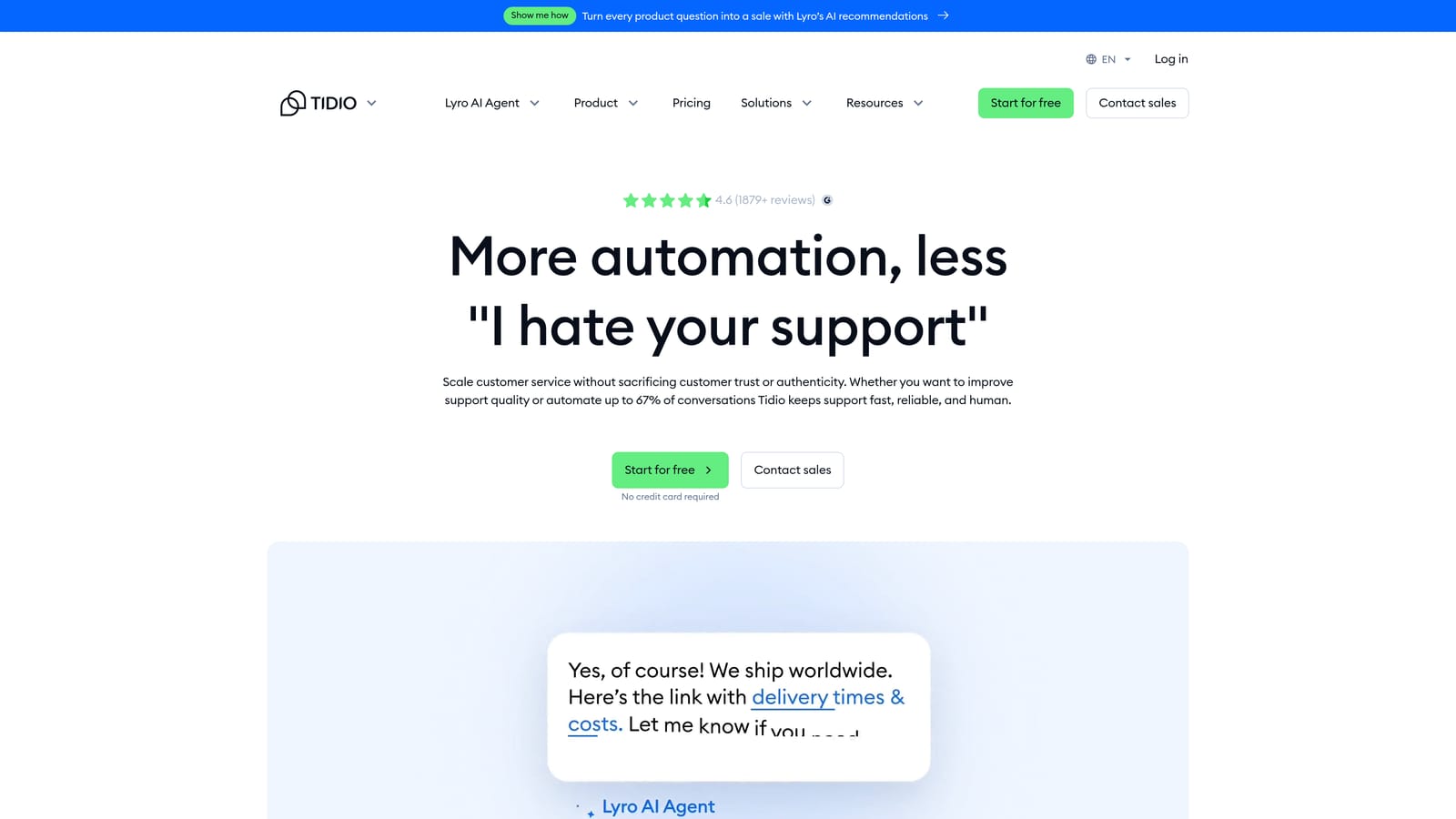
Tidio is an accessible AI chat platform featuring the Lyro AI chatbot, designed for teams that need query deflection quickly without complex configuration.
Where This Tool Shines
Tidio's primary advantage is speed to value. The visual flow builder requires no coding, and most teams can have Lyro AI handling basic queries within a day of setup. For small businesses or early-stage SaaS teams that don't yet have a dedicated support function, this kind of accessibility is genuinely useful.
Live agent handoff is included and works smoothly, with full chat context passed to the human agent so customers don't repeat themselves. The unified inbox combining email and chat keeps things simple for small teams managing both channels.
Key Features
Lyro AI Chatbot: Handles autonomous query resolution for common questions, with natural language understanding for straightforward interactions.
Visual Flow Builder: No-code automation setup for routing, responses, and escalation logic.
Live Agent Handoff: Transfers conversations to human agents with full context intact.
E-Commerce Integrations: Connects to Shopify and WooCommerce for order-aware support responses.
Unified Inbox: Manages email and chat from a single workspace.
Best For
SMBs, e-commerce brands, and early-stage SaaS teams that need affordable, fast-to-deploy AI chat. Tidio is less suited to complex B2B support workflows with multi-system integrations or sophisticated escalation logic, but for straightforward deflection at volume, it delivers strong value for the price.
Pricing
Free plan available; Lyro AI from $29 per month. Check Tidio's pricing page for current plan options.
8. Medallia
Best for: Large enterprises running sophisticated, omnichannel experience management programs
Medallia is an enterprise Voice of Customer and experience management platform with AI-powered text analytics across digital, contact center, and in-person channels.
Where This Tool Shines
Medallia operates at a different scale and scope than most tools on this list. It's not a helpdesk or a survey tool in the traditional sense. It's a strategic experience intelligence layer designed for organizations running CX programs across multiple channels simultaneously, including digital, physical, and contact center touchpoints.
The AI text analytics capability is particularly strong, enabling organizations to process large volumes of unstructured feedback (call transcripts, open-text responses, social mentions) and surface themes, sentiment trends, and risk signals without manual review. Role-based dashboards make it accessible to CX, operations, and executive stakeholders simultaneously.
Key Features
Omnichannel Feedback Collection: Gathers signals across digital, contact center, and in-person interactions in a unified platform.
AI Text Analytics: Processes unstructured feedback at scale to surface themes, sentiment, and emerging issues.
Role-Based Dashboards: Tailored views for CX teams, operations leaders, and executives with different reporting needs.
Predictive Analytics: Identifies churn risk and satisfaction decline before they become visible in aggregate scores.
Enterprise Security: Built for large organizations with complex compliance, data residency, and security requirements.
Best For
Large enterprises with mature CX programs, significant feedback volume across multiple channels, and the implementation resources to configure a sophisticated platform. Medallia requires meaningful investment to deploy well. It's not the right fit for early-stage teams or those looking for quick deployment.
Pricing
Custom enterprise pricing. Contact Medallia directly for a quote based on your organization's scope and requirements.
9. Gorgias
Best for: E-commerce brands that want support automation deeply integrated with their store data
Gorgias is a support automation platform purpose-built for e-commerce, with deep Shopify integration and revenue-tied ticket workflows that set it apart from general-purpose helpdesks.
Where This Tool Shines
Gorgias solves a specific and common e-commerce problem: support agents spending the majority of their time on order-related queries (where's my order, can I return this, my package is damaged) without having order data readily accessible. Gorgias surfaces Shopify order data directly within the ticket view, so agents and automation have full purchase context without switching tabs.
The revenue tracking feature is a differentiator: Gorgias connects support interactions to downstream purchases, giving teams visibility into the revenue impact of their support operations. For D2C brands that view support as a revenue driver, this framing resonates.
Key Features
Deep E-Commerce Integrations: Connects to Shopify, WooCommerce, and Magento with order data surfaced directly in the ticket view.
Revenue Tracking: Ties support interactions to conversion and purchase data to quantify the business impact of support.
AI Agent: Handles automated responses to common e-commerce queries like order status, returns, and shipping updates.
Macros and Rules: High-volume automation for repetitive ticket types, reducing manual handling at scale.
Unified Inbox: Manages email, chat, social, and SMS support from one workspace.
Best For
D2C e-commerce brands and retail businesses with Shopify or WooCommerce stores that handle high volumes of order-related support queries. Gorgias is less relevant for pure B2B SaaS teams whose support needs don't center on order management workflows.
Pricing
Starts at $10 per month for up to 50 tickets, scaling with volume. Check Gorgias's pricing page for current plan details.
Which Tool Is Right for Your Team?
The right choice depends on two things: what kind of automation you need, and where you are in your growth journey.
If you're a B2B SaaS team that wants AI-native support automation with business intelligence baked in, Halo AI is the strongest starting point. Its page-aware agents, continuous learning architecture, and smart inbox analytics go well beyond what legacy helpdesks with AI layers can offer.
For teams already invested in Intercom or Zendesk, the question is whether the AI capabilities on those platforms meet your deflection and intelligence needs, or whether a purpose-built AI layer is worth evaluating alongside them.
For enterprise CX programs: Medallia handles the complexity of omnichannel experience management at scale, and it's in a different category from the helpdesk and survey tools on this list.
For satisfaction measurement specifically: Delighted is the fastest path to automated CSAT and NPS collection. Survicate is the better choice if you want surveys triggered by specific product behaviors rather than just post-interaction sends.
For e-commerce brands: Gorgias is the clear specialist. If your support queue is dominated by order-related queries, no general-purpose helpdesk matches its depth of Shopify integration.
For early-stage teams on a budget: Tidio and Freshdesk both offer free tiers and quick setup paths. They won't deliver the intelligence depth of AI-native platforms, but they're solid foundations for teams building their first structured support function.
One broader point worth considering as you evaluate: there's a real architectural difference between platforms built AI-first and those that have added AI features to existing helpdesk infrastructure. That distinction matters for teams that want deflection quality to improve over time rather than staying static. The tools that learn from every interaction compound their value in ways that bolt-on AI simply can't.
Your support team shouldn't scale linearly with your customer base. Let AI agents handle routine tickets, guide users through your product, and surface business intelligence while your team focuses on complex issues that need a human touch. See Halo in action and discover how continuous learning transforms every interaction into smarter, faster support.