9 Best Customer Service AI Alternatives in 2026
This guide evaluates nine Customer Service AI Alternatives across autonomy, context-awareness, integration depth, and scalability to help B2B SaaS teams move beyond basic chatbots. Rather than naming one universal winner, it matches each tool to the team type most likely to benefit from its distinct strengths.
 Matt PattoliFounder14 min read
If you're evaluating customer service AI alternatives, the landscape looks very different in 2026 than it did just a couple of years ago. The gap between genuinely autonomous AI support platforms and glorified FAQ bots has never been wider. Whether you're outgrowing your current helpdesk, frustrated by bolt-on chatbot limitations, or simply ready for smarter automation, this list cuts through the noise.
We evaluated nine tools across four key dimensions: autonomy (how much can the AI actually resolve without human intervention?), context-awareness, integration depth, and scalability for B2B SaaS teams. Each tool has a distinct strength, so rather than declaring one universal winner, we'll match the right tool to the right team.
1. Halo AI
Best for: B2B SaaS teams that want autonomous resolution, product-aware guidance, and business intelligence in one platform.
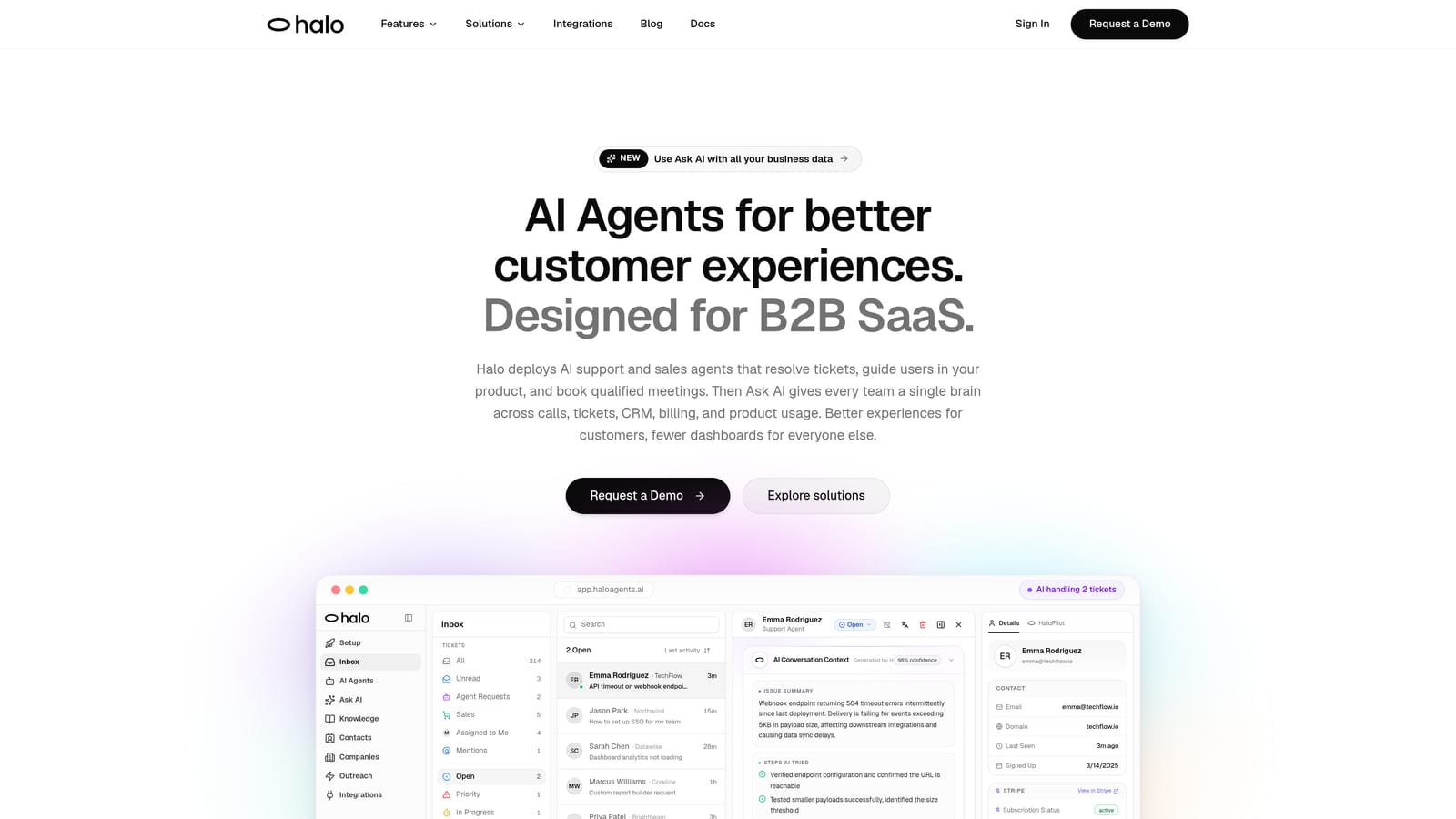
Halo AI is an AI-first customer support platform built to resolve tickets autonomously, guide users through your product with page-level context, and surface business intelligence that goes far beyond ticket metrics.
Where This Tool Shines
What separates Halo from most alternatives is its page-aware architecture. The AI actually sees which page or feature a user is on when they reach out, enabling contextual guidance rather than generic answers. This is the difference between a support bot that says "check our docs" and one that walks a user through the exact UI element causing confusion.
Beyond resolution, Halo's smart inbox surfaces customer health signals, revenue anomalies, and product feedback trends. Your support function stops being a cost center and starts generating intelligence your product and revenue teams can act on.
Key Features
Page-Aware Chat Widget: The AI understands which product page or feature the user is viewing, enabling precise, in-context guidance without the user needing to explain where they are.
Autonomous Ticket Resolution with Live Handoff: AI resolves tickets end-to-end and escalates to human agents with full context preserved, so no customer ever has to repeat themselves.
Auto Bug Ticket Creation: When the AI identifies a bug, it logs a structured ticket directly to Linear without any agent involvement, closing the loop between support and engineering automatically.
Smart Inbox with Business Intelligence: Goes beyond CSAT scores to surface customer health signals, churn risk indicators, and product feedback trends from support conversations.
Deep Integration Stack: Connects natively to Linear, Slack, HubSpot, Stripe, Intercom, Zoom, PandaDoc, and Fathom, enabling the AI to take action across your business stack, not just answer questions.
Best For
B2B SaaS companies and product-led growth teams that want their support function to do more than deflect tickets. Particularly strong for teams using Linear for engineering, HubSpot for CRM, or Stripe for billing who want AI that can act across those systems in real time.
Pricing
Contact for pricing. Halo is positioned for B2B SaaS and enterprise teams; reach out via the website for a tailored quote.
2. Intercom Fin
Best for: Teams already on Intercom who want autonomous AI resolution without migrating to a new platform.
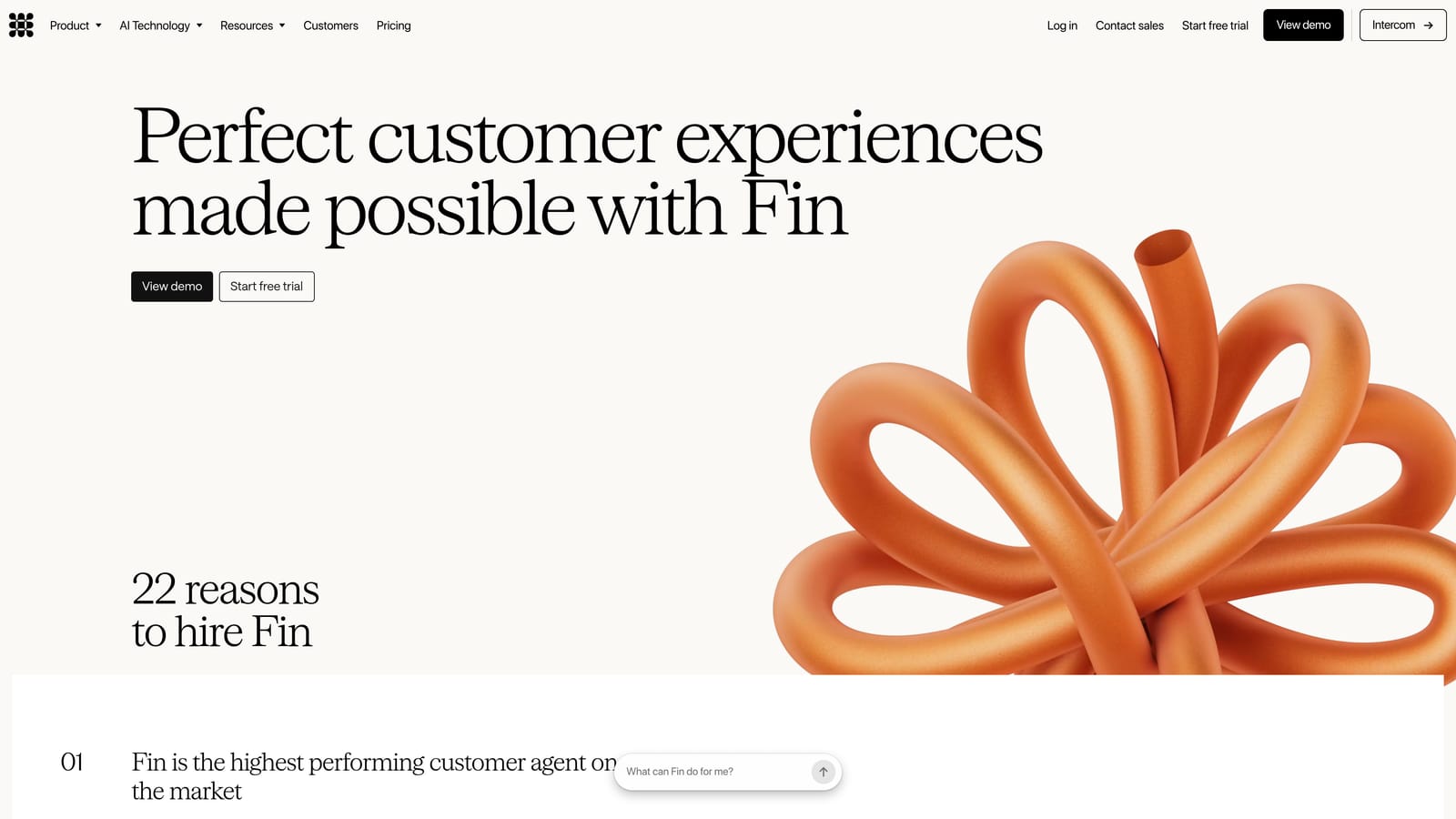
Intercom Fin is Intercom's native AI agent, powered by advanced language models, designed to resolve customer queries autonomously within the Intercom Messenger ecosystem.
Where This Tool Shines
Fin's biggest advantage is zero migration friction. If your team is already running on Intercom, Fin layers directly onto your existing help center content and conversation history. The current version introduced improved multi-step reasoning, handling more complex queries than a simple FAQ lookup.
The handoff experience is also genuinely smooth. When Fin can't resolve something, the escalation happens within the same Messenger thread, so the customer experience stays consistent and agents receive full conversation context.
Key Features
Advanced Language Model Reasoning: Handles multi-step queries by reasoning across help center content and conversation history, not just keyword matching.
Native Intercom Integration: No third-party setup required; Fin works directly within your existing Intercom workspace and content library.
Smooth In-Thread Handoff: Escalations to human agents happen within the same Messenger thread, preserving full conversation context for both agent and customer.
Usage-Based Pricing: Pay for resolutions rather than seats, which aligns cost with actual value delivered.
Help Center Leverage: Fin learns from your existing documentation, meaning your prior investment in knowledge base content directly improves AI performance.
Best For
Teams already invested in the Intercom ecosystem who want to add autonomous resolution without changing their support stack. Less ideal for teams that need the AI to take actions outside Intercom, such as creating bug tickets or querying billing data.
Pricing
Usage-based add-on to an existing Intercom subscription. Intercom business plans start at several hundred dollars per month before Fin is added.
3. Zendesk AI
Best for: Large support organizations running Zendesk Suite that want AI to augment agent workflows rather than replace them.
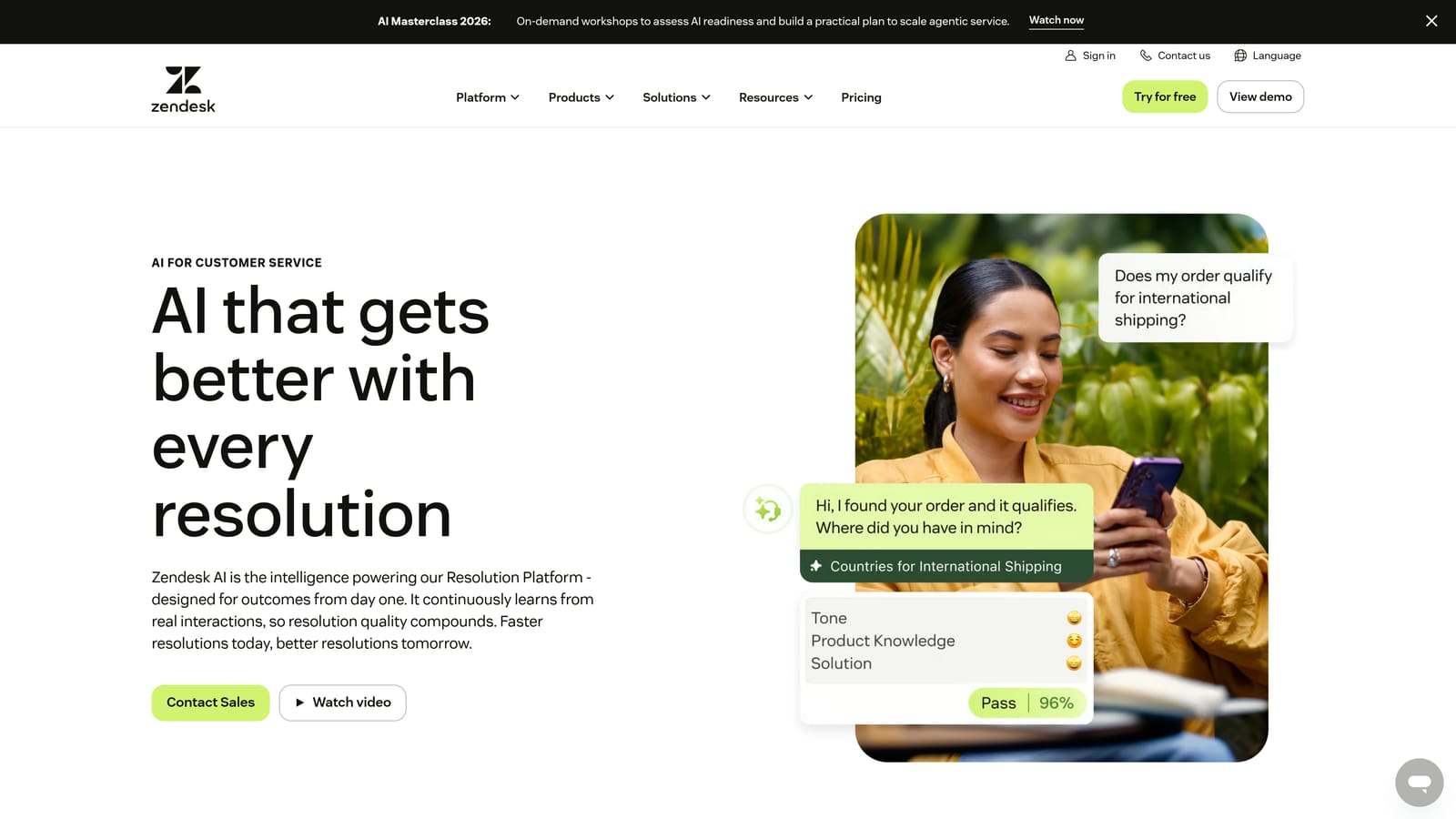
Zendesk AI is a suite of AI capabilities embedded across Zendesk, covering intelligent triage, agent copilot, macro suggestions, and automated routing for high-volume teams.
Where This Tool Shines
Zendesk AI is best understood as an agent efficiency multiplier. It doesn't aim to replace your support team; it makes each agent faster and more consistent. Intelligent triage routes tickets based on intent and sentiment before a human ever opens them, while the agent copilot surfaces suggested replies and relevant macros in real time.
For large teams where agents will always be central to the workflow, this approach makes a lot of sense. The AI handles the cognitive overhead of context-switching, summarizing previous interactions so agents can get up to speed instantly.
Key Features
Intelligent Triage and Routing: Automatically classifies and routes tickets by intent, urgency, and sentiment before any agent involvement.
Agent Copilot: Surfaces suggested replies, macro recommendations, and next-best-action guidance within the agent workspace.
AI-Powered Conversation Summaries: Condenses long ticket threads so agents can context-switch faster without reading every message.
Quality Assurance AI: Flags interactions for review and identifies coaching opportunities across the team automatically.
Native Suite Integration: All AI features are embedded directly in Zendesk Suite, requiring no third-party tools or custom development.
Best For
Enterprise and mid-market teams with large agent headcounts running Zendesk Suite. Best suited to organizations where human agents remain central and the goal is efficiency improvement rather than autonomous resolution.
Pricing
Zendesk Suite starts at approximately $55 per agent per month. AI features are available as separate add-ons at additional cost.
4. Freshdesk Freddy AI
Best for: SMBs and mid-market teams on Freshdesk looking for affordable AI assistance without switching platforms.
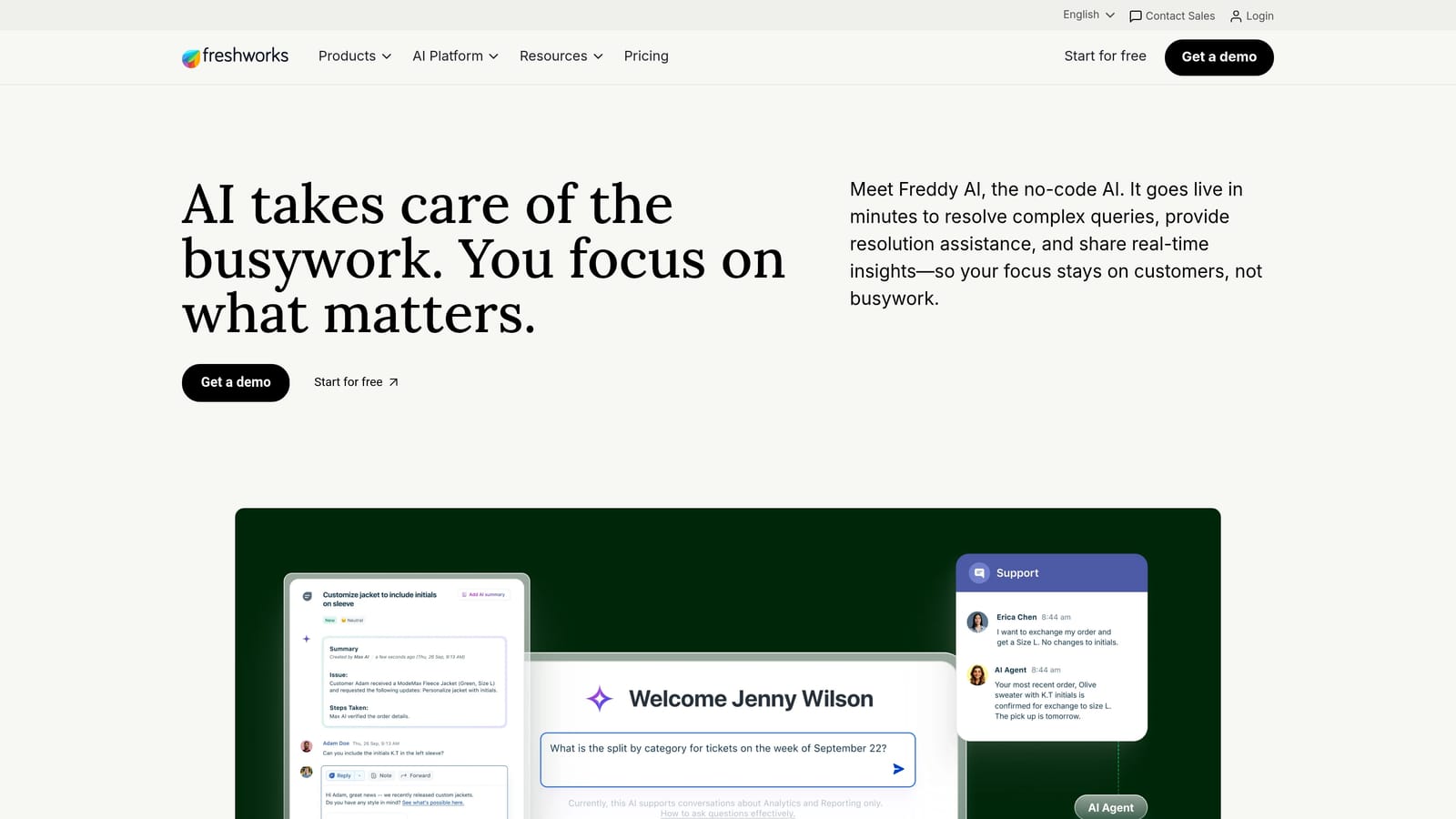
Freshdesk Freddy AI is Freshworks' AI layer across Freshdesk, covering self-service deflection, agent assistance, and analytics for teams already in the Freshdesk ecosystem.
Where This Tool Shines
Freddy AI covers three distinct jobs: deflecting tickets before they reach agents (Freddy Self Service), helping agents respond faster and more accurately (Freddy Copilot), and giving support leaders AI-driven performance insights (Freddy Insights). For a team already on Freshdesk, this three-layer approach requires minimal setup and delivers value quickly.
The pricing is also a genuine differentiator. Freshdesk's entry point is one of the most accessible in the market, making Freddy AI a realistic option for smaller teams that can't justify enterprise-tier costs.
Key Features
Freddy Self Service: Bot-based deflection that handles common queries before they enter the ticket queue, reducing inbound volume for agents.
Freddy Copilot: Provides agents with suggested responses, ticket summaries, and next-best-action recommendations within the Freshdesk interface.
Freddy Insights: AI-driven analytics that surface support performance trends and recommend operational improvements for team leads.
Native Freshdesk Integration: Works immediately within existing Freshdesk setups with minimal configuration required.
Affordable Entry Point: AI features accessible on Growth plan and above, making this one of the most budget-friendly AI options available.
Best For
SMBs and growing mid-market teams already using Freshdesk who want to add AI assistance without significant investment or platform migration. Not the best fit for teams needing deep integrations with external business systems.
Pricing
Freddy AI features are available on Freshdesk Growth plan and above, starting at approximately $15 per agent per month.
5. Tidio Lyro
Best for: Small businesses and e-commerce brands that need fast deployment and autonomous handling of repetitive queries.
Tidio Lyro is a conversational AI built for SMBs and e-commerce brands, designed for rapid deployment and autonomous resolution of common, repetitive customer questions.
Where This Tool Shines
Lyro's standout quality is its setup speed. Many teams can go from signup to live AI conversations in a matter of hours, not weeks. For a small business that doesn't have a dedicated IT team or a lengthy implementation runway, this matters enormously.
It also integrates natively with Shopify and WordPress, making it a natural fit for e-commerce operations where questions about orders, shipping, and returns represent the bulk of inbound volume. Lyro handles these autonomously so your team can focus on exceptions.
Key Features
Rapid Deployment: Can be live within hours of setup, with no complex configuration or technical implementation required.
Autonomous Query Resolution: Handles common repetitive questions without any agent involvement, reducing ticket volume from day one.
Native E-Commerce Integrations: Connects directly with Shopify and WordPress for order and product context in customer conversations.
Multi-Channel Coverage: Handles conversations across both chat and email channels from a single platform.
Accessible Pricing: One of the most affordable AI options available, with a free base tier and low-cost AI add-on.
Best For
Small businesses, e-commerce brands, and solo operators who need fast, affordable AI deflection for repetitive queries. Not designed for complex B2B SaaS support workflows or teams requiring deep integrations with business systems like CRM or billing platforms.
Pricing
Lyro AI starts at approximately $29 per month as an add-on. A free tier is available for the Tidio base product.
6. Forethought
Best for: Teams on Zendesk or Salesforce Service Cloud that want AI triage, routing, and agent assist layered onto their existing setup.
Forethought is an AI platform specializing in intelligent triage, routing, and agent assistance, built to layer onto existing helpdesks rather than replace them.
Where This Tool Shines
Forethought's product architecture maps directly to the support workflow: Solve handles self-service deflection before tickets are created, Triage routes what gets through based on intent and urgency, Assist surfaces relevant knowledge for agents in real time, and Discover identifies automation gaps and knowledge holes across your operation.
For teams with established Zendesk or Salesforce Service Cloud deployments, Forethought adds meaningful AI capability without requiring a platform migration. It's particularly effective at reducing misrouted tickets, which is often a hidden source of inefficiency in larger support organizations.
Key Features
Solve (Self-Service AI): Deflects tickets before they enter the queue by resolving common queries through an AI-powered self-service layer.
Triage (Intelligent Routing): Routes incoming tickets based on intent, urgency, and topic classification to the right team or agent automatically.
Assist (Agent Copilot): Surfaces relevant knowledge base content and suggested responses to agents in real time during live interactions.
Discover (Analytics): Identifies automation opportunities and knowledge gaps by analyzing patterns across your ticket history.
Deep Helpdesk Integration: Native integration with Zendesk and Salesforce Service Cloud, working within your existing workflows rather than beside them.
Best For
Mid-market and enterprise teams with existing Zendesk or Salesforce Service Cloud deployments who want to add AI capability incrementally. Requires an existing ticketing system; not a standalone platform.
Pricing
Custom enterprise pricing. Contact Forethought directly for a quote based on your team size and requirements.
7. Ada
Best for: Enterprise teams in regulated industries that need highly customizable, brand-controlled AI agents at scale.
Ada is an enterprise no-code AI agent builder offering extensive conversation flow customization, strong brand control, and a robust security posture for compliance-sensitive organizations.
Where This Tool Shines
Ada's strength is control. Where many AI platforms make autonomous decisions about how to respond, Ada gives enterprise teams the ability to design conversation flows precisely, ensuring every interaction reflects brand voice, stays within compliance boundaries, and follows approved messaging. This matters enormously in regulated sectors like financial services, healthcare, or legal.
Ada also handles very high interaction volumes with consistency. When you're serving millions of customers and brand reputation is on the line, predictability in AI behavior is a feature, not a limitation.
Key Features
No-Code Agent Builder: Drag-and-drop conversation design enables non-technical teams to build, test, and deploy AI agents without engineering support.
Brand and Tone Customization: Extensive controls ensure the AI always communicates in the organization's approved voice and within defined content boundaries.
Enterprise Security and Compliance: Built to meet the security and regulatory requirements of large enterprises in regulated industries.
High-Volume Consistency: Designed to handle very large interaction volumes while maintaining predictable, on-brand responses at scale.
Broad Integration Support: Connects with major helpdesks, CRMs, and business systems to pull context and trigger actions across the enterprise stack.
Best For
Large enterprises in regulated industries, or any organization where brand consistency and compliance are non-negotiable. Be aware that setup and customization can require significant implementation effort, particularly for complex conversation flows.
Pricing
Enterprise pricing with custom quotes. Contact Ada directly for pricing based on your organization's scale and requirements.
8. Kustomer AI
Best for: High-volume consumer brands that need AI with full customer history context for personalized support at scale.
Kustomer AI is a CRM-native customer service platform with AI built into its core, giving both AI bots and human agents complete customer history context for every interaction.
Where This Tool Shines
Kustomer's CRM-first architecture is its defining feature. The AI doesn't just see the current conversation; it has access to the customer's full order history, previous interactions across every channel, and account-level data. This enables genuinely personalized responses rather than generic deflection.
For high-volume consumer support operations where context is everything, this architecture makes a real difference. An AI that knows a customer placed three orders last month and had a return issue last week can respond very differently than one seeing them for the first time.
Key Features
CRM-First Architecture: AI accesses full customer history, orders, and interaction timelines, enabling contextually aware responses from the first message.
Unified Customer Timeline: All interactions across every channel are consolidated into a single customer view, accessible to both AI and human agents.
AI-Powered Routing and Deflection: Intelligently routes and deflects conversations based on customer context, not just query content.
Built-In Reporting and AI Insights: Analytics are native to the platform, providing performance visibility without requiring separate BI tools.
High-Volume Personalization: Designed specifically to deliver personalized experiences at consumer-brand scale, where interaction volumes are very high.
Best For
B2C and DTC brands with high interaction volumes where personalization based on purchase and interaction history is a priority. Less suited to B2B SaaS support workflows where the primary need is product guidance and technical issue resolution rather than order management.
Pricing
Starts at approximately $89 per user per month at the Enterprise tier.
9. Aisera
Best for: Large enterprises that need to unify internal IT support and external customer service under a single AI platform.
Aisera is an enterprise AI platform that spans both IT service management and customer service, enabling large organizations to consolidate internal and external support under one AI layer.
Where This Tool Shines
Aisera's unique value proposition is breadth. Most customer service AI platforms focus exclusively on external customer interactions. Aisera also handles internal IT support, meaning a single platform can serve both the employee helpdesk and the customer support function. For large enterprises with complex internal operations, this consolidation can significantly reduce tooling overhead.
Its integration depth with enterprise systems like ServiceNow, Salesforce, and Workday is also notable. The AI can take action within these systems, not just surface information from them, which is what genuine enterprise automation requires.
Key Features
Unified ITSM and Customer Service: Covers both internal IT support and external customer service in a single platform, eliminating the need for separate AI tools across functions.
Enterprise System Integrations: Deep native connections to ServiceNow, Salesforce, Workday, and other enterprise platforms, enabling the AI to take action within these systems.
Conversational AI Across Channels: Natural language understanding across chat, email, and voice channels for both employee and customer interactions.
AI-Driven Self-Service Resolution: Handles routine queries autonomously for both internal employees and external customers, reducing load across both support functions.
Enterprise Governance and Analytics: Robust governance controls and analytics designed for large organizations with complex compliance and reporting requirements.
Best For
Large enterprises with both a significant IT helpdesk function and a customer support operation who want to consolidate under one AI platform. The complexity and cost make this a poor fit for SMB or mid-market teams.
Pricing
Enterprise pricing with custom quotes. Contact Aisera directly for a proposal based on your organization's scope.
Which Tool Is Right for Your Team?
The right choice depends less on feature lists and more on two questions: how much autonomy do you actually need, and how deep do your integration requirements go?
Here's a practical decision framework based on team type:
B2B SaaS teams wanting full autonomy and business intelligence: Halo AI is the strongest fit. Its page-aware context, deep integration stack, and smart inbox go beyond ticket deflection into genuine product intelligence. If your support function should be informing your product roadmap and revenue team, this is where to start.
Teams already on Intercom: Intercom Fin is the path of least resistance. Strong autonomous resolution, no migration required, and a smooth handoff experience. The limitation is that it stays within the Intercom ecosystem.
Large enterprise teams on Zendesk or Salesforce: Zendesk AI and Forethought are both strong options. Zendesk AI is best when agents remain central to your workflow. Forethought is better when you want to add AI triage and deflection without disrupting your existing setup.
SMBs and e-commerce brands on a budget: Freshdesk Freddy AI and Tidio Lyro are the most accessible options. Lyro wins on deployment speed; Freddy wins if you're already a Freshdesk customer.
Enterprise teams in regulated industries: Ada's customization and compliance posture make it the safest choice. Aisera is the right call if you need to unify IT and customer support under one platform. Kustomer is strongest for high-volume consumer brands where customer history context drives personalization.
One final piece of advice: when evaluating any of these tools, ask vendors specifically about their autonomy rate in deployments similar to yours, and ask what happens to context when the AI escalates to a human. Those two answers will tell you more than any feature comparison matrix.
Your support team shouldn't scale linearly with your customer base. Let AI agents handle routine tickets, guide users through your product, and surface business intelligence while your team focuses on complex issues that need a human touch. See Halo in action and discover how continuous learning transforms every interaction into smarter, faster support.