9 Best Customer Service AI Tools With Free Trials in 2026
Choosing the right customer service AI free trial requires hands-on testing beyond a polished demo, which is why this guide evaluates 9 platforms on trial generosity, AI capabilities, and integration depth. From AI-first agents to full-stack support suites, each tool is assessed for real-world performance to help B2B SaaS teams confidently select and implement automated customer support before committing to a contract.
 Grant CooperFounder14 min read
Shopping for a customer service AI platform is a serious commitment. You're trusting it with every support interaction your customers have, which means a polished sales demo isn't enough. You need to test real ticket deflection, see how handoffs actually feel, and verify that integrations work before signing a contract.
That's exactly why free trials matter. The tools on this list all offer meaningful free trials or free tiers, not just a 15-minute sandbox with pre-loaded scenarios. Each has been evaluated on trial generosity, core AI capabilities, integration depth, and fit for B2B SaaS teams.
Whether you're migrating away from a legacy helpdesk or building your first automated support layer, you'll find options here ranging from AI-first agents to chatbot builders to full-stack support suites. Halo AI leads the list as the most purpose-built option for B2B product teams, but every tool here earns its place.
1. Halo AI
Best for: B2B SaaS product teams that want autonomous support with business intelligence built in.
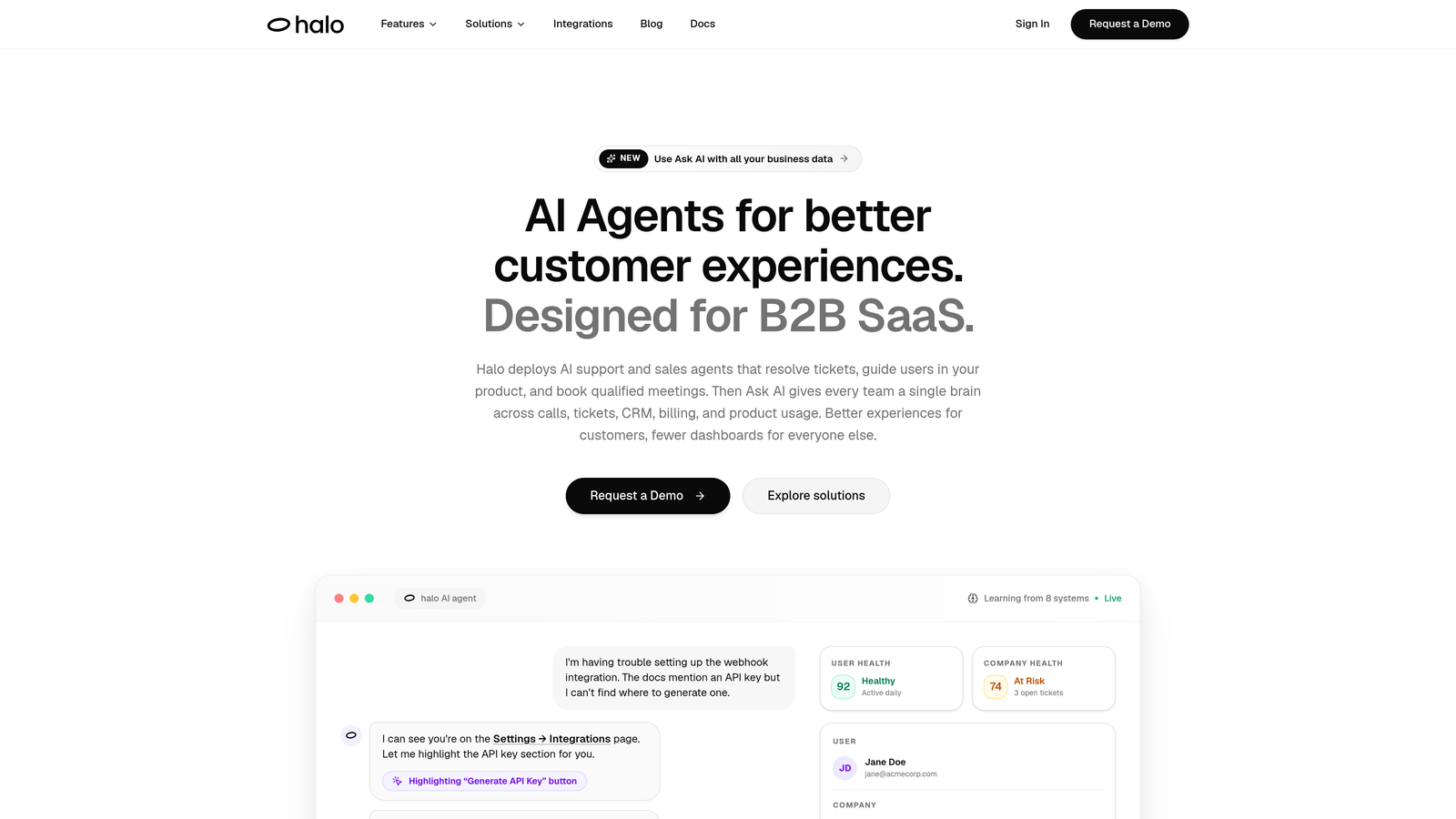
Halo AI is an AI-first customer support platform that deploys autonomous agents to resolve tickets, guide users through your product with page-aware context, auto-generate bug reports, and surface revenue intelligence — all while learning from every resolved interaction.
Where This Tool Shines
Most customer service AI tools are bolt-ons to existing helpdesks. Halo was built AI-first from the ground up, which means the intelligence isn't layered on top — it's the foundation. The page-aware chat widget is a standout feature: the AI agent actually sees what the user sees inside your product UI, so it can guide them through specific screens rather than giving generic help center answers.
Beyond deflection, Halo's smart inbox surfaces business intelligence that most support tools completely ignore. It detects customer health signals, revenue anomalies, and churn indicators from support conversations, turning your support queue into a source of strategic insight rather than just a cost center.
Key Features
Page-Aware Chat Widget: The AI agent sees what the user sees in your product UI, enabling contextual step-by-step guidance rather than generic responses.
Autonomous Ticket Resolution: Resolves support tickets end-to-end with intelligent live agent handoff when complexity requires a human.
Auto Bug Ticket Creation: Detects patterns across support conversations and automatically creates tickets in Linear or Jira, eliminating manual bug logging.
Smart Inbox with Business Intelligence: Surfaces customer health signals, revenue anomalies, and churn indicators directly from support data.
Deep Integration Stack: Connects with Slack, HubSpot, Intercom, Stripe, Zoom, PandaDoc, Fathom, and Linear out of the box.
Continuous Learning: Improves from every resolved interaction, getting smarter over time without manual retraining.
Best For
B2B SaaS product teams and customer success leaders who want more than deflection. If your support data should also be informing your product roadmap, retention strategy, and revenue forecasting, Halo is built for that use case. It's particularly strong for teams that currently rely on multiple tools to cover what Halo handles in one platform.
Pricing
Free trial available at haloagents.ai. Paid plans are designed for B2B SaaS teams. Verify current pricing directly on the site, as SaaS pricing changes frequently.
2. Intercom
Best for: Teams already on the Intercom platform who want to add AI resolution without changing tools.
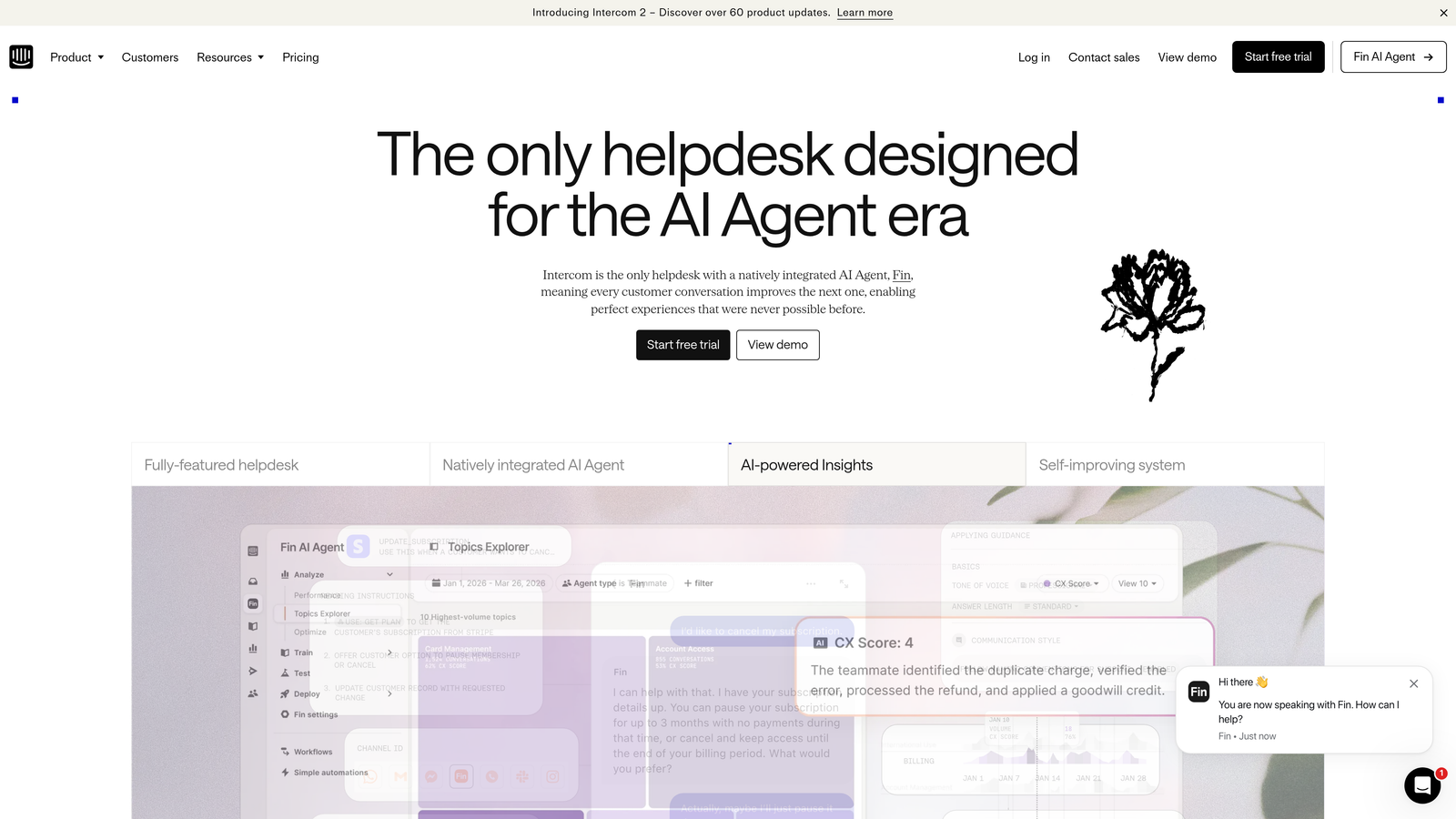
Intercom is a leading customer communications platform with Fin, an AI agent built on large language models that resolves support queries using your existing help center content.
Where This Tool Shines
Fin is genuinely impressive at what it does: it reads your help center, understands intent, and resolves a meaningful portion of inbound queries without human involvement. If your team is already using Intercom's inbox and CRM, adding Fin is a relatively low-friction upgrade since everything lives in the same ecosystem.
The conversation handoff experience is also well-executed. When Fin can't resolve something, it passes the full conversation context to a human agent inside Intercom's inbox, which avoids the frustrating "start over" experience customers often face with less integrated tools.
Key Features
Fin AI Agent: Trained on your help center and knowledge base to resolve queries autonomously using LLM reasoning.
Seamless Human Handoff: Transfers conversations to live agents within Intercom's inbox with full context preserved.
AI-Generated Summaries: Automatically summarizes conversations and suggests replies to speed up agent responses.
CRM and Workflow Integration: Deep native connection to Intercom's CRM, automation workflows, and reporting suite.
Consumption-Based Pricing for Fin: You pay per resolution, which aligns cost directly with AI performance.
Best For
Teams already invested in the Intercom ecosystem. As a standalone AI purchase, it's less compelling compared to purpose-built AI platforms. But if Intercom is already your communications hub, Fin is the natural next step.
Pricing
14-day free trial available. Fin AI is priced per resolution on top of your base Intercom plan. Costs can scale quickly at high conversation volumes, so model this carefully before committing.
3. Zendesk AI
Best for: Large enterprise support teams with complex routing, SLA management, and multi-channel needs.
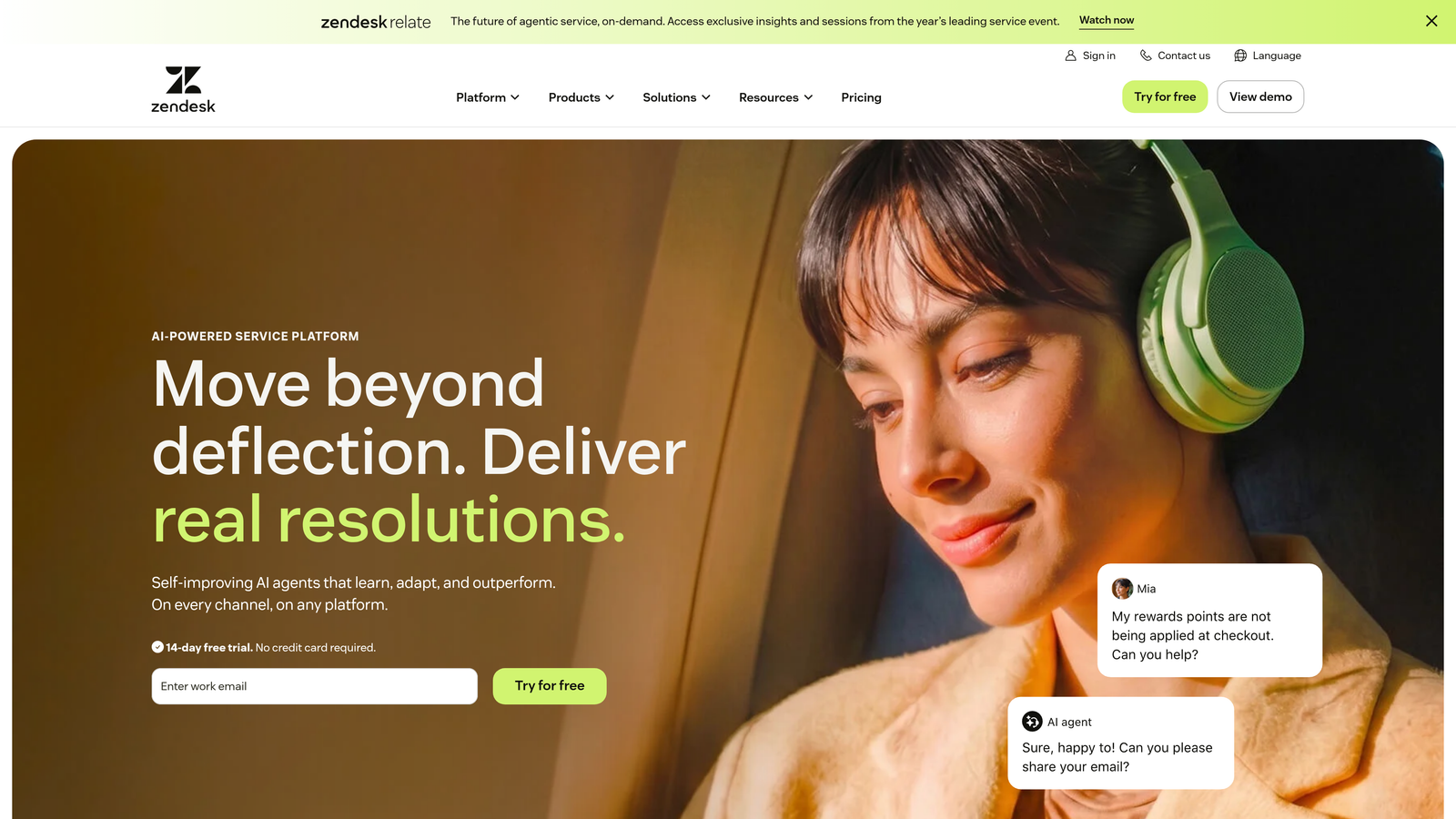
Zendesk is an enterprise helpdesk suite with AI triage, intent detection, and intelligent automation layered across tickets, chat, and voice.
Where This Tool Shines
Zendesk's strength is handling complexity at scale. Its AI triage layer — which includes intent detection, sentiment analysis, and automated routing — is genuinely useful when you're managing thousands of tickets across multiple channels and teams. The AI-generated ticket summaries alone can save agents significant time when picking up mid-conversation tickets.
That said, Zendesk can feel heavy for smaller teams. The platform is feature-rich, which means there's a real learning curve, and the AI features are positioned as an add-on rather than a core capability.
Key Features
Intelligent Triage: Detects intent and sentiment to automatically categorize and prioritize incoming tickets.
AI-Suggested Macros: Recommends response templates to agents based on ticket content, reducing manual lookup time.
Automated Ticket Routing: Routes tickets by topic, urgency, and team based on AI-detected signals.
AI Ticket Summaries: Generates concise summaries so agents can get up to speed on long threads instantly.
Advanced Reporting and SLA Management: Enterprise-grade analytics and compliance tracking across all channels.
Best For
Large organizations with established support operations, complex routing logic, and multi-region teams. If you're a smaller B2B SaaS team, the overhead may outweigh the benefits compared to leaner AI-first alternatives.
Pricing
14-day free trial on Suite plans. AI features are available as an add-on, which means your effective cost is higher than the base plan price suggests. Verify current add-on pricing at zendesk.com.
4. Freshdesk
Best for: SMBs and growing teams that want solid AI assistance across email, chat, and phone without enterprise-level pricing.
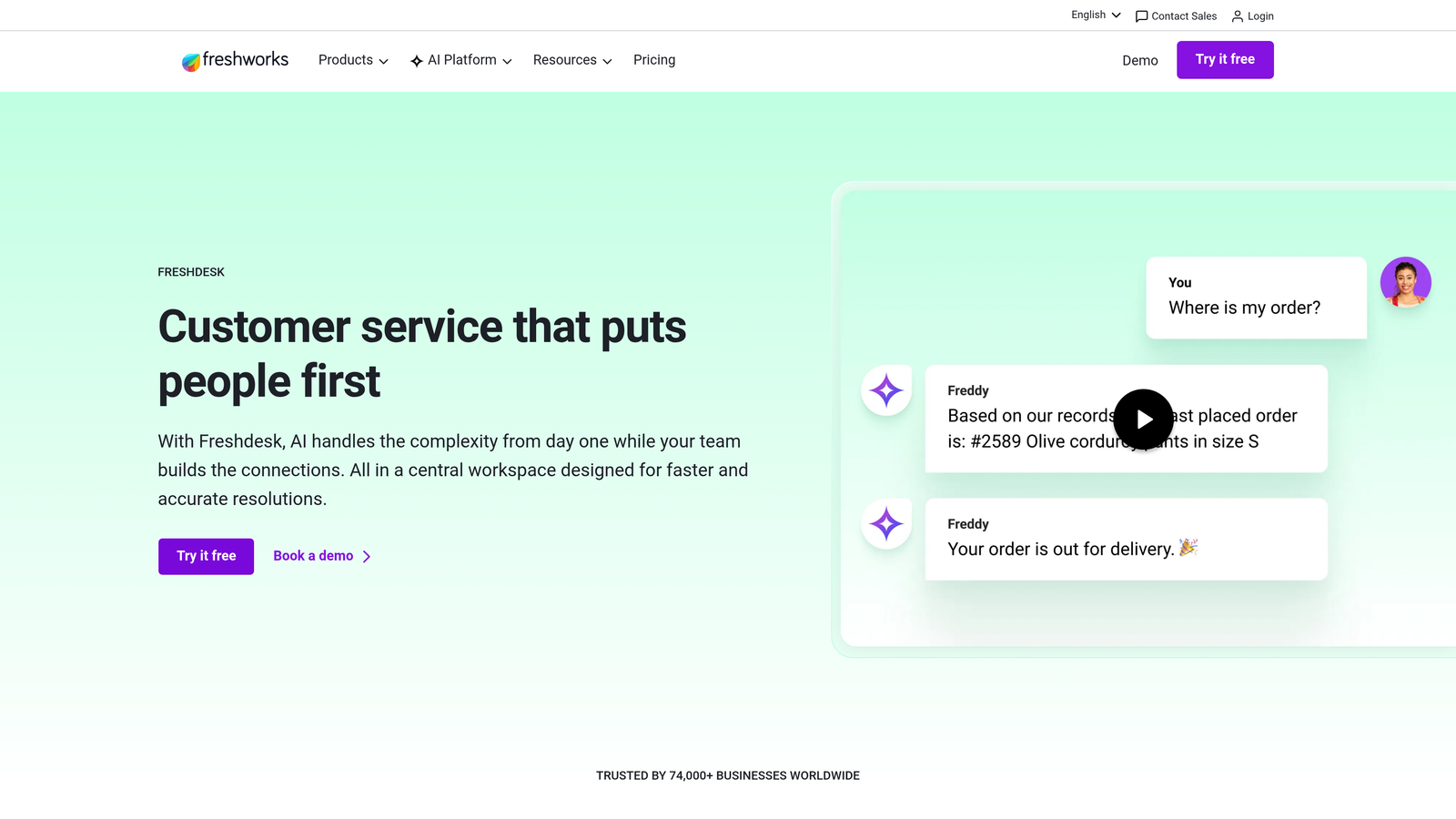
Freshdesk is a widely-used helpdesk platform with Freddy AI built in, offering both agent-assist and self-service automation across accessible pricing tiers.
Where This Tool Shines
Freshdesk's value proposition is straightforward: you get a capable AI layer without the price tag of Zendesk or the complexity of enterprise platforms. Freddy AI splits into two distinct modes — Copilot for helping agents draft and improve responses, and Self Service for autonomous deflection of common queries. Having both modes available at the Growth plan tier makes it genuinely accessible for smaller teams.
The 21-day free trial is also one of the more generous in this space, giving teams enough time to run real conversations and measure deflection rates before committing.
Key Features
Freddy Copilot: AI drafting, summarization, and tone suggestions that help agents respond faster and more consistently.
Freddy Self Service: Autonomous deflection for common queries without human agent involvement.
Free Plan Available: Limited-agent free tier for small teams testing the platform before upgrading.
Omnichannel Support: Handles email, chat, phone, and social from a single inbox.
Extensive Marketplace: Over 1,000 integrations available through the Freshworks marketplace.
Best For
SMBs and mid-market teams that need a full helpdesk with AI features at a price point that scales with their growth. Less suited for teams with complex B2B SaaS support needs that require deep product context or business intelligence.
Pricing
Free plan available with limited features. 21-day trial on paid plans. Freddy AI is included on the Growth plan and above. Verify current tier pricing at freshdesk.com.
5. Tidio
Best for: E-commerce businesses and small teams that need autonomous chat support deployed quickly with minimal setup.
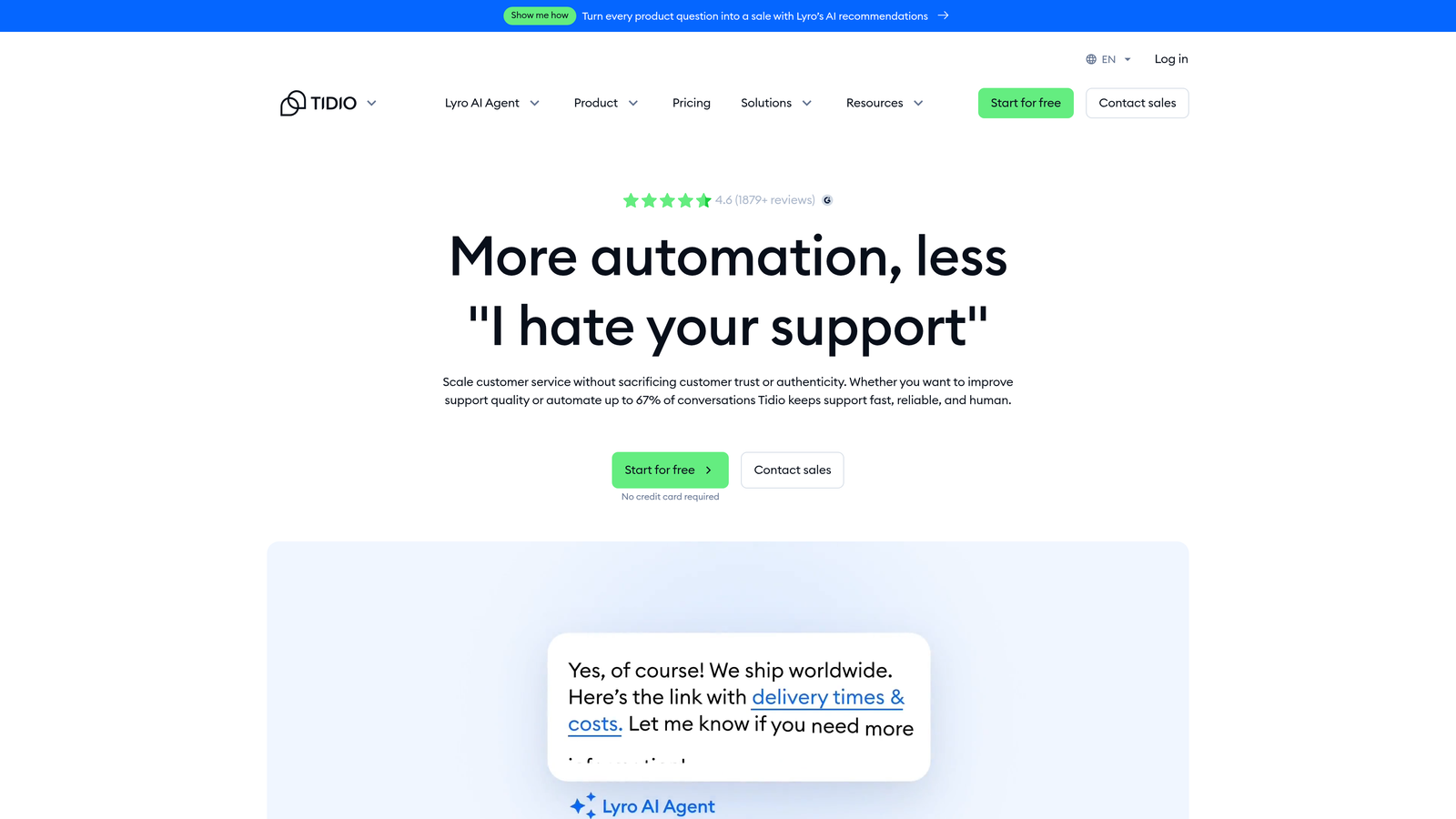
Tidio is a fast-to-deploy AI chat and helpdesk platform with Lyro AI, designed for businesses that need autonomous conversation handling without complex configuration.
Where This Tool Shines
Tidio's biggest advantage is speed of deployment. You can have Lyro AI handling customer FAQs within a day of signing up, which is a meaningful differentiator for small teams without dedicated technical resources. Its native integrations with Shopify, WooCommerce, and WordPress make it a natural fit for e-commerce operators who need support automation without building custom integrations.
The free tier is a genuine starting point, not just a teaser. You get real Lyro conversations included, which lets you validate whether the AI handles your specific query types before spending anything.
Key Features
Lyro AI: Handles FAQs and support queries autonomously, trained on your content without complex setup.
Free Tier: Limited Lyro conversations available at no cost, allowing real testing before purchase.
E-Commerce Integrations: Native connections to Shopify, WooCommerce, and WordPress out of the box.
Unified Inbox: Live chat, email, and Messenger support managed from a single interface.
Visual Chatbot Builder: Drag-and-drop flow builder for creating custom conversation paths without code.
Best For
E-commerce businesses, small online retailers, and early-stage teams that need fast, affordable AI chat support. Less suited for B2B SaaS teams with complex routing requirements, multi-system integrations, or business intelligence needs.
Pricing
Free tier available. Paid plans from approximately $29/month. Lyro AI conversations are priced separately on some plans. Verify current pricing at tidio.com.
6. Drift
Best for: Revenue teams that want support automation and sales qualification running through the same conversation interface.
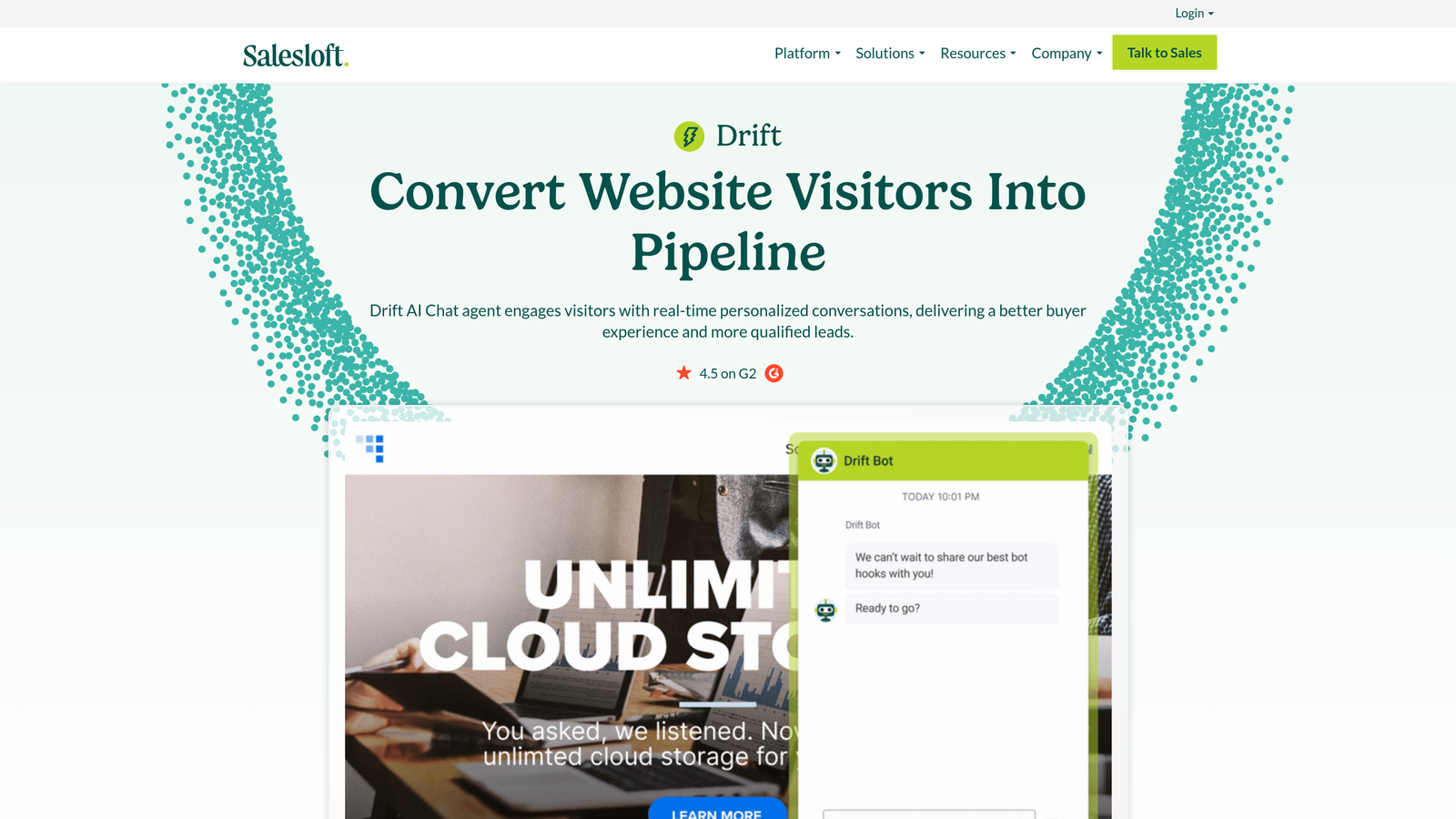
Drift is a conversational AI platform, now part of Salesloft, that blends support automation with sales qualification by routing conversations based on buyer intent.
Where This Tool Shines
Drift occupies a unique position: it's not purely a support tool and not purely a sales tool. Its AI playbooks detect whether an incoming conversation is a support request, a sales inquiry, or an account management question, and routes accordingly. For revenue-focused teams, this means one platform can handle the full spectrum of customer and prospect conversations.
The real-time personalization based on CRM data is also a differentiator. Drift can recognize a returning customer, pull their account data, and tailor the conversation flow before they've typed a single word.
Key Features
Intent-Based AI Playbooks: Routes conversations by detected intent — support, sales qualification, or account management.
Real-Time Personalization: Tailors conversation flows based on visitor data and CRM records in real time.
Built-In Meeting Scheduling: Allows prospects and customers to book meetings directly within the chat flow.
CRM Integrations: Native connections to Salesforce, HubSpot, Marketo, and Salesloft.
Conversation Intelligence: Reporting on pipeline contribution and conversation outcomes across support and sales.
Best For
B2B teams where support and revenue generation overlap — particularly those with SDR teams, account managers, and customer success all needing visibility into the same conversations. Less suited for teams whose primary need is pure support deflection.
Pricing
Free trial available. Pricing is enterprise-oriented; contact Drift directly for a quote. Verify current offerings at drift.com.
7. Chatbase
Best for: Startups and small teams that need a working AI support agent deployed in minutes with no engineering resources.
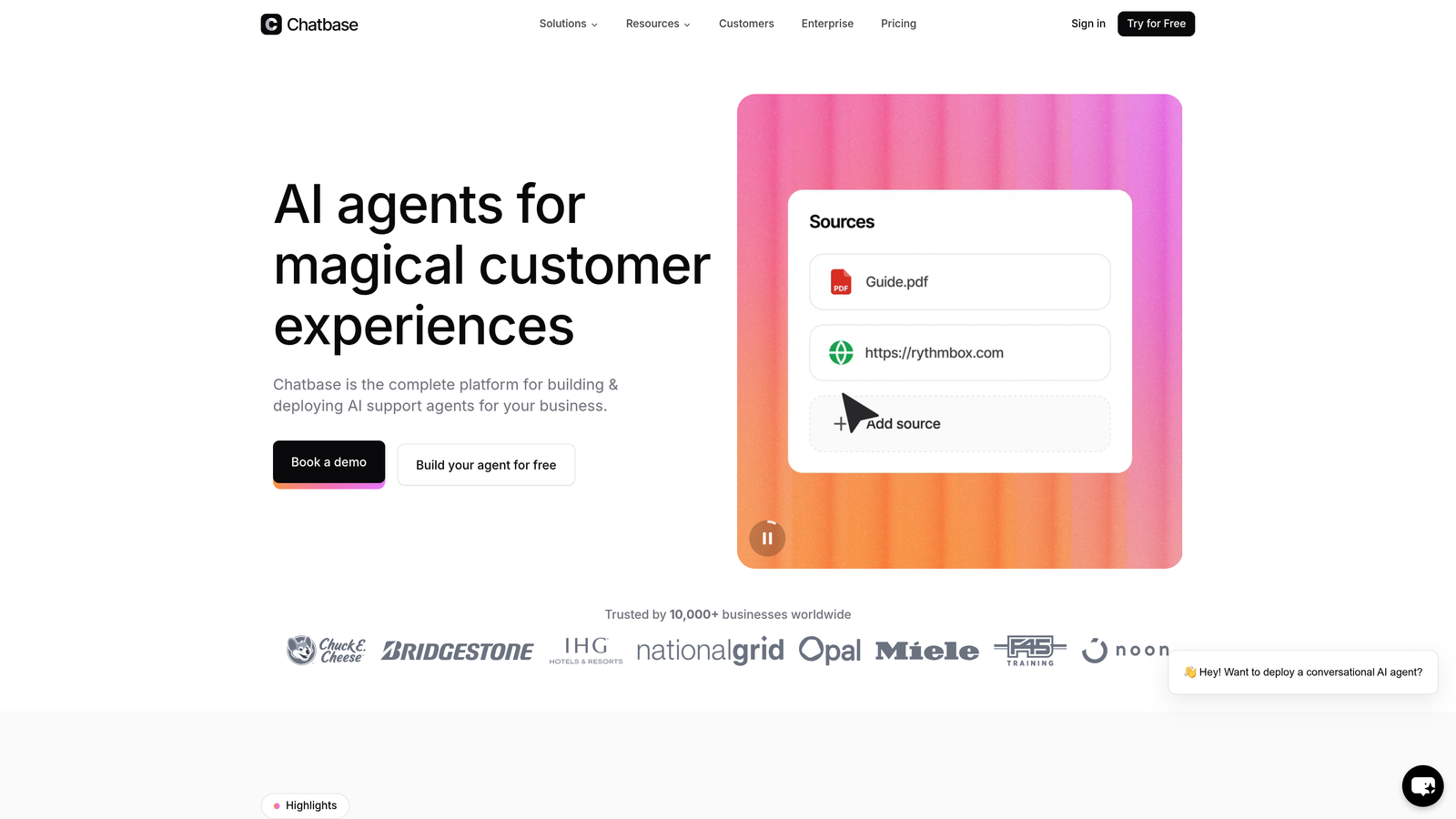
Chatbase is a lightweight AI agent builder that lets you train a custom chatbot on your documentation, URLs, or PDFs and deploy it immediately without technical setup.
Where This Tool Shines
Chatbase removes almost all friction from getting an AI agent live. You paste in a URL, upload a PDF, or drop in your help docs, and within minutes you have a functioning AI agent that can answer questions based on that content. For a startup without a dedicated support team, that's a meaningful capability to have quickly.
It's worth being clear about what Chatbase is and isn't. It's a content-trained chatbot builder, not a full support platform. There's no ticket management, no escalation routing, and no business intelligence. But for teams that just need a first layer of AI deflection, it's hard to beat for simplicity.
Key Features
Flexible Training Sources: Train your AI agent on PDFs, URLs, help docs, or plain text with no technical configuration.
Free Tier: Limited messages per month available at no cost for testing and early deployment.
Embeddable Widget: Deploy the chat widget on any website with a simple embed code.
Lead Capture: Basic lead collection and conversation history on paid plans.
API Access: Available on paid plans for teams that want to build custom integrations.
Best For
Early-stage startups, indie developers, and small teams that need a fast, low-configuration AI agent. Not suited for teams that need ticket routing, escalation workflows, CRM integrations, or any form of support analytics.
Pricing
Free tier available with limited monthly messages. Paid plans from approximately $19/month. Verify current pricing at chatbase.co.
8. Help Scout
Best for: Customer-centric teams where response quality, tone, and empathy are as important as resolution speed.
Help Scout is a customer-centric helpdesk platform with AI Assist for agent drafting and summarization, built for teams where human-quality communication is the priority.
Where This Tool Shines
Help Scout has built its reputation on making support feel human, and its AI layer reflects that philosophy. AI Assist doesn't try to replace agents — it makes them faster and better by drafting responses, adjusting tone, and summarizing long threads. For teams where a poorly worded AI reply could damage a customer relationship, this approach is genuinely valuable.
Beams AI, their newer autonomous layer, is still maturing but shows promise for self-service deflection. The platform's clean UI and minimal learning curve also mean faster onboarding for new team members.
Key Features
AI Assist: Drafts, summarizes, and improves agent replies with tone and clarity suggestions.
Beams AI: Autonomous self-service capability for deflecting common queries without agent involvement.
Unified Platform: Shared inbox, live chat, and knowledge base managed in a single interface.
Customer Profiles: Full conversation history attached to each customer record for context-rich support.
Clean, Intuitive UI: Minimal learning curve compared to enterprise helpdesk platforms.
Best For
Teams where brand voice and response quality matter as much as efficiency. Particularly well-suited for B2C companies, professional services, and any team where a robotic-sounding AI reply would undermine customer trust.
Pricing
15-day free trial available. Plans from approximately $22 per user per month. Verify current pricing at helpscout.com.
9. Zoho Desk
Best for: Teams already using Zoho CRM who want native AI support without adding another vendor to their stack.
Zoho Desk is a helpdesk platform with Zia AI built in, offering sentiment analysis, ticket tagging, and response suggestions with deep integration across the Zoho ecosystem.
Where This Tool Shines
If your team runs on Zoho CRM, Zoho Analytics, or other Zoho products, Desk is the obvious choice for support. The native data sharing across the Zoho suite means your support agents have full CRM context without any custom integration work, and Zia AI can surface anomalies and sentiment signals across that combined data set.
The free plan for up to three agents is one of the most generous starting points in this category. It's a legitimate way to run a small support operation at no cost before deciding whether to scale up.
Key Features
Zia AI: Sentiment detection, ticket tagging, anomaly alerts, and AI-suggested responses built into the platform.
Knowledge Base Suggestions: Zia surfaces relevant help articles to agents during active tickets, reducing lookup time.
Free Plan: Up to three agents at no cost, with core helpdesk functionality included.
Zoho Ecosystem Integration: Native connection to Zoho CRM, Analytics, SalesIQ, and other Zoho products.
Multi-Channel Support: Email, chat, phone, social media, and web forms managed from one platform.
Best For
Small to mid-sized teams already invested in the Zoho ecosystem. The AI features are more capable on higher-tier plans, so teams that want Zia's full intelligence layer should plan for the Professional plan or above.
Pricing
Free plan for up to 3 agents. 15-day trial on paid plans. Zia AI is available on the Professional plan and above. Verify current pricing at zoho.com/desk.
Which Tool Is Right for Your Team?
The right choice depends on where you are, what you need, and how you plan to grow. Here's a quick way to think through it.
If you're a B2B SaaS product team that wants autonomous ticket resolution, page-aware product guidance, and business intelligence from support data, Halo AI is the most purpose-built option on this list. Nothing else combines page context, auto bug reporting, and revenue signals in a single platform.
If you're already on Intercom and want to add AI resolution without switching tools, Fin is the natural upgrade. The per-resolution pricing model also makes it easy to measure ROI directly.
If you're an enterprise with complex routing needs and thousands of daily tickets, Zendesk AI's triage and SLA management capabilities are hard to match. Just budget for the add-on costs.
If you're an SMB watching budget carefully, Freshdesk offers the best combination of AI capability and accessible pricing, with a 21-day trial to validate it properly.
If you're in e-commerce and need something live this week, Tidio deploys faster than anything else on this list.
If revenue and support overlap in your team's day-to-day, Drift's intent-based routing makes it the only tool here that bridges both functions natively.
If you just need a fast AI agent with minimal setup and no budget, Chatbase's free tier gets you there in minutes.
When you're in a free trial, don't just test the happy path. Run real customer queries through the AI. Test an edge case that should escalate to a human. Check whether the integration with your CRM or ticketing system actually syncs data correctly. Measure deflection rate on your actual query mix, not the vendor's benchmark scenarios.
Your support team shouldn't scale linearly with your customer base. Let AI agents handle routine tickets, guide users through your product, and surface business intelligence while your team focuses on complex issues that need a human touch. See Halo in action and discover how continuous learning transforms every interaction into smarter, faster support.