9 Best Customer Service AI Platforms Compared for 2026
This comprehensive customer service AI platform comparison evaluates nine leading solutions for 2026 across six critical criteria—including AI accuracy, integration depth, and pricing transparency—helping SaaS companies and enterprise teams identify the right autonomous support platform to reduce ticket volume, detect churn signals, and scale customer service operations efficiently.
 Grant CooperFounder13 min read
Choosing the right AI customer service platform has never been more consequential — or more confusing. The market has matured rapidly through 2025 and into 2026, shifting from simple chatbot overlays to fully autonomous agent architectures that can resolve tickets, detect churn signals, and integrate with your entire business stack.
Whether you're a scaling SaaS company drowning in support volume or an enterprise team evaluating whether to build on your existing helpdesk or switch to an AI-first system, the differences between platforms matter enormously. Resolution quality, integration depth, learning capabilities, and pricing models vary wildly across the field.
We evaluated platforms across six key criteria: AI accuracy and autonomy, integration ecosystem, analytics and reporting, ease of setup, scalability, and pricing transparency. Here are the platforms worth your attention in 2026.
1. Halo AI
Best for: B2B SaaS teams wanting an AI-first platform that resolves tickets, guides users, and surfaces business intelligence.
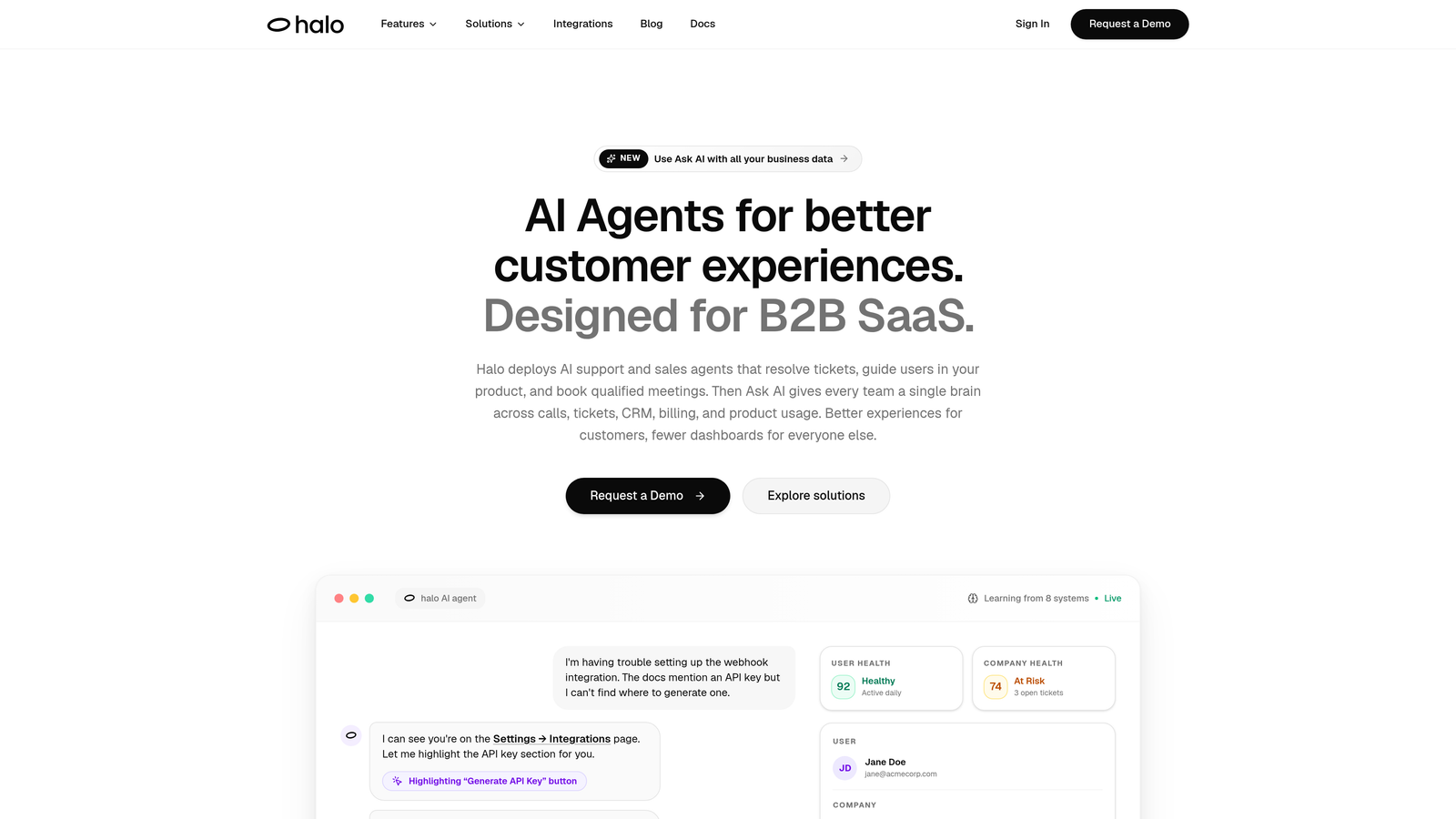
Halo AI is an AI-native customer support platform that deploys autonomous agents to resolve tickets, provide page-aware guidance, and surface revenue and product intelligence from support interactions.
Where This Tool Shines
What separates Halo from most platforms on this list is its architecture. Rather than bolting AI onto a legacy ticketing system, Halo is built AI-first from the ground up. That distinction has real consequences: the AI agents learn continuously from every resolved interaction, meaning the platform gets meaningfully smarter over time rather than staying static.
The page-aware chat widget is a standout capability. It understands the exact page a user is on and can provide visual UI guidance, not just text answers. For SaaS products with complex interfaces, this is the difference between a user getting unstuck and abandoning your product entirely.
Key Features
Page-Aware Chat Widget: Sees what users see in real time and delivers contextual, visual UI guidance rather than generic help content.
Autonomous Ticket Resolution: AI agents resolve tickets end-to-end with continuous learning from every interaction, improving accuracy over time.
Auto Bug Ticket Creation: Automatically identifies and routes bug reports directly to engineering tools like Linear, closing the loop between support and product.
Smart Inbox with Business Intelligence: Goes beyond support metrics to surface churn signals, revenue intelligence, and anomaly detection from your support data.
Deep Integration Ecosystem: Connects natively with Slack, HubSpot, Intercom, Stripe, Zoom, PandaDoc, Fathom, and more, giving it visibility across your full business stack.
Best For
B2B product teams and support leaders who want AI that does more than deflect tickets. Halo is particularly well-suited for SaaS companies that need support, product, and revenue signals in one place, and who are ready to move beyond bolt-on AI features on legacy helpdesks.
Pricing
Contact for pricing. A demo is available at haloagents.ai, which is the recommended starting point for evaluating fit.
2. Intercom Fin
Best for: Teams already on Intercom who want native AI resolution without changing their support stack.
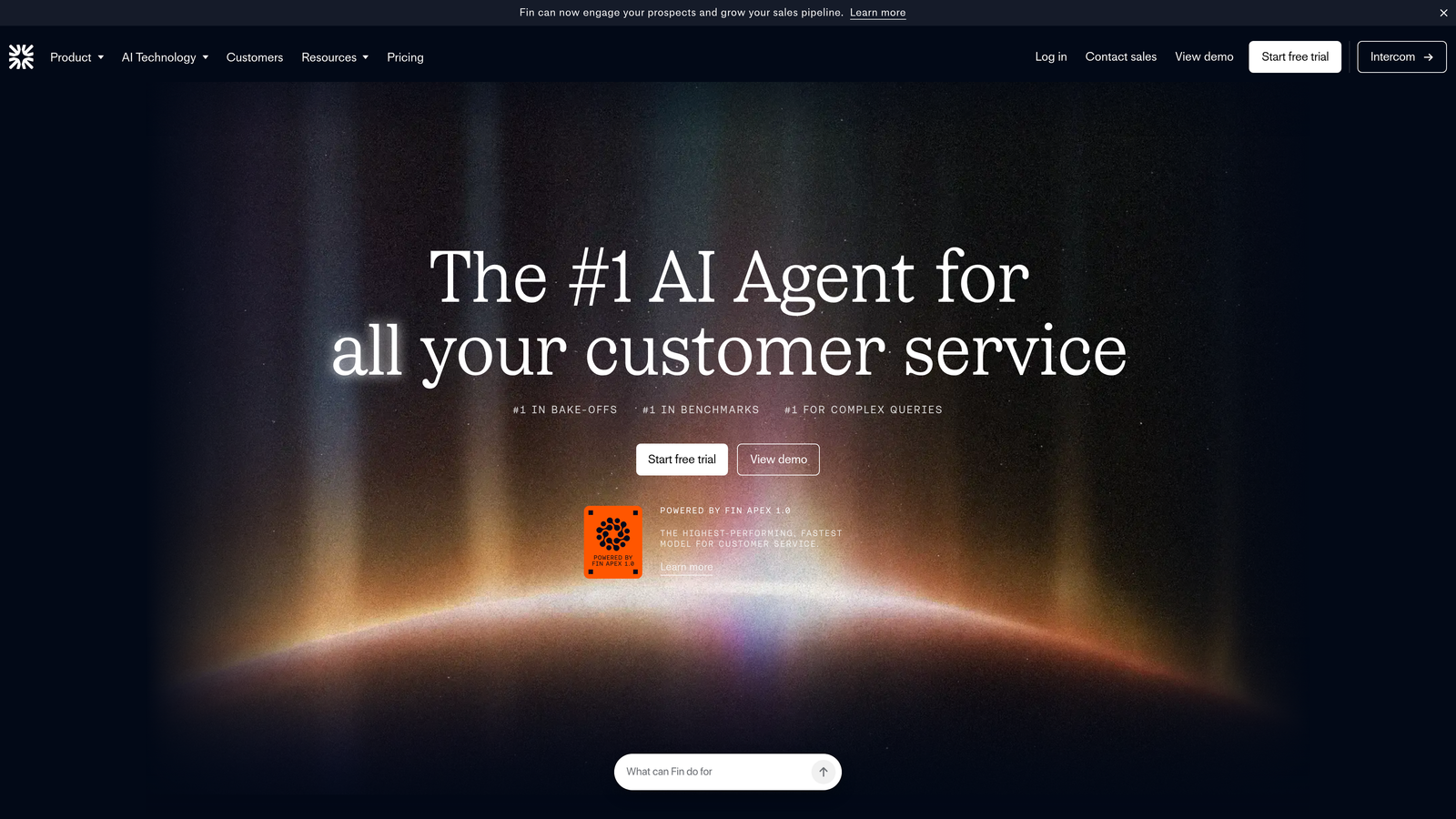
Intercom Fin is Intercom's native AI agent, trained on your help center content and conversation history to resolve customer questions directly within the Intercom messenger experience.
Where This Tool Shines
Fin's biggest advantage is how deeply it sits inside the Intercom ecosystem. If your team already lives in Intercom, the setup friction is minimal. Fin pulls from your existing articles, past conversations, and inbox workflows without requiring a separate integration layer. The handoff experience is also well-executed: when Fin escalates to a human, the full conversation context carries over seamlessly.
The per-resolution pricing model is worth understanding carefully. It aligns cost with value delivered, but for high-volume teams it can become expensive quickly depending on resolution rates. Run the math against your current ticket volume before committing.
Key Features
Native Help Center Training: Trains directly on your Intercom articles, past conversations, and existing content without manual setup.
Tone and Persona Customization: Allows teams to configure Fin's communication style to match their brand voice.
Human Handoff with Context: Escalates to live agents with the full conversation history intact, preserving continuity for the customer.
Multi-Language Support: Automatically detects customer language and responds accordingly across supported languages.
Inbox Workflow Integration: Works natively within Intercom's existing routing and inbox management workflows.
Best For
Companies already using Intercom as their primary support and messaging platform. Fin is the lowest-friction AI upgrade for existing Intercom customers, though teams evaluating a full platform switch may find its capabilities more limited outside the Intercom ecosystem.
Pricing
Per-resolution pricing model, charged per AI-resolved conversation. Requires an active Intercom subscription. Costs scale with resolution volume, so evaluate against your ticket mix carefully.
3. Zendesk AI
Best for: Enterprise teams running Zendesk Suite who want AI layered into existing ticketing workflows.
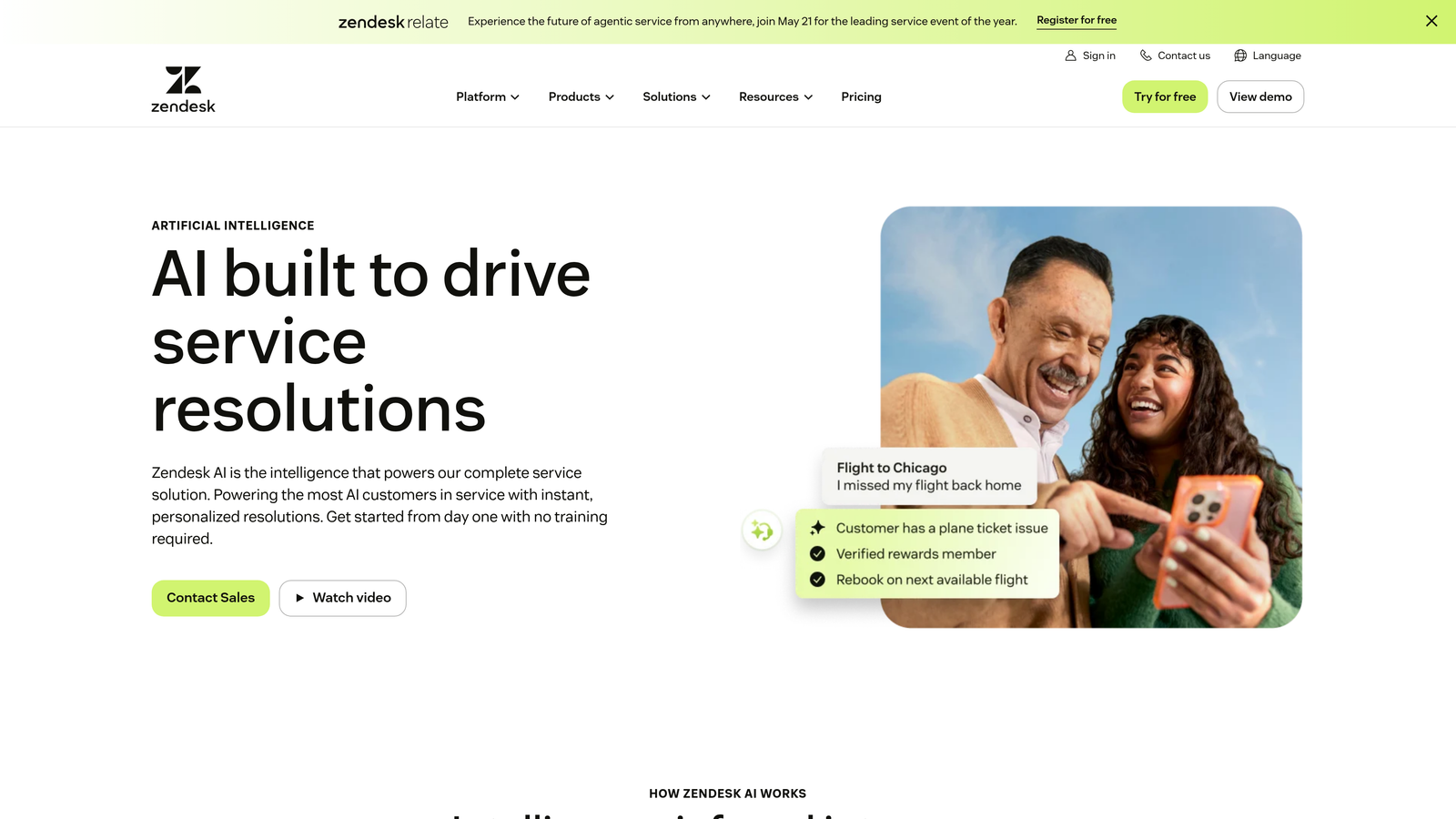
Zendesk AI is a suite of AI capabilities built into the Zendesk platform, spanning autonomous resolution, intelligent triage, agent copilot assistance, and generative content tools.
Where This Tool Shines
Zendesk AI benefits from the platform's enormous knowledge base of support interaction data, which informs its triage and classification models. The intelligent triage feature is particularly strong: it auto-classifies tickets by intent, language, and sentiment before a human ever touches them, which meaningfully reduces routing errors in high-volume environments.
The agent copilot adds real value for teams that aren't ready to go fully autonomous. Suggested replies and next-best-action recommendations keep human agents faster without removing them from the loop entirely.
Key Features
AI Agents for Autonomous Resolution: Trained on your Zendesk knowledge base to handle common questions without agent involvement.
Intelligent Triage: Automatically classifies ticket intent, language, and sentiment to route issues to the right team or workflow.
Agent Copilot: Provides human agents with suggested replies and next-best-action recommendations during live interactions.
Generative AI for Help Center: Assists with creating and expanding knowledge base articles to keep self-service content current.
Enterprise Compliance: Meets enterprise-grade security and compliance certifications, important for regulated industries.
Best For
Large support teams already invested in the Zendesk ecosystem who want AI features without a platform migration. Less compelling for teams considering a move away from Zendesk or those who want AI as the primary architecture rather than a layer on top.
Pricing
AI features are included in Zendesk Suite plans, with an Advanced AI add-on available at additional per-agent cost. Pricing scales with agent seat count, which can add up in larger teams.
4. Ada
Best for: Enterprise teams needing high-volume automation with strong multilingual capabilities and non-technical bot management.
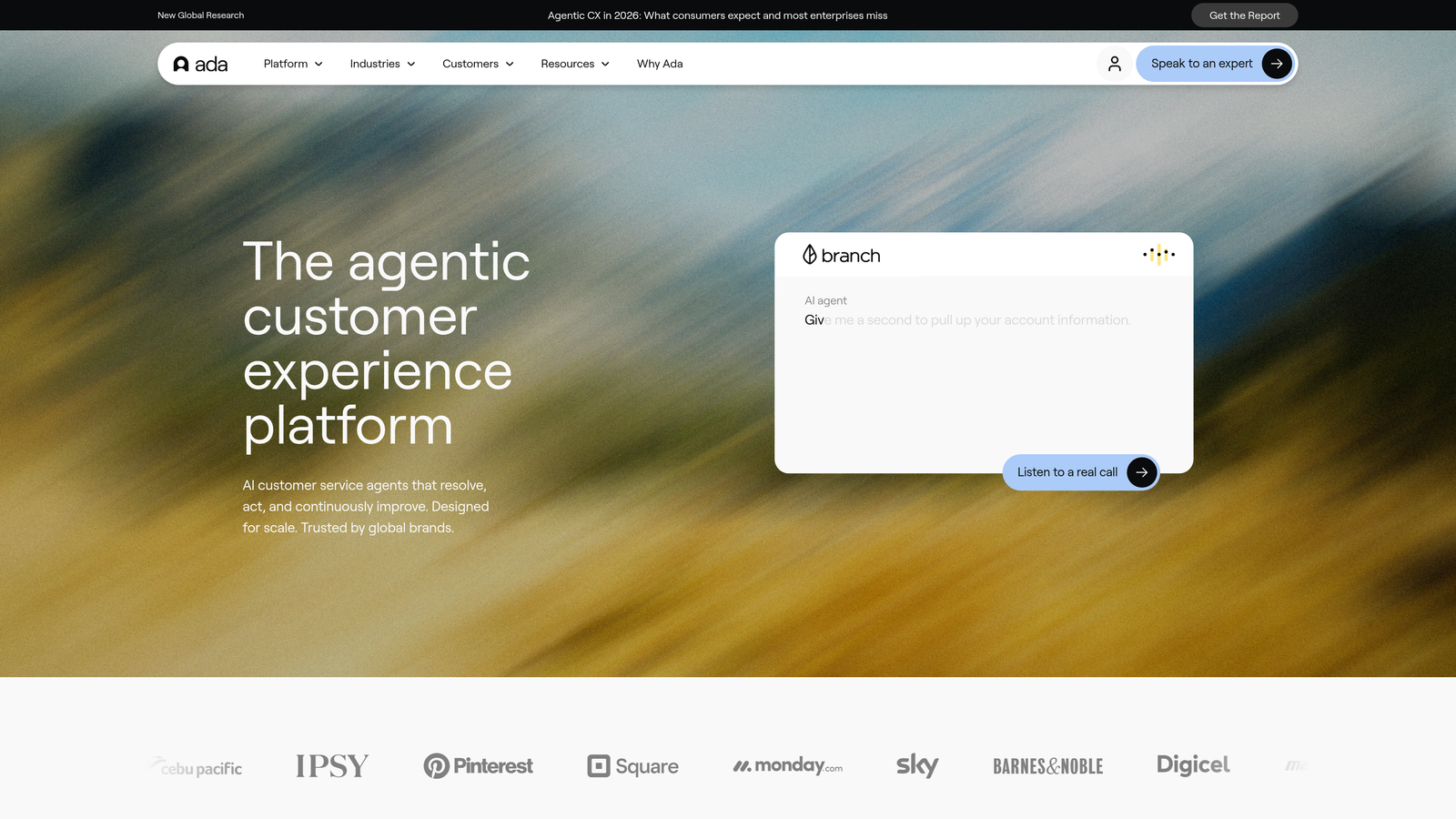
Ada is an enterprise-grade conversational AI platform focused on scalable automation, offering no-code bot building, broad multilingual support, and deep integrations with major CRMs and helpdesks.
Where This Tool Shines
Ada's no-code bot builder genuinely empowers non-technical teams to create and manage AI conversation flows without engineering involvement. For support operations teams that want ownership over their automation without constant IT dependency, this is a meaningful differentiator.
The multilingual capability is among the strongest in this comparison. Supporting over 50 languages with nuanced resolution, not just basic translation, makes Ada a natural fit for global support operations where language coverage is a hard requirement rather than a nice-to-have.
Key Features
No-Code Bot Builder: Enables support operations teams to create and modify AI conversation flows without engineering resources.
50+ Language Support: Handles multilingual resolution with nuance, not just surface-level translation.
Broad Integration Library: Connects with major CRMs, helpdesks, and e-commerce platforms across the enterprise stack.
Generative AI Responses: Grounds AI answers in your specific knowledge base to reduce hallucination and improve accuracy.
Resolution Analytics: Dashboard tracking resolution rate, containment metrics, and automation performance over time.
Best For
Enterprise companies with global customer bases and high ticket volumes, particularly those with multilingual support requirements. Ada is also well-suited for teams that need non-technical staff to own and iterate on bot flows independently.
Pricing
Custom enterprise pricing. Contact Ada directly for a quote. Expect pricing discussions to center on conversation volume and integration requirements.
5. Freshdesk Freddy AI
Best for: Growing teams on Freshdesk looking for AI-powered support at a competitive price point.
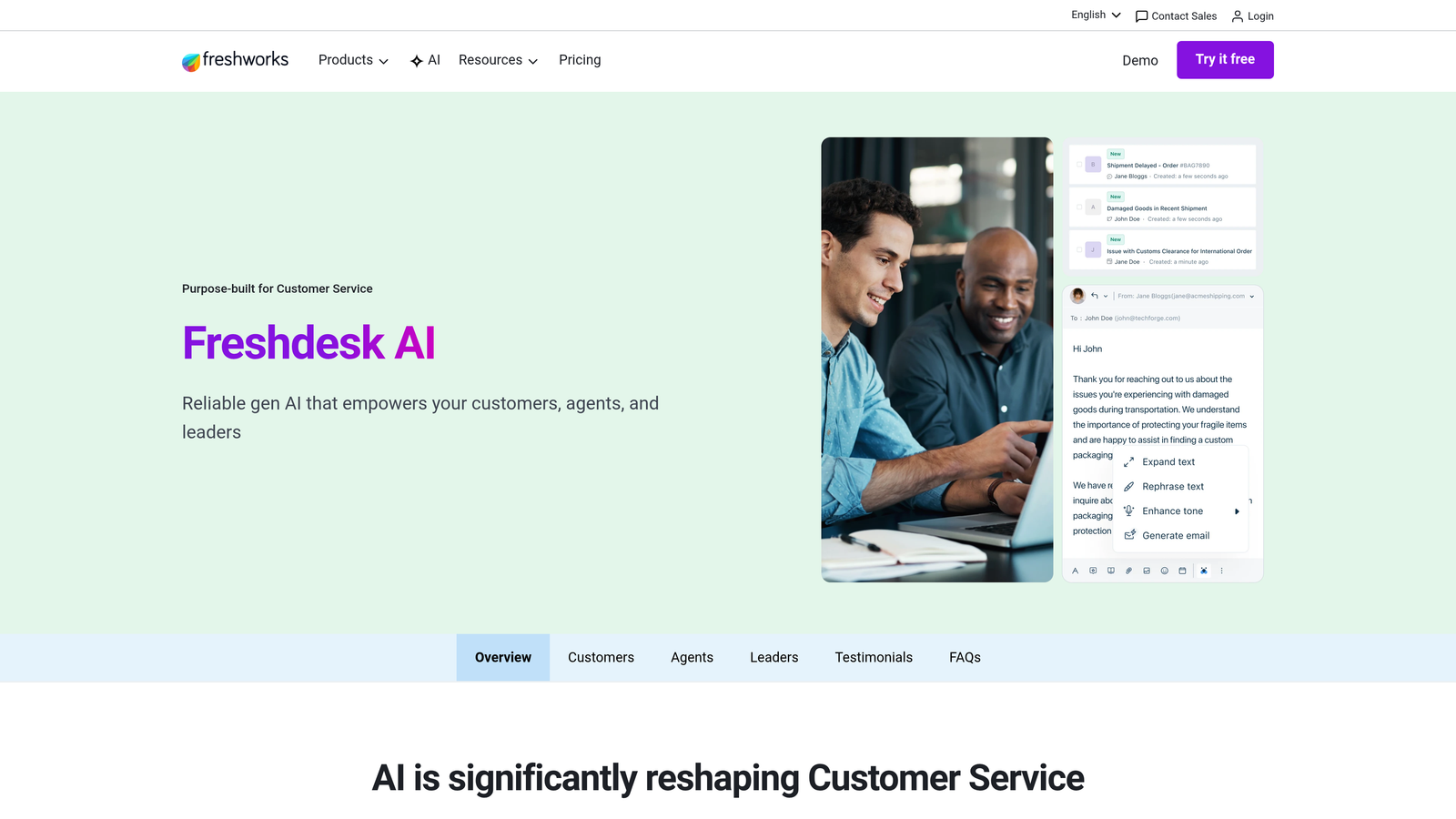
Freshdesk Freddy AI is Freshworks' AI layer for Freshdesk, providing chatbot automation, agent-assist features, and auto-triage capabilities built into one of the more affordable helpdesk platforms on the market.
Where This Tool Shines
Freddy AI's value proposition is clear: solid AI capabilities at a price point that doesn't require an enterprise budget. For mid-market teams already on Freshdesk, the integration is seamless and the learning curve is minimal. Freddy Copilot's reply suggestions and conversation summarization genuinely reduce handle time for agents dealing with complex or lengthy threads.
The broader Freshworks ecosystem is also worth noting. Teams using Freshdesk alongside Freshsales or Freshservice get cross-product AI benefits that aren't available when mixing vendors, which can be a meaningful factor for companies standardizing on the Freshworks stack.
Key Features
Freddy AI Agent: Self-service chatbot that resolves common customer questions without agent involvement.
Freddy Copilot: Agent-assist tool providing reply suggestions, conversation summaries, and next-step recommendations.
Auto-Triage: Automatically predicts and fills ticket fields like category, priority, and type based on incoming content.
Freshworks Ecosystem Integration: Shares AI capabilities across Freshdesk, Freshsales, and Freshservice for teams on the full Freshworks stack.
Accessible Entry Point: AI features available at lower price tiers compared to enterprise-only competitors.
Best For
Small to mid-market support teams already using or evaluating Freshdesk, particularly those who want AI features without a significant budget increase. Less suited for teams needing deep custom integrations outside the Freshworks ecosystem.
Pricing
AI features available on Pro and Enterprise Freshdesk plans. Freddy AI Copilot is available as a paid add-on. Generally one of the more cost-accessible options in this comparison.
6. Tidio
Best for: Small businesses and e-commerce teams wanting fast deployment with combined live chat and AI in one widget.
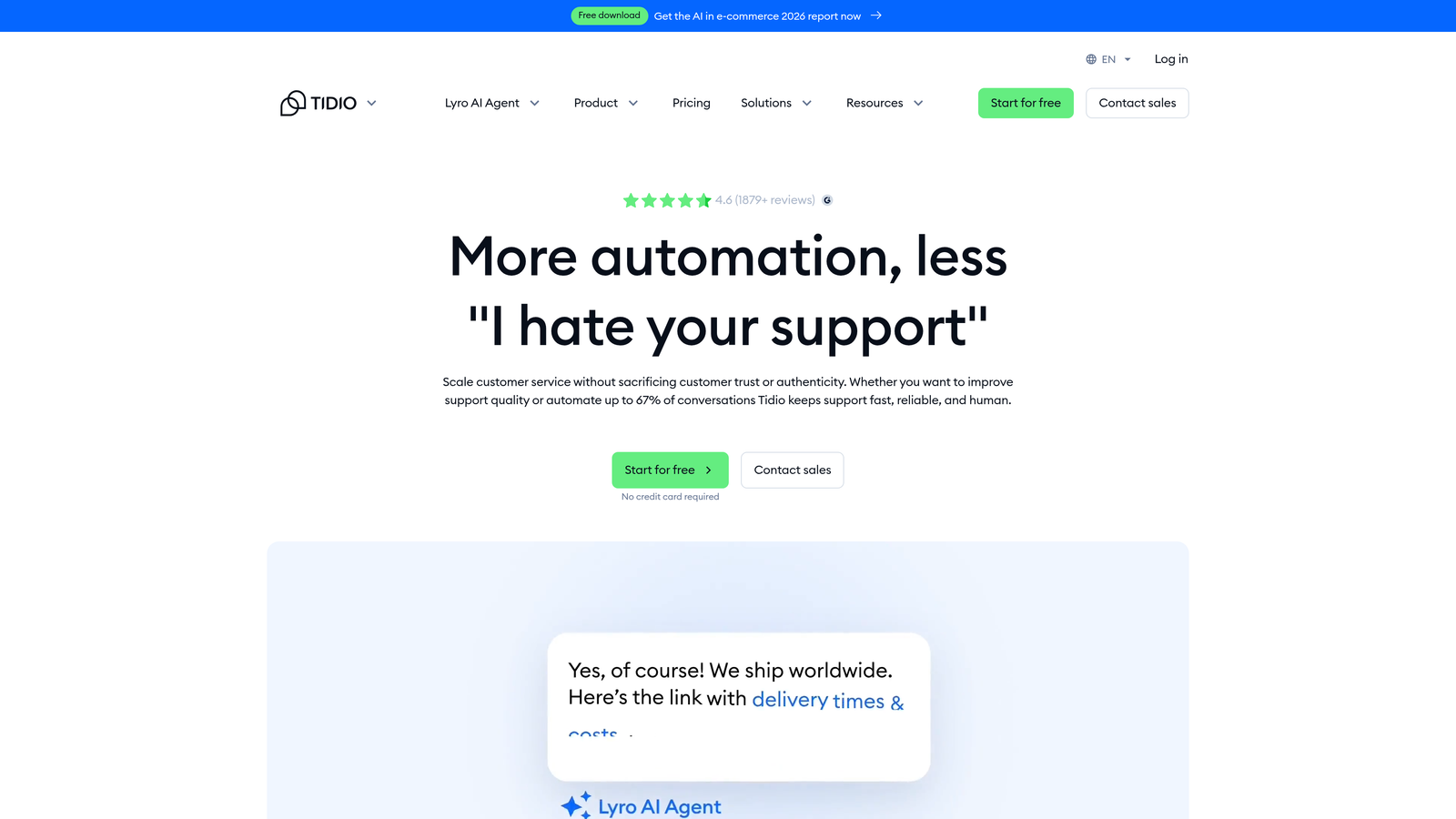
Tidio is a conversational AI platform featuring the Lyro AI chatbot, designed for quick deployment and accessible pricing, with particular strength in e-commerce integrations.
Where This Tool Shines
Tidio's standout quality is speed to value. The platform is genuinely quick to set up, often operational within minutes, making it one of the fastest paths from decision to deployment in this comparison. For small teams without dedicated technical resources, that matters.
The combination of live chat and AI in a single widget is also practically useful. Rather than managing separate tools for human and automated conversations, Tidio handles both in one interface, which simplifies operations for lean support teams.
Key Features
Lyro AI Chatbot: Learns from your FAQ and support content to handle common questions autonomously.
Combined Live Chat and AI: Manages both human and automated conversations within a single widget and interface.
Visual Flow Builder: Drag-and-drop chatbot builder for creating custom conversation automation without code.
E-Commerce Integrations: Native connections with Shopify, WooCommerce, and other e-commerce platforms for order and customer data access.
Fast Setup: Designed for quick deployment without technical configuration requirements.
Best For
Small businesses, e-commerce stores, and early-stage teams that need a live chat and AI chatbot solution without complexity or high cost. Tidio is less suited for enterprise teams needing deep CRM integrations, advanced analytics, or high-volume autonomous resolution.
Pricing
Free tier available. Paid plans start around $29/month. Lyro AI conversations are billed separately based on usage volume, so factor that into cost modeling as traffic grows.
7. Forethought
Best for: Mid-market and enterprise support teams focused on intelligent triage, routing, and AI-powered knowledge gap discovery.
Forethought is an AI support platform built around SupportGPT technology, offering modular products covering ticket resolution, intelligent triage, agent assist, and support analytics.
Where This Tool Shines
Forethought's modular architecture is genuinely useful for teams that want to start with one capability and expand over time. You can deploy Triage for intelligent routing before adding Solve for autonomous resolution, rather than committing to a full platform overhaul upfront. This phased approach reduces implementation risk for larger teams with complex existing workflows.
The Discover module stands out in the analytics category. Rather than simply reporting on what happened in support, it surfaces knowledge gaps and emerging trends, giving support leaders actionable intelligence about where their content and processes need improvement.
Key Features
Solve: AI agent for autonomous ticket resolution across chat and email channels.
Triage: Intelligent classification and routing based on ticket intent, urgency, and customer context.
Assist: Agent copilot surfacing relevant knowledge articles and drafting reply suggestions during live interactions.
Discover: AI-powered analytics identifying support trends, knowledge gaps, and resolution opportunities.
Helpdesk Integrations: Native connections with Zendesk, Salesforce, Freshdesk, and ServiceNow for teams not looking to replace their existing stack.
Best For
Mid-market and enterprise teams running Zendesk, Salesforce, or ServiceNow who want to add a sophisticated AI layer without replacing their core helpdesk. Also well-suited for support leaders who want actionable intelligence about their knowledge base and team performance.
Pricing
Custom pricing based on ticket volume and the specific modules selected. Contact Forethought for a quote tailored to your support scale and use case.
8. Kustomer
Best for: Teams wanting a CRM-native support platform with AI built into a unified customer timeline view.
Kustomer is a CRM-centric customer service platform that combines AI classification, suggested responses, and omnichannel support within a unified customer timeline, now operating independently after its Meta acquisition period.
Where This Tool Shines
Kustomer's core differentiator is the unified customer timeline. Every interaction across email, chat, social, SMS, and voice is aggregated into a single view per customer, giving agents immediate context without switching between tools. When AI surfaces a suggested response, it's informed by the full relationship history, not just the current ticket.
The custom workflow builder adds meaningful flexibility for teams with complex business processes. Support teams that need to automate multi-step workflows beyond basic ticket routing will find more room to work here than in simpler platforms.
Key Features
Unified Customer Timeline: Aggregates all customer interactions across every channel into a single, chronological view per customer.
AI Classification and Sentiment: Automatically classifies incoming conversations and detects sentiment to inform routing and prioritization.
Suggested Responses: Surfaces relevant knowledge base content and response suggestions for agents during live interactions.
Omnichannel Coverage: Handles email, chat, social media, SMS, and voice from one platform.
Custom Workflow Automation: Business process automation builder for creating complex, multi-step support workflows.
Best For
Customer-obsessed teams that want CRM depth combined with support tooling, particularly those handling high-value customers across multiple channels where relationship context matters as much as resolution speed.
Pricing
Enterprise pricing. Contact Kustomer directly for current plan details and volume-based pricing options.
9. Cognigy
Best for: Enterprise teams needing AI automation across both voice and digital channels simultaneously.
Cognigy is an enterprise conversational AI platform with particular strength in voice automation, enabling companies to deploy AI agents across phone and digital channels through a unified orchestration layer.
Where This Tool Shines
Most platforms on this list are primarily chat-focused, with voice as an afterthought or not supported at all. Cognigy inverts that assumption. Its voice AI agents handle phone-based support automation at enterprise scale, making it the strongest choice in this comparison for organizations where phone support remains a primary channel.
The low-code conversation designer supports genuinely complex dialogue flows, including multi-turn conversations with conditional logic that goes well beyond simple FAQ deflection. For enterprise contact centers with sophisticated call flows, this design capability is a significant practical advantage.
Key Features
Voice AI Agents: Deploys autonomous AI agents for phone-based support, not just digital chat channels.
Omnichannel Orchestration: Manages AI agent behavior consistently across voice, chat, and messaging from a single platform.
Low-Code Conversation Designer: Enables building complex, multi-turn dialogue flows without heavy engineering involvement.
Enterprise Contact Center Integrations: Native connections with SAP, Salesforce, Genesys, and major contact center infrastructure platforms.
Agent Assist for Live Calls: Provides real-time guidance to human agents during live phone conversations.
Best For
Large enterprises running contact centers where phone support is a primary channel alongside digital. Cognigy is particularly strong for organizations needing consistent AI behavior across voice and chat simultaneously, especially those running Genesys or similar contact center infrastructure.
Pricing
Enterprise pricing. Contact Cognigy directly for a custom quote based on channel mix, conversation volume, and integration requirements.
How to Pick the Right AI Support Platform for Your Team
The right platform depends less on feature checklists and more on three honest questions: Where does your support volume actually live? What does your current tech stack look like? And how much of your support operation do you want AI to own versus assist?
If your team is already running Intercom or Zendesk and wants AI layered in without a platform change, Intercom Fin and Zendesk AI are the lowest-friction paths. If you're on Freshdesk and budget is a real constraint, Freddy AI delivers solid capability without enterprise pricing. For small e-commerce businesses, Tidio gets you operational faster than any other option on this list.
For mid-market and enterprise teams evaluating a more strategic move, the decision often comes down to architecture. Platforms like Forethought and Ada add a sophisticated AI layer on top of your existing helpdesk. Cognigy is the clear choice if voice automation is a core requirement. Kustomer fits teams where CRM depth and customer relationship context are as important as resolution speed.
But if you're a B2B SaaS team that wants AI as the foundation rather than a feature, and you want support data to feed into product, revenue, and engineering workflows, Halo AI is built for exactly that use case. The combination of page-aware guidance, continuous learning, auto bug ticket creation, and business intelligence signals goes well beyond what bolt-on AI can deliver.
Your support team shouldn't scale linearly with your customer base. Let AI agents handle routine tickets, guide users through your product, and surface business intelligence while your team focuses on complex issues that need a human touch. See Halo in action and discover how continuous learning transforms every interaction into smarter, faster support.