9 Best Customer Service AI Platforms and What They Actually Cost in 2026
Pricing for AI customer support platforms is notoriously opaque, but this guide breaks down the real customer service AI platform cost across nine leading tools — covering seat-based, usage-based, and enterprise models — so B2B teams can compare options and budget accurately without a sales call.
 Matt PattoliFounder14 min read
Pricing pages for AI customer support platforms can be notoriously opaque. Vague tiers, per-seat fees, usage-based add-ons, and enterprise-only quotes that require a sales call just to get a number. If you're evaluating customer service AI platform costs for your B2B team, this guide cuts through the noise.
We've compiled nine platforms worth serious consideration, breaking down what each one does, who it's built for, and what you can actually expect to pay. Whether you're a lean startup looking to automate tier-1 tickets without hiring, or a scaling SaaS company replacing a patchwork of helpdesk tools, this list covers the full spectrum.
We've included platforms with transparent pricing, usage-based models, and seat-based structures so you can compare apples to apples. For further context on AI support automation, see our guides on automated customer support, AI helpdesk software, and AI support agents.
Understanding the Pricing Landscape Before You Compare
Before diving into specific platforms, it helps to understand the four pricing models you'll encounter. Per-seat pricing charges by the number of agents using the platform, common in traditional helpdesks. Per-resolution pricing charges only when AI successfully closes a ticket, which sounds appealing but can get expensive at scale. Platform subscription plus usage combines a flat monthly fee with caps or overages. And enterprise custom quotes, which dominate the high end of the market, require a sales conversation before you see any numbers.
The other key distinction worth knowing upfront: some platforms are AI-native, built from the ground up around autonomous agents. Others are AI-augmented helpdesks that bolt AI features onto existing ticket infrastructure. The architecture difference matters for both capability and total cost of ownership.
With that framing in place, here are the nine platforms worth your evaluation time.
1. Halo AI
Best for: B2B SaaS teams that want an AI-native platform with deep integration and business intelligence
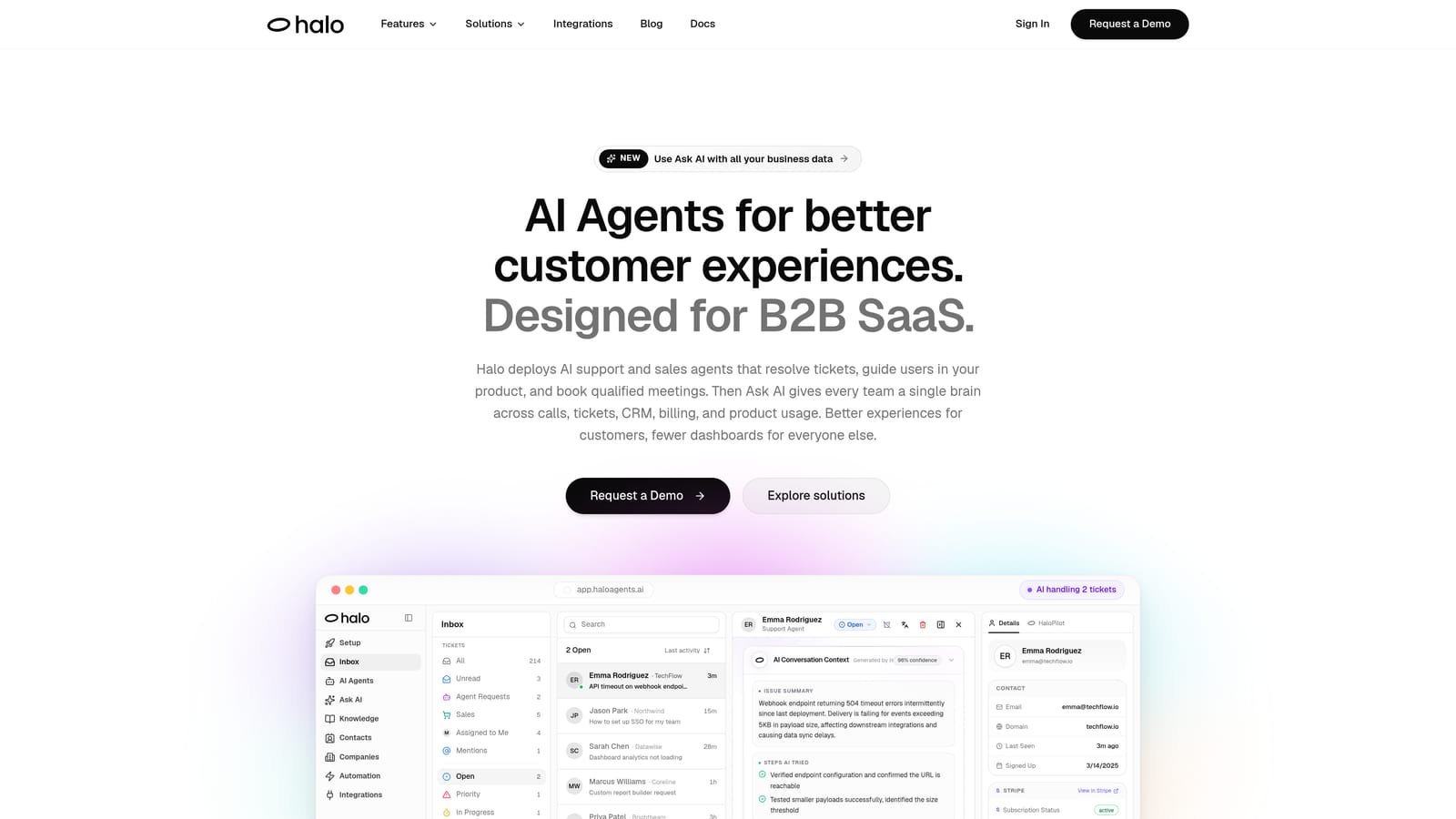
Halo AI is an AI-native customer support platform that deploys intelligent agents to resolve tickets, guide users through your product with page-aware context, auto-create bug reports, and surface business intelligence signals — all while learning continuously from every interaction.
Where This Tool Shines
What separates Halo from most platforms on this list is the page-aware context engine. The AI agent can actually see what the user is looking at in your product and provide contextual UI guidance, not just generic help center answers. That's a meaningful difference when your users are stuck mid-workflow.
The business intelligence layer is the other standout. Beyond ticket deflection, Halo surfaces customer health signals, revenue anomaly detection, and churn indicators from support interactions. Your support inbox becomes a source of strategic insight, not just a queue to clear.
Key Features
Page-Aware AI Agents: Agents see what the user is looking at in real time and deliver contextual guidance specific to that screen or workflow.
Smart Inbox with Business Intelligence: Customer health signals, revenue anomaly detection, and churn indicators surface automatically from conversation data.
Auto Bug Ticket Creation: Automatically generates and routes bug reports directly to Linear or connected dev tools without manual handoff.
Live Agent Handoff: Escalates to human agents with full conversation context preserved, so customers never have to repeat themselves.
Deep Integration Stack: Connects to Slack, HubSpot, Intercom, Stripe, Zoom, PandaDoc, Fathom, and Linear — covering the full B2B tech stack.
Continuous Learning: Improves from every resolved interaction without requiring manual retraining cycles.
Best For
B2B SaaS and product teams that want more than ticket deflection. If you need AI that understands product context, integrates across your revenue and engineering stack, and provides intelligence beyond support metrics, Halo is built for that use case. Less suited to simple FAQ bots or e-commerce-first workflows.
Pricing
Pricing is not publicly listed. Contact Halo AI for a demo and custom quote. As an AI-native platform replacement rather than a helpdesk add-on, pricing typically reflects mid-to-enterprise positioning. Verify at haloagents.ai.
2. Intercom (Fin AI)
Best for: Teams already using Intercom who want to add autonomous AI resolution on top of existing infrastructure
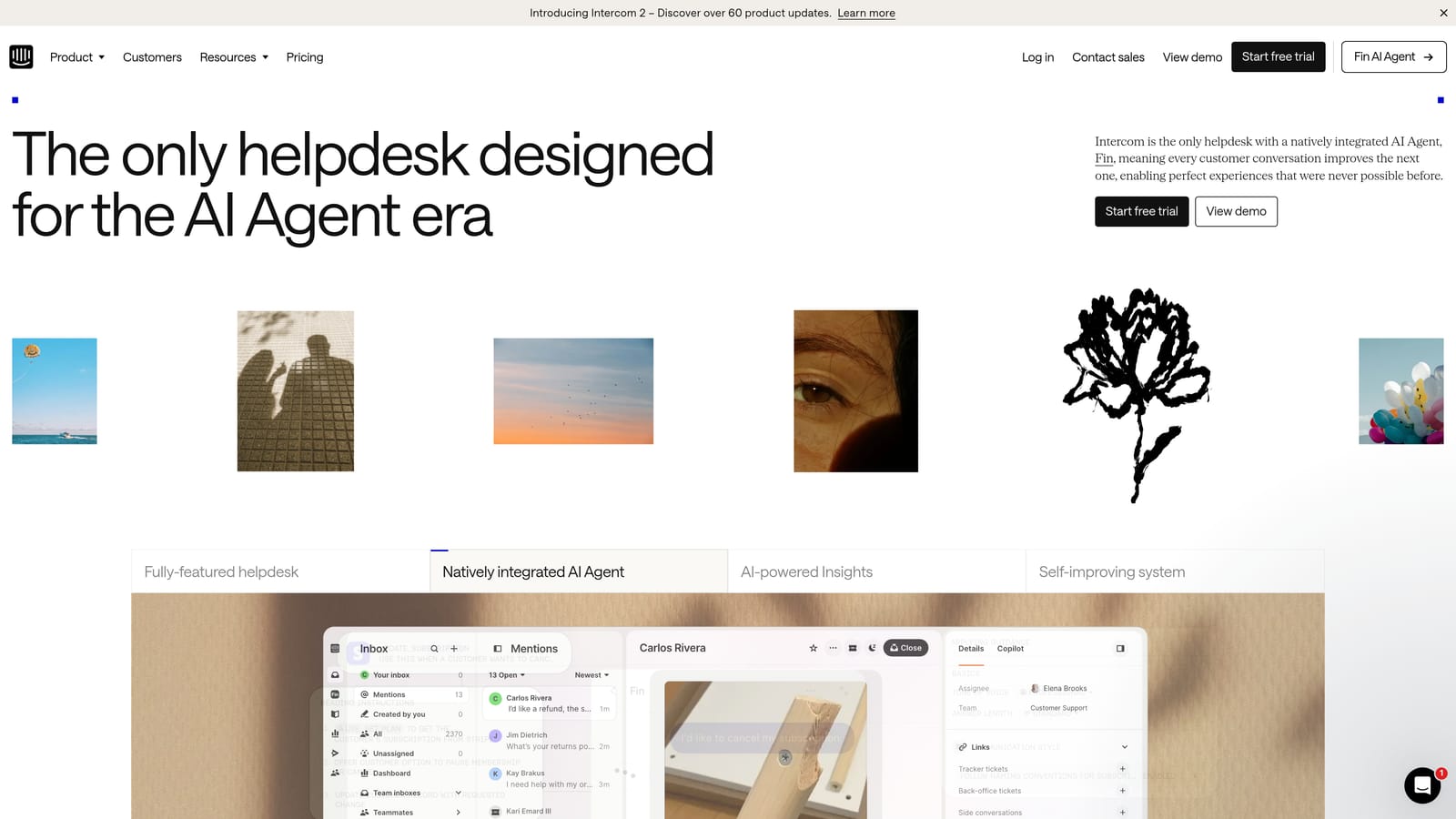
Intercom's Fin AI is a GPT-powered resolution agent that sits on top of Intercom's established messaging and helpdesk infrastructure, handling tier-1 questions before routing to human agents.
Where This Tool Shines
Fin's per-resolution pricing model is genuinely interesting. You pay only when Fin successfully closes a ticket, which aligns cost directly with value delivered. For teams with predictable resolution volumes, this can be more economical than per-seat models that charge regardless of AI utilization.
The native integration with Intercom's full ecosystem — Inbox, Articles, and Messenger — means setup is relatively fast for existing Intercom users. Fin draws on your existing help center content without requiring a separate knowledge base migration.
Key Features
Autonomous Resolution: Fin resolves conversations using your existing help center content without human involvement for qualifying questions.
Per-Resolution Pricing: You pay only when Fin successfully closes a ticket, not for every conversation it touches.
Native Intercom Integration: Works directly within Intercom Inbox, Articles, and Messenger with no separate setup required.
Customizable Tone and Fallback: Configure how Fin communicates and what happens when it can't resolve a query.
Multi-Language Support: Handles customer conversations across multiple languages out of the box.
Best For
Teams already invested in Intercom's platform who want to layer autonomous resolution without switching tools. Less compelling if you're not already an Intercom customer, since the base platform cost is a prerequisite.
Pricing
Intercom base plans start around $39/seat/month (Essential tier). Fin AI charges an additional per-resolution fee, publicly documented at approximately $0.99 per resolution. Costs scale with resolution volume. Verify current pricing at intercom.com/pricing.
3. Zendesk AI
Best for: Large enterprises running complex multi-channel support operations on Zendesk Suite
Zendesk AI adds intelligent triage, intent detection, agent copilot assistance, and automated workflows on top of the Zendesk Suite — one of the most widely deployed enterprise helpdesk platforms in the market.

Where This Tool Shines
Zendesk AI's strength is breadth. It covers email, chat, voice, and social channels with consistent AI-assisted triage and routing. For large support orgs already running Zendesk, adding AI capabilities without migrating platforms is a significant operational advantage.
The Agent Copilot feature is particularly useful for teams where human agents handle complex tickets. It suggests responses and next steps in real time, reducing handle time without fully automating the interaction.
Key Features
Intelligent Triage: Automatically classifies incoming tickets by intent, sentiment, and language at scale.
Agent Copilot: Surfaces suggested responses and next steps for human agents directly within the inbox.
AI-Powered Self-Service Bots: Deploys automated bots via Zendesk Messaging for tier-1 deflection.
Automated Workflows: Triggers routing and workflow actions based on AI-detected intent.
Omnichannel Coverage: Consistent AI capabilities across email, chat, voice, and social touchpoints.
Best For
Enterprise support organizations with high ticket volumes across multiple channels that are already committed to the Zendesk ecosystem. Smaller teams may find the per-agent cost structure expensive relative to the AI value delivered.
Pricing
Zendesk Suite plans start around $55/agent/month (Suite Team). AI add-ons including Intelligent Triage and Agent Copilot are priced additionally per agent. Full AI capabilities at enterprise scale require custom quotes. Verify current pricing at zendesk.com/pricing.
4. Freshdesk (Freddy AI)
Best for: Mid-market teams that want a full helpdesk plus AI at accessible per-agent pricing
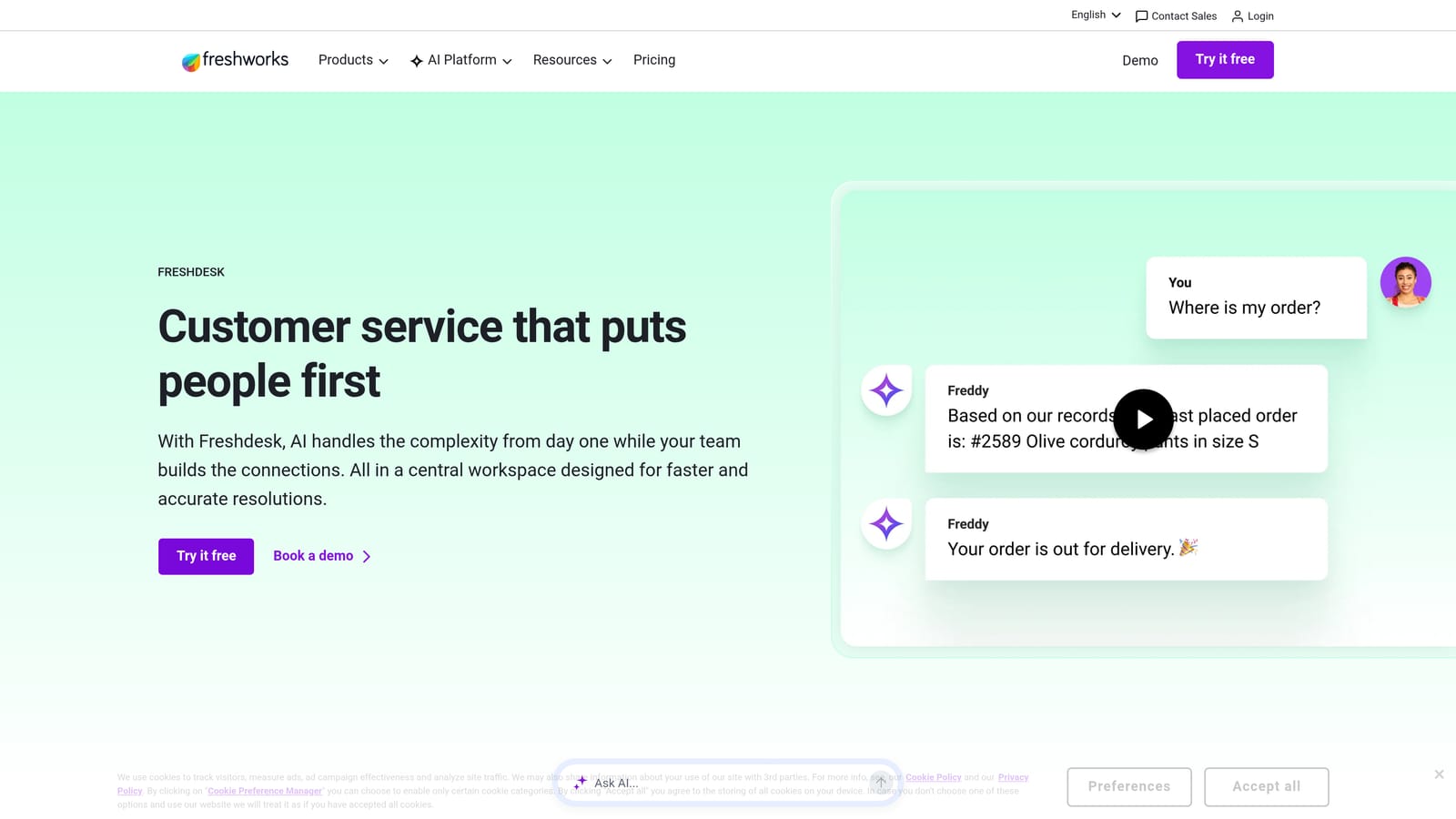
Freshdesk's Freddy AI is a modular AI layer for the Freshdesk helpdesk, offering self-service bots, agent assist, and analytics with one of the more accessible price points for growing teams.
Where This Tool Shines
Freddy's modular structure is its practical advantage. You can start with the base Freshdesk helpdesk and add only the Freddy components you actually need, rather than paying for a full AI suite upfront. That flexibility makes it a reasonable entry point for teams that want to grow into AI gradually.
Freddy Insights, the analytics component, adds genuine value beyond basic reporting. It surfaces anomalies and trends in support data, giving team leads visibility into what's driving volume before it becomes a crisis.
Key Features
Freddy Self Service: AI bot that deflects tickets using your existing knowledge base content.
Freddy Copilot: In-inbox AI assistance with suggested replies and conversation summarization for human agents.
Freddy Insights: AI-powered analytics with anomaly detection and trend identification across support data.
Modular Pricing: Buy only the Freddy components relevant to your current needs.
Omnichannel Helpdesk Integration: Works within Freshdesk's full email, chat, phone, and social support infrastructure.
Best For
Mid-market SaaS and tech companies that need a full-featured helpdesk with AI capabilities but aren't ready for enterprise-tier pricing. A strong choice if you're currently on a basic helpdesk and want to upgrade without a full platform migration.
Pricing
Freshdesk base plans start around $15/agent/month (Growth). Freddy AI Copilot is an add-on at approximately $29/agent/month. Freddy Self Service bot sessions are priced separately. Verify current pricing at freshdesk.com/pricing.
5. Tidio
Best for: Small businesses and e-commerce teams that need transparent, affordable AI chat
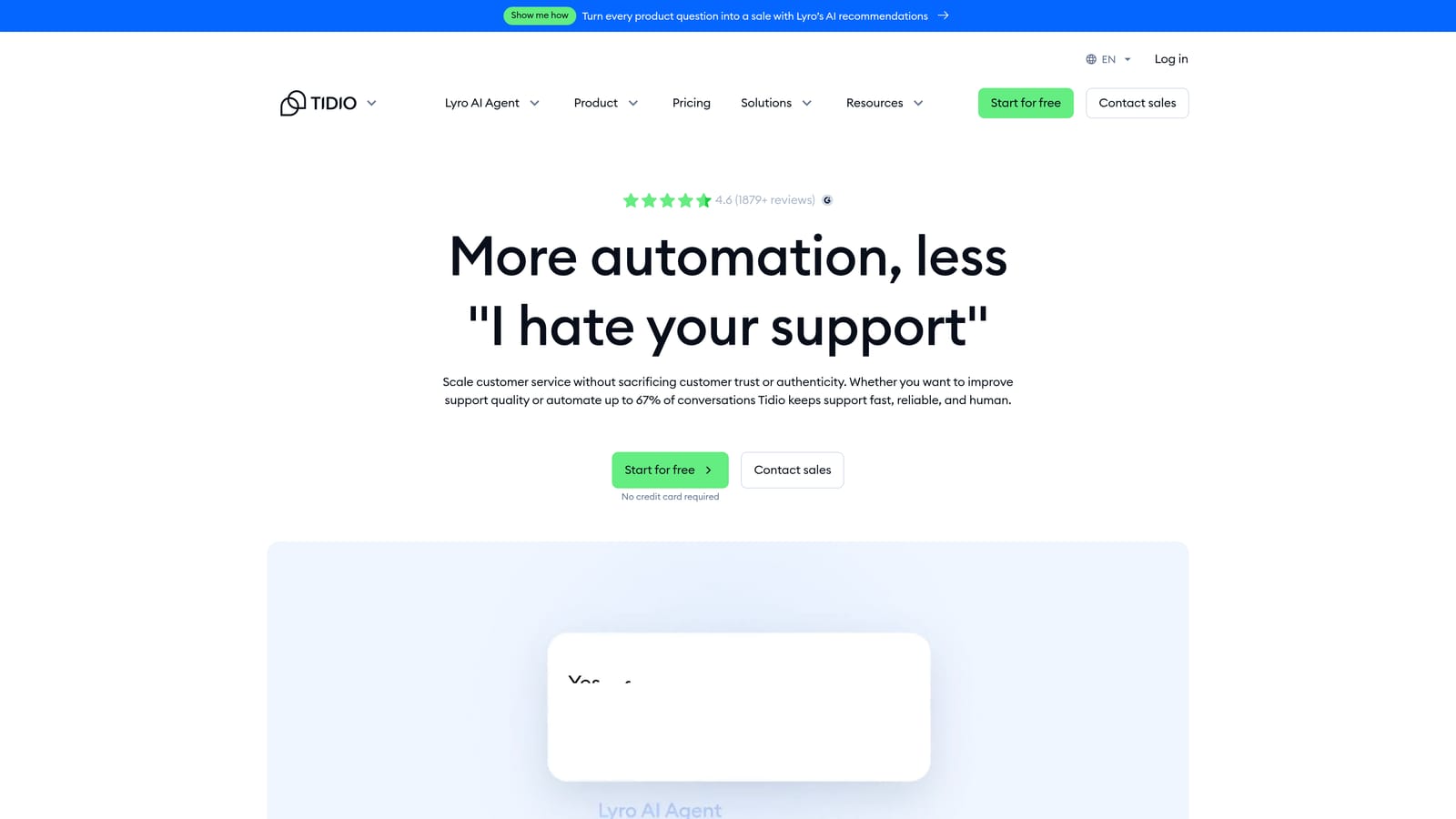
Tidio is a live chat and AI chatbot platform with one of the most transparent pricing structures in the market, making it a popular entry point for small businesses and e-commerce brands.
Where This Tool Shines
Tidio's pricing page is genuinely refreshing in a category full of "contact us for pricing" walls. You can see exactly what you're getting at each tier without a sales call, which makes budget planning straightforward for smaller teams.
Lyro AI, Tidio's conversational AI agent, is trained on your support content and handles common questions autonomously. For e-commerce brands with repetitive order, shipping, and return inquiries, the deflection rate can be meaningful even at entry-level volumes.
Key Features
Lyro AI: Conversational AI agent trained on your support content for autonomous resolution of common questions.
Live Chat with Human Fallback: Seamless handoff to human agents when Lyro can't resolve a query.
Visual Chatbot Builder: Drag-and-drop builder for rule-based conversation flows without coding.
E-Commerce Integrations: Native integrations with Shopify, WordPress, and major e-commerce platforms.
Free Tier: Available for low-volume teams getting started with chat support.
Best For
Small businesses, e-commerce brands, and early-stage startups that want AI-assisted chat without enterprise pricing or complexity. Not the right fit for B2B SaaS teams needing deep CRM integration or business intelligence capabilities.
Pricing
Free plan available. Paid plans start around $29/month. Lyro AI starts around $39/month for limited conversations with usage-based scaling. One of the most cost-transparent options in the category. Verify current pricing at tidio.com/pricing.
6. Drift (Salesloft)
Best for: Revenue teams that want to blend support automation with sales qualification and pipeline acceleration
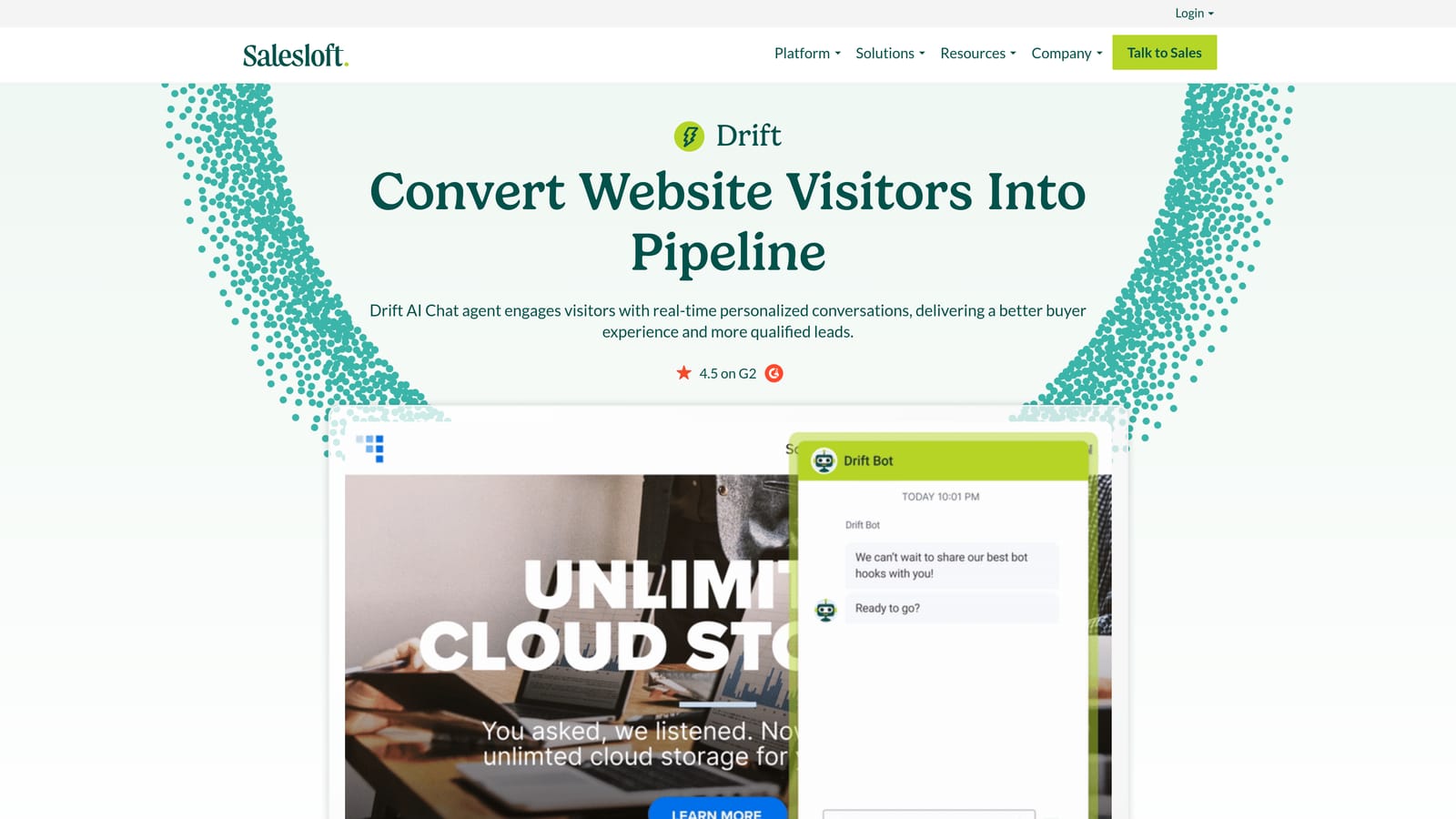
Drift, now part of the Salesloft revenue platform, is a conversational AI tool oriented around buyer engagement — blending support automation with sales qualification and pipeline acceleration in a single interface.
Where This Tool Shines
Drift's differentiation is its revenue orientation. Where most platforms on this list are primarily support tools, Drift is built to serve both support deflection and sales qualification simultaneously. A single conversation can resolve a product question and book a demo with an account executive.
The intent-based personalization for website visitors is a genuine capability that pure-play support tools don't offer. Drift can identify company and buyer intent signals and route conversations accordingly, which matters for B2B teams with complex sales motions.
Key Features
AI-Powered Buyer Qualification: Chatbots handle support deflection and sales qualification in the same conversation flow.
Meeting Scheduling Integration: Books meetings with sales reps directly within chat conversations.
Intent-Based Personalization: Identifies website visitor intent and personalizes the conversation experience accordingly.
CRM Integrations: Deep integrations with Salesforce and HubSpot for revenue team workflows.
Revenue Intelligence Reporting: Conversation analytics oriented around pipeline impact, not just support metrics.
Best For
B2B companies where the line between support and sales is intentionally blurred. If your support team and revenue team share tooling and goals, Drift's combined approach makes sense. Not the right fit for support-only teams on lean budgets.
Pricing
Custom enterprise pricing only. No public tiers available. Positioned at the higher end of the market. Contact Salesloft or Drift directly for a quote, and budget accordingly for revenue-team-level investment.
7. Kustomer
Best for: High-volume consumer support operations that need CRM depth alongside AI routing
Kustomer is a CRM-native customer service platform that unifies every customer interaction into a single timeline, with AI layered across routing, response suggestions, and self-service — built for high-volume consumer support operations.
Where This Tool Shines
Kustomer's unified customer timeline is its core differentiator. Every interaction, order, event, and conversation appears in a single chronological view, giving agents full context without switching between systems. For brands handling high volumes of repeat customers, that context depth reduces handle time significantly.
The CRM data model is more flexible than traditional helpdesks, allowing teams to customize the data structure to match their specific customer journey rather than forcing workflows into a generic ticket schema.
Key Features
Unified Customer Timeline: Every interaction, order, and event consolidated into a single chronological view per customer.
AI-Powered Routing: Prioritizes and routes tickets based on full customer history and context, not just the current message.
KIQ Customer Assist: AI self-service bot for tier-1 deflection before reaching human agents.
Omnichannel Coverage: Email, chat, SMS, social, and voice in a single unified inbox.
Flexible CRM Data Model: Customizable data structure that adapts to your customer journey, not the other way around.
Best For
Consumer brands and D2C companies with high ticket volumes and complex customer histories. The CRM depth justifies the cost for teams where customer context is a competitive advantage. Less compelling for B2B SaaS teams with simpler customer data needs.
Pricing
Enterprise pricing with custom quotes. Historically positioned in the $89–$139/user/month range for enterprise tiers, though pricing structures can change. Verify current pricing directly with Kustomer before budgeting.
8. Forethought
Best for: Large support orgs that want AI intelligence layered on top of existing helpdesk investments
Forethought is an enterprise AI platform focused on intelligent ticket triage, routing, and deflection — designed to layer on top of existing helpdesks like Zendesk and Salesforce rather than replace them.
Where This Tool Shines
Forethought's positioning as a helpdesk-agnostic AI layer is its practical advantage for large organizations. If you've spent years configuring Zendesk or Salesforce Service Cloud and have no appetite to migrate, Forethought adds meaningful AI intelligence without disrupting existing workflows.
The Discover AI component is particularly useful for mature support teams. It identifies knowledge gaps and automation opportunities by analyzing where existing AI fails to resolve tickets, giving you a roadmap for improving deflection rates over time.
Key Features
Triage AI: Automatically classifies, tags, and routes incoming tickets before a human ever touches them.
Solve AI: Self-service resolution using your existing knowledge content, deployed as a customer-facing bot.
Assist AI: In-inbox suggestions and context for human agents during live ticket handling.
Discover AI: Identifies knowledge gaps and new automation opportunities from unresolved ticket patterns.
Helpdesk-Agnostic Integration: Works alongside Zendesk, Salesforce Service Cloud, and ServiceNow without requiring migration.
Best For
Enterprise support organizations with significant existing helpdesk investments that want AI capabilities without a platform migration. Not a fit for smaller teams or anyone looking for transparent, self-serve pricing.
Pricing
Enterprise pricing with custom quotes only. No public tiers available. Budget planning requires a direct conversation with the Forethought sales team. Best evaluated alongside your existing helpdesk vendor's AI offerings for total cost comparison.
9. Chatbase
Best for: Teams that need a document-trained AI chatbot fast, with minimal setup and maximum pricing transparency
Chatbase is a lightweight AI chatbot builder that lets you train a GPT-powered bot on your documents and knowledge base, with some of the most transparent and affordable pricing in the entire category.
Where This Tool Shines
Chatbase's simplicity is its strength. You can upload PDFs, paste URLs, add help docs, and have a functioning AI chatbot embedded on your website in under an hour. There's no complex configuration, no sales process, and no ambiguity about what you're paying.
For teams that just need basic question deflection from existing documentation — and don't need CRM integrations, business intelligence, or omnichannel routing — Chatbase delivers the core value at a fraction of the cost of more complex platforms.
Key Features
Document-Based Training: Train your chatbot on PDFs, URLs, help docs, and custom text without technical setup.
Embeddable Chat Widget: Deploy on any website with a simple embed code, no engineering required.
Lead Capture and History: Captures contact information from conversations and stores conversation history for review.
API Access: Available for teams that want to build custom integrations beyond the standard widget.
Multiple AI Model Options: Choose between different underlying AI models based on your accuracy and cost preferences.
Best For
Early-stage startups, small teams, and anyone who needs a functioning AI chatbot quickly without enterprise budget or technical resources. Also useful as a low-risk entry point to test AI deflection before committing to a full platform investment.
Pricing
Free tier available. Paid plans start around $19/month (Hobby). Business plans around $99/month. One of the most cost-transparent options in the market. Verify current pricing at chatbase.co/pricing.
Choosing the Right Platform for Your Budget and Use Case
Here's the honest reality: the right platform depends less on which tool has the best features list and more on where you are today and where you need to go.
If you're a small business or e-commerce brand on a tight budget, Tidio and Chatbase offer the most transparent entry points with free tiers and sub-$100/month paid plans. You can start immediately without a sales conversation.
If you're a mid-market team that wants a full helpdesk plus AI without enterprise pricing, Freshdesk with Freddy AI is the most balanced option. The modular pricing lets you grow into AI capabilities at your own pace.
If you're already committed to Intercom or Zendesk, adding their native AI layers is the path of least resistance. Just model out the per-resolution or per-agent AI costs against your current ticket volumes before assuming it's cost-effective at scale.
For enterprise teams that can't migrate away from existing helpdesks, Forethought adds AI intelligence without disruption. For high-volume consumer support with CRM depth requirements, Kustomer earns its price point. For revenue teams that blur the line between support and sales, Drift is purpose-built for that motion.
And if you're a B2B SaaS team that wants an AI-native platform with page-aware context, business intelligence signals, and deep integration across your entire tech stack, Halo AI is built specifically for that use case. Your support team shouldn't scale linearly with your customer base. Let AI agents handle routine tickets, guide users through your product, and surface business intelligence while your team focuses on complex issues that need a human touch. See Halo in action and discover how continuous learning transforms every interaction into smarter, faster support.