9 Best Customer Service AI Platforms in 2026 (Honest Reviews)
This article delivers honest, in-depth Customer Service AI Platform Reviews of nine leading tools, evaluating each on AI capability, integration breadth, deployment ease, and scalability. Whether you're a B2B SaaS team looking to scale support without adding headcount or a support leader exploring AI-first alternatives, this guide surfaces each platform's real strengths, limitations, and ideal use cases.
 Grant CooperFounder14 min read
Finding the right customer service AI platform is harder than it looks. The market is crowded with tools that promise autonomous resolution, intelligent routing, and seamless escalation — but most bolt AI onto legacy helpdesk infrastructure as an afterthought. The result is clunky handoffs, shallow automation, and support teams that still spend hours triaging tickets manually.
This review covers nine platforms built to genuinely transform customer support operations, not just add a chatbot to your existing stack. We evaluated each tool on AI capability depth, integration breadth, ease of deployment, scalability, and how well it handles the messy edge cases that define real support work.
Whether you're a B2B SaaS company looking to scale support without scaling headcount, a product team frustrated with Zendesk's limitations, or a support leader evaluating AI-first alternatives, this list is built for you. Each entry includes honest assessments of strengths, limitations, and who each platform actually serves best.
1. Halo AI
Best for: B2B SaaS product teams scaling support without scaling headcount
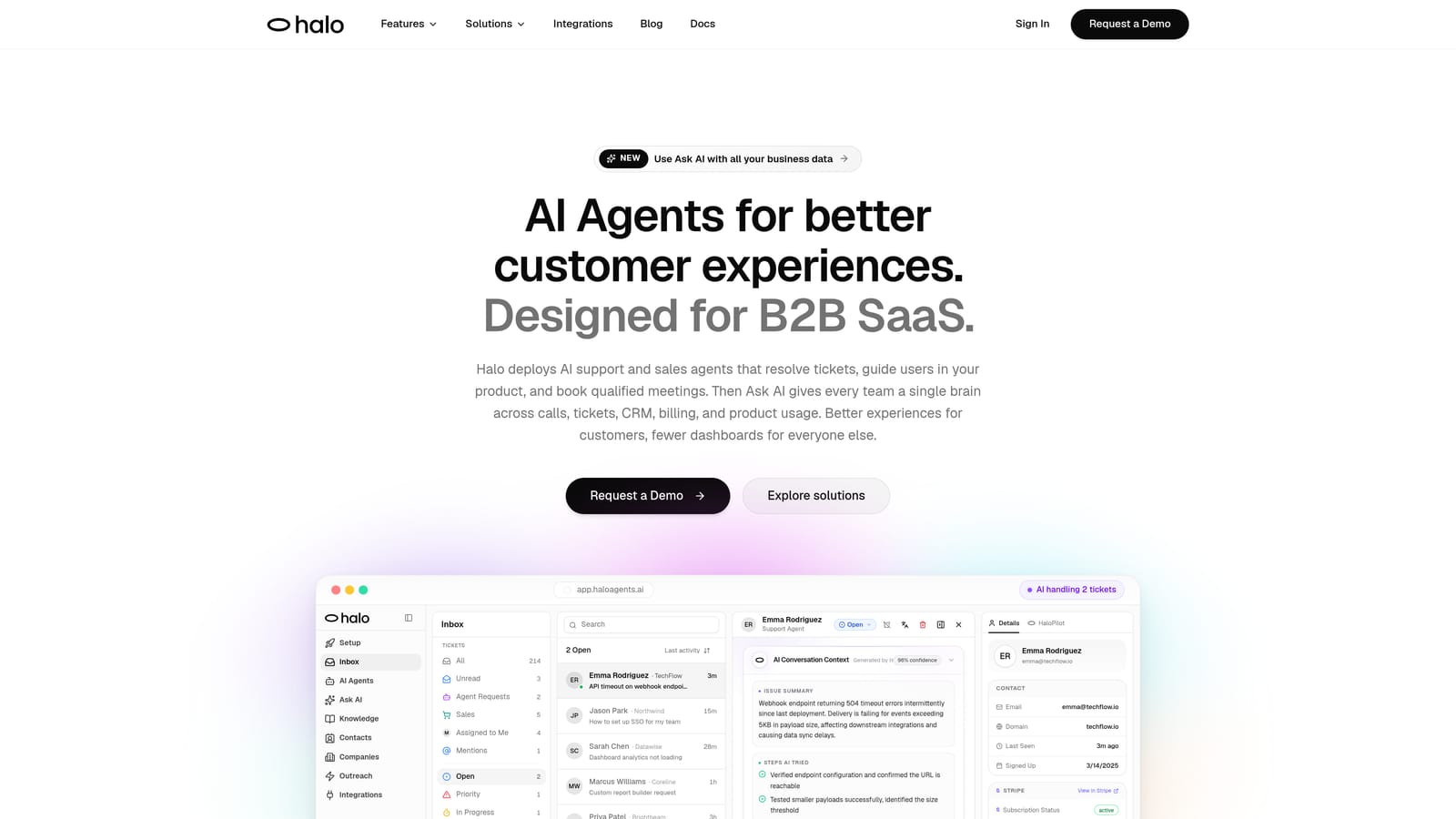
Halo AI is an AI-first customer support platform that deploys intelligent agents to resolve tickets, guide users through your product with page-aware context, and surface business intelligence from every support interaction.
Where This Tool Shines
Most platforms in this space treat AI as a feature. Halo treats it as the foundation. The architecture is built from the ground up around autonomous resolution, which means the AI isn't fighting against legacy helpdesk logic to do its job. That distinction matters when you're handling hundreds of tickets per day and need real resolution, not just deflection.
The standout capability is page-aware context. Halo's chat widget knows what page a user is currently on inside your product, which means its AI agents can provide guidance that's actually relevant to where that user is stuck right now. That's a meaningful step beyond generic FAQ matching, and it's the kind of context awareness that reduces escalations before they happen.
Key Features
Page-Aware AI Agents: The AI understands the user's current product context and delivers visual UI guidance specific to their location in the app.
Smart Inbox with Business Intelligence: Surfaces customer health signals, revenue anomalies, and product feedback patterns directly from support data, turning your inbox into a source of strategic insight.
Auto Bug Ticket Creation: Automatically generates bug reports in Linear when support conversations reveal product issues, closing the loop between support and engineering without manual handoffs.
Live Agent Handoff: Escalates to human agents with full conversation context preserved, so customers never have to repeat themselves.
Continuous Learning: The platform learns from every resolved interaction, improving resolution accuracy over time without requiring manual retraining.
Broad Integration Stack: Connects natively with Linear, Slack, HubSpot, Intercom, Stripe, Zoom, PandaDoc, and Fathom, covering the full range of tools modern SaaS teams actually use.
Best For
Halo is purpose-built for B2B SaaS teams that want AI-native support, not an AI upgrade to a legacy system. It's particularly well-suited for product-led growth companies where the support experience is deeply tied to product adoption, and for teams that want support data to feed back into product and revenue decisions.
Pricing
Contact for pricing; Halo operates on a demo-first model. You can request a demo directly at haloagents.ai to see the platform in action before any sales conversation.
2. Intercom
Best for: SaaS teams wanting a mature AI agent with strong conversation design tools
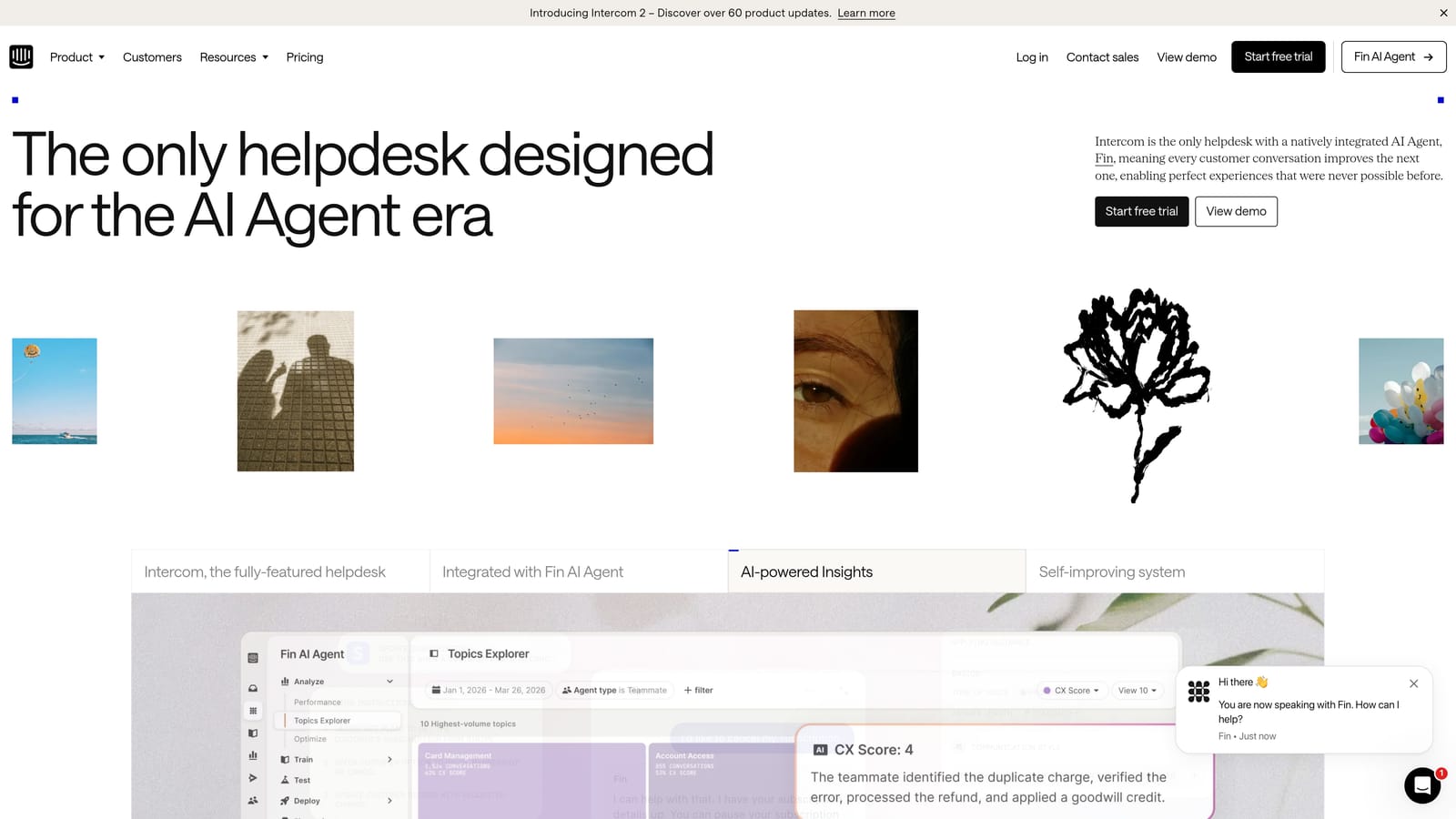
Intercom is a customer messaging platform with Fin, one of the most widely deployed AI support agents in SaaS, capable of handling complex multi-turn conversations across chat, email, and in-app channels.
Where This Tool Shines
Fin is genuinely impressive at handling nuanced, multi-step customer questions. Built on large language models, it goes beyond keyword matching to understand intent and context across a full conversation thread. For teams with well-documented knowledge bases, Fin can achieve meaningful autonomous resolution rates without heavy customization.
Intercom's conversation design tools and visual workflow builder also stand out. Support teams can build sophisticated routing logic, set escalation triggers, and design the customer journey without needing engineering support. The Messenger-first architecture means the in-app chat experience is polished and consistent across devices.
Key Features
Fin AI Agent: LLM-powered autonomous resolution for complex, multi-turn customer conversations across all channels.
Visual Workflow Builder: No-code conversation design for building routing logic, escalation paths, and automated sequences.
Omnichannel Inbox: Unified handling of chat, email, and in-app messages from a single interface.
AI Resolution Reporting: Tracks resolution rates and conversation quality metrics to measure AI performance over time.
Broad Integration Ecosystem: Connects with major CRM, helpdesk, and analytics tools across the SaaS stack.
Best For
Intercom works well for scaling SaaS companies that want a proven AI agent and strong in-app messaging experience. It's less suited for teams that need deep product-state context awareness or tight integration with engineering and PM tooling. At high resolution volumes, pricing can escalate significantly, so cost modeling matters before committing.
Pricing
Tiered pricing model; AI resolution volume affects cost at scale. Check intercom.com for current plans.
3. Zendesk AI
Best for: Large enterprises with existing Zendesk investment seeking incremental AI improvement
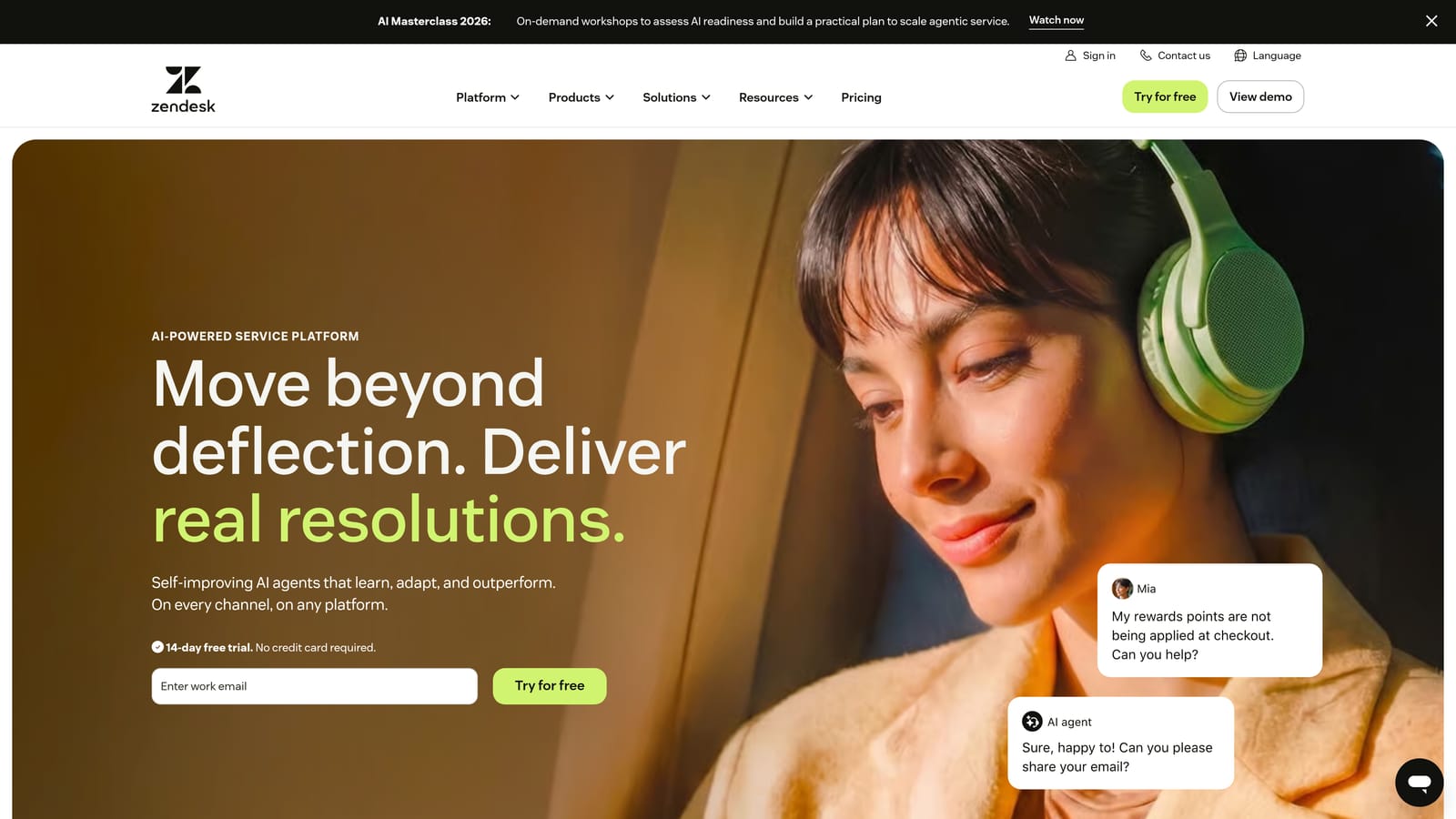
Zendesk is the enterprise helpdesk standard, now with AI features layered across ticket triage, agent assistance, intelligent routing, and self-service, backed by one of the most mature integration ecosystems in the industry.
Where This Tool Shines
If your organization already runs on Zendesk, the AI additions are a logical next step. The triage and routing capabilities are solid, and Agent Copilot's suggested replies and next-best-action guidance can meaningfully reduce handle time for experienced support teams. The integration marketplace is unmatched in breadth, and Zendesk's enterprise compliance and security certifications make it a safe choice for regulated industries.
The honest caveat is that the AI feels additive rather than foundational. It's built on top of a ticketing system designed before the current generation of AI, which creates friction in advanced automation scenarios. Teams that need truly autonomous resolution often find themselves doing significant configuration work to get there.
Key Features
AI-Powered Triage: Automatically classifies and routes incoming tickets based on intent and content.
Agent Copilot: Provides suggested replies and next-best-action recommendations to agents during live conversations.
Extensive Integration Marketplace: Hundreds of pre-built integrations across CRM, billing, analytics, and engineering tools.
Enterprise Compliance: Strong security certifications and data governance features for regulated industries.
Advanced Analytics Suite: Detailed reporting on ticket volume, resolution time, CSAT, and team performance.
Best For
Zendesk AI is the right choice for large enterprises already invested in the Zendesk ecosystem who want AI improvements without a platform migration. It's less compelling for teams evaluating AI-native alternatives from scratch, where the foundational architecture difference becomes more apparent.
Pricing
Per-agent pricing model; AI features available on Suite Professional and above. Visit zendesk.com for current tier details.
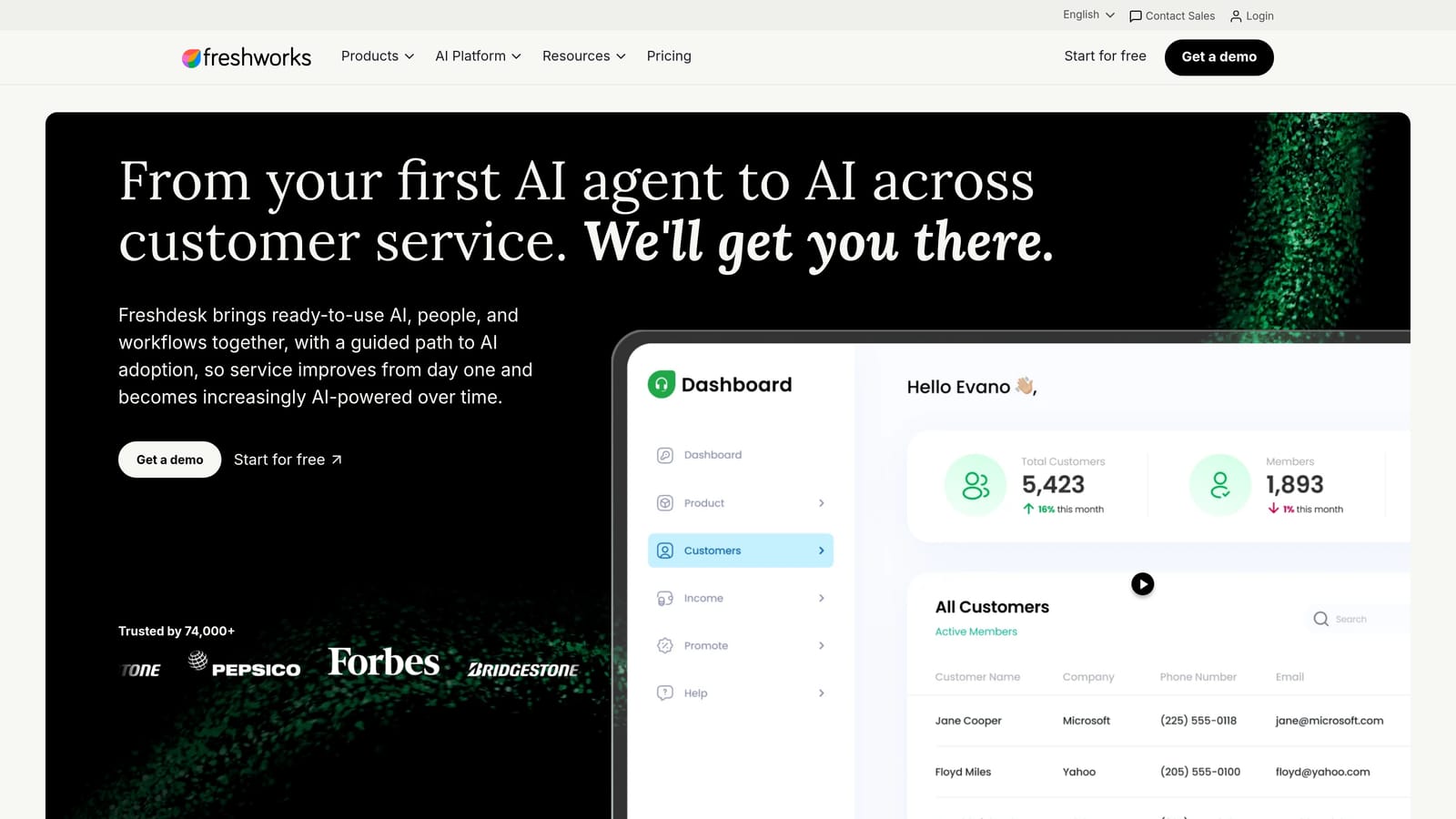
4. Freshdesk (Freddy AI)
Best for: SMBs and growing teams wanting an all-in-one suite at competitive pricing
Freshdesk is a full-featured helpdesk suite with Freddy AI spanning self-service, agent assist, and analytics, positioned as an affordable alternative to Zendesk for teams that don't need enterprise complexity.
Where This Tool Shines
Freshdesk's strongest argument is value. You get a complete omnichannel support suite, AI-powered self-service, real-time agent assistance, and analytics in a package that's meaningfully more affordable than Zendesk or Salesforce at comparable tiers. For teams that need to get operational quickly without a large implementation budget, that matters.
Freddy AI's three-layer approach is thoughtfully structured: Freddy Self Service handles autonomous customer-facing resolution, Freddy Copilot assists agents in real time, and Freddy Insights surfaces patterns in support data. It covers the full workflow without requiring separate tooling for each layer.
Key Features
Freddy Self Service: Autonomous resolution layer for common customer questions without agent involvement.
Freddy Copilot: Real-time agent assistance including reply drafting and suggested responses during live conversations.
Freddy Insights: AI-driven analytics that surface trends, anomalies, and performance patterns from support data.
Omnichannel Coverage: Unified inbox across email, chat, phone, and social channels.
Competitive Pricing: More accessible price points compared to enterprise alternatives at similar feature levels.
Best For
Freshdesk is a strong fit for SMBs and mid-market teams that want comprehensive support tooling without enterprise price tags. Teams that need deep AI autonomy or complex integrations with engineering and product tooling may find the AI depth limiting compared to purpose-built AI-native platforms.
Pricing
Freddy AI features available on Growth plans and above; additional AI add-ons available separately. See freshdesk.com for current tier details.
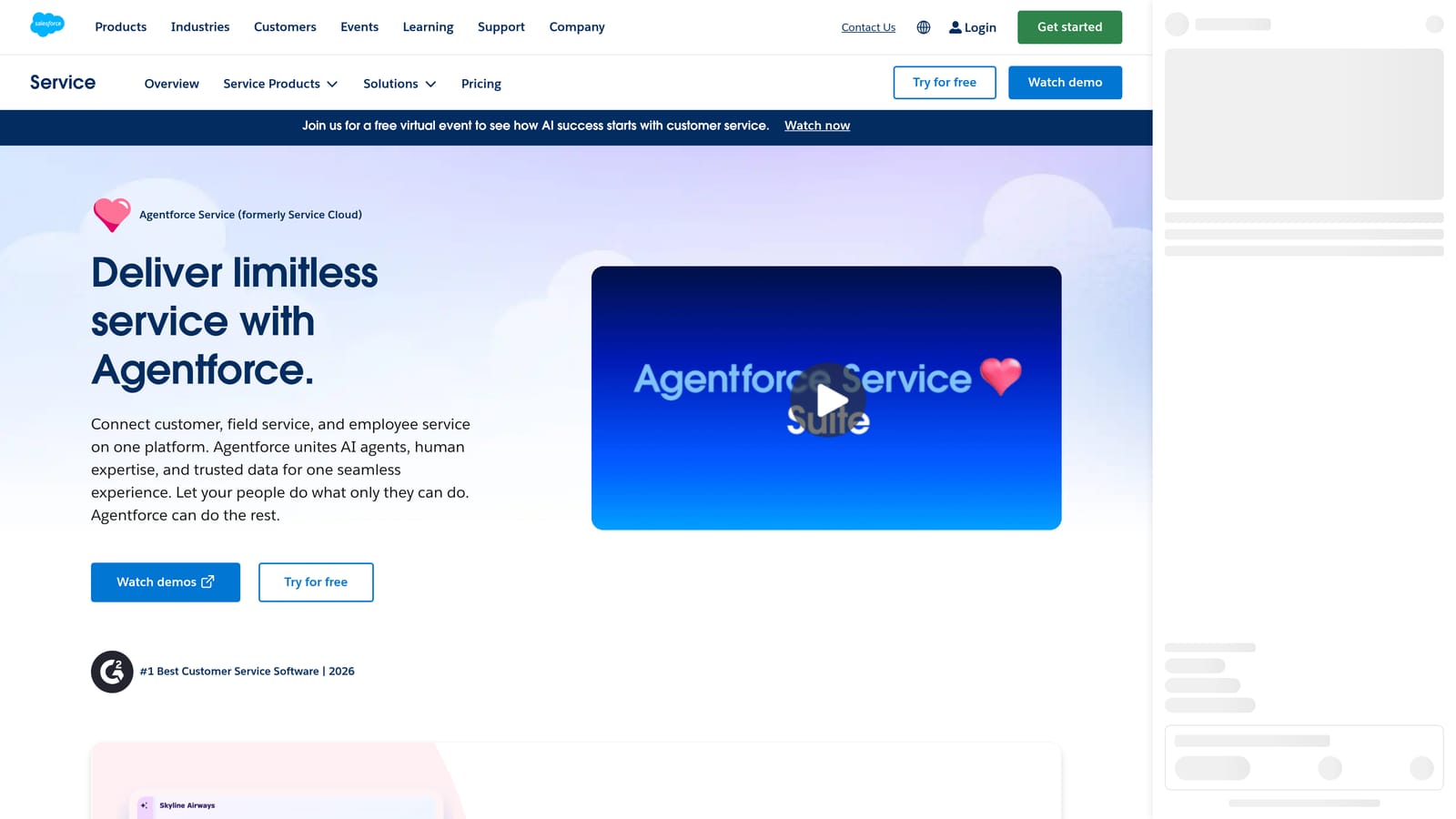
5. Salesforce Einstein for Service
Best for: Enterprises already running on Salesforce who want AI grounded in full CRM context
Salesforce Einstein for Service delivers AI-powered support capabilities built directly into Service Cloud, giving agents access to the full customer CRM record for highly personalized, context-rich support experiences.
Where This Tool Shines
The core differentiator here is CRM depth. When your AI has access to a customer's full purchase history, open opportunities, previous cases, and account health data, the quality of support interactions improves substantially. Einstein Copilot for Service grounds its generative AI assistance in that real customer data, which means recommendations and suggested responses are actually relevant to the individual customer's situation.
For enterprises already running Sales Cloud and Marketing Cloud alongside Service Cloud, the unified data model is genuinely powerful. Support agents see the full customer picture without switching tools, and AI recommendations reflect the complete relationship, not just the current ticket.
Key Features
Einstein Copilot for Service: Generative AI assistance grounded in live CRM data for contextually accurate agent guidance.
Case Classification and Routing: Intelligent case categorization and assignment based on customer history and case attributes.
Knowledge Article Suggestions: Surfaces relevant knowledge base content to agents and customers based on case context.
Next-Best-Action Recommendations: AI-driven guidance on optimal next steps for agents during complex cases.
Full Salesforce Ecosystem Integration: Native connection to Sales Cloud, Marketing Cloud, and the broader Salesforce platform.
Best For
Einstein for Service is compelling almost exclusively for organizations already invested in the Salesforce ecosystem. The implementation complexity and licensing costs make it a poor fit for teams not already on the platform. For Salesforce shops, however, it's the most natural path to AI-assisted support with genuine CRM context.
Pricing
Requires a Salesforce Service Cloud license; Einstein AI features available on higher tiers. Contact Salesforce directly for current pricing, as it varies significantly by configuration and contract size.
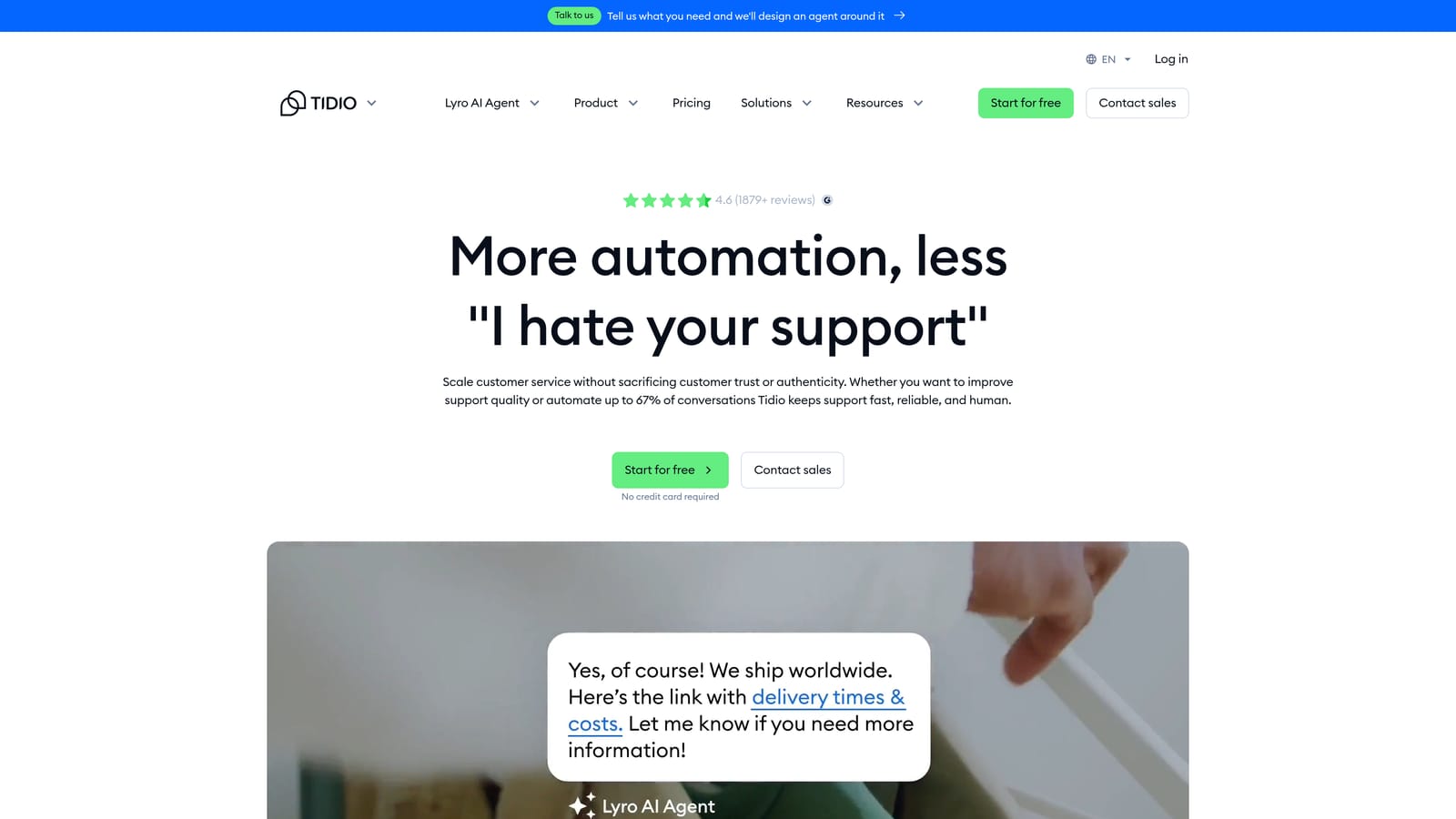
6. Tidio
Best for: Small ecommerce and SMB teams wanting fast deployment and accessible pricing
Tidio is a lightweight AI chat platform with Lyro, an AI agent designed for fast deployment and autonomous resolution of common questions, particularly popular with ecommerce and SMB teams.
Where This Tool Shines
Tidio's strongest selling point is speed to value. Teams can go from signup to live AI agent in hours, not weeks, without any engineering involvement. For small businesses that need something working immediately, that frictionless setup is genuinely valuable. Lyro handles common questions autonomously and improves as it processes more conversations.
The native Shopify and WooCommerce integrations make Tidio particularly well-suited for ecommerce teams. Lyro can answer order status questions, return policy inquiries, and product questions by pulling directly from store data, which covers a significant portion of typical ecommerce support volume.
Key Features
Lyro AI Agent: Autonomous conversation handling for common customer questions with no-code setup.
Ecommerce Integrations: Native Shopify and WooCommerce connections for order and product data access.
Multichannel Inbox: Unified handling of live chat, email, and Messenger conversations.
No-Code Configuration: Full setup without engineering support; operational within hours of signup.
Free Tier: Entry-level access available for small teams testing the platform before committing to paid plans.
Best For
Tidio is well-matched for B2C ecommerce businesses, small retail teams, and SMBs with straightforward support needs. It's not designed for complex B2B SaaS support environments where technical context, product-state awareness, or deep integrations with engineering tooling are required.
Pricing
Free tier available for small teams; Lyro AI included on paid plans. See tidio.com for current pricing tiers.
7. Kustomer
Best for: High-volume consumer support teams wanting a unified customer timeline
Kustomer is a CRM-native customer service platform that unifies every interaction into a single customer timeline, with AI features for intent detection, automated workflows, and agent assistance built around rich customer history.
Where This Tool Shines
Kustomer's defining feature is the unified customer timeline. Every email, chat, order, return, and previous support interaction is consolidated into a single view, which means agents walk into every conversation with full context. For high-volume consumer support environments where customers contact support repeatedly across different channels, this eliminates the "let me pull up your account" friction that frustrates customers and slows agents down.
The AI layer sits on top of that rich data, using intent detection to route conversations intelligently and triggering automated workflows based on customer attributes and behavioral signals. The result is a platform that combines CRM depth with operational automation in a way that's particularly suited to consumer-facing brands.
Key Features
Unified Customer Timeline: All interactions, orders, and history consolidated into a single customer view for agents.
AI Intent Detection: Automatically identifies conversation intent for intelligent routing and prioritization.
Automated Workflows: Triggered by customer attributes, behavior, and conversation signals for hands-off case handling.
Omnichannel Inbox: Email, chat, SMS, social, and voice channels managed from a unified interface.
Customer Attribute-Based Routing: Routes conversations based on customer tier, history, and other CRM signals.
Best For
Kustomer is a strong fit for consumer-facing brands and DTC companies handling high interaction volumes where customer history context is critical. It's less suited for technical B2B SaaS support environments where product-state awareness and engineering integrations matter more than consumer transaction history.
Pricing
Per-user pricing; enterprise-focused model. Contact Kustomer directly for current plans and volume pricing.
8. Forethought
Best for: Teams wanting AI capabilities layered on top of an existing helpdesk without migration
Forethought is an AI layer that sits on top of existing helpdesks like Zendesk and Salesforce, adding autonomous resolution, intelligent triage, and real-time agent assist without requiring teams to replace their current stack.
Where This Tool Shines
Forethought solves a specific and common problem: you've invested heavily in a helpdesk like Zendesk, you don't want to migrate, but you need meaningfully better AI than what your current platform offers natively. Forethought slots in as an AI layer that works with your existing infrastructure rather than replacing it.
The three-component architecture is well-designed for this use case. Solve AI handles autonomous resolution of common questions. Triage AI predicts ticket intent and routes automatically before an agent ever sees the ticket. Assist AI provides real-time recommendations to agents during live conversations. Each component can be deployed independently, which gives teams flexibility to start with the highest-impact layer.
Key Features
Solve AI: Autonomous handling of common support questions without agent involvement.
Triage AI: Intent prediction and automatic ticket routing before tickets reach the agent queue.
Assist AI: Real-time agent recommendations and suggested responses during live conversations.
Helpdesk-Native Integration: Works directly within Zendesk, Salesforce, and other major platforms without requiring a stack change.
Modular Deployment: Components can be deployed independently based on where AI impact is needed most.
Best For
Forethought is ideal for teams that want AI-native capabilities but aren't in a position to migrate away from their current helpdesk. It's worth noting that it requires an existing helpdesk to function; it's not a standalone platform and can't replace the underlying infrastructure.
Pricing
Contact for pricing; enterprise-focused deployment model. Reach out to Forethought directly for current plans and implementation details.
9. Help Scout
Best for: Small teams wanting a clean, human-first inbox with lightweight AI assistance
Help Scout is a clean, human-first shared inbox platform with AI assist features designed to help small teams respond faster and more consistently, without overwhelming them with configuration complexity.
Where This Tool Shines
Help Scout's value proposition is clarity. In a market full of platforms that require weeks of setup, complex workflow configuration, and dedicated administrators, Help Scout gets teams operational in a day. The UX is genuinely clean, and the AI features are designed to assist agents rather than replace them, which aligns well with teams where human judgment and relationship quality are central to the support experience.
AI Summarize is a practical time-saver for teams handling long, complex conversation threads. Instead of scrolling through 30 messages to understand context, agents get an instant summary. AI Assist helps draft and improve replies, which is particularly useful for smaller teams where writing quality and consistency matter but dedicated QA resources don't exist.
Key Features
AI Summarize: Instantly condenses long conversation threads so agents can get up to speed without reading the full history.
AI Assist: Drafts and improves agent replies for faster, more consistent responses.
Beacon Widget: In-app help center and live chat widget for proactive customer support.
Transparent Pricing: Straightforward per-user monthly pricing with no hidden complexity or surprise add-ons.
Minimal Setup: Teams can be fully operational within a day without engineering or admin support.
Best For
Help Scout is purpose-built for small teams, early-stage startups, and businesses where support volume is manageable and the human element of customer relationships is a priority. It's not designed for high-volume automated resolution, and teams that need autonomous AI handling of large ticket volumes will quickly outgrow its capabilities.
Pricing
Transparent per-user monthly pricing; accessible for small teams. See helpscout.com for current tiers.
Which Platform Is Right for Your Team?
The right customer service AI platform depends less on feature checklists and more on two fundamental questions: what kind of AI architecture do you actually need, and where does your team sit today?
If you're building or scaling a B2B SaaS product and want AI-native support that learns continuously, understands product context, and surfaces business intelligence beyond ticket resolution, Halo AI is the strongest fit. It's the only platform on this list built from the ground up around autonomous resolution with page-aware context and deep integrations across the modern SaaS stack.
For teams already deep in the Salesforce ecosystem, Einstein for Service is the natural choice. For large enterprises with significant Zendesk investment, Zendesk AI offers incremental improvement without migration risk. Freshdesk and Tidio serve cost-conscious buyers well, particularly at SMB scale. Intercom remains a strong contender for teams that want a proven AI agent with excellent in-app messaging. Forethought is the right answer when you need AI capabilities but can't migrate your helpdesk. Kustomer and Help Scout serve their specific niches, consumer-facing brands and small teams respectively, with genuine quality.
Here's a quick reference by use case:
Scaling B2B SaaS without scaling headcount: Halo AI
Proven AI agent with strong in-app messaging: Intercom
Enterprise with existing Zendesk investment: Zendesk AI
SMB wanting affordable all-in-one suite: Freshdesk
Full Salesforce ecosystem users: Salesforce Einstein
Ecommerce and small business: Tidio
High-volume consumer support: Kustomer
AI layer on existing helpdesk: Forethought
Small team, human-first inbox: Help Scout
Your support team shouldn't scale linearly with your customer base. Let AI agents handle routine tickets, guide users through your product, and surface business intelligence while your team focuses on complex issues that need a human touch. See Halo in action and discover how continuous learning transforms every interaction into smarter, faster support.