9 Best Customer Service AI Platforms in 2026
This guide evaluates the 9 best customer service AI platforms for B2B SaaS teams and support managers seeking AI-native solutions that go beyond basic chatbot deflection. Each platform is assessed on autonomous resolution, integration depth, continuous learning, escalation quality, and advanced analytics—helping teams identify which tools can genuinely transform support operations rather than simply layer AI onto legacy helpdesk infrastructure.
 Matt PattoliFounder13 min read
Most support teams don't have a chatbot problem. They have an architecture problem. Bolting an AI layer onto a legacy helpdesk can handle simple FAQs, but it rarely learns, rarely resolves, and rarely gives you anything useful beyond a deflection rate. The platforms that actually move the needle are built AI-first, where autonomous resolution, continuous learning, and business intelligence are part of the foundation, not an afterthought.
This guide is for B2B SaaS teams, product leaders, and support managers evaluating whether to replace or augment their current helpdesk with something smarter. Each platform was assessed on five criteria: degree of AI autonomy, integration depth, learning capability over time, escalation and handoff quality, and analytics beyond basic CSAT. Whether you're exploring AI-native support agents for the first time or comparing enterprise options side by side, this breakdown will help you find the right fit.
1. Halo AI
Best for: B2B SaaS teams that want AI-native support without rebuilding around a legacy helpdesk
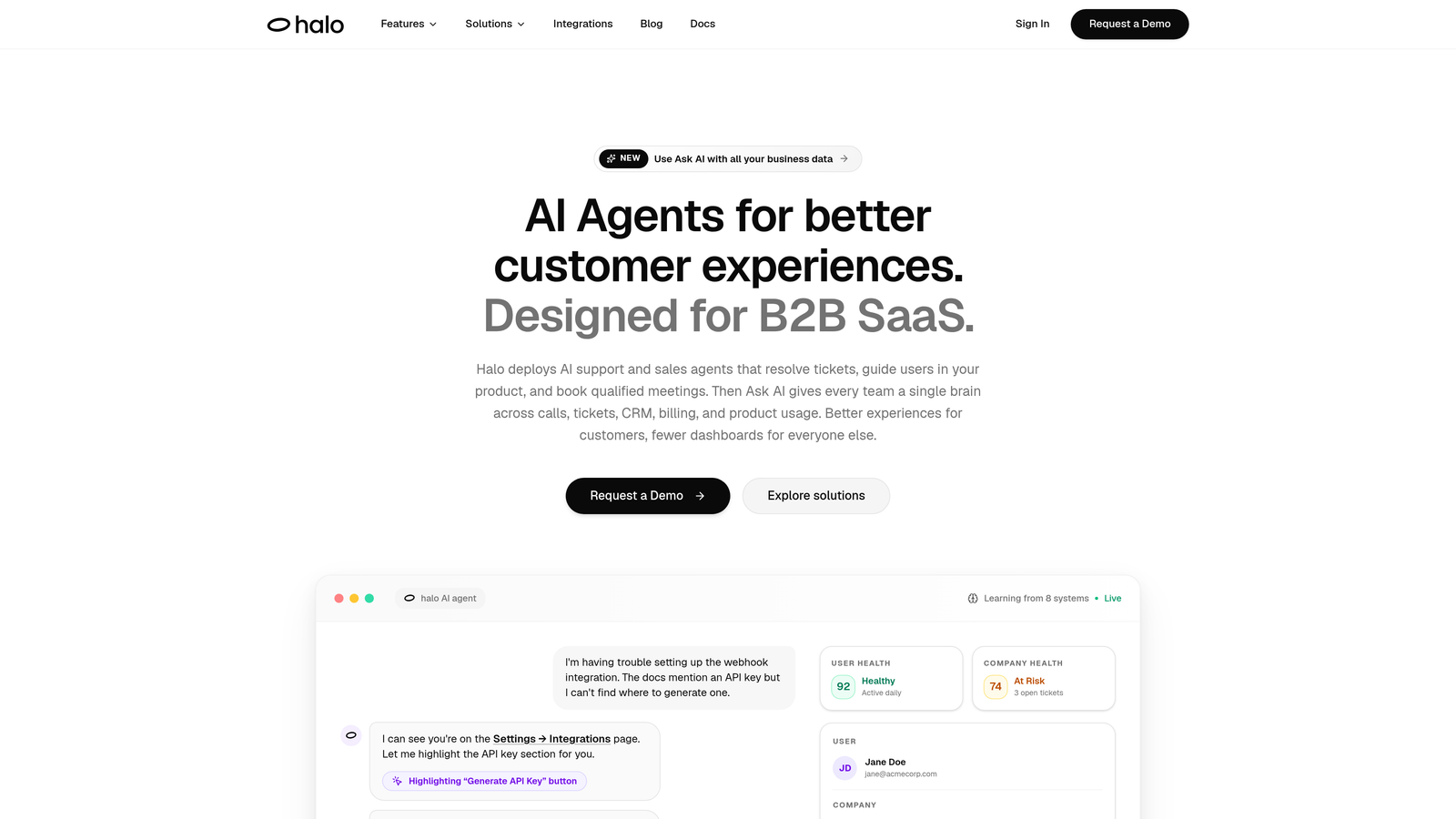
Halo AI is an AI-first customer support platform that deploys autonomous agents to resolve tickets, guide users through your product in real time, and surface business intelligence signals across your entire customer base.
Where This Tool Shines
What sets Halo apart from most platforms in this list is the architectural decision to build AI-first rather than layer AI on top of an existing ticketing system. Every resolved ticket feeds back into the model, which means the system genuinely gets smarter over time rather than staying static at the level it was trained.
The page-aware chat widget is a particularly strong differentiator. Instead of responding to text queries in isolation, Halo's widget understands which page or product state the user is currently in, allowing it to provide contextually precise guidance rather than generic documentation links. For SaaS products with complex workflows, this changes the quality of self-service dramatically.
Key Features
Page-Aware Chat Widget: Understands the user's current page and product state in real time, enabling contextually accurate guidance rather than generic responses.
Autonomous Ticket Resolution: Resolves support tickets end-to-end with continuous learning from every interaction, improving resolution quality over time.
Auto Bug Ticket Creation: Automatically identifies and routes bug reports to Linear and connected development tools, closing the loop between support and engineering.
Smart Inbox with Business Intelligence: Surfaces customer health signals, revenue anomalies, and churn indicators alongside standard support metrics, giving support leaders visibility beyond CSAT.
Live Agent Handoff: Escalates to human agents with full conversation context preserved, so agents never start from scratch.
Integration Stack: Connects natively with Slack, HubSpot, Intercom, Stripe, Zoom, PandaDoc, and Fathom.
Best For
Halo is purpose-built for B2B SaaS product teams and support leaders who want autonomous resolution, not just deflection. It's particularly well-suited for teams where support conversations overlap with product feedback, bug detection, and customer health monitoring.
Pricing
Contact for pricing. You can request a demo and explore capabilities directly at haloagents.ai.
2. Intercom Fin
Best for: Teams already on Intercom who want AI resolution without switching platforms
Intercom Fin is Intercom's LLM-powered resolution agent, trained on your knowledge base and operating natively within the Intercom messenger ecosystem.
Where This Tool Shines
Fin's biggest advantage is how seamlessly it fits into an existing Intercom setup. If your team already uses Intercom for live chat and inbox management, adding Fin requires minimal configuration and no new tooling. The handoff between Fin and human agents is smooth because everything lives in the same system.
The LLM foundation means Fin can handle nuanced questions with more fluency than traditional rule-based bots. It pulls answers from your help content and responds conversationally, which tends to feel more natural to end users than scripted chatbot flows.
Key Features
LLM-Powered Resolution: Trained on your existing help content to answer questions conversationally without requiring manual flow building.
Seamless Human Handoff: Escalates to live agents within the Intercom inbox with full conversation history intact.
Omnichannel Support: Operates across chat, email, and WhatsApp from a single configuration.
Conversation Analytics: Tracks resolution rates, CSAT, and topic trends within the Intercom dashboard.
Usage-Based Pricing: Charges per resolution, which aligns costs with actual value delivered rather than seat counts.
Best For
Teams already invested in the Intercom ecosystem who want to add AI resolution without migrating to a new platform. Less ideal for teams looking for deep business intelligence or AI that learns beyond the knowledge base.
Pricing
Usage-based add-on to existing Intercom plans. Intercom base plans start at approximately $39/month, with Fin pricing layered on top per resolution.
3. Zendesk AI
Best for: Enterprise teams with mature Zendesk workflows looking to add AI across triage, routing, and agent assistance
Zendesk AI embeds intelligent automation across Zendesk's enterprise helpdesk suite, covering ticket triage, agent copilot suggestions, self-service deflection, and quality assurance.
Where This Tool Shines
Zendesk's AI capabilities are broad by design. Rather than focusing on a single use case, the platform adds AI assistance at multiple points in the support workflow: routing tickets by intent and sentiment, suggesting replies to agents, powering self-service bots, and flagging quality issues post-resolution. For large teams with complex workflows, this breadth is genuinely useful.
The compliance and security posture is also a meaningful differentiator for enterprise buyers in regulated industries. Zendesk's maturity as a platform means the AI features inherit a well-established governance framework.
Key Features
Intelligent Triage and Routing: Automatically categorizes and routes tickets based on detected intent, sentiment, and priority signals.
Agent Copilot: Provides suggested replies and next-best-action prompts to help agents respond faster and more consistently.
AI-Powered Self-Service Bots: Deflects common queries before they reach the agent queue.
Advanced Analytics and QA: Surfaces quality assurance insights and performance trends across the support operation.
Enterprise Compliance Controls: Meets enterprise security and data governance requirements for regulated industries.
Best For
Organizations already running Zendesk at scale who want AI to augment existing agent workflows rather than replace them. The AI add-ons are most valuable when layered onto an established Zendesk configuration.
Pricing
AI features are available as add-ons. Zendesk Suite plans start at approximately $55/agent/month, with AI capabilities priced separately.
4. Freshdesk Freddy AI
Best for: SMB and mid-market teams wanting AI-assisted support at competitive pricing
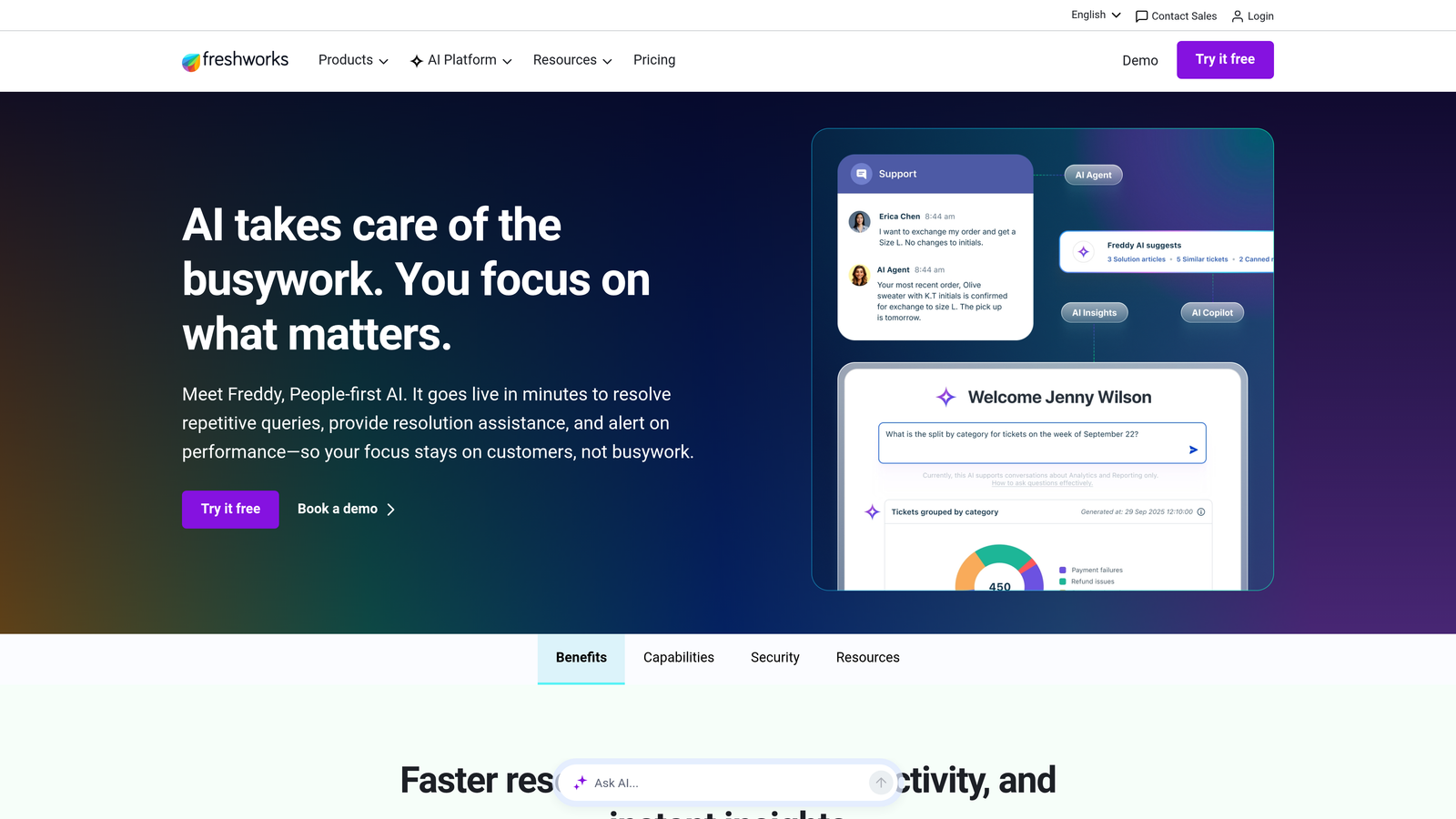
Freshdesk Freddy AI is Freshworks' AI layer spanning self-service deflection, agent assistance, and analytics, tightly bundled with Freshdesk's ticketing infrastructure.
Where This Tool Shines
Freddy AI is structured as three distinct capabilities that address different parts of the support workflow. Freddy Self Service handles deflection before tickets are created, Freddy Copilot assists agents during resolution, and Freddy Insights surfaces trends and anomalies for support leaders. This modular approach lets teams adopt the pieces they need without overpaying for capabilities they won't use.
Pricing is notably competitive compared to enterprise alternatives, which makes Freshdesk Freddy a practical choice for growing teams that need AI capabilities without Zendesk-level costs.
Key Features
Freddy Self Service: Automates deflection by resolving common queries through AI-powered FAQ handling before they become tickets.
Freddy Copilot: Assists agents with reply suggestions, ticket summarization, and recommended next steps.
Freddy Insights: Detects support trends, volume anomalies, and performance gaps across the team.
Native Freshworks Integration: Works seamlessly across Freshdesk, Freshchat, and Freshsales without additional configuration.
Accessible Pricing: Competitive cost structure relative to enterprise alternatives, with a free tier available on Freshdesk.
Best For
SMB and mid-market teams already using or evaluating Freshworks products. Strong value for teams that want AI assistance across the full support lifecycle without committing to enterprise-level spend.
Pricing
Freddy AI add-ons start at approximately $29/agent/month. Freshdesk offers a free tier for basic ticketing.
5. Salesforce Agentforce
Best for: Enterprise teams running Salesforce Service Cloud who need autonomous AI agents operating across CRM data
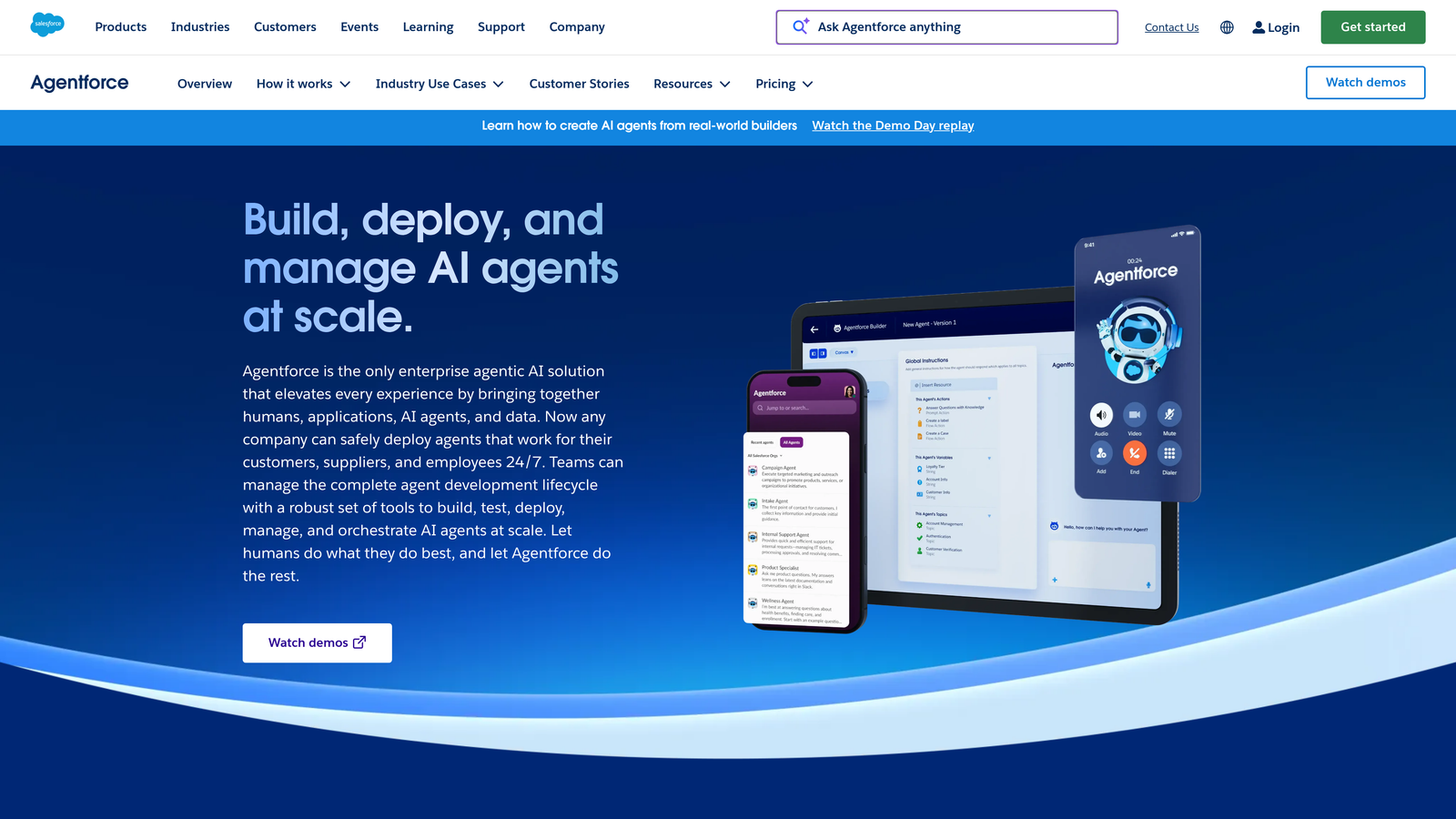
Salesforce Agentforce is Salesforce's autonomous AI agent platform, designed to take action across CRM records, cases, and service workflows without requiring human intervention for each step.
Where This Tool Shines
Agentforce represents a meaningful evolution beyond traditional Einstein bots. Where earlier Salesforce AI primarily suggested or routed, Agentforce can resolve cases, update CRM records, and execute multi-step workflows using the full context of a customer's Salesforce history, including orders, entitlements, and prior interactions.
For organizations where Salesforce is the system of record, this depth of integration is hard to replicate with any other platform. The low-code Agent Builder also makes it accessible to operations teams who don't want to depend on engineering resources for every configuration change.
Key Features
Autonomous Case Resolution: Resolves service cases and updates CRM records without requiring human intervention at each step.
Deep Salesforce Integration: Operates across Service Cloud data including customer history, orders, entitlements, and cases.
Multi-Step Reasoning: Handles complex queries that require pulling context from multiple data sources within Salesforce.
Agent Handoff with Full Context: Escalates to human agents with complete Salesforce case context preserved.
Low-Code Agent Builder: Configurable by operations teams without extensive engineering involvement.
Best For
Enterprise service teams where Salesforce is the primary system of record and CRM-native AI resolution is the priority. Less practical for teams not already invested in the Salesforce ecosystem.
Pricing
Agentforce starts at $2/conversation. Requires an existing Salesforce Service Cloud subscription.
6. Tidio Lyro
Best for: Small businesses and e-commerce brands that want fast AI deployment at accessible pricing
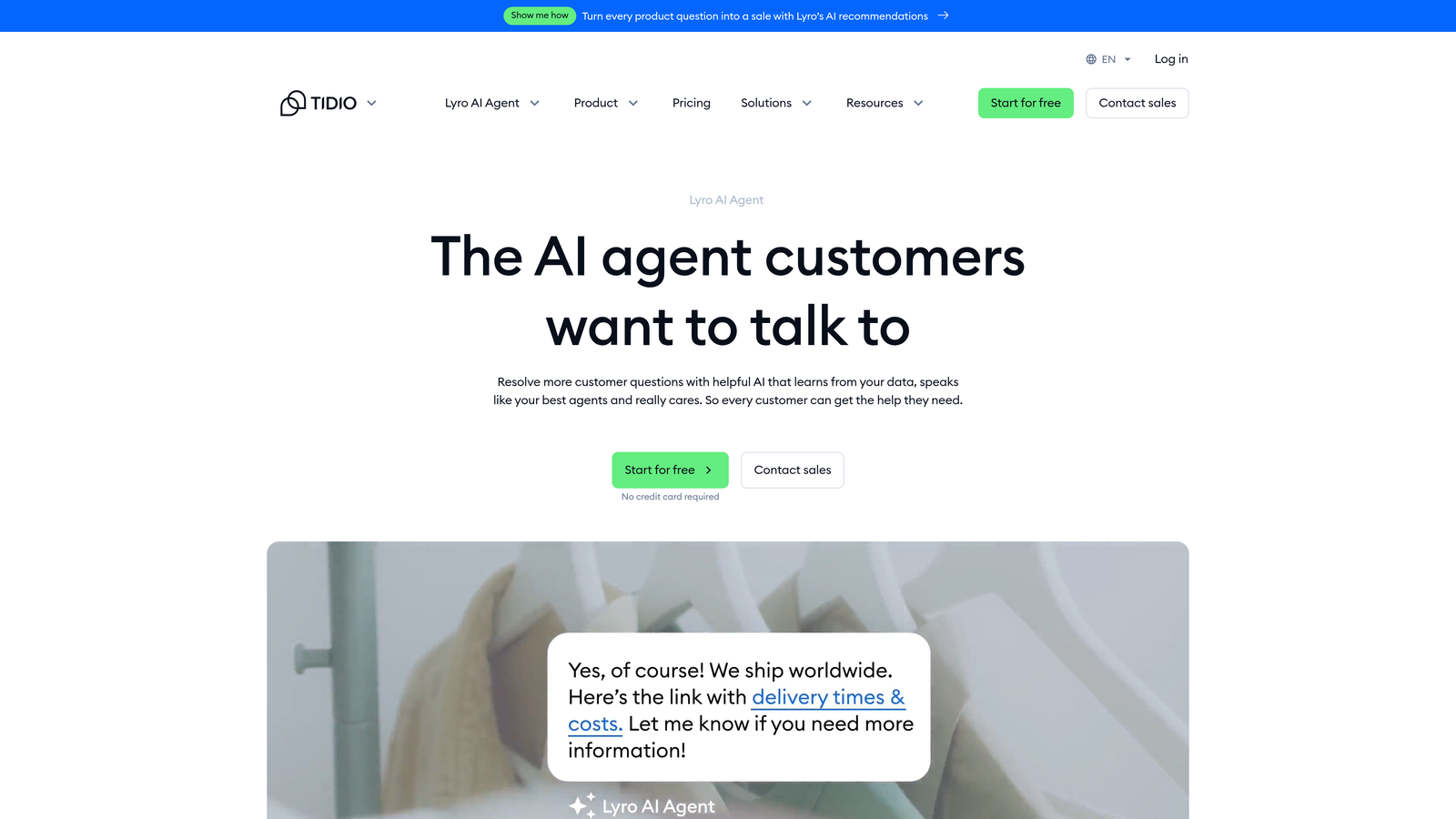
Tidio Lyro is Tidio's conversational AI product focused on helping small businesses resolve common customer queries quickly, with minimal setup and built-in live chat fallback.
Where This Tool Shines
Lyro's core appeal is simplicity. You point it at your FAQ content, and it starts handling queries within hours. There's no complex flow building, no engineering resources required, and no lengthy onboarding process. For small teams that need AI support coverage without a dedicated implementation project, this is a significant practical advantage.
The Shopify and WooCommerce integrations make Lyro particularly well-suited for e-commerce brands where order status, returns, and product questions represent a large share of support volume.
Key Features
Knowledge Base Training: Trains on your existing FAQ and help content with minimal configuration required.
Automatic Escalation: Detects low-confidence situations and transfers to live chat agents without friction.
E-Commerce Integrations: Connects with Shopify and WooCommerce for order-aware support conversations.
Bot Performance Analytics: Tracks resolution rates, conversation volume, and escalation patterns.
No-Code Configuration: Fully manageable by non-technical team members.
Best For
Small businesses and e-commerce brands with high FAQ volume and limited technical resources. Less suited for complex B2B support workflows or teams that need deep CRM integration and business intelligence.
Pricing
Lyro starts at approximately $29/month. A free tier is available for Tidio's base live chat product.
7. Drift (Salesloft)
Best for: B2B teams where buyer conversations and customer support overlap within the same platform
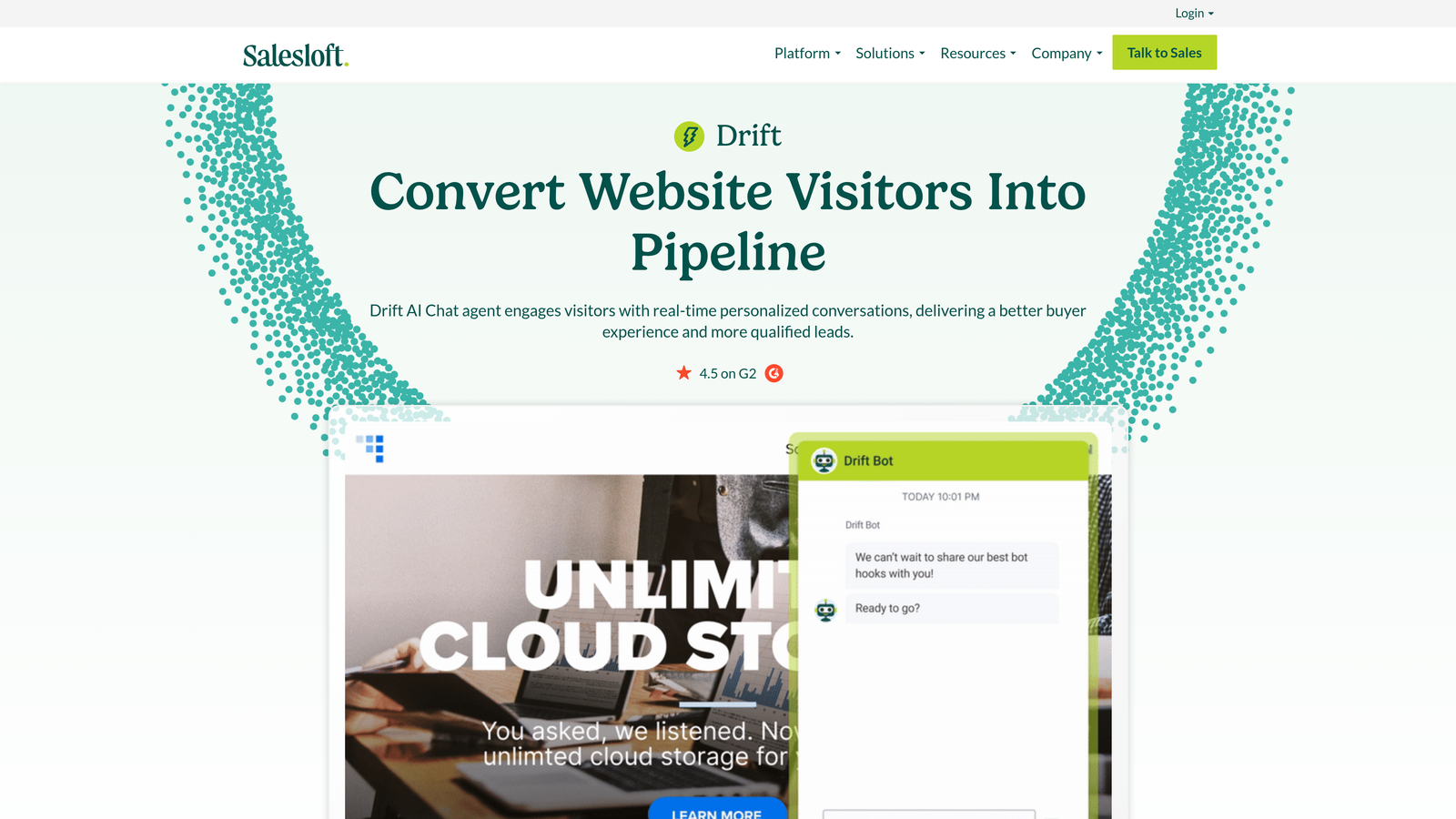
Drift, now part of the Salesloft revenue platform, blends conversational AI for sales engagement and support handling, useful for B2B companies where the line between a support query and a sales conversation is often blurry.
Where This Tool Shines
Drift's differentiation is the combination of sales and support in a single conversational layer. The AI can qualify visitors, route them to the right team, book meetings, and handle support queries without requiring separate tools for each use case. For B2B revenue teams, this consolidation has real operational appeal.
After the Salesloft acquisition, Drift's positioning has shifted more explicitly toward revenue intelligence, which means the platform is strongest when support and sales workflows are genuinely intertwined rather than separate functions.
Key Features
AI-Powered Routing and Qualification: Identifies visitor intent and routes conversations to the appropriate team, whether sales or support.
Meeting Booking Automation: Integrates with calendar and CRM to schedule meetings directly from chat conversations.
Conversation Intelligence: Tracks engagement patterns and surfaces insights across buyer and customer interactions.
CRM and Salesloft Integration: Connects with Salesforce, HubSpot, and Salesloft workflows for unified revenue context.
Account-Based Targeting: Personalizes experiences based on company identity and account data.
Best For
B2B companies where sales and support teams share a conversational channel and want unified visibility across both. Less ideal for teams looking for pure support automation without the sales layer.
Pricing
Contact for pricing. Premium plans are reported to start at approximately $2,500/month, positioning Drift as an enterprise and mid-market product.
8. Ada
Best for: Enterprise brands in regulated industries needing multilingual, omnichannel AI agents with strong compliance controls
Ada is an enterprise-grade no-code AI agent builder with strong multilingual support, omnichannel deployment, and a compliance posture designed for organizations operating in regulated environments.
Where This Tool Shines
Ada's no-code builder genuinely enables non-technical teams to create and maintain sophisticated conversation flows without engineering involvement. Combined with support for more than 50 languages, this makes Ada a practical choice for global brands that need consistent AI support experiences across multiple markets and channels.
The compliance and security architecture is a meaningful differentiator for industries like financial services, healthcare, and telecommunications, where data handling requirements are strict and vendor risk management is rigorous.
Key Features
No-Code Agent Builder: Enables operations and support teams to build and customize conversation flows without writing code.
Multilingual Support: Handles conversations across 50+ languages from a single configuration.
Omnichannel Deployment: Deploys across web, mobile, SMS, WhatsApp, and additional messaging channels.
Dynamic Data Retrieval: Uses API integrations to pull real-time data into conversations, enabling personalized responses beyond static FAQ content.
Best For
Large enterprises in regulated industries that need multilingual, omnichannel AI agents and have strict compliance requirements. Custom contracts make Ada best suited for organizations with defined procurement processes.
Pricing
Contact for pricing. Ada operates on custom enterprise contracts, typically suited for larger organizations with established procurement processes.
9. Kustomer
Best for: High-volume consumer brands that need a unified customer timeline with AI automation layered on top
Kustomer is a CRM-native customer service platform that consolidates support history, orders, and customer data into a single timeline view, with AI automation handling routing, triage, and repetitive resolution patterns.
Where This Tool Shines
Kustomer's core strength is the unified customer timeline. In high-volume consumer support environments, agents often waste significant time jumping between systems to piece together a customer's history before they can respond. Kustomer eliminates that context-switching by pulling support interactions, order data, and CRM records into a single view per customer.
The AI automation layer handles the repetitive work, routing tickets, suggesting responses, and triggering workflows, so agents can focus their attention on the interactions that genuinely require human judgment.
Key Features
Unified Customer Timeline: Combines support history, order data, and CRM records into a single customer view for agents.
AI-Powered Routing and Triage: Automatically categorizes and routes incoming contacts based on intent and customer context.
Omnichannel Inbox: Manages email, chat, social, SMS, and voice from a single unified interface.
Workflow Automation: Automates repetitive resolution patterns to reduce manual handling time.
Proactive Outreach: Enables customer health tracking and proactive communication based on behavioral signals.
Best For
High-volume consumer brands, particularly in retail, e-commerce, and subscription services, where a unified view of the customer across all touchpoints is essential for fast, accurate support.
Pricing
Kustomer's Enterprise plan starts at approximately $89/agent/month.
Choosing the Right Platform for Your Team
The right platform depends heavily on where you are, what you're already running, and what you actually need AI to do. Here's a quick-reference guide to cut through the noise.
For B2B SaaS teams that want AI-native resolution: Halo AI is the strongest fit. The page-aware context, continuous learning, bug ticket automation, and business intelligence signals are purpose-built for product-led SaaS environments where support, product feedback, and customer health overlap.
For teams already on Intercom or Zendesk: Fin and Zendesk AI are the natural paths of least resistance. You won't get AI-native architecture, but you'll get meaningful automation without migrating your entire support stack.
For mid-market teams watching budget: Freshdesk Freddy AI offers competitive pricing and solid coverage across deflection, agent assistance, and analytics. It punches above its price point for teams not yet at enterprise scale.
For Salesforce-native enterprises: Agentforce is the obvious choice when Salesforce is your system of record and you need AI that operates across CRM data, not just chat transcripts.
For e-commerce and small businesses: Tidio Lyro gets you running quickly with minimal overhead. Kustomer is the stronger choice if you need a unified customer timeline at higher volume.
The architectural point worth emphasizing: AI-native platforms tend to compound in value over time because every interaction makes the system smarter. Bolt-on AI stays roughly where it started. That gap widens as your product evolves and your customer base grows.
Your support team shouldn't scale linearly with your customer base. Let AI agents handle routine tickets, guide users through your product, and surface business intelligence while your team focuses on complex issues that need a human touch. See Halo in action and discover how continuous learning transforms every interaction into smarter, faster support.