9 Best Customer Service AI Platforms Compared for 2026
This customer service AI platforms comparison evaluates nine tools across the full spectrum—from autonomous AI-first architectures to helpdesk add-ons—rating each on AI quality, integration depth, deployment ease, and scalability. Whether you're a SaaS startup, enterprise, or product team, this guide helps you identify the right platform to improve resolution rates, reduce ticket volume, and boost customer satisfaction.
 Matt PattoliFounder13 min read
Choosing the right customer service AI platform is one of the highest-leverage decisions a support or product team can make. The difference between a bolt-on chatbot and a genuinely intelligent AI agent shows up in resolution rates, escalation volume, and customer satisfaction scores — and it shows up fast.
This comparison covers nine platforms across the full spectrum: AI-first architectures built to resolve tickets autonomously, AI layers sitting on top of existing helpdesks, and specialized tools for specific channels or team sizes. Each tool is evaluated on the same criteria: AI quality and autonomy, integration depth, ease of deployment, and how well it scales with your team.
Whether you're a SaaS startup outgrowing manual support, an enterprise looking to reduce ticket volume without sacrificing quality, or a product team that wants support data feeding back into the roadmap, there's a right tool for your situation. Here's how they stack up.
1. Halo AI
Best for: SaaS and B2B product teams that want AI-first support with business intelligence built in.
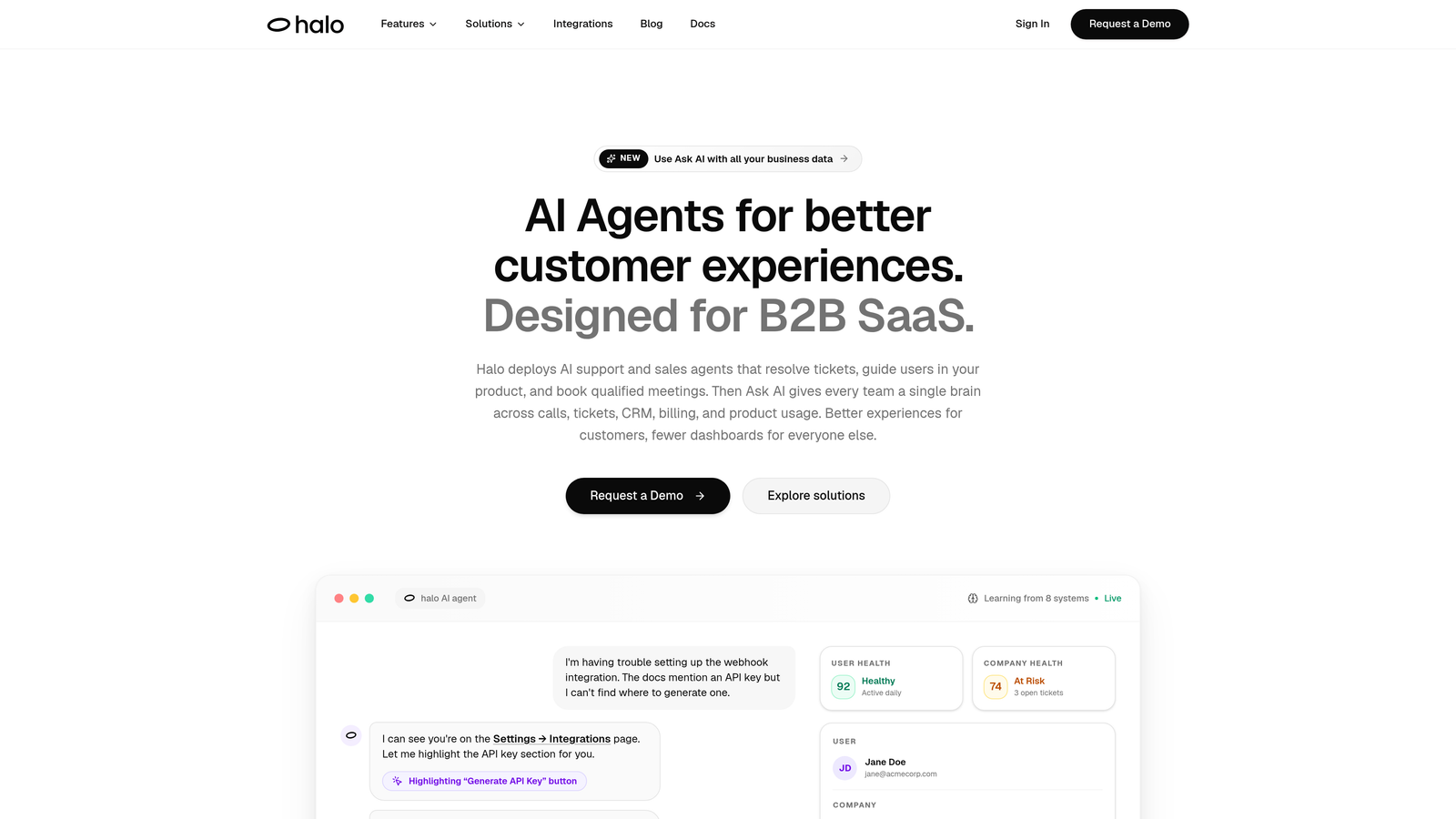
Halo AI is an AI-first customer support platform that deploys intelligent agents to resolve tickets, guide users through your product with page-aware context, and surface business intelligence from every support interaction.
Where This Tool Shines
Halo isn't an AI layer bolted onto a legacy helpdesk. It's built ground-up for autonomous resolution, which means the architecture itself is optimized for AI performance rather than retrofitted around human workflows. The platform continuously learns from every interaction, so resolution quality improves over time without manual retraining.
What genuinely sets Halo apart is the combination of page-aware context and business intelligence. The chat widget sees what the user sees on screen, enabling in-product guidance that's specific to where someone is stuck. And beyond closing tickets, the smart inbox surfaces customer health signals, revenue intelligence, and anomaly detection — turning support data into product and business insight.
Key Features
Page-Aware Chat Widget: The AI sees the user's current screen context, enabling precise, in-product guidance rather than generic answers.
Autonomous Ticket Resolution: AI agents handle routine tickets end-to-end, with smart live agent handoff for issues that genuinely need a human.
Auto Bug Ticket Creation: Automatically routes bug reports directly to Linear, reducing the gap between customer-reported issues and engineering response.
Smart Inbox with Business Intelligence: Surfaces customer health signals, revenue intelligence, and anomaly detection from within the support stream.
Deep Integration Stack: Connects to Linear, Slack, HubSpot, Intercom, Stripe, Zoom, PandaDoc, and Fathom — enabling action-taking across your entire business stack.
Continuous Learning: Every resolved interaction improves the model, compounding resolution quality over time.
Best For
Halo is purpose-built for SaaS and B2B product teams that want more from support than ticket deflection. If you want AI that takes action in connected systems, surfaces product insights, and gets smarter with every interaction, this is the architecture designed for that outcome.
Pricing
Pricing is not publicly listed. Visit haloagents.ai for current pricing and to explore a demo tailored to your team's support volume and stack.
2. Intercom (Fin AI Agent)
Best for: Teams already on Intercom who want to add AI resolution without switching platforms.
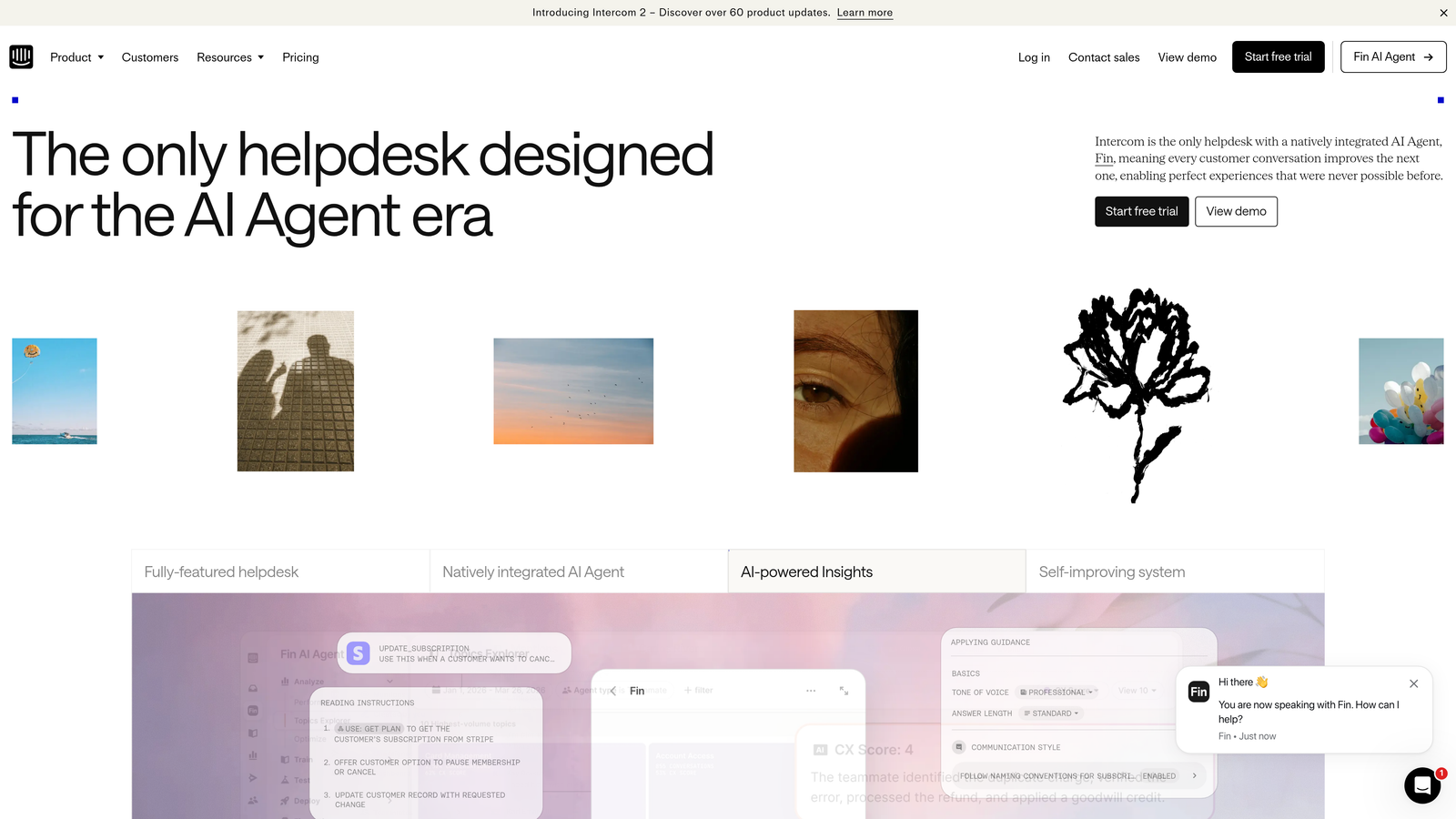
Intercom is a customer messaging platform whose native AI agent, Fin, delivers autonomous conversation resolution using help center content and connected knowledge sources.
Where This Tool Shines
Fin's biggest advantage is how frictionlessly it activates for existing Intercom customers. There's no separate integration, no new interface to learn, and no migration risk. If you're already running support on Intercom, Fin is the fastest path to meaningful AI resolution.
Fin 2 expanded beyond simple Q&A to include action-taking capabilities, multi-source knowledge support, and customizable AI personas. The handoff experience is also well-executed: when Fin can't resolve something, it passes the conversation to a human agent within the same thread, preserving context.
Key Features
Native Intercom Integration: No separate setup required for existing Intercom customers — Fin activates within your current environment.
Multi-Source Knowledge Support: Draws from help center content, connected URLs, and external knowledge sources for resolution.
Action-Taking (Fin 2): Goes beyond Q&A to take actions within connected systems, expanding resolution scope.
Customizable AI Persona: Adjust tone, name, and behavior to match your brand voice.
Seamless Human Handoff: Passes unresolved conversations to live agents within the same thread, maintaining full context.
Best For
Teams already invested in the Intercom platform who want AI resolution without the overhead of evaluating and migrating to a new tool. Less compelling if you're not already on Intercom, given the per-resolution pricing model that can escalate at scale.
Pricing
Fin is charged per resolution on top of Intercom seat pricing. Intercom plans start at approximately $39/seat/month; total cost depends heavily on resolution volume.
3. Zendesk AI
Best for: Large enterprise support organizations already running on Zendesk Suite.
Zendesk AI is an enterprise-grade AI layer built into the Zendesk Suite, covering autonomous AI agents, agent copilot tools, intelligent triage, and workflow automation across the full Zendesk product line.
Where This Tool Shines
Zendesk has invested significantly in AI capability, particularly following its acquisition of Ultimate.ai. The result is a comprehensive AI suite that covers both customer-facing resolution and agent-assist workflows within a platform that large support orgs already know well.
The intelligent triage and routing capabilities are particularly strong for organizations with complex escalation logic, multiple product lines, or large agent teams. If your support operation has significant existing Zendesk infrastructure, the incremental AI adoption path is well-defined and low-risk.
Key Features
AI Agents: Autonomous customer-facing resolution for common queries without agent involvement.
Agent Copilot: Suggested replies, ticket summarization, and next-best-action recommendations for human agents.
Intelligent Triage: Automatic routing and prioritization based on detected intent, sentiment, and urgency.
Macro Suggestions and Auto-Population: Reduces repetitive agent work by suggesting macros and auto-filling ticket fields.
Cross-Product Coverage: AI features available across Zendesk Support, Chat, and Voice products.
Best For
Established enterprise support teams with significant Zendesk investment who want AI capabilities without platform disruption. The seat-based pricing model and higher-tier plan requirements make this less accessible for smaller teams or startups.
Pricing
AI features are available on Suite Professional and above. Suite plans start at approximately $115/agent/month; total cost scales with team size and feature tier.
4. Freshdesk Freddy AI
Best for: Growing SMB and mid-market teams that want meaningful AI features at accessible price points.
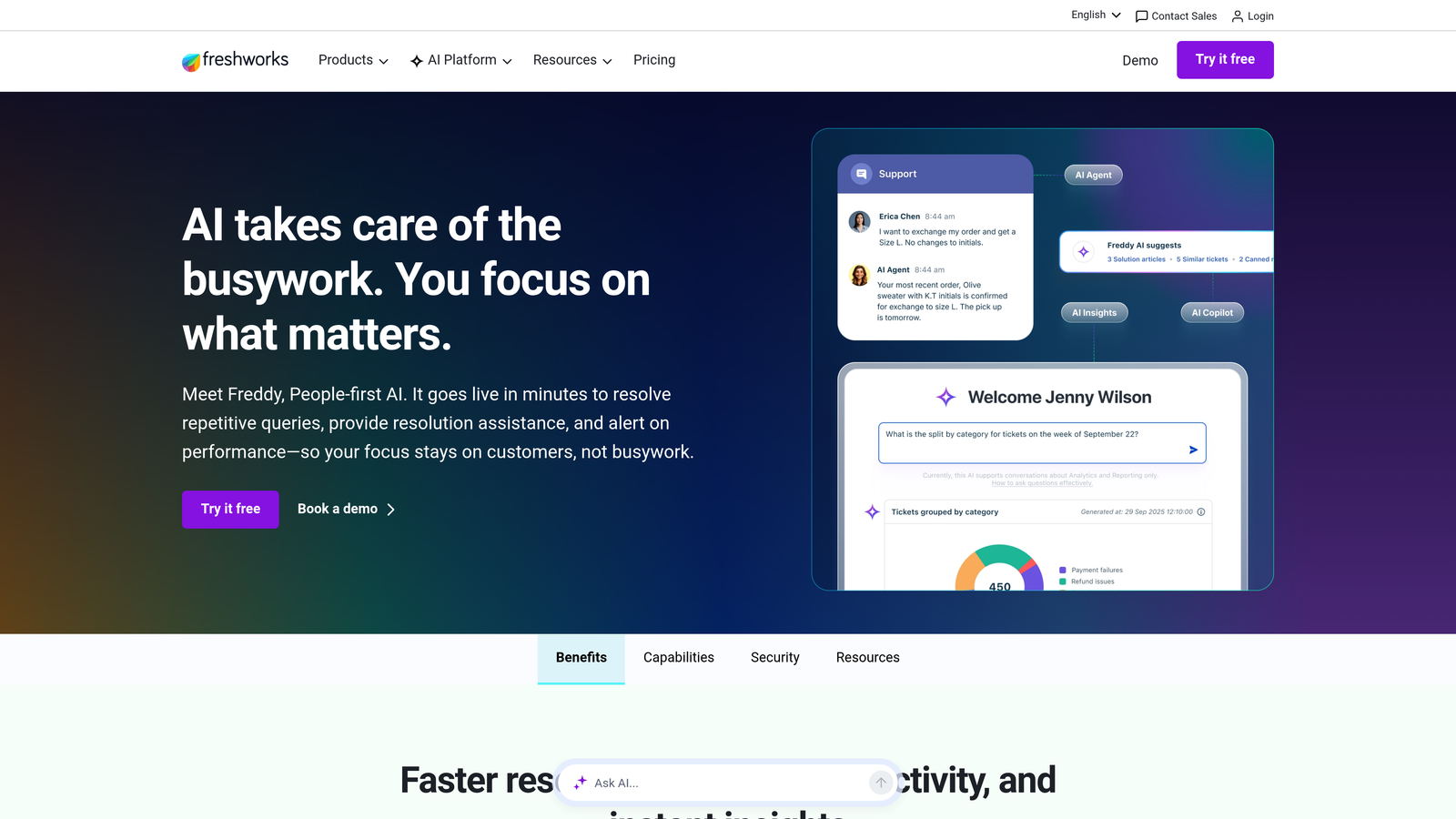
Freshdesk Freddy AI is Freshworks' AI suite embedded across Freshdesk, offering self-service bots, agent copilot capabilities, and analytics intelligence at more accessible price points than enterprise alternatives.
Where This Tool Shines
Freddy's strength is breadth at a price point that doesn't require enterprise budget approval. It covers deflection, agent assist, and analytics in a single add-on, making it a practical choice for teams that want to adopt AI incrementally without committing to a full platform overhaul.
Freddy Insights is a standout component: it surfaces anomaly detection and performance analytics that help support managers spot trends before they become problems. For teams moving from reactive to proactive support operations, this layer adds genuine value beyond ticket handling.
Key Features
Freddy Self Service: Bot-based deflection for common queries before they reach the agent queue.
Freddy Copilot: Suggested replies, tone adjustment, and ticket summarization to accelerate agent resolution.
Freddy Insights: Anomaly detection and performance analytics to surface trends and operational gaps.
Cross-Product Availability: Works across Freshdesk, Freshchat, and Freshservice for consistent AI coverage.
SMB-Friendly Pricing: Meaningfully more accessible than Zendesk or Salesforce Service Cloud for teams watching budget.
Best For
SMB and mid-market teams on Freshdesk that want AI-assisted workflows without enterprise-level spend. Also a strong option for teams considering Freshworks as a Zendesk alternative who want AI baked in from the start.
Pricing
Freddy Copilot add-on from approximately $29/agent/month. Base Freshdesk plans start from $15/agent/month, making the combined cost competitive for smaller teams.
5. Tidio
Best for: E-commerce brands and small businesses needing fast deployment with minimal technical overhead.
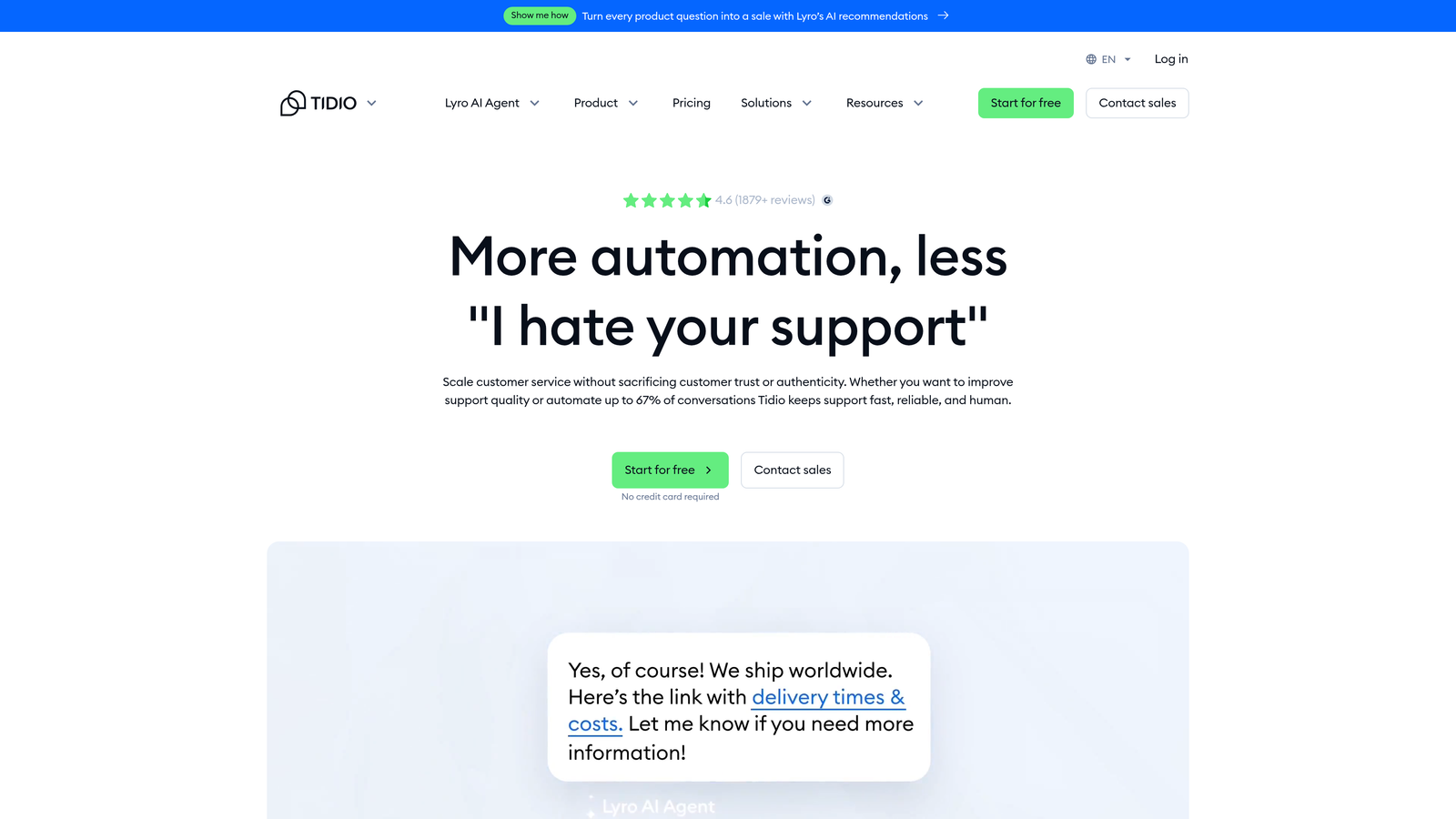
Tidio is a live chat and AI platform popular with e-commerce and small business teams, featuring Lyro AI for automated FAQ resolution and a visual bot builder for quick deployment.
Where This Tool Shines
Tidio's defining characteristic is speed to value. Teams regularly get live within hours rather than days or weeks, which matters enormously for small businesses that don't have dedicated implementation resources. The visual drag-and-drop bot builder requires no coding knowledge, and Lyro AI activates from existing support content without complex training workflows.
The e-commerce integrations are well-developed: Shopify and WooCommerce connections let Lyro pull order data to answer shipping, return, and product questions automatically. For DTC brands handling high volumes of repetitive queries, this is a meaningful deflection lever.
Key Features
Lyro AI: Conversational AI trained on your support content to handle FAQ and common support queries automatically.
Visual Bot Builder: Drag-and-drop interface for building bot flows without any coding requirement.
Multi-Channel Support: Covers live chat, email, and Facebook Messenger from a single platform.
Fast Deployment: Designed to be live within hours, not weeks.
E-Commerce Integrations: Native connections to Shopify and WooCommerce for order-aware support automation.
Best For
E-commerce brands, small businesses, and non-technical teams that need accessible AI-assisted support without implementation complexity. Less suited for complex B2B SaaS workflows, multi-tier escalation logic, or teams that need deep CRM and product integrations.
Pricing
A free plan is available. Lyro AI starts from approximately $29/month; paid plans from approximately $19/month, making Tidio one of the most accessible options in this comparison.
6. Kustomer
Best for: High-volume B2C brands that need a unified customer timeline alongside AI-powered conversation handling.
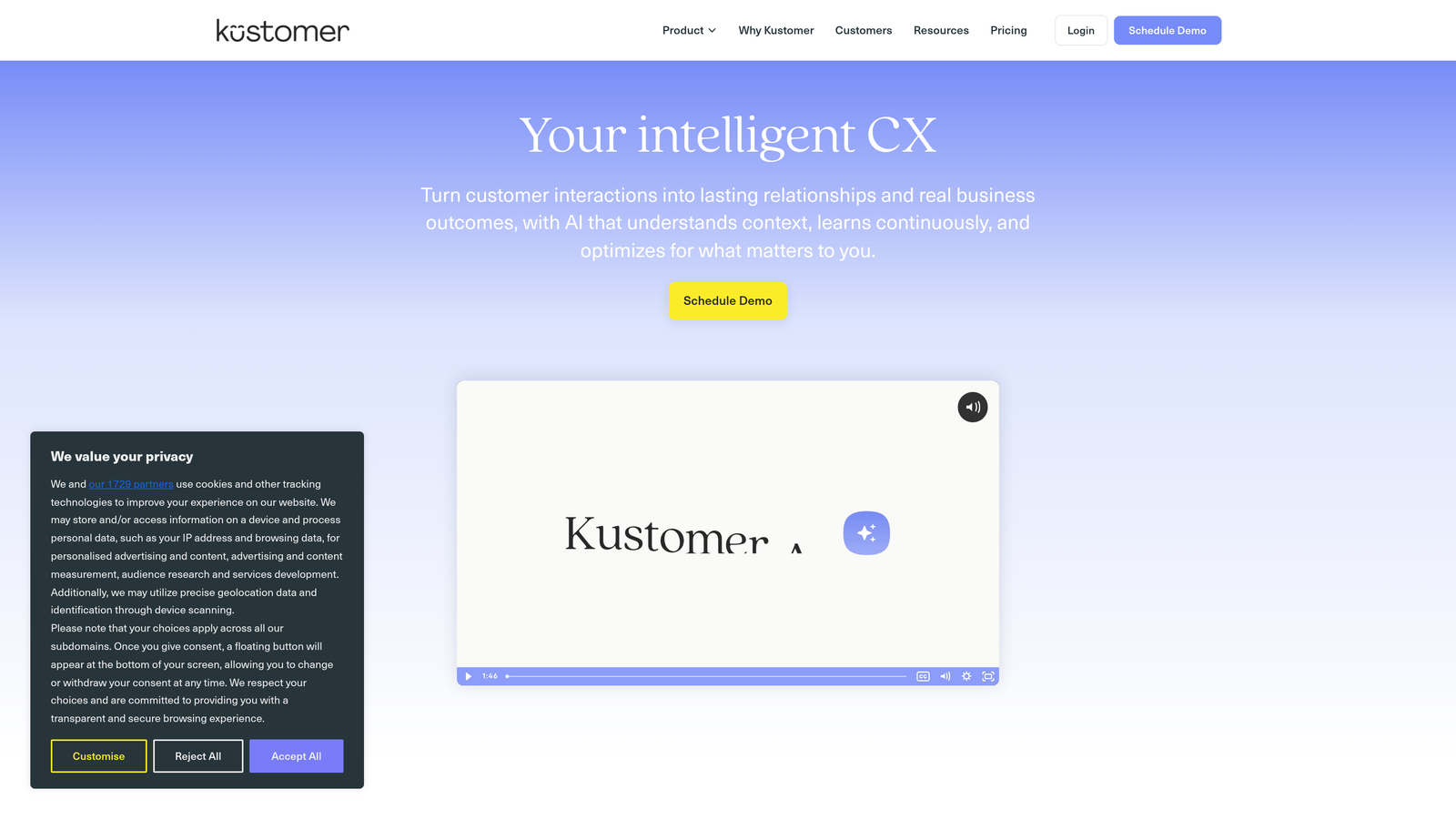
Kustomer is a CRM-native customer service platform combining unified customer timelines with AI-powered conversation handling, designed for high-volume B2C support operations.
Where This Tool Shines
Kustomer's differentiation is the CRM-native architecture. Rather than treating support as an isolated ticket queue, Kustomer surfaces purchase history, prior support interactions, and behavioral data in a single unified timeline. This context makes every conversation smarter, whether it's handled by an AI or a human agent.
For B2C brands with repeat customers and complex order histories, this unified view reduces the back-and-forth that frustrates customers and slows resolution. AI intent detection and routing are built on top of this rich data layer, which improves classification accuracy compared to tools working with conversation text alone.
Key Features
Unified Customer Timeline: Purchase history, support history, and conversation data combined in a single view for every customer.
AI Intent Detection and Routing: Intelligent classification and routing informed by full customer context, not just message content.
Omnichannel Coverage: Handles email, chat, SMS, social, and voice from a single platform.
Automated Workflows: Triggered by customer data and events, enabling proactive and reactive automation.
Built-In CRM: Reduces dependency on a separate customer data tool for support operations.
Best For
B2C brands with high interaction volume, repeat customers, and complex order histories where customer context meaningfully improves resolution. Less common in pure B2B SaaS contexts where the CRM-native model is less central to support workflows.
Pricing
Enterprise pricing; plans typically start around $89/agent/month. Contact Kustomer directly for current rates and volume-based options.
7. Ada
Best for: Enterprise teams that need action-taking AI agents with strong governance and compliance controls.
Ada is an enterprise no-code AI agent platform built for action-taking, not just answering questions, with strong brand safety controls and deep backend system integrations.
Where This Tool Shines
Ada sits in a distinct position: it's designed for enterprises that need AI to actually do things, not just retrieve information. Processing refunds, updating account details, checking order status via API — these are the workflows Ada is built to automate. That action-taking capability, combined with no-code accessibility, makes it unusually deployable for non-technical teams at enterprise scale.
The governance layer is a genuine differentiator for regulated industries or brands with strict compliance requirements. Ada's brand safety controls let enterprises define exactly how the AI represents the company, reducing the risk of off-brand or non-compliant responses at scale.
Key Features
No-Code AI Agent Builder: Non-technical teams can build and manage AI agents without engineering involvement.
Action-Taking via API: Processes refunds, updates accounts, checks order status, and more through connected system integrations.
Brand Safety and Governance Controls: Enterprise-grade guardrails to ensure AI responses stay on-brand and compliant.
Broad Integration Support: Connects with Salesforce, Zendesk, Shopify, and other major platforms.
Multi-Language Support: Handles customer interactions across multiple languages and channels.
Best For
Enterprise organizations in regulated industries or high-compliance environments that need AI to take meaningful action in backend systems, not just surface answers. Requires a sales conversation to get started; not suited for small teams or quick-deploy scenarios.
Pricing
Enterprise pricing with custom quotes. Contact Ada directly for current rates based on volume and integration requirements.
8. Forethought
Best for: Teams that want meaningful AI improvement on top of an existing helpdesk without migrating platforms.
Forethought is an AI overlay platform that adds intelligent triage, resolution, agent assist, and analytics on top of existing helpdesks including Zendesk, Salesforce Service Cloud, and Freshdesk.
Where This Tool Shines
Forethought's value proposition is clear: if you're deeply invested in a helpdesk and can't or won't replace it, Forethought adds a meaningful AI layer without requiring migration. It's an ops-focused choice for teams that want to extract more performance from current infrastructure rather than rethink the stack.
The four-product architecture covers the full support workflow: Solve handles autonomous resolution, Triage handles intelligent routing, Assist supports agents in real time, and Discover surfaces insights and trend analysis. Teams can adopt one component or the full suite depending on where their biggest performance gaps are.
Key Features
Solve: AI-powered autonomous resolution for incoming tickets before they reach the agent queue.
Triage: Intelligent routing and prioritization based on detected intent and urgency signals.
Assist: Agent copilot with suggested responses and in-context knowledge retrieval.
Discover: Analytics and insights layer surfacing support trends, knowledge gaps, and performance patterns.
No Platform Migration Required: Layers on top of existing helpdesks, preserving current workflows and data.
Best For
Support operations teams at mid-market and enterprise companies that are committed to their current helpdesk but want to layer in AI resolution, smarter routing, and agent assist without a full platform switch.
Pricing
Enterprise pricing with custom quotes. Contact Forethought directly for rates based on helpdesk, volume, and product selection.
9. Helpshift
Best for: Mobile app companies and gaming studios that need native in-app support with async messaging.
Helpshift is a mobile-first customer support platform with a native mobile SDK and async messaging model, purpose-built for mobile apps and gaming studios with large user bases.
Where This Tool Shines
Helpshift occupies a specific niche that few other platforms address well: support embedded directly inside a mobile app. The native iOS and Android SDK delivers an in-app support experience that feels native to the product rather than redirecting users to a web interface or email thread.
The async messaging model is well-matched to mobile UX patterns, where users expect to send a message and check back rather than wait in a live chat queue. For gaming studios in particular, the smart routing capabilities that incorporate player data and issue type enable personalized, context-aware support at scale.
Key Features
Native Mobile SDK: iOS and Android SDK for seamless in-app support without leaving the product experience.
Async Messaging: Conversation model suited to mobile UX patterns and user behavior.
AI Bot Flows and Intent Classification: Automated resolution paths with intelligent intent detection.
Smart Routing: Routes issues based on player or user data and issue type for contextually appropriate handling.
In-App Knowledge Base: FAQ and help content integrated directly into the mobile experience.
Best For
Mobile app developers and gaming studios with large user bases that need native in-app support infrastructure. Less relevant for web-only SaaS products or teams whose primary support surface is a browser-based interface.
Pricing
Custom enterprise pricing. Contact Helpshift directly for rates based on monthly active users and support volume.
Which Platform Is Right for Your Team?
The right choice depends less on feature checklists and more on where your team sits architecturally and what you're optimizing for.
If you want AI-first architecture with business intelligence: Halo AI is built for this. Page-aware context, autonomous resolution, continuous learning, and a smart inbox that surfaces customer health signals and revenue intelligence make it the strongest fit for SaaS and B2B product teams that want support data to feed back into the business, not just close tickets.
If you're already on Intercom or Zendesk: Fin and Zendesk AI are the lowest-friction paths to AI resolution. Fin works best for teams already on Intercom who want incremental adoption. Zendesk AI suits large enterprise orgs with complex routing logic and significant existing infrastructure investment.
If you're an SMB watching budget: Freshdesk Freddy AI offers the best balance of capability and cost. Tidio is the right call for e-commerce and small business teams that need to be live fast with minimal technical overhead.
If you need action-taking AI with enterprise governance: Ada is purpose-built for this, particularly for regulated industries or brands with strict compliance requirements.
If you can't migrate your helpdesk but want AI improvement: Forethought layers intelligently on top of Zendesk, Salesforce, and Freshdesk without requiring platform change.
If your primary support surface is a mobile app: Helpshift is the only platform in this list built specifically for that context.
Your support team shouldn't scale linearly with your customer base. Let AI agents handle routine tickets, guide users through your product, and surface business intelligence while your team focuses on complex issues that need a human touch. See Halo in action and discover how continuous learning transforms every interaction into smarter, faster support.