9 Best Customer Service AI Solutions for B2B Teams in 2026
This guide reviews the 9 best customer service AI solutions available to B2B teams in 2026, evaluating each on autonomous resolution capability, integration depth, ease of deployment, and scalability. Whether you're augmenting an existing helpdesk or replacing your stack entirely, it cuts through the noise to help you choose the tool that matches your team's actual needs.
 Grant CooperFounder14 min read
Customer support teams are under more pressure than ever. Ticket volumes are climbing, headcounts are leaner, and customers expect instant, accurate answers around the clock. AI-powered customer service solutions have moved from experimental to essential, helping B2B teams resolve tickets faster, reduce escalations, and surface insights that would otherwise stay buried in conversation logs.
The challenge is that not all AI support tools are built the same. Some bolt AI onto legacy helpdesk infrastructure. Others are built AI-first from the ground up. Some focus purely on chat deflection; others extend into business intelligence, bug tracking, and revenue signals. Choosing the wrong one means paying for capability you'll never use, or worse, missing the capability you actually need.
This list covers the top customer service AI solutions available in 2026, evaluated for autonomous resolution capability, integration depth, ease of deployment, and how well they scale without scaling headcount. Whether you're running support on Zendesk, Freshdesk, Intercom, or looking to replace your current stack entirely, there's an option here for your team.
1. Halo AI
Best for: B2B SaaS teams that want AI-first autonomous support with deep product and business context.
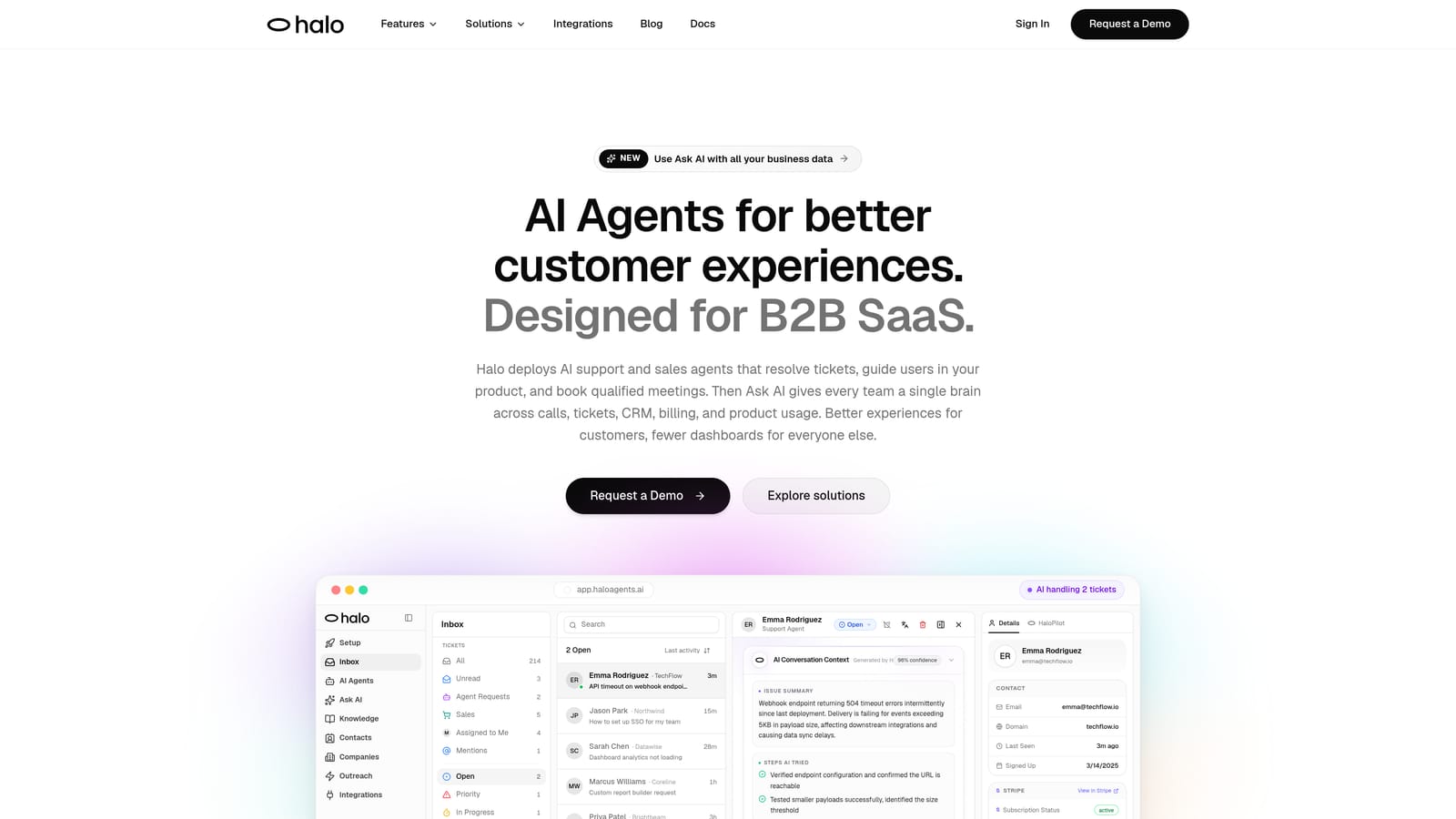
Halo AI is an AI-first customer support platform that deploys intelligent agents to resolve tickets, guide users through your product with page-aware context, and surface business intelligence signals while learning from every interaction.
Where This Tool Shines
Most AI support tools are built on top of a helpdesk. Halo is built around the AI itself, which means resolution is the core function, not an afterthought. The platform's page-aware chat widget is a genuine differentiator: it sees what the user is looking at inside your product and uses that context to deliver guidance that's actually relevant to the moment, not just a generic FAQ lookup.
Beyond support, Halo's smart inbox surfaces business intelligence signals from within conversations: customer health indicators, revenue anomalies, and churn signals that most teams would never catch by reading tickets manually. For product-led SaaS companies, the auto bug ticket creation routed directly to Linear closes the loop between support and engineering without requiring manual handoffs.
Key Features
Page-Aware Chat Widget: The AI sees what users see in your product, delivering contextually relevant guidance based on the exact page or feature they're on.
Autonomous Ticket Resolution: AI agents handle routine tickets end-to-end, with intelligent handoff to live agents when complexity warrants human judgment, preserving full conversation context.
Auto Bug Ticket Creation: Automatically identifies and routes bug reports directly to Linear, reducing the friction between customer-reported issues and engineering response.
Smart Inbox with Business Intelligence: Surfaces customer health signals, revenue anomalies, and churn indicators from within support conversations, turning your inbox into a strategic data source.
Deep Integration Stack: Connects natively with HubSpot, Slack, Intercom, Stripe, Zoom, PandaDoc, and Fathom, so the AI can draw on context from across your business, not just your helpdesk.
Best For
Halo is best suited for B2B SaaS teams and product-led growth companies that want more than ticket deflection. If your support conversations carry revenue signals, product feedback, or bug reports that need to reach the right teams fast, Halo's AI-first architecture and integration depth make it a strong fit.
Pricing
Pricing is available via demo or direct contact. Book a session at haloagents.ai to get a tailored walkthrough based on your team's use case and volume.
2. Intercom Fin
Best for: Teams already on Intercom who want AI resolution without migrating their stack.
Intercom Fin is Intercom's native AI agent that resolves customer conversations using your existing knowledge base, built directly into the Intercom messenger experience.
Where This Tool Shines
Fin's biggest advantage is how naturally it fits into an existing Intercom setup. If your team is already using Intercom for messaging and your help center content is already there, Fin can be deployed quickly without significant reconfiguration. It uses large language models to generate responses grounded in your existing documentation rather than scripted decision trees.
The handoff experience is notably smooth. When Fin reaches the edge of what it can confidently resolve, it passes the conversation to a human agent within the same messenger thread, preserving context so the customer doesn't have to repeat themselves.
Key Features
LLM-Powered Resolution: Generates accurate, conversational responses using your existing help center content as the knowledge source.
Native Intercom Integration: Works within the Intercom messenger and draws on CRM and conversation history without additional configuration.
Seamless Human Handoff: Escalates within the same thread, so agents receive full context when they take over a conversation.
Consumption-Based Pricing: Charges per resolved conversation rather than per seat, which can be cost-effective for teams with variable support volume.
Multi-Language Support: Handles conversations across multiple languages, useful for global customer bases.
Best For
Fin is an excellent choice for teams already invested in the Intercom ecosystem who want AI resolution without introducing a separate platform. It's less compelling if you're not already on Intercom, since the value is tightly coupled to the existing infrastructure.
Pricing
Consumption-based pricing charged per resolved conversation. Current rates are available at intercom.com.
3. Zendesk AI
Best for: Enterprise teams with complex workflows already standardized on Zendesk Suite.
Zendesk AI is a set of AI capabilities embedded across the Zendesk Suite, including intelligent triage, agent copilot suggestions, and automated routing.
Where This Tool Shines
Zendesk AI doesn't ask you to rethink your support infrastructure. It layers intelligence on top of what you already have, which is a significant practical advantage for enterprise teams that have spent years configuring workflows, macros, and reporting inside Zendesk. Intelligent triage and intent detection mean tickets reach the right queue faster, and agent copilot surfaces relevant knowledge articles and suggested replies without agents having to search manually.
The AI-generated conversation summaries are particularly useful for teams handling high volumes: agents picking up escalated tickets get a concise summary of what's already happened rather than reading through an entire thread.
Key Features
AI-Powered Triage and Intent Detection: Automatically categorizes and routes incoming tickets based on topic, urgency, and sentiment.
Agent Copilot: Surfaces suggested replies and relevant knowledge base content in real time as agents work a ticket.
Automated Routing: Directs tickets to the right team or agent based on AI-detected topic and sentiment signals.
AI-Generated Conversation Summaries: Condenses long threads so agents can get up to speed quickly on escalated or transferred tickets.
Suite Integration: AI capabilities connect directly into Zendesk's existing reporting, workflows, and automation infrastructure.
Best For
Zendesk AI is best for large enterprise support organizations that are deeply embedded in the Zendesk ecosystem and want to add AI efficiency without changing platforms. Teams evaluating Zendesk for the first time may find the add-on pricing model less straightforward than AI-native alternatives.
Pricing
Available as an add-on to existing Zendesk Suite plans. Enterprise pricing is available on request at zendesk.com.
4. Freshdesk Freddy AI
Best for: SMB and mid-market teams on Freshdesk looking for accessible AI across self-service, agent assistance, and analytics.
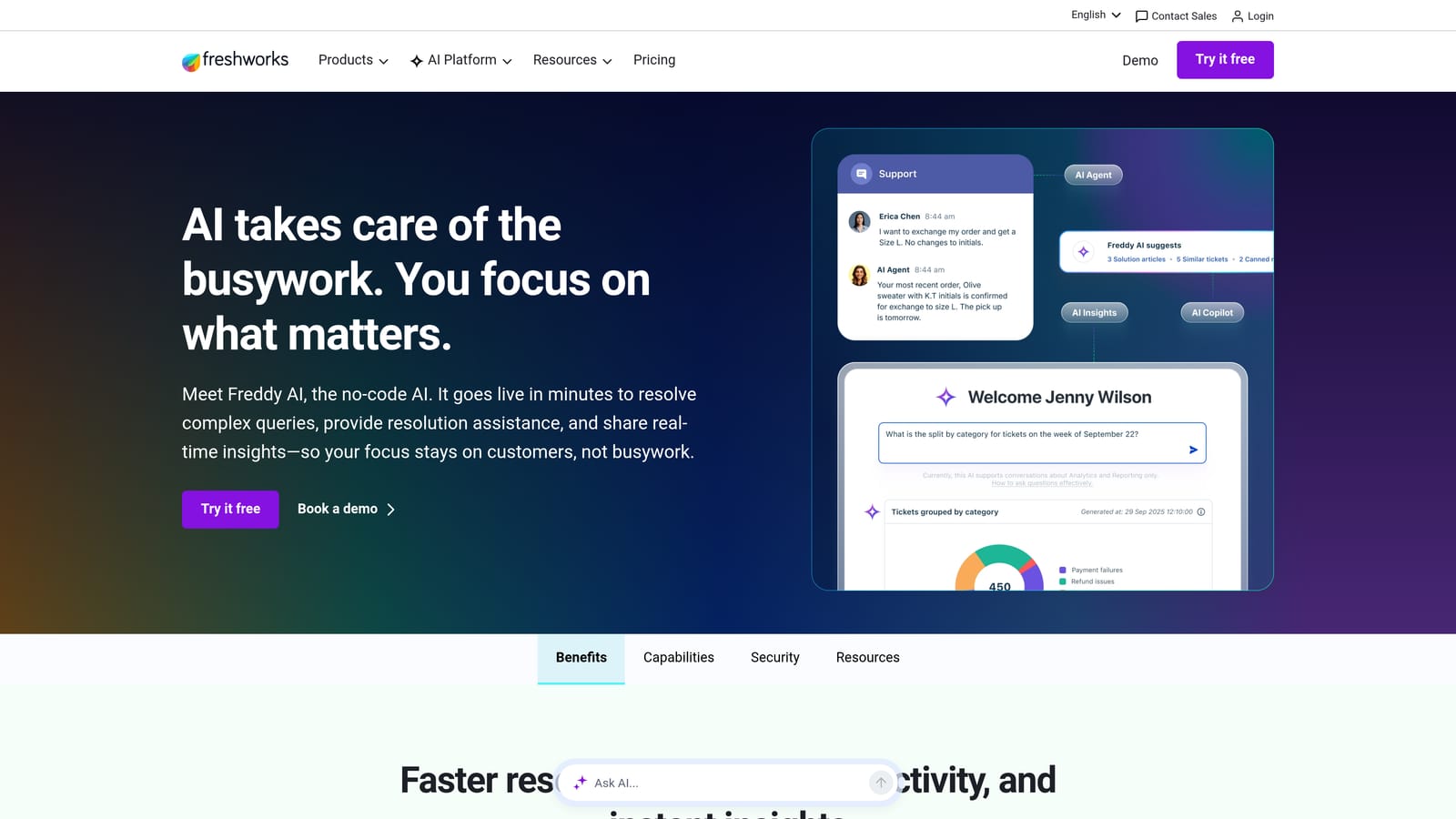
Freshdesk Freddy AI is Freshworks' AI layer for Freshdesk, covering customer-facing self-service, agent assistance, and analytics under a unified brand.
Where This Tool Shines
Freddy AI is structured as three distinct capabilities: Freddy Self Service handles customer-facing ticket deflection, Freddy Copilot assists agents with suggested responses and summaries in real time, and Freddy Insights surfaces analytics and trend detection across your support data. Having all three under one roof, within the Freshdesk environment, reduces the need for separate point solutions.
Freshdesk's pricing positioning makes Freddy more accessible than enterprise-focused alternatives. Teams that find Zendesk's pricing prohibitive often land on Freshdesk as a capable, more cost-efficient option, and Freddy AI extends that value proposition into the AI layer.
Key Features
Freddy Self Service: Customer-facing AI bot that handles common queries and deflects tickets before they reach your team.
Freddy Copilot: Real-time agent assistance including suggested responses, ticket summaries, and knowledge recommendations.
Freddy Insights: AI-driven analytics that surface trends, anomalies, and performance signals across your support operation.
Native Freshdesk Integration: All three layers operate within the existing Freshdesk helpdesk environment without additional configuration overhead.
Accessible Pricing Tier: More cost-accessible than enterprise-only competitors, making it viable for growing teams watching budget carefully.
Best For
Freddy AI is a strong fit for SMB and mid-market teams already on Freshdesk who want to layer AI into self-service, agent workflows, and reporting without overhauling their stack. Less suited for teams with complex B2B workflows requiring deep CRM or product integrations.
Pricing
Freddy Self Service is included in select Freshdesk plans; Freddy Copilot is available as an add-on. Current tiers are listed at freshworks.com.
5. Tidio Lyro
Best for: Small businesses and e-commerce teams that need fast deployment and affordable AI chat.
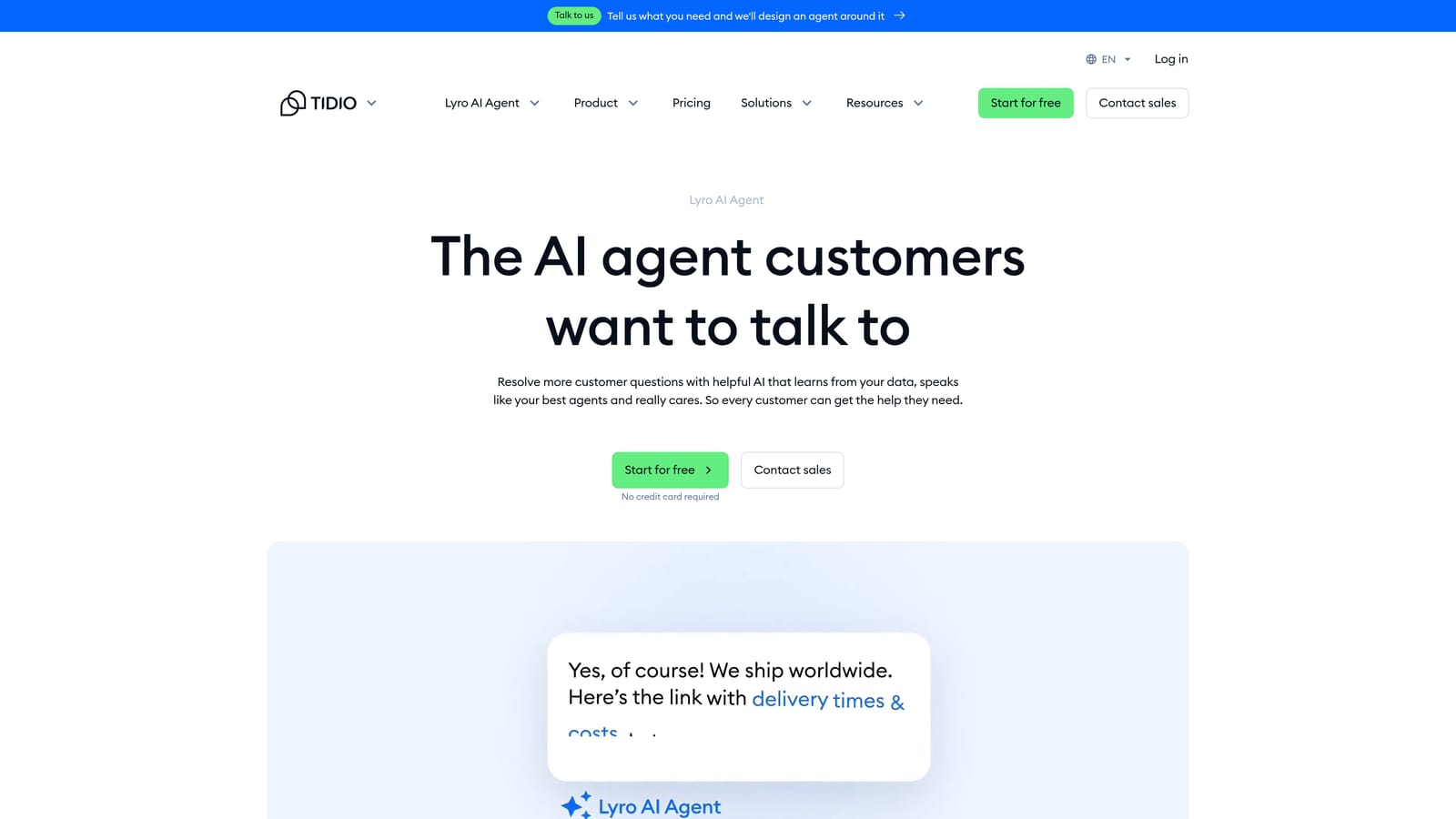
Tidio Lyro is Tidio's conversational AI agent designed for rapid deployment, particularly for small businesses and e-commerce teams with straightforward support workflows.
Where This Tool Shines
Speed to value is Lyro's headline advantage. Where enterprise AI platforms often require weeks of configuration and training, Lyro can be live with minimal setup, drawing on your existing FAQ and support content as its knowledge source. For teams that need AI support capability quickly without a dedicated implementation project, that matters.
The e-commerce integrations with Shopify and WordPress make Lyro a natural fit for direct-to-consumer brands. When AI confidence drops below a threshold, the platform routes to live chat automatically, so customers aren't left with an unhelpful bot response.
Key Features
Rapid Deployment: Goes live with minimal configuration using your existing FAQ and support documentation as the training source.
Conversational AI: Handles common customer queries in a natural conversational format rather than rigid decision trees.
E-Commerce Integrations: Native connections to Shopify, WordPress, and common e-commerce platforms.
Live Chat Fallback: Automatically routes to a human agent when AI confidence is low, preventing dead-end bot interactions.
SMB-Friendly Pricing: Free tier available with paid plans at accessible price points for small teams.
Best For
Lyro is best for small businesses and e-commerce operators who want fast, affordable AI chat without complex implementation. It's not designed for complex B2B support workflows or teams that need deep CRM and product integrations.
Pricing
Free tier available; paid plans start at SMB-accessible price points. Current pricing is at tidio.com.
6. Kustomer
Best for: High-volume consumer brands that need a unified customer data layer beneath their AI automation.
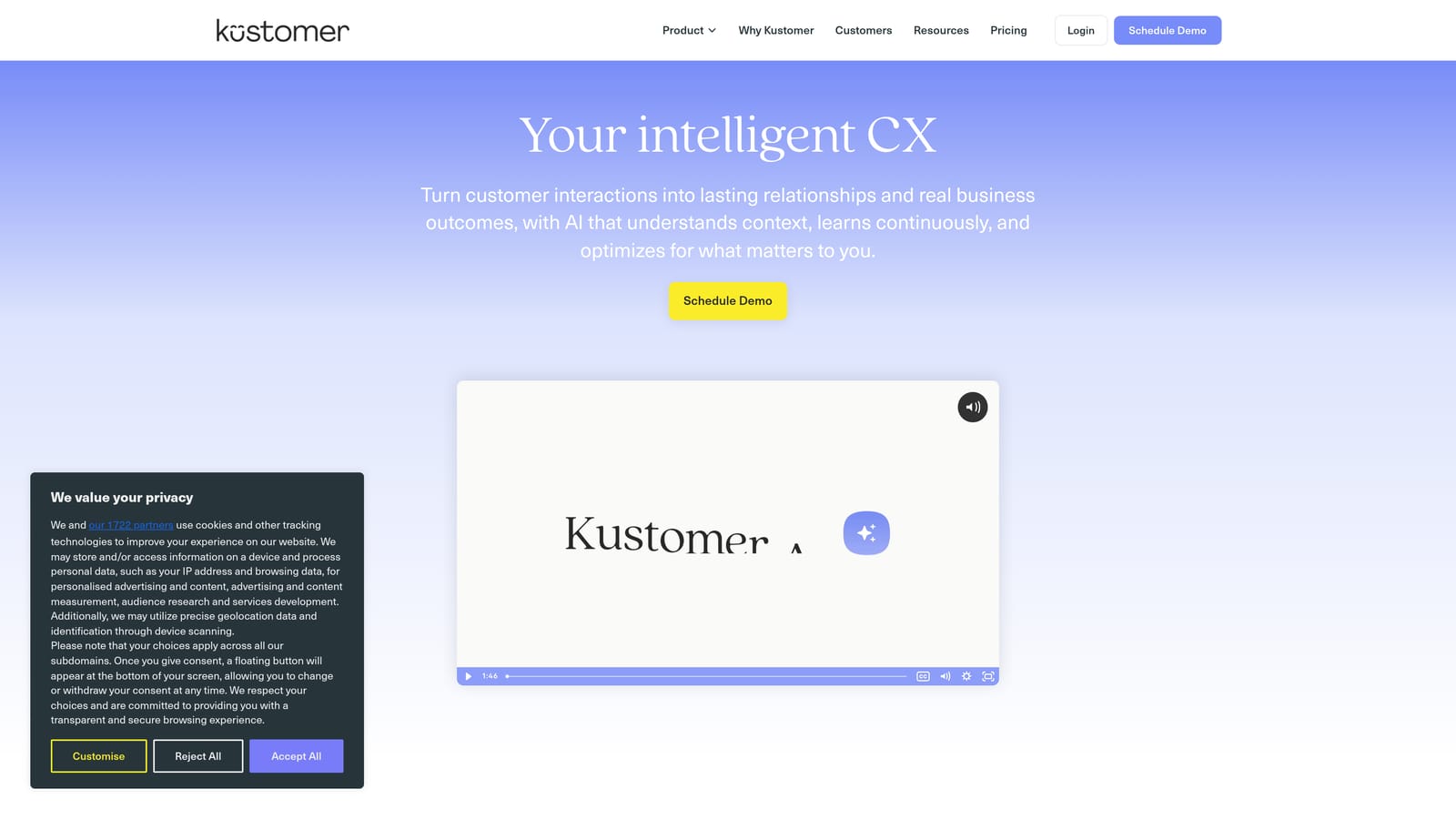
Kustomer is a CRM-native customer service platform that unifies customer data across purchase history, support history, and communication channels, with AI automation layered on top of that unified view.
Where This Tool Shines
Kustomer's core differentiator is its unified customer timeline. Rather than treating each support ticket in isolation, Kustomer presents agents with a complete view of every interaction, purchase, and communication touchpoint in a single record. AI automation then operates on top of that rich data context, which means automated workflows can factor in a customer's full history rather than just the current conversation.
For high-volume consumer brands where context matters, such as subscription businesses or retailers with complex order histories, this architecture produces meaningfully better automation outcomes than tools working from thinner data.
Key Features
Unified Customer Timeline: Combines CRM data, support history, and transaction records into a single customer view accessible across every interaction.
AI-Powered Automation: Automates workflows across the full customer journey using the unified data layer as context.
Omnichannel Support: Handles email, chat, social, SMS, and voice within a single platform.
Proactive Support Workflows: Triggers automated outreach or support actions based on customer behavior signals.
High-Volume Optimization: Architecture designed for brands handling large support volumes across multiple channels simultaneously.
Best For
Kustomer is a strong fit for high-volume consumer brands and subscription businesses where unified customer data drives better automation. It's less commonly used in pure B2B SaaS contexts where product-specific integrations and technical support workflows are the priority.
Pricing
Enterprise pricing; contact Kustomer directly for current rates at kustomer.com.
7. Forethought
Best for: Support operations leaders who want AI triage and routing on top of their existing helpdesk without replacing it.
Forethought is an AI platform focused on triage, routing, and resolution that sits on top of existing helpdesks like Zendesk and Salesforce Service Cloud.
Where This Tool Shines
Forethought's value proposition is efficiency on top of what you already have. Rather than asking you to migrate away from Zendesk or Salesforce Service Cloud, it trains predictive models on your historical ticket data and uses those models to route, tag, and prioritize incoming tickets more intelligently than rule-based automation alone. Teams focused on handle time and first-contact resolution metrics will find the analytics layer directly relevant to those goals.
Agent assist functionality surfaces relevant knowledge in real time as agents work tickets, reducing the time spent searching for answers and improving consistency across the team.
Key Features
Predictive Triage: AI trained on historical ticket data routes and prioritizes incoming tickets with greater accuracy than manual rules.
Automated Tagging and Deflection: Handles ticket categorization and deflects resolvable queries before they reach the queue.
Real-Time Agent Assist: Surfaces relevant knowledge and suggested responses as agents work, reducing lookup time.
Helpdesk-Agnostic Architecture: Works alongside existing helpdesks rather than replacing them, lowering migration risk.
Efficiency-Focused Analytics: Reporting centered on handle time, first-contact resolution, and deflection rates.
Best For
Forethought is best for enterprise support operations teams that want measurable efficiency gains on top of an existing Zendesk or Salesforce investment without the disruption of a platform change. Less suited for teams looking for AI-first autonomous resolution from the ground up.
Pricing
Enterprise pricing; contact Forethought directly for a quote at forethought.ai.
8. Helpshift
Best for: Mobile and gaming companies that need AI-powered in-app support built for mobile interaction patterns.
Helpshift is an SDK-based customer support platform built specifically for mobile and gaming companies, with AI automation tailored for in-app support experiences.
Where This Tool Shines
Helpshift occupies a specific niche and serves it well. The SDK-first approach means support is embedded directly within iOS and Android apps rather than redirecting users to a browser or external portal. For gaming studios and mobile-first consumer apps, this is the right architecture: players stay in the experience, and support interactions follow mobile interaction patterns like asynchronous messaging rather than forcing users into a traditional ticket flow.
AI-powered bots and automated FAQ resolution work within this mobile UX context, handling common queries without breaking the in-app experience. Smart campaigns and proactive in-app messaging extend the platform beyond reactive support into player engagement.
Key Features
Native SDK Integration: Embeds support directly into iOS and Android apps without redirecting users externally.
In-App AI Bots: AI-powered bots handle FAQ resolution and common queries within the mobile user experience.
Asynchronous Messaging: Support interactions follow mobile-native patterns rather than traditional synchronous chat flows.
Smart Campaigns: Proactive in-app messaging for player engagement, onboarding, and issue prevention.
Mobile-First Design: Architecture purpose-built for gaming studios and mobile-first consumer apps.
Best For
Helpshift is the clear choice for gaming studios and mobile-first consumer apps that need in-app support without breaking the user experience. It's not designed for web-based B2B SaaS support workflows and would be a poor fit outside its core mobile use case.
Pricing
Pricing based on monthly active users and feature tier; contact Helpshift directly for a quote at helpshift.com.
9. Drift (Salesloft)
Best for: B2B revenue teams where support conversations frequently carry renewal or upsell potential.
Drift, now part of Salesloft, is a conversational AI platform that blends marketing, sales, and support interactions with a focus on revenue execution rather than pure support resolution.
Where This Tool Shines
Drift's positioning has shifted since the Salesloft acquisition. It's less a pure support tool and more a revenue conversation platform where support interactions are one entry point among several. The strength here is buyer intent detection: when a customer contacts support, Drift can surface signals that indicate renewal risk, expansion opportunity, or active evaluation, routing that conversation appropriately rather than treating it as a routine ticket.
For B2B teams where the line between support and account management is blurry, the integration with Salesloft's broader revenue intelligence platform creates a more connected workflow than a standalone support tool would provide.
Key Features
Conversational AI Across Support and Sales: Handles conversations that span support, sales, and marketing touchpoints within a single platform.
Buyer Intent Signals: Surfaces intent indicators during support interactions, flagging renewal risk or upsell potential in real time.
Meeting Scheduling and Routing: Built-in scheduling and routing for conversations that need to move from chat to a human meeting.
Salesloft Integration: Connects to Salesloft's revenue intelligence platform for a unified view across the customer lifecycle.
Revenue-Aware Routing: Routes conversations based on commercial signals, not just support topic or queue.
Best For
Drift is best suited for B2B teams where support conversations frequently carry renewal or upsell potential and where the support function is closely aligned with account management. Teams looking for a dedicated support AI with high autonomous resolution rates will find Drift's revenue-first focus less aligned with that goal.
Pricing
Enterprise-oriented pricing; contact Drift or Salesloft directly for current rates at drift.com.
Which Tool Is Right for Your Team?
The right customer service AI solution depends less on which tool has the most features and more on where you're starting from and what you're trying to accomplish.
If you're a B2B SaaS team that wants AI-first autonomous resolution with deep product context and business intelligence built in, Halo AI is built for exactly that use case. The page-aware context, continuous learning, and smart inbox signals go well beyond what helpdesk add-ons can offer.
If you're deeply embedded in an existing platform and not ready to migrate, Intercom Fin, Zendesk AI, and Freshdesk Freddy AI each layer AI onto familiar infrastructure. Fin is the strongest of the three for autonomous resolution; Zendesk AI suits large enterprises with complex workflows; Freddy AI is the most accessible for SMBs watching budget.
For e-commerce and small businesses, Tidio Lyro offers the fastest path to live AI chat without a significant implementation investment. For mobile and gaming, Helpshift is purpose-built and hard to match. For teams where support and revenue intersect, Drift adds commercial intelligence that pure support tools don't provide. And for support ops leaders who want efficiency gains without platform migration, Forethought and Kustomer each serve distinct needs.
Your support team shouldn't scale linearly with your customer base. Let AI agents handle routine tickets, guide users through your product, and surface business intelligence while your team focuses on complex issues that need a human touch. See Halo in action and discover how continuous learning transforms every interaction into smarter, faster support.