9 Best Customer Service AI Tools in 2026
This guide ranks the 9 best customer service AI tools available in 2026, evaluating each on autonomous resolution capability, integration depth, ease of deployment, and real business impact. Whether you're a B2B SaaS team or a product-led company, it cuts through the noise to help you find the right platform for scaling support without scaling headcount.
 Grant CooperFounder14 min read
Customer support teams are under more pressure than ever. Rising ticket volumes, 24/7 expectations, and lean headcounts don't mix well — and the old playbook of hiring your way out of the problem simply doesn't scale anymore.
AI tools have moved well beyond basic chatbots. Today's platforms can resolve tickets autonomously, detect bugs, surface revenue signals, and hand off seamlessly to human agents when needed. But not every tool is built the same way. Some bolt AI onto legacy helpdesk infrastructure. Others are built AI-first from the ground up. Some excel at deflection; others at deep integrations or genuine business intelligence.
Here are the top customer service AI tools available in 2026, evaluated on autonomous resolution capability, integration depth, ease of deployment, and real business impact beyond deflection rates. Whether you're a B2B SaaS team outgrowing your current helpdesk or a product-led company looking to scale support without scaling headcount, there's a fit here for you.
1. Halo AI
Best for: B2B SaaS teams that need autonomous resolution, deep integrations, and business intelligence in one platform.
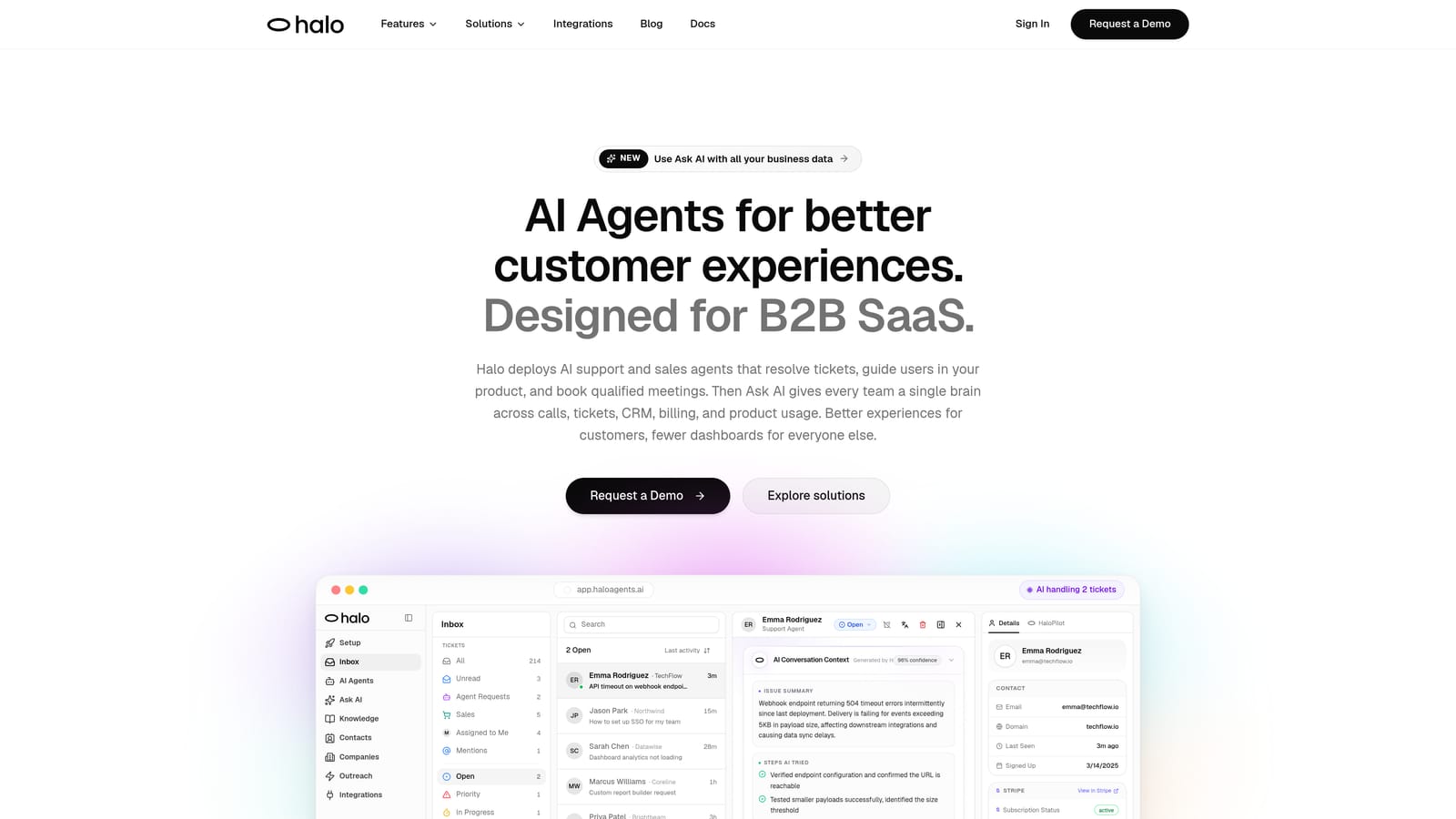
Halo AI is an AI-first customer support platform built specifically for B2B SaaS teams that need more than ticket deflection.
Where This Tool Shines
What separates Halo from most tools on this list is that it isn't a layer on top of an existing helpdesk — it is the support system, built AI-first from the ground up. That architectural decision matters: rather than retrofitting intelligence onto legacy infrastructure, Halo's agents learn from every resolved interaction, getting smarter over time without manual retraining.
The page-aware chat widget is a standout feature. It understands what page a user is currently on and delivers contextual visual guidance based on that context — meaning users get relevant help, not generic responses. Pair that with a smart inbox that surfaces customer health signals, revenue intelligence, and anomaly detection, and you have a support platform that generates business intelligence alongside ticket resolution.
Key Features
Page-Aware Chat Widget: Understands the user's current page and provides contextual visual guidance tailored to their exact location in your product.
Autonomous Ticket Resolution: AI agents resolve tickets end-to-end with intelligent handoff to human agents for complex issues that genuinely need one.
Smart Inbox with Business Intelligence: Surfaces customer health signals, revenue intelligence, and anomaly detection beyond standard CSAT metrics.
Auto Bug Ticket Creation: Automatically identifies and routes bug reports directly to Linear or equivalent project management tools without agent intervention.
Deep Integration Stack: Connects natively with Linear, Slack, HubSpot, Intercom, Stripe, Zoom, PandaDoc, and Fathom — covering the full B2B SaaS toolchain.
Continuous Learning: Every resolved interaction feeds back into the system, improving resolution quality over time without manual configuration.
Best For
B2B SaaS companies that want an AI-first support system rather than an AI add-on to an existing helpdesk. Particularly strong for product-led growth teams where contextual, page-aware guidance is critical, and for support operations that want to extract business intelligence from support interactions.
Pricing
Contact for pricing. Halo is built for B2B SaaS teams at scale — reach out directly through the website for a tailored quote.
2. Intercom Fin
Best for: Teams already on Intercom who want native AI resolution without switching platforms.
Intercom Fin is Intercom's native AI agent that resolves support queries using your existing knowledge base content.
Where This Tool Shines
If your team is already living inside Intercom, Fin is the path of least resistance to AI-powered resolution. It uses your existing knowledge base content to answer queries, and the Fin 2 update introduced multi-step reasoning that handles more complex questions than earlier versions could manage.
The handoff experience is particularly smooth. When Fin can't resolve a query, it passes the conversation to a human agent within the same thread — no context lost, no jarring transitions. For teams where Intercom is the primary support channel, this native integration removes a lot of deployment friction.
Key Features
GPT-Powered Resolution: Uses your existing knowledge base to answer queries without requiring a separate content migration or setup process.
Multi-Step Reasoning: Fin 2 can work through more complex, multi-part queries rather than relying solely on direct knowledge base matches.
Native Intercom Integration: No additional setup required for existing Intercom users — Fin activates within your current environment.
Seamless Human Handoff: Passes unresolved conversations to human agents within the same thread, preserving full conversation context.
Resolution-Based Pricing: You pay per resolution rather than per seat, which aligns cost with actual AI output.
Best For
Teams where Intercom is already the primary support channel and who want to add autonomous resolution without changing their core tooling. Less compelling for teams not already in the Intercom ecosystem.
Pricing
Resolution-based pricing — costs scale with usage volume. This model works well at lower volumes but can become expensive as resolution counts grow.
3. Zendesk AI
Best for: Enterprises with established Zendesk workflows that want AI embedded across their existing suite.
Zendesk AI is a set of AI capabilities embedded across the full Zendesk Suite, covering triage, agent assist, automated responses, and predictive analytics.
Where This Tool Shines
Zendesk's strength is breadth. AI features touch every part of the platform: intelligent triage routes tickets before agents see them, Copilot surfaces suggested replies and knowledge base content during live conversations, and automated CSAT prediction gives managers early warning on at-risk interactions.
For enterprises with deeply configured Zendesk environments, this is additive intelligence rather than a platform change. The tradeoff is complexity: configuring Zendesk AI well requires investment, and the AI layers onto existing infrastructure rather than replacing it with something purpose-built.
Key Features
Intelligent Triage and Routing: Automatically classifies and routes incoming tickets across the full Suite based on intent and priority signals.
AI Copilot: Assists human agents with suggested replies and real-time knowledge retrieval during active conversations.
Automated CSAT Prediction: Predicts satisfaction scores before surveys go out, enabling proactive intervention on at-risk tickets.
AI-Powered Macros: Suggests and generates response macros based on ticket patterns, reducing repetitive agent effort.
Enterprise Integration Ecosystem: Connects with a broad range of enterprise tools through Zendesk's established marketplace.
Best For
Large enterprises with complex, established Zendesk workflows that need AI augmentation rather than a platform switch. Teams evaluating a full migration to an AI-first system may find the additive model limiting.
Pricing
AI features are an add-on to existing Zendesk Suite plans. Enterprise pricing applies — contact Zendesk for current tier details.
4. Freshdesk Freddy AI
Best for: SMB and mid-market teams on Freshworks who want AI across support, CRM, and ITSM in one ecosystem.
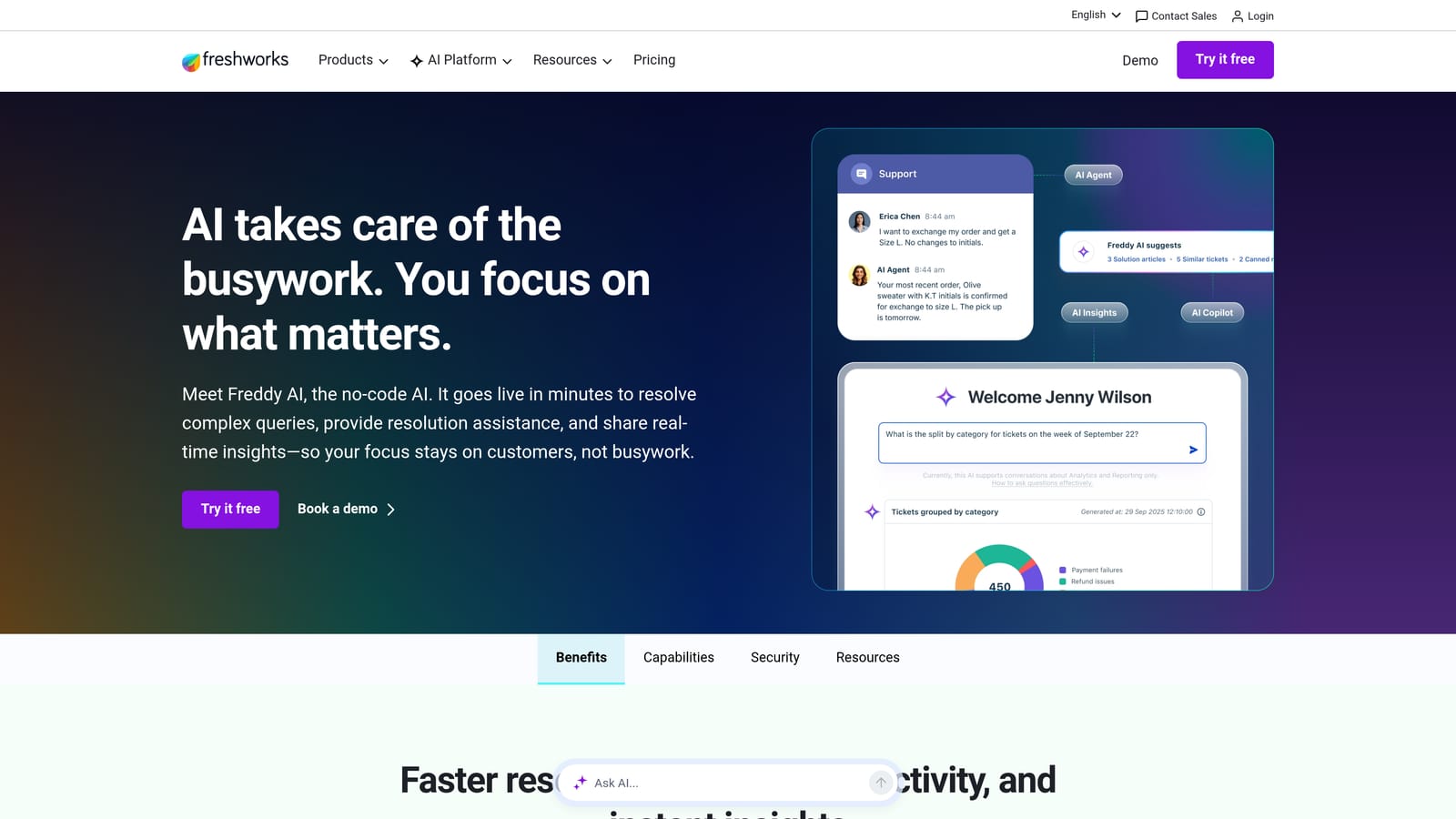
Freshdesk Freddy AI is Freshworks' AI layer spanning self-service deflection, agent assist, and analytics across the Freshdesk support platform.
Where This Tool Shines
Freddy AI's biggest advantage is cross-suite coverage. If your team uses Freshdesk for support, Freshsales for CRM, and Freshservice for IT, Freddy connects intelligence across all three. That unified context means agents get a more complete picture of the customer without switching between systems.
Pricing is also more accessible than enterprise-tier competitors. For SMBs and mid-market teams that want capable AI without Zendesk-level costs, Freddy represents solid value — particularly if the Freshworks suite is already in use.
Key Features
Freddy Self Service: Handles automated deflection using your knowledge base, reducing ticket volume before queries reach agents.
Freddy Copilot: Provides agents with suggested responses, drafts, and contextual knowledge retrieval during live interactions.
Freddy Insights: Delivers AI-powered analytics on support patterns, team performance, and resolution trends.
Cross-Suite Integration: Connects with Freshsales CRM and Freshservice ITSM for unified customer context across the Freshworks ecosystem.
Accessible Pricing: More affordable than enterprise-tier alternatives at comparable feature levels.
Best For
SMB and mid-market teams already using multiple Freshworks products who want AI assistance across their support stack without enterprise-level investment. Less suited to teams needing deep autonomous resolution or integrations outside the Freshworks ecosystem.
Pricing
Included in select Freshdesk plans; Freddy Copilot is available as an add-on. Check Freshworks' current pricing page for tier details.
5. Tidio
Best for: E-commerce and SMB teams that need fast deployment with Shopify or WooCommerce integrations.
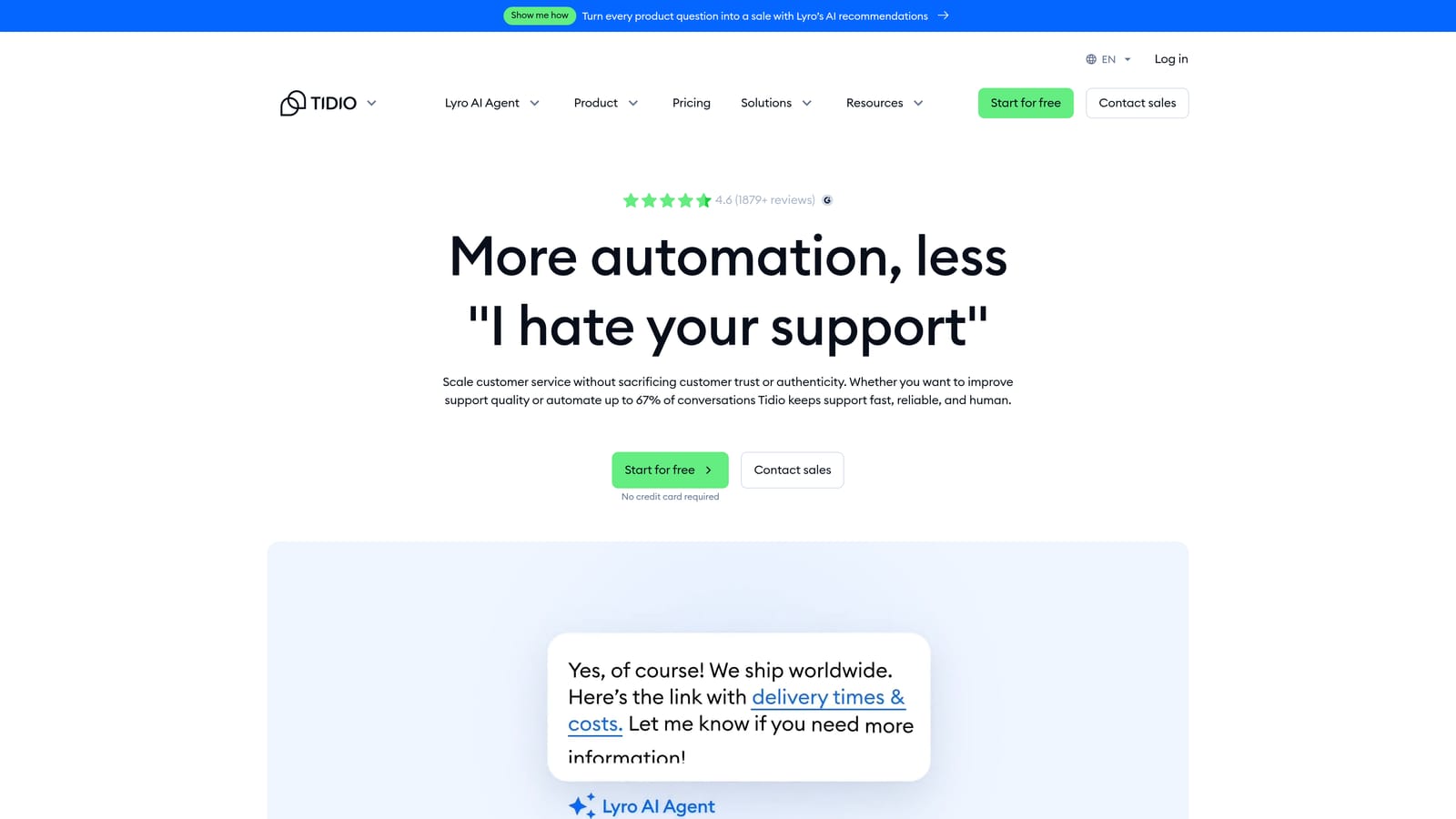
Tidio is an AI-powered chat and automation platform featuring the Lyro AI conversational agent and a visual flow builder for rule-based automation.
Where This Tool Shines
Tidio's appeal is speed and simplicity. The Lyro AI agent can be deployed quickly using your existing support content, and the visual flow builder lets non-technical team members build automation without writing a line of code. For e-commerce teams, native integrations with Shopify and WooCommerce make setup genuinely fast.
It's worth being clear about where Tidio fits: this is a platform built for SMBs and e-commerce, not complex B2B SaaS environments with multi-system integration needs. Within its intended use case, it delivers well. Outside of it, teams may find the integration depth limiting.
Key Features
Lyro AI: Conversational AI agent that resolves queries using your existing support content with minimal configuration required.
Visual Flow Builder: Drag-and-drop automation builder for rule-based flows — no coding required for basic automation.
E-Commerce Integrations: Native connections with Shopify, WooCommerce, and other major e-commerce platforms.
Live Agent Fallback: Seamlessly transfers conversations to human agents within the same chat interface when AI can't resolve the query.
Fast Deployment: Minimal technical setup required — teams can go live quickly without engineering resources.
Best For
E-commerce businesses and SMBs that need accessible AI chat with strong platform integrations and fast deployment. Not the right fit for B2B SaaS teams with complex multi-system support needs.
Pricing
Free plan available; paid plans start at approximately $29/month. One of the more accessible price points on this list for small teams.
6. Forethought
Best for: High-volume support teams that need smarter intake and routing without replacing their existing helpdesk.
Forethought is an AI triage and routing platform that layers on top of existing helpdesks to classify, prioritize, and route tickets before agents touch them.
Where This Tool Shines
Forethought solves a specific problem well: getting the right ticket to the right person at the right time. Its Agatha AI predicts ticket intent and routes incoming queries based on classification before any human involvement. For high-volume support organizations, this upstream intelligence can meaningfully reduce misrouting and queue buildup.
The key design choice is that Forethought works as a layer on top of Zendesk, Salesforce, Freshdesk, and other established helpdesks. Teams that want smarter intake without migrating their entire support stack will find this approach appealing. Teams looking for end-to-end autonomous resolution may need to look elsewhere.
Key Features
Agatha AI: Predicts ticket intent and classifies incoming queries for routing before agents engage.
Helpdesk Agnostic: Layers on top of Zendesk, Salesforce, Freshdesk, and other major platforms without requiring a migration.
Automated Deflection: Handles common query types automatically, reducing volume that reaches human agents.
Agent Assist: Surfaces suggested responses from your knowledge base during active agent conversations.
Pattern Analytics: Provides visibility into ticket patterns and resolution efficiency over time.
Best For
High-volume support organizations with established helpdesk investments that need smarter triage and routing without a platform change. Teams wanting full autonomous resolution will need a more comprehensive solution.
Pricing
Custom pricing based on volume and helpdesk integration. Contact Forethought directly for a quote.
7. Ada
Best for: Global enterprises needing multilingual AI agents across web, mobile, and messaging channels without engineering resources.
Ada is an enterprise-grade no-code AI agent builder with strong multilingual capabilities and broad channel support.
Where This Tool Shines
Ada's no-code visual builder is genuinely capable. Support teams can configure AI agents, build conversation flows, and connect customer data without engineering involvement. For global enterprises managing support across multiple languages and channels, Ada's multilingual support across dozens of languages is a meaningful differentiator.
Channel breadth is another strength. Ada can deploy across web, mobile, SMS, and social messaging platforms from a single configuration — useful for enterprises with diverse customer touchpoints. The tradeoff is cost and complexity: Ada is built for enterprise scale, and smaller teams may find the investment difficult to justify.
Key Features
No-Code Visual Builder: Configure AI agents and conversation flows without engineering resources through a drag-and-drop interface.
Multilingual Support: Handles customer interactions across dozens of languages, making it practical for global support operations.
Multi-Channel Deployment: Deploy across web, mobile, SMS, and social messaging platforms from a single configuration.
CRM-Powered Personalization: Uses customer data from CRM systems to personalize AI agent responses.
Enterprise Security and Compliance: Built-in controls for enterprise-grade security, data governance, and compliance requirements.
Best For
Global enterprises with diverse language requirements and multi-channel support needs that want to configure AI agents without engineering resources. Less suitable for smaller teams where the cost-to-value ratio may not hold.
Pricing
Custom enterprise pricing. Contact Ada directly for a quote based on your volume and channel requirements.
8. Kustomer
Best for: High-volume B2C companies where full customer context — purchase history, past interactions, behavioral data — is central to support quality.
Kustomer is a CRM-native customer service platform that combines a unified customer timeline with AI-powered support workflows.
Where This Tool Shines
Kustomer's defining feature is the unified customer timeline. Rather than treating each support ticket as an isolated event, Kustomer pulls together purchase history, past interactions, and behavioral data into a single view. When AI surfaces a suggested response, it's informed by that full context — not just the current message.
This approach is particularly powerful for B2C companies in retail, subscription commerce, and consumer services where customer history is directly relevant to resolution. For pure B2B SaaS environments, the CRM-native model may be more than what's needed, and the per-seat pricing reflects the platform's enterprise positioning.
Key Features
Unified Customer Timeline: Combines purchase history, past support interactions, and behavioral data into a single agent view.
AI Intent Detection: Automatically identifies query intent and routes tickets to the appropriate team or automated workflow.
Context-Aware Agent Assist: Suggests replies based on the full customer timeline, not just the current conversation.
Omnichannel Support: Handles email, chat, phone, and social channels within a single unified platform.
Workflow Automation: Automates repetitive support processes and routing rules across the full customer journey.
Best For
High-volume B2C companies in retail, subscription commerce, or consumer services where customer context is central to support quality. Less commonly the right fit for B2B SaaS teams.
Pricing
Starts at approximately $89/user/month. Enterprise pricing available for larger teams — contact Kustomer for volume details.
9. Help Scout AI
Best for: Small teams that want AI assistance to reduce agent effort without replacing the human touch entirely.
Help Scout is a human-first support platform that has added AI assistance features to reduce agent effort while keeping humans at the center of every interaction.
Where This Tool Shines
Help Scout's AI additions are practical and well-integrated into a platform that small teams already love for its clean, minimal interface. AI Summarize condenses long conversation threads instantly. AI Drafts generates reply suggestions from conversation context. AI Assist adjusts tone and improves message clarity. None of these replace the agent — they just make the agent faster.
This is intentional. Help Scout is built on a human-first philosophy, and the AI features reflect that. If your team values the quality and warmth of human interaction and wants AI to reduce friction rather than take over, Help Scout is a natural fit. If you need autonomous resolution at scale, this isn't the right tool.
Key Features
AI Summarize: Generates instant summaries of long conversation threads so agents can get up to speed without reading everything.
AI Drafts: Suggests complete reply drafts based on conversation context, which agents can edit and send.
AI Assist: Adjusts tone, improves clarity, and helps agents refine messages before sending.
Clean, Minimal Interface: Designed for small team usability — low learning curve, high day-to-day usability.
Shared Inbox, Docs, and Chat: Combines core support channels in one straightforward platform without unnecessary complexity.
Best For
Small support teams that want AI assistance to reduce repetitive drafting and summarization work without automating the human relationship out of support. Not built for autonomous resolution or complex B2B SaaS integration needs.
Pricing
Plans start at approximately $22/user/month. AI features are included in higher tiers — check Help Scout's current pricing page for the latest details.
Which Tool Is Right for Your Team?
The right customer service AI tool depends heavily on where you are today and what you actually need from AI. Here's a quick way to think through the decision.
If you're a B2B SaaS team that wants AI-first architecture: Halo AI is the strongest fit. It's not a layer on top of an existing helpdesk — it is the support system, built from the ground up for autonomous resolution, deep integrations, and business intelligence. The page-aware context and continuous learning make it particularly well-suited for product-led teams.
If you're already on Zendesk or Freshdesk and don't want to migrate: Zendesk AI or Freshdesk Freddy AI are the logical choices. Both add meaningful AI capability to existing workflows without requiring a platform change. Zendesk skews enterprise; Freshdesk is more accessible for SMBs and mid-market teams.
If you're in e-commerce or running a small team: Tidio offers the fastest path to AI-powered chat with accessible pricing and strong e-commerce integrations. Help Scout is worth considering if your team values human interaction and wants AI to assist rather than automate.
If you need smarter routing without switching helpdesks: Forethought solves the intake problem well for high-volume teams that have invested heavily in existing platforms.
If you're a global enterprise with multilingual needs: Ada's no-code builder and broad language support make it a strong contender, though the investment reflects enterprise positioning.
The broader shift in this market is clear: buyers are moving away from evaluating tools purely on deflection rates and toward asking harder questions about autonomous resolution quality, integration depth, and the business intelligence that support interactions can surface. Deflection is table stakes. What happens after deflection — and what your support data tells you about your customers — is where the real differentiation lives.
Your support team shouldn't scale linearly with your customer base. Let AI agents handle routine tickets, guide users through your product, and surface business intelligence while your team focuses on complex issues that need a human touch. See Halo in action and discover how continuous learning transforms every interaction into smarter, faster support.