9 Best Customer Service AI Use Cases (And the Tools That Power Them) in 2026
This guide breaks down nine of the most impactful Customer Service AI Use Cases — from autonomous ticket resolution and customer health monitoring to intelligent routing — and compares the platforms best equipped to deliver them. It's built for B2B SaaS and product-led teams evaluating or replacing AI support tools in 2026.
 Matt PattoliFounder14 min read
Customer service AI has moved well past chatbots that answer FAQs. Today's AI tools resolve tickets autonomously, detect customer health signals, route complex issues to the right human, and even file bug reports without adding headcount. But the landscape is crowded, and not every tool handles every use case equally well.
This guide breaks down nine of the most impactful customer service AI use cases and the platforms built to deliver them. Whether you're evaluating your first AI support tool or looking to replace a bolt-on solution that's underperforming, you'll find honest, structured comparisons here. We've focused on tools that serve B2B SaaS teams and product-led companies, particularly those already using helpdesks like Zendesk, Freshdesk, or Intercom, and ranked them by breadth of use case coverage, depth of AI capability, and real-world integration flexibility.
1. Halo AI
Best for: B2B SaaS teams wanting autonomous ticket resolution, page-aware guidance, and business intelligence in one platform.
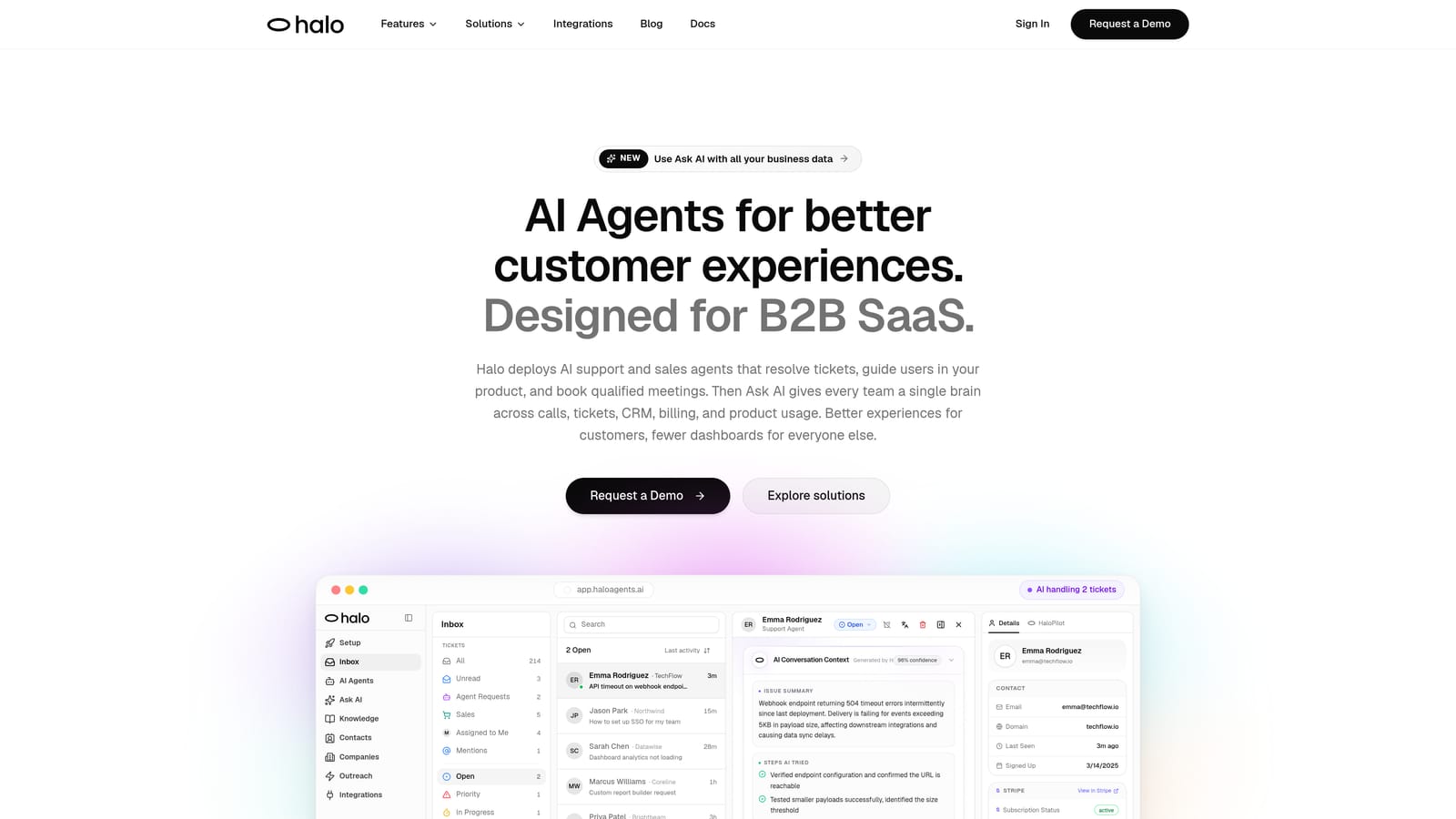
Halo AI is an AI-first customer support platform that resolves tickets autonomously, guides users through your product with page-aware visual context, and surfaces business intelligence across every interaction.
Where This Tool Shines
Halo AI isn't a layer bolted onto an existing helpdesk. It's built from the ground up around autonomous resolution, which means the AI agents are designed to handle tickets end-to-end without human involvement, not just suggest replies for agents to approve. That architectural difference matters when you're evaluating whether AI will actually reduce ticket volume or just make your agents slightly faster.
The page-aware chat widget is a genuinely distinctive capability. It sees what the user sees, providing visual UI guidance in context rather than generic instructions. For SaaS products with complex workflows, this closes the gap between "here's a help article" and "here's exactly what to click next." Add the smart inbox with anomaly detection, customer health signals, and revenue intelligence, and you're looking at a platform that does more than support, it surfaces business intelligence that product and success teams actually care about.
Key Features
Autonomous AI Agents: Resolve support tickets end-to-end without requiring human approval on every response.
Page-Aware Chat Widget: Sees what the user sees in real time and delivers visual UI guidance specific to their current context in your product.
Smart Inbox with Business Intelligence: Surfaces anomaly detection, customer health signals, and revenue intelligence directly from support data.
Auto Bug Ticket Creation: Detects recurring issues and automatically routes bug tickets to engineering via Linear integration.
Live Agent Handoff: Escalates complex issues to human agents with full context preserved, so nothing gets repeated.
Broad Integration Stack: Connects with Slack, HubSpot, Intercom, Stripe, Zoom, PandaDoc, and Fathom.
Best For
Halo AI is best suited for B2B SaaS companies and product-led growth teams that want AI to handle the full support lifecycle, not just assist agents. It's particularly strong for teams that need their support data to feed product decisions, not just support metrics. If you're already using Intercom, HubSpot, or Linear, the integration depth is a practical advantage from day one.
Pricing
Contact haloagents.ai directly for current pricing. Given the platform's breadth, pricing is best evaluated in the context of your specific team size and ticket volume.
2. Intercom
Best for: Teams already using Intercom as their primary support channel who want AI-powered autonomous conversation handling.
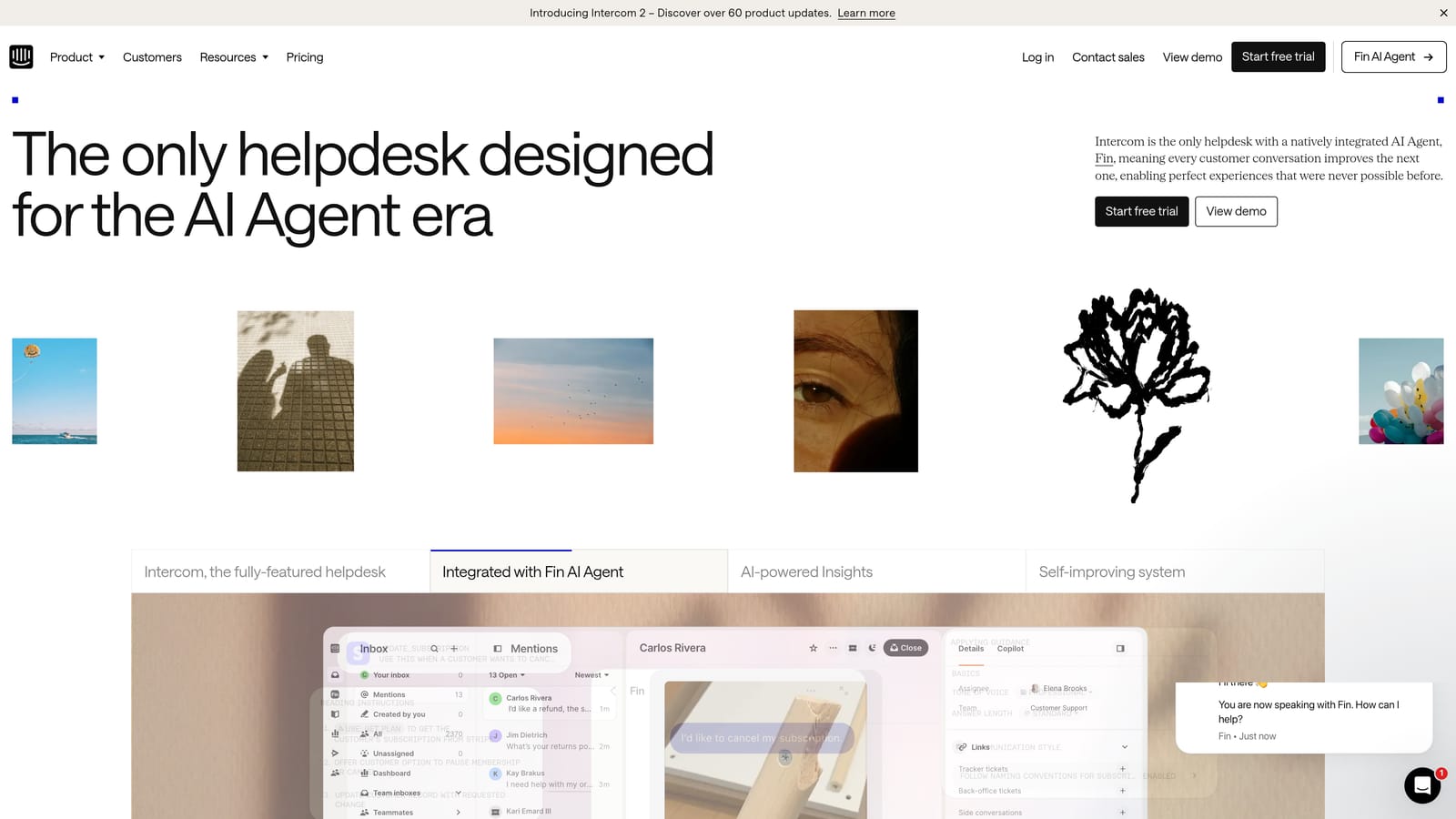
Intercom is a customer messaging platform featuring Fin, an AI agent built on large language models that handles support conversations across chat, email, and more.
Where This Tool Shines
Fin is one of the most widely deployed AI support agents in SaaS. It's deeply embedded in Intercom's messenger experience, which means if your team already lives in Intercom, adding Fin is a relatively seamless expansion rather than a separate implementation project. The AI handles conversation resolution autonomously and hands off to human agents with full context when needed.
Where Intercom excels is in the ecosystem fit. The combination of Fin's resolution capability with Intercom's inbox, help center, and analytics creates a cohesive experience. Teams that aren't already using Intercom as their primary channel may find less value, since the AI capabilities are most powerful within that native environment.
Key Features
Fin AI Agent: Handles support conversations autonomously using large language models trained on your help content.
AI-Powered Inbox: Surfaces suggested replies and conversation summaries to assist human agents.
Native Help Center Integration: Fin draws on your existing help content without requiring separate training pipelines.
Human Handoff with Context: Escalates to live agents with the full conversation history intact.
Resolution Rate Analytics: Tracks AI resolution rates and CSAT scores to measure actual impact.
Best For
Teams already invested in the Intercom ecosystem. Fin is a strong choice when you want AI-powered resolution without switching platforms. Less compelling for teams using Zendesk or Freshdesk as their primary helpdesk.
Pricing
Fin AI agent is priced per resolution. Intercom plans start at published tiers. Check intercom.com for current rates, as pricing has evolved with the Fin product.
3. Zendesk AI
Best for: Large support organizations with established Zendesk workflows looking to add AI triage, routing, and agent assist natively.
Zendesk AI is a suite of native AI capabilities built into Zendesk, covering triage, routing, agent assist, and generative reply suggestions.
Where This Tool Shines
For teams deeply embedded in Zendesk, the native AI integration is a practical advantage. There's no separate tool to implement, no data sync to manage, and no additional vendor relationship to maintain. Intent detection, smart triage, and macro suggestions work within existing workflows, which reduces adoption friction for large teams.
The tradeoff is that Zendesk AI feels additive rather than transformative for many teams. It enhances what agents already do rather than replacing the need for agent involvement on routine tickets. For organizations where autonomous resolution is the goal, this distinction matters.
Key Features
Intent Detection: Classifies incoming tickets by topic and urgency automatically.
Smart Routing: Directs tickets to the right agent or queue based on AI-detected intent.
Macro and Reply Suggestions: Surfaces relevant response templates and AI-drafted replies for agents.
AI Ticket Summaries: Generates concise summaries of long conversation threads to speed up agent context-gathering.
Suite Integration: All AI features are embedded in Zendesk Suite with no separate tool required.
Best For
Enterprise support teams with high ticket volumes and established Zendesk deployments. Best suited for organizations that want to improve agent efficiency rather than replace agent involvement on most tickets.
Pricing
AI features are included in higher Zendesk Suite tiers. Enterprise pricing requires a custom quote. Check zendesk.com for current tier details.
4. Freshdesk Freddy AI
Best for: Mid-market teams on Freshdesk that want modular AI coverage across self-service, agent assist, and support analytics.
Freshdesk Freddy AI is a modular AI layer covering self-service, agent copilot, and support analytics across the Freshdesk platform.
Where This Tool Shines
Freddy AI's modular structure is one of its most practical advantages. Rather than buying a single AI package, teams can adopt the layers they actually need: Freddy Self Service for deflection, Freddy Copilot for agent assist, and Freddy Insights for analytics. This makes it easier to start with one capability and expand as the team's AI maturity grows.
For growing mid-market teams, the breadth of coverage across three distinct use cases, without requiring a platform migration, is a genuine selling point. The analytics layer in particular gives support leaders visibility into trends and team performance that goes beyond basic ticket metrics.
Key Features
Freddy Self Service: AI-powered bot that deflects common queries before they reach the support queue.
Freddy Copilot: Provides real-time reply suggestions, conversation summaries, and draft responses for human agents.
Freddy Insights: AI-driven analytics that surface trends in support volume, team performance, and customer sentiment.
Modular Pricing: Adopt individual layers based on current needs rather than paying for the full suite upfront.
Native Freshdesk Integration: Works within existing Freshdesk workflows without additional implementation overhead.
Best For
Mid-market support teams already using Freshdesk who want to add AI incrementally. Particularly well-suited for teams that want analytics and agent assist before committing to full autonomous resolution.
Pricing
Modular add-on pricing on top of Freshdesk base plans. Check freshworks.com for current rates on each Freddy module.
5. Salesforce Einstein for Service
Best for: Enterprise organizations already on Salesforce Service Cloud that need AI personalization informed by full CRM context.
Salesforce Einstein for Service is an AI capability suite embedded in Salesforce Service Cloud, drawing on full CRM context to personalize and automate customer support at enterprise scale.
Where This Tool Shines
Einstein's core differentiator is context depth. Because it operates within Salesforce Service Cloud, the AI has access to full account history, purchase data, case history, and CRM records when generating responses or recommendations. For enterprise support teams where every interaction needs to reflect the full customer relationship, this context richness is difficult to replicate with standalone AI tools.
The tradeoff is complexity and cost. Einstein is not a lightweight implementation, and the value scales directly with how deeply a company has invested in the Salesforce ecosystem. Teams that aren't already on Service Cloud will find the onboarding investment substantial.
Key Features
CRM-Informed AI Responses: Generates responses and recommendations using full account history, purchase data, and case history.
Einstein Copilot: Provides next-best-action recommendations and agent assist capabilities within the Service Cloud interface.
Automated Case Classification: Classifies and routes incoming cases based on AI-detected intent and customer context.
Knowledge Article Recommendations: Surfaces relevant knowledge base content for agents during active cases.
Data Cloud Integration: Connects with Salesforce's broader data infrastructure for analytics and reporting.
Best For
Large enterprises already committed to the Salesforce ecosystem. If your support, sales, and success teams all operate in Salesforce, Einstein's context depth is a compelling advantage. Not recommended as a first AI investment for teams outside the Salesforce ecosystem.
Pricing
Requires a Salesforce Service Cloud license as the base. Einstein add-ons are priced separately and typically require an enterprise quote. Contact Salesforce directly for current pricing.
6. Tidio
Best for: SMBs and e-commerce brands looking for affordable AI-powered chat and self-service with minimal setup.
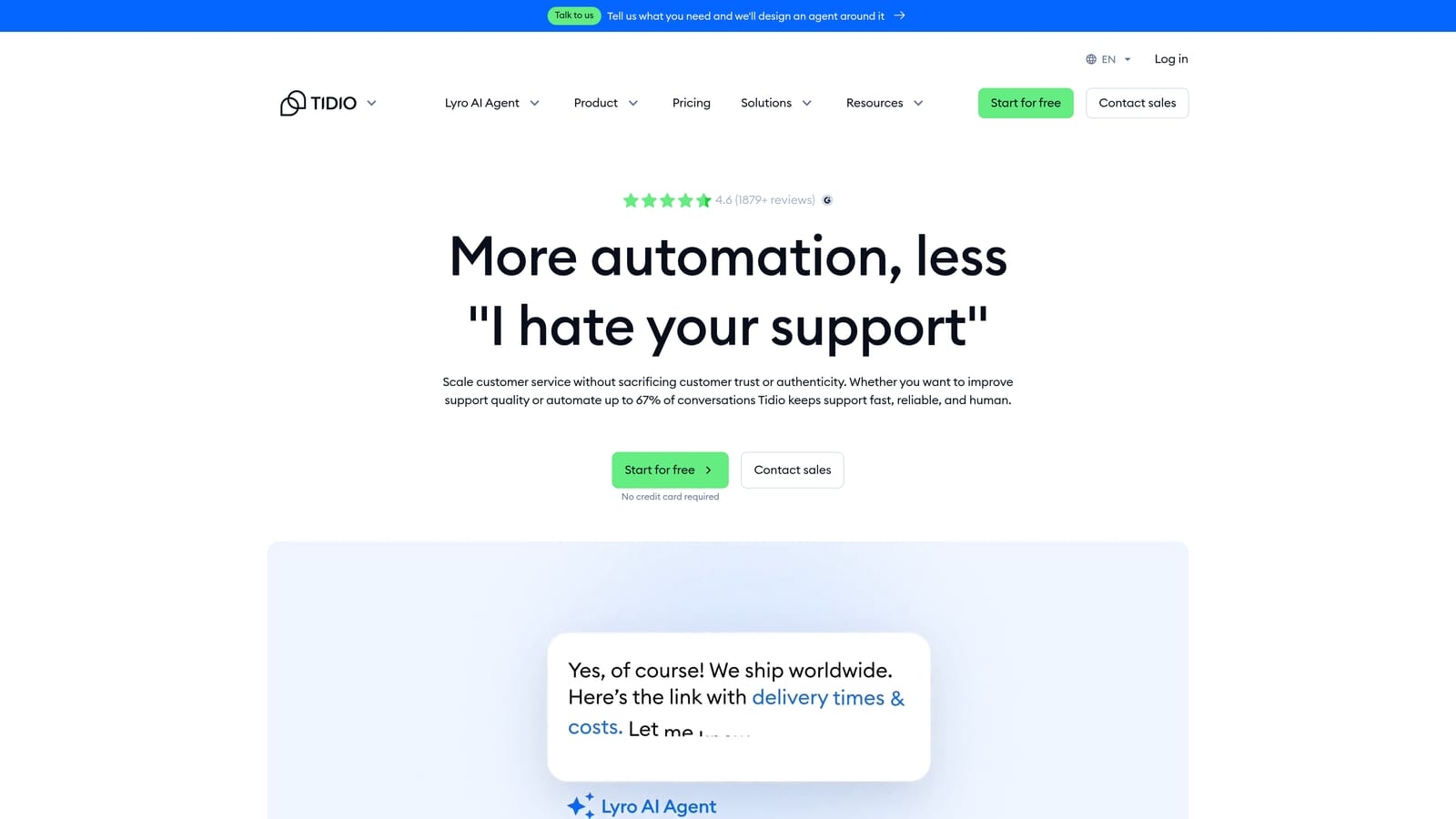
Tidio is an accessible AI customer service platform featuring Lyro AI, designed to handle common customer queries with minimal training data required.
Where This Tool Shines
Tidio's strength is accessibility. Lyro AI can handle a meaningful volume of common queries without requiring extensive training datasets or lengthy implementation timelines. For small teams that need to extend their support capacity without hiring, this is a practical entry point into AI-powered support.
The native Shopify and WooCommerce integrations make Tidio particularly well-suited for e-commerce brands. Order status, returns, and product questions are handled in context of actual transaction data. For B2B SaaS teams with complex workflows, Tidio's capabilities are more limited, but for straightforward consumer-facing support, it delivers solid value at a competitive price point.
Key Features
Lyro AI Agent: Handles common customer queries autonomously with minimal training data needed to get started.
Unified Inbox: Consolidates live chat, email, and messenger conversations in a single interface.
E-Commerce Integrations: Native connections to Shopify and WooCommerce for order and product context.
Visual Flow Builder: Lets non-technical teams create custom automation flows without writing code.
Free Tier Available: Allows smaller teams to start with basic functionality before committing to a paid plan.
Best For
SMBs and e-commerce brands that need affordable AI-powered support without complex implementation. Not designed for B2B SaaS teams with multi-step workflows or enterprise-grade integration requirements.
Pricing
Free plan available. Lyro AI is included on paid plans. Check tidio.com for current plan details and Lyro-specific pricing.
7. Forethought
Best for: Support operations leaders who want accurate AI triage and agent assist without replacing their existing helpdesk.
Forethought is an AI platform focused on triage accuracy and agent assist, designed to work alongside existing helpdesks rather than replace them.
Where This Tool Shines
Forethought is built for teams that want to improve what's already working rather than rethink their entire support stack. Its Triage AI is known for accurate intent classification, which means tickets land with the right agent or queue more consistently, reducing reassignments and handle time. SupportGPT adds generative agent-assist capabilities for drafting replies and surfacing relevant context.
The Solve product handles deflection before tickets reach agents, which addresses the upstream problem of ticket volume rather than just making agents faster. For ops-focused support leaders who track deflection rate and handle time closely, Forethought's analytics are aligned with the metrics that matter most.
Key Features
Triage AI: Classifies ticket intent accurately and routes to the appropriate agent or queue.
SupportGPT: Generative AI that drafts agent-assist replies and surfaces relevant context during active tickets.
Solve: Deflects tickets before they reach the queue by resolving common queries at the point of submission.
Helpdesk Compatibility: Works with Zendesk, Salesforce, ServiceNow, and other major platforms.
Operations-Focused Analytics: Tracks handle time, deflection rate, and triage accuracy as primary metrics.
Best For
Support operations teams that want to improve triage accuracy and reduce handle time without migrating away from their current helpdesk. Strong fit for Zendesk and Salesforce shops looking for an intelligent layer on top of existing infrastructure.
Pricing
Custom pricing based on volume and use case. Contact forethought.ai for a quote.
8. Ada
Best for: Enterprise teams that need high-volume deflection at scale with multilingual support and a no-code management experience.
Ada is a no-code AI bot platform built for large-scale deflection, with strong multilingual capabilities and broad integration options across helpdesks and CRMs.
Where This Tool Shines
Ada's no-code builder is a genuine operational advantage for enterprise teams. Non-technical team members can build, update, and manage AI bot flows without engineering involvement, which reduces the time between identifying a support gap and deploying a solution. For organizations operating across multiple languages, Ada's multilingual support is one of the more robust options in the market.
Where Ada is less differentiated is in agent assist and business intelligence. The platform is optimized for deflection at scale, meaning it's designed to keep tickets from reaching agents rather than making agents more effective once tickets arrive. Teams that need both deflection and deep agent-assist capabilities may find Ada best used alongside another tool.
Key Features
No-Code Bot Builder: Non-technical team members can create and manage AI bot flows without engineering support.
Multilingual Support: Handles conversations across dozens of languages, making it viable for global support operations.
Broad Integration Options: Connects with major helpdesks, CRMs, and e-commerce platforms.
AI-Powered Personalization: Uses customer data to tailor bot responses based on individual context.
Deflection Analytics: Tracks containment rate and deflection performance as primary success metrics.
Best For
Enterprise teams with high ticket volumes and multilingual support requirements. Particularly strong for organizations that want non-technical teams to own the bot experience. Less suited to teams that need deep agent-assist or business intelligence features alongside deflection.
Pricing
Custom enterprise pricing. Contact ada.cx for a quote based on volume and use case.
9. Kustomer
Best for: Teams that want CRM-native customer history timelines combined with AI automation for context-rich omnichannel support.
Kustomer is a CRM-native customer service platform that combines full customer history timelines with AI automation, delivering context-rich support across every channel.
Where This Tool Shines
Kustomer's unified customer timeline is its defining feature. Every interaction, across chat, email, SMS, social, and voice, is surfaced in a single chronological view tied to the individual customer record. For support teams where context is everything, this eliminates the common problem of agents asking customers to repeat information they've already provided.
The AI capabilities layer onto this foundation: conversation routing, suggested replies, and workflow automation all operate with full customer history as context. It's worth noting that Kustomer was acquired by Meta and subsequently spun back out as an independent company, which enterprise buyers doing vendor due diligence should factor into their evaluation.
Key Features
Unified Customer Timeline: Every interaction across all channels consolidated in a single customer record view.
AI-Powered Routing: Routes conversations to the right agent based on intent and customer history.
Suggested Replies: AI-generated response suggestions informed by full customer context.
Omnichannel Coverage: Supports chat, email, SMS, social, and voice in a single platform.
Built-In Business Intelligence: Reporting and analytics embedded directly in the platform without requiring a separate BI tool.
Best For
Teams that prioritize full customer context in every support interaction. Strong fit for consumer brands and B2B companies with complex customer relationships across multiple channels. Enterprise buyers should review the ownership history as part of their vendor evaluation process.
Pricing
Custom pricing based on seats and usage. Contact kustomer.com for current pricing details.
Which Tool Is Right for Your Team?
The right customer service AI platform depends less on which tool has the longest feature list and more on which use cases actually matter for your team right now.
If you're a B2B SaaS company that wants autonomous resolution, page-aware product guidance, and business intelligence beyond support metrics, Halo AI is the most purpose-built option in this list. It's the only platform here that connects auto bug ticket creation directly to engineering workflows, surfaces customer health signals for success teams, and provides visual UI guidance that sees what users see. For product-led companies where support data should inform product decisions, that combination is difficult to replicate elsewhere.
If your team is already deep in a specific ecosystem, the native options are worth serious consideration. Fin AI for Intercom shops, Zendesk AI for large Zendesk deployments, Freddy AI for mid-market Freshdesk teams, and Einstein for enterprise Salesforce organizations all reduce implementation friction by staying within familiar infrastructure.
For teams focused specifically on deflection at scale, Ada's no-code multilingual approach is strong. For triage accuracy without a platform migration, Forethought is a logical add-on. For SMBs and e-commerce brands with straightforward support needs, Tidio offers accessible AI at a competitive price. And for teams where full customer context is the priority across every channel, Kustomer's unified timeline is genuinely differentiated.
The broader question worth asking before you choose: do you need a bolt-on AI layer that improves an existing helpdesk, or do you need an AI-first platform built for autonomous resolution and intelligent business signals from the ground up?
Your support team shouldn't scale linearly with your customer base. Let AI agents handle routine tickets, guide users through your product, and surface business intelligence while your team focuses on complex issues that need a human touch. See Halo in action and discover how continuous learning transforms every interaction into smarter, faster support.