9 Best Customer Service AI Agents vs. Chatbots: Which Tools Actually Resolve Issues in 2026
This comprehensive guide compares nine customer service AI vs chatbots tools evaluated for 2026, helping support teams distinguish between true AI agents that autonomously resolve issues and rule-based chatbots that merely deflect them. From lean SaaS operations to scaling B2B teams, the breakdown covers each tool's real strengths, limitations, and ideal use cases to match the right solution to your specific support needs.
 Grant CooperFounder13 min read
The difference between a chatbot and a customer service AI agent isn't just marketing language. It's the difference between a tool that deflects questions and one that actually solves them. Traditional chatbots follow scripts. AI agents reason, learn, and act. But the market is crowded with tools claiming to be "AI-powered" when they're really just decision trees with a fresh coat of paint.
This guide cuts through the noise. We've evaluated nine tools across both categories — true AI agents and rule-based chatbots — so you can match the right solution to your actual support needs. Whether you're running a lean SaaS team drowning in Zendesk tickets or a scaling B2B operation that needs intelligent triage and handoff, this list covers the full spectrum. We'll highlight what each tool genuinely does well, where it falls short, and who it's built for.
1. Halo AI
Best for: B2B SaaS teams needing autonomous ticket resolution with deep product and business context
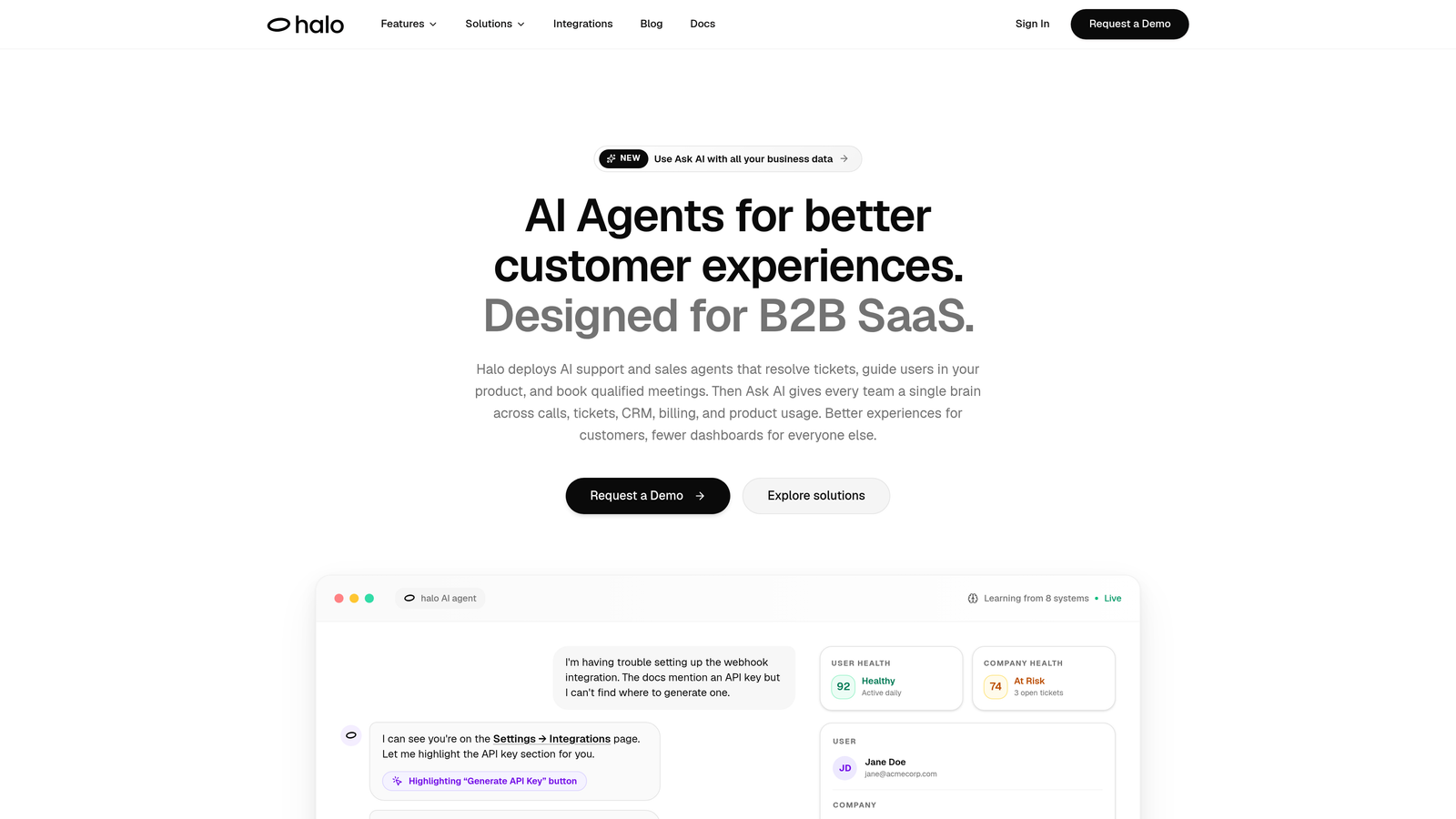
Halo AI is an AI-first customer support platform that deploys autonomous agents for ticket resolution, UI guidance, bug reporting, and business intelligence.
Where This Tool Shines
What separates Halo from most tools on this list is its page-aware architecture. The AI doesn't just read a message and search a knowledge base — it sees what the user is actually looking at inside your product, which means it can provide precise, contextual UI guidance rather than generic answers. That's a meaningful distinction for SaaS teams where half the support queue is "how do I do X in the product."
Beyond resolving tickets, Halo's Smart Inbox surfaces business intelligence signals that most support platforms ignore entirely: customer health trends, revenue anomalies, and early churn indicators. Your support function stops being a cost center and starts generating intelligence your whole team can act on.
Key Features
Page-Aware Chat Widget: The AI sees the user's current screen context, enabling precise UI guidance that's actually relevant to where they are in the product.
Autonomous Ticket Resolution: AI agents handle tickets end-to-end, with intelligent live agent handoff for complex issues that genuinely require a human.
Auto Bug Ticket Creation: Automatically generates and routes bug reports to Linear or connected project management tools, closing the loop between support and engineering.
Smart Inbox with Business Intelligence: Surfaces customer health signals, revenue anomalies, and churn detection directly in the support workflow.
Broad Integration Stack: Connects natively with Linear, Slack, HubSpot, Intercom, Stripe, Zoom, PandaDoc, and Fathom — not just your helpdesk.
Continuous Learning: Learns from every resolved interaction without requiring manual retraining, improving over time automatically.
Best For
B2B SaaS teams currently using Zendesk, Freshdesk, or Intercom who need more than ticket deflection. Particularly strong for product-led growth companies where support, product feedback, and customer health are all interconnected. Less suited for simple e-commerce or consumer-facing use cases where the support volume is high but the complexity is low.
Pricing
Contact for pricing. Halo is designed for B2B SaaS teams and priced accordingly — visit haloagents.ai for details.
2. Intercom Fin
Best for: Teams already on Intercom who want GPT-powered resolution without switching platforms
Intercom Fin is a GPT-powered AI agent built natively into Intercom Messenger, designed to resolve support questions using your existing help center content.
Where This Tool Shines
Fin's biggest advantage is how seamlessly it fits into an existing Intercom setup. If your team already lives in Intercom, there's no new tool to configure, no separate dashboard to manage, and no migration headache. Fin reads your help center articles and uses them to generate answers — not just match keywords.
The per-resolution pricing model is worth understanding. Rather than paying for every conversation (many of which go nowhere), you pay when Fin actually closes a ticket. For teams with high deflection rates, this can make the economics work out well. For teams with lower deflection, it's worth modeling before committing.
Key Features
Help Center Reasoning: Answers questions by reasoning over your Intercom articles rather than simple keyword matching.
Per-Resolution Pricing: Charged per resolved conversation on the base tier, aligning cost with actual value delivered.
Native Human Handoff: Seamlessly escalates to human agents within Intercom Messenger when Fin can't resolve the issue.
Ecosystem Integration: Works within existing Intercom workflows — no separate tool to manage or configure.
Best For
Teams already invested in the Intercom platform who want to add AI resolution without introducing a new vendor. Works best when your help center content is comprehensive and well-maintained. Less suited for teams needing deep CRM integrations or engineering tool connectivity beyond the Intercom ecosystem.
Pricing
Priced per resolution; requires an active Intercom subscription. Check intercom.com/fin for current rates, as pricing changes frequently.
3. Zendesk AI
Best for: Established Zendesk users who want AI to augment agent workflows rather than replace them
Zendesk AI is a suite of native AI capabilities embedded across Zendesk Support, Chat, and Voice — covering intelligent triage, intent detection, sentiment analysis, and an in-workspace agent copilot.
Where This Tool Shines
Zendesk AI is fundamentally an augmentation layer. It doesn't try to replace your agents — it makes them faster and more consistent. Intelligent triage automatically routes incoming tickets based on intent, sentiment, and language, which means tickets land with the right team without a human sorting queue. For support orgs handling thousands of tickets weekly, that routing accuracy compounds quickly.
The Agent Copilot is where this becomes genuinely useful in practice. Agents get real-time suggestions, AI-generated macro recommendations, and response drafts surfaced directly inside the ticket view. The workflow doesn't change — it just gets faster.
Key Features
Intelligent Triage: Auto-routes tickets based on detected intent, sentiment, and language without manual configuration per ticket type.
AI-Generated Macro Suggestions: Surfaces relevant macros and response templates directly in the agent workspace as tickets come in.
Agent Copilot: Provides real-time in-ticket guidance to help agents resolve issues faster and more consistently.
Multi-Channel Coverage: Works across Zendesk Support, Chat, and Voice channels from a single configuration.
Best For
Mature Zendesk deployments with well-structured ticket workflows and established help content. Teams looking to accelerate agent performance rather than fully automate resolution. Less valuable for teams with a minimal Zendesk configuration — the AI needs good data to work with.
Pricing
AI features are available as add-ons to Zendesk Suite plans, not included in base tiers. Check zendesk.com for current add-on pricing.
4. Freshdesk Freddy AI
Best for: Freshworks customers wanting an all-in-one AI layer across self-service, agent assist, and analytics
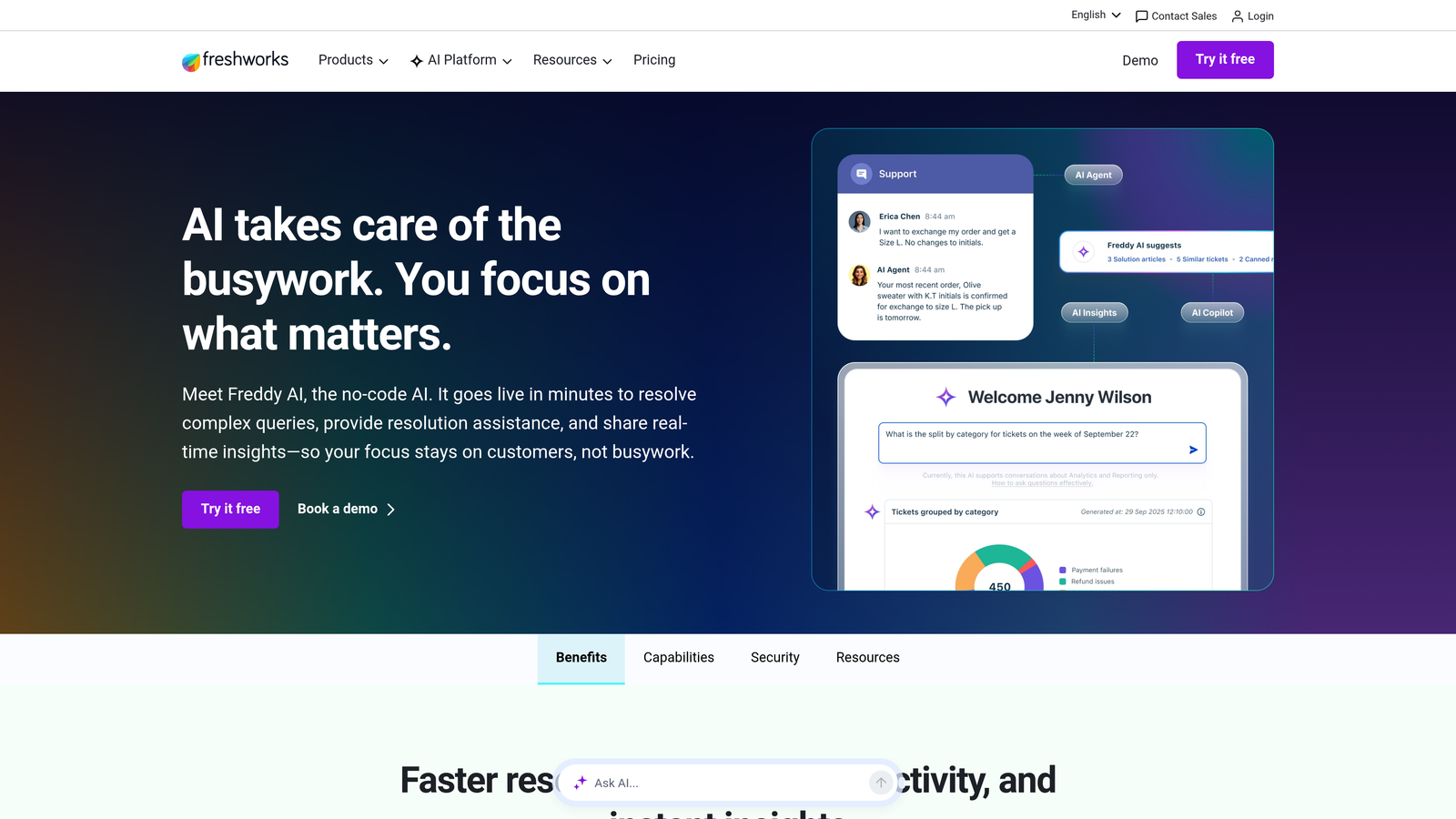
Freshdesk Freddy AI is Freshworks' modular AI suite covering customer-facing deflection, real-time agent assistance, and support analytics — all native to the Freshdesk environment.
Where This Tool Shines
Freddy's modular structure is its practical strength. Rather than forcing you into a single AI product, Freshworks breaks it into three distinct layers: Freddy Self Service for customer-facing deflection, Freddy Copilot for agent assistance, and Freddy Insights for analytics and anomaly detection. You can prioritize whichever layer matters most to your team right now.
For teams already running Freshdesk, the zero-integration-overhead argument is real. Everything sits inside the same platform, which simplifies administration and reduces the vendor sprawl that plagues many support stacks.
Key Features
Freddy Self Service: Customer-facing bot that handles common queries before they generate tickets, reducing inbound volume.
Freddy Copilot: Real-time suggestions and auto-fill for agents actively working tickets, improving resolution speed.
Freddy Insights: AI-generated analytics and anomaly detection for support managers tracking team performance and trends.
Native Freshworks Integration: No additional integration overhead for teams already on Freshdesk — everything is configured in one place.
Best For
SMBs and mid-market teams already committed to the Freshworks ecosystem. Teams that want AI across multiple support layers without managing separate tools. Less compelling for teams on other helpdesks or those needing AI capabilities that go significantly beyond the Freshworks platform.
Pricing
Freddy AI features are tiered across Freshdesk Growth, Pro, and Enterprise plans. Check freshworks.com for current plan breakdowns.
5. Tidio
Best for: Small businesses and e-commerce teams wanting fast AI chatbot deployment at an accessible price point
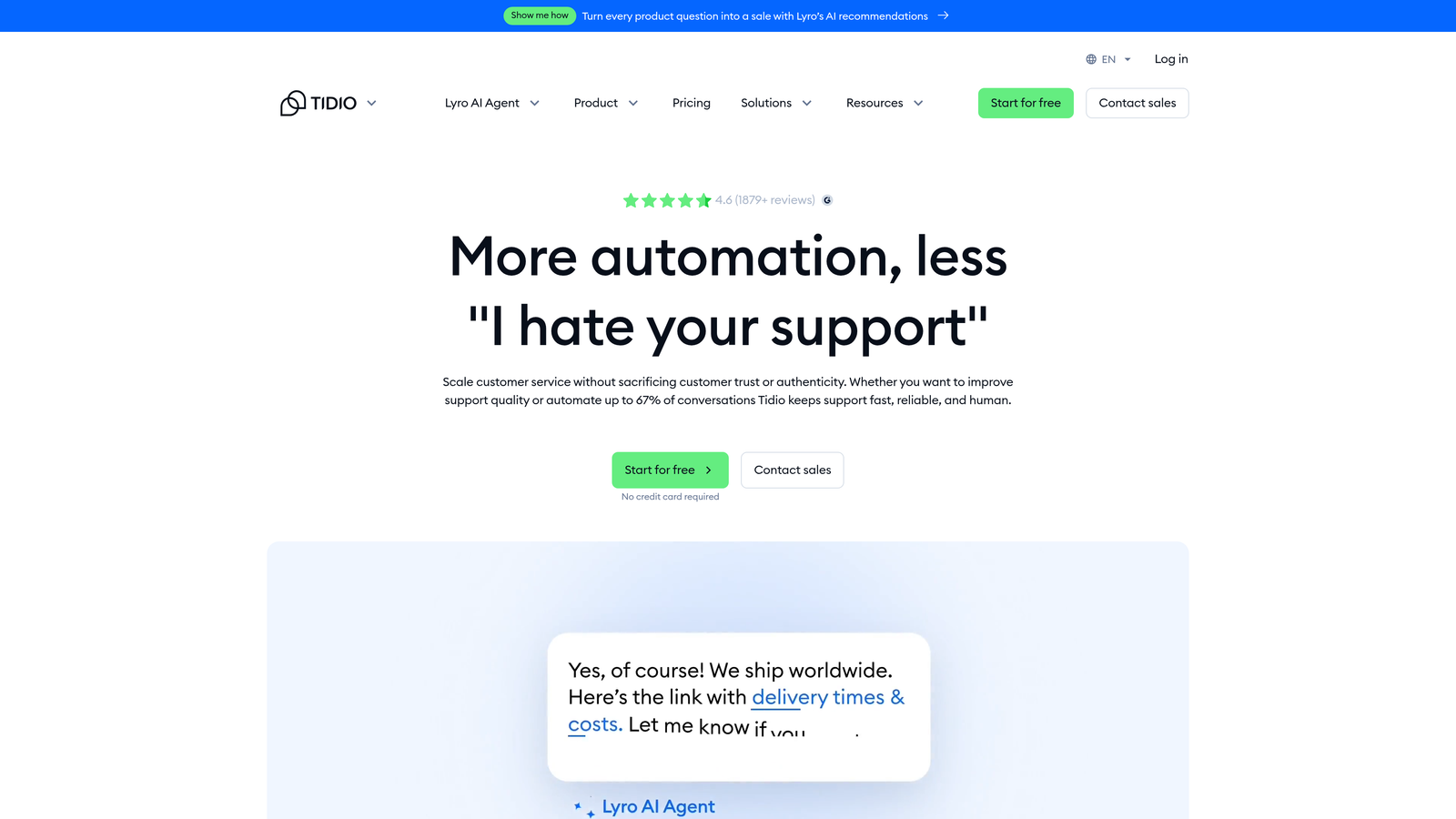
Tidio is a live chat and AI chatbot platform featuring Lyro, a conversational AI trained on your help documentation, with live chat fallback built in.
Where This Tool Shines
Tidio's core appeal is speed to value. You can have a functioning AI chatbot live on your website in hours, not weeks. Lyro trains on your FAQ content and help documentation, then handles common questions conversationally. When it reaches the edge of its confidence, it hands off to a live agent rather than confusing the customer with a bad answer.
The native integrations with Shopify, WooCommerce, and WordPress make Tidio a natural fit for e-commerce teams. If your support queue is dominated by order status, returns, and product questions, Lyro can handle a meaningful portion of that volume without much configuration effort.
Key Features
Lyro AI Chatbot: Conversational AI trained on your FAQ and help documentation, handling common queries without scripted flows.
Live Chat Fallback: Automatically transfers to a human agent when Lyro reaches its confidence threshold, preventing dead-end conversations.
E-Commerce Integrations: Native connections to Shopify, WooCommerce, and WordPress out of the box.
Fast Setup: Functional deployment in hours — no lengthy onboarding or technical configuration required.
Best For
Small businesses, e-commerce brands, and content sites that need affordable AI chat without enterprise complexity. Note that Lyro has conversation caps on lower pricing tiers, and the platform is less suited for complex B2B support workflows or multi-step ticket resolution.
Pricing
Free plan available; Lyro AI starts from approximately $29/month. Verify current pricing at tidio.com as tiers evolve regularly.
6. Drift
Best for: B2B teams where customer support and sales qualification happen in the same conversation
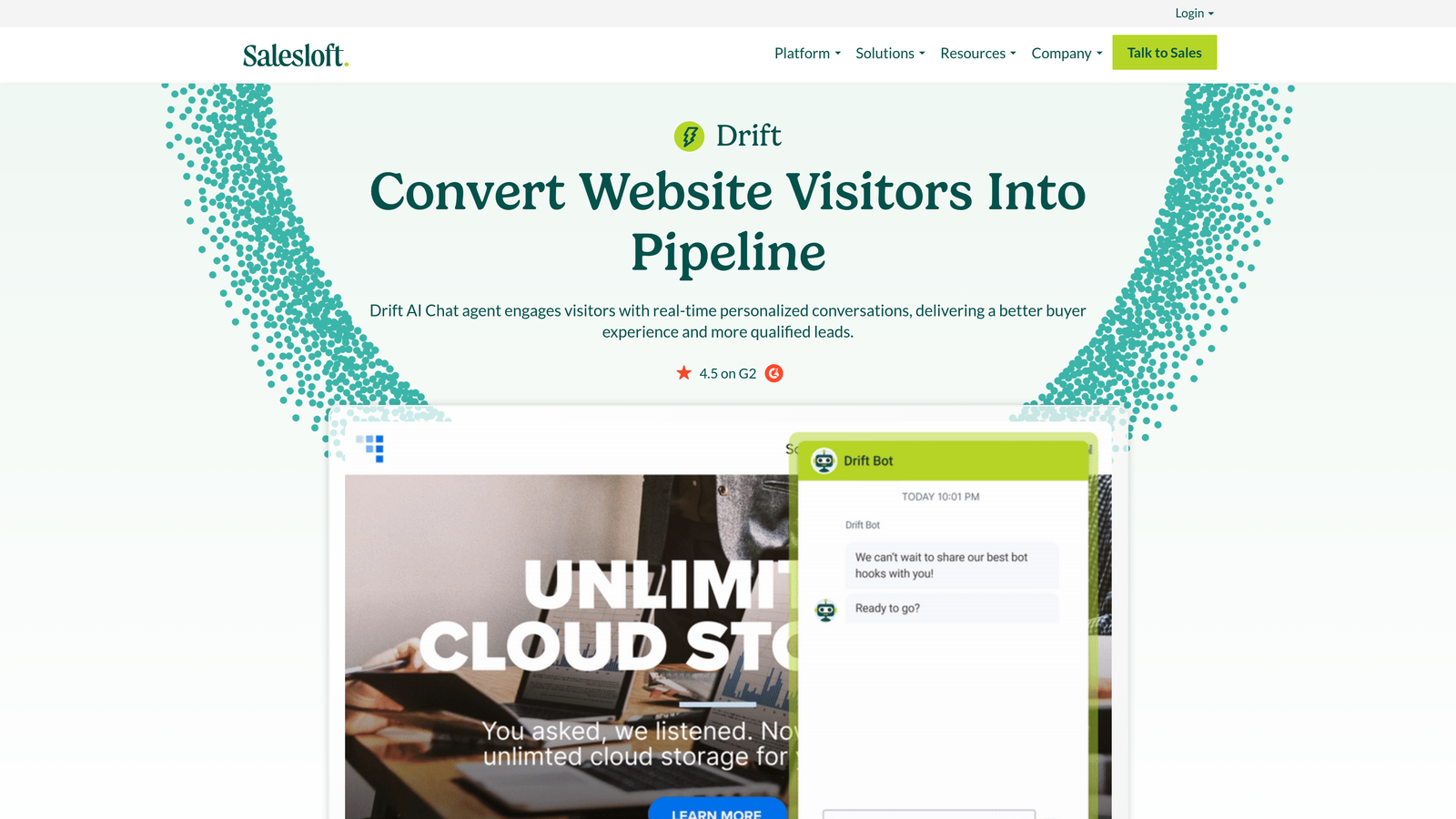
Drift is a conversational platform blending AI chatbot capabilities with sales qualification, designed for B2B teams where pipeline generation and support overlap.
Where This Tool Shines
Drift's strength is routing intelligence. It can distinguish a high-intent sales visitor from a customer with a support issue and handle both within the same interface — booking a meeting with an SDR for one, answering a product question for the other. For teams where the website is both a sales channel and a support entry point, that distinction matters.
The Playbooks feature lets teams script conversation paths for specific scenarios while layering AI augmentation on top. It's a practical middle ground between fully scripted chatbots and fully autonomous AI agents.
Key Features
AI-Powered Routing: Distinguishes high-intent sales visitors from support queries and routes each appropriately.
Meeting Booking and SDR Handoff: Built-in calendar booking and sales rep handoff flows within the chat interface.
Playbooks: Scripted conversation paths with AI augmentation, giving teams control over key conversation flows.
CRM Integrations: Native connections to Salesforce, Marketo, and major CRM platforms for pipeline tracking.
Best For
B2B revenue teams where support and sales qualification share the same front door. Less suited as a standalone support resolution tool — Drift is not purpose-built for ticket resolution and works best when the primary goal includes pipeline generation alongside support.
Pricing
Enterprise pricing — contact Drift directly for current rates at drift.com.
7. Ada
Best for: Enterprise CX teams needing multilingual AI agents with strong governance and brand controls
Ada is a no-code AI agent platform designed for enterprise customer experience teams, with multilingual support, brand voice controls, and compliance-grade governance features.
Where This Tool Shines
Ada's no-code builder is genuinely accessible for non-technical teams. CX managers and operations leads can build, deploy, and modify AI agents without engineering involvement — which matters at enterprise scale where IT backlogs can delay every tool change. The governance layer gives legal and brand teams control over how the AI communicates, which is a real requirement in regulated industries.
Multilingual support across dozens of languages makes Ada particularly relevant for global CX operations. Rather than maintaining separate bots per region, teams can manage a single agent configuration that adapts to language automatically.
Key Features
No-Code Agent Builder: Non-technical teams can deploy and manage AI agents without engineering resources.
Multilingual Support: Handles customer conversations across dozens of languages from a single configuration.
Enterprise Governance: Brand voice controls, escalation rules, and compliance guardrails built into the platform.
Broad Integrations: Connects with major CRMs, helpdesks, and commerce platforms.
Best For
Enterprise CX teams operating across multiple markets and languages, or in industries with strict compliance requirements. Complex customization at the edge may require professional services engagement. Pricing reflects the enterprise positioning, making Ada less accessible for smaller teams.
Pricing
Enterprise pricing — contact Ada for current rates at ada.cx.
8. Chatbase
Best for: Teams wanting a simple GPT-powered knowledge base bot without complex configuration
Chatbase is a lightweight tool for building GPT-powered chatbots from your own documentation — upload PDFs, URLs, or text and deploy a knowledge-base bot with minimal setup.
Where This Tool Shines
Chatbase earns its place on this list through sheer simplicity. You upload your documentation, connect a URL, or paste text content — and within minutes you have a chatbot that can answer questions about it. There's no flowchart to build, no intent to label, and no training pipeline to manage. GPT-4 handles the reasoning, and Chatbase handles the interface.
Source citations in responses are a practical feature that builds user trust. Rather than presenting AI-generated answers as authoritative without backing, Chatbase can show users where the answer came from — useful for technical documentation or policy content where accuracy matters.
Key Features
Flexible Training Sources: Train a chatbot on PDFs, website URLs, Notion pages, or plain text with minimal friction.
Embeddable Widget: Deploy on any website with minimal technical configuration — no developer required for basic setup.
GPT-4 Powered Responses: Generates answers with source citations rather than simple keyword matching.
API Access: Available on higher tiers for teams wanting to build custom integrations or embed Chatbase in their own applications.
Best For
Small teams, documentation-heavy products, or developers who need a fast knowledge-base bot without building one from scratch. Not designed for autonomous ticket resolution, multi-step workflows, or deep helpdesk integration. Think of it as a smart FAQ layer, not a full support platform.
Pricing
Free plan available; paid plans start from approximately $19/month. Verify current pricing at chatbase.co.
9. Forethought
Best for: High-volume support operations teams needing modular AI across deflection, routing, and agent assist
Forethought is a modular AI platform built for support operations, combining ticket deflection, intelligent routing, and in-ticket agent assistance — designed for teams handling significant ticket volume.
Where This Tool Shines
Forethought's modular structure is its most practical feature. The platform breaks into three distinct products: Solve for AI-powered deflection before tickets are created, Triage for intelligent routing based on intent and urgency, and Assist for real-time AI suggestions surfaced inside the agent's helpdesk view. Teams can deploy one component or the full suite, which means adoption can be staged rather than requiring a big-bang rollout.
The focus on support operations rather than just customer experience makes Forethought particularly relevant for support leaders who care about handle time, routing accuracy, and agent efficiency metrics. It's built for teams that measure their support function with precision.
Key Features
Solve: AI deflection that handles common queries before they reach the agent queue, reducing inbound ticket volume.
Triage: Intelligent ticket routing based on detected intent, urgency, and topic — reducing manual sorting.
Assist: Real-time AI suggestions surfaced inside the agent's helpdesk view during active ticket resolution.
Modular Deployment: Adopt individual components independently or deploy the full suite — no all-or-nothing commitment.
Best For
Established support organizations handling high ticket volumes who need measurable improvements in routing accuracy and agent efficiency. The complexity and cost profile makes Forethought better suited for mature support teams than early-stage companies still building their support function.
Pricing
Enterprise pricing — contact Forethought for current rates at forethought.ai.
Which Tool Is Right for Your Team?
The tools on this list aren't all competing for the same customer. They sit on a spectrum from lightweight FAQ bots to fully autonomous AI agents — and the right choice depends on what you actually need to solve.
If you need a simple knowledge-base bot with minimal setup, Chatbase gets you there in an afternoon. If you need live chat with AI fallback for an e-commerce store, Tidio is purpose-built for that. If you're already deep in the Intercom or Freshdesk ecosystem, Intercom Fin or Freddy AI give you AI without adding another vendor to manage.
For enterprise teams with complex governance requirements or global language needs, Ada and Forethought are built for that scale. For B2B teams where support and sales qualification share the same conversation, Drift handles the overlap well. And if you're augmenting a mature Zendesk deployment, Zendesk AI slots in without disruption.
For B2B SaaS teams that need more than deflection — teams where support, product feedback, and customer health are all connected — Halo AI is built specifically for that environment. The page-aware context, autonomous resolution, and business intelligence layer address problems that most support platforms don't even recognize as support problems.
Your support team shouldn't scale linearly with your customer base. Let AI agents handle routine tickets, guide users through your product, and surface business intelligence while your team focuses on complex issues that need a human touch. See Halo in action and discover how continuous learning transforms every interaction into smarter, faster support.