9 Best Customer Service AI Tools vs Human Agent Platforms in 2026
This guide evaluates nine customer service AI vs human agents platforms for B2B SaaS teams, comparing purpose-built AI tools and human-first systems on resolution quality, escalation handling, and real workload reduction. Whether you're scaling support without adding headcount or replacing a legacy helpdesk, it helps you find the right balance of automation and human oversight.
 Matt PattoliFounder14 min read
The debate around customer service AI vs human agents has largely been settled. Not by choosing one over the other, but by understanding when each excels. For B2B SaaS teams, the real question is: which platforms give you the right mix of AI automation and human escalation without creating operational chaos?
This list covers nine tools that sit at the intersection of that decision. Some are purpose-built AI agents that handle tickets autonomously. Others are human-first platforms with AI assist layers. A few do both well. We've evaluated them on resolution quality, integration depth, escalation handling, and how much they actually reduce your support team's workload — not just ticket volume.
Whether you're replacing a legacy helpdesk, augmenting a small human team, or scaling support without scaling headcount, this guide will help you find the right fit. For broader context on the tradeoffs, see our deep dive on customer support AI benefits and customer service automation.
1. Halo AI
Best for: B2B SaaS teams wanting an AI-first architecture that goes beyond ticket deflection
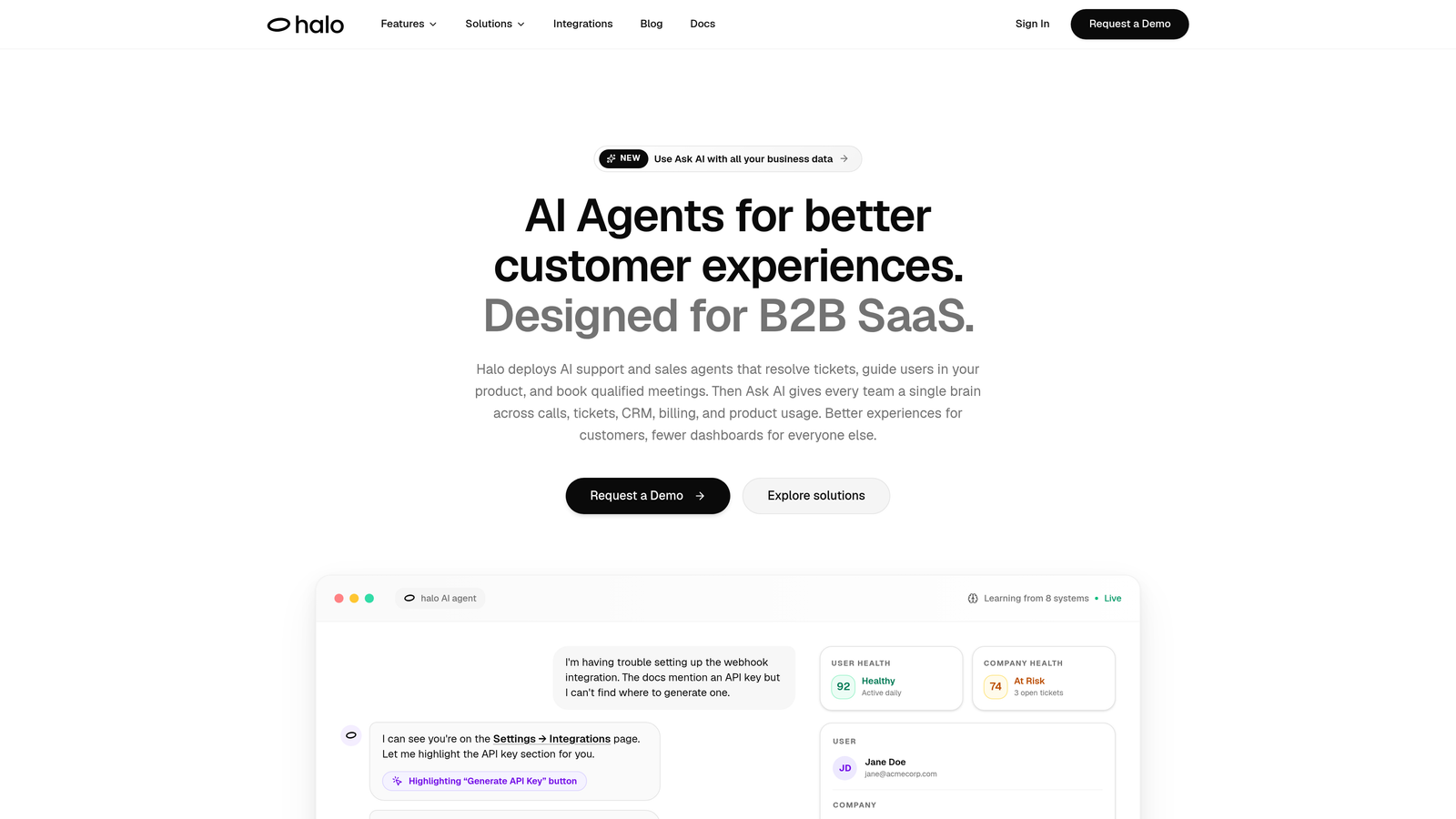
Halo AI is an AI-first customer support platform built specifically for B2B SaaS product teams who need intelligent automation without the limitations of a bolt-on AI layer.
Where This Tool Shines
What separates Halo from most tools on this list is its page-aware context. The AI agent can see what a user sees on-screen, which means it doesn't just respond to what someone types — it understands where they are in your product and provides visual UI guidance accordingly. That's a meaningful difference when your users are stuck mid-workflow, not just looking for a help article.
Halo also doesn't treat support as an isolated function. Its smart inbox surfaces business intelligence signals alongside ticket data: customer health scores, revenue anomalies, and behavioral patterns that your support team would otherwise never see. This turns your support queue into a strategic data source, not just a cost center.
Key Features
Page-Aware Chat Widget: The AI sees what users see on-screen and provides contextual, visual UI guidance based on their current location in your product.
Intelligent AI Agents: Resolve tickets autonomously and continuously learn from every interaction, improving resolution quality over time without manual retraining.
Auto Bug Ticket Creation: Automatically identifies and routes bug reports directly to Linear, removing a manual step that typically falls through the cracks.
Smart Inbox with Business Intelligence: Surfaces customer health scores, revenue signals, and anomaly detection alongside your support queue for a fuller picture of account health.
Live Agent Handoff: Escalates complex issues to human agents with full context preserved, so agents don't start from scratch.
Deep Integrations: Connects natively with Linear, Slack, HubSpot, Intercom, Stripe, Zoom, PandaDoc, and Fathom for a unified operational stack.
Best For
Halo is best suited for B2B SaaS product teams that want AI to do more than deflect tickets. If you're trying to connect support data to product development, customer success, and revenue intelligence — while keeping a clean human escalation path — Halo is built for exactly that workflow.
Pricing
Contact for pricing. Details available at haloagents.ai.
2. Intercom (Fin AI)
Best for: Teams already on Intercom who want autonomous AI resolution layered into their existing workflow
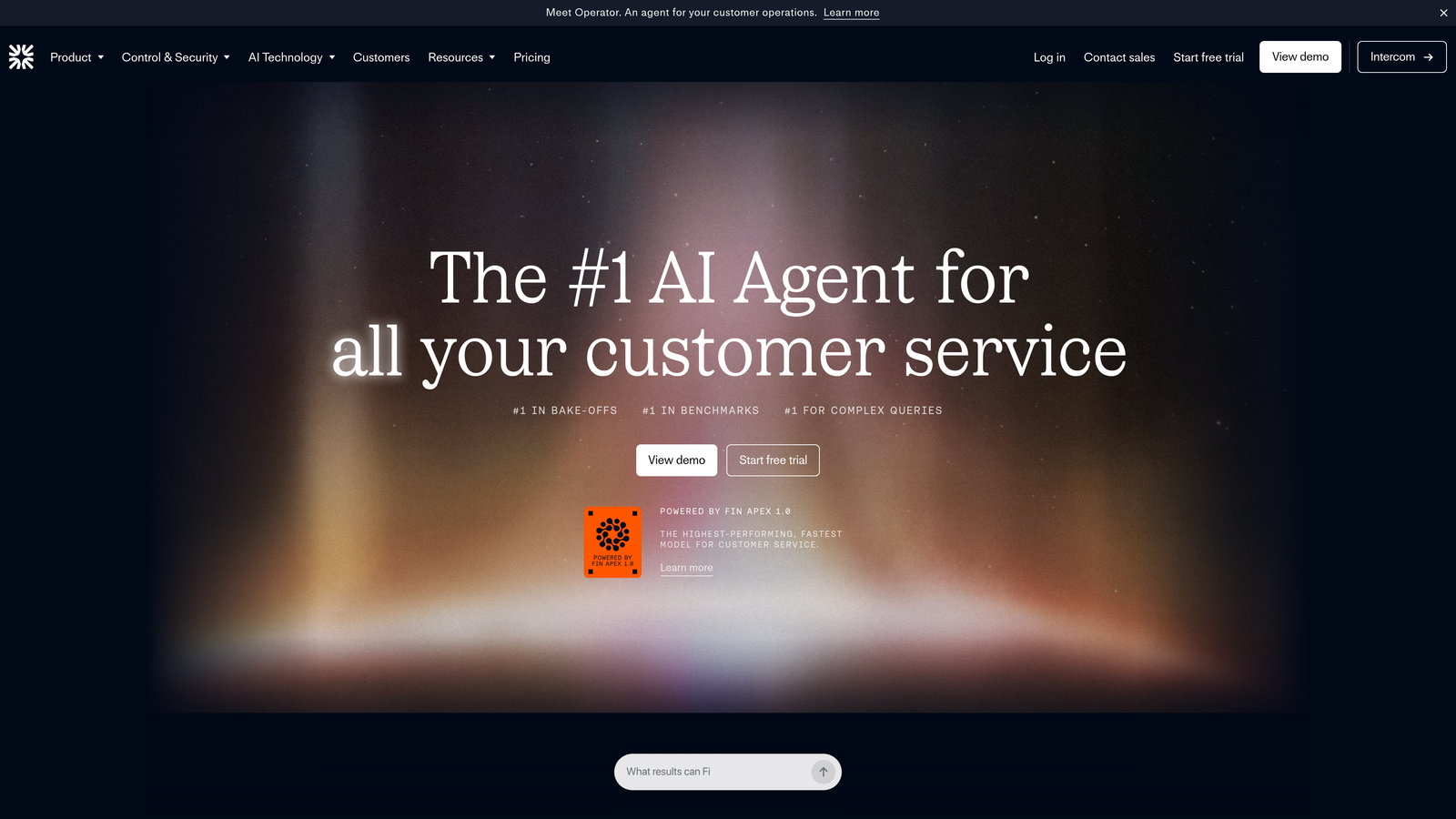
Intercom's Fin is a GPT-4-powered AI agent that resolves customer conversations autonomously within the Intercom Messenger before handing off to human agents when needed.
Where This Tool Shines
Fin's biggest advantage is how deeply it lives inside the Intercom ecosystem. If your team is already running Intercom for inbox management, customer messaging, and help center content, Fin plugs in without requiring a separate deployment. It learns from your existing articles and past conversations, which means it can get up to speed relatively quickly on your product's common questions.
The consumption-based pricing model is worth noting. You pay per resolution rather than per seat, which can work well for teams with variable ticket volumes. For high-volume periods, though, costs can escalate quickly, so it's worth modeling your resolution rates before committing.
Key Features
Autonomous Resolution: Fin handles full conversations end-to-end before escalating, reducing the volume that reaches human agents.
Native Intercom Integration: Built directly into the Intercom inbox, Messenger, and workflow tooling with no separate setup required.
Learns from Existing Content: Uses your help center articles and historical conversations as its knowledge base from day one.
Omnichannel Coverage: Handles chat, email, and social channels within a unified Intercom view.
Consumption-Based Pricing: Billed per resolution rather than per seat, which aligns costs with actual AI usage.
Best For
Teams already invested in the Intercom ecosystem who want to add autonomous AI resolution without migrating platforms. Less compelling as a standalone choice if you're not already using Intercom's broader suite.
Pricing
Fin AI is billed per resolution, layered on top of Intercom's base plans. Intercom seat-based plans start at approximately $39 per agent per month.
3. Zendesk AI
Best for: High-volume enterprise support teams with complex routing, SLA requirements, and compliance needs
Zendesk AI is a comprehensive AI layer built across the Zendesk Suite, covering intelligent triage, routing, agent copilot features, and automated summarization for enterprise-scale support operations.
Where This Tool Shines
Zendesk AI is built for scale. If your team is handling thousands of tickets per day across multiple channels with strict SLA requirements, Zendesk's AI triage and routing capabilities are genuinely mature. Intent detection helps route tickets to the right team automatically, while agent copilot features give human agents suggested replies and instant ticket summaries to reduce handle time.
For enterprises in regulated industries, Zendesk's compliance controls and audit trails are a meaningful differentiator. The tradeoff is complexity: Zendesk's AI capabilities are powerful, but they require configuration investment and often rely on professional services to deploy well.
Key Features
AI-Powered Triage and Routing: Automatically classifies tickets by intent and routes them to the appropriate team or workflow.
Agent Copilot: Provides human agents with suggested replies, ticket summaries, and next-best-action recommendations in real time.
Automated Workflows: Triggers downstream actions based on AI classification, reducing manual queue management.
Full Suite Integration: AI capabilities span the entire Zendesk platform including Support, Guide, and Talk.
Enterprise Compliance Controls: Includes audit trails, data governance features, and controls suited to regulated industries.
Best For
Large enterprise support teams already on Zendesk Suite who need AI to handle routing complexity and agent efficiency at scale. Overkill for smaller teams, and the add-on pricing model can make total cost of ownership high.
Pricing
AI features are sold as add-ons to Zendesk Suite plans. Suite Team starts at approximately $55 per agent per month before AI add-ons.
4. Freshdesk Freddy AI
Best for: SMBs and growing SaaS teams that want AI-assisted support without enterprise-level pricing
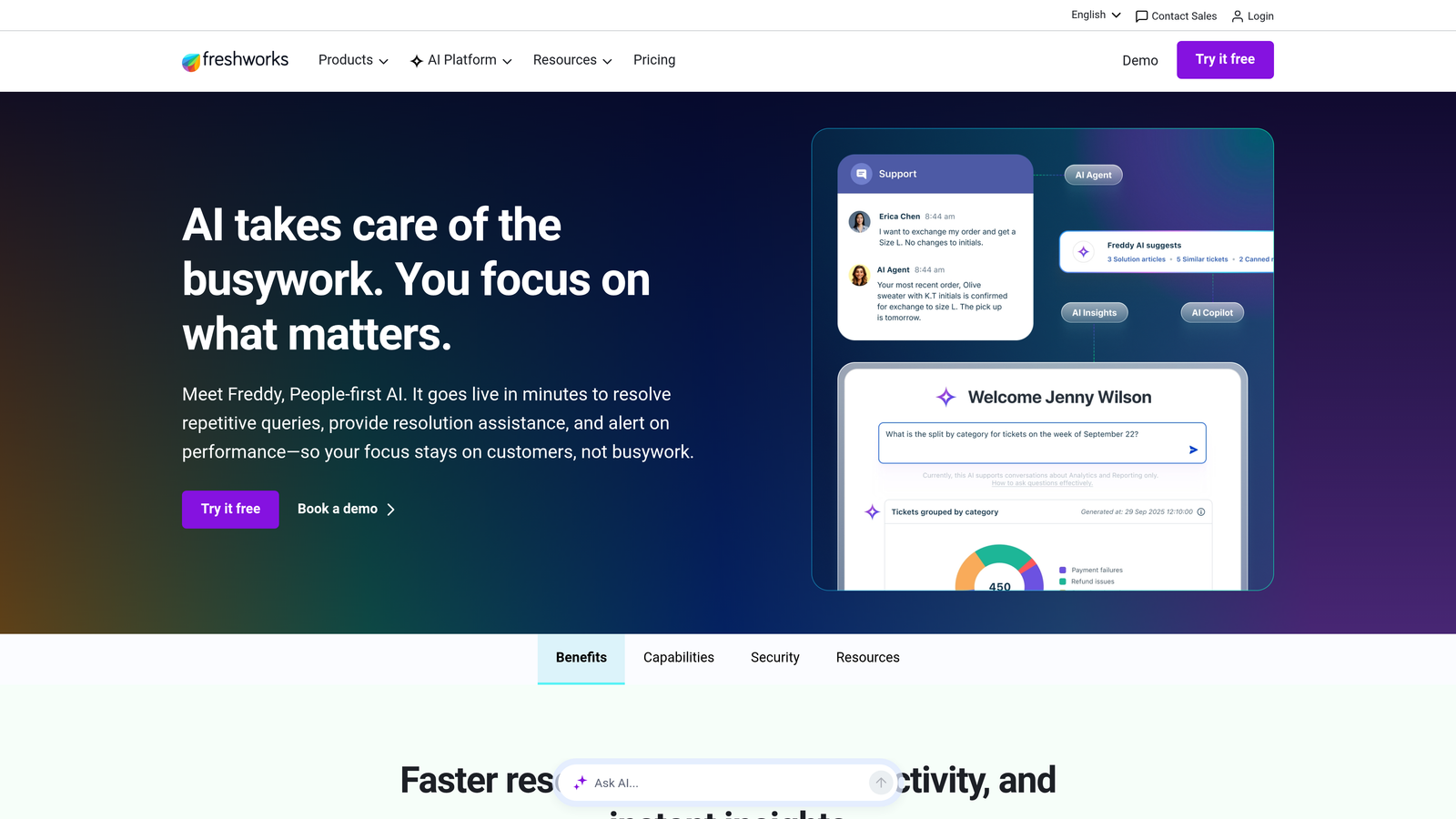
Freshdesk's Freddy AI is Freshworks' AI layer spanning Freshdesk, Freshchat, and Freshsales, offering self-service bots, agent copilot features, and analytics at price points accessible to smaller teams.
Where This Tool Shines
Freddy AI's value proposition is breadth at an accessible price. The three-component structure — Freddy Self Service for deflection, Freddy Copilot for agent assist, and Freddy Insights for analytics — gives teams a reasonably complete AI toolkit without requiring a large investment. For teams that find Zendesk's pricing prohibitive, Freshdesk is often the natural comparison.
The cross-product integration across Freshdesk, Freshchat, and Freshsales also makes Freddy useful for teams that want to unify support and CRM data within the Freshworks ecosystem. That said, Freshdesk's AI capabilities are generally considered less sophisticated than Zendesk's at the enterprise tier.
Key Features
Freddy Self Service: Automated bot that handles common questions and deflects tickets before they reach human agents.
Freddy Copilot: Provides agents with suggested replies, ticket summaries, and contextual recommendations during live interactions.
Freddy Insights: AI-driven analytics that surface patterns in ticket volume, resolution rates, and agent performance.
Cross-Product Integration: Works natively across Freshdesk, Freshchat, and Freshsales for a connected Freshworks experience.
Accessible Pricing: AI add-ons available at lower price points than most enterprise alternatives.
Best For
SMBs and growing SaaS teams that want AI-assisted support without committing to enterprise-tier pricing. A solid choice if your team is already in the Freshworks ecosystem.
Pricing
Freddy AI add-ons are available on Freshdesk Growth plans starting at approximately $15 per agent per month and above.
5. Salesforce Agentforce
Best for: Enterprises where support workflows are deeply unified with Salesforce CRM data
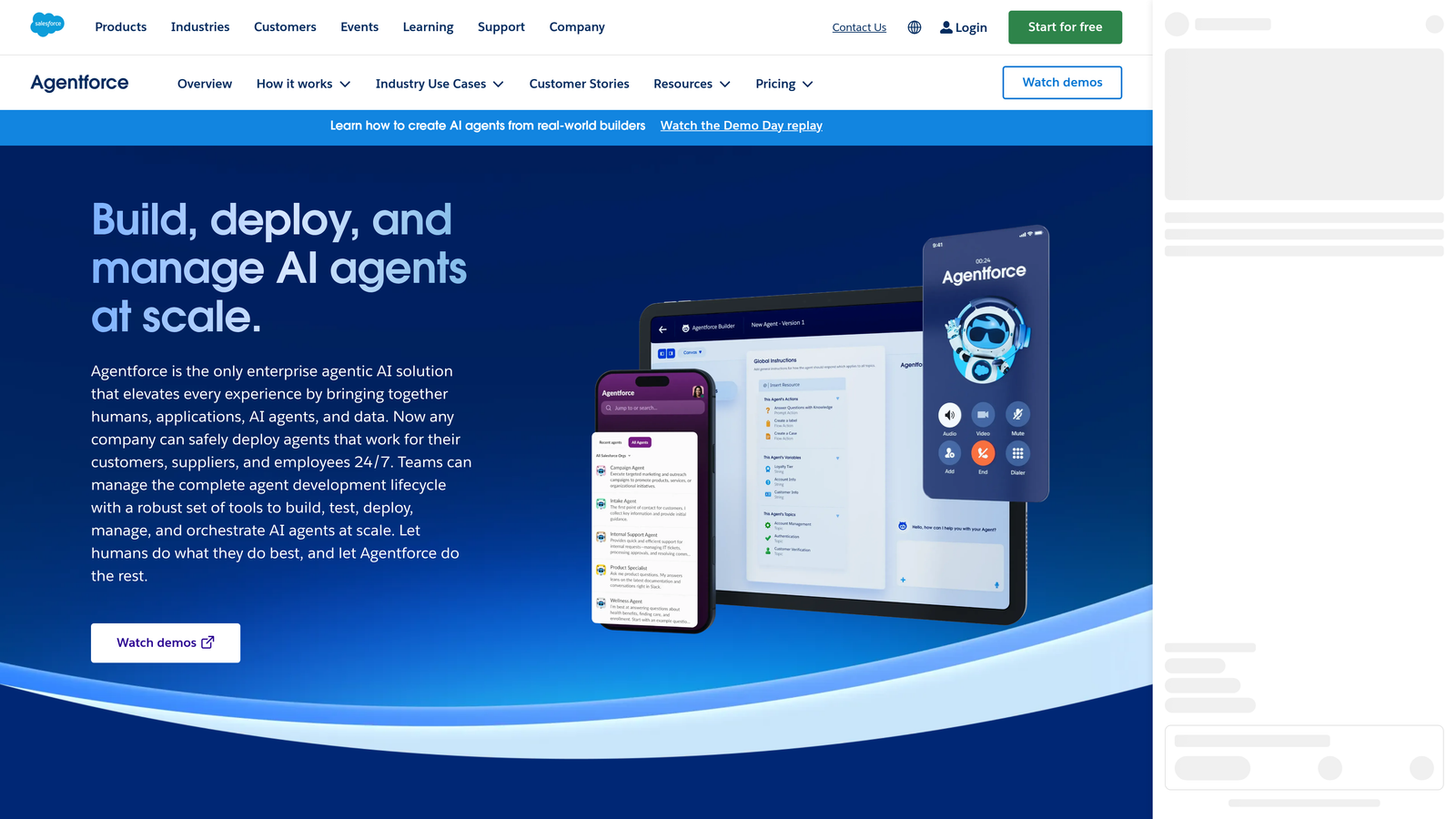
Salesforce Agentforce is an autonomous AI agent platform that operates with full CRM context, accessing order history, cases, and contracts to resolve support issues end-to-end within the Salesforce ecosystem.
Where This Tool Shines
Agentforce's core differentiator is CRM depth. Because it operates natively within Salesforce, AI agents can pull order history, contract details, account data, and open cases to resolve issues that would otherwise require a human to look up information manually. For enterprises where support and CRM are already unified in Salesforce, this is a genuine capability advantage.
The governance and compliance features built on the Einstein AI platform also make Agentforce well-suited for regulated industries. The tradeoff is that Agentforce is most valuable when you're deeply committed to the Salesforce stack. For teams not already on Service Cloud, the implementation investment is significant.
Key Features
Full CRM Context: AI agents access order history, cases, contracts, and account data to resolve issues without human lookup.
Action Across Salesforce Objects: Agents can take actions — updating cases, processing requests — not just retrieve information.
Einstein AI Platform: Built on Salesforce's established AI infrastructure with enterprise governance and safety controls.
Service Cloud Integration: Deep integration with Service Cloud workflows, routing, and case management.
Compliance and Audit Trail: Strong controls for regulated industries requiring documented AI decision-making.
Best For
Large enterprises already running Salesforce Service Cloud where support, sales, and CRM data live in the same system. Not practical as a standalone support tool for teams outside the Salesforce ecosystem.
Pricing
Agentforce pricing varies by edition and requires an existing Salesforce Service Cloud subscription. Contact Salesforce for current pricing.
6. Kustomer
Best for: Teams handling complex, multi-touch customer relationships that need a unified customer timeline
Kustomer is a CRM-native support platform that builds a unified customer timeline across all touchpoints, with AI features layered across the agent experience to assist rather than replace human judgment.
Where This Tool Shines
Kustomer's defining feature is the unified customer timeline. Rather than treating each ticket as an isolated event, Kustomer aggregates every interaction — chat, email, voice, social, purchase history — into a single chronological view per customer. For agents handling complex B2B relationships or high-value accounts, this context is invaluable. You're not starting from scratch on every conversation.
The AI layer in Kustomer is more assist-oriented than autonomous. Suggested replies, sentiment analysis, and behavioral automation help agents move faster, but the platform is designed with the assumption that humans are making the final call. That's a deliberate philosophy, and it suits teams where relationship quality is as important as resolution speed.
Key Features
Unified Customer Timeline: Every interaction across all channels consolidated into a single chronological view per customer.
AI-Powered Suggested Replies: Surfaces relevant response suggestions based on conversation context and historical patterns.
Sentiment Analysis: Flags at-risk conversations in real time so agents can adjust their approach accordingly.
Behavioral Automation: Triggers workflows based on customer data and interaction patterns, not just ticket categories.
Omnichannel in One View: Chat, email, voice, and social managed from a single interface without tab-switching.
Best For
Teams managing high-value, multi-touch customer relationships where full interaction history matters. Particularly strong for B2B support teams where account context drives every conversation.
Pricing
Kustomer's Enterprise plan starts at approximately $89 per agent per month.
7. Ada
Best for: Enterprise teams that need AI agents to take actions in external systems, not just answer questions
Ada is an enterprise-grade no-code AI agent builder where agents go beyond answering questions to take actions in external systems — processing refunds, updating records, and completing transactions autonomously.
Where This Tool Shines
Ada's differentiator is action depth. Most AI support tools are fundamentally question-answering systems — they retrieve information and respond. Ada's agents can actually do things: process a refund, update a shipping address, change a subscription tier. For support teams where a large percentage of tickets require system actions rather than just information, this is a meaningful capability gap to close.
The no-code builder with enterprise governance tools also makes Ada appealing for large CX teams that need to deploy and iterate on AI agents without heavy engineering involvement. The testing and oversight tools help enterprise teams maintain quality control as agent complexity grows.
Key Features
Action-Oriented AI: Agents execute tasks in external systems rather than just retrieving and relaying information.
No-Code Agent Builder: Build, test, and deploy AI agents without engineering resources, with enterprise-grade governance controls.
Multilingual Support: Handles conversations across more than 50 languages for global support operations.
Containment and Escalation Analytics: Detailed reporting on which queries AI handles successfully versus where human escalation occurs.
Broad Integrations: Connects with major CRMs, helpdesks, and e-commerce platforms to enable system-level actions.
Best For
Enterprise CX teams where a significant portion of support volume involves transactional actions — not just answers. Strong fit for e-commerce, fintech, and SaaS companies with high-volume, action-heavy support queues.
Pricing
Custom enterprise pricing. Contact Ada directly for a quote at ada.cx.
8. Tidio
Best for: Small businesses and early-stage SaaS teams that need a fast, affordable AI and live chat combo
Tidio is a lightweight live chat and AI platform featuring Lyro, their conversational AI agent, designed for teams that need to get up and running quickly without complex configuration.
Where This Tool Shines
Tidio's appeal is simplicity and speed. The platform combines live chat and AI in a single package that can realistically be deployed in under an hour. For early-stage SaaS teams or small businesses that don't have a dedicated support ops function, that deployment speed matters. There's no lengthy implementation project, no professional services requirement, and no steep learning curve.
Lyro, Tidio's AI agent, handles common questions automatically within that same interface. It's not the most sophisticated AI on this list, but for teams whose support volume is manageable and whose queries are relatively predictable, it covers the basics well at a price point that's hard to argue with.
Key Features
Lyro AI Agent: Handles common customer questions automatically, reducing the volume that reaches live agents.
Unified Live Chat and AI: Both human and AI support managed from a single, easy-to-navigate interface.
Visual Chatbot Builder: Pre-built templates and a drag-and-drop builder for creating custom conversation flows without coding.
Platform Integrations: Connects with Shopify, WordPress, and major helpdesk platforms for quick deployment.
Fast Deployment: Designed to be live and handling conversations within an hour of setup.
Best For
Small businesses, e-commerce teams, and early-stage SaaS companies that need affordable AI-assisted support without complex implementation. Less suited for B2B SaaS teams with intricate workflows or high-stakes enterprise support requirements.
Pricing
Free plan available. Lyro AI starts at $29 per month, with paid plans also beginning at $29 per month.
9. Gladly
Best for: Brands where human relationship quality is a core differentiator and ticket numbers are beside the point
Gladly is a people-centric support platform built around the philosophy that great customer service is fundamentally human — with AI assisting agents rather than replacing them.
Where This Tool Shines
Gladly's most distinctive design choice is the elimination of ticket numbers. Instead of treating each interaction as an isolated support event, Gladly builds one continuous conversation thread per customer across every channel — voice, email, chat, SMS, and social. Agents see the full relationship history, not just the current ticket. For brands that compete on customer experience quality, this framing changes how agents approach every interaction.
The people-match routing feature connects customers to the agent best suited to help them based on history and expertise rather than queue availability alone. AI in Gladly is genuinely assistive: it surfaces context, suggests responses, and reduces agent effort without trying to remove the human from the conversation.
Key Features
Single Conversation Thread: One continuous customer record across all channels, with no ticket numbers and no fragmented history.
AI Agent Assist: Surfaces relevant context and suggested replies to help human agents respond faster and more accurately.
People-Match Routing: Connects customers to the most suitable available agent based on relationship history and expertise.
True Omnichannel View: Voice, email, chat, SMS, and social in a single unified interface with shared customer context.
Relationship-First Design: Built for brands where the quality of human interaction is a strategic differentiator, not just a cost to minimize.
Best For
Consumer brands, premium B2C companies, and service-led businesses where customer relationship quality drives loyalty and retention. Less suited for high-volume, repetitive B2B SaaS support where automation depth matters more than relationship continuity.
Pricing
Gladly's Hero plan starts at approximately $150 per agent per month.
Which Tool Is Right for Your Team?
The right choice here depends less on which tool has the longest feature list and more on where your support operation sits today — and where it needs to go.
If you're a B2B SaaS team that wants AI to do more than deflect tickets — connecting support signals to product development, customer success, and revenue intelligence — Halo AI is built for that specific problem. Its page-aware context, continuous learning architecture, and business intelligence layer make it genuinely different from tools that bolt AI onto an existing helpdesk.
For teams already deep in the Intercom ecosystem, Fin AI is the path of least resistance to autonomous resolution. For enterprise teams on Zendesk or Salesforce, the native AI layers in those platforms are the logical starting point given existing investment. Freshdesk Freddy AI covers the SMB middle ground at accessible pricing.
If your support volume is action-heavy — lots of refunds, account updates, transactional requests — Ada's action-oriented AI is worth serious consideration. For teams where human relationship quality is non-negotiable, Gladly's people-first philosophy is a deliberate and defensible choice.
Here's a quick orientation by scenario:
Scaling B2B SaaS without scaling headcount: Halo AI or Intercom Fin, depending on your existing stack.
Enterprise with Salesforce as the system of record: Agentforce, with Zendesk AI as an alternative if you're on the Zendesk Suite.
SMB or early-stage with limited budget: Freshdesk Freddy AI or Tidio depending on complexity needs.
High-value relationships where human warmth is the product: Gladly or Kustomer, depending on whether you need CRM depth or channel unification.
Your support team shouldn't scale linearly with your customer base. Let AI agents handle routine tickets, guide users through your product, and surface business intelligence while your team focuses on complex issues that need a human touch. See Halo in action and discover how continuous learning transforms every interaction into smarter, faster support.
For more on building the right support foundation, explore our guides on customer support AI benefits and customer service automation.