9 Best Customer Service Automation Tools for Ecommerce in 2026
Ecommerce support teams struggling with high ticket volumes can find relief through customer service automation for ecommerce, and this guide reviews nine top tools—from AI-first agents to full helpdesk platforms—evaluated on ecommerce-specific features, integrations, and scalability. Whether you run a DTC brand or a large marketplace, these solutions can autonomously resolve the majority of order, return, and shipping inquiries while freeing agents for complex customer interactions.
 Matt PattoliFounder13 min read
Ecommerce support teams face a relentless volume problem: order status questions, return requests, shipping delays, and product inquiries flood in around the clock, often faster than human agents can handle. The good news is that modern customer service automation tools can resolve the majority of these tickets without human intervention, freeing your team to focus on complex, high-value interactions.
This list covers nine tools purpose-built or well-suited for ecommerce customer service automation, from AI-first support agents to helpdesk platforms with strong automation layers. We evaluated each based on ecommerce-specific capabilities, integration depth, ease of setup, and scalability. Whether you're a fast-growing DTC brand or a marketplace with thousands of SKUs, there's an option here that fits your stack.
1. Halo AI
Best for: Ecommerce teams wanting autonomous AI resolution with business intelligence beyond basic support metrics
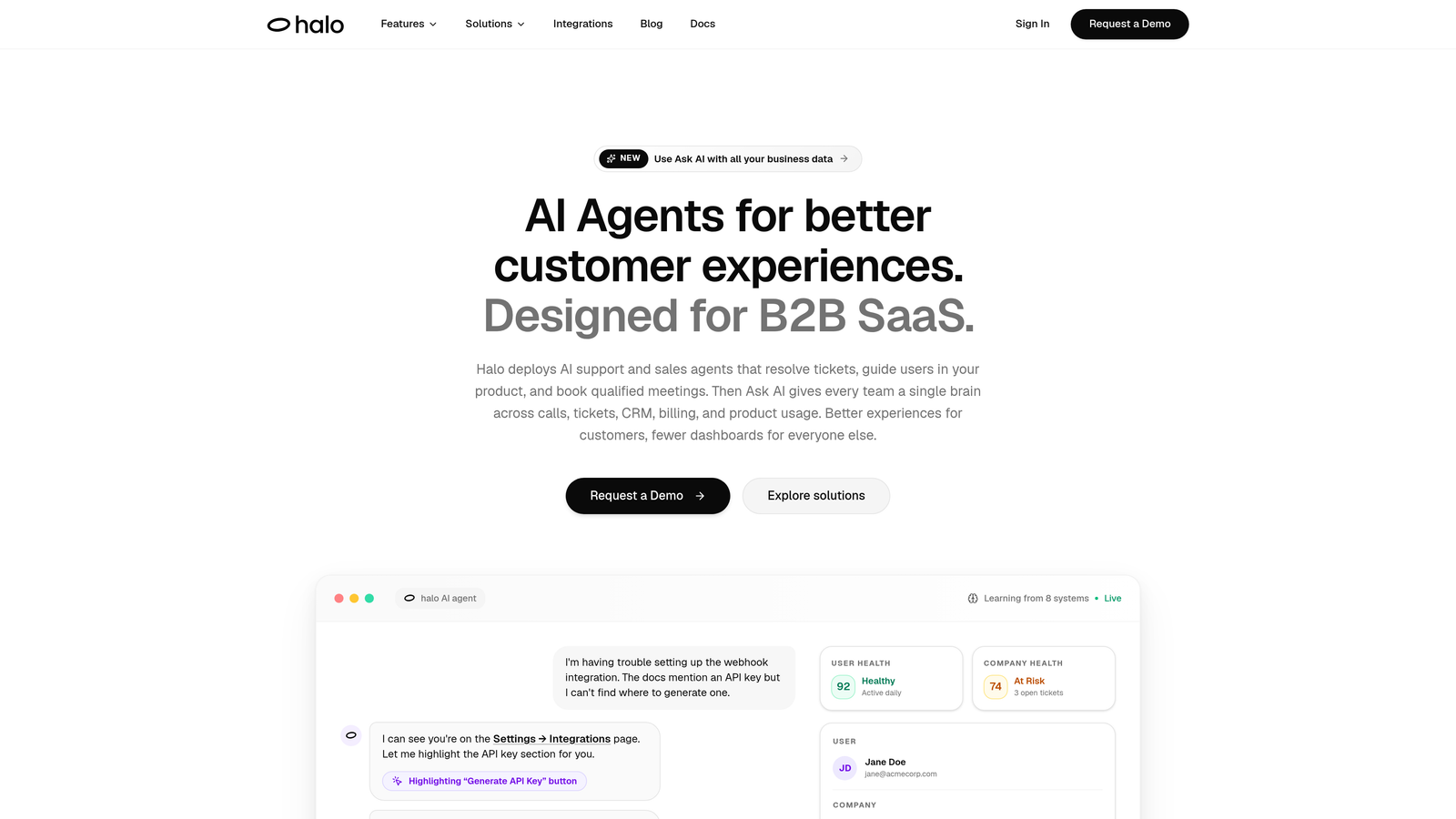
Halo AI is an AI-first customer support platform that deploys intelligent agents to resolve tickets autonomously, guide users through your product, and surface business intelligence from every support interaction.
Where This Tool Shines
Most support tools automate routing or suggest responses. Halo AI goes further: its agents actually resolve tickets end-to-end, without waiting for a human to approve each step. For ecommerce teams drowning in WISMO queries and return requests, that distinction matters enormously.
What sets Halo apart from other AI-augmented helpdesks is the page-aware context layer. The AI sees exactly what the user sees on screen, which means it can guide shoppers through checkout issues, account problems, or product configuration with genuine contextual awareness rather than generic scripted replies. And because it learns from every interaction, the system gets smarter over time without manual retraining.
Key Features
Autonomous AI Agents: Resolve tickets without human intervention, handling the full resolution workflow from first contact to close.
Page-Aware Chat Widget: The AI sees what the user sees on screen, enabling contextual guidance that generic chatbots simply cannot match.
Smart Inbox with Business Intelligence: Surfaces customer health signals, revenue intelligence, and anomaly detection so your support data becomes a strategic asset.
Auto Bug Ticket Creation: Automatically routes bug reports to engineering tools like Linear, removing manual handoffs between support and product teams.
Live Agent Handoff: Escalates complex issues to human agents seamlessly, with full context preserved so agents never start from scratch.
Deep Integrations: Connects with Slack, HubSpot, Intercom, Stripe, Zoom, PandaDoc, Fathom, and Linear for a genuinely connected support stack.
Best For
Ecommerce brands and B2B product teams that want AI to do more than triage tickets. Particularly strong for teams who want support interactions to generate business intelligence, not just close tickets. Also a natural fit for companies already using Stripe, HubSpot, or Linear who want their support layer connected to the rest of their stack.
Pricing
Contact for pricing at haloagents.ai. Custom plans available based on your support volume and integration requirements.
2. Gorgias
Best for: Shopify and BigCommerce merchants who want order data embedded directly in every support ticket
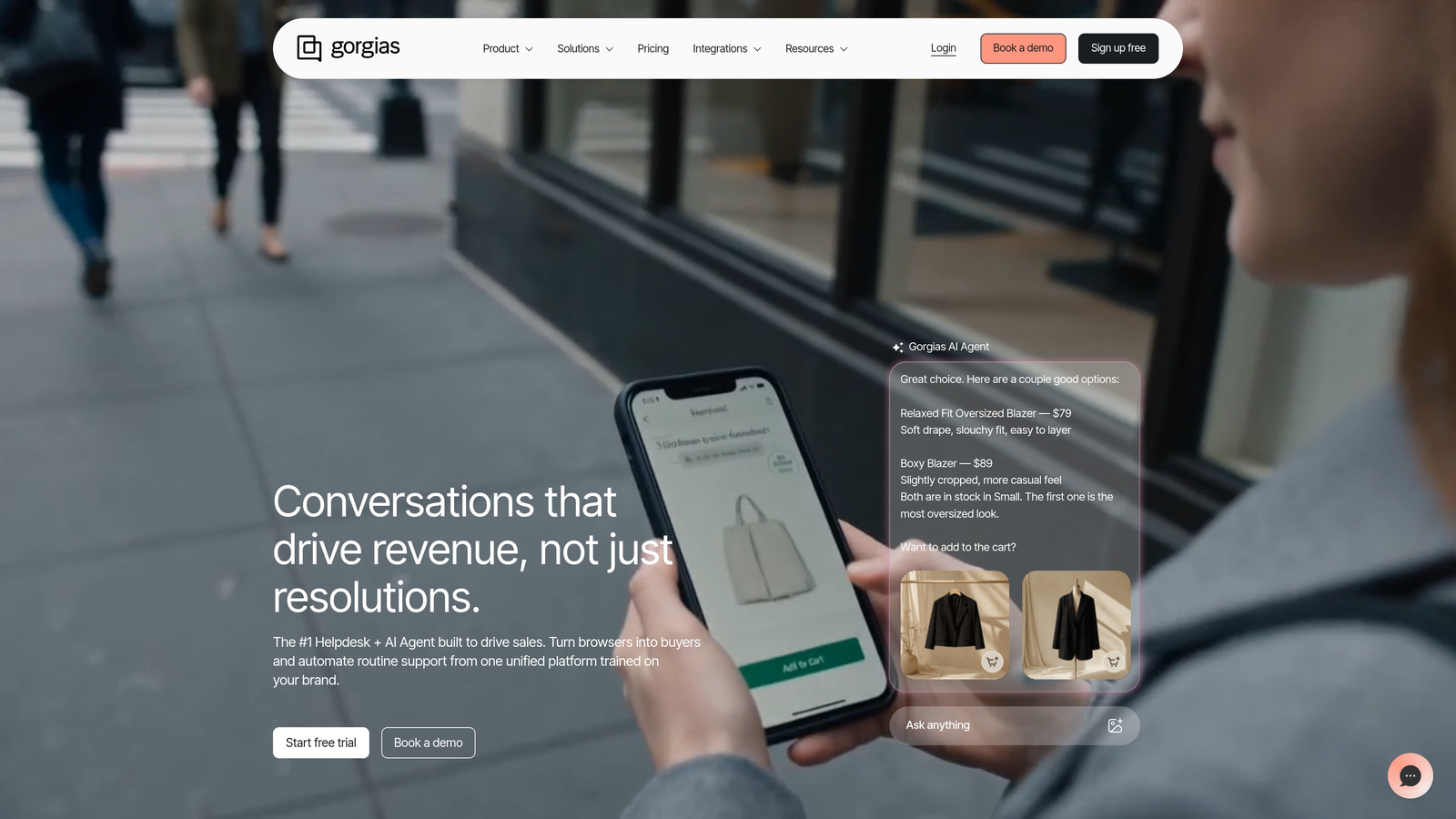
Gorgias is an ecommerce-native helpdesk built around order data, designed specifically for merchants who need automation tied directly to their storefront.
Where This Tool Shines
Gorgias has built its entire product around the reality of ecommerce support: most tickets are about orders. When an agent opens a ticket in Gorgias, they immediately see the customer's order history, shipping status, and purchase data pulled directly from Shopify or BigCommerce. No tab-switching, no copy-pasting order numbers.
The automation layer is equally order-aware. You can build rules that auto-close WISMO tickets when tracking shows a package is in transit, or trigger refund flows based on order status. For high-volume DTC brands, this kind of structured automation can deflect a significant portion of incoming tickets without any AI required.
Key Features
Native Storefront Integrations: Deep integrations with Shopify, BigCommerce, and Magento pull live order data into every ticket automatically.
Order-Aware Automation Rules: Build automation for WISMO and return tickets using real-time order context, not just keyword matching.
Macros and Templates: Speed up agent responses for common scenarios with pre-built reply templates.
Revenue Statistics per Ticket: See the revenue associated with each support interaction, connecting support activity to business outcomes.
100+ Ecommerce App Integrations: Connects with the broader ecommerce tool ecosystem including loyalty, reviews, and shipping apps.
Best For
DTC brands and Shopify merchants with moderate-to-high ticket volumes who want an ecommerce-native helpdesk with solid automation rules. Less suited for teams looking for fully autonomous AI resolution; Gorgias is stronger as a structured automation and agent efficiency platform.
Pricing
Tiered by ticket volume with a Starter plan for smaller operations, scaling through to Enterprise for high-volume merchants. Pricing is publicly listed on their website.
3. Tidio
Best for: SMB ecommerce stores that want affordable live chat and AI automation without a complex setup
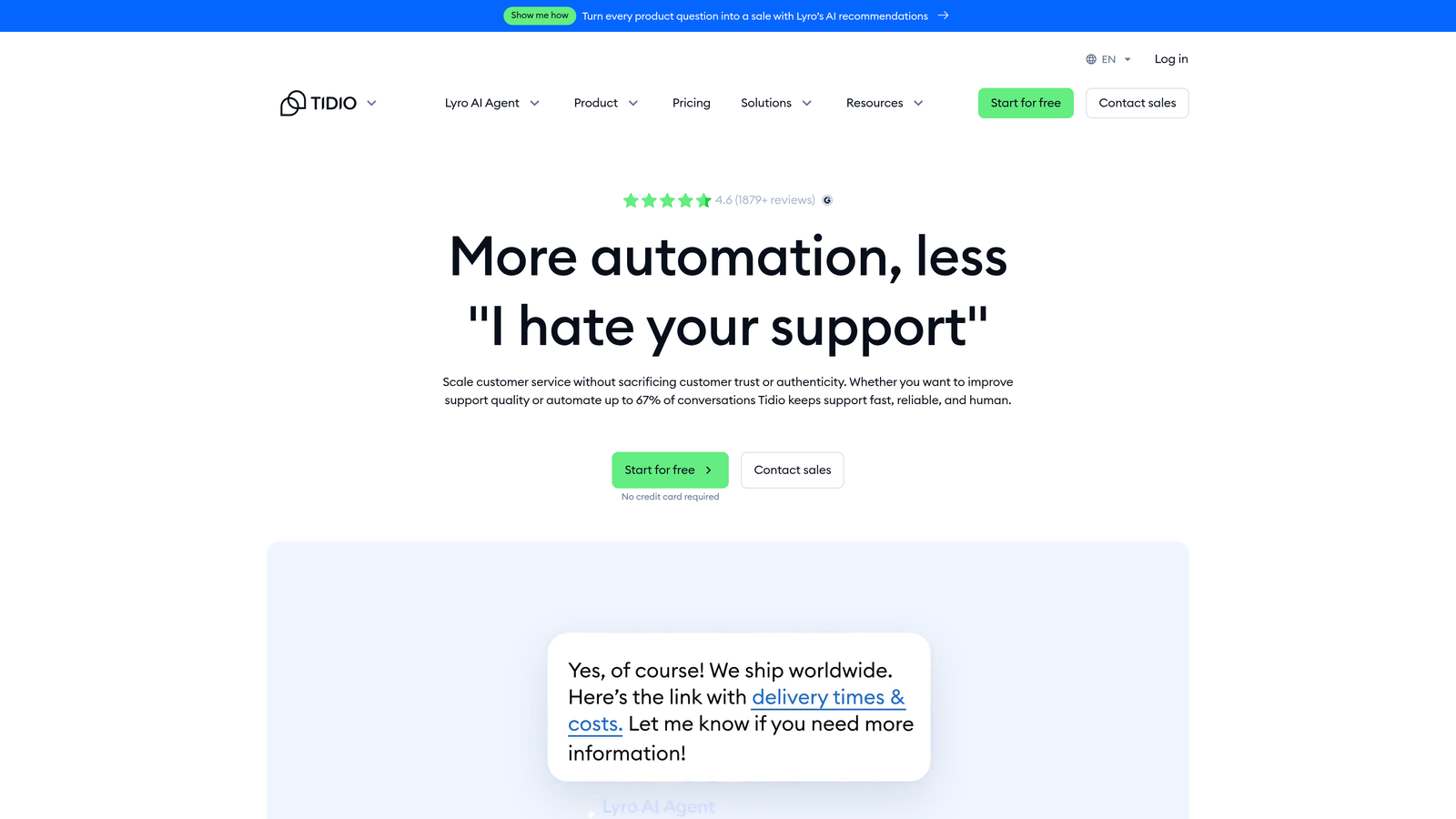
Tidio is an affordable live chat and AI chatbot platform for small-to-mid-size ecommerce stores, featuring Lyro AI for conversational automation of common customer queries.
Where This Tool Shines
If you're running a growing Shopify or WooCommerce store and you're not ready for enterprise-grade tooling, Tidio is one of the fastest ways to add meaningful automation. Lyro AI handles conversational FAQs and common ecommerce queries, and when it reaches the edge of its capabilities, it hands off to a live agent without the customer noticing a jarring transition.
Setup is genuinely straightforward. The visual chatbot builder lets non-technical team members create custom flows without engineering support, which is a real advantage for lean ecommerce operations where everyone wears multiple hats.
Key Features
Lyro AI Chatbot: Handles FAQs and ecommerce queries conversationally, trained on your support content without requiring manual flow-building for every scenario.
Live Chat with Agent Takeover: Smooth handoff from AI to human agent when conversations require a personal touch.
Ecommerce Platform Integrations: Native connections with Shopify, WooCommerce, Wix, and BigCommerce.
Visual Chatbot Builder: Build custom conversation flows with a drag-and-drop interface, no coding required.
Free Plan Available: Small stores can get started without committing to a paid plan, making it easy to test before scaling.
Best For
Early-stage and growing ecommerce brands that want to add chat automation quickly and affordably. Not the right fit for enterprise operations with complex workflows or teams that need deep CRM and order management integrations.
Pricing
Free plan available for small stores. Paid plans start at accessible SMB price points and scale with usage and feature requirements.
4. Zendesk
Best for: Enterprise ecommerce operations with complex multi-channel support workflows and large agent teams
Zendesk is an enterprise-grade support platform with mature automation capabilities, AI-powered triage, and an extensive app marketplace for ecommerce integrations.

Where This Tool Shines
Zendesk's strength is its maturity. It has been refined over many years into one of the most configurable support platforms available, with automation capabilities that can handle genuinely complex ecommerce workflows: multi-region routing, SLA management across channels, and sophisticated escalation rules that account for customer tier, product category, and issue type.
The app marketplace is another significant advantage. With hundreds of integrations including Shopify, Magento, and a wide range of ecommerce tools, Zendesk can slot into almost any existing tech stack. The tradeoff is that realizing this configurability requires meaningful admin investment upfront.
Key Features
AI-Powered Triage and Routing: Automatically categorizes, prioritizes, and routes incoming tickets based on content and context.
Omnichannel Support: Manages email, live chat, social, and voice from a unified inbox.
Extensive App Marketplace: Hundreds of integrations including Shopify, Magento, and the broader ecommerce ecosystem.
Advanced Reporting and Analytics: Deep reporting capabilities for tracking team performance, ticket trends, and SLA compliance.
Highly Customizable Workflows: Build complex automation rules, triggers, and macros to match your specific operational requirements.
Best For
Larger ecommerce operations with dedicated support operations teams, multiple channels, and complex routing requirements. Less suited for small teams that need quick setup and affordable entry-level pricing.
Pricing
Suite plans starting at mid-market price points, with Enterprise plans available for large-scale operations. Pricing is seat-based and publicly listed on their website.
5. Freshdesk
Best for: Growing ecommerce teams that want AI-assisted automation at pricing more accessible than enterprise platforms
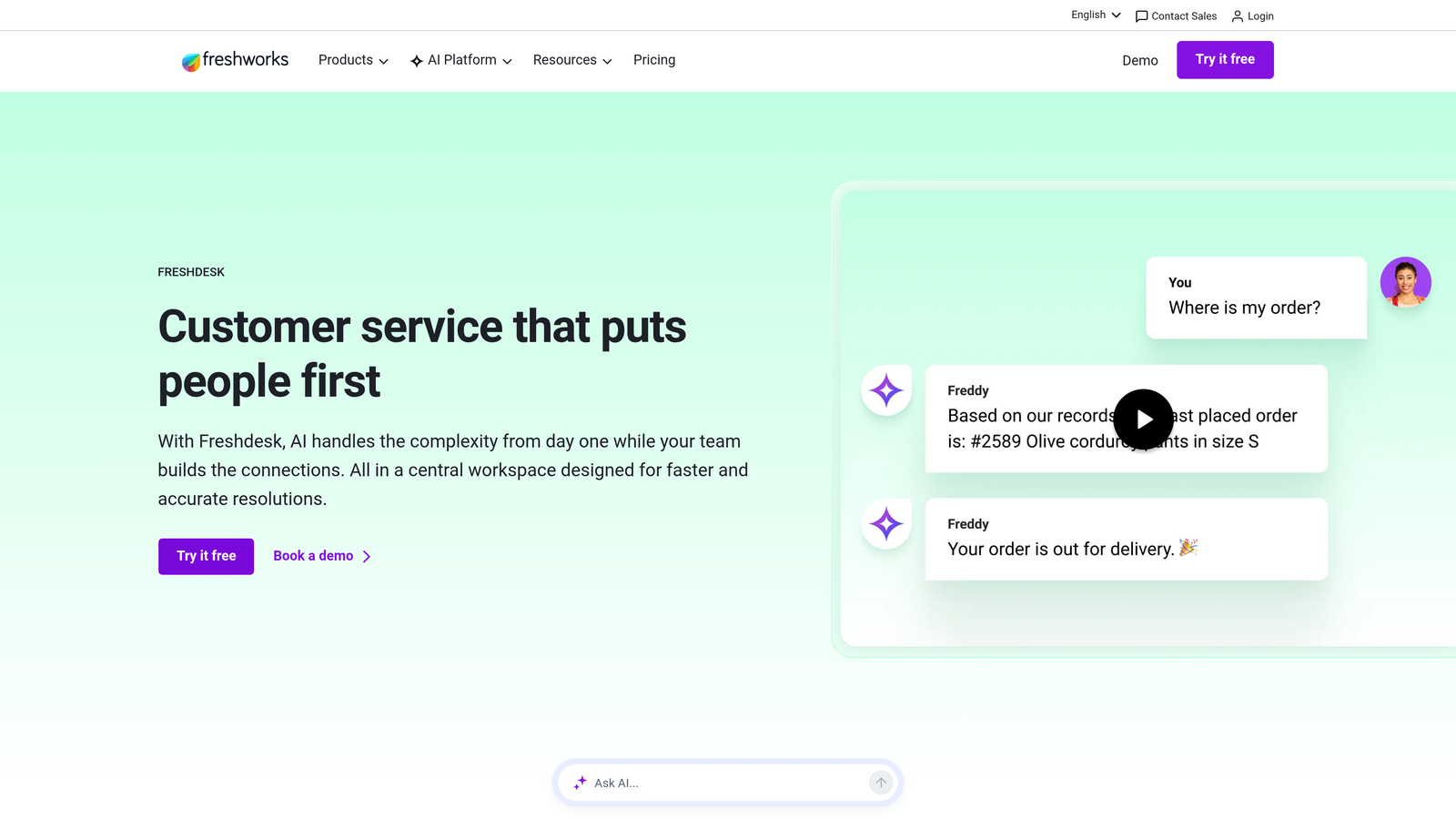
Freshdesk is a cloud-based helpdesk with Freddy AI for automated ticket categorization, suggested responses, and agent assist, at pricing accessible to growing ecommerce teams.
Where This Tool Shines
Freshdesk occupies a useful middle ground in the market: more capable than entry-level chat tools, but more approachable than Zendesk for teams without dedicated support operations staff. Freddy AI handles the automation layer, auto-categorizing incoming tickets, suggesting responses to agents, and flagging priority issues before they escalate.
The omnichannel inbox consolidates email, chat, social, and phone into one workspace, which is particularly useful for ecommerce brands managing customer conversations across multiple platforms. The free plan for small teams makes it easy to get started before committing to a paid tier.
Key Features
Freddy AI: Handles auto-categorization, suggested responses, and agent assist to reduce manual work on every ticket.
Omnichannel Inbox: Consolidates email, chat, social, and phone support into a single agent workspace.
Ecommerce Integrations: Shopify and other ecommerce platform connections available via the marketplace.
Automation Rules: Ticket routing, SLA management, and escalation rules configurable without engineering support.
Free Plan for Small Teams: Generous free tier lets small ecommerce operations get started without upfront cost.
Best For
Mid-market ecommerce teams that have outgrown basic chat tools but aren't ready for the complexity and cost of enterprise platforms. Strong fit for teams that want AI assistance for agents rather than fully autonomous resolution.
Pricing
Free plan available. Paid plans scale by agent seat, with multiple tiers covering SMB through enterprise needs.
6. Re:amaze
Best for: Multi-brand and multi-storefront operators managing several ecommerce properties under one account
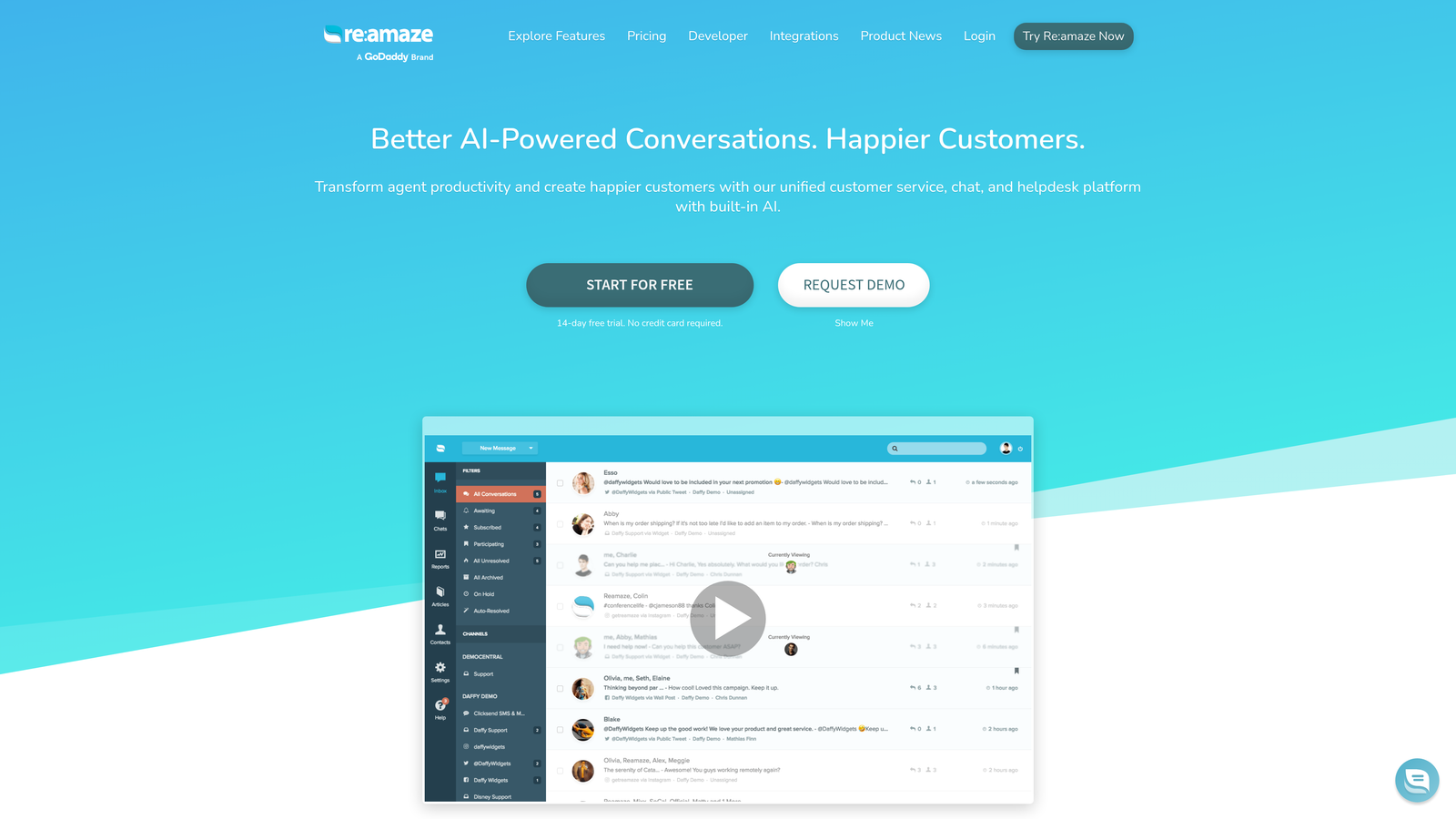
Re:amaze is an ecommerce-focused helpdesk and live chat platform with strong multi-brand and multi-store support, ideal for operators managing several storefronts under one account.
Where This Tool Shines
Re:amaze was built with ecommerce operators in mind, and it shows. The multi-brand management capability is genuinely differentiated: if you're running multiple Shopify stores, managing several product lines, or operating across different regional storefronts, Re:amaze lets you handle all of them from a single account without creating separate instances or managing separate billing.
The built-in chatbot builder comes with ecommerce-specific flows out of the box, covering order tracking, returns, and common product questions. Combined with a unified inbox that pulls in email, chat, social, and SMS, it gives lean teams a comprehensive view of customer conversations across all channels and brands.
Key Features
Multi-Brand and Multi-Store Management: Manage multiple storefronts and brands from a single account, a standout capability for portfolio operators.
Built-In Chatbot Builder: Create ecommerce-specific conversation flows with a visual builder, including order tracking and return workflows.
Broad Storefront Integrations: Native connections with Shopify, BigCommerce, WooCommerce, and Magento.
Unified Omnichannel Inbox: Email, chat, social, and SMS conversations consolidated in one workspace.
Canned Responses and Automated Workflows: Reduce repetitive agent work with pre-built responses and rule-based automation.
Best For
Ecommerce operators managing multiple brands or storefronts who need one platform to rule them all. Also a solid choice for single-brand DTC teams that want ecommerce-native tooling with a straightforward per-agent pricing model.
Pricing
Per-agent pricing with Basic, Pro, and Enterprise tiers. Pricing is listed publicly on their website.
7. Intercom
Best for: Ecommerce brands with digital or subscription products that want AI to handle complex, multi-turn support conversations
Intercom is a full customer messaging platform featuring Fin AI agent, designed to resolve complex support conversations autonomously using your company's knowledge base.
Where This Tool Shines
Intercom's Fin AI agent is built for something more ambitious than basic FAQ deflection: it's designed to handle multi-turn conversations that require reasoning across your knowledge base, not just keyword matching against a list of canned answers. For ecommerce brands with complex product catalogs, subscription models, or software-enabled products, that capability matters.
Intercom also excels at the full customer journey, not just reactive support. Product tours, onboarding flows, and proactive messaging sit alongside the support inbox, making it a strong choice for brands that want to engage customers throughout the lifecycle rather than just when something goes wrong.
Key Features
Fin AI Agent: Autonomously resolves complex support conversations using your knowledge base, handling multi-turn dialogue without scripted flows.
Unified Messaging Platform: In-app messaging, live chat, and email managed from one platform.
Ecommerce Integrations: Shopify and other ecommerce platform connections available.
Product Tours and Onboarding Flows: Proactive engagement tools for ecommerce apps and subscription products.
Flexible Pricing Models: Per-resolution pricing option available alongside traditional seat-based plans.
Best For
Ecommerce brands with a digital or SaaS-adjacent component: subscription boxes, software-enabled products, or apps. Less optimized for pure transactional retail with high WISMO volume, where ecommerce-native helpdesks like Gorgias or Richpanel may be a better fit.
Pricing
Seat-based and per-resolution pricing options available. Contact Intercom for enterprise pricing.
8. Richpanel
Best for: High-volume DTC brands that want to deflect WISMO and return tickets through customer self-service
Richpanel is an ecommerce helpdesk with a standout customer self-service portal that lets shoppers resolve order issues, returns, and subscriptions without ever contacting an agent.
Where This Tool Shines
Richpanel's defining feature is its self-service portal, and it's genuinely well-executed. Rather than routing every order inquiry to an agent, Richpanel gives customers a branded portal where they can track orders, initiate returns, manage subscriptions, and resolve common issues entirely on their own. For DTC brands with predictable, structured support requests, this can meaningfully reduce the number of tickets that ever reach the queue.
When tickets do reach agents, the workspace gives them full order context alongside the conversation, eliminating the need to pull up a separate order management system. AI-assisted response suggestions further speed up resolution for the tickets that do require human attention.
Key Features
Customer Self-Service Widget: Branded portal for order tracking, returns, and subscription management that customers can use without contacting support.
Native Ecommerce Integrations: Deep connections with Shopify, WooCommerce, and Magento for live order data.
Agent Workspace with Full Order Context: Agents see complete order history alongside every conversation, no tab-switching required.
WISMO and Return Automation: Automated ticket deflection for the most common ecommerce support categories.
AI-Assisted Response Suggestions: Helps agents respond faster to tickets that do require human handling.
Best For
High-volume DTC brands and subscription ecommerce businesses with predictable, structured support requests. Particularly strong for teams whose primary goal is deflecting WISMO and return tickets before they reach the queue.
Pricing
Tiered pricing based on order and revenue volume, making costs scale with business growth rather than agent headcount.
9. Kustomer
Best for: Enterprise retailers prioritizing customer lifetime value with a CRM-first approach to support
Kustomer is a CRM-first enterprise customer service platform with a unified customer timeline and AI-powered workflows, built for retailers who prioritize customer lifetime value.
Where This Tool Shines
Kustomer approaches customer service from a fundamentally different angle than pure helpdesk tools. Instead of organizing around tickets, it organizes around customers. Every agent interaction opens a unified timeline showing the customer's complete history: all orders, all previous conversations, all touchpoints across channels. For enterprise retailers where understanding the full customer relationship shapes how you respond, this context is invaluable.
The AI-powered workflow layer handles routing, tagging, and automated responses at scale, while the advanced reporting gives customer-level analytics rather than just ticket-level metrics. If you need to understand which customer segments generate the most support load, or which issues correlate with churn, Kustomer's data model is built for that kind of analysis.
Key Features
Unified Customer Timeline: Every order, interaction, and touchpoint consolidated in a single customer view, not a ticket-by-ticket interface.
AI-Powered Routing and Workflows: Automated routing, tagging, and response workflows that operate at enterprise scale.
Omnichannel Support: Email, chat, social, voice, and SMS managed from one platform.
Shopify and BigCommerce Integrations: Ecommerce platform connections bring order data into the customer timeline.
Customer-Level Analytics: Advanced reporting that goes beyond ticket metrics to surface customer-level insights and trends.
Best For
Enterprise retailers and high-volume ecommerce operations where customer lifetime value is a core business metric. Not the right fit for SMBs or teams that need quick, affordable setup; Kustomer is built for organizations with the resources to leverage its full capability.
Pricing
Enterprise pricing. Contact Kustomer directly for a quote based on your team size and requirements.
Which Tool Is Right for Your Ecommerce Operation?
The right choice depends on where you are, what you're building, and what you need automation to actually do for your team.
SMB Shopify brands getting started with automation will find Gorgias or Tidio the most practical entry points. Gorgias brings order-aware automation that's deeply integrated with your storefront; Tidio adds conversational AI chat at an accessible price point.
Enterprise operations with complex multi-channel workflows and large agent teams will find the most capability in Zendesk or Kustomer, depending on whether you prioritize workflow configurability or a CRM-first customer view.
Multi-brand operators running several storefronts should look closely at Re:amaze, which is genuinely built for that use case in a way most platforms are not.
High-volume DTC brands whose primary challenge is WISMO and return ticket deflection will get strong results from Richpanel's self-service portal approach.
Teams wanting AI-first autonomous resolution with business intelligence beyond basic support metrics should evaluate Halo AI. It's the option on this list built from the ground up for autonomous resolution rather than agent augmentation, and it surfaces insights from support interactions that most helpdesks simply don't capture.
Before committing to any platform, ask three questions: Does it integrate with my ecommerce platform and existing stack? Can it resolve tickets autonomously, or does it just triage them? Will it surface insights beyond basic support metrics? The answers will narrow the field quickly.
Your support team shouldn't scale linearly with your customer base. Let AI agents handle routine tickets, guide users through your product, and surface business intelligence while your team focuses on complex issues that need a human touch. See Halo in action and discover how continuous learning transforms every interaction into smarter, faster support.