9 Best Customer Service Automation Platforms Compared in 2026
This comprehensive comparison of customer service automation platforms evaluated in 2026 examines nine leading solutions across six key criteria—including AI autonomy depth, integrations, and pricing transparency—helping businesses from small teams to enterprises identify the right fit for their specific support needs and workflows.
 Matt PattoliFounder14 min read
Choosing the right customer service automation platform in 2026 feels a bit like shopping for a car when every dealership claims theirs is the fastest, smartest, and most fuel-efficient. The market is genuinely crowded, and the options range from legacy helpdesks that have bolted AI onto their existing architecture to purpose-built platforms where AI is the foundation, not an afterthought.
To cut through the noise, we evaluated these platforms across six criteria: depth of AI autonomy (can it fully resolve tickets or just suggest replies?), integration ecosystem, ease of deployment, analytics and intelligence capabilities, scalability, and pricing transparency. The result is a list that spans AI-native platforms, established helpdesk suites with automation layers, and lightweight tools built for smaller teams.
Whether you're a B2B product team looking to connect support directly to engineering workflows, an enterprise evaluating CRM-connected service platforms, or a growing startup that needs affordable automation fast, you'll find a fit here. For broader context, explore our customer service automation overview and customer support automation strategy guides before diving in.
1. Halo AI
Best for: B2B product teams wanting AI-first autonomous support with business intelligence built in
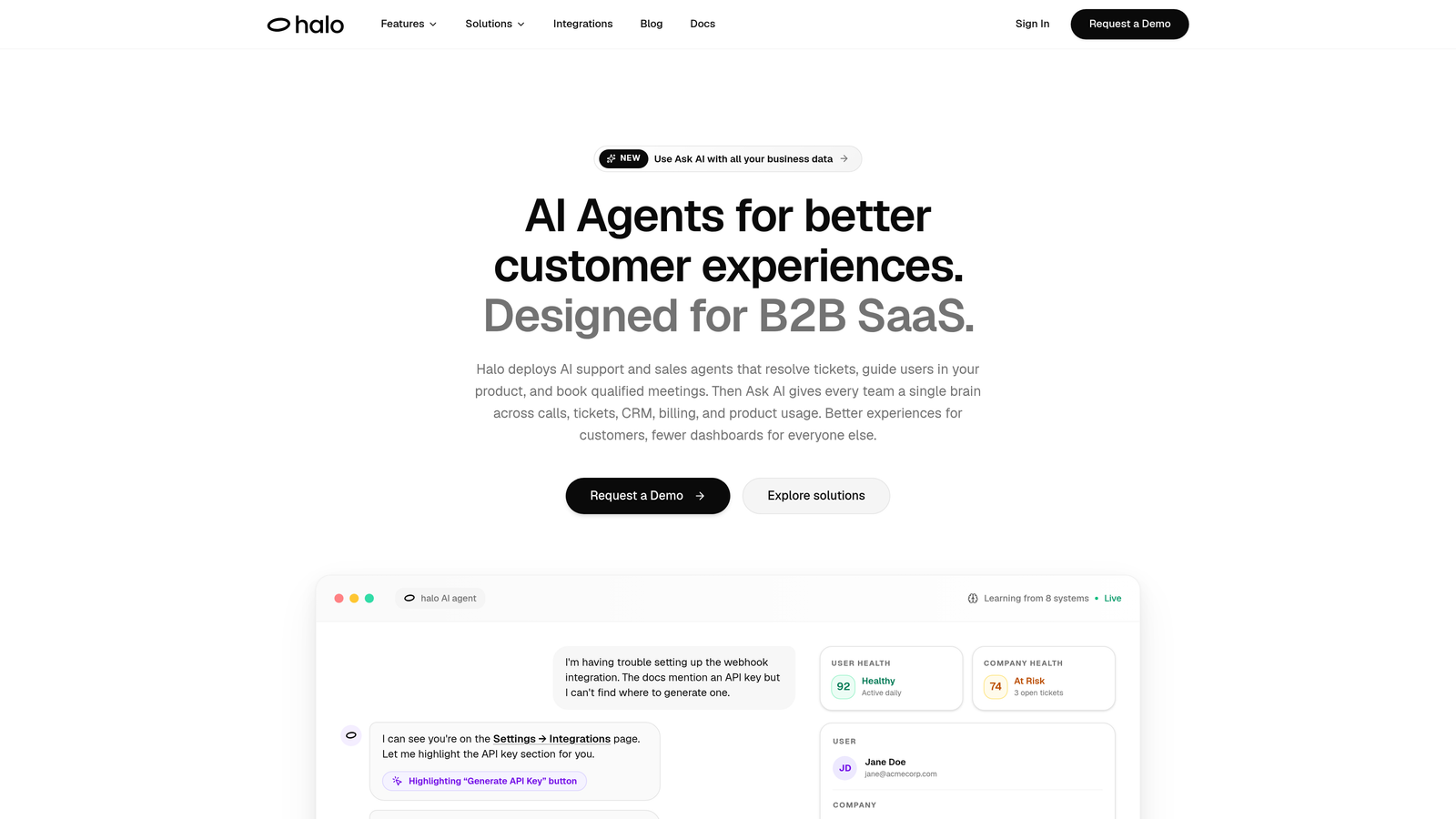
Halo AI is an AI-native customer support platform where autonomous agents resolve tickets, guide users visually through your product, and surface actionable business intelligence.
Where This Tool Shines
What separates Halo from most platforms on this list is the architecture. Rather than adding AI capabilities on top of an existing helpdesk, Halo is built from the ground up around autonomous agents that learn continuously from every interaction. That distinction matters: the learning loop is tighter, the context is richer, and the system gets progressively smarter without manual retraining.
The page-aware capability is particularly compelling for B2B SaaS teams. Halo's agents can see what a user is looking at in your product, enabling contextual visual guidance that goes well beyond a generic FAQ answer. Combined with a smart inbox that surfaces customer health signals and revenue intelligence, Halo positions support as a business intelligence function, not just a cost center.
Key Features
Page-Aware AI Agents: Agents understand the specific page a user is on and provide contextual, visual guidance tailored to that exact moment in their journey.
Smart Inbox with Business Intelligence: Goes beyond ticket metrics to surface customer health signals, churn risk indicators, and revenue-relevant insights directly in the support workflow.
Automatic Bug Ticket Creation: Detects and routes bug reports autonomously to engineering tools like Linear, closing the loop between support and product teams without manual triage.
Deep Integration Ecosystem: Connects natively with Slack, HubSpot, Intercom, Stripe, Zoom, PandaDoc, and more, linking support context to your entire business stack.
Continuous Learning: Every resolved interaction feeds back into the model, making resolution quality progressively stronger over time without manual intervention.
Best For
B2B SaaS companies and product teams that want support to do more than deflect tickets. Particularly strong for teams that need engineering integration, want customer health signals surfaced from support data, or are scaling headcount and need AI to absorb volume without proportional hiring.
Pricing
Contact for pricing; plans scale based on usage and team size. Reach out directly at haloagents.ai for a custom quote.
2. Zendesk AI
Best for: Enterprises with established Zendesk workflows wanting to layer AI onto proven infrastructure
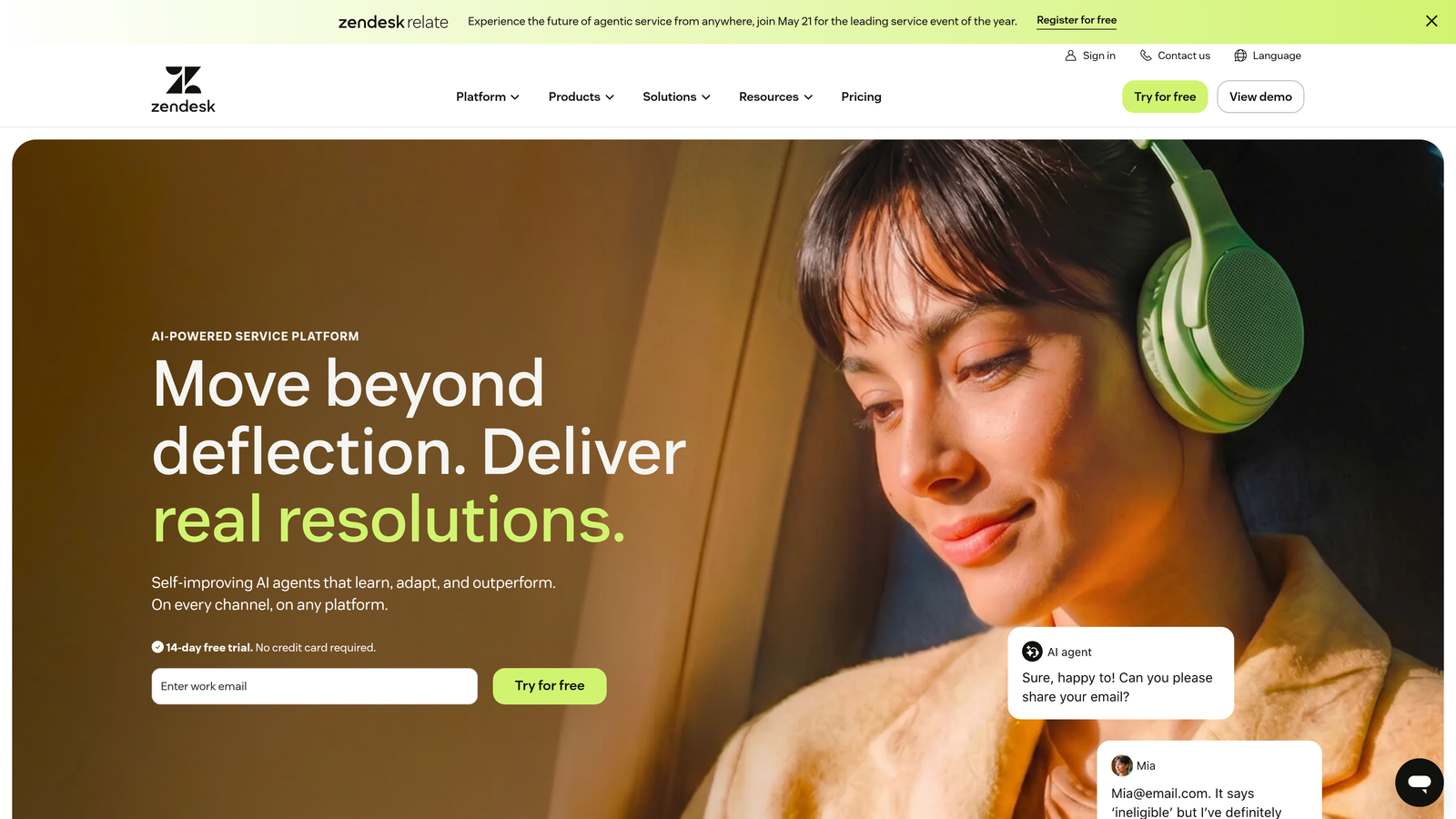
Zendesk AI is the AI-enhanced version of the industry's most recognized helpdesk, adding intelligent bots, triage, and agent assist to an already mature platform.
Where This Tool Shines
Zendesk's biggest advantage is its maturity. With a marketplace of over 1,500 pre-built integrations and years of enterprise deployment experience, it offers a level of ecosystem depth that newer platforms simply can't match yet. If your team already lives in Zendesk, the AI layer slots in without a migration headache.
The intelligent triage functionality is genuinely useful for high-volume teams, automatically classifying intent, language, and sentiment so tickets land with the right agent or bot from the start. Agent assist helps human agents respond faster with AI-suggested replies pulled from your knowledge base.
Key Features
AI-Powered Bots: Automated ticket resolution and self-service flows that handle common questions before they reach a human agent.
Intelligent Triage: Auto-classifies tickets by intent, language, and sentiment to ensure accurate routing from the moment a ticket arrives.
Agent Assist: Surfaces AI-suggested replies and relevant knowledge base articles to help agents respond faster and more consistently.
1,500+ Integrations: An extensive marketplace covering CRMs, communication tools, e-commerce platforms, and developer tools.
Advanced Analytics: Robust reporting dashboards for tracking resolution rates, agent performance, and customer satisfaction trends.
Best For
Mid-market and enterprise teams already invested in the Zendesk ecosystem, or organizations that need a proven, widely-supported platform with extensive integration options and don't want to migrate their existing workflows.
Pricing
Suite plans start at $55/agent/month; AI capabilities are available as an additional add-on at extra cost.
3. Intercom Fin
Best for: Product-led growth companies wanting proactive, conversational in-app support
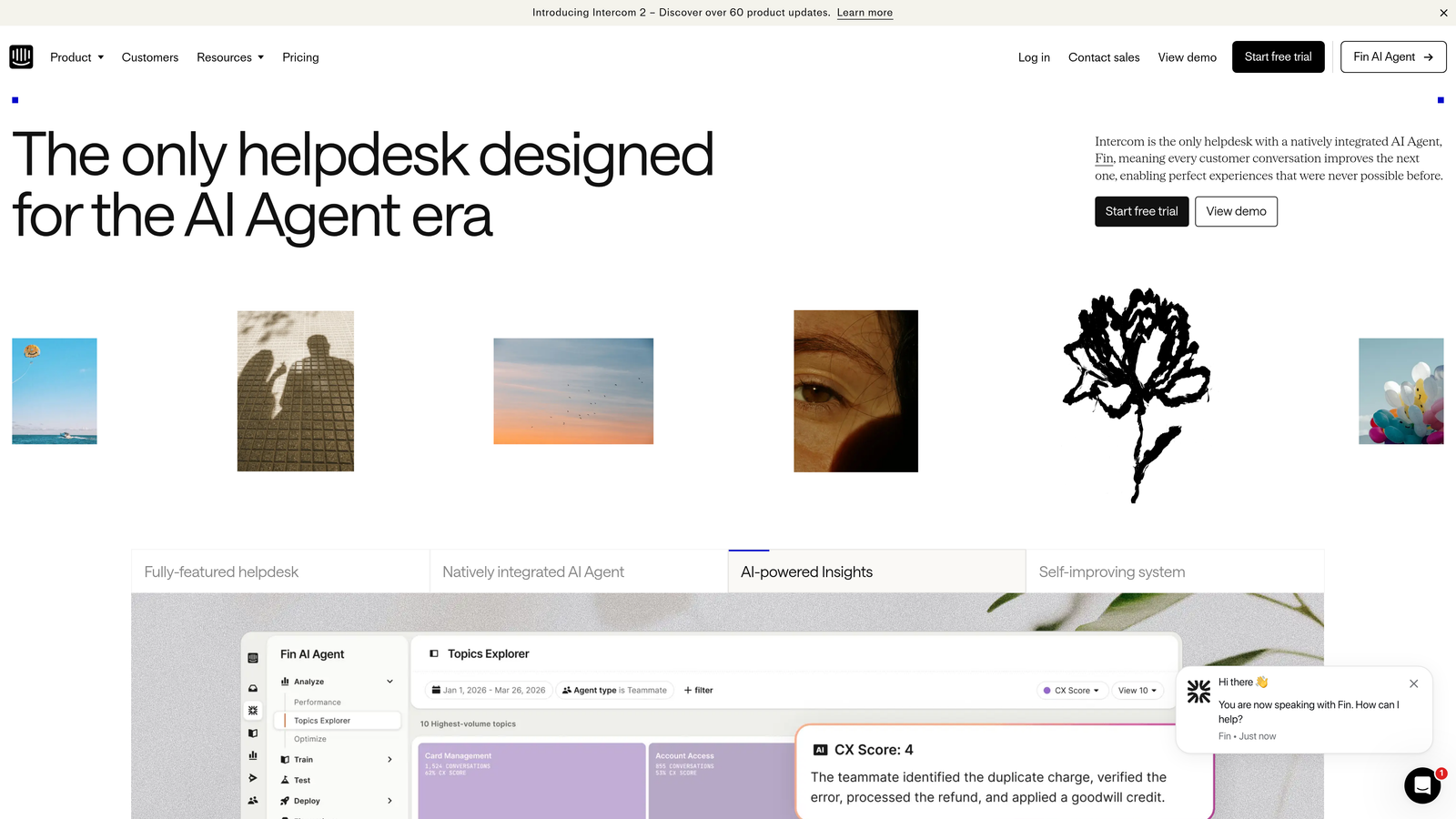
Intercom Fin is a conversational AI agent built into Intercom's messaging-first platform, designed to resolve questions autonomously using your existing help content.
Where This Tool Shines
Intercom has always been the platform of choice for product-led companies, and Fin extends that strength into AI-powered resolution. Fin draws on your help center content and custom knowledge to answer questions without human intervention, and the quality of resolution tends to be strong when your documentation is solid.
The proactive support capabilities, including in-app messaging, product tours, and outbound triggers, make Intercom a particularly good fit for teams that want to get ahead of support issues rather than just react to them. The unified inbox spanning chat, email, and social keeps everything in one place.
Key Features
Fin AI Agent: Resolves customer questions autonomously using your help center and custom content, with smooth handoff to human agents when needed.
Proactive Support: In-app messaging, product tours, and outbound triggers to address user needs before they become support tickets.
Customizable Workflows: Flexible conversation routing and workflow automation to match your specific support process.
Unified Inbox: Consolidates chat, email, and social channel conversations into a single agent workspace.
Customer Data Platform: Rich user data context enables personalized interactions based on product usage, plan type, and behavior.
Best For
SaaS companies with a product-led growth motion, teams that invest heavily in proactive onboarding and in-app guidance, and organizations that want AI resolution tightly coupled with customer messaging and lifecycle data.
Pricing
Essential plan starts at $29/seat/month; Fin AI usage is billed per resolution, so costs scale with the volume of AI-handled conversations.
4. Freshdesk (Freddy AI)
Best for: Budget-conscious teams wanting omnichannel support with AI automation across the Freshworks suite
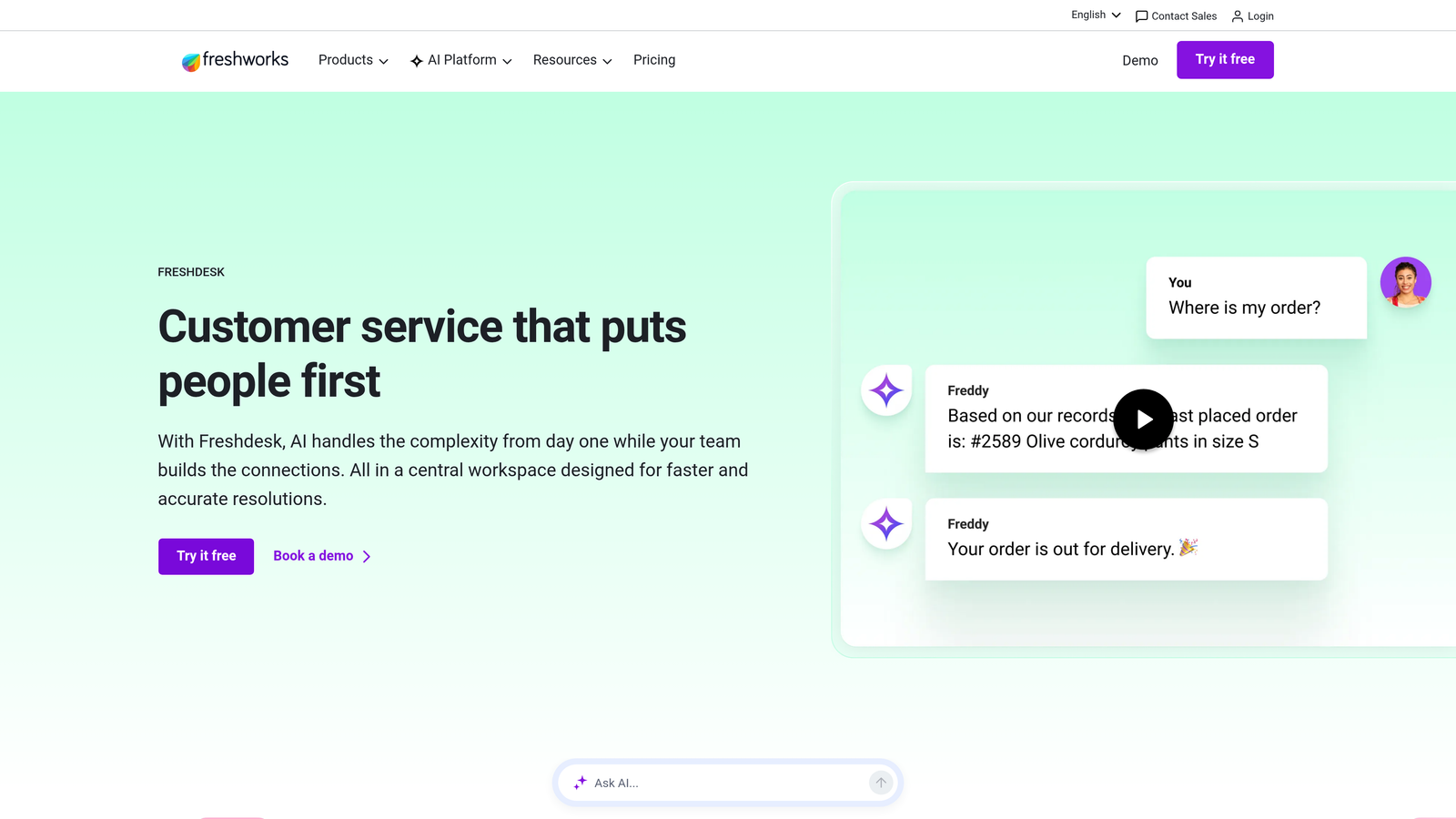
Freshdesk is an affordable, full-featured helpdesk with Freddy AI handling auto-triage, suggested responses, and chatbot flows as part of the broader Freshworks business suite.
Where This Tool Shines
Freshdesk's value proposition is clear: you get a genuinely capable omnichannel helpdesk with AI automation at a price point that doesn't require a large enterprise budget. The free tier for small teams is a real differentiator, making it accessible for companies that are just beginning to formalize their support operations.
For teams already using other Freshworks products like Freshsales or Freshservice, the cross-suite integration creates a unified view of the customer that adds real context to support interactions. Freddy AI handles the fundamentals well, particularly auto-triage and canned response suggestions.
Key Features
Freddy AI: Handles auto-triage, canned response suggestions, and chatbot conversation flows to reduce manual workload.
Omnichannel Support: Manages email, chat, phone, and social media conversations from a single platform.
Team Collaboration Tools: Built-in features for internal notes, ticket sharing, and collaborative resolution across team members.
Freshworks Suite Integration: Native connections to Freshsales, Freshmarketer, and Freshservice for a unified business view.
Free Tier: A genuinely usable free plan for teams of up to two agents, with core helpdesk functionality included.
Best For
Small to mid-sized businesses looking for cost-effective omnichannel support, teams already using Freshworks products, and companies that want AI automation without a premium price tag.
Pricing
Free plan available for up to 2 agents; paid plans start at $15/agent/month, making it one of the more affordable options on this list.
5. Ada
Best for: Enterprises wanting autonomous AI resolution layered on top of existing helpdesk and CRM infrastructure
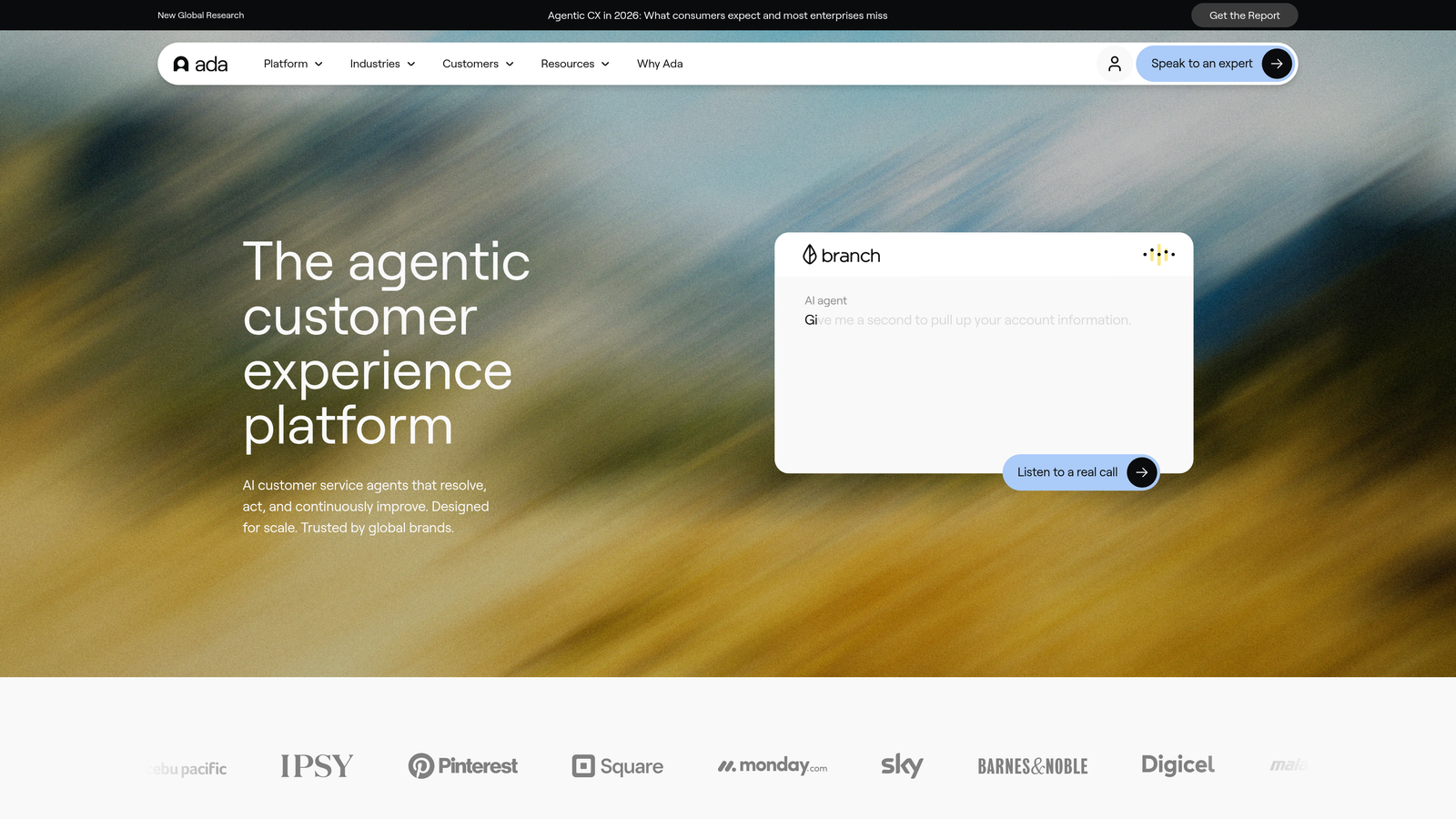
Ada is an enterprise-grade AI agent platform designed to deliver autonomous resolution at scale without replacing your current helpdesk or CRM stack.
Where This Tool Shines
Ada's positioning as an overlay rather than a replacement is its defining characteristic. Rather than asking you to migrate away from Zendesk, Salesforce, or whatever helpdesk you've invested in, Ada sits on top and handles resolution autonomously, passing complex cases back to your existing workflows. For enterprises with significant sunk costs in their current stack, this is a genuinely attractive architecture.
The reasoning engine powering Ada's no-code bot builder handles complex, multi-step workflows that go well beyond simple FAQ deflection. Multilingual support across many languages also makes it a strong option for global support operations.
Key Features
Autonomous AI Agent: Connects to your knowledge base, CRM, and backend systems to resolve tickets without human intervention across complex scenarios.
No-Code Bot Builder: Reasoning engine supports multi-step, conditional workflows that non-technical teams can build and manage.
Helpdesk Overlay Architecture: Integrates with Zendesk, Salesforce, and other major platforms as an autonomous layer rather than a replacement.
Multilingual Support: Handles customer interactions across many languages, suitable for global enterprise deployments.
Enterprise Security and Compliance: Certifications and controls designed to meet enterprise security requirements.
Best For
Large enterprises with established helpdesk investments that want to add a layer of autonomous AI resolution without a full platform migration. Also strong for global teams needing multilingual AI support at scale.
Pricing
Custom enterprise pricing; contact Ada directly for a quote based on your volume and use case requirements.
6. Tidio
Best for: Small businesses and e-commerce teams wanting fast, affordable chat and chatbot automation
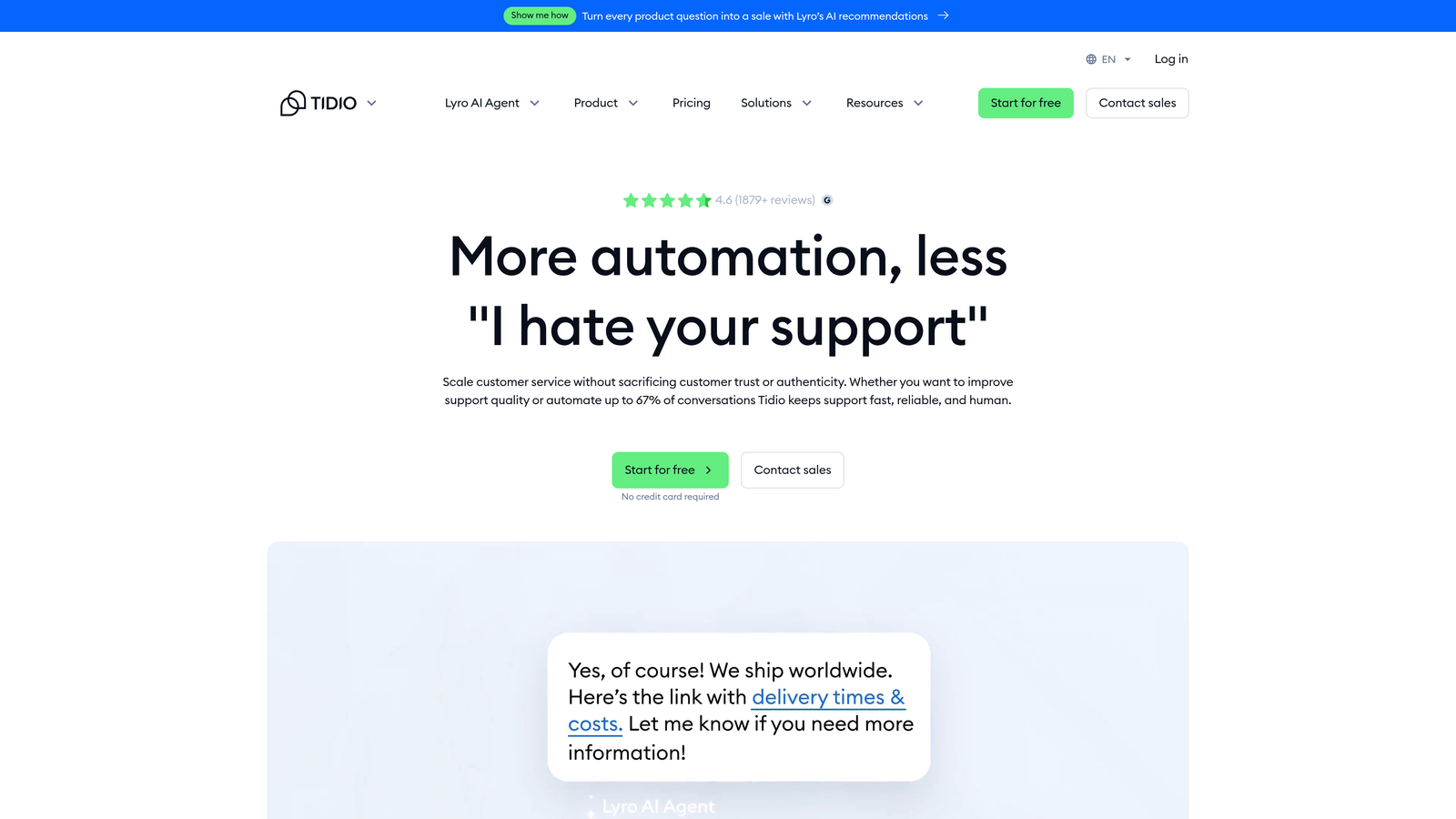
Tidio is a lightweight live chat and chatbot platform with a Lyro AI assistant built for small businesses that need automation without complexity or cost.
Where This Tool Shines
Tidio is genuinely easy to get up and running. The visual drag-and-drop chatbot builder means you don't need technical resources to create functional automation flows, and the Lyro AI assistant learns from your FAQ and help content quickly. For e-commerce businesses in particular, the Shopify and WordPress integrations make it a natural fit.
The free plan is more generous than most competitors at this price point, giving small teams access to core live chat and basic automation before committing to paid tiers. It's not built for complex enterprise workflows, but that's not the audience it's designed for.
Key Features
Lyro AI Assistant: Conversational AI trained on your FAQ and help content to handle common questions automatically.
Visual Bot Builder: Drag-and-drop interface for creating custom chatbot flows without writing code.
E-Commerce Integrations: Native connections to Shopify, WordPress, and other e-commerce platforms for context-aware support.
Live Chat with Visitor Tracking: Real-time monitoring of site visitors with live chat capability for immediate human intervention when needed.
Generous Free Plan: Core live chat and automation features available without a paid subscription.
Best For
Small businesses, e-commerce stores, and early-stage startups that need affordable, easy-to-deploy chat automation without the complexity or cost of enterprise platforms.
Pricing
Free plan available; paid plans start at $29/month, making it one of the most accessible options for budget-conscious teams.
7. HubSpot Service Hub
Best for: Teams already in the HubSpot ecosystem wanting unified CRM-connected customer service
HubSpot Service Hub is a customer service platform natively integrated with HubSpot CRM, combining ticketing, knowledge base, and AI-powered automation in one place.
Where This Tool Shines
The core advantage here is context. Because Service Hub sits on the same CRM as HubSpot's Marketing and Sales tools, support agents see the full customer lifecycle: what emails the customer has received, what deals are open, what pages they've visited, and what their relationship history looks like. That context transforms support interactions from transactional exchanges into genuinely informed conversations.
For teams that are already paying for HubSpot, adding Service Hub often makes more financial and operational sense than introducing a separate support platform. The AI chatbot builder and conversation intelligence features are solid, if not the most advanced on this list.
Key Features
Native CRM Integration: Full customer lifecycle context is available to support agents without switching tools or looking up external records.
AI Chatbot Builder and Conversation Intelligence: Automated chat flows and AI-powered analysis of support conversations for coaching and quality insights.
Unified Platform: Ticketing, knowledge base, and customer feedback surveys managed from a single interface.
Shared Inbox with SLA Management: Automated routing, SLA tracking, and team inbox management in one workspace.
Cross-Hub Connectivity: Seamless data flow between Service Hub, Marketing Hub, and Sales Hub for a unified go-to-market view.
Best For
Companies already invested in the HubSpot ecosystem, teams that want CRM context deeply embedded in their support workflow, and organizations that prefer consolidating tools rather than managing separate platforms.
Pricing
Free tools available; Starter at $20/month/seat; Professional at $100/month/seat.
8. Salesforce Service Cloud (Einstein AI)
Best for: Large enterprises needing deeply customizable, CRM-connected service with autonomous AI agents
Salesforce Service Cloud is an enterprise service platform powered by Einstein AI and Agentforce, built for organizations that need complex multi-department workflows and deep Salesforce ecosystem integration.
Where This Tool Shines
Service Cloud's strength is its configurability. With Flow Builder, custom objects, and the full breadth of the Salesforce platform underneath it, organizations can build support workflows of extraordinary complexity. Einstein AI handles case classification, next-best-action recommendations, and reply generation, while Agentforce enables the deployment of autonomous AI service agents for more advanced automation scenarios.
The omnichannel routing across voice, chat, email, messaging, and social is genuinely comprehensive. For enterprises where support is intertwined with sales, field service, and marketing operations, the depth of Salesforce integration is difficult to replicate elsewhere.
Key Features
Einstein AI: Case classification, next-best-action recommendations, and AI-generated reply suggestions built into the agent workflow.
Agentforce: Enables deployment of autonomous AI service agents for handling cases without human intervention at scale.
Omnichannel Routing: Unified routing across voice, chat, email, messaging, and social media channels.
Flow Builder: Visual workflow automation tool for building complex, multi-step support processes without custom code.
Salesforce Ecosystem Integration: Deep native connections to Sales Cloud, Marketing Cloud, and the broader Salesforce platform.
Best For
Large enterprises already on Salesforce, organizations with complex multi-department service workflows, and companies that need a highly customizable platform with the full weight of the Salesforce ecosystem behind it.
Pricing
Starter Suite at $25/user/month; Enterprise at $165/user/month; Einstein AI capabilities available as additional add-ons.
9. Help Scout
Best for: Teams that want smart automation without losing the personal, human feel of their support
Help Scout is a clean, human-first shared inbox with AI drafts, summarization tools, and a well-designed knowledge base for teams that value simplicity and warmth.
Where This Tool Shines
Help Scout occupies a specific and valuable niche: automation that enhances human agents rather than trying to replace them. The AI Drafts feature generates reply suggestions based on your knowledge base and past conversations, giving agents a strong starting point without removing their judgment from the equation. It's a philosophy that resonates with teams where brand voice and relationship quality matter.
The platform is genuinely pleasant to use. The shared inbox is clean, the collision detection prevents agents from accidentally doubling up on responses, and the Docs knowledge base is straightforward to build and maintain. It won't win on raw AI autonomy, but for teams where "human touch" is a deliberate strategy, it's an excellent fit.
Key Features
AI Drafts: Generates reply suggestions based on your knowledge base and historical conversations to accelerate agent response time.
AI Summarize: Instant conversation summaries during handoffs so agents get up to speed without reading full thread histories.
Clean Shared Inbox: Collision detection, private notes, and intuitive team inbox management designed for collaborative support.
Docs Knowledge Base: Straightforward knowledge base with built-in search and embeddable widgets for in-product help.
Beacon Widget: In-app help widget for proactive support and self-service, surfacing relevant articles before users submit a ticket.
Best For
Small to mid-sized teams that prioritize human-feeling support interactions, companies where brand voice is central to customer experience, and organizations that want AI to assist agents rather than replace them entirely.
Pricing
Standard plan at $25/user/month; Plus at $50/user/month. Straightforward, transparent pricing with no AI add-on complexity.
How to Choose the Right Platform for Your Team
The honest answer is that the best platform depends less on feature checklists and more on where AI fits in your support philosophy and your existing tech stack.
If you're a B2B SaaS team that wants AI to be the core of your support operation, not a layer on top of something else, the AI-native platforms are worth prioritizing. Halo AI stands out here, particularly if you need support to connect to engineering workflows, surface customer health signals, and provide page-aware guidance that reflects what users are actually experiencing in your product. It's built for teams that want support to generate intelligence, not just resolve tickets.
If you're deeply invested in an existing platform and migration isn't realistic, the overlay approach makes more sense. Ada works well for enterprises that want to add autonomous resolution on top of Zendesk or Salesforce without a full rip-and-replace. Zendesk AI and Salesforce Service Cloud are the right choices when you're already in those ecosystems and want to activate AI within familiar infrastructure.
For product-led growth companies where messaging and proactive support are central to the user experience, Intercom Fin is the natural fit. For teams already in HubSpot, Service Hub provides CRM-connected support without adding another tool. For smaller teams watching budget, Freshdesk and Tidio offer real automation at accessible price points. And for teams where the human touch is a deliberate brand decision, Help Scout strikes the right balance.
The broader trend worth noting: in 2026, the gap between platforms that use AI to suggest actions and platforms where AI takes autonomous action is widening. Teams that want to scale support without scaling headcount linearly are increasingly gravitating toward the latter.
Your support team shouldn't grow in direct proportion to your customer base. Let AI agents handle routine tickets, guide users through your product, and surface business intelligence while your team focuses on the complex issues that genuinely need a human touch. See Halo in action and discover how continuous learning transforms every interaction into smarter, faster support.