9 Best Customer Service Automation Tools and Their Pricing in 2026
This guide breaks down customer service automation pricing across 9 leading platforms, cutting through opaque vendor pricing models to reveal actual costs, fee structures, and who each tool best serves—helping SaaS teams and enterprises build an informed shortlist without endless sales calls.
 Matt PattoliFounder14 min read
Customer service automation pricing is notoriously difficult to compare. Vendors bury costs behind "contact sales" gates, per-seat models, and resolution-based fees that balloon as you scale. Whether you're a lean SaaS team evaluating your first AI agent or an enterprise reassessing bloated helpdesk costs, understanding what you'll actually pay matters just as much as what the tool can do.
This guide covers leading customer service automation platforms, their pricing structures, and who each one is best suited for. We've prioritized tools that offer genuine transparency on cost, meaningful automation depth, and clear upgrade paths. Each entry covers where the tool excels, key features, ideal users, and current pricing tiers so you can build an informed shortlist without booking a dozen sales calls.
A quick note on pricing: All figures in this guide are approximate and based on publicly available information as of mid-2026. Prices change frequently. Always verify current pricing directly with each vendor before making a decision.
Understanding the Three Pricing Models
Before diving into specific tools, it helps to understand how customer service automation vendors structure their costs. There are three dominant models, and knowing which one applies changes how you evaluate total cost of ownership.
Per-seat/agent pricing: You pay a monthly fee for each support agent using the platform. Predictable and easy to budget, but costs multiply fast as your team grows. Common in Zendesk, Freshdesk, and Intercom.
Per-resolution or per-conversation pricing: You're charged based on actual usage, often per successful AI resolution or ticket handled. This aligns cost with value delivered but can spike unexpectedly during high-volume periods. Used by Gorgias and increasingly by AI-first vendors.
Flat-rate usage tiers: A fixed monthly fee for a set volume of conversations or messages. Easier to budget at SMB scale. Common in newer AI tools like Tidio and Chatbase.
Keep an eye out for hidden costs too: onboarding fees, API call limits, integration charges, AI add-on fees layered on top of base subscriptions, and model training costs. These can significantly change the real price of a platform.
1. Halo AI
Best for: B2B SaaS teams that want AI-first support automation with built-in business intelligence
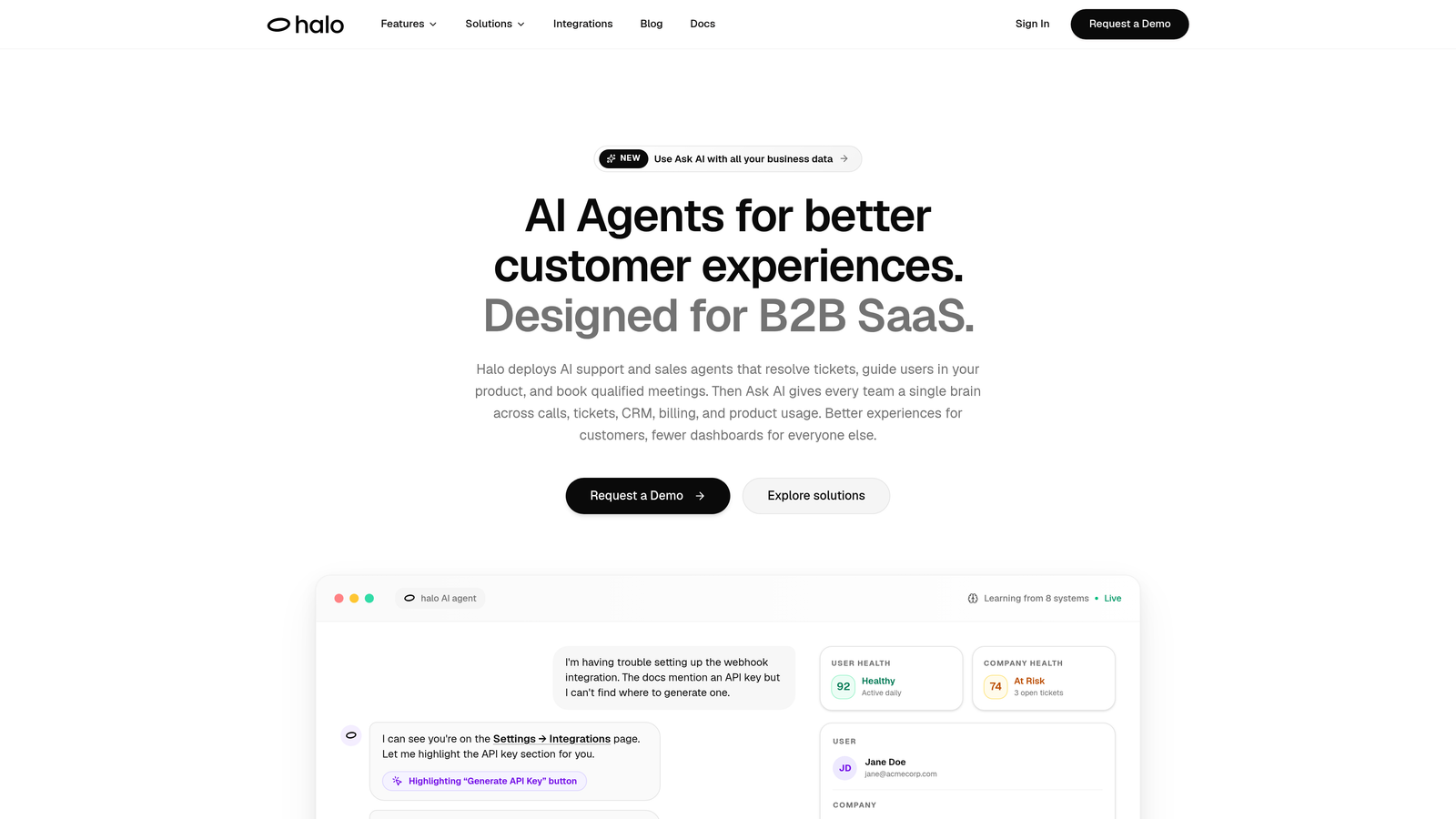
Halo AI is an AI-first customer support platform built to resolve tickets, guide users visually through your product, and surface business intelligence — all while continuously learning from every interaction.
Where This Tool Shines
What separates Halo from most tools on this list is its architecture. Rather than bolting AI onto an existing helpdesk, Halo is built AI-first from the ground up. That distinction matters in practice: the system doesn't just respond to tickets, it actively learns from each resolved interaction to get smarter over time.
The page-aware chat widget is a standout capability. It understands the context of where a user is in your product and delivers visual, contextual guidance rather than generic help center links. For SaaS products with complex onboarding or multi-step workflows, this is a meaningful differentiator.
Key Features
Page-Aware Chat Widget: Sees what users see in your product and delivers contextual visual guidance based on their current location in the app.
Intelligent AI Agents: Resolve tickets autonomously with seamless escalation to human agents when complexity requires it.
Smart Inbox with Business Intelligence: Surfaces customer health signals, revenue anomalies, and trend detection beyond basic support metrics.
Auto Bug Ticket Creation: Automatically generates and routes bug reports directly to Linear or your preferred issue tracker without manual handoff.
Native Integrations: Connects with Slack, HubSpot, Intercom, Stripe, Zoom, PandaDoc, and Fathom out of the box.
Continuous Learning Architecture: Improves with every resolved interaction, so your support quality compounds over time rather than staying static.
Best For
Halo is built for B2B SaaS companies that want to scale support without scaling headcount. It's particularly well-suited for product teams where support, engineering, and customer success overlap — the auto bug ticket creation and business intelligence features speak directly to that cross-functional context.
Pricing
Contact haloagents.ai for current pricing. Halo is designed for B2B SaaS teams looking to scale support operations without proportionally growing their support team.
2. Intercom
Best for: Teams that want a mature, all-in-one communications platform with AI layered on top
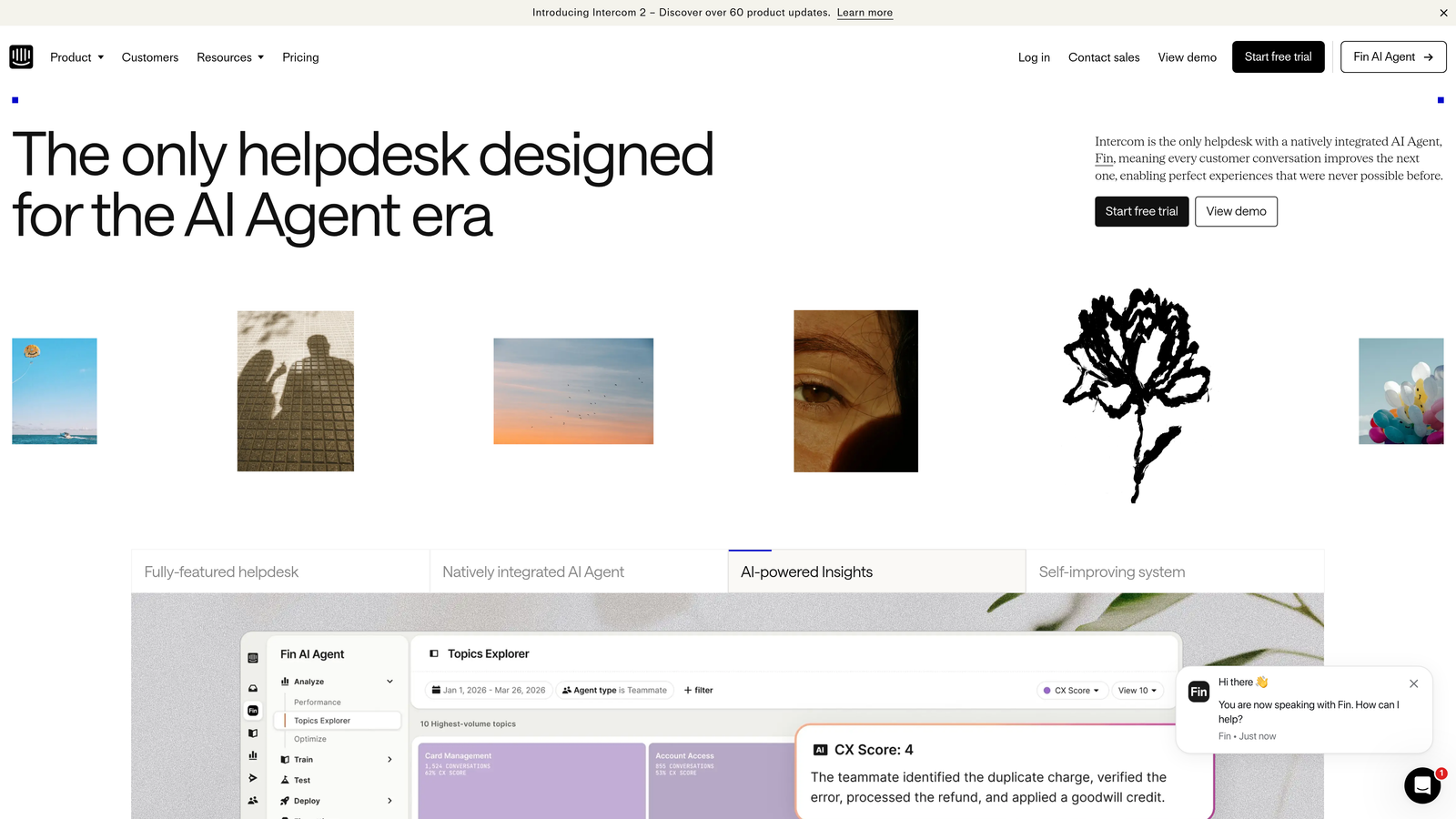
Intercom is a mature customer communications platform with Fin, its AI agent, built on top of a robust live chat, inbox, and automation suite.
Where This Tool Shines
Intercom has been refining its platform for years, and it shows. The combination of live chat, email, in-app messaging, and product tours in a single interface is genuinely compelling for teams that want one tool covering multiple customer touchpoints. Fin, Intercom's AI agent, handles common queries using your existing help content and has matured significantly since its initial release.
The tradeoff is pricing complexity. Intercom charges per seat for base access, then adds separate per-resolution fees for Fin AI. At scale, these costs can compound in ways that are difficult to predict from the outset. It's worth building out a usage model before committing.
Key Features
Fin AI Agent: Handles common support queries using your help center content, with configurable fallback to human agents.
Omnichannel Inbox: Combines chat, email, and social channels into a single unified workspace.
Workflow Automation Builder: Visual builder for routing rules, escalation logic, and automated responses.
Product Tours and In-App Messaging: Guide users through features directly inside your product without leaving the platform.
Conversation Analytics: Reporting on resolution rates, response times, and customer satisfaction scores.
Best For
Intercom suits growth-stage SaaS companies that need a broad communications platform covering support, onboarding, and marketing messages. Teams already invested in the Intercom ecosystem will find the AI additions a natural extension rather than a separate tool to manage.
Pricing
Core plans start around $39/seat/month. Fin AI resolutions are billed separately per successful resolution on top of the base subscription. Verify current pricing at intercom.com/pricing.
3. Zendesk
Best for: Mid-market and enterprise teams that need deep ticketing infrastructure with established AI capabilities
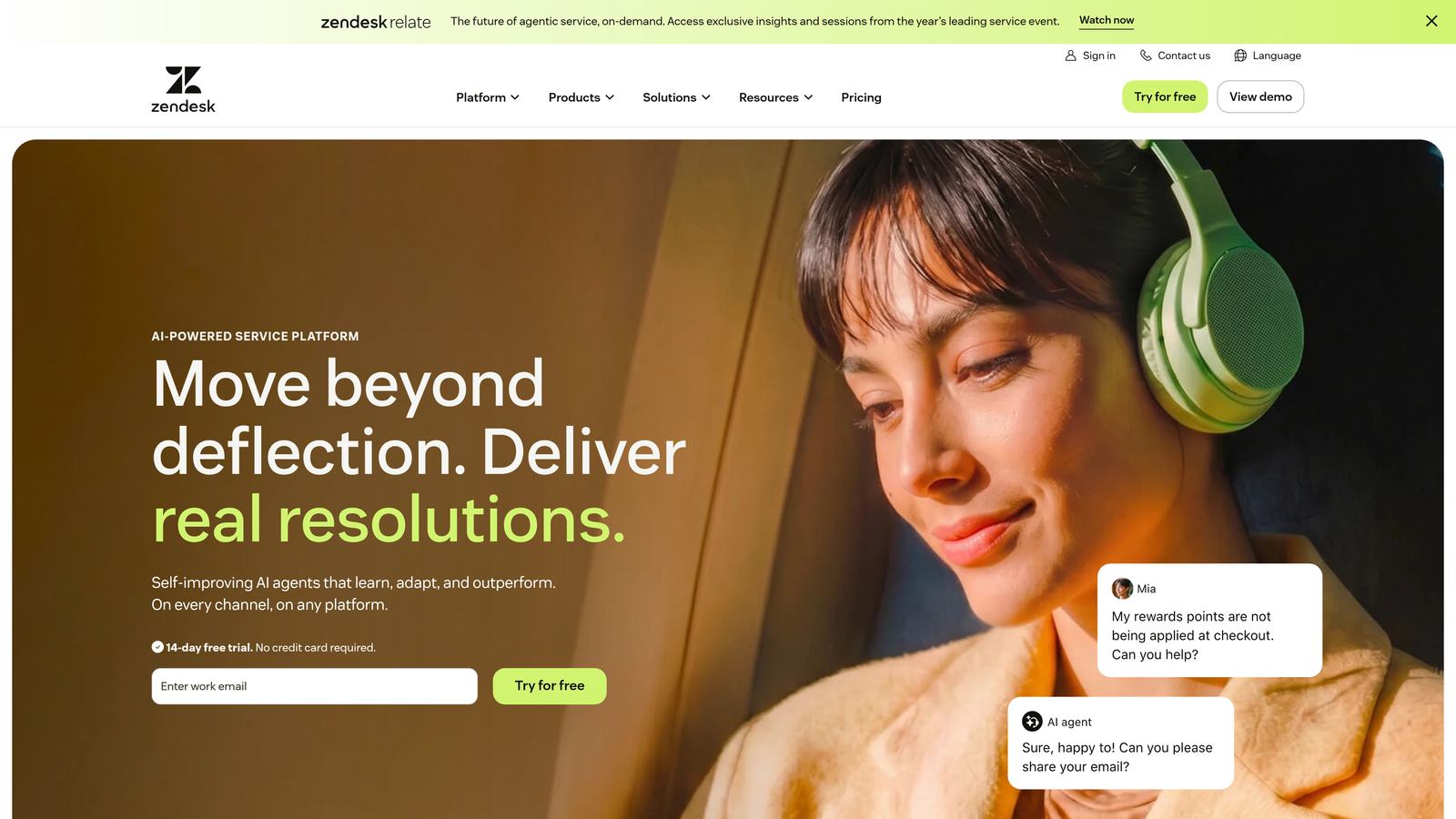
Zendesk is one of the most established helpdesk platforms, offering deep ticketing infrastructure with AI features including Answer Bot and Agent Copilot.
Where This Tool Shines
Zendesk's strength is its depth. The ticketing system, SLA management, and routing rules are battle-tested across thousands of enterprise deployments. If your support operation has complex workflows, compliance requirements, or a large agent team, Zendesk has the infrastructure to support it.
The AI features have improved considerably, with Agent Copilot providing suggested replies and next-best-action guidance that genuinely speeds up agent workflows. That said, Zendesk's AI capabilities are still largely agent-assist rather than fully autonomous resolution, which matters when comparing it to AI-first platforms.
Key Features
Answer Bot: Deflects common tickets by surfacing relevant help center articles before a ticket is created.
Agent Copilot: Provides suggested replies, tone adjustments, and next-best-action recommendations directly in the agent workspace.
Advanced SLA Management: Granular SLA policies, routing rules, and escalation paths for complex support operations.
App Marketplace: Over 1,000 integrations covering CRM, billing, project management, and communication tools.
Robust Reporting: CSAT tracking, custom dashboards, and analytics across all support channels.
Best For
Zendesk is a natural fit for mid-market and enterprise teams with established support operations that need proven infrastructure. It's less ideal for small teams where the per-agent cost model and setup complexity may outweigh the benefits.
Pricing
Suite plans run approximately $55/agent/month (Team) to $115+/agent/month (Professional). Enterprise pricing requires a custom quote. AI features are available on higher tiers or as add-ons. Verify current pricing at zendesk.com/pricing.
4. Freshdesk
Best for: SMBs and growing teams looking for competitive per-agent pricing with AI features on higher tiers
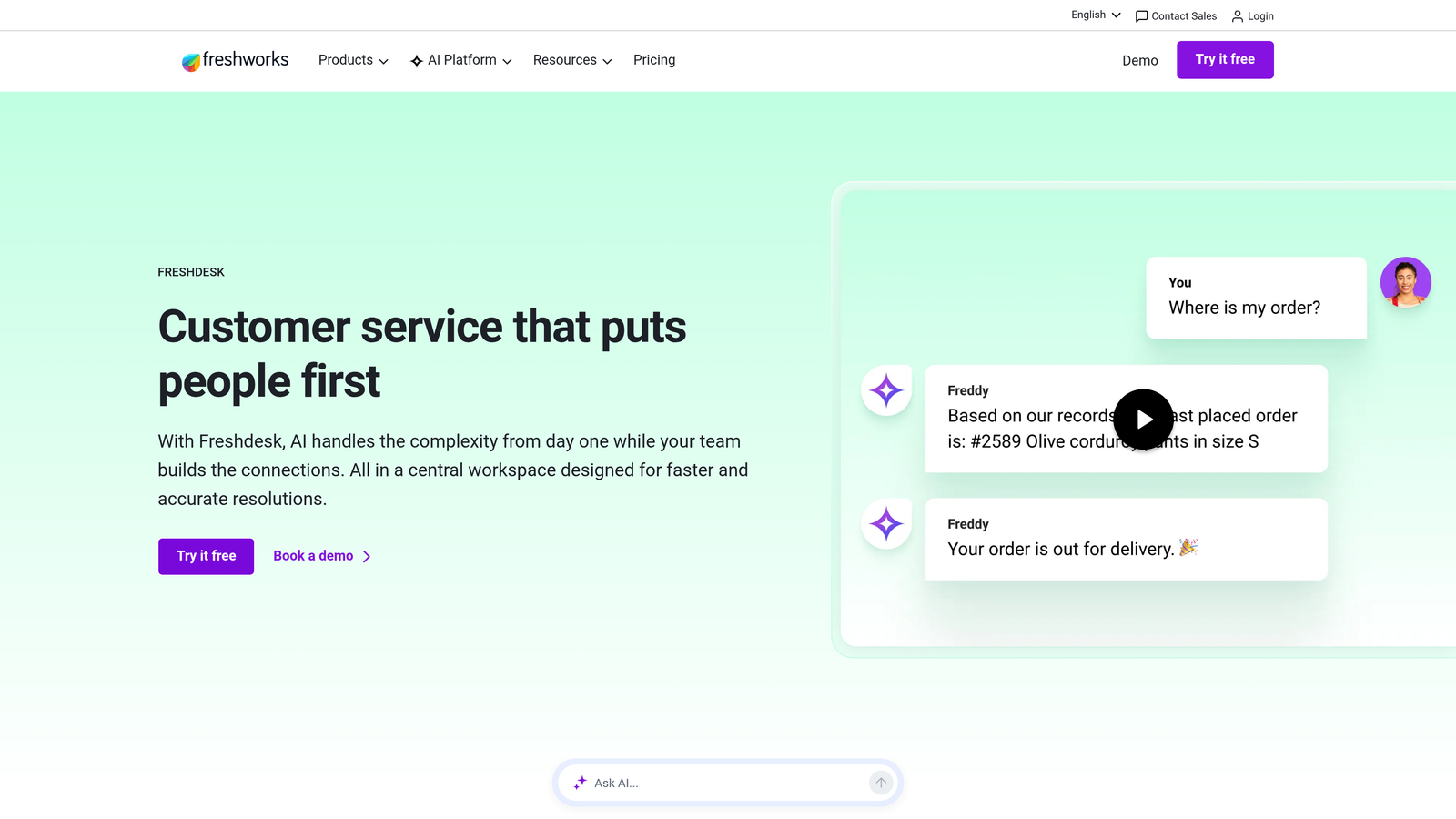
Freshdesk is a popular helpdesk platform with competitive pricing tiers and Freddy AI built into higher plans, making it a strong option for teams watching their budget.
Where This Tool Shines
Freshdesk's free plan for up to 10 agents is a genuine entry point, not a crippled trial. Teams can get real multichannel support running before spending a dollar, which makes it unusually accessible for early-stage companies. As teams grow, the pricing tiers remain competitive compared to Zendesk at similar feature levels.
Freddy AI, Freshdesk's AI layer, handles automated ticket responses and agent assistance on Pro and Enterprise plans. It's competent rather than cutting-edge, but it covers the core automation use cases most SMB teams actually need.
Key Features
Freddy AI: Automated ticket responses, agent assistance, and predictive support features available on higher plans.
Free Plan: Up to 10 agents with core helpdesk features, making it genuinely useful for early-stage teams.
Multichannel Support: Email, chat, phone, and social media support managed from a unified inbox.
Automation Rules: Ticket routing, prioritization, and assignment rules without requiring developer involvement.
Self-Service Portal: Knowledge base builder and customer-facing portal for deflecting common queries.
Best For
Freshdesk is best for SMBs and growing teams that need a capable helpdesk without enterprise-level pricing. Teams already using other Freshworks products (CRM, ITSM) will benefit from native cross-product integration.
Pricing
Free plan available. Growth approximately $15/agent/month, Pro approximately $49/agent/month, Enterprise approximately $79/agent/month. Freddy AI features unlock at Pro and above. Verify current pricing at freshdesk.com/pricing.
5. Tidio
Best for: Small businesses and e-commerce brands wanting fast deployment with a transparent, conversation-based pricing model
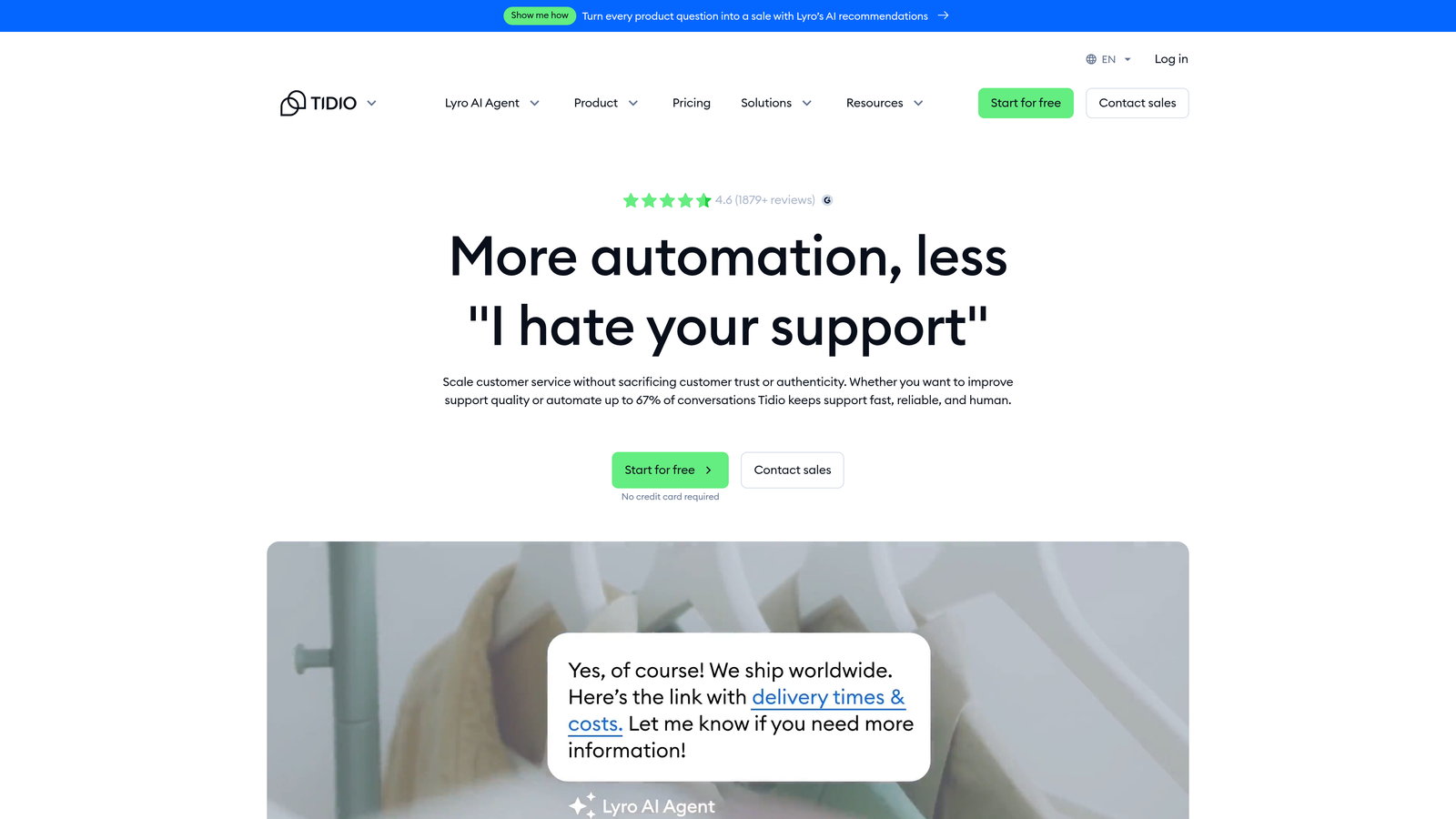
Tidio is a lightweight, fast-to-deploy chat and AI automation tool with a generous free tier, particularly popular with e-commerce and small businesses.
Where This Tool Shines
Tidio's biggest advantage is speed. You can have a functioning AI chatbot live on your site within an hour, trained on your own support content. For small teams without dedicated technical resources, that low barrier to entry is genuinely valuable. Lyro, Tidio's AI chatbot powered by Claude, handles natural conversations without requiring elaborate flow-building.
The conversation-volume pricing model is also refreshingly transparent. Rather than per-seat fees that penalize team growth, you pay based on how many AI conversations happen each month. For businesses with seasonal traffic patterns, this can be more cost-effective than seat-based alternatives.
Key Features
Lyro AI Chatbot: Powered by Claude, trained on your support content, and capable of natural multi-turn conversations.
Free Plan: Limited Lyro AI conversations included, with live chat and email support at no cost.
E-Commerce Integrations: Native connections to Shopify, WooCommerce, and other major e-commerce platforms.
Drag-and-Drop Flow Builder: Visual chatbot builder for teams that want to customize conversation flows beyond the AI defaults.
Multichannel Inbox: Live chat, email, and Facebook Messenger managed from a single workspace.
Best For
Tidio is ideal for e-commerce brands and small businesses that want AI automation without complexity. It's less suited to B2B SaaS teams that need deep product integrations, business intelligence, or complex escalation workflows.
Pricing
Free plan available. Lyro AI plans start around $29/month, scaling by conversation volume. Verify current pricing at tidio.com/pricing.
6. Drift (Salesloft)
Best for: B2B revenue teams where support automation and sales qualification need to work from the same platform
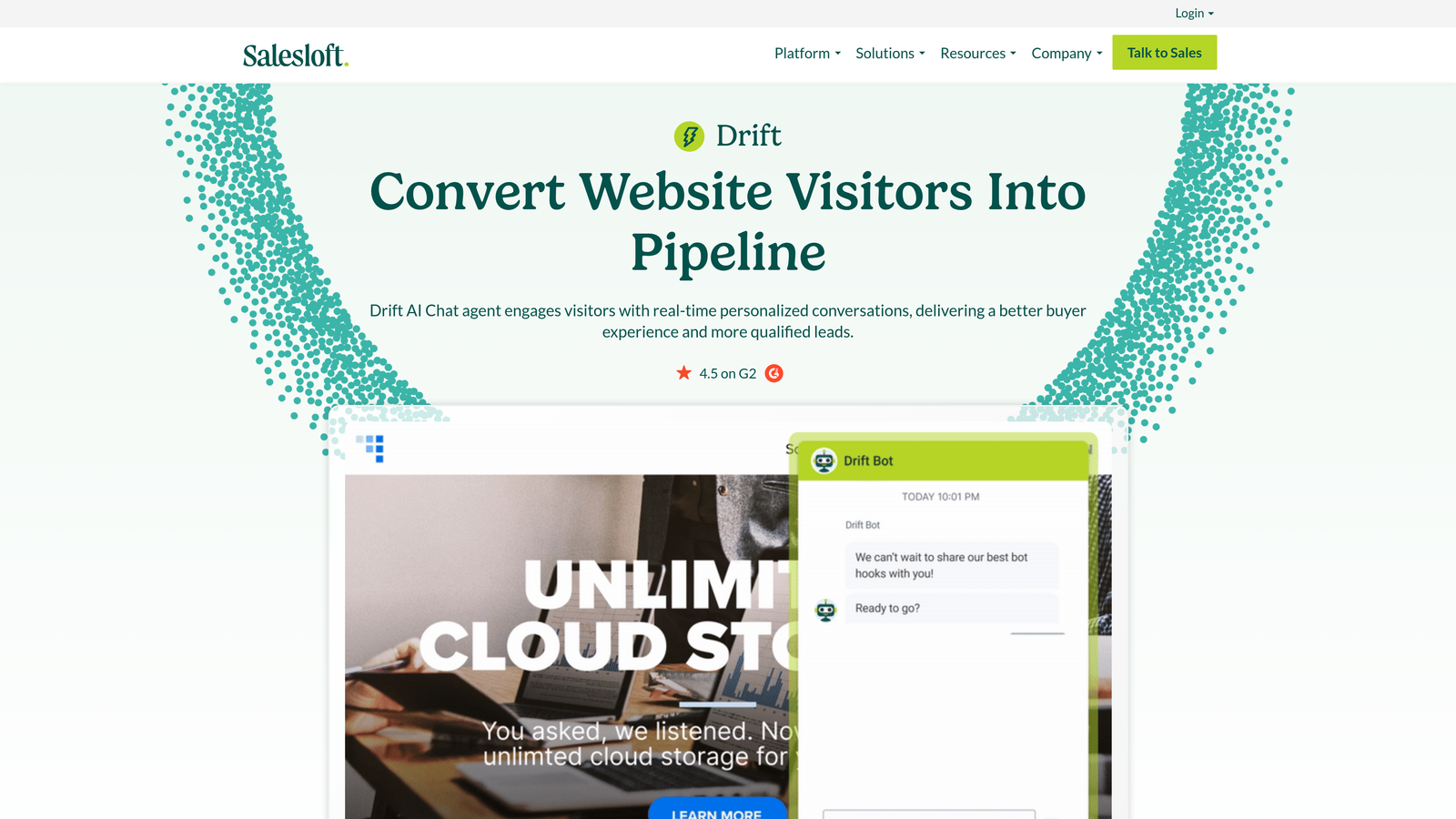
Drift, now part of Salesloft, is a conversational platform that blends support automation with sales qualification, best for B2B teams where support and revenue overlap.
Where This Tool Shines
Drift occupies a unique position: it's not purely a support tool, and that's intentional. The platform is built for B2B companies where a website visitor might be an existing customer with a support question or a prospect ready to buy, and the system needs to handle both intelligently. The AI-powered playbooks route conversations based on intent signals, account data, and firmographic context.
For pure support automation, Drift may be more than you need. But for revenue teams that want support conversations to feed directly into pipeline attribution and account-based targeting, it's a compelling option. The Salesloft integration deepens this revenue focus considerably.
Key Features
AI-Powered Playbooks: Route and respond to support and sales conversations based on visitor intent and account data.
Buyer Intent Signals: Real-time account-based targeting that identifies high-intent visitors and routes them appropriately.
Meeting Scheduling Automation: Books demos and sales calls directly within chat flows without leaving the conversation.
CRM Integrations: Native connections to Salesforce, HubSpot, and Marketo for pipeline tracking.
Conversation Analytics: Pipeline attribution and revenue reporting tied to chat interactions.
Best For
Drift suits enterprise B2B companies with dedicated revenue operations teams. It's not the right fit for pure support automation or for teams that need transparent, predictable pricing at SMB scale.
Pricing
Pricing is not publicly listed. Drift is enterprise-focused and requires direct contact with their sales team. Verify at drift.com.
7. Chatbase
Best for: Developers and technical teams that want to build custom AI chatbots trained on proprietary documentation
Chatbase is a developer-friendly tool for building custom GPT-powered chatbots trained on your own documentation, URLs, or uploaded files, with minimal setup required.
Where This Tool Shines
Chatbase's core value proposition is simplicity of training. You point it at your documentation, upload PDFs, or paste URLs, and within minutes you have an AI chatbot that can answer questions about your product using your actual content. For teams with well-maintained documentation, this can be remarkably effective out of the box.
The API access makes Chatbase genuinely useful for technical teams that want to embed AI support into custom interfaces rather than relying on a standard widget. It's a building block as much as a finished product, which is either a strength or a limitation depending on your team's capabilities.
Key Features
Custom Training: Train your chatbot on PDFs, URLs, plain text, or uploaded files in minutes without technical expertise.
GPT-4 Powered Responses: Answers questions with source citations, reducing hallucination risk and increasing user trust.
Embeddable Widget: Deploy on any website with a simple embed code, no development required for basic use.
API Access: Full API for teams that want to integrate the AI into custom workflows or interfaces.
Lead Capture: Collect contact information within conversations and store conversation history for follow-up.
Best For
Chatbase works well for technical teams, agencies, or startups that want a customizable AI chatbot without building from scratch. It's less suited to teams that need advanced routing, human escalation workflows, or deep helpdesk integration.
Pricing
Free plan available with limited messages per month. Paid plans start around $19/month, scaling by message volume and number of chatbots. Verify current pricing at chatbase.co/pricing.
8. Gorgias
Best for: E-commerce brands on Shopify that want a helpdesk built specifically for their operational model
Gorgias is a helpdesk built specifically for e-commerce brands, with deep Shopify integration and a unique per-ticket pricing model that aligns cost with actual support volume.
Where This Tool Shines
Gorgias does one thing exceptionally well: e-commerce support. The Shopify integration is genuinely deep, pulling order data, shipping status, and customer history directly into the support ticket view so agents never need to switch tabs. For brands where the majority of support queries are about orders, returns, and shipping, this context is transformative.
The per-ticket pricing model is worth understanding carefully. On one hand, it aligns cost directly with support volume, which is fair. On the other hand, seasonal spikes during peak shopping periods can drive costs up sharply. Teams should model their average and peak ticket volumes before committing.
Key Features
Deep E-Commerce Integrations: Native connections to Shopify, WooCommerce, and Magento with order data visible directly in tickets.
Per-Ticket Pricing: Pay based on actual ticket volume rather than agent seats, aligning cost with support activity.
Automated Responses: Pre-built automations for order status, return requests, and shipping queries that handle common questions without agent involvement.
Macros and Rules: Templated responses and routing rules tailored to common e-commerce workflows.
Revenue Statistics: Tracks revenue influenced by support interactions to demonstrate the business impact of your support team.
Best For
Gorgias is the clear choice for direct-to-consumer e-commerce brands, particularly those on Shopify. It's not designed for B2B SaaS, services businesses, or teams that need complex escalation logic or business intelligence beyond e-commerce metrics.
Pricing
Starter plan from approximately $10/month for 50 tickets, scaling by ticket volume. Verify current pricing at gorgias.com/pricing.
9. Zoho Desk
Best for: Budget-conscious teams already in the Zoho ecosystem who want solid automation with a low per-agent cost
Zoho Desk is a cost-effective helpdesk with Zia AI assistance, strong workflow automation, and native integration across the Zoho ecosystem.
Where This Tool Shines
Zoho Desk's pricing is among the most competitive on this list, and the feature set punches above its price point. Zia, Zoho's AI assistant, handles sentiment analysis, automatic ticket tagging, and response suggestions — capabilities that typically appear only on more expensive platforms. For teams already using Zoho CRM or Zoho Analytics, the native integration creates a unified customer data environment without additional integration work.
The Blueprint workflow automation is a standout feature for process-heavy support operations. It lets teams define multi-step workflows with conditional logic, approvals, and SLA triggers without writing code. For operations teams that want structured, auditable support processes, this is genuinely useful.
Key Features
Zia AI: Sentiment analysis, automatic ticket tagging, anomaly detection, and response suggestions built into the platform.
Free Plan: Up to 3 agents with core helpdesk functionality, useful for very early-stage teams.
Multichannel Support: Email, live chat, social media, and telephony managed from a single inbox.
Blueprint Workflow Automation: Visual workflow builder for complex, multi-step support processes with conditional logic and approval gates.
Zoho Ecosystem Integration: Native connections to Zoho CRM, Zoho Analytics, and Zoho SalesIQ without third-party connectors.
Best For
Zoho Desk is ideal for teams already invested in the Zoho ecosystem and for budget-conscious operations that want solid AI assistance without premium pricing. Teams outside the Zoho ecosystem may find better value in tools with broader native integrations.
Pricing
Free plan for up to 3 agents. Standard approximately $14/agent/month, Professional approximately $23/agent/month, Enterprise approximately $40/agent/month. Zia AI features available on higher tiers. Verify current pricing at zoho.com/desk/pricing.
Which Tool Is Right for Your Team?
The right customer service automation tool depends heavily on your business model, team size, and where you are in your support maturity curve. Here's a quick orientation by team type.
B2B SaaS teams scaling support: Halo AI is purpose-built for this context. The combination of autonomous ticket resolution, page-aware guidance, auto bug ticket creation, and business intelligence goes well beyond what a standard helpdesk offers. If you're trying to scale support without scaling headcount, it's the strongest fit on this list.
Growth-stage SaaS with broad communications needs: Intercom covers more ground across support, onboarding, and in-app messaging. Factor in the per-resolution fees for Fin AI when modeling costs at scale.
Enterprise teams with complex ticketing requirements: Zendesk's infrastructure depth and marketplace ecosystem make it hard to beat for large, established support operations.
SMBs watching budget: Freshdesk and Zoho Desk offer the best value per dollar, with Freshdesk's free plan making it particularly accessible for early-stage teams.
E-commerce brands on Shopify: Gorgias is the specialist choice. No other tool on this list matches its depth of e-commerce context.
Small businesses wanting fast AI deployment: Tidio gets you live quickly with transparent pricing and a solid free tier.
Your support team shouldn't scale linearly with your customer base. Let AI agents handle routine tickets, guide users through your product, and surface business intelligence while your team focuses on complex issues that need a human touch. See Halo in action and discover how continuous learning transforms every interaction into smarter, faster support.