9 Best Customer Service Chatbots with Context Awareness in 2026
Discover the 9 best customer service chatbot with context awareness options in 2026, evaluated on their ability to track conversation history, account data, and user behavior to deliver relevant, personalized support. This guide helps B2B SaaS teams identify solutions that eliminate repetitive, frustrating interactions by understanding exactly where customers are and what they've already tried.
 Grant CooperFounder13 min read
Most chatbots fail not because they can't answer questions, but because they have no idea where the customer is, what they've already tried, or what they did five minutes ago. Context-blind bots repeat themselves, escalate unnecessarily, and frustrate the very users they're supposed to help.
Context-aware customer service chatbots change that equation entirely. They understand conversation history, the user's current page or product state, account data, and prior interactions, so every response feels relevant rather than robotic. For B2B SaaS teams especially, where users are often mid-workflow on a specific feature page with account-specific configurations, that difference between generic and contextual can make or break the support experience.
Here are the top context-aware customer service chatbots available in 2026, evaluated on depth of contextual understanding, integration capabilities, AI quality, and fit for B2B SaaS teams. For a broader look at the landscape, see our customer support AI software comparison.
1. Halo AI
Best for: B2B SaaS teams that need page-level context, autonomous resolution, and business intelligence from support data.
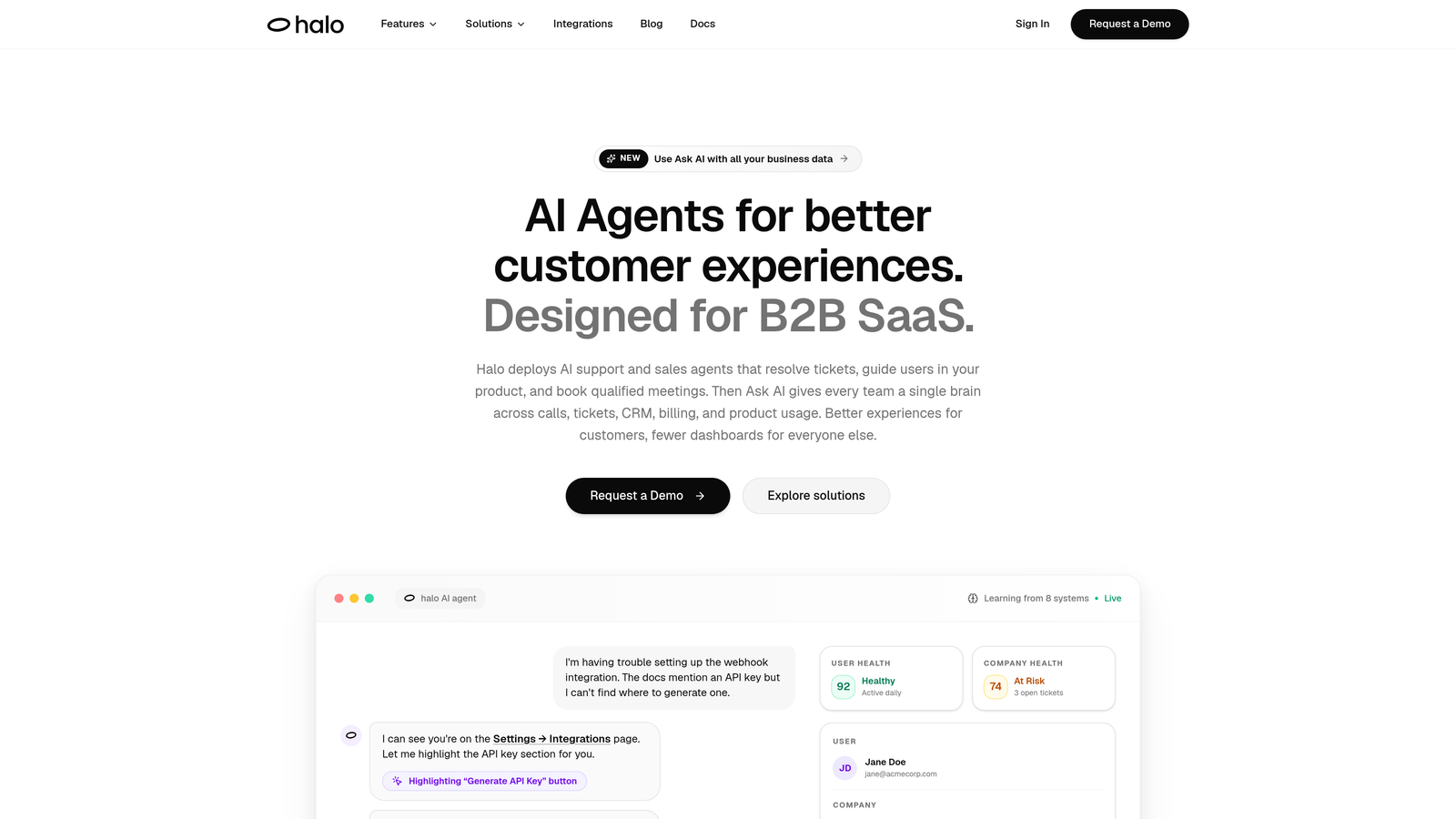
Halo AI is an AI-first customer support platform built around contextual awareness at every layer of the support interaction.
Where This Tool Shines
What sets Halo apart from most tools on this list is page-aware context. The chat widget actually sees what page and product state the user is on, then adapts its responses accordingly. This is a meaningful technical differentiator: instead of asking "where are you in the product?" the AI already knows, and can give specific, relevant guidance immediately.
Beyond resolving tickets, Halo's smart inbox surfaces business intelligence from support interactions: customer health signals, revenue intelligence, and anomaly detection. Support data becomes a strategic input, not just a queue to clear. That combination of deep contextual resolution and business intelligence makes it particularly well-suited for product-led SaaS teams.
Key Features
Page-Aware Chat Widget: The AI sees the user's current product state and page in real time, adapting responses to their exact context without requiring the user to explain where they are.
Autonomous Ticket Resolution: AI agents resolve support tickets end-to-end, with continuous learning from every interaction to improve over time.
Auto Bug Ticket Creation: User-reported issues are automatically converted into structured bug reports, reducing manual triage work for engineering teams.
Smart Inbox with Business Intelligence: The inbox surfaces customer health signals, revenue intelligence, and anomaly detection alongside standard support analytics.
Live Agent Handoff with Context Preservation: When escalation is needed, the full conversation context transfers to the human agent seamlessly.
Deep Integrations: Connects natively with Linear, Slack, HubSpot, Intercom, Stripe, Zoom, PandaDoc, and Fathom.
Best For
B2B SaaS companies and product teams that want an AI-first support layer, not a bolt-on to an existing helpdesk. Particularly strong for teams where support data should inform product decisions, customer success, and revenue intelligence, not just reduce ticket volume.
Pricing
Pricing is not publicly listed. Contact haloagents.ai directly for current plans and pricing details.
2. Intercom Fin
Best for: Teams already on Intercom who want native AI resolution without platform migration.
Intercom Fin is Intercom's native AI agent, powered by GPT-4-class reasoning and deeply integrated with Intercom's conversation and customer data infrastructure.
Where This Tool Shines
Fin's strongest contextual layer is its access to Intercom's full conversation history and customer attribute data. It knows what the user has asked before, what their account looks like, and what your help center says, all within the same session. Fin 2, the current generation, goes beyond Q&A into multi-step actions, meaning it can do things on behalf of the user rather than just answer questions about how to do them.
The handoff experience is also well-designed: Fin knows when it's reached the limits of what it can resolve and passes the full context to a human agent, so users don't have to repeat themselves.
Key Features
Full Conversation History Context: Uses Intercom's complete conversation and customer attribute data as context for every response.
Multi-Step Action Capability: Can take actions within connected systems, not just answer questions about them.
Intelligent Escalation: Knows when to hand off to humans and transfers full context when it does.
Help Center Training: Trained on your existing help center content for domain-specific, accurate answers.
Best For
Support teams already operating within the Intercom ecosystem who want strong AI resolution without switching platforms. Less ideal for teams needing deep page-level or product-state awareness.
Pricing
Fin uses per-resolution pricing. Check intercom.com for current rates, as pricing is updated regularly.
3. Zendesk AI
Best for: High-volume support organizations already running on Zendesk Suite.
Zendesk AI is a native AI layer across the Zendesk platform, combining intelligent triage, AI Agents for self-service, and Agent Copilot for human-assist workflows.
Where This Tool Shines
Zendesk AI's contextual depth comes from its tight integration with the Zendesk data model: ticket history, customer profiles, macro usage patterns, and knowledge base content all feed into how it triages, routes, and resolves. For teams with large historical ticket volumes, that corpus becomes a meaningful contextual asset.
Agent Copilot is a standout feature for hybrid teams: it surfaces relevant context to human agents in real time as they're working a ticket, reducing the time agents spend hunting for information and improving response quality.
Key Features
Contextual Triage: Uses ticket history, customer profile, and intent detection to route and prioritize incoming requests accurately.
AI Agents for Self-Service: Resolve common issues autonomously using knowledge base content and customer-specific data.
Agent Copilot: Surfaces relevant context, suggested responses, and knowledge articles to human agents in real time.
Native Integration: No separate integration layer required; everything runs within the existing Zendesk Suite.
Best For
Mid-market to enterprise support teams with high ticket volumes already invested in the Zendesk ecosystem. Strong choice when platform migration is off the table and you want AI that deepens what Zendesk already does.
Pricing
Bundled with Zendesk Suite plans; AI add-ons vary by tier. Check zendesk.com for current pricing.
4. Freshdesk Freddy AI
Best for: SMB to mid-market teams on the Freshworks stack seeking integrated AI without extra tooling.
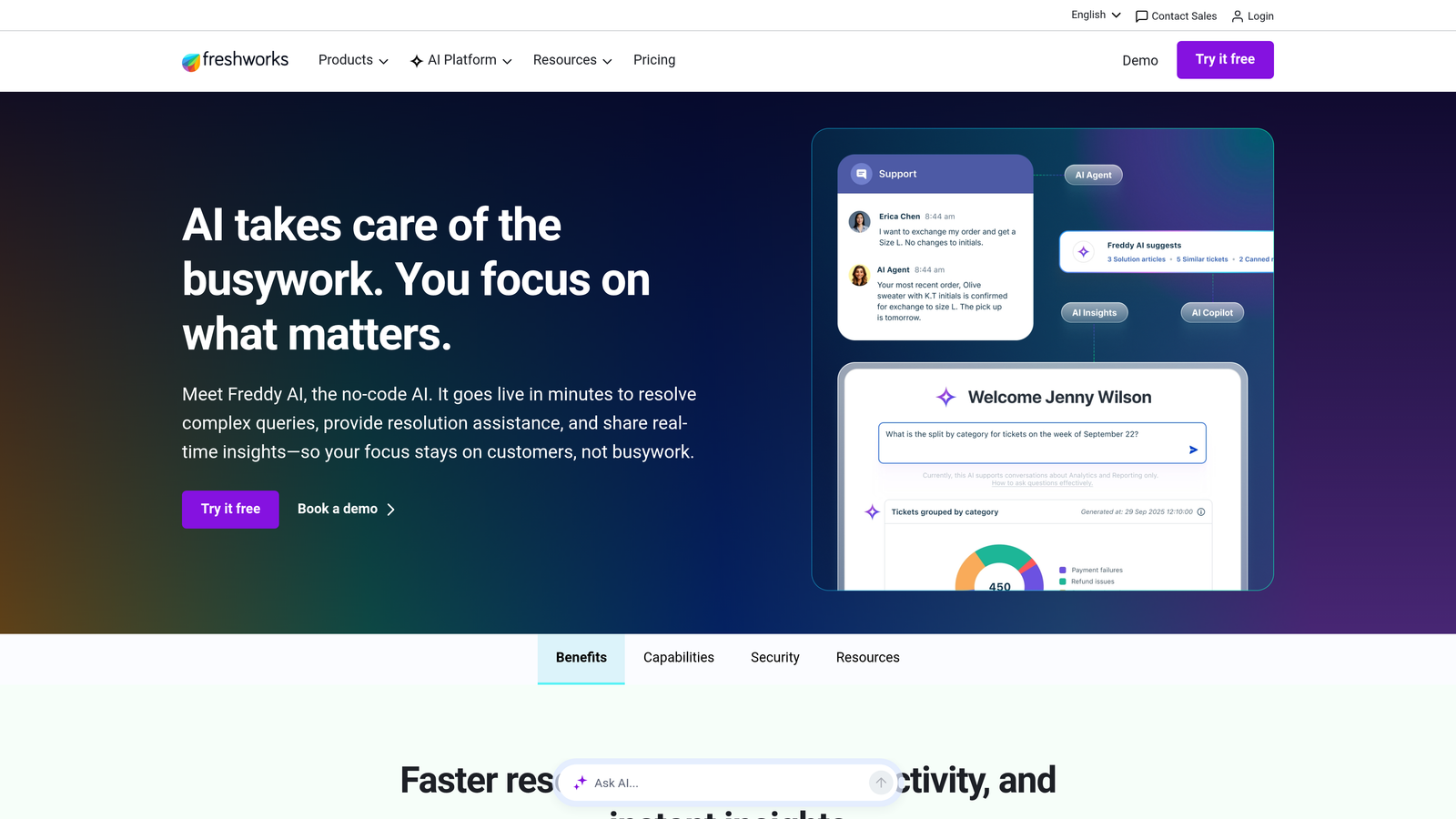
Freshdesk Freddy AI is Freshworks' AI layer across its support products, combining self-service automation and agent assist with context drawn from ticket history and customer profiles.
Where This Tool Shines
Freddy's contextual value is strongest for teams already using multiple Freshworks products. Because it operates natively across Freshdesk, Freshservice, and other Freshworks tools, it can pull context from a wider surface area than a standalone chatbot would see. Freddy Self Service handles end-user interactions using knowledge base and ticket history context, while Freddy Copilot assists agents with suggested responses and relevant articles.
Freddy Insights adds an analytics layer on top, surfacing patterns in support volume, resolution trends, and team performance, which gives managers a clearer picture of where automation is working and where it needs improvement.
Key Features
Freddy Self Service: Handles end-user interactions with knowledge base and ticket history as context, reducing agent load on common issues.
Freddy Copilot: Assists agents with suggested responses, relevant knowledge articles, and contextual prompts during live interactions.
Freddy Insights: Analytics layer that surfaces patterns in support data to inform team and process decisions.
Native Freshworks Integration: Operates across the Freshworks product suite without additional integration work.
Best For
Teams already on Freshworks products, particularly those in the SMB to mid-market range who want AI-assisted support without managing a separate AI platform or complex integration.
Pricing
Some Freddy AI features are included in Growth, Pro, and Enterprise plans. Check freshworks.com for current tier details.
5. Drift (Salesloft)
Best for: B2B teams where support, sales, and customer success conversations overlap significantly.
Drift, now part of Salesloft, is a conversational AI platform that brings account-level CRM context into every chat interaction.
Where This Tool Shines
Drift's contextual strength is account-level enrichment. Before the conversation even starts, it knows who the company is, their tier, their sales stage, and their relationship history with your team. For B2B teams where a support conversation can quickly become a renewal discussion or an upsell opportunity, that pre-loaded context is genuinely valuable.
It's worth noting that Drift's positioning has shifted toward revenue acceleration since the Salesloft acquisition. It's less specialized for pure support volume and more powerful for teams running blended support-and-sales motions.
Key Features
Account-Level CRM Context: Pulls company tier, sales stage, and relationship history from Salesforce and HubSpot before the conversation begins.
Conversational AI Routing: Can route, qualify, and resolve in a single flow based on account context and intent.
Revenue-Aware Interactions: Designed for conversations where support and commercial outcomes intersect.
Salesforce and HubSpot Integration: Deep native connections to major CRM platforms for rich account data.
Best For
B2B teams where customer success, sales, and support share a single conversation surface. Less ideal for high-volume pure support operations where ticket resolution speed is the primary metric.
Pricing
Enterprise-oriented. Check salesloft.com/drift for current pricing and packaging.
6. Ada
Best for: Large enterprises with complex data environments and multilingual, omnichannel support needs.
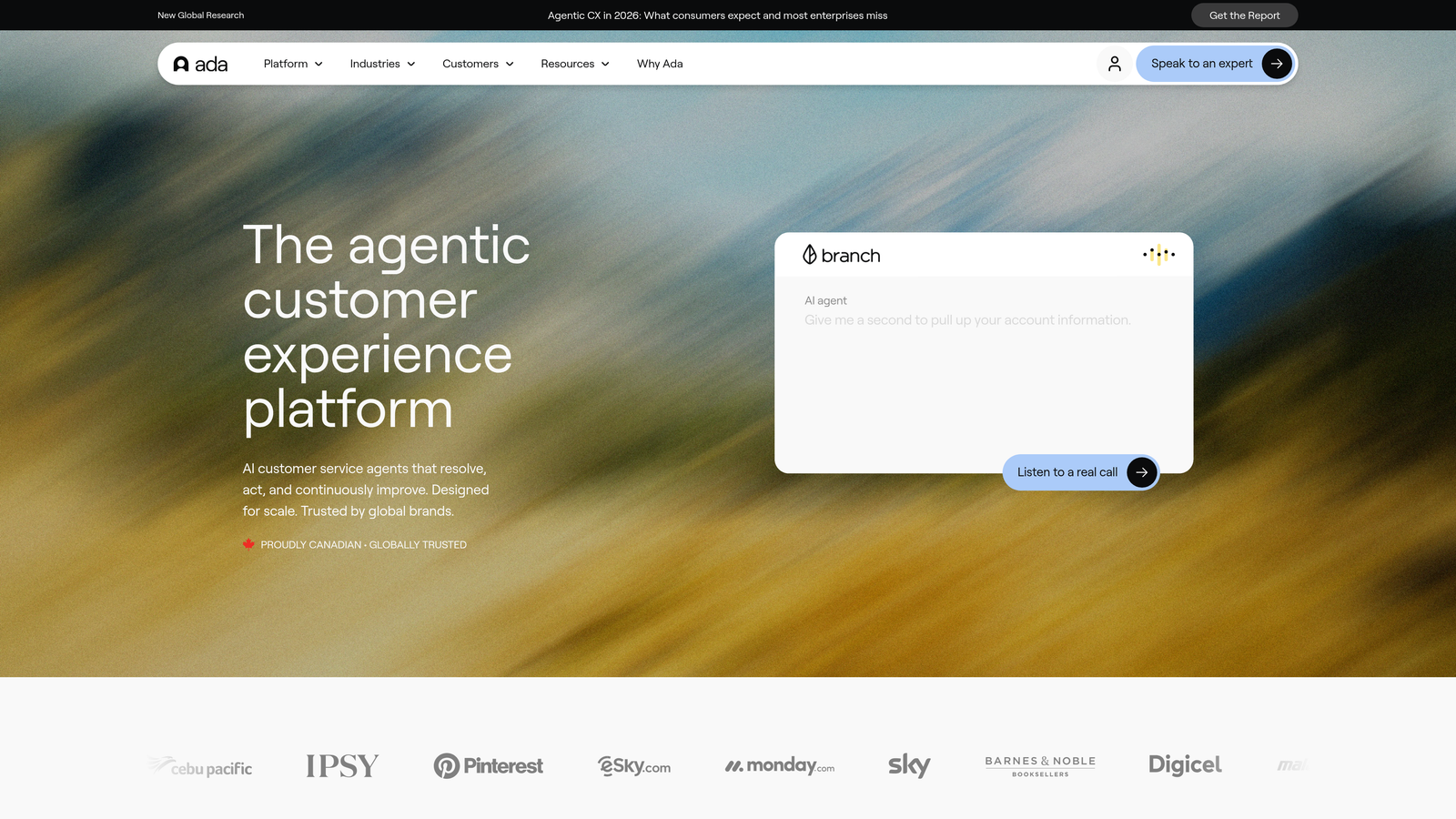
Ada is an enterprise-grade AI platform that connects to CRM systems, order management tools, and custom APIs to deliver deeply contextual automated support at scale.
Where This Tool Shines
Ada's reasoning engine can pull context from multiple data sources simultaneously, which is where it earns its enterprise positioning. Rather than relying on a single system of record, it can combine CRM data, order history, custom API responses, and conversation context into a coherent, personalized response. That multi-source reasoning capability is difficult to replicate with simpler tools.
Ada also handles multilingual and omnichannel deployments well, covering web, mobile, SMS, and social from a single platform. For global support operations with diverse customer bases and complex data environments, that breadth is a real operational advantage.
Key Features
Multi-Source Reasoning Engine: Pulls context from CRM, order management, custom APIs, and conversation history simultaneously to construct accurate, personalized responses.
Multilingual and Omnichannel: Supports web, mobile, SMS, and social channels with consistent context across all of them.
No-Code/Low-Code Builder: Non-technical teams can build and modify support flows without engineering involvement.
Complex Multi-Step Flows: Handles sophisticated support scenarios with dynamic context throughout the interaction.
Best For
Enterprise organizations with complex data environments, global customer bases, and support operations spanning multiple channels. Overkill for smaller teams; purpose-built for large-scale complexity.
Pricing
Enterprise contracts. Check ada.cx for current pricing and to request a demo.
7. Tidio Lyro
Best for: Smaller teams that want fast deployment and conversational context without enterprise complexity or cost.
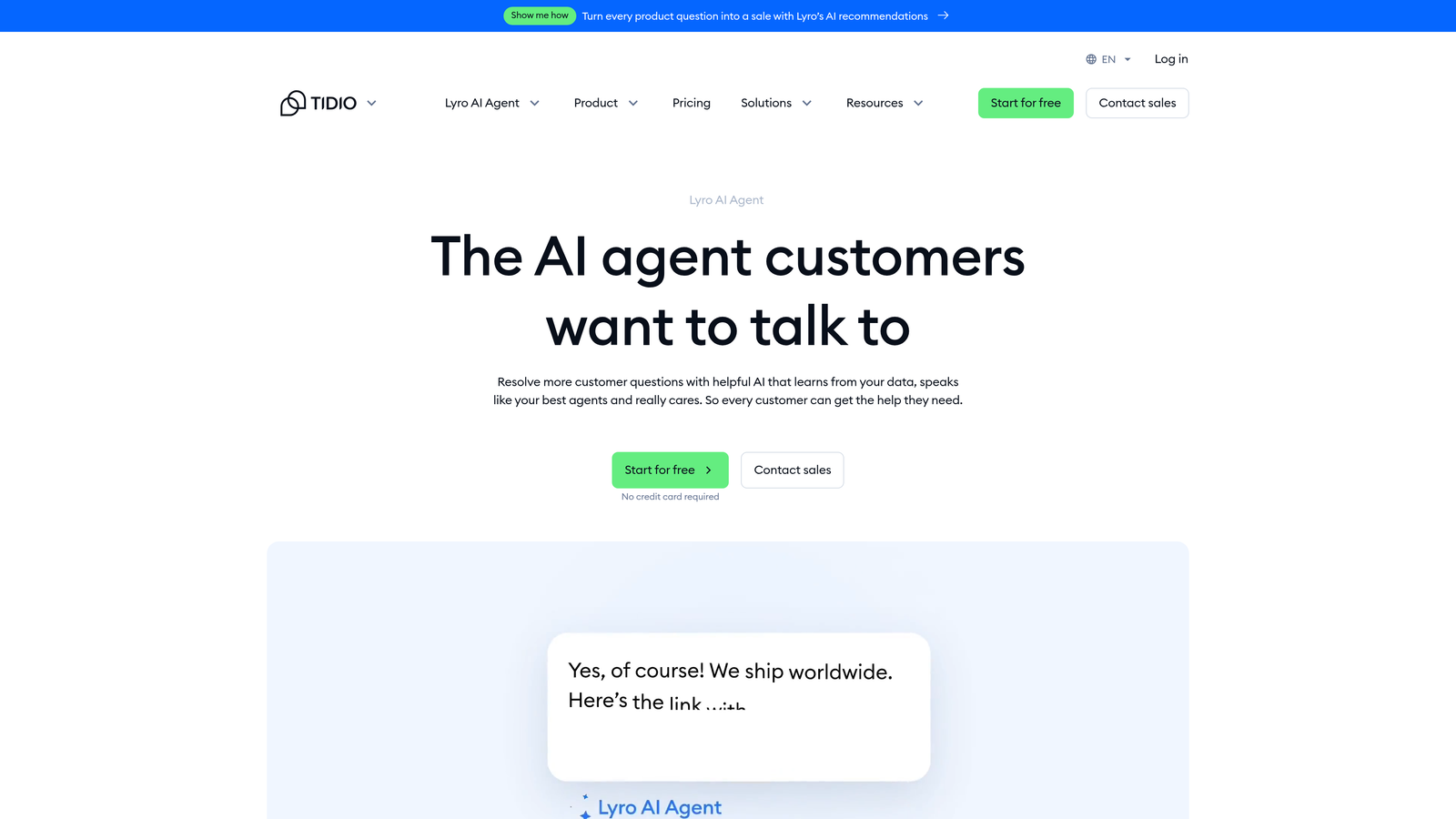
Tidio Lyro is an AI chatbot built on Claude (Anthropic) designed to get smaller teams up and running with context-aware support automation quickly.
Where This Tool Shines
Lyro's primary advantage is speed to value. It learns from your existing help content and website pages, maintains conversational context within sessions, and can typically be deployed in hours rather than weeks. For teams that have been putting off AI support automation because it felt too complex or expensive, Lyro removes most of the friction.
The context depth is more limited compared to enterprise tools: it's strongest on conversational and help-content context, with less depth on CRM or account-level data. But for many smaller teams, that's exactly the right trade-off: solid contextual conversation without the complexity of multi-system integration.
Key Features
Help Content Learning: Automatically learns from your existing help articles and website pages to build its knowledge base.
Session-Level Conversational Context: Maintains context throughout a conversation so users don't repeat themselves within a session.
Fast Deployment: Typically live in hours, not weeks, with minimal technical setup required.
Human Escalation with Context: Hands off to human agents with the full conversation context intact.
Best For
Small to mid-sized teams new to AI support automation, or those with limited technical resources who need a working solution quickly. A strong entry point before scaling to more complex platforms.
Pricing
Lyro AI starts from approximately $29/month at lower tiers. Check tidio.com for current plans, as pricing is updated regularly.
8. Forethought SupportGPT
Best for: Teams with large historical ticket corpora who want AI that learns from past resolutions to improve future ones.
Forethought SupportGPT is a retrieval-augmented AI platform that surfaces the most relevant tickets, articles, and context in real time for both self-service and agent assist workflows.
Where This Tool Shines
Forethought's RAG-based approach is its defining characteristic. Rather than relying solely on a knowledge base, it retrieves the most relevant past tickets and knowledge content per query in real time. For organizations with years of support history, that corpus becomes an increasingly powerful contextual asset: the AI gets better as your ticket history grows.
The agent assist layer is particularly strong. Human agents get relevant past tickets, suggested responses, and knowledge articles surfaced automatically as they work, reducing the time spent searching and improving consistency across the team.
Key Features
RAG-Based Retrieval: Retrieves the most relevant past tickets and knowledge content per query in real time, not just static knowledge base lookup.
Intelligent Triage and Routing: Predicts intent and urgency to route tickets accurately before a human touches them.
Agent Assist Layer: Surfaces relevant context, suggested responses, and past tickets to human agents during live interactions.
Helpdesk-Agnostic: Works alongside existing helpdesks without requiring platform migration.
Best For
Support organizations with substantial historical ticket data who want AI that compounds in value over time. Also strong for teams running hybrid human-AI support where agent assist quality matters as much as self-service resolution.
Pricing
Enterprise-oriented. Check forethought.ai for current pricing and to request a demo.
9. Kustomer IQ
Best for: Teams where lifetime customer relationship context shapes every support decision.
Kustomer IQ is the AI layer built on the Kustomer CRM platform, using a unified customer timeline as rich context for every support interaction.
Where This Tool Shines
Kustomer's contextual foundation is the unified customer timeline: every order, past conversation, sentiment signal, and custom attribute in a single view. When the AI responds to a support request, it's drawing on the full relationship history, not just the current ticket. That depth of longitudinal context is rare and genuinely useful for teams where understanding the customer's history changes how you respond.
Both the AI self-service layer and the agent assist layer draw from the same unified context model, which means there's no disconnect between what the bot knows and what the human agent sees when they take over.
Key Features
Unified Customer Timeline: Full order history, past conversations, sentiment signals, and custom attributes in a single context layer accessible to both AI and human agents.
Relationship-Aware AI Responses: Uses lifetime context to personalize responses and anticipate customer needs based on history.
Consistent Context Across AI and Human: Both self-service and agent assist draw from the same unified data model, eliminating context gaps at handoff.
Sentiment and Behavior Signals: Incorporates sentiment history as a contextual input, not just transactional data.
Best For
Teams in industries where the full customer relationship matters: subscription businesses, high-touch B2B, or any context where a customer's history with your company should meaningfully shape how you respond to their current issue.
Pricing
Enterprise tiers. Check kustomer.com for current pricing and packaging options.
Which Tool Is Right for Your Team
The right choice here depends less on feature lists and more on where your context actually lives and how you want to use it.
If you're a B2B SaaS team that wants the deepest page-level context, autonomous ticket resolution, and business intelligence surfaced from support data, Halo AI is built for exactly that use case. Its AI-first architecture and page-aware widget address the core problem that most chatbots miss: knowing not just who the user is, but where they are and what they're trying to do right now.
If you're locked into an existing helpdesk, Zendesk AI, Freshdesk Freddy, and Intercom Fin all offer strong native context without requiring platform migration. Each is a meaningful upgrade over basic chatbot automation within their respective ecosystems.
For enterprise scale with complex, multi-source data environments, Ada stands out. For teams where account-level CRM context and revenue conversations intersect with support, Drift brings something the pure support tools don't. For historical ticket-driven intelligence, Forethought's RAG approach compounds in value over time. For relationship-first support where lifetime context matters, Kustomer IQ is purpose-built. And for smaller teams that need context-aware automation without the complexity, Tidio Lyro is the fastest path to a working solution.
The common thread across every tool on this list: context is the multiplier. A chatbot with great AI but no situational awareness will still frustrate users. A chatbot that knows the user's current page, account history, and prior conversations can resolve issues the first time, every time.
Your support team shouldn't scale linearly with your customer base. Let AI agents handle routine tickets, guide users through your product, and surface business intelligence while your team focuses on complex issues that need a human touch. See Halo in action and discover how continuous learning transforms every interaction into smarter, faster support.
For more on building a high-performing support operation, explore our guides on AI support tool features, reducing support wait times, and visual UI guidance in support chat.