9 Best Customer Success AI Platforms in 2026
Customer success teams facing larger books of business and rising churn risk need smarter tools — and this guide ranks the 9 best Customer Success AI Platform options in 2026. Evaluated across automation depth, integration breadth, business intelligence quality, and scalability, the list helps B2B SaaS teams of any size find the right platform to stay proactive and reduce churn.
 Grant CooperFounder14 min read
Customer success teams are under more pressure than ever: larger books of business, higher churn risk, and mounting expectations to be proactive rather than reactive. AI platforms built specifically for customer success are changing that equation, automating routine touchpoints, surfacing health signals before they become churn events, and giving CSMs the intelligence to act at the right moment.
But "customer success AI platform" means different things to different vendors. Some focus on deep analytics and health scoring. Others lead with automated support resolution. A few are trying to do both. This list cuts through the noise.
We evaluated nine platforms across four dimensions: automation depth, integration breadth, business intelligence quality, and scalability for growing B2B teams. Whether you're a 10-person startup or a scaling SaaS company with hundreds of accounts, there's a right fit here.
1. Halo AI
Best for: B2B SaaS teams that want support resolution and customer intelligence in one platform
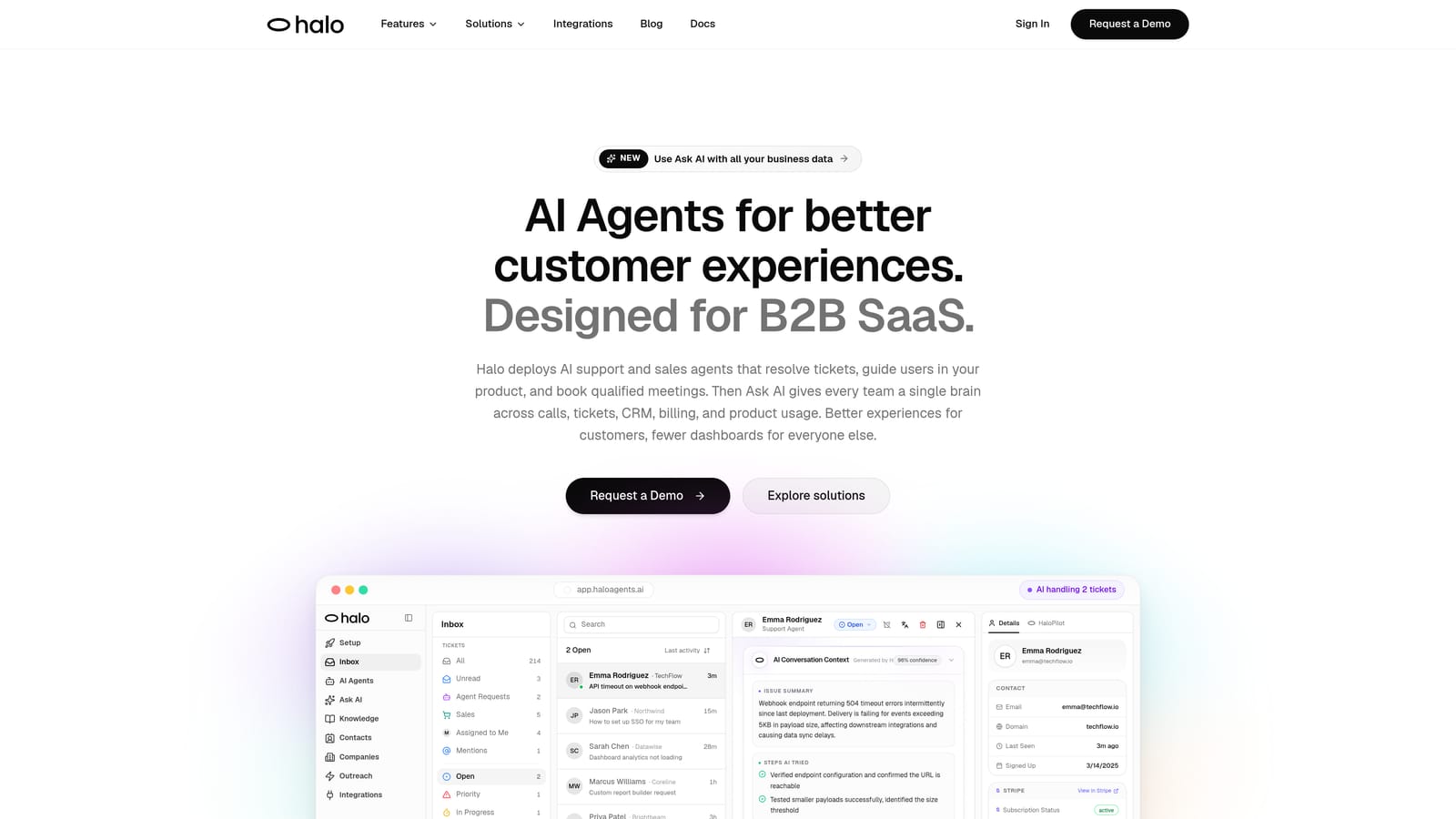
Halo AI is an AI-first customer support and success platform that deploys intelligent agents to resolve tickets, guide users with page-aware context, and surface business intelligence from every support interaction.
Where This Tool Shines
Most platforms in this category either handle support or handle customer health monitoring. Halo AI operates at the intersection of both. Its page-aware AI agents understand exactly what a user is looking at in your product and can provide contextual, visual guidance in real time — not generic help center links, but relevant, situational support.
What genuinely differentiates Halo is what happens after the ticket resolves. The smart inbox doesn't just organize conversations; it surfaces customer health signals, revenue anomalies, and churn risk indicators drawn from support interactions. That means your CS team gets intelligence from a layer of the business that traditional success platforms often ignore entirely.
Key Features
Page-Aware AI Agents: The AI understands what page the user is on and delivers contextual, visual guidance rather than generic responses.
Smart Inbox with Business Intelligence: Surfaces customer health signals, revenue anomalies, and churn risk from support conversations in real time.
Auto Bug Ticket Creation: Automatically creates bug reports connected to Linear, reducing manual handoff between support and engineering.
Live Agent Handoff: Escalates complex or sensitive issues to human agents with full conversation context preserved.
Broad Integration Stack: Connects with HubSpot, Slack, Stripe, Intercom, Zoom, PandaDoc, Fathom, and Linear — covering the full B2B SaaS toolchain.
Continuous Learning: Every resolved interaction improves the AI's ability to handle similar issues faster and more accurately over time.
Best For
B2B SaaS companies that want a single platform connecting support resolution to customer intelligence. Particularly strong for product teams and CS leaders who want churn signals surfaced from the support layer, not just from CRM data or usage metrics.
Pricing
Contact for pricing. Halo AI operates on an enterprise SaaS model; reach out directly for a demo and custom quote based on your team size and use case.
2. Gainsight
Best for: Large enterprise CS organizations managing complex renewal and expansion workflows
Gainsight is the most established name in customer success management, offering deep health scoring, lifecycle playbooks, renewal risk management, and an AI layer for predictive churn scoring.
Where This Tool Shines
Gainsight is the category benchmark for enterprise CS teams. If you have a dedicated customer success organization managing hundreds of accounts with complex renewal cycles, Gainsight's depth of functionality is hard to match. The platform's playbook automation covers onboarding, adoption, and renewal workflows with a level of configurability that suits large, structured CS operations.
The AI layer adds predictive churn scoring and recommended next actions on top of that operational foundation. For teams that need executive-level reporting alongside day-to-day CSM workflows, Gainsight's dashboards and NPS tooling make it a comprehensive choice — though that comprehensiveness comes with meaningful implementation complexity.
Key Features
Predictive Health Scoring: AI-powered churn risk identification based on usage, engagement, and relationship signals.
Playbook Automation: Pre-built and customizable workflows for onboarding, adoption milestones, and renewal sequences.
NPS and Survey Tools: Built-in customer feedback collection integrated directly into the CS workflow.
Renewal and Expansion Tracking: Revenue intelligence for managing at-risk accounts and identifying growth opportunities.
Executive Dashboards: Robust reporting for CS leadership and cross-functional stakeholders.
Best For
Enterprise SaaS companies with dedicated CS teams of five or more people, complex account portfolios, and a need for structured lifecycle management. Less suited to smaller teams that need fast time-to-value without significant configuration investment.
Pricing
Enterprise pricing; not publicly listed. Generally considered a premium investment. Contact Gainsight sales for a custom quote.
3. Totango
Best for: Mid-market teams that want structured CS programs without building from scratch
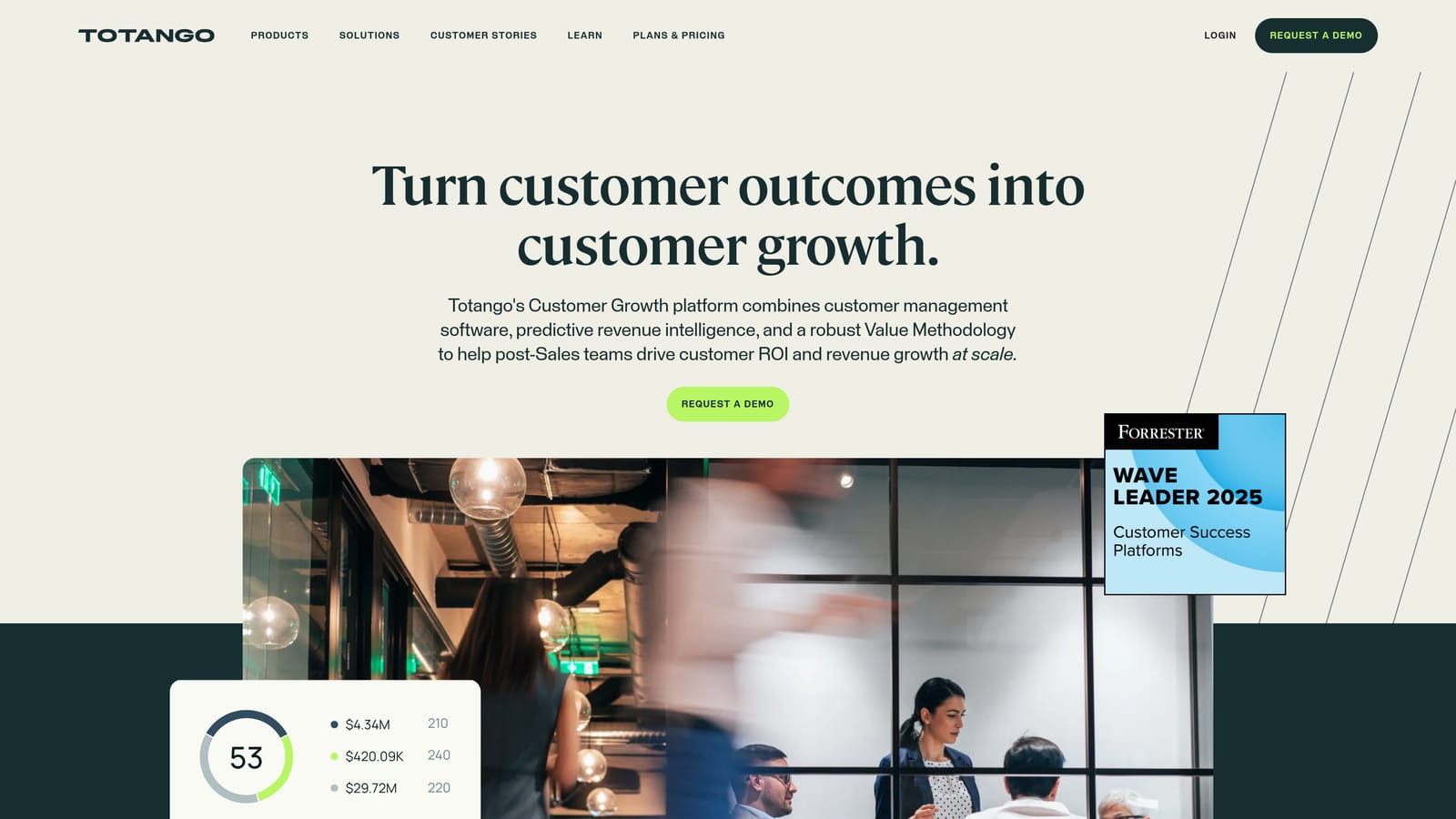
Totango is a customer success platform built around SuccessBLOCs, modular pre-built programs for onboarding, adoption, and renewal that help teams get structured quickly without starting from zero.
Where This Tool Shines
The SuccessBLOC framework is Totango's most distinctive feature. Rather than asking your team to design CS programs from a blank canvas, Totango provides deployable templates built around proven customer success motions. For teams that know they need structure but don't have the resources to build it internally, this dramatically reduces time-to-value.
Totango's health score automation and journey analytics give CS leaders visibility into where customers are in their lifecycle and which accounts need attention. It strikes a reasonable balance between configurability and out-of-the-box functionality, making it more accessible than Gainsight for teams without large CS ops resources.
Key Features
SuccessBLOCs: Pre-built customer success programs covering onboarding, adoption, renewal, and more — deployable without custom development.
Health Score Automation: Automated scoring based on usage data, engagement signals, and customer journey milestones.
In-App Messaging: Automated touchpoints and in-product messaging for proactive customer engagement.
Usage Data Integration: Connects product usage data for product-led insights alongside traditional CS signals.
Team Collaboration Tools: Shared account views and task management to align CS team members on account strategy.
Best For
Mid-market SaaS companies that want to implement structured customer success programs faster than building from scratch. A good fit for teams graduating from spreadsheet-based CS management who need a real platform without Gainsight's implementation overhead.
Pricing
Starter plans available; enterprise pricing on request. More accessible entry point than some competitors, with pricing that scales by account volume.
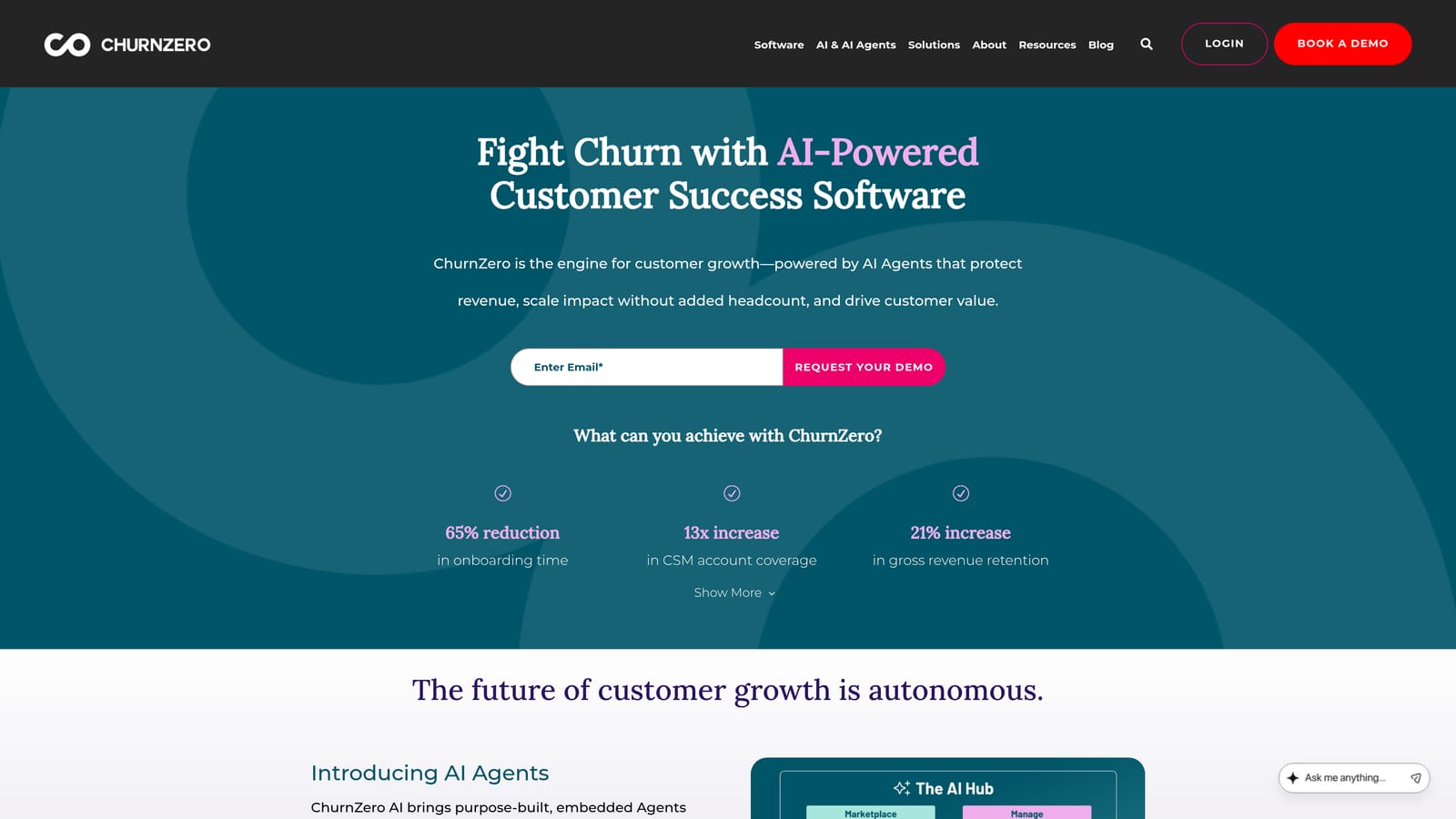
4. ChurnZero
Best for: Subscription SaaS companies laser-focused on churn prevention and retention
ChurnZero is a churn prevention-focused platform that triggers real-time alerts and automated plays when customer usage or health signals drop below defined thresholds.
Where This Tool Shines
ChurnZero earns its name. The platform is built around the specific problem of subscription revenue retention, and that focus shows in the product. Real-time usage alerts mean your CS team knows the moment an account goes quiet — before that silence turns into a cancellation notice. The automated plays system lets you define exactly what happens when a risk signal fires, whether that's an email sequence, a CSM task, or an in-app message.
For SaaS companies where churn is the primary business risk, ChurnZero's specificity is a strength. It doesn't try to be everything; it tries to be the best tool for keeping customers from leaving, and it does that well.
Key Features
Real-Time Usage Alerts: Instant notifications when customer activity drops below defined thresholds, enabling timely intervention.
Automated Plays: Triggered sequences of actions based on customer behavior, reducing manual follow-up burden on CS teams.
In-App Messaging and NPS: Embedded surveys and messaging for proactive customer engagement without leaving the product.
Renewal Pipeline Tracking: Visibility into upcoming renewals and expansion opportunities across the account portfolio.
CRM and Product Analytics Integration: Connects with existing CRM and product data sources to build a complete account picture.
Best For
SaaS companies with subscription-based revenue models where churn prevention is the primary CS objective. Strong fit for mid-market teams that need automated intervention workflows without heavy configuration.
Pricing
Contact for pricing. Mid-market to enterprise positioning; not publicly listed. Pricing typically based on the number of customer accounts managed.
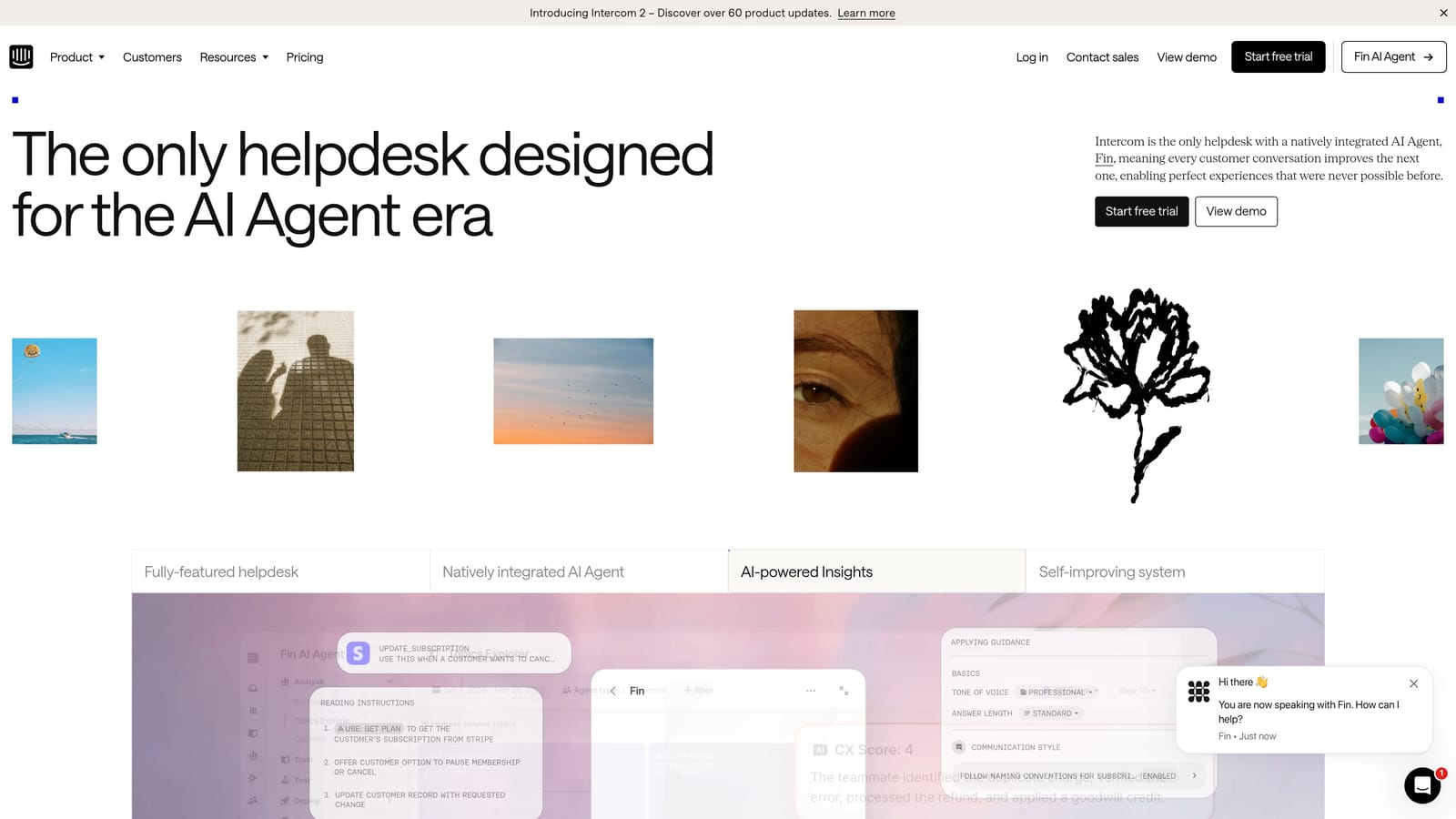
5. Intercom
Best for: Teams that want AI-powered support resolution with strong in-product messaging
Intercom is a customer communications platform with a strong AI agent called Fin for support resolution, in-product messaging, and proactive customer engagement across the lifecycle.
Where This Tool Shines
Fin, Intercom's AI agent, is one of the more capable self-serve support tools in the market. It handles a meaningful volume of support queries without human involvement, drawing on your help center content and product knowledge to resolve common questions. For teams with high inbound support volume, that self-serve resolution capability directly reduces ticket load on human agents.
Beyond support, Intercom's in-product messaging and proactive outreach tools give CS and growth teams a channel for reaching customers at the right moment in their journey. The AI Copilot feature also assists human agents during live conversations, surfacing relevant context and suggested responses in real time.
Key Features
Fin AI Agent: Handles high-volume support queries with self-serve resolution, drawing on your existing knowledge base.
AI Copilot: Assists human agents during live conversations with suggested replies and relevant context.
In-Product Messaging: Proactive outreach and in-app messaging for onboarding, feature adoption, and retention campaigns.
Conversation Analytics: CSAT tracking and conversation-level reporting to monitor support quality.
Integration Marketplace: Broad ecosystem of integrations across CRM, product analytics, and communication tools.
Best For
Companies already invested in the Intercom ecosystem, or those that want a combined support and messaging platform. Note that Halo AI integrates with Intercom, so teams using both can layer Halo's customer intelligence capabilities on top of Intercom's messaging infrastructure.
Pricing
Starts at approximately $39 per seat per month; AI features available on higher tiers. Pricing scales with seat count and feature tier.
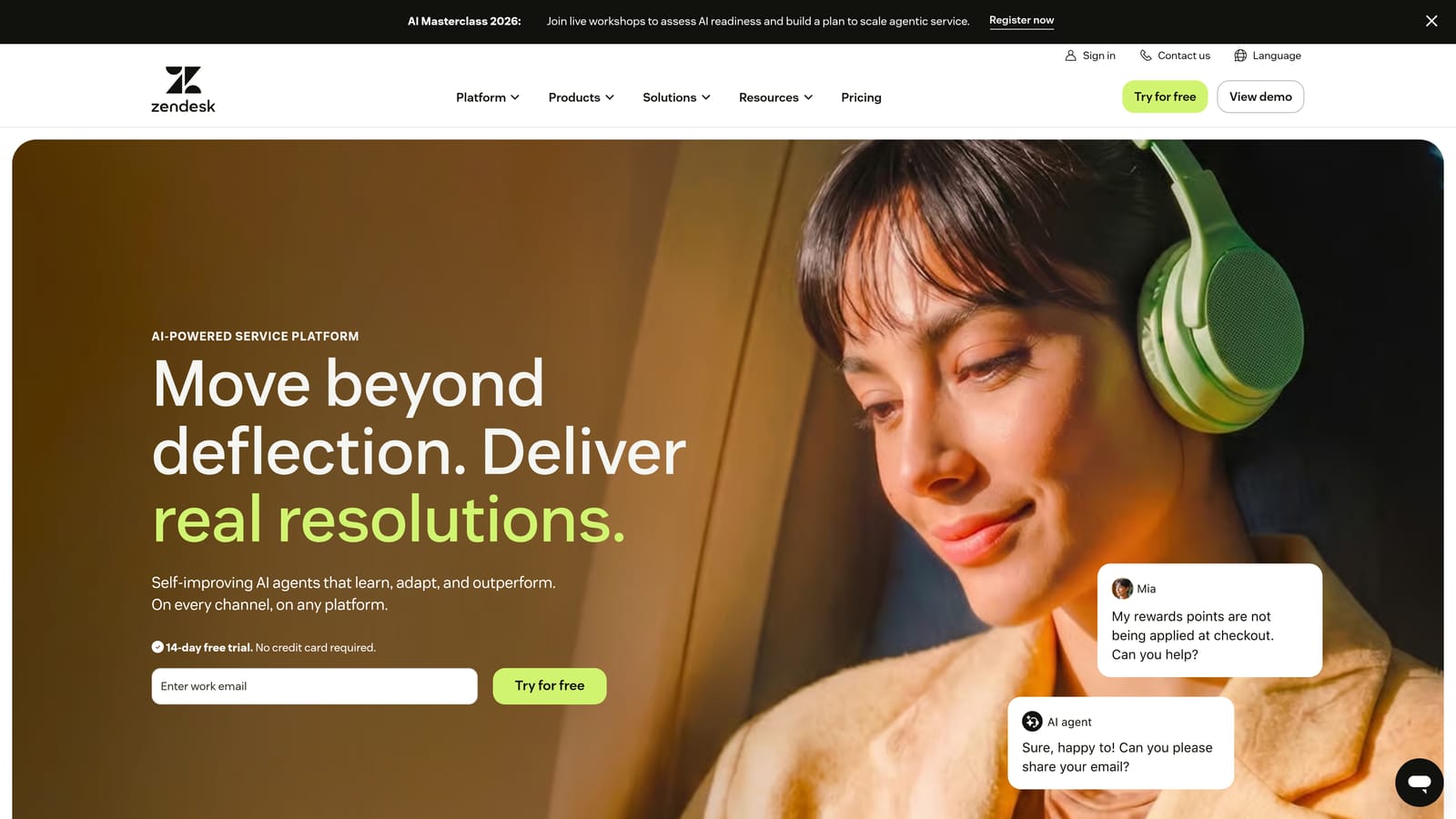
6. Zendesk (with AI)
Best for: Teams with existing Zendesk infrastructure looking for incremental AI improvement
Zendesk is a mature helpdesk platform with AI capabilities — including triage, suggested replies, and ticket summarization — layered onto a widely adopted support infrastructure.
Where This Tool Shines
Zendesk's primary advantage is its ubiquity. If your team is already operating in Zendesk, the AI layer offers a relatively low-friction path to automation without a platform migration. AI triage and intent detection help route tickets to the right queue faster, while suggested replies and ticket summarization reduce the cognitive load on agents handling high volumes.
The platform's breadth of integrations and its mature SLA management tooling make it a reliable choice for support organizations that need enterprise-grade reliability. The tradeoff is that Zendesk's AI capabilities are incremental improvements to a helpdesk workflow rather than a ground-up AI-first architecture — meaningful for existing users, but less transformative for teams starting fresh.
Key Features
AI Ticket Triage: Automated intent detection and routing to reduce manual categorization work.
Suggested Replies: Agent-assist features that surface relevant responses during live ticket handling.
Ticket Summarization: Condenses long conversation threads to reduce handle time and improve handoff quality.
App Marketplace: Extensive ecosystem of third-party integrations across CRM, analytics, and communication tools.
SLA Management and Reporting: Advanced reporting and SLA tracking for enterprise support operations.
Best For
Support teams with existing Zendesk investment who want to add AI capabilities without migrating to a new platform. Less ideal for teams starting from scratch who want AI-first architecture rather than AI as an add-on.
Pricing
Suite starts at approximately $55 per agent per month; AI features available on higher tiers. Enterprise pricing available for larger organizations.
7. Freshdesk (Freddy AI)
Best for: Budget-conscious teams that want meaningful AI capabilities without enterprise pricing
Freshdesk is an affordable helpdesk platform with Freddy AI providing ticket summarization, auto-triage, agent suggestions, and a self-service bot for end users across multiple support channels.
Where This Tool Shines
Freshdesk's strongest argument is accessibility. The free tier makes it genuinely available to very small teams, and the paid plans scale affordably compared to Zendesk or enterprise CS platforms. Freddy AI covers the core automation needs: auto-triage reduces manual sorting, agent suggestions speed up response drafting, and the Freddy Self Service bot handles common end-user questions without human involvement.
For SMB teams that need omnichannel support coverage across email, chat, phone, and social without a large budget, Freshdesk delivers solid functionality. The AI capabilities are less sophisticated than AI-first platforms, but for teams where cost is a primary constraint, the value proposition is clear.
Key Features
Freddy Auto-Triage: Automatic ticket categorization and routing based on content and intent.
Agent Assist: Suggested replies and conversation summarization to speed up agent response times.
Freddy Self Service: End-user bot for self-resolution of common support queries without agent involvement.
Omnichannel Support: Unified inbox for email, chat, phone, and social media support channels.
Free Tier: Functional free plan available for small teams getting started with helpdesk tooling.
Best For
Small to mid-sized teams that need omnichannel support with AI assistance at a price point that doesn't require a business case to finance. Strong fit for companies that aren't ready for enterprise CS platform investment but want more than a basic helpdesk.
Pricing
Free tier available; paid plans from approximately $15 per agent per month. Freddy AI features available on higher-tier plans. Pricing is among the most accessible in this category.
8. Planhat
Best for: Data-driven CS teams that prioritize clean, unified customer data over feature breadth
Planhat is a data-model-first customer success platform that unifies product usage, CRM, and support data into a clean customer view with AI-assisted health scoring and anomaly detection.
Where This Tool Shines
Planhat's defining characteristic is its emphasis on data integrity. Rather than layering features onto a messy data foundation, Planhat starts with a unified customer data model that connects product usage, revenue data, and support history into a single coherent view. For CS leaders who have struggled with inconsistent health scores driven by fragmented data sources, that foundation matters.
The AI-assisted anomaly detection is particularly useful for identifying accounts that are behaving unexpectedly, whether that's sudden usage drops, unusual support volume spikes, or revenue signals that don't match engagement patterns. The dashboards are clean and customizable, making Planhat a strong choice for CS leaders who need to present account health to executive stakeholders without manual report building.
Key Features
Unified Customer Data Model: Connects product usage, CRM, and support data into a single, coherent customer view.
AI-Assisted Health Scoring: Health scores built on clean, unified data rather than siloed metrics.
Anomaly Detection: Surfaces accounts behaving unexpectedly based on usage, revenue, and engagement patterns.
Revenue Analytics: Expansion opportunity tracking and revenue intelligence for CS-driven growth.
Customizable Dashboards: Clean, flexible reporting for CS leaders and executive stakeholders.
Best For
Mid-market CS teams that have experienced the pain of fragmented customer data and want a platform built around data quality first. Strong fit for analytics-oriented CS leaders who want accuracy in health scoring over quantity of features.
Pricing
Contact for pricing. Mid-market positioning; not publicly listed. Reach out to Planhat directly for a quote based on your account volume and team size.
9. Catalyst
Best for: Salesforce-centric organizations that want CS intelligence inside their existing CRM
Catalyst is a Salesforce-native customer success platform that surfaces health scoring, renewal tracking, and AI-powered insights directly inside CRM views, designed for teams that live and work in Salesforce.
Where This Tool Shines
For organizations where Salesforce is the operational center of gravity, Catalyst's native integration removes a persistent friction point in CS tooling: the context switch between CRM and success platform. CS intelligence, health scores, renewal timelines, and AI-recommended next actions appear directly in Salesforce views, meaning CSMs don't need to toggle between systems to get a complete account picture.
The AI layer adds predictive insights and recommended actions on top of the health scoring and success plan framework. For enterprise teams where Salesforce adoption is high and migration away from it is not realistic, Catalyst offers a path to sophisticated CS capabilities without disrupting existing workflows.
Key Features
Salesforce-Native Integration: CS intelligence surfaces directly inside Salesforce CRM views without requiring a separate application.
AI-Powered Predictive Insights: Recommended next actions and predictive health signals based on CRM and product data.
Success Plans and Milestone Tracking: Structured account planning tools connected to CRM records and renewal timelines.
Renewal and Expansion Management: Revenue tracking for at-risk accounts and growth opportunities within the Salesforce environment.
Health Scoring: Connected to both CRM data and product usage signals for a multi-dimensional account view.
Best For
Enterprise organizations with deep Salesforce investment where CSMs and account executives already operate primarily within the CRM. Less relevant for teams on HubSpot or other CRM platforms, or those open to adopting a standalone CS tool.
Pricing
Contact for pricing. Enterprise positioning; not publicly listed. Pricing is typically based on seat count and account volume.
Making the Right Choice
The right customer success AI platform depends on where your biggest gap is right now. These nine tools solve different versions of the same problem, and choosing the wrong fit means paying for capabilities you won't use while missing the ones you actually need.
If you're losing time to repetitive tickets and missing churn signals buried in support conversations, you need a platform that connects support resolution to customer intelligence. That's where Halo AI stands out: it operates at the layer most CS platforms ignore, turning every support interaction into a signal your team can act on. If you're a large enterprise with a dedicated CS org managing complex renewals, Gainsight or ChurnZero may be the better fit. For teams already inside Zendesk or Intercom, their native AI layers offer the fastest path to automation without migration overhead.
Before committing to any platform, ask yourself three questions. Does this platform learn from every interaction, or just route and respond? Does it connect to the tools my team already uses? And does it give me intelligence I can act on, not just dashboards I have to interpret?
Your support team shouldn't scale linearly with your customer base. Let AI agents handle routine tickets, guide users through your product, and surface business intelligence while your team focuses on complex issues that need a human touch. See Halo in action and discover how continuous learning transforms every interaction into smarter, faster support.