8 Best Customer Support AI Tools for B2B SaaS in 2026
B2B SaaS teams face unique support challenges — technical users, multi-product complexity, and deep CRM integrations — that generic AI tools simply aren't built for. This guide reviews the 8 best customer support AI for B2B SaaS platforms in 2026, evaluating each on autonomous resolution, integration depth, and real-world fit for SaaS workflows.
 Matt PattoliFounder13 min read
B2B SaaS teams are under mounting pressure to deliver fast, accurate support without proportionally growing headcount. The good news: AI-native support tools have moved well beyond basic chatbots. Today's platforms resolve tickets autonomously, surface business intelligence, and hand off seamlessly to human agents when complexity demands it.
But not every tool is built for the nuances of B2B SaaS. Multi-product complexity, technical user bases, deep integrations with engineering and CRM stacks, and the need for context-aware responses all raise the bar considerably. A tool that works beautifully for an e-commerce brand may fall flat when your users are developers filing bug reports or enterprise buyers expecting white-glove support.
This list focuses on tools purpose-built or well-suited for that environment. We evaluated each on autonomy, integration depth, learning capability, and how well they fit B2B SaaS workflows — not just generic chat volume. Whether you're exploring a dedicated customer support solution, evaluating integration depth, or ready to book a demo, this breakdown will help you find the right fit for your team's stage and complexity.
1. Halo AI
Best for: B2B SaaS teams that want an AI-first support platform with deep product and engineering integrations.
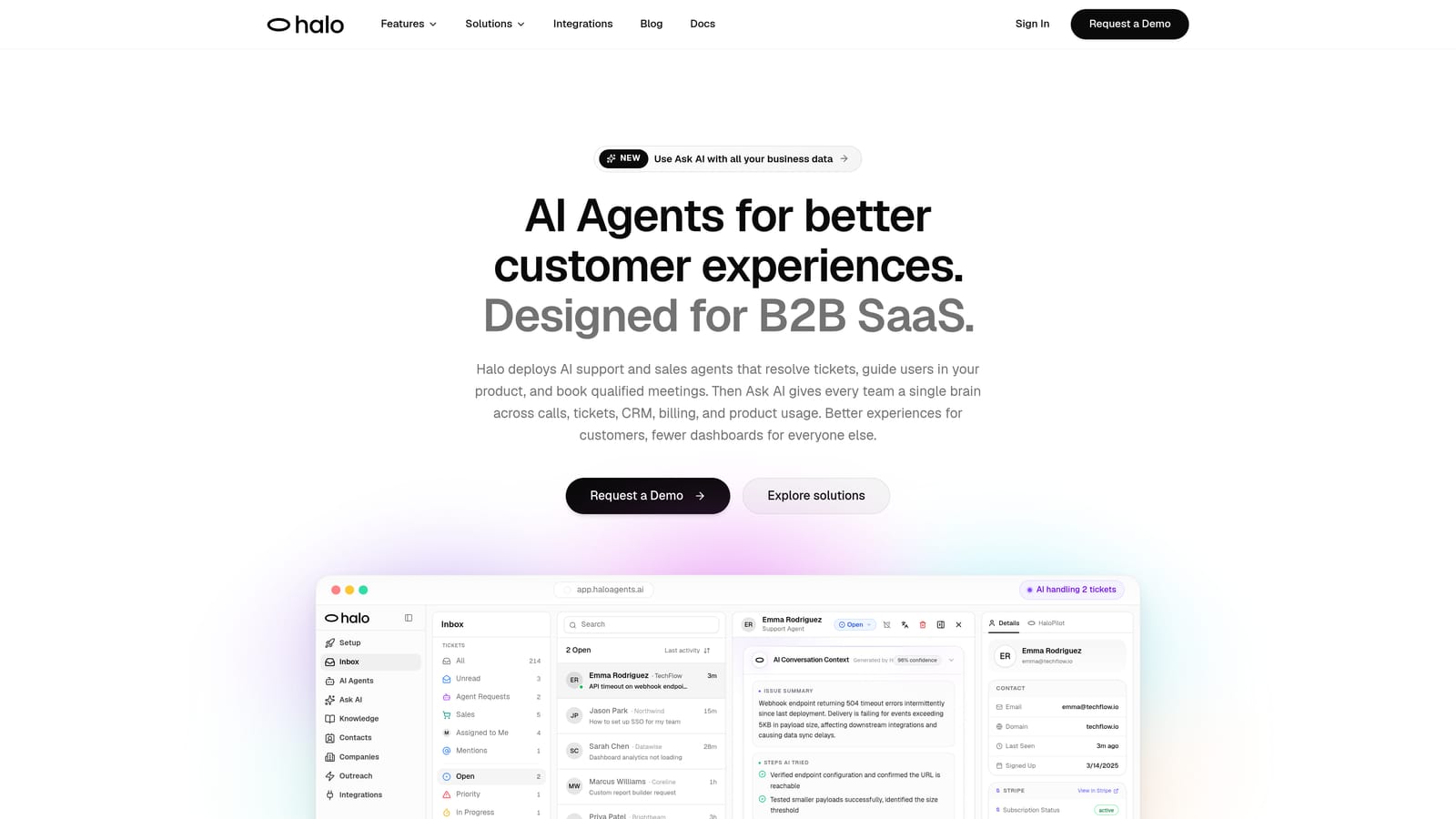
Halo AI is an AI-native customer support platform built specifically for B2B SaaS, deploying autonomous agents that resolve tickets, guide users with visual context, and surface business intelligence across every interaction.
Where This Tool Shines
Halo's most distinctive capability is its page-aware chat widget: the AI agent can see exactly what the user sees in your product, enabling context-accurate guidance rather than generic answers. This is particularly valuable for SaaS products with complex UIs, multi-step workflows, or onboarding friction points where "check the help center" simply isn't good enough.
Beyond ticket resolution, Halo's smart inbox surfaces business intelligence that most support tools ignore entirely: customer health signals, anomaly detection, and revenue intelligence. Your support data becomes a strategic input, not just a queue to clear. The platform also auto-creates bug tickets routed directly to Linear or your engineering stack, closing the loop between customer-reported issues and product fixes without manual handoff.
Key Features
Page-Aware Chat Widget: The AI sees the user's current screen context, enabling precise, step-by-step product guidance rather than generic responses.
Autonomous Ticket Resolution: AI agents handle routine and mid-complexity tickets independently, with smart escalation to live agents when issues require human judgment.
Auto Bug Ticket Creation: Automatically generates and routes bug reports to Linear or your engineering stack, reducing manual triaging by support and engineering teams.
Smart Inbox with Business Intelligence: Surfaces customer health signals, anomaly detection, and revenue intelligence beyond standard support analytics.
Broad Integration Stack: Connects natively with Linear, Slack, HubSpot, Intercom, Stripe, Zoom, PandaDoc, and Fathom for a unified support and business operations view.
Best For
SaaS companies that want AI-first architecture rather than AI bolted onto an existing helpdesk. Particularly strong for product-led growth teams, technical support environments, and organizations where support data should inform product and revenue decisions — not just close tickets.
Pricing
Demo-first pricing model. Halo does not publish plans publicly. Contact the team directly or book a demo at haloagents.ai for a tailored quote.
2. Intercom (Fin AI Agent)
Best for: SaaS teams already using Intercom for messaging who want autonomous AI resolution layered in.
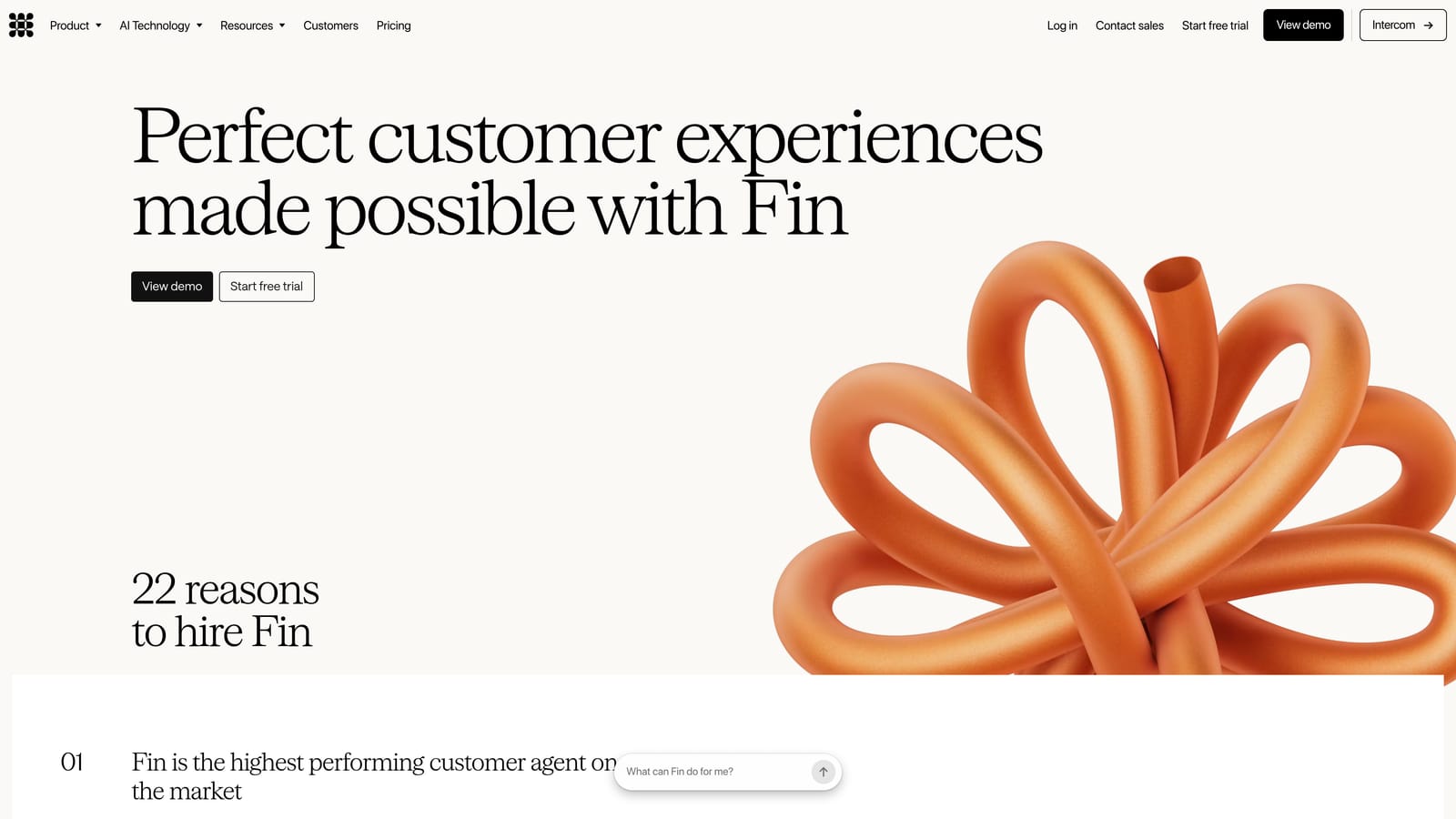
Intercom's Fin AI Agent is a large language model-powered support agent trained on your help content and embedded within Intercom's messenger and inbox ecosystem.
Where This Tool Shines
Fin's strength is its tight integration with the Intercom platform. If your team already uses Intercom for proactive messaging, onboarding flows, and customer communication, adding Fin AI Agent is a natural extension rather than a platform switch. The LLM-powered resolution is trained directly on your help center and knowledge base, which means setup is relatively straightforward for teams with well-documented support content.
The handoff experience between Fin and human agents is smooth, operating within the same Intercom inbox your team already works in. This reduces friction for both agents and customers during escalation.
Key Features
LLM-Powered Autonomous Resolution: Fin is trained on your help center and knowledge base to resolve common queries without human involvement.
Seamless Agent Handoff: Escalations happen within the Intercom inbox, keeping the conversation context intact for human agents picking up the thread.
Proactive Messaging Integration: Leverages Intercom's outbound messaging capabilities for proactive support workflows, not just reactive ticket handling.
Usage-Based AI Pricing: Billed per AI resolution, giving teams visibility into ROI relative to deflected tickets.
SaaS Integration Ecosystem: Connects with a broad range of SaaS tools through Intercom's existing integration library.
Best For
Teams already invested in the Intercom ecosystem who want to extend their existing setup with AI resolution rather than adopt a separate platform. Less compelling as a standalone choice if you're not already using Intercom's broader suite.
Pricing
Usage-based pricing for AI resolutions layered on top of core Intercom plans. Core plans start at approximately $39 per seat per month; verify current pricing on Intercom's website as plans evolve frequently.
3. Zendesk AI
Best for: Large enterprise support teams with complex routing needs and existing Zendesk Suite investment.
Zendesk AI is the AI layer built natively into the Zendesk Suite, offering intelligent triage, routing, agent assist, and AI-generated summaries at enterprise scale.
Where This Tool Shines
Zendesk AI's biggest advantage is depth of integration with the Zendesk Suite itself. Intent detection, sentiment analysis, and language identification work across tickets, messaging, and voice channels without additional configuration. For large support organizations handling high ticket volumes across multiple channels, this native coverage removes a lot of operational complexity.
The agent-assist features are particularly well-developed: macro suggestions, AI-generated response drafts, and conversation summaries help experienced agents work faster without replacing their judgment. This hybrid model suits enterprise B2B SaaS teams where complex, high-stakes tickets still require human expertise.
Key Features
Intelligent Triage: Automatically detects intent, sentiment, and language to route tickets to the right team or queue from the moment they arrive.
Macro and Response Suggestions: AI surfaces relevant macros and draft responses for agents, reducing time-to-reply on common ticket types.
AI-Generated Conversation Summaries: Reduces handle time by summarizing ticket history for agents picking up mid-conversation or escalated threads.
Native Suite Integration: AI features work across Zendesk's full stack — tickets, messaging, voice, and help center — without third-party connectors.
Advanced AI Performance Analytics: Reporting on AI resolution rates, deflection, and agent assist usage to measure impact over time.
Best For
Enterprise SaaS and mid-market teams with established Zendesk deployments that want to add AI capability without migrating platforms. The value is highest for organizations already running complex Zendesk configurations.
Pricing
AI features are available on Suite Professional plans and above. Pricing varies by plan tier and seat count; verify current pricing directly with Zendesk as enterprise tiers are typically quoted.
4. Freshdesk Freddy AI
Best for: Mid-market SaaS teams wanting an all-in-one AI support suite at competitive pricing.
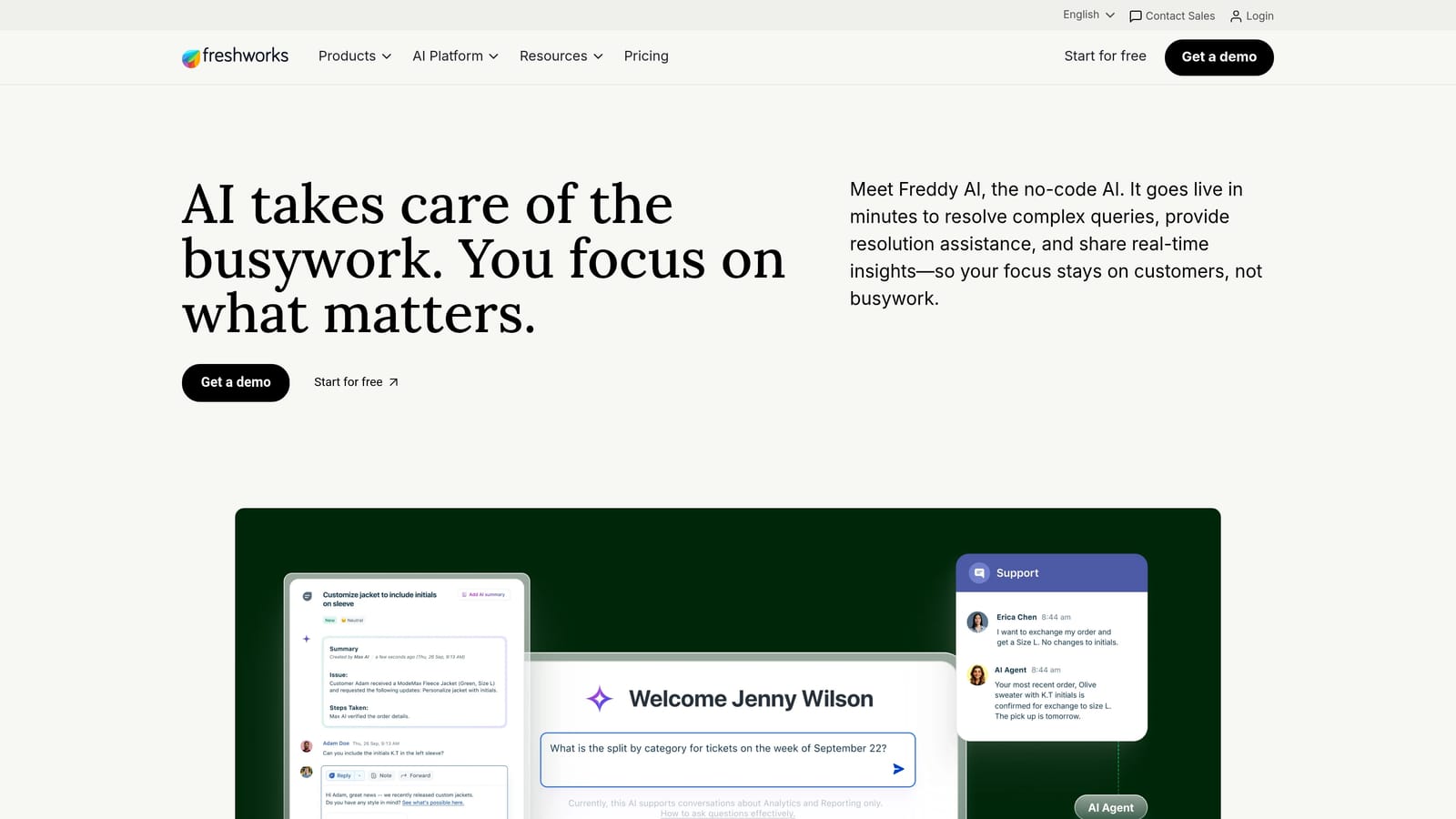
Freshdesk Freddy AI is Freshworks' umbrella AI brand covering self-service deflection, agent copilot assistance, and analytics across the Freshworks product suite.
Where This Tool Shines
Freddy AI covers three distinct functions within the Freshdesk ecosystem: Freddy Self Service handles autonomous deflection for common queries, Freddy Copilot provides real-time suggestions and summarization for agents during live tickets, and Freddy Insights surfaces AI-driven analytics identifying trends and knowledge gaps. This layered approach means teams can adopt AI incrementally rather than committing to full automation from day one.
Freshdesk's pricing relative to Zendesk makes it a practical choice for mid-market SaaS companies that want enterprise-level AI capabilities without enterprise-level costs. The cross-product coverage across Freshsales and Freshservice also appeals to teams wanting to unify support, CRM, and ITSM under one vendor.
Key Features
Freddy Self Service: AI bot that deflects common queries autonomously before they reach the human agent queue.
Freddy Copilot: Real-time suggestions, response drafting, and conversation summarization to speed up agent resolution.
Freddy Insights: AI-driven analytics that surface ticket trends, anomalies, and knowledge gaps for proactive improvement.
Cross-Product Coverage: AI capabilities extend across Freshsales and Freshservice for teams using multiple Freshworks products.
Competitive Mid-Market Pricing: More accessible pricing than comparable enterprise alternatives, particularly for growing SaaS teams.
Best For
Mid-market SaaS companies looking for a cost-effective alternative to Zendesk, especially those already using or evaluating other Freshworks products. Less suited for teams needing deep custom integrations with engineering tools or advanced business intelligence beyond support metrics.
Pricing
Freddy AI is available as an add-on to Freshdesk plans. The Growth plan starts at approximately $15 per agent per month; verify current pricing on the Freshworks website as add-on costs vary by tier.
5. Forethought
Best for: Teams that want to add AI intelligence to an existing helpdesk without replacing it.
Forethought is a workflow-first AI support platform designed to layer intelligent triage, autonomous resolution, and agent assist over your current helpdesk infrastructure.
Where This Tool Shines
Forethought's architecture is deliberately additive: it enhances whatever helpdesk you're already running rather than asking you to migrate. This makes it particularly valuable for organizations with significant investment in Zendesk, Salesforce Service Cloud, Freshdesk, or ServiceNow configurations they're not ready to abandon. The intent detection capabilities are well-regarded, enabling nuanced routing beyond simple keyword matching.
The Discover module is a practical differentiator: it analyzes ticket data to identify automation opportunities and knowledge gaps, giving support leaders a roadmap for where AI can create the most impact rather than requiring them to guess.
Key Features
Solve: Autonomous AI resolution for common and repeatable ticket types without agent involvement.
Triage: AI-powered intent detection and routing to direct tickets to the right team or queue from the outset.
Assist: In-context agent suggestions and knowledge retrieval surfaced during live ticket handling.
Discover: Analytics module identifying automation opportunities and knowledge gaps from historical ticket data.
Multi-Helpdesk Integration: Native integrations with Zendesk, Salesforce Service Cloud, Freshdesk, and ServiceNow.
Best For
SaaS companies with established helpdesk configurations that want to add AI capability as an intelligent layer rather than replace their existing platform. Particularly useful for teams with mature support operations looking to optimize systematically.
Pricing
Custom pricing only. Contact Forethought directly for a quote tailored to your ticket volume and use case.
6. Kustomer
Best for: Relationship-heavy B2B SaaS support where full customer context matters as much as resolution speed.
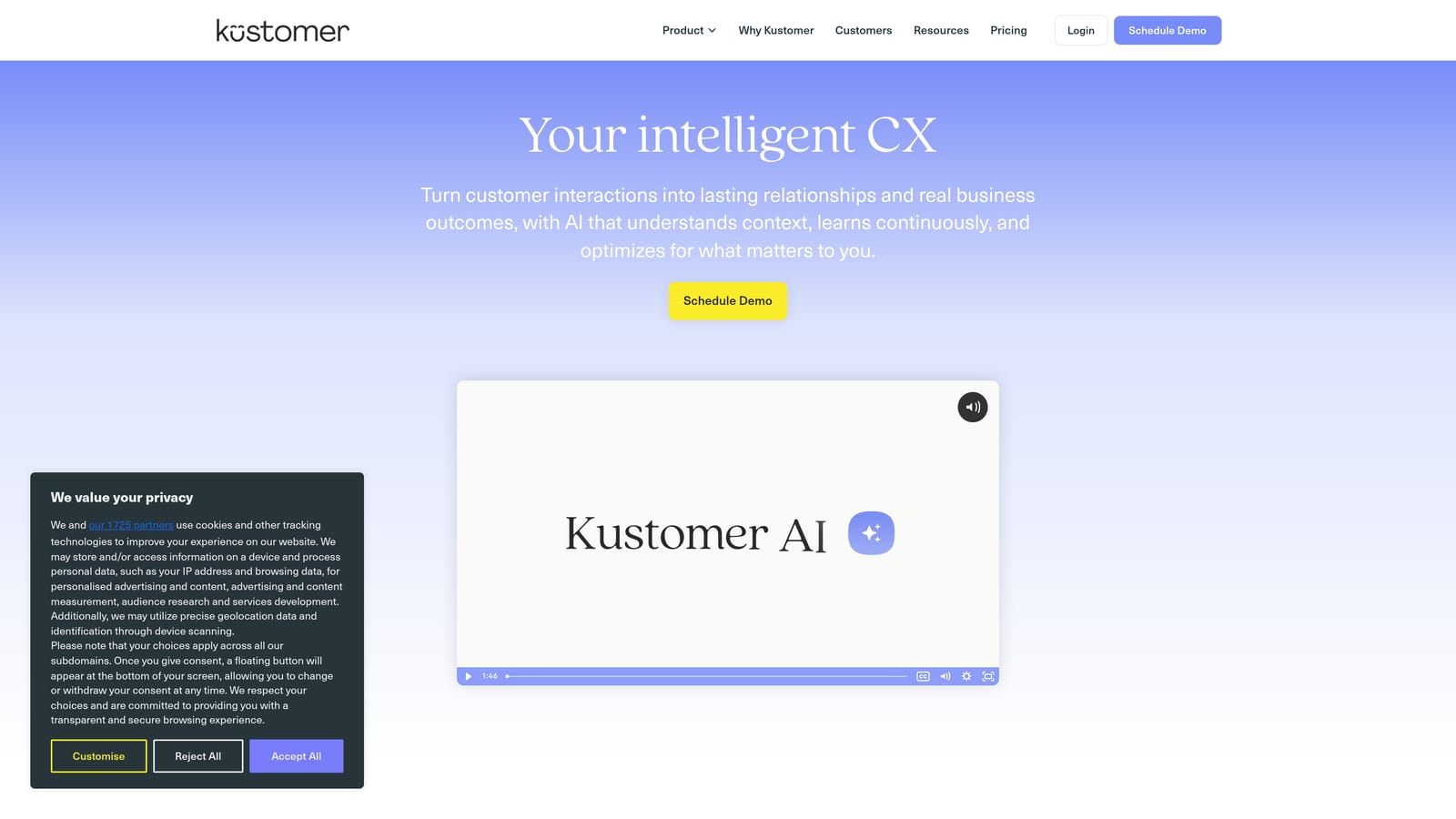
Kustomer is a CRM-native customer service platform, owned by Meta, that embeds AI into a full customer timeline view designed for high-context support interactions.
Where This Tool Shines
Kustomer's core differentiator is its customer timeline: every interaction, purchase, product event, and communication is consolidated into a single view that agents access during every conversation. AI features surface relevant context and suggest responses within this view, rather than operating as a separate AI layer. For B2B SaaS companies where support conversations frequently involve account history, contract details, or prior escalations, this context-first approach can meaningfully improve both agent efficiency and customer experience.
The omnichannel coverage across email, chat, social, voice, and SMS is comprehensive, making Kustomer a viable choice for SaaS teams that need to manage support across multiple channels from a single platform.
Key Features
Full Customer Timeline: CRM-native view consolidating all customer interactions, product events, and history for every support conversation.
AI-Suggested Responses: Context-aware response suggestions surfaced within the timeline view to speed up agent handling.
Workflow Automation: AI-driven routing, SLA management, and process automation for consistent support operations.
Omnichannel Coverage: Unified inbox spanning email, chat, social, voice, and SMS without separate platform management.
Relationship-Driven Support Model: Better suited for high-touch B2B accounts than high-volume transactional support.
Best For
B2B SaaS companies with enterprise customers where relationship context and account history drive support quality. Less focused on autonomous AI deflection; stronger as an agent-empowerment platform with AI assistance embedded throughout.
Pricing
Enterprise plan starts at approximately $89 per user per month. Verify current pricing directly with Kustomer, as enterprise plans are often customized.
7. Tidio (Lyro AI)
Best for: Early-stage SaaS teams that need fast AI deployment without extensive configuration or training data.
Tidio's Lyro AI is a conversational AI agent built for rapid deployment, designed to handle common support queries with minimal setup time and accessible pricing.
Where This Tool Shines
Lyro's defining characteristic is speed to value. Where many enterprise AI support tools require weeks of configuration, knowledge base preparation, and integration work, Lyro is designed to go live in hours. This makes it a practical option for early-stage SaaS teams that need to reduce support load quickly without a dedicated implementation project.
The accessible pricing model also matters at this stage. Lyro handles FAQ-type and common support queries well, and the live chat handoff to human agents provides a safety net when the AI reaches the boundary of its capability. For teams not yet dealing with high technical complexity, this is often sufficient to meaningfully reduce first-response burden.
Key Features
Fast Deployment: Go live in hours rather than weeks, with minimal training data or configuration required upfront.
Conversational AI Resolution: Handles common and FAQ-type queries autonomously without human involvement.
Live Chat Handoff: Smooth escalation to human agents when Lyro reaches the limits of its knowledge or complexity threshold.
Volume-Based Pricing: Billed by conversation volume, making cost predictable and accessible for smaller teams.
SMB-Accessible Entry Point: Free plan available for very low volumes; paid plans start at a price point suited to early-stage budgets.
Best For
Early-stage or SMB SaaS teams that need immediate AI support coverage without the implementation overhead of enterprise platforms. Less suited for complex technical support environments or organizations needing deep engineering and CRM integrations.
Pricing
Free plan available for limited volumes. Lyro AI conversations are billed by volume; paid plans start at approximately $29 per month. Verify current pricing on Tidio's website.
8. Capacity
Best for: SaaS companies that need to automate both customer-facing and internal (IT/HR) support from a single platform.
Capacity is an AI-powered support automation platform built around a knowledge management core, spanning external customer support and internal helpdesk use cases.
Where This Tool Shines
Capacity's distinctive positioning is its dual coverage of external customer support and internal employee support (IT helpdesk, HR queries) within the same platform. For SaaS companies that are simultaneously scaling their customer base and their internal team, consolidating both support functions under one AI layer can reduce operational overhead and create a single knowledge management system that serves both audiences.
The knowledge base at Capacity's core learns and improves from every interaction, which means the system gets progressively more useful over time rather than requiring manual updates to stay current. This continuous learning dynamic is particularly valuable for fast-moving SaaS products where documentation frequently changes.
Key Features
Self-Improving Knowledge Base: AI-powered knowledge management that learns from every interaction and improves resolution accuracy over time.
Dual-Use Coverage: Supports both external customer-facing and internal IT/HR helpdesk automation from one platform.
AI Chat with Escalation: Conversational AI layer with structured escalation workflows to human agents when needed.
SaaS Tool Integrations: Connects with common SaaS tools for knowledge sync and workflow automation.
Unified Support Automation: Reduces the need for separate platforms managing internal and external support queues.
Best For
SaaS companies at a growth stage where both customer support and internal operations are scaling simultaneously. Particularly useful when a unified knowledge management approach would benefit both employee and customer-facing teams.
Pricing
Custom pricing only. Contact Capacity directly for a quote based on your use case and scale.
Which Tool Is Right for Your Team?
The right choice here depends less on feature checklists and more on one fundamental question: do you need AI built into the foundation of your support platform, or AI layered onto a helpdesk you're already committed to?
If you're starting fresh or ready to rethink your support stack with an AI-first architecture, Halo AI is the strongest option for B2B SaaS. The page-aware context, autonomous resolution, auto bug ticket creation, and business intelligence capabilities go beyond what any bolt-on AI layer can offer — and the integrations with Linear, HubSpot, Slack, and Stripe make it a natural fit for product-led SaaS teams.
For teams already deep in the Intercom or Zendesk ecosystem, Fin AI Agent and Zendesk AI are the logical next steps without requiring a platform migration. Freshdesk Freddy AI is the strongest mid-market alternative if cost is a constraint. Forethought is worth evaluating if you need AI intelligence across multiple helpdesk platforms simultaneously.
For relationship-heavy enterprise accounts, Kustomer's CRM-native timeline approach offers something the others don't. And if you're early-stage and need something live this week, Tidio's Lyro AI is the most practical entry point. Capacity stands out specifically for teams that need to automate both customer and internal support from one system.
Your support team shouldn't scale linearly with your customer base. Let AI agents handle routine tickets, guide users through your product, and surface business intelligence while your team focuses on complex issues that need a human touch. See Halo in action and discover how continuous learning transforms every interaction into smarter, faster support.