9 Best Customer Support AI Tools for Developer Tools Companies in 2026
Customer support AI for developer tools requires platforms capable of handling technical complexity—stack traces, API errors, and precise debugging queries from engineering-savvy users. This guide evaluates the 9 best AI support tools in 2026 specifically for developer tools companies, comparing them on technical depth, automation capability, and integration ecosystems to help teams resolve tickets faster without frustrating their expert users.
 Matt PattoliFounder14 min read
Developer tools companies face a support challenge unlike any other: your users are engineers. They come to support with stack traces, API error codes, and reproduction steps already in hand. They don't want to be asked "have you tried clearing your cache?" They want precise answers, fast, and they'll lose patience quickly if they don't get them.
The good news is that AI-powered support platforms have matured significantly, and several are now genuinely capable of handling the technical complexity your users bring to every conversation. Whether you're running a CI/CD platform, a developer API product, or a devtool SaaS, the right AI support tool can resolve tickets autonomously, route bugs to engineering before they escalate, and give your team back the time they need to build.
Here are the top customer support AI tools evaluated specifically for developer tools companies in 2026, assessed on technical depth, integration ecosystem, automation capability, and real-world fit for lean, technical support teams.
1. Halo AI
Best for: Developer tools companies that want autonomous ticket resolution with deep product and engineering workflow integration.
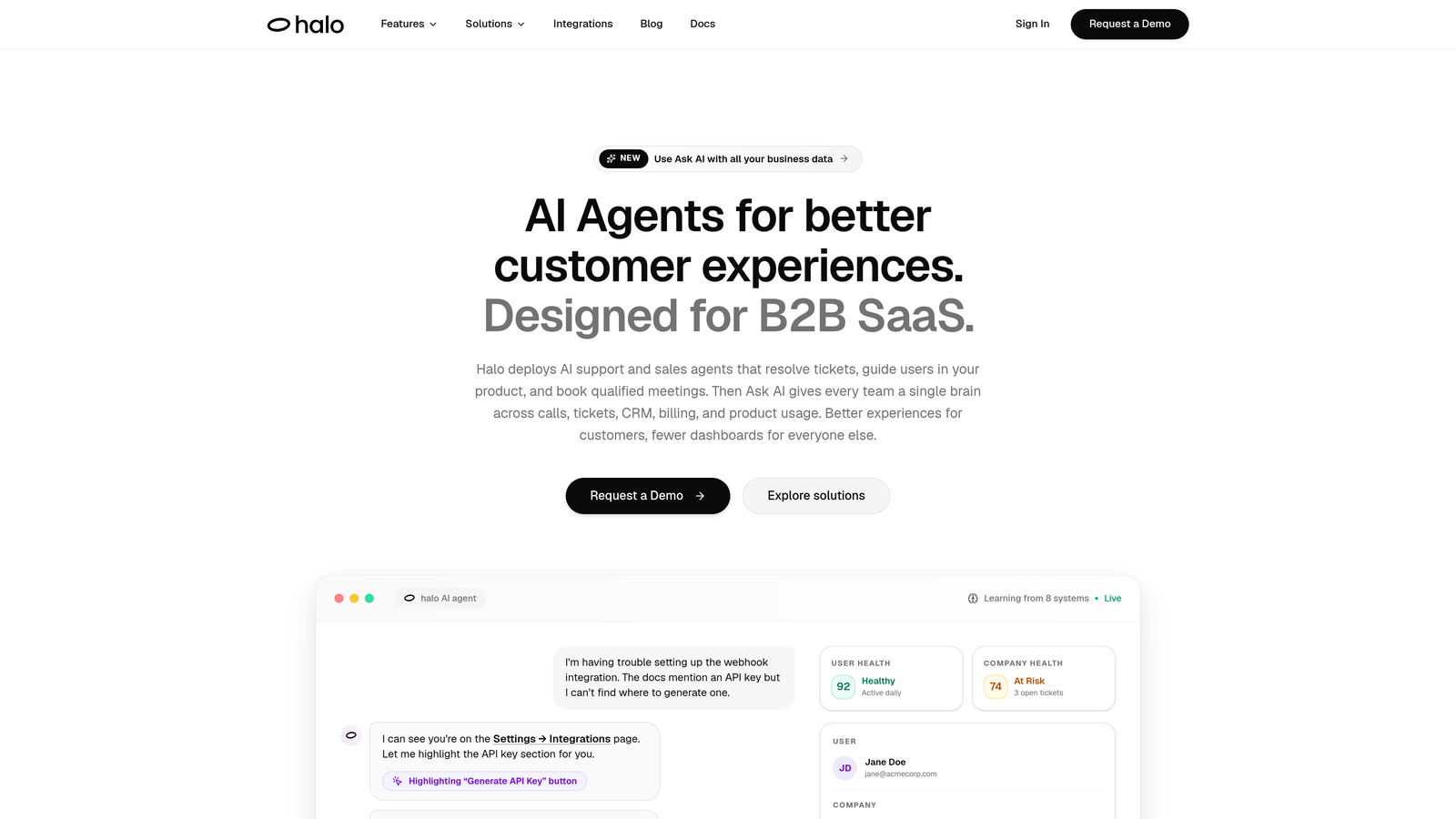
Halo AI is an AI-first customer support platform built specifically for B2B SaaS and developer tools companies, deploying intelligent agents that resolve tickets, guide users through your product, and surface business intelligence signals from every interaction.
Where This Tool Shines
What sets Halo apart for developer tools companies is its page-aware architecture. When a user reaches out, Halo's AI agent already knows what page they're on, what they were doing, and what context surrounds their question. That's the difference between an agent that says "can you describe your issue?" and one that says "I see you're on the API authentication page — here's what typically causes this error."
The auto bug ticket creation is particularly valuable for devtool teams. When a user reports something that looks like a product bug rather than a user error, Halo automatically creates a structured ticket and routes it directly to Linear or your engineering workflow. No copy-pasting, no manual triage, no issues falling through the cracks between support and engineering.
Key Features
Page-Aware AI Agents: Understands what users are doing in-product at the moment they reach out, enabling contextually precise responses without requiring users to explain their setup.
Auto Bug Ticket Creation: Detects product bugs from support conversations and routes structured tickets directly to Linear or your engineering workflow automatically.
Smart Inbox with Business Intelligence: Goes beyond ticket resolution to surface customer health signals, revenue anomalies, and churn indicators from support interaction patterns.
Live Agent Handoff: Transfers complex conversations to human agents with full context preserved, so customers never have to re-explain their issue.
Broad Integration Ecosystem: Connects with Linear, Slack, HubSpot, Intercom, Stripe, Zoom, PandaDoc, and Fathom, making it a natural fit for developer tools stacks.
Continuous Learning: Improves response quality over time by learning from every resolved interaction, getting smarter as your product and user base evolve.
Best For
Developer tools companies that want true autonomous resolution, not just AI-assisted human agents. Particularly strong for teams that need tight integration between support and engineering workflows, and for companies where support data should be feeding product and revenue decisions, not just sitting in a helpdesk.
Pricing
Contact for pricing. See haloagents.ai for details and to book a demo.
2. Intercom
Best for: Teams already in the Intercom ecosystem looking for a mature AI agent with strong inbox and messaging capabilities.
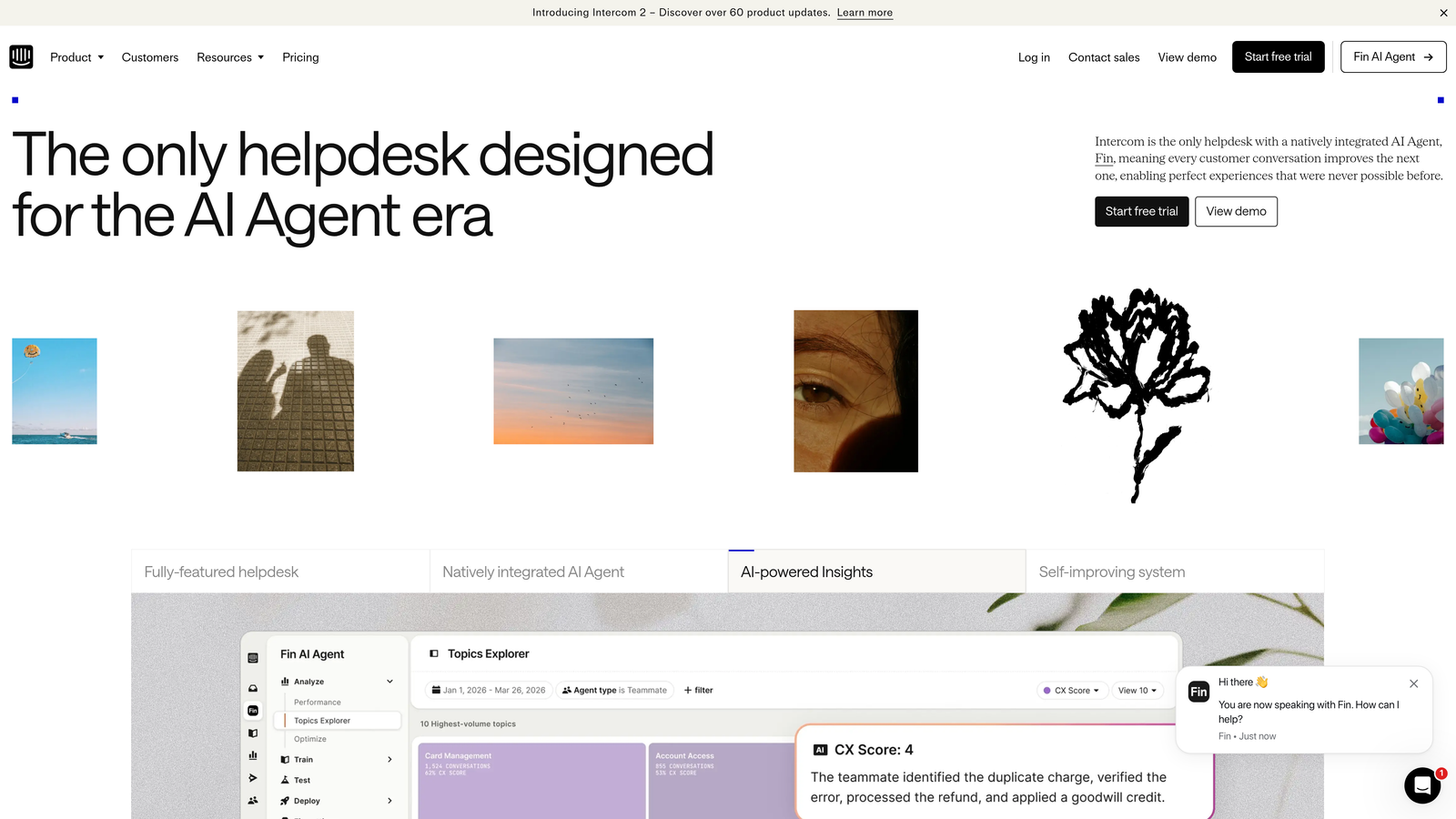
Intercom is an all-in-one customer messaging platform featuring Fin, an AI agent built on GPT-4 that handles support queries autonomously and escalates to human agents when needed.
Where This Tool Shines
Intercom's Fin AI agent is one of the more capable general-purpose AI agents on the market. It draws on your existing help content to answer questions autonomously, and its handoff logic to human agents is smooth and well-designed. For developer tools companies already using Intercom for messaging and onboarding, adding Fin is a natural extension rather than a platform switch.
The app marketplace is extensive, covering most common developer tools integrations. However, Intercom is a horizontal platform, not purpose-built for technical support teams, so the depth of developer-specific features like engineering workflow integration or bug detection is more limited compared to specialized tools.
Key Features
Fin AI Agent: Resolves queries autonomously using your help content, with GPT-4 powering its understanding of complex questions.
Shared Inbox: AI-assisted routing and tagging keeps your team organized across high-volume support queues.
App Marketplace: Over 300 integrations covering most common SaaS and developer tools connections.
Proactive Messaging: Product tours and in-app messaging for onboarding and self-service deflection.
CSAT and Reporting: Built-in satisfaction tracking and conversation analytics.
Best For
Mid-market and growth-stage developer tools companies already invested in the Intercom ecosystem, or teams that prioritize messaging and onboarding alongside support.
Pricing
Starts at approximately $39/seat/month; Fin AI usage is billed per resolution. Costs can scale quickly for high-volume teams.
3. Zendesk AI
Best for: Enterprise developer tools companies with high ticket volumes that need robust SLA management and workflow automation.
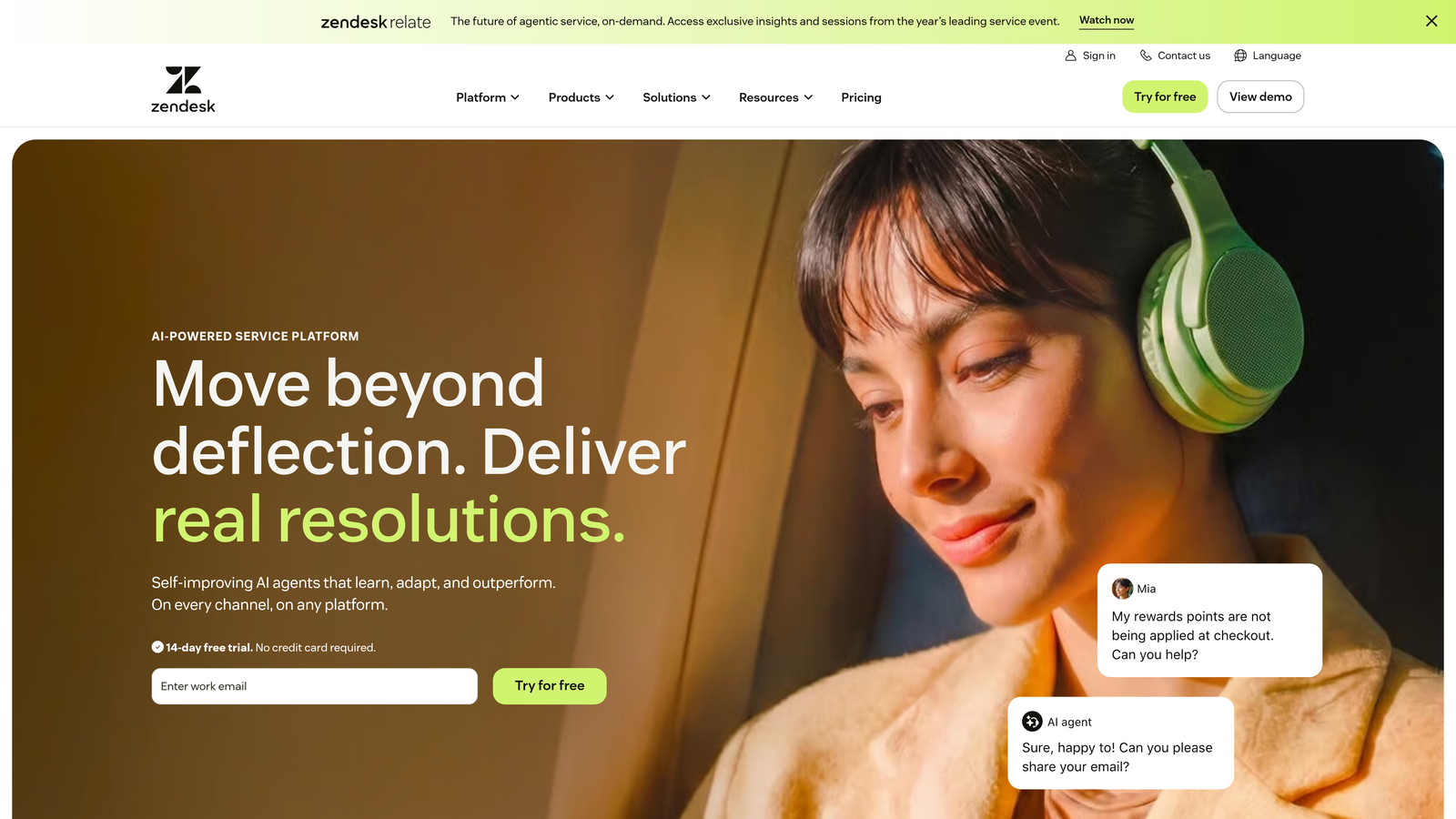
Zendesk is an enterprise helpdesk platform with AI capabilities layered in through the Zendesk Suite, including intelligent triage, agent copilot features, and automated workflow tools.
Where This Tool Shines
Zendesk's strength is scale. For developer tools companies handling thousands of tickets per month across multiple channels, Zendesk's workflow engine, SLA management, and reporting infrastructure are genuinely enterprise-grade. The AI features have improved significantly in recent releases, with intent detection and agent copilot suggestions that reduce handle time meaningfully.
The trade-off is complexity. Zendesk can feel heavyweight for lean developer tools teams, and getting the AI capabilities fully configured often requires significant setup investment. It's a powerful platform, but one that rewards teams with the resources to configure and maintain it properly.
Key Features
AI-Powered Triage: Detects intent and routes incoming tickets automatically based on content and context.
Agent Copilot: Suggests replies and recommends macros to speed up agent response times.
Sunshine Platform: Advanced workflow automation for building custom support processes.
SLA Management: Robust service level tracking and escalation rules for enterprise support operations.
Integration Ecosystem: Large marketplace with apps covering most major developer tools and enterprise systems.
Best For
Enterprise-stage developer tools companies with established support operations, dedicated support ops resources, and high ticket volumes that justify the platform's complexity and price.
Pricing
Suite plans start at approximately $55/agent/month; AI add-ons are priced separately, which can add meaningful cost at scale.
4. Freshdesk (Freddy AI)
Best for: Growing developer tools startups that need solid AI-assisted support without enterprise-level pricing.
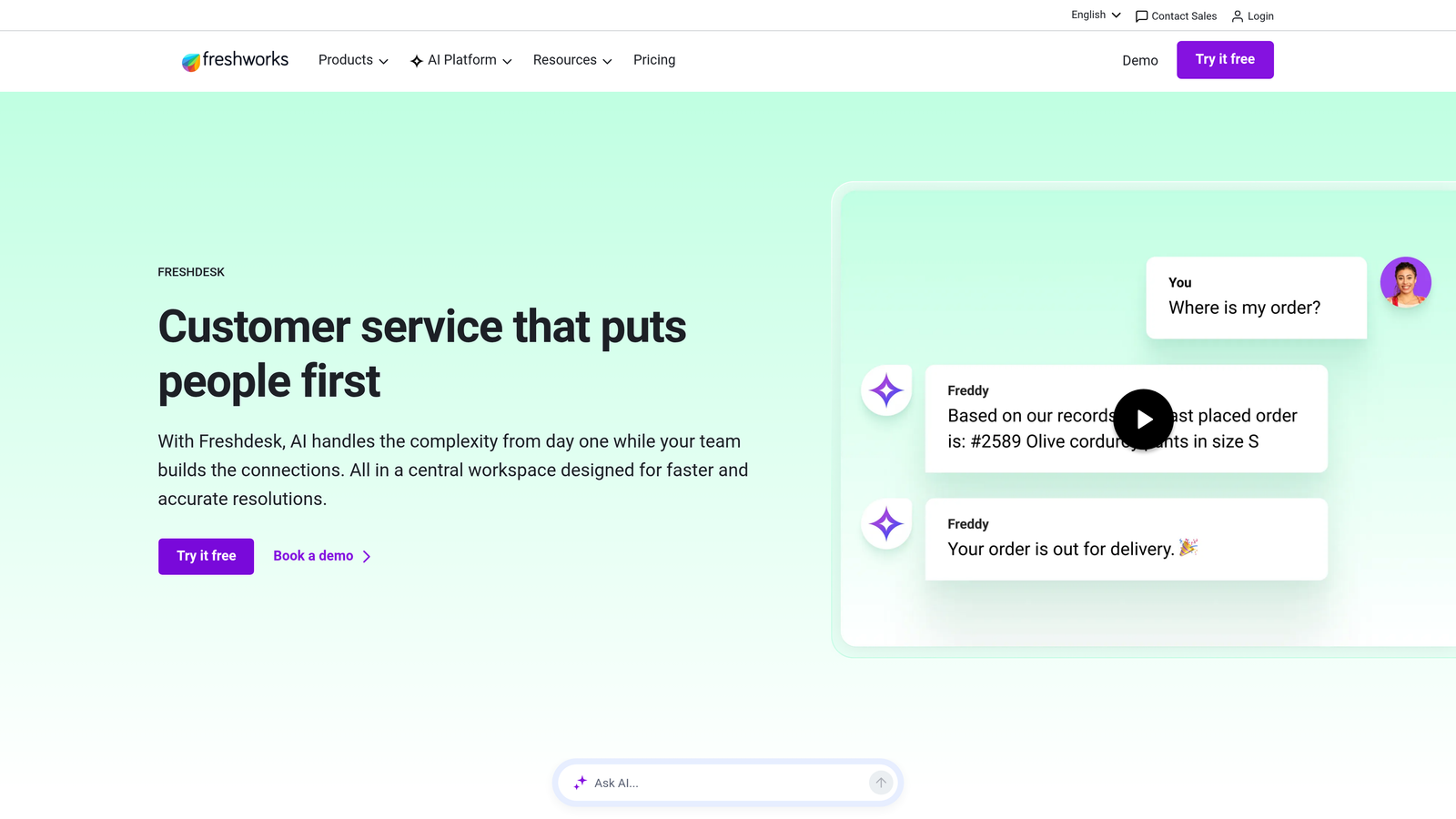
Freshdesk is a cloud-based helpdesk platform featuring Freddy AI, which provides auto-triage, response suggestions, and self-service bot capabilities at a more accessible price point than enterprise alternatives.
Where This Tool Shines
Freshdesk hits a practical sweet spot for developer tools companies in the scaling phase: more capable than entry-level tools, more affordable than Zendesk or Intercom at comparable feature tiers. Freddy AI handles the foundational AI tasks well, including automatic ticket categorization, priority assignment, and surfacing relevant knowledge base articles for agents.
The Freddy Self Service bot can deflect a meaningful portion of common queries, which is valuable for lean teams. The Jira and Slack integrations are solid, though the depth of engineering workflow integration is more limited compared to tools built specifically for developer-first companies.
Key Features
Freddy AI Triage: Automatically categorizes and prioritizes incoming tickets based on content analysis.
Freddy Self Service: Deflects common queries before they become tickets using your documentation.
Agent Assist: Surfaces suggested responses and relevant knowledge base content for human agents.
Omnichannel Support: Handles email, chat, phone, and social from a unified inbox.
Developer Tool Integrations: Marketplace connections with Slack, Jira, and other common developer tools.
Best For
Seed to Series B developer tools companies scaling their first real support operation and looking for a capable, affordable platform that won't require a dedicated support ops team to maintain.
Pricing
Free plan available; paid plans from approximately $15/agent/month; Freddy AI add-ons from approximately $29/agent/month.
5. Plain
Best for: API-first and developer-first companies that want a support platform that feels like it was built by engineers, for engineers.
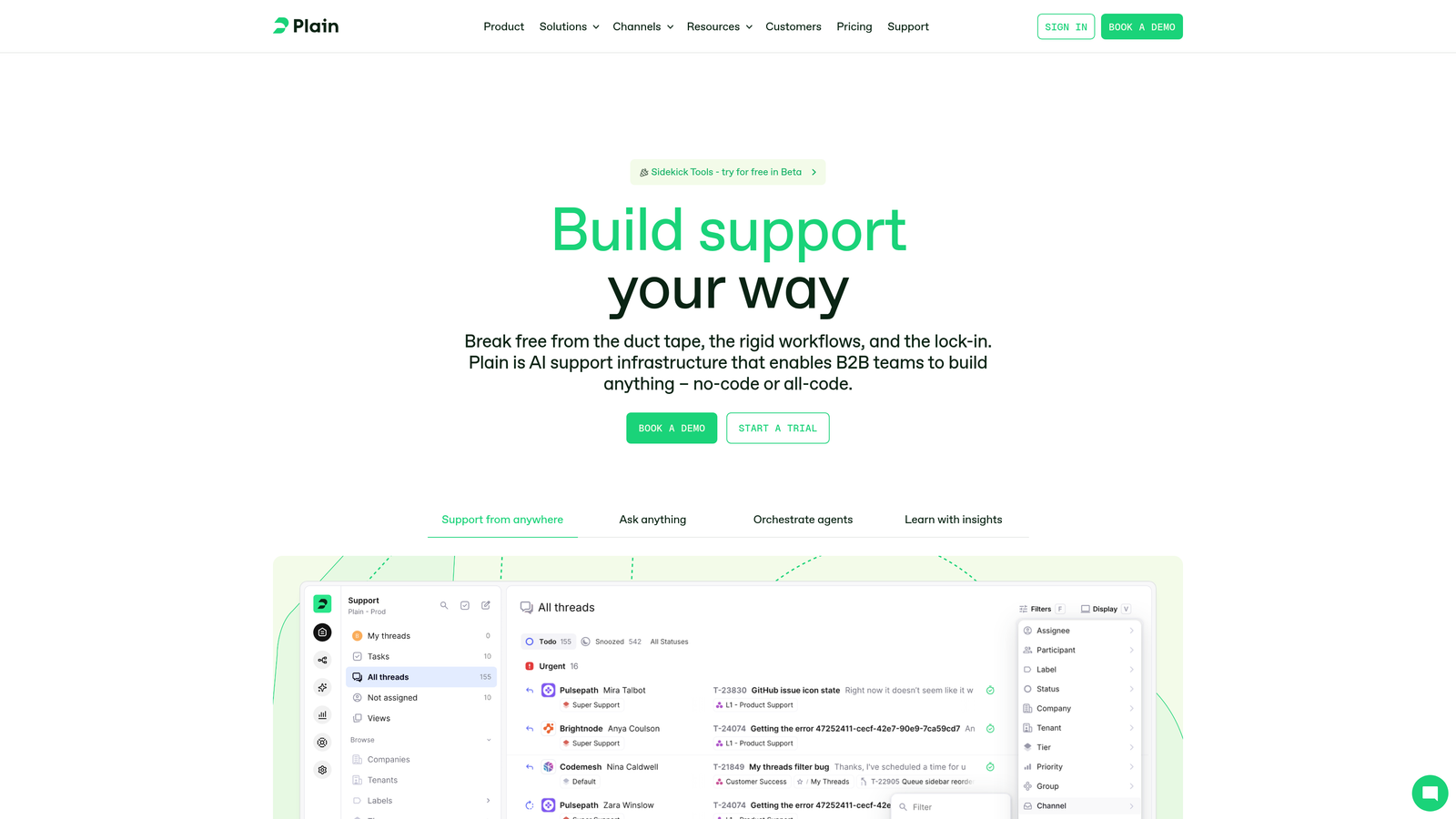
Plain is a developer-first support platform built API-first with Slack-native workflows, designed to feel like a natural extension of a technical team's stack rather than a traditional helpdesk bolted on from the outside.
Where This Tool Shines
Plain is genuinely different from most tools on this list. It was designed from the ground up for technical teams, which means the architecture itself reflects how developer tools companies actually work. Support threads sync natively with Slack, tickets can be created programmatically via API, and custom UI components let you embed rich product context directly into support views.
For small, technical support teams at API-first companies, Plain can feel refreshingly lightweight. It removes the overhead of traditional helpdesk UX and lets your team focus on the conversation rather than the platform. It's still a relatively newer player, but it's gaining real traction in the developer tools segment specifically.
Key Features
API-First Architecture: Deep custom integration with your product via a well-documented API, enabling programmatic ticket creation and data enrichment.
Slack-Native Threads: Support conversations sync directly with your Plain workspace, keeping technical teams in their natural environment.
Custom UI Components: Embed rich context from your product directly into support views, giving agents full situational awareness.
Developer-Optimized Triage: Routing and prioritization designed for small, technical teams rather than large enterprise support operations.
Webhooks and Programmatic Workflows: Build custom support automation using webhooks and developer-friendly tooling.
Best For
Early to mid-stage API-first and developer tools companies with small technical support teams who want a platform that integrates deeply with their product and engineering workflows without traditional helpdesk overhead.
Pricing
Starts at approximately $200/month. See plain.com for current plan details.
6. Unthread
Best for: Developer tools companies whose customers live in Slack and don't want to force them into a separate support portal.
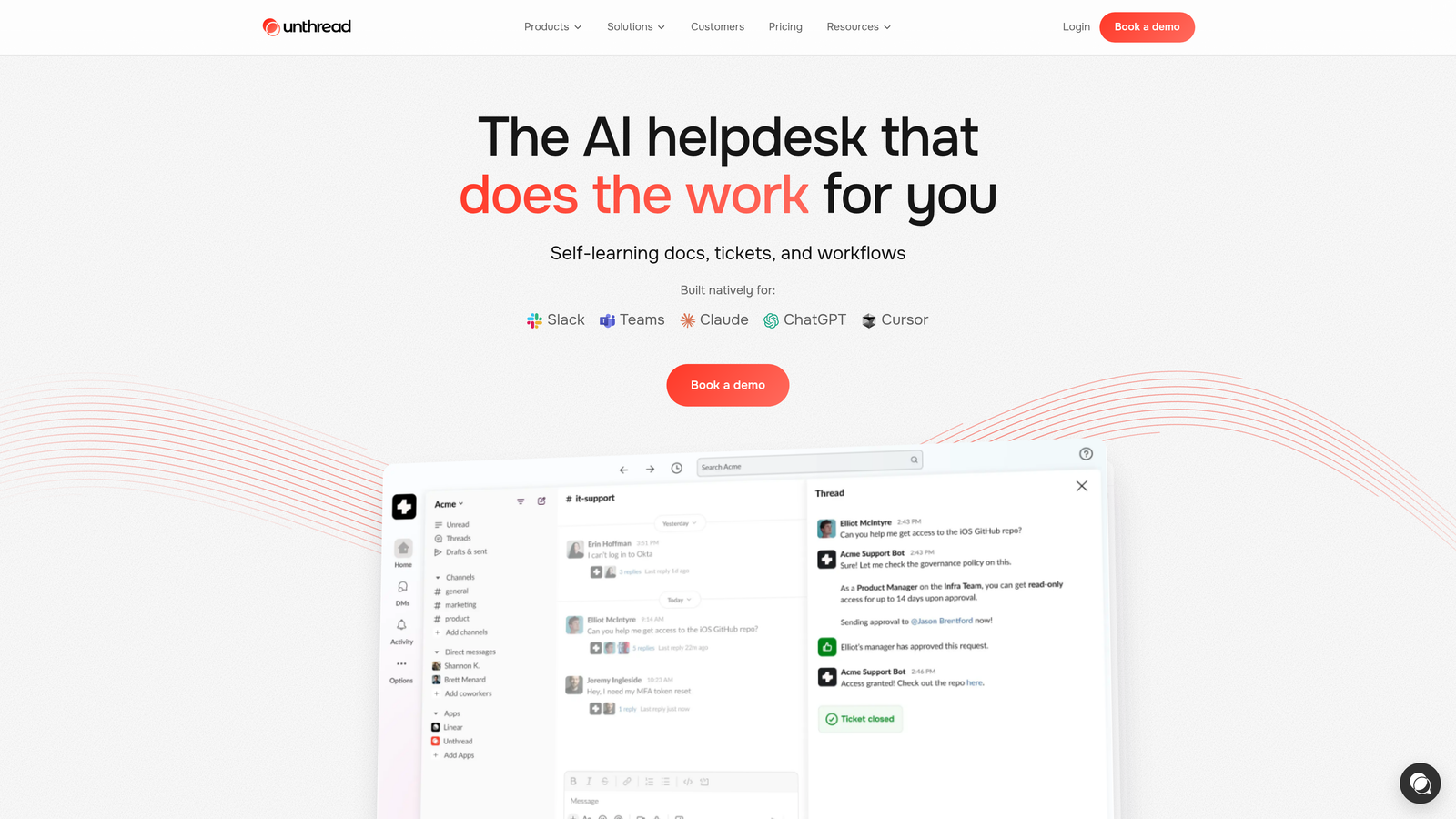
Unthread turns Slack into a fully trackable support system, converting conversations into tickets with AI-assisted response suggestions and SLA tracking built directly into the Slack environment.
Where This Tool Shines
In the B2B developer tools world, many customer relationships live in shared Slack channels. Unthread recognizes this reality and leans into it rather than fighting it. Instead of asking customers to log into a separate portal, Unthread converts Slack threads into tracked tickets automatically, with AI suggesting responses based on previous conversations and your documentation.
The integrations with Linear, Jira, GitHub, and Notion make it a natural fit for developer tools stacks. For teams where the alternative is managing support through a chaotic mix of Slack channels and spreadsheets, Unthread provides structure without forcing a platform change on customers.
Key Features
Automatic Slack Ticket Creation: Converts Slack threads into tracked support tickets without requiring customers to use a separate portal.
AI-Suggested Replies: Recommends responses based on previous conversations and connected documentation.
SLA Tracking in Slack: Monitors response times and triggers escalation alerts directly within your Slack workspace.
Performance Reporting: Tracks response times, ticket volume, and team performance without leaving the Slack ecosystem.
Engineering Integrations: Connects with Linear, Jira, GitHub, and Notion for seamless bug routing and issue tracking.
Best For
Developer tools companies with shared Slack channels for customer support, particularly those with enterprise customers who prefer Slack-based communication over traditional ticketing portals.
Pricing
Starts at approximately $50/month. See unthread.io for current pricing tiers.
7. Forethought
Best for: Teams with an existing helpdesk investment that want to layer AI triage and deflection on top without switching platforms.
Forethought is an AI triage and deflection layer that sits on top of existing helpdesks like Zendesk and Salesforce Service Cloud, using a SupportGPT model trained specifically on support conversation data.
Where This Tool Shines
Forethought's key advantage is that it doesn't require you to rip and replace your existing helpdesk. If your team is already established on Zendesk or Salesforce, Forethought adds a meaningful AI layer on top: smarter triage, better deflection before tickets are created, and an agent copilot that surfaces contextual suggestions in real time.
The SupportGPT model is trained specifically on support language patterns rather than general web data, which gives it stronger performance on support-specific queries. For developer tools companies with large existing knowledge bases and established helpdesk workflows, Forethought can improve resolution rates without requiring a platform migration.
Key Features
SupportGPT Model: Trained specifically on support conversation patterns, not just general language data, for stronger support-specific performance.
Triage AI: Automatically routes, tags, and prioritizes incoming tickets based on content and intent.
Solve AI: Deflects queries autonomously before they become tickets, reducing overall ticket volume.
Assist AI: Agent copilot that surfaces contextual response suggestions during live conversations.
Helpdesk Overlay: Works on top of Zendesk, Salesforce, and other major helpdesks rather than replacing them.
Best For
Developer tools companies already invested in Zendesk or Salesforce Service Cloud that want to improve AI capabilities without a full platform migration. Also well-suited for teams with large, mature knowledge bases that can power strong deflection rates.
Pricing
Custom pricing. Contact Forethought directly for a quote based on your volume and use case.
8. Drift (Salesloft)
Best for: Product-led growth developer tools companies where support conversations frequently overlap with expansion and sales opportunities.
Drift, now part of Salesloft, is a conversational AI platform that blends support and sales conversations, making it particularly relevant for PLG developer tools companies where a support interaction can surface a meaningful revenue opportunity.
Where This Tool Shines
Drift's positioning is distinct from pure support tools: it's designed to blur the line between support and revenue. For developer tools companies operating a product-led growth motion, this matters. A developer hitting a wall on a paid feature is also a potential expansion conversation. Drift's playbooks and routing logic can handle both in the same chat flow.
That said, Drift is less focused on pure support automation than most tools on this list. If your primary goal is autonomous ticket resolution and engineering workflow integration, other options will serve you better. But if you want support and sales to work from the same conversational layer, Drift is worth evaluating seriously.
Key Features
Conversational AI: Qualifies, routes, and responds to both support and sales queries from a unified chat interface.
Meeting Scheduling: Books demos and meetings directly within chat flows, connecting support conversations to sales pipeline.
Playbooks: Automates common support and sales conversation paths with customizable branching logic.
CRM and Marketing Integrations: Connects with Salesforce, HubSpot, Marketo, and Slack for full revenue context.
Revenue Intelligence Reporting: Links conversation data to pipeline and revenue outcomes.
Best For
PLG developer tools companies where support and sales motions overlap significantly, and where the team wants a single conversational layer that can handle both without context switching.
Pricing
Custom pricing. Contact Drift or Salesloft directly for current plan details.
9. Tidio
Best for: Early-stage or bootstrapped developer tools companies that need functional AI chat support without significant upfront investment.
Tidio is an accessible AI chat platform featuring the Lyro AI chatbot with live agent hybrid capabilities, offering a practical entry point for smaller developer tools companies building their first support operation.
Where This Tool Shines
Tidio's primary advantage is accessibility. The setup is straightforward, the pricing is transparent, and Lyro AI can start deflecting common queries quickly using your existing documentation. For an indie SaaS founder or a small team that doesn't yet need enterprise-grade support infrastructure, Tidio removes the friction of getting started.
The live chat fallback with seamless handoff to human agents is well-implemented for a platform at this price point. The trade-off is technical depth: Tidio isn't purpose-built for developer tools companies, and its ability to handle complex API errors, code-level debugging questions, or engineering workflow integration is more limited than specialized tools higher on this list.
Key Features
Lyro AI Chatbot: Resolves queries autonomously using your help content, with natural language understanding for common support scenarios.
Live Chat Fallback: Seamless handoff to human agents when Lyro reaches the limits of its knowledge or confidence.
Visual Chatbot Builder: Creates custom conversation flows without requiring engineering resources.
Multi-Channel Support: Handles email and Messenger alongside live chat from a unified interface.
Analytics Dashboard: Tracks resolution rates, satisfaction scores, and conversation volume in a simple reporting view.
Best For
Early-stage, indie, or bootstrapped developer tools companies that need a functional AI chat solution quickly and affordably, and where support volume doesn't yet justify a more complex platform investment.
Pricing
Free plan available; Lyro AI from approximately $29/month. See tidio.com for current tier details.
Choosing the Right Tool for Your Stage and Stack
The right customer support AI for a developer tools company depends heavily on where you are, how your customers communicate, and what your engineering workflow looks like. Here's a quick-reference view of how these tools map to different situations.
For autonomous resolution with engineering workflow integration: Halo AI is the strongest fit for developer tools companies that want AI agents resolving tickets independently, routing bugs to Linear automatically, and surfacing business intelligence from every support interaction. It's built for this use case specifically, not adapted from a general-purpose platform.
For teams already on Intercom or Zendesk: If you're deeply embedded in either ecosystem, Intercom's Fin agent or Forethought as an AI overlay are the path of least resistance. Switching platforms carries real cost, and both options deliver meaningful AI capability without requiring migration.
For Slack-first customer relationships: Unthread is the natural choice when your B2B customers live in shared Slack channels. It brings structure and AI assistance to where the conversations are already happening, rather than asking customers to change their behavior.
For developer-native teams that want a platform that feels like a developer tool: Plain is worth a serious look, particularly for API-first companies with small technical support teams who value architectural elegance over feature breadth.
For early-stage teams on a tight budget: Freshdesk with Freddy AI or Tidio both offer functional AI support at accessible price points. Freshdesk scales better as your operation grows; Tidio is the faster, simpler starting point.
For PLG companies where support and sales overlap: Drift's conversational AI approach makes sense when you want a single layer handling both support queries and expansion conversations.
Your support team shouldn't scale linearly with your customer base. Let AI agents handle routine tickets, guide users through your product, and surface business intelligence while your team focuses on complex issues that need a human touch. See Halo in action and discover how continuous learning transforms every interaction into smarter, faster support.