9 Best Customer Support AI Tools for Healthcare Software in 2026
Healthcare software companies face uniquely high-stakes support demands, and this guide evaluates the 9 best customer support AI for healthcare software tools in 2026 — ranked on HIPAA compliance readiness, integration depth, and the ability to handle nuanced clinical and billing queries without sacrificing speed or accuracy.
 Matt PattoliFounder15 min read
Healthcare software companies operate in one of the most demanding support environments in B2B SaaS. Your users aren't just frustrated customers — they're clinicians mid-shift, billing administrators under audit pressure, and patients navigating unfamiliar interfaces. A slow response or an inaccurate answer doesn't just create a bad experience; it can disrupt care delivery.
At the same time, support teams are stretched thin, ticket volumes keep climbing, and simply hiring more agents isn't a sustainable answer. AI-powered customer support has matured significantly, and several tools are now well-adapted for the healthcare software context: handling HIPAA-sensitive conversations, integrating with complex tech stacks, and resolving issues without human intervention.
This guide covers the top customer support AI tools for healthcare software companies in 2026, evaluated on intelligence, compliance readiness, integration depth, and the ability to handle nuanced health tech queries. Whether you're running an EHR platform, a telehealth app, or a healthcare SaaS product, there's a solution here for your team.
A note on compliance: HIPAA compliance posture, BAA availability, and data handling policies evolve. Always verify directly with vendors before deploying any AI support tool in a healthcare context.
1. Halo AI
Best for: Healthcare software teams wanting an AI-first support platform with deep product context and business intelligence
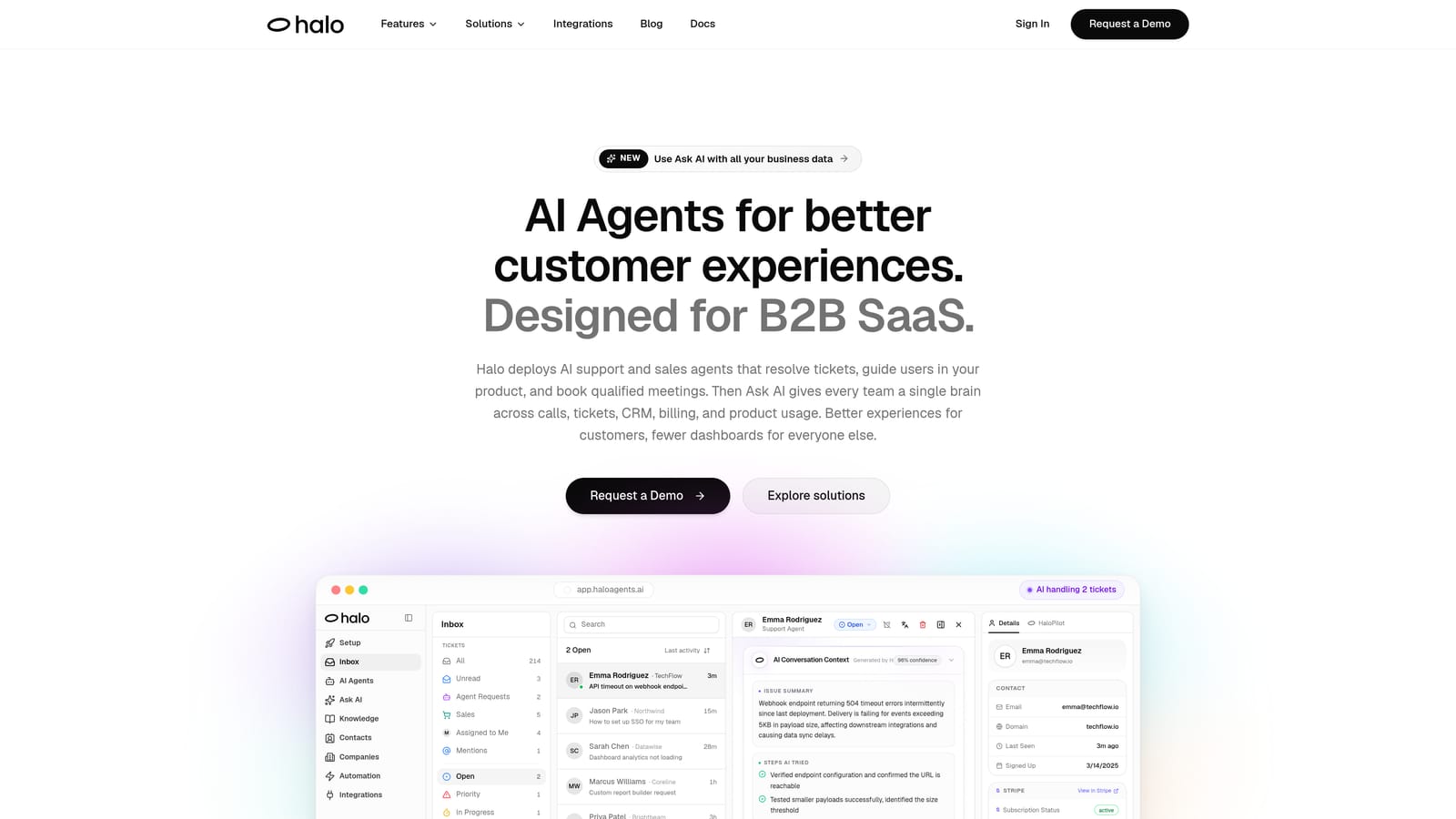
Halo AI is an AI-native customer support platform that deploys intelligent agents to resolve tickets, guide users through complex product workflows, and surface business intelligence — continuously learning from every interaction.
Where This Tool Shines
What sets Halo apart in the healthcare software context is its page-aware architecture. The AI agent can see what page or state a user is currently on within your product, delivering contextually relevant guidance rather than generic help article links. For complex healthcare software interfaces — think multi-step EHR workflows or billing configuration screens — this is a meaningful difference.
Halo is also built AI-first, not as a feature layer added onto an existing helpdesk. That architecture means the intelligence runs deeper: agents learn from every resolved ticket, adapt to your evolving product, and escalate gracefully to human agents when a query warrants it. The smart inbox goes beyond standard support metrics, surfacing customer health signals and anomaly detection that give your team early warning on at-risk accounts.
Key Features
Page-Aware Chat Widget: The AI sees what users see in real time, providing contextual UI guidance that's especially valuable for complex healthcare software interfaces.
Intelligent Ticket Resolution: AI agents resolve tickets autonomously with smooth human handoff for complex or sensitive cases requiring judgment.
Auto Bug Ticket Creation: When users report product issues, Halo automatically generates structured bug reports in Linear — removing a manual step from your engineering workflow.
Smart Inbox with Business Intelligence: Surfaces customer health signals, revenue intelligence, and anomaly detection beyond standard support metrics.
Deep Integration Stack: Connects with Linear, Slack, HubSpot, Intercom, Stripe, Zoom, PandaDoc, and Fathom for a unified operational picture.
Best For
Healthcare software companies that want an AI-native platform rather than AI features bolted onto an existing helpdesk. Particularly strong for product teams managing complex interfaces where contextual guidance reduces user confusion and support volume simultaneously. Verify HIPAA and BAA status directly with Halo AI before deployment.
Pricing
Contact for pricing. Visit haloagents.ai to learn more and request a demo.
2. Intercom
Best for: Healthcare software teams wanting omnichannel AI support with a mature messaging platform
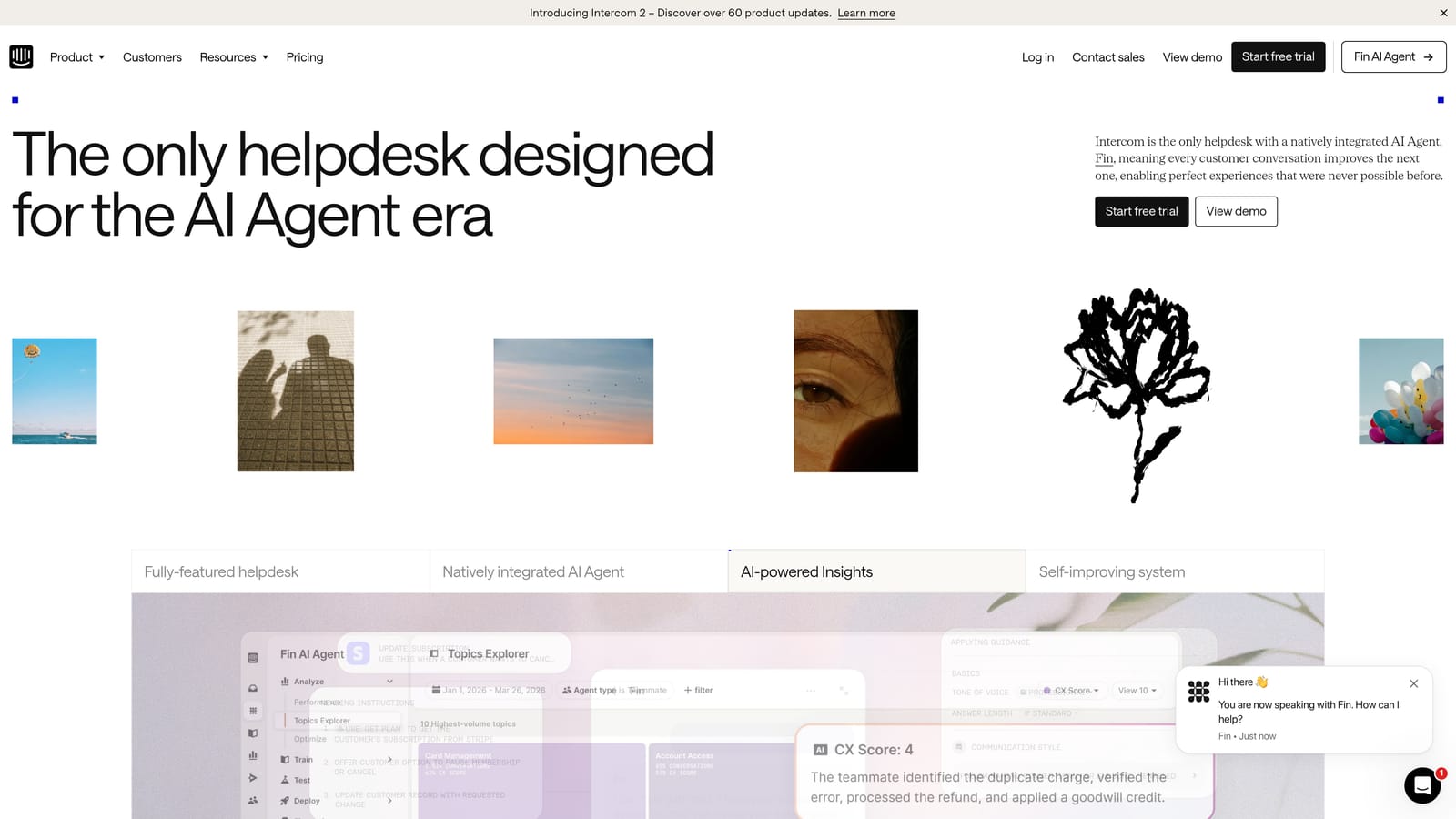
Intercom is a leading customer messaging platform featuring Fin, its AI agent built on large language models, capable of resolving support queries from a custom knowledge base across chat, email, and more.
Where This Tool Shines
Fin's ability to train on your existing knowledge base, help documentation, and past conversations means healthcare software companies can get meaningful deflection without rebuilding their content from scratch. The omnichannel coverage is genuinely broad, and the Messenger SDK makes it straightforward to embed support into both web applications and mobile apps — relevant for telehealth platforms serving patients directly.
Intercom's integration marketplace is extensive, and its conversation analytics give support leaders visibility into resolution rates, CSAT, and topic trends. For teams already invested in the Intercom ecosystem, adding Fin AI is a natural evolution rather than a platform migration.
Key Features
Fin AI Agent: Trained on your knowledge base, help docs, and past conversations to resolve queries without human intervention.
Omnichannel Inbox: Covers chat, email, and social channels in a unified workspace.
Messenger SDK: Embeds support in web and mobile applications — valuable for patient-facing telehealth products.
Integration Marketplace: Large ecosystem with many SaaS and healthcare-adjacent tool connections.
Conversation Analytics: Detailed CSAT tracking and resolution metrics for support leaders.
Best For
Healthcare software teams already using Intercom for messaging who want to layer in AI resolution without switching platforms. Also strong for telehealth companies needing mobile-embedded support. Verify BAA availability and HIPAA compliance posture directly with Intercom before deploying in a PHI-adjacent context.
Pricing
Usage-based pricing; base plans start at approximately $39/seat/month. Fin AI resolution fees apply separately and can scale significantly at higher volumes.
3. Zendesk AI
Best for: Enterprise healthcare software teams already on Zendesk needing AI-enhanced triage and routing
Zendesk AI is an enterprise-grade helpdesk platform with AI capabilities including intelligent triage, intent detection, smart routing, and suggested replies — built into one of the most mature support infrastructures available.
Where This Tool Shines
Zendesk's strength is its depth of infrastructure. For healthcare software companies managing high ticket volumes across multiple product lines or customer segments, the AI triage and intent detection capabilities can meaningfully reduce the time tickets spend in the wrong queue. Intelligent routing ensures complex clinical workflow questions reach your most experienced agents, while simpler account queries get handled by automation.
Zendesk has published HIPAA compliance documentation and offers BAAs for qualifying plans, which gives it a compliance baseline that many newer AI tools haven't established yet. The Zendesk Marketplace also includes healthcare-specific integrations that can extend the platform's usefulness in health tech environments.
Key Features
AI Triage and Intent Detection: Routes tickets to the right team or automation based on content and context.
Intelligent Suggested Replies: Helps agents respond faster with AI-drafted responses surfaced in-inbox.
AI Thread Summarization: Condenses long ticket histories so agents get context quickly without reading everything.
Healthcare Integrations: Zendesk Marketplace includes healthcare-specific tool connections.
HIPAA Compliance: BAA available on qualifying plans — verify current terms directly with Zendesk.
Best For
Enterprise healthcare software teams already operating on Zendesk who want to enhance their existing workflows with AI rather than migrate platforms. Less compelling as a greenfield choice for teams starting fresh.
Pricing
Suite plans start at approximately $55/agent/month. AI add-ons are priced separately — factor this into total cost of ownership.
4. Freshdesk Freddy AI
Best for: Healthcare software startups and growth-stage companies needing capable AI support at a lower price point
Freshdesk's Freddy AI suite covers self-service chatbots, agent copilot assistance, and analytics insights — offering a cost-effective entry point for healthcare software companies earlier in their growth journey.
Where This Tool Shines
Freddy's three-layer architecture is well-designed for teams that want AI across the full support lifecycle without enterprise-level spend. Freddy Self Service handles deflection, Freddy Copilot assists human agents in-inbox, and Freddy Insights surfaces trends in support data. For a healthcare software startup managing a lean support team, having all three capabilities under one roof at accessible pricing is genuinely useful.
Freshworks has published HIPAA compliance information, though BAA availability varies by plan tier — a detail worth confirming before deployment. The multi-channel coverage across email, chat, phone, and social also means you're not locked into a single support surface.
Key Features
Freddy Self Service: AI chatbot for ticket deflection and FAQ resolution without human involvement.
Freddy Copilot: In-inbox assistant that suggests replies and summarizes tickets for human agents.
Freddy Insights: AI-driven analytics surfacing trends and anomalies in support data.
Multi-Channel Support: Covers email, chat, phone, and social channels from a single platform.
HIPAA Features: Available on certain plans — verify BAA availability for your specific tier before deployment.
Best For
Healthcare software startups and growth-stage companies that need capable AI support across multiple channels without enterprise pricing. Also a good fit for teams that want agent assist and self-service in a single platform without managing separate tools.
Pricing
Free plan available; paid plans start at approximately $15/agent/month. Freddy AI features unlock on higher tiers — review plan details carefully to understand which Freddy capabilities you're getting.
5. Salesforce Agentforce
Best for: Enterprise healthcare software companies already in the Salesforce ecosystem needing CRM-native AI agents
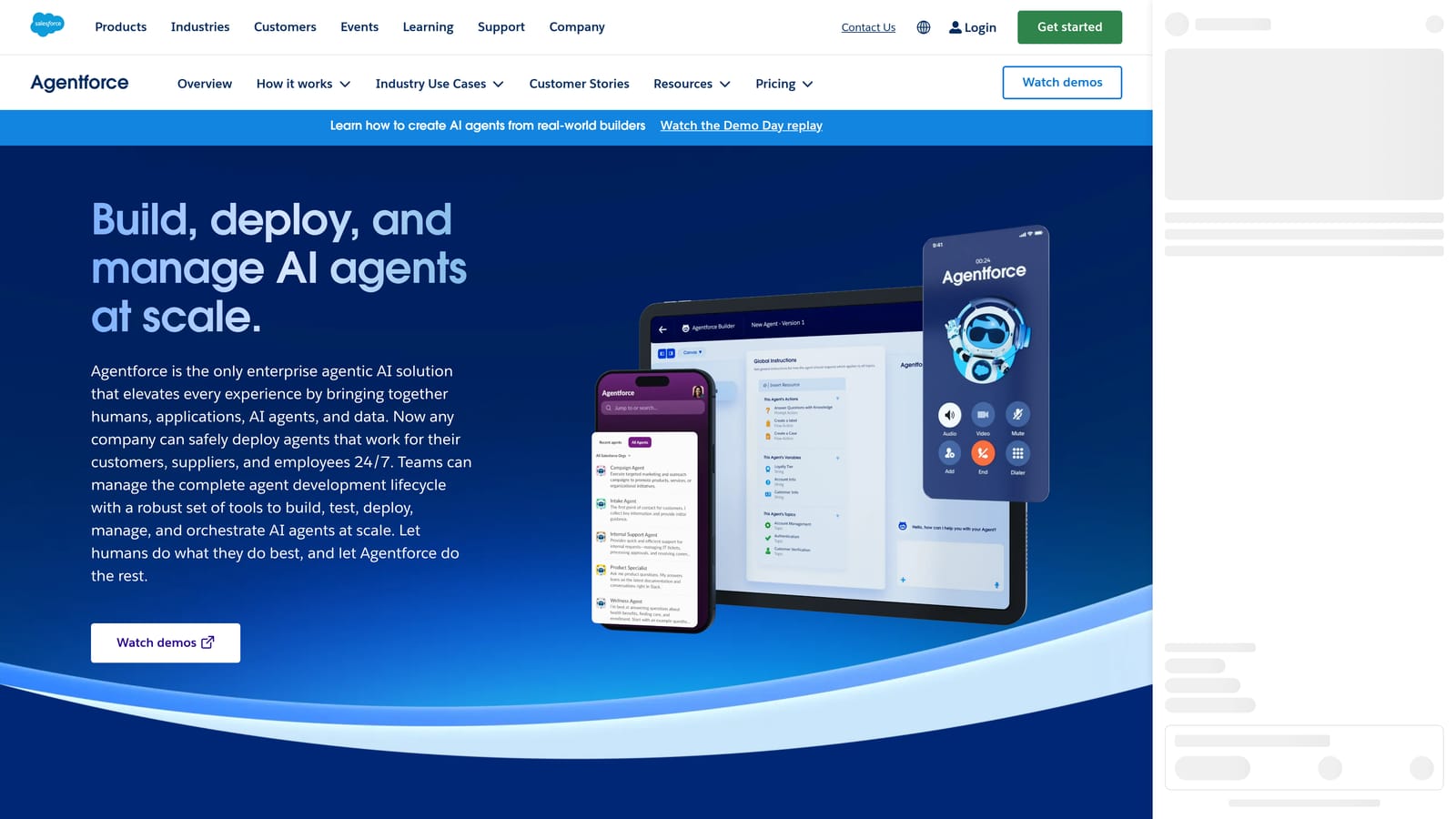
Salesforce Agentforce is Salesforce's autonomous AI agent platform that operates with full CRM context — account history, contracts, case data — making it a powerful option for large healthcare software organizations already running on Salesforce.
Where This Tool Shines
The core differentiator here is context depth. Agentforce agents don't just answer questions from a knowledge base — they operate with full visibility into Salesforce CRM and Health Cloud data, meaning they can reference a customer's contract history, open cases, and account health in a single interaction. For enterprise healthcare software companies where support queries frequently touch billing, licensing, or implementation status, that context changes the quality of every response.
Salesforce also has well-established HIPAA compliance credentials, including BAA availability — a meaningful advantage for health tech enterprises navigating procurement and security reviews. The tradeoff is implementation complexity and cost, which makes Agentforce a better fit for organizations with existing Salesforce infrastructure than for teams starting from scratch.
Key Features
CRM-Native AI Agents: Full access to Salesforce CRM and Health Cloud data for deeply contextualized responses.
Service Cloud Integration: Enterprise-grade ticket management built into the same platform.
Customizable Agent Actions: Agents can execute workflows and trigger integrations, not just retrieve answers.
HIPAA Compliance: Strong credentials with BAA availability — verify current terms with Salesforce.
Einstein Analytics: AI-powered analytics embedded across the platform for support and business insights.
Best For
Large healthcare software enterprises already operating on Salesforce that want AI agents with full CRM context. High implementation complexity makes this less suitable for smaller teams or those without existing Salesforce investment.
Pricing
Agentforce starts at approximately $2/conversation. Requires existing Salesforce licenses — enterprise pricing applies and total cost can be significant.
6. Ada
Best for: Enterprise healthcare software teams needing governance-heavy AI with action-oriented agents and brand safety controls
Ada is a no-code AI agent platform built for enterprise teams that need strong governance, brand safety controls, and action-oriented AI — not just Q&A retrieval — making it well-suited for regulated industries including healthcare software.
Where This Tool Shines
Ada's emphasis on governance and brand safety is directly relevant to healthcare software companies concerned about AI providing clinically inappropriate or misleading information. The platform gives non-technical teams meaningful control over what agents can and cannot say, how they escalate, and what actions they're permitted to take. In a context where an AI saying the wrong thing carries real risk, that level of control matters.
The no-code builder also means clinical operations or product teams can update agent flows without engineering involvement — a practical advantage when healthcare regulations or product workflows change frequently. Ada's action-oriented architecture means agents can process requests and trigger integrations rather than simply retrieving static answers.
Key Features
Action-Oriented AI Agents: Execute workflows and trigger integrations rather than just answering questions from static content.
No-Code Builder: Non-technical teams can create and update AI agent flows without engineering support.
Governance and Brand Safety Controls: Fine-grained controls over AI behavior — critical for clinically sensitive contexts.
Multi-Language Support: Serves diverse patient and provider user bases across languages.
Helpdesk Integrations: Connects with Zendesk, Salesforce, and other major platforms.
Best For
Enterprise healthcare software companies where AI governance, brand safety, and clinical accuracy guardrails are non-negotiable requirements. Also strong for teams with non-technical staff who need to manage and update AI flows independently. Verify HIPAA and BAA status directly with Ada.
Pricing
Custom enterprise pricing. Contact Ada directly for a quote based on your volume and requirements.
7. Forethought
Best for: Healthcare software support teams where human judgment is still central and agents need AI-powered efficiency
Forethought is an AI platform focused on triage and agent assist — routing tickets with context and helping human agents respond faster — making it a strong fit for healthcare software teams where many queries still require human judgment.
Where This Tool Shines
Not every healthcare software support ticket is a candidate for full AI deflection. Integration failures, clinical workflow questions, and compliance queries often need a human in the loop. Forethought is designed for exactly this reality: its Triage AI routes incoming tickets with contextual summaries to the right agent or queue, while its Assist AI drafts suggested responses to speed up human resolution. The result is a faster human-assisted workflow rather than a push toward full automation.
For teams that have tried aggressive AI deflection and found it creates more problems than it solves in a healthcare context, Forethought's human-in-the-loop philosophy is a more measured approach. Its native integrations with Zendesk, Salesforce, and Freshdesk mean it can layer onto your existing helpdesk without a platform change.
Key Features
Triage AI: Routes incoming tickets with contextual summaries to the right agent or queue automatically.
Assist AI: Drafts suggested responses in-inbox to accelerate human agent resolution time.
Solve AI: Self-service deflection for common queries that don't require human involvement.
Native Helpdesk Integrations: Works within Zendesk, Salesforce, Freshdesk, and other major platforms.
Analytics Dashboard: Tracks deflection rates, resolution time, and agent productivity in one view.
Best For
Healthcare software support teams managing high complexity ticket volumes where human agents remain central to resolution. Strong choice for organizations that want AI to make their existing team more efficient rather than replace the human layer entirely. Verify HIPAA compliance posture directly with Forethought.
Pricing
Custom pricing based on volume and feature selection. Contact Forethought directly for a quote.
8. Drift (Salesloft)
Best for: Healthcare software companies where support conversations frequently surface expansion or upsell opportunities
Drift, now part of Salesloft, is a conversational AI platform that blends support and sales interactions in a single chat layer — useful for healthcare software companies where support conversations regularly reveal commercial signals.
Where This Tool Shines
Drift occupies a distinct position in this list: it's less a pure support AI tool and more a revenue-aware conversation platform. For healthcare software companies where a support chat about billing or feature limitations frequently turns into a conversation about upgrading or expanding, Drift's ability to identify those signals and route accordingly is genuinely valuable. The Bionic Chatbots feature combines AI with human handoff for nuanced conversations that don't fit neatly into either sales or support categories.
The built-in meeting scheduling capability is also worth noting for healthcare software companies where complex issues often need to be resolved on a call. Rather than asking users to navigate to a separate scheduling tool, Drift surfaces that option directly within the chat interaction.
Key Features
AI-Powered Chat: Handles support queries and routes sales-ready conversations simultaneously in one interface.
Bionic Chatbots: Combines AI and human handoff for conversations that require nuanced judgment.
Revenue Intelligence: Identifies upsell and expansion signals within support interactions.
CRM and Marketing Integrations: Connects with Salesforce, HubSpot, Marketo, and other major platforms.
In-Chat Meeting Scheduling: Useful for onboarding calls and complex issue resolution without leaving the conversation.
Best For
Healthcare software companies where the line between support and sales is blurry — particularly those with usage-based or expansion-driven revenue models where support conversations frequently signal commercial opportunities. Note that post-Salesloft acquisition, product direction continues to evolve — verify the current feature set directly with the team.
Pricing
Custom pricing following the Salesloft acquisition. Contact Drift directly for current plans and packaging.
9. HubSpot Service Hub AI
Best for: Healthcare software companies already running HubSpot CRM who want unified support and customer data
HubSpot Service Hub with Breeze AI provides ticket summarization, chatbot flows, and suggested replies — all unified with HubSpot CRM data, making it the natural choice for healthcare software companies already in the HubSpot ecosystem.
Where This Tool Shines
The primary advantage here is data unification. When your AI support tool shares a data layer with your CRM, agents and AI alike have full context: deal history, contact records, recent activity, and open issues in a single view. For healthcare software companies where support queries often touch account-level questions about licensing, implementation status, or renewal timelines, that context eliminates the back-and-forth that frustrates users and slows resolution.
Breeze AI's ticket summarization is also a practical time-saver for support teams managing long, complex threads — a common reality in healthcare software where an issue might involve multiple stakeholders and a detailed technical history before it reaches resolution.
Key Features
Breeze AI: Powers ticket summarization, suggested replies, and chatbot conversation flows within Service Hub.
CRM Unification: AI agents operate with full HubSpot CRM context including deal history and contact data.
Knowledge Base Builder: AI-assisted content suggestions help teams build and maintain self-service resources.
Customer Portal: Self-service ticket tracking for customers without requiring agent involvement.
HIPAA Compliance: Available on certain plans — verify current availability and BAA terms directly with HubSpot.
Best For
Healthcare software companies already using HubSpot as their CRM who want to extend AI capabilities into support without adopting a separate platform. Less compelling for teams not already in the HubSpot ecosystem, where the CRM unification advantage doesn't apply. Note that Breeze AI has a lower ceiling for complex autonomous agent behavior compared to dedicated AI-first platforms.
Pricing
Service Hub Starter from approximately $15/seat/month. Professional and Enterprise tiers required for full AI feature access — review plan details before committing.
Choosing the Right Tool for Your Healthcare Software Team
Healthcare software support has higher stakes than most SaaS verticals. Compliance matters. Accuracy matters. User trust — from clinicians who need reliable answers fast to patients navigating unfamiliar workflows — matters enormously. The right AI support tool isn't just the one with the best deflection rate; it's the one that handles sensitive conversations responsibly, integrates with your existing stack, and keeps learning as your product evolves.
Here's a quick reference for matching tool to use case:
AI-first architecture with continuous learning: Halo AI — built from the ground up for intelligent support, not retrofitted onto a legacy helpdesk.
Enterprise helpdesk with AI layers: Zendesk AI — best for teams already on Zendesk who want AI-enhanced triage and routing without migration.
Established messaging platform: Intercom — strong for omnichannel coverage and teams wanting Fin AI within a mature messaging infrastructure.
CRM-native for Salesforce shops: Salesforce Agentforce — unmatched context depth for enterprises already running Health Cloud and Service Cloud.
CRM-native for HubSpot shops: HubSpot Service Hub AI — natural fit for teams where CRM and support data unification is the priority.
SMB and growth-stage budget: Freshdesk Freddy AI — capable AI across the full support lifecycle at a price point that works for earlier-stage companies.
Governance-first enterprise: Ada — the strongest option when AI brand safety controls and governance are non-negotiable requirements.
Human-in-the-loop efficiency: Forethought — built for teams where human judgment remains central and AI's job is to make agents faster, not replace them.
Revenue and support combined: Drift — best when support conversations regularly surface commercial signals worth capturing.
Regardless of which tool you evaluate, prioritize vendors who are transparent about data handling, offer clear BAA terms for healthcare contexts, and demonstrate a path to continuous improvement rather than a static knowledge base. The tools that will serve healthcare software companies best in 2026 are the ones that get smarter with every interaction — not just the ones that answer questions today.
Your support team shouldn't scale linearly with your customer base. Let AI agents handle routine tickets, guide users through your product, and surface business intelligence while your team focuses on complex issues that need a human touch. See Halo in action and discover how continuous learning transforms every interaction into smarter, faster support.