9 Best Customer Support AI Tools for SaaS Companies in 2026
Discover the 9 best customer support AI for SaaS companies in 2026, evaluated specifically for technical products with high ticket volumes and constant feature updates. This guide compares autonomous AI agents that resolve tickets end-to-end, integrate with engineering and revenue tools, and improve over time—helping SaaS teams reduce churn, handle onboarding questions at scale, and choose the right solution for their team size and growth stage.
 Grant CooperFounder14 min read
SaaS companies face a support challenge that's genuinely different from other industries. Your customers are technical, your product changes constantly, and a confused user doesn't just call in frustrated — they churn. Ticket volumes spike with every new feature release, onboarding questions pile up, and your support team ends up answering the same questions hundreds of times a week.
The good news: ai customer service has matured well beyond scripted chatbots. Today's best tools deploy autonomous agents that resolve tickets end-to-end, understand product context, and surface intelligence that goes far beyond simple deflection metrics. The challenge is finding the right fit for your team's size, stack, and growth stage.
We evaluated these tools specifically through a SaaS lens: product-aware context, integration depth with engineering and revenue tools, learning loops that improve over time, and pricing that makes sense as you scale. Whether you're a two-person team looking for basic automated customer support or an enterprise org managing thousands of daily tickets, there's a tool on this list for you.
1. Halo AI
Best for: SaaS teams that want an AI-first support platform with deep product context and business intelligence.
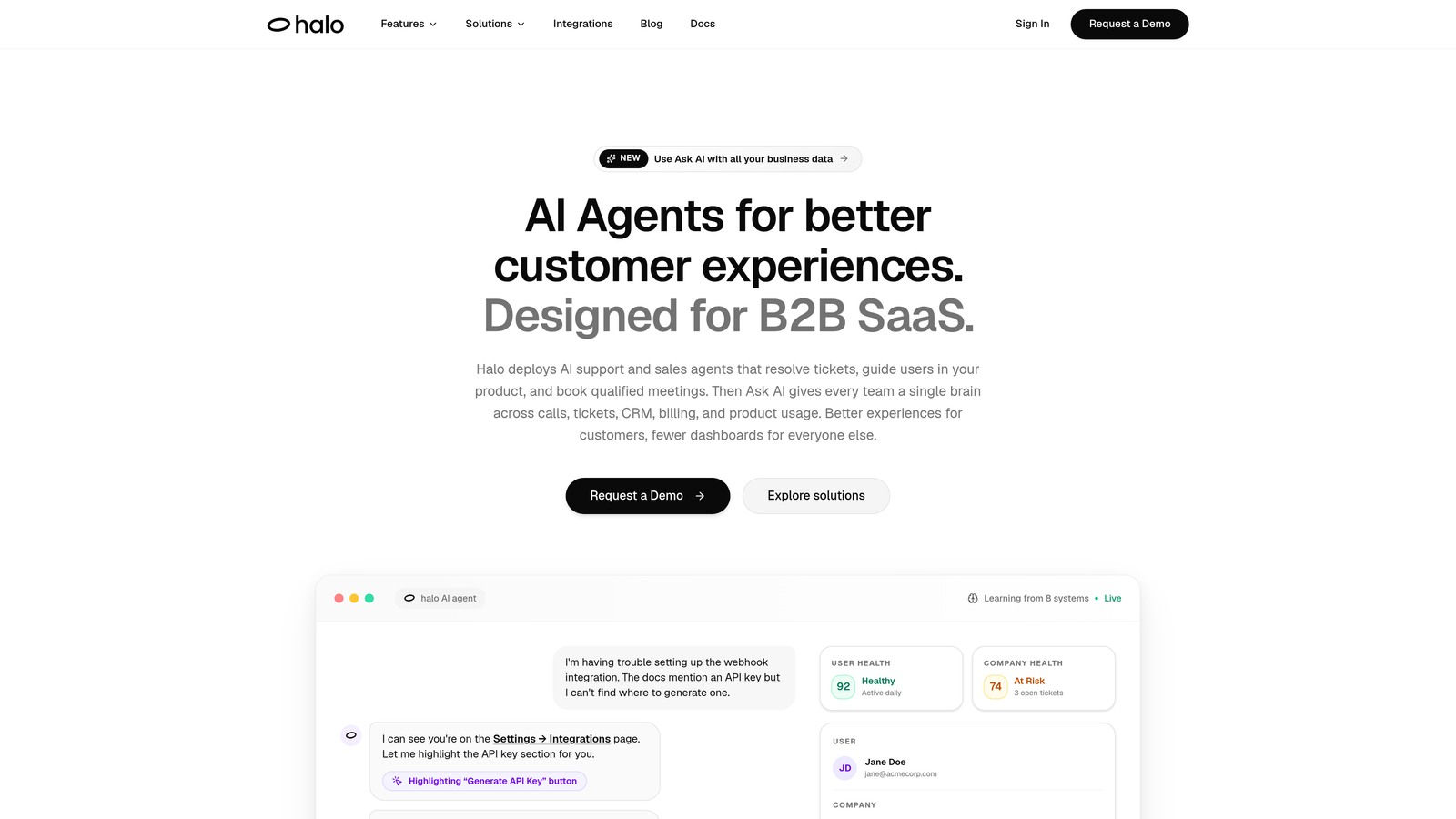
Halo AI is an AI-native customer support platform that deploys autonomous agents to resolve tickets, guide users visually through your product, and turn support interactions into actionable business intelligence.
Where This Tool Shines
Most support AI tools are bolted onto existing helpdesks as an afterthought. Halo was built AI-first from the ground up, which means the entire platform is designed around how AI agents actually work rather than retrofitting intelligence into legacy workflows. That architectural difference shows up in the quality of resolutions and the depth of context available to every interaction.
What genuinely sets Halo apart is page-aware context. The chat widget sees what your user sees in real time, allowing it to provide visual UI guidance specific to the exact screen they're on. Pair that with continuous learning from every interaction, and the system gets meaningfully smarter over time rather than staying static.
Key Features
Page-Aware Chat Widget: Understands the user's current location in your product and delivers contextually relevant guidance, including visual UI walkthroughs.
Continuous Learning Engine: Every resolved ticket improves the model's accuracy, so resolution rates compound as your support volume grows.
Smart Inbox with Business Intelligence: Goes beyond ticket management to surface customer health signals, revenue intelligence, and anomaly detection directly from support data.
Auto Bug Ticket Creation: Automatically identifies and logs bugs from support conversations, with live agent handoff for issues that require human judgment.
Deep SaaS Stack Integrations: Connects natively with Linear, Slack, HubSpot, Intercom, Stripe, Zoom, PandaDoc, and Fathom — covering engineering, revenue, and communication workflows in one platform.
Best For
SaaS product teams that want support AI to do more than deflect tickets. Halo is particularly well-suited for companies that need their support layer to inform product decisions, flag churn risk, and integrate tightly with both their engineering and customer success workflows.
Pricing
Contact for pricing. Built specifically for scaling SaaS teams, with a model designed to grow with your support volume rather than penalize you for it.
2. Intercom Fin
Best for: Teams already on Intercom who want native AI resolution without switching platforms.
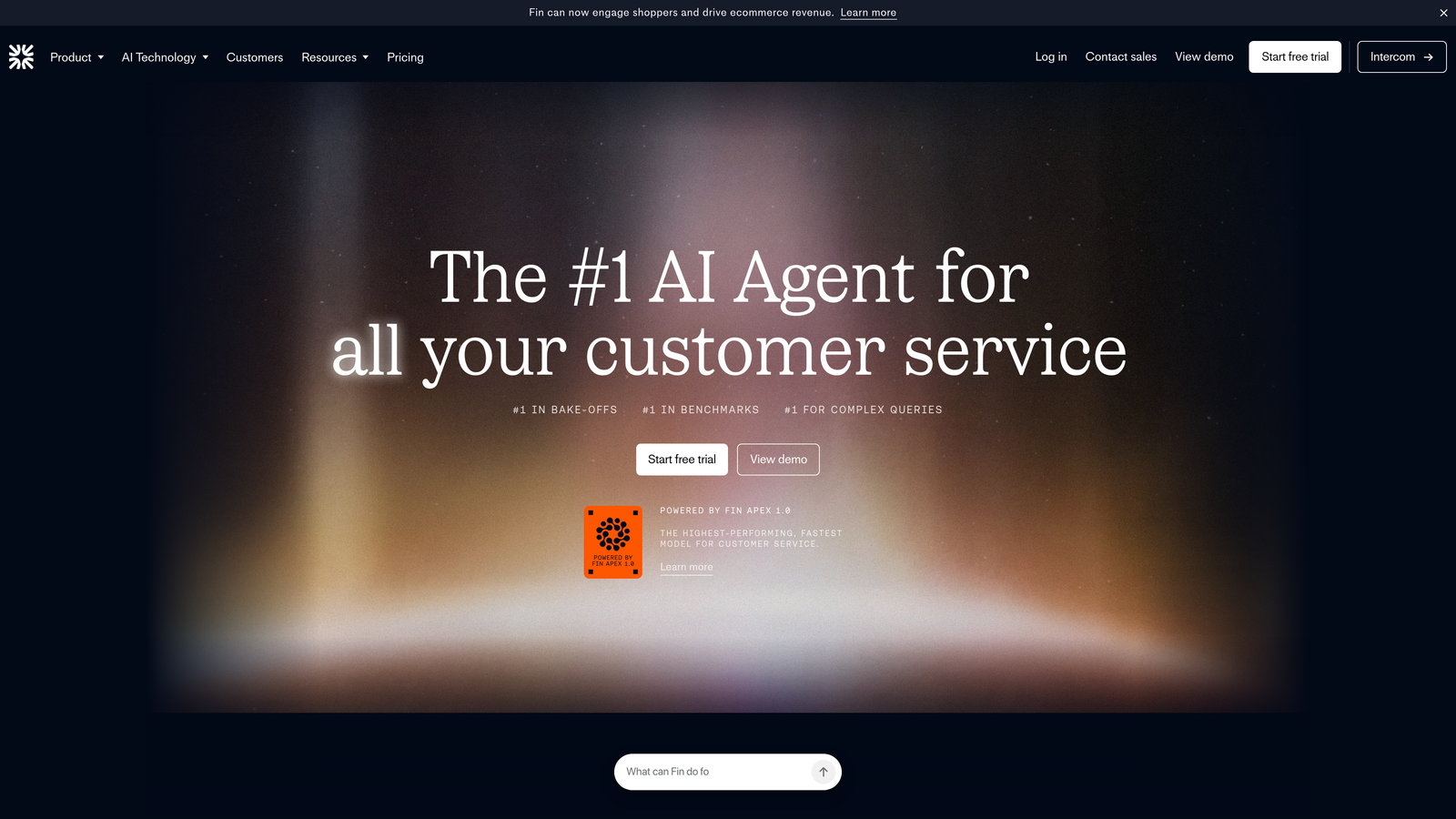
Intercom Fin is Intercom's built-in AI agent that resolves customer questions using your help center content and conversation history.
Where This Tool Shines
If your team is already living in Intercom, Fin is the path of least resistance to AI-powered resolution. It plugs directly into your existing messenger, workflows, and customer data without any migration or integration work. The retrieval-augmented generation approach means Fin grounds its answers in your actual documentation rather than hallucinating responses.
The usage-based pricing model is genuinely appealing for teams with variable ticket volumes. You pay per resolution rather than per seat, which aligns costs directly with value delivered. That said, costs can scale quickly during high-volume periods, so it's worth modeling your expected resolution volume before committing.
Key Features
Retrieval-Augmented Generation: Pulls answers from your help center content and past conversation history to generate accurate, grounded responses.
Native Intercom Integration: Works seamlessly within Intercom's messenger, workflows, and customer data platform with no additional setup.
Tone and Persona Customization: Lets you configure Fin's communication style to match your brand voice.
Contextual Human Handoff: Transfers to human agents with full conversation context preserved, so customers don't have to repeat themselves.
Usage-Based Pricing: Charges per successful resolution, making costs directly proportional to outcomes.
Best For
Companies already invested in the Intercom ecosystem who want to activate AI resolution quickly. Less ideal if you're evaluating a broader platform switch or need intelligence that extends beyond the Intercom environment.
Pricing
Starts at $0.99 per resolution. Requires an active Intercom subscription, so total cost depends on your existing plan tier.
3. Zendesk AI Agents
Best for: Enterprise SaaS teams with high ticket volumes already running on Zendesk.
Zendesk AI Agents are enterprise-grade AI capabilities built directly into the Zendesk platform, pre-trained on a large corpus of support interactions across industries.
Where This Tool Shines
Zendesk's scale advantage is real. The pre-training dataset spans billions of support interactions, which gives the AI a strong baseline understanding of customer service patterns before you've added a single piece of your own content. For enterprise teams handling diverse, high-volume ticket queues, that head start matters.
The agent assist tools are particularly valuable for hybrid support orgs where AI handles tier-one resolution and human agents take over complex escalations. Suggested responses, intelligent routing, and in-context knowledge surfacing all reduce handle time for your human team even when the AI doesn't resolve the ticket outright.
Key Features
Pre-Trained Foundation: Built on a large dataset of customer service interactions, providing strong out-of-the-box performance across common support scenarios.
Intelligent Triage and Routing: Automatically classifies, prioritizes, and routes incoming tickets to the right queue or agent.
Generative AI Responses: Produces knowledge-base-grounded responses for automated resolution of common questions.
Agent Assist Tools: Surfaces suggested responses and relevant knowledge articles for human agents handling escalations.
Zendesk Explore Analytics: Deep reporting on AI performance, deflection rates, and resolution quality within the broader Zendesk analytics suite.
Best For
Enterprise SaaS organizations already standardized on Zendesk with dedicated support operations teams. Smaller teams may find the pricing and complexity more than they need.
Pricing
AI features are included in Suite plans starting around $55 per agent per month. An advanced AI add-on is available for teams that need additional capabilities beyond the base suite.
4. Ada
Best for: Mid-market to enterprise brands needing multilingual, omnichannel AI resolution at scale.
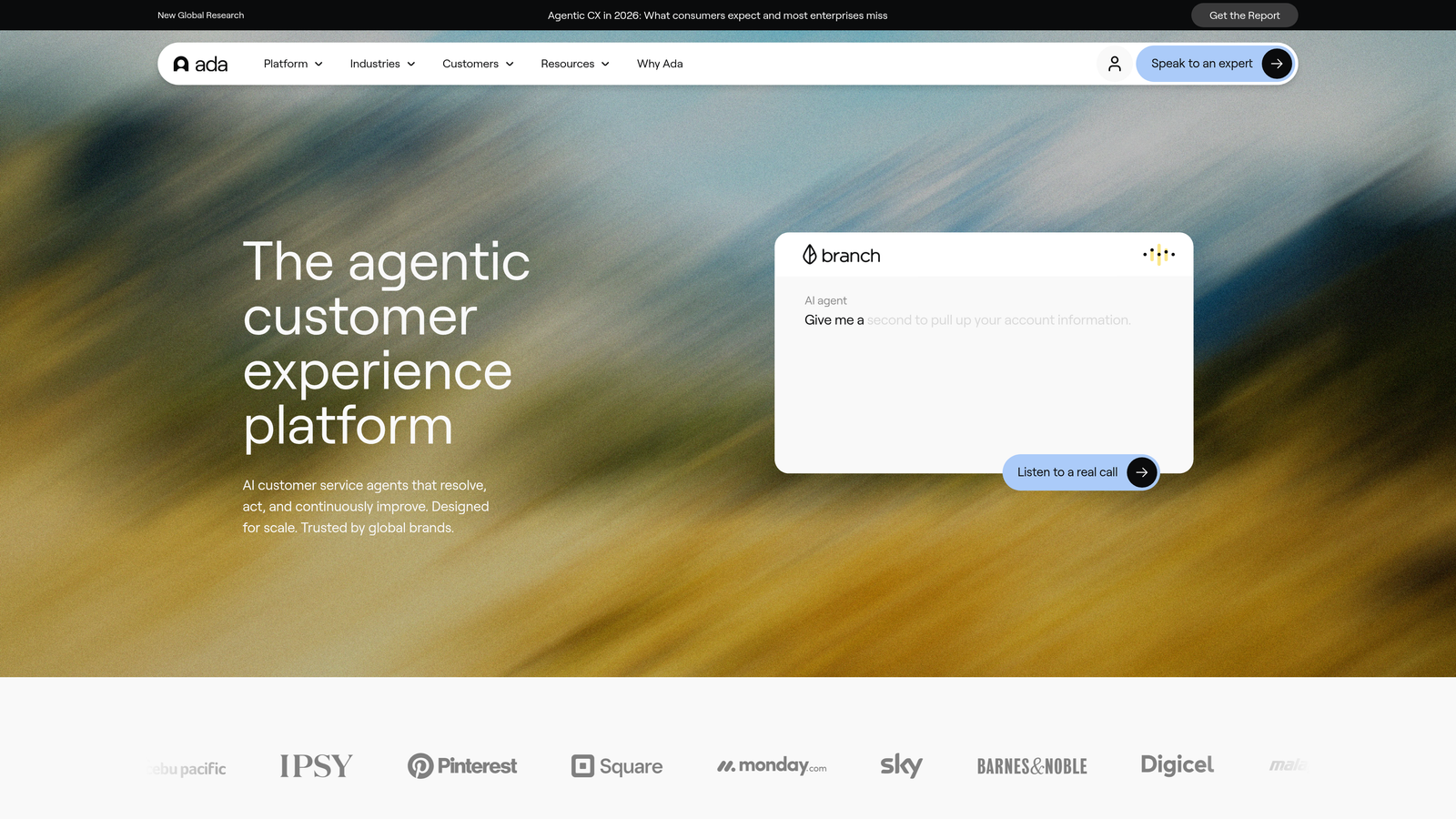
Ada is an AI-powered customer service automation platform built for enterprise brands, with an AI reasoning engine designed for complex, multi-step resolution flows.
Where This Tool Shines
Ada's reasoning engine handles the kind of nuanced, multi-step support scenarios that trip up simpler AI tools. Rather than matching questions to static answers, it can reason through conditional logic — checking account status, applying business rules, and taking action across integrated systems before responding. For SaaS companies with complex product configurations or subscription logic, that capability is meaningful.
The multilingual support is genuinely strong. With coverage across 50-plus languages out of the box, Ada is one of the better options for SaaS companies with a global customer base that needs consistent support quality regardless of language.
Key Features
AI Reasoning Engine: Handles complex, multi-step resolutions that require conditional logic and action across integrated systems.
50+ Language Support: Multilingual capability built in by default, without requiring separate configuration per language.
Omnichannel Deployment: Operates across chat, email, social media, and SMS from a single platform.
No-Code Automation Builder: Lets non-technical teams build custom resolution workflows without engineering involvement.
Broad Integration Library: Connects with major CRMs, helpdesks, and commerce platforms.
Best For
Mid-market and enterprise SaaS companies with global customer bases, complex subscription logic, and support operations that span multiple channels. Typically requires a larger budget than early-stage teams can justify.
Pricing
Custom pricing. Ada is generally positioned for mid-market to enterprise buyers, so expect an enterprise sales process and contract structure.
5. Freshdesk Freddy AI
Best for: Growing SaaS teams that want AI-powered support built into an accessible, full-featured helpdesk.
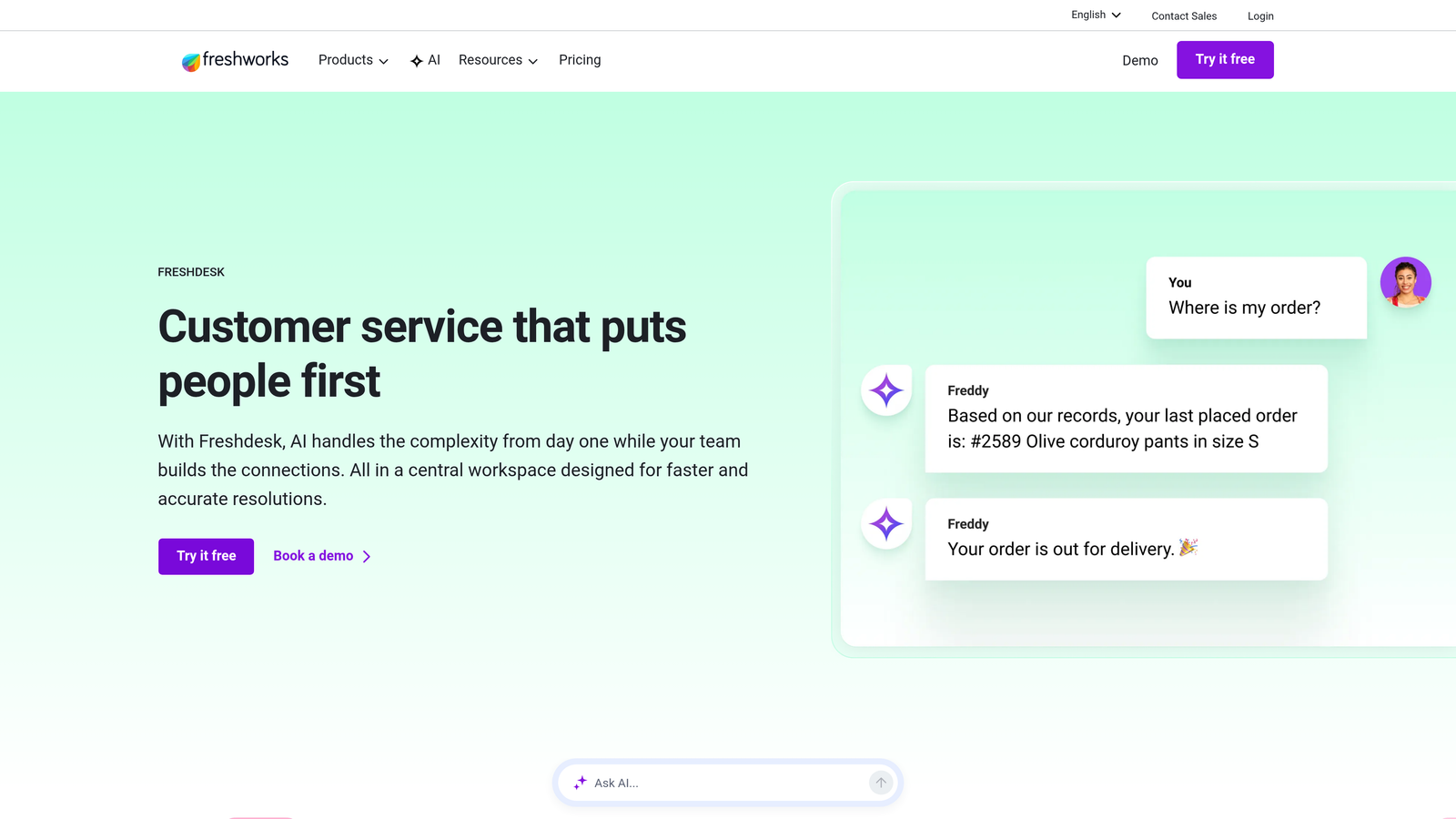
Freshdesk Freddy AI is Freshworks' AI layer built into the Freshdesk helpdesk, covering ticket triage, auto-responses, and self-service bots at price points accessible to growing teams.
Where This Tool Shines
Freddy AI's biggest advantage is the combination of capability and price. You get AI-powered ticket classification, suggested responses for human agents, and self-service bots without the enterprise price tags that come with Zendesk or Ada. For SaaS teams in the growth stage that need to professionalize their support operations without a massive budget commitment, Freshdesk is worth serious consideration.
The free tier is genuinely useful for early-stage teams. It provides enough functionality to handle basic support operations and gives you time to evaluate whether the AI features justify upgrading to a paid plan as your volume grows.
Key Features
AI Ticket Classification: Automatically categorizes and assigns priority to incoming tickets based on content and history.
Freddy Self Service Bots: Deploys automated bots to resolve common questions before they reach your human team.
Suggested Responses: Surfaces relevant responses for human agents based on similar past tickets, reducing handle time.
Full Helpdesk Suite: Includes shared inbox, SLA management, and reporting alongside AI features in a single platform.
Accessible Pricing: Free tier available, with AI capabilities unlocking at competitive paid plan price points.
Best For
SaaS teams in the early-to-mid growth stage that need a complete helpdesk with AI capabilities at a price that fits a scaling budget. Less suited for teams that need deep product-context awareness or advanced business intelligence from support data.
Pricing
Free tier available. Paid plans start from $15 per agent per month, with AI features unlocking in higher tiers.
6. Forethought
Best for: Teams on Zendesk or Salesforce that want to layer intelligent AI without migrating their helpdesk.
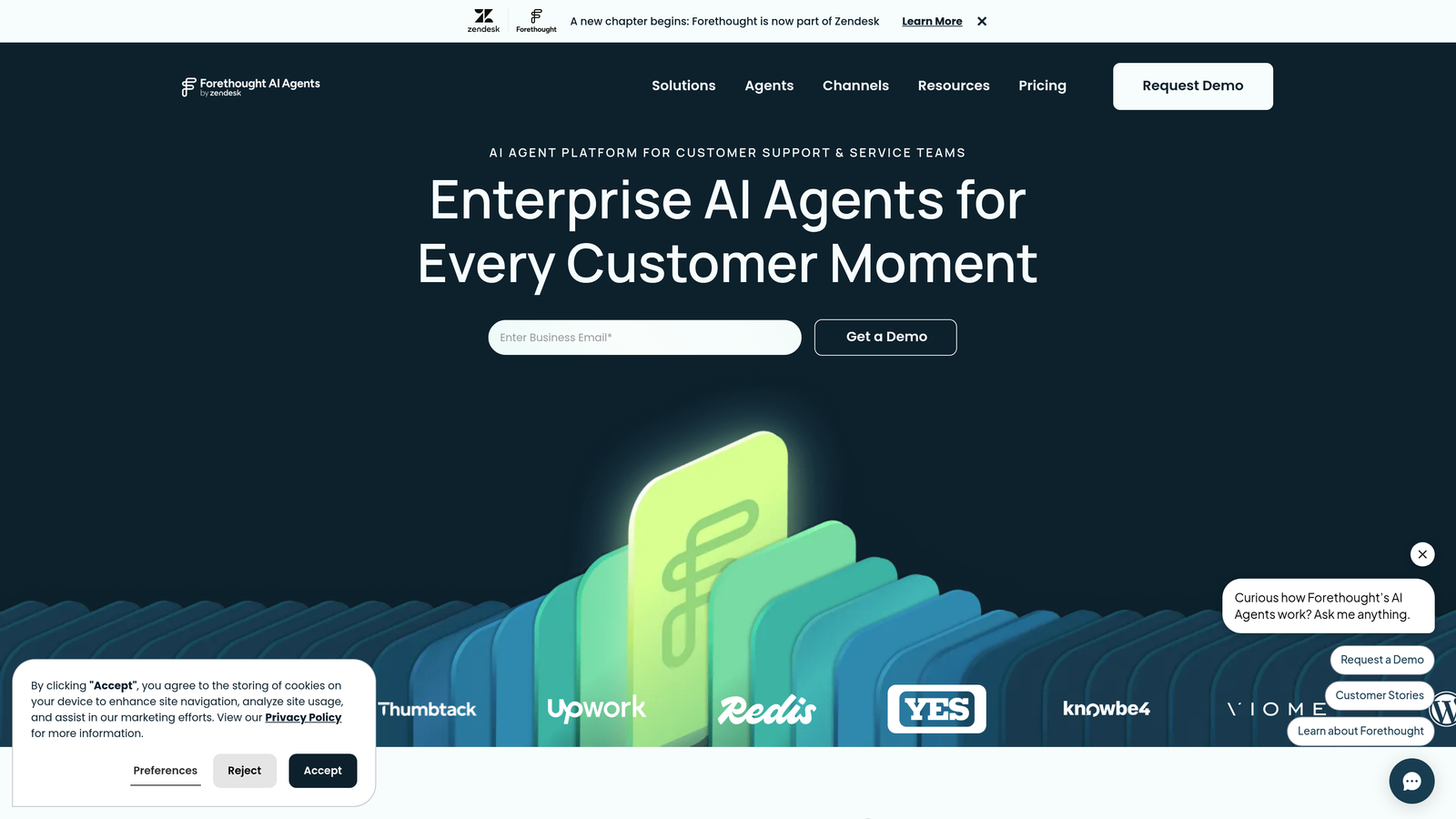
Forethought is a SupportGPT-powered platform that adds intelligent triage, routing, and automated resolution as a layer on top of existing helpdesk infrastructure.
Where This Tool Shines
Forethought's overlay approach is its core value proposition. If your team has years of historical ticket data in Zendesk or Salesforce Service Cloud and isn't ready to migrate, Forethought plugs in on top and immediately starts learning from that history. The SupportGPT model is trained on your specific ticket corpus, which means it understands your product's terminology and common issues from day one.
The triage accuracy is a genuine differentiator. Intelligent classification that routes tickets correctly the first time reduces both resolution time and the cognitive load on your support team, particularly during high-volume periods like product launches or outages.
Key Features
SupportGPT: Generative AI responses trained specifically on your historical ticket data for contextually accurate resolutions.
Intelligent Triage: High-accuracy ticket classification and routing that works across complex support taxonomies.
Helpdesk Overlay: Works on top of Zendesk, Salesforce Service Cloud, and other major helpdesks without requiring migration.
Workflow Automation: Handles repetitive multi-step processes automatically, reducing manual work for your team.
Deflection Analytics: Tracks deflection rates and resolution quality to demonstrate ROI and identify improvement opportunities.
Best For
SaaS support teams with substantial historical ticket data in Zendesk or Salesforce who want AI capabilities without disrupting their existing helpdesk investment.
Pricing
Custom pricing based on ticket volume and the specific modules selected. Requires a sales conversation to get a quote.
7. Tidio
Best for: Small SaaS teams that need fast, simple AI chat deployment with minimal setup overhead.
Tidio is a lightweight AI chatbot and live chat platform featuring Lyro AI, designed for small teams that want basic AI support automation without complex configuration.
Where This Tool Shines
Speed to deployment is Tidio's headline advantage. The platform can be live in under ten minutes, which matters for early-stage SaaS teams that need to stop answering the same questions manually but don't have engineering resources to spare on a complex integration project. Lyro AI trains on your existing FAQ and help content, so the knowledge transfer is straightforward.
The combined AI and live chat in a single widget is practical for small teams. You're not managing two separate tools — the AI handles what it can, and conversations escalate to human agents seamlessly within the same interface.
Key Features
Lyro AI Chatbot: Trains on your FAQ and help documentation to answer common questions automatically.
Unified AI and Live Chat: Combines automated AI responses and human live chat in a single widget experience.
Visual Flow Builder: Lets non-technical team members build custom chatbot conversation flows without code.
Generous Free Tier: Includes up to 50 AI conversations per month at no cost, useful for validating the tool before committing.
Fast Setup: Can be fully deployed and live in under ten minutes with minimal configuration.
Best For
Early-stage SaaS teams or solo founders who need basic AI deflection quickly and don't require deep helpdesk integrations, product-context awareness, or advanced analytics.
Pricing
Free tier available with up to 50 Lyro AI conversations per month. Paid Lyro AI plans start around $39 per month.
8. Kastro
Best for: Small SaaS teams that want a clean, purpose-built AI chatbot trained on their documentation.
Kastro is a lightweight, ChatGPT-powered support chatbot built specifically for SaaS products, trained directly on your knowledge base and documentation to deflect repetitive questions.
Where This Tool Shines
Kastro's focus is narrow by design, and that's a feature rather than a limitation for the right team. It does one thing well: trains on your documentation and answers questions from it accurately. The setup is minimal, the widget is clean and modern, and the pricing is accessible for small SaaS teams that don't need the full complexity of an enterprise platform.
The conversation analytics are genuinely useful for product teams. Identifying where users get stuck and what questions the bot can't answer reveals documentation gaps and product UX issues that would otherwise go unnoticed until they become churn signals.
Key Features
Documentation-Based Training: Trains directly on your help docs and knowledge base with minimal configuration required.
SaaS-Native Widget Design: Clean, modern chat widget built to fit naturally into SaaS product interfaces.
AI-Human Handoff: Escalates to human agents when questions exceed the bot's knowledge, with conversation context preserved.
Knowledge Gap Analytics: Tracks which questions the AI can't answer to identify documentation and product gaps.
Affordable Pricing: Positioned specifically for small SaaS teams with budget-conscious pricing tiers.
Best For
Small SaaS teams or indie developers who want a focused, documentation-trained chatbot without the overhead of a full support platform. Not suited for teams that need omnichannel support, deep integrations, or business intelligence from support data.
Pricing
Plans start around $35 per month, making it one of the more accessible options on this list for early-stage teams.
9. DevRev
Best for: Product-led SaaS teams that want customer support and product development connected in a single platform.
DevRev is an AI-native platform that converges customer support and product development, linking customer issues directly to engineering work items.
Where This Tool Shines
DevRev addresses a problem that most support tools ignore entirely: the gap between what customers report and what engineers actually build. In most SaaS companies, support tickets live in one system and engineering work lives in another, with a manual, lossy translation process in between. DevRev eliminates that gap by treating support and product development as a single unified workflow.
The AI-powered issue clustering is particularly valuable for product teams. When the system automatically groups similar customer issues and connects them to product areas, you get a real-time signal on what's breaking, what's confusing, and where engineering attention will have the most customer impact.
Key Features
Unified Support and Development Workspace: Combines support ticketing and product development in a single platform, eliminating the handoff gap between teams.
Automatic Issue Linking: AI connects customer support tickets to relevant engineering work items without manual tagging.
PLuG In-App Widget: Delivers in-app support with full product context, surfacing relevant help content based on user location in the product.
AI Issue Clustering: Groups similar customer issues automatically to surface patterns and identify high-impact product problems.
Support-to-Product Analytics: Connects support volume data directly to product areas, giving engineering teams customer-impact context for prioritization.
Best For
Product-led SaaS teams where support and engineering collaborate closely, and where customer feedback needs to flow directly into the product roadmap. Less suited for teams that need a traditional helpdesk-first approach or omnichannel customer communication.
Pricing
Free tier available for small teams. Paid plans are available with custom pricing based on team size and usage requirements.
How to Choose the Right AI Support Tool for Your SaaS
The right tool depends less on feature checklists and more on where you are as a company and what you actually need support AI to do.
If you're early-stage and just need to stop answering the same questions manually, Tidio or Kastro will get you live fast without requiring engineering time or a significant budget commitment.
If your team is already standardized on a major helpdesk, the path of least resistance is to activate that platform's native AI. Intercom Fin for Intercom users, Zendesk AI Agents for Zendesk users, and Freshdesk Freddy AI for Freshdesk users all deliver meaningful automation without a platform migration. Forethought is worth considering if you're on Zendesk or Salesforce and want more sophisticated AI without changing your helpdesk.
If you need enterprise-grade multilingual, omnichannel automation, Ada is built for that scale. And if your support and engineering teams need to work from a single source of truth, DevRev's unified approach is genuinely differentiated.
For SaaS teams that want AI-first architecture with product-aware context, business intelligence from support data, and deep integration across the entire SaaS stack, Halo AI is built specifically for that use case. The combination of page-aware guidance, continuous learning, and intelligence that surfaces churn risk and revenue signals makes it more than a support tool — it becomes a strategic layer across your entire customer relationship.
Your support team shouldn't scale linearly with your customer base. Let AI agents handle routine tickets, guide users through your product, and surface business intelligence while your team focuses on complex issues that need a human touch. See Halo in action and discover how continuous learning transforms every interaction into smarter, faster support.