9 Best Customer Support AI Tools for Tech Companies in 2026
Tech companies dealing with complex products and sophisticated users need more than basic chatbots—this guide evaluates nine customer support AI for tech companies platforms that understand product context, integrate with developer workflows, and deliver intelligent escalation. From early-stage SaaS teams to enterprise organizations, each tool is assessed on AI capability depth, integration ecosystem, and real-world applicability for B2B and product-led growth environments.
 Grant CooperFounder14 min read
Tech companies face a support challenge that generic helpdesk chatbots were never designed to solve. Your users are sophisticated, your product is complex, and every slow resolution compounds into churn, reputation damage, and engineering time spent on tickets instead of features. Scripted FAQ bots don't cut it here.
The best customer support AI tools for tech companies go further: they understand product context, integrate with developer workflows, surface business intelligence, and escalate intelligently when a human needs to step in. This list covers nine platforms purpose-built or well-suited for technical support environments, from early-stage SaaS teams to enterprise product organizations.
Selection criteria: depth of AI capability, integration ecosystem, suitability for technical teams, pricing transparency, and real-world applicability for B2B SaaS and product-led growth companies. Here are the top tools worth evaluating.
1. Halo AI
Best for: B2B SaaS teams that want AI-first support with deep product context and business intelligence
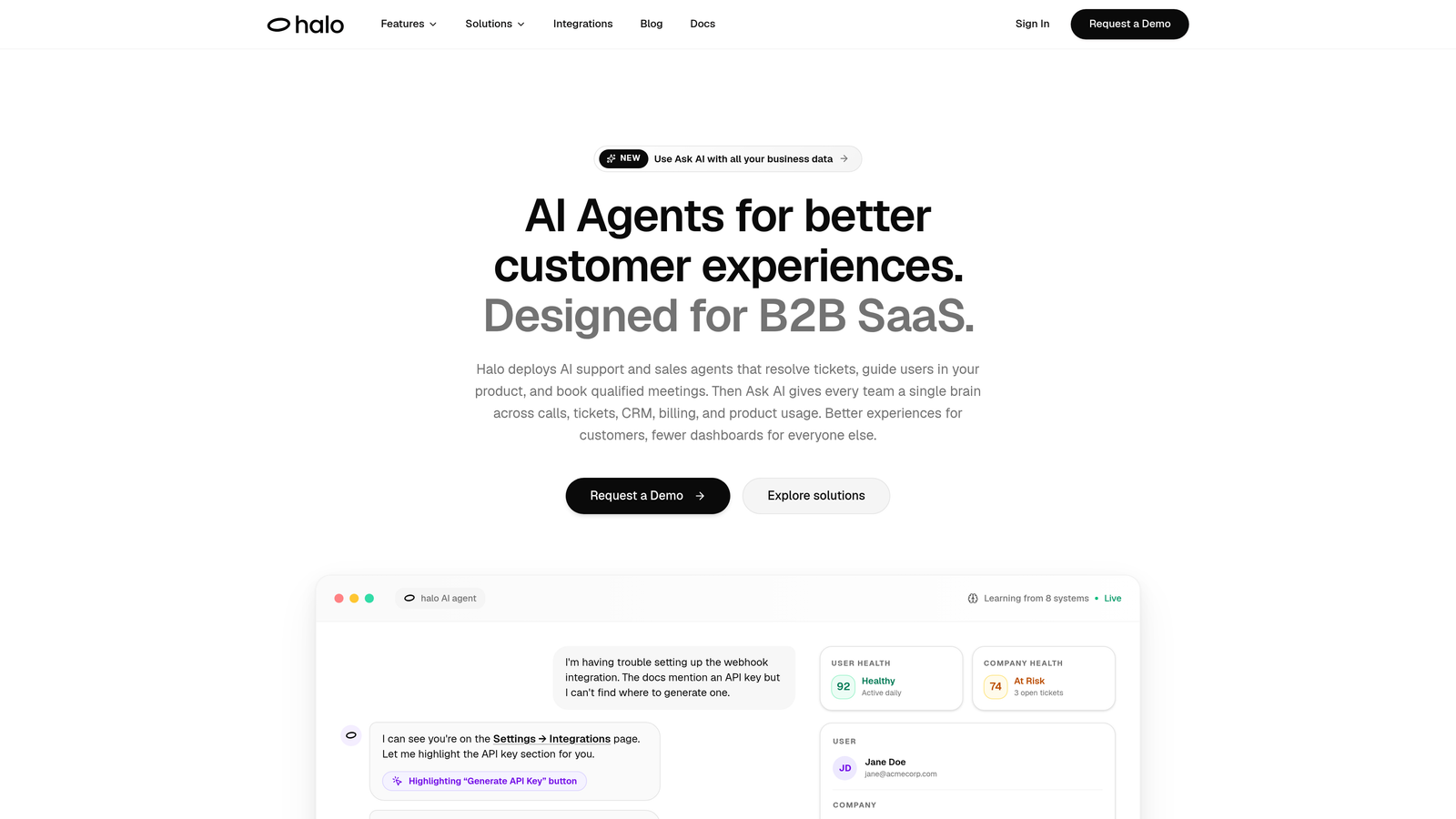
Halo AI is an AI-first customer support platform built specifically for B2B SaaS teams who need more than ticket deflection.
Where This Tool Shines
Most AI support tools bolt intelligence onto a legacy helpdesk. Halo was built AI-first, which means the architecture is designed for autonomous operation from the ground up. The standout capability is page-aware context: Halo's chat widget sees what the user sees, allowing it to provide visual UI guidance and contextually relevant answers based on exactly where someone is in your product.
Beyond resolution, Halo surfaces business intelligence signals that most support tools ignore entirely. Customer health scoring, anomaly detection, and revenue signals flow through the smart inbox, turning your support operation into a strategic data source. For SaaS teams who want support that learns and improves with every interaction rather than staying static, this continuous learning architecture is a genuine differentiator.
Key Features
Page-Aware Chat Widget: The AI sees what users see in real time, enabling visual UI guidance and context-specific answers based on the user's current location in your product.
Autonomous Ticket Resolution with Human Handoff: AI agents resolve tickets end-to-end, with intelligent escalation to live agents when complexity warrants it.
Auto Bug Ticket Creation: Automatically generates and routes bug reports directly to Linear, Jira, or your existing dev workflow, closing the loop between support and engineering.
Smart Inbox with Business Intelligence: Customer health scoring, anomaly detection, and revenue signals built into the inbox, not bolted on as a separate analytics product.
Deep Integration Stack: Connects to Slack, HubSpot, Intercom, Stripe, Zoom, PandaDoc, and Fathom, so support data flows across your entire business stack.
Continuous Learning Architecture: Every resolved interaction improves the AI's future performance, compounding value over time rather than requiring constant manual retraining.
Best For
B2B SaaS teams and product-led growth companies that want AI support that does more than answer FAQs. Particularly strong for teams frustrated by the disconnect between support tooling and developer workflows, and for organizations that want support data to inform product and revenue decisions.
Pricing
Contact for pricing at haloagents.ai. Custom pricing reflects the depth of integration and AI capability involved.
2. Intercom
Best for: SaaS teams wanting a proven omnichannel platform with a capable LLM-powered AI agent
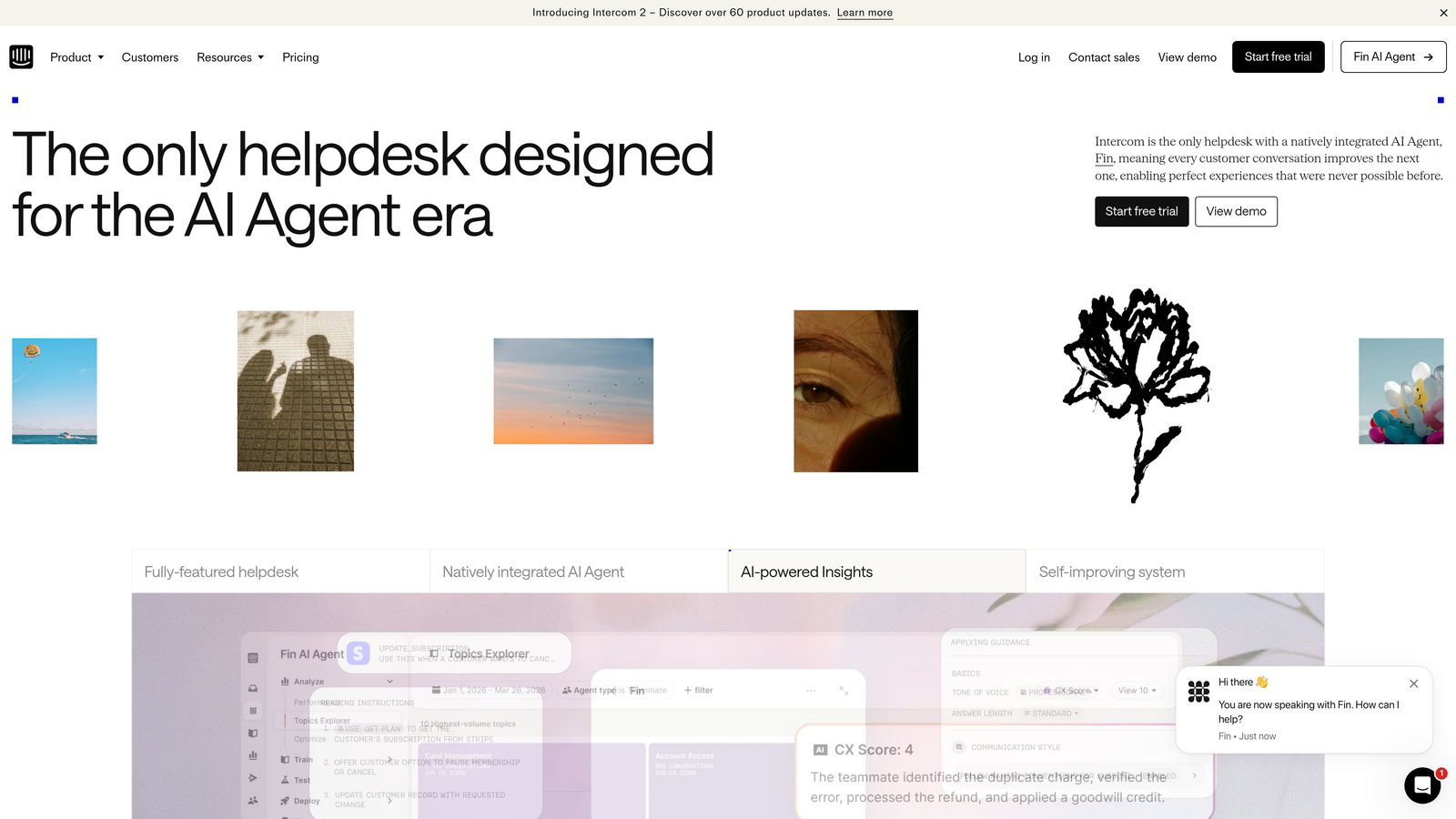
Intercom is an established customer messaging platform with Fin, its large language model-powered AI agent built for autonomous inbound query resolution.
Where This Tool Shines
Fin is one of the more mature AI agents in this space. It draws on your knowledge base and documentation to resolve queries without human intervention, handling a meaningful portion of inbound volume for teams with well-maintained content. The omnichannel inbox covering chat, email, and in-app messaging is genuinely polished and widely trusted across the SaaS industry.
Where Intercom has faced pushback is pricing. Costs have increased significantly in recent years, and smaller teams often find the per-resolution pricing model for Fin adds up quickly. It remains a strong choice for teams already invested in the Intercom ecosystem, but worth modeling costs carefully before committing.
Key Features
Fin AI Agent: LLM-powered autonomous resolution using your knowledge base, with human handoff for queries it cannot confidently answer.
Omnichannel Inbox: Unified inbox covering chat, email, and in-app messaging with AI-assisted agent replies.
AI-Assisted Agent Replies: Suggested responses and actions surface for human agents handling complex tickets.
Robust Reporting and CSAT Tracking: Detailed performance analytics and customer satisfaction measurement built in.
Large Integration Marketplace: Extensive third-party integrations covering CRM, billing, analytics, and developer tools.
Best For
Mid-market and growth-stage SaaS companies with established knowledge bases who want a mature, well-documented platform. Less ideal for very early-stage teams sensitive to per-resolution pricing at scale.
Pricing
Starts at $39/seat/month. Fin AI is an add-on priced per resolution, so total costs scale with support volume.
3. Zendesk AI
Best for: Enterprise support teams already in the Zendesk ecosystem needing AI across ticketing, routing, and agent assist
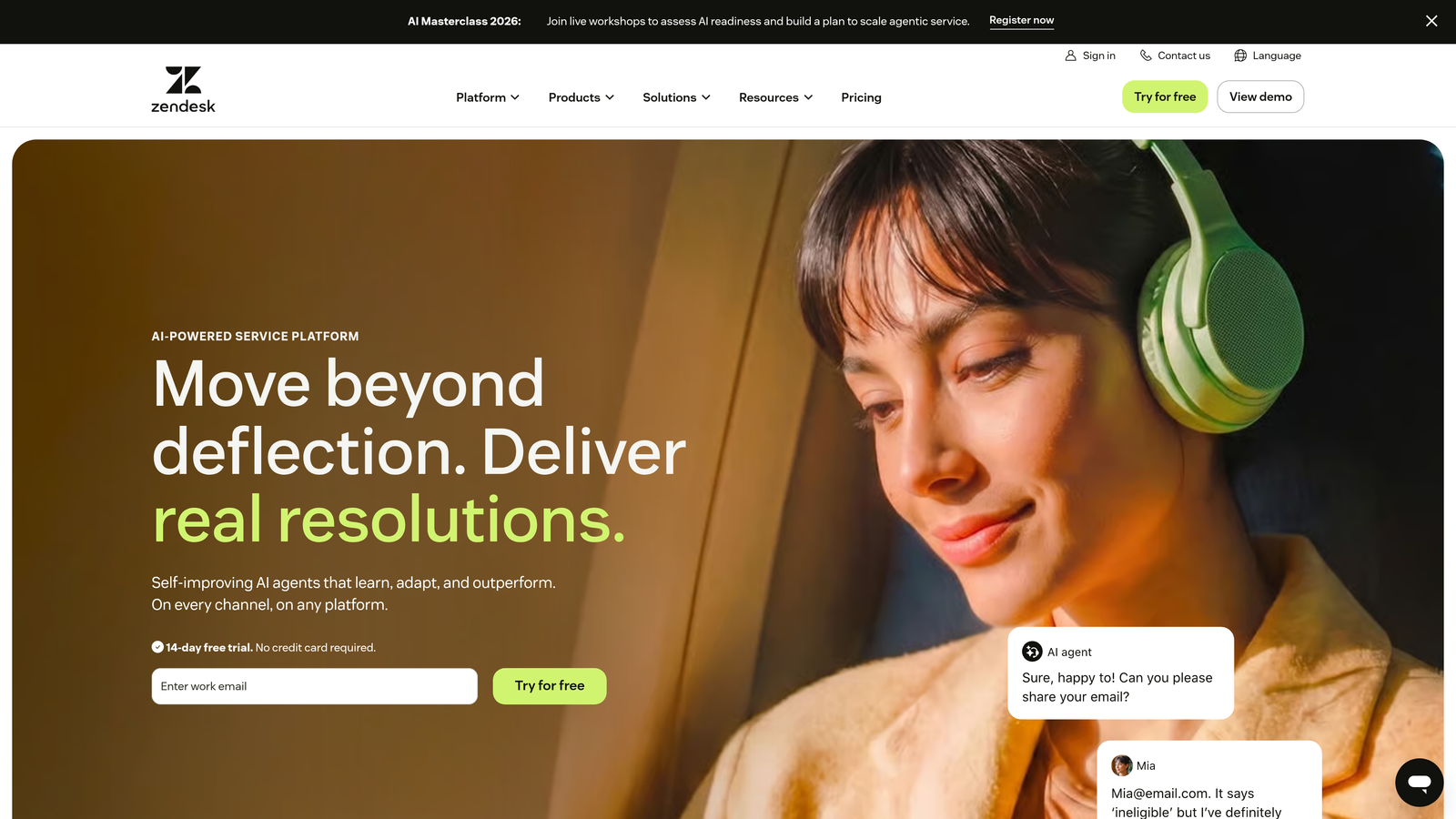
Zendesk is an enterprise support suite with AI woven across ticket triage, routing, agent assistance, and self-service at scale.
Where This Tool Shines
Zendesk's AI layer is broad. Agent Copilot provides in-conversation suggestions and post-interaction summaries, while automated triage handles classification and routing before tickets reach a human. For organizations already running on Zendesk with years of historical ticket data, the AI has a rich foundation to work from.
The tradeoff is complexity and cost. Zendesk can be time-intensive to configure, and meaningful AI features are gated behind higher pricing tiers. Teams evaluating Zendesk AI should factor in implementation time alongside licensing costs. It is best suited for companies with dedicated support ops resources who can get the most out of the platform's depth.
Key Features
AI-Powered Ticket Triage: Automatic classification, priority assignment, and routing based on ticket content and intent.
Agent Copilot: Real-time suggestions, recommended responses, and post-conversation summaries for human agents.
AI-Powered Help Center: Automated self-service recommendations surfaced from your knowledge base.
Advanced Analytics and Workforce Management: Reporting, forecasting, and capacity planning tools built for large support operations.
Enterprise Security and Compliance: Strong compliance posture including SOC 2, GDPR, and HIPAA support for regulated industries.
Best For
Enterprise product and support organizations with existing Zendesk infrastructure, dedicated support ops teams, and the resources to configure and maintain a complex platform.
Pricing
Suite plans from $55/agent/month. Advanced AI features are available on higher tiers, so total costs for AI-enabled teams are typically higher than the base rate suggests.
4. Freshdesk (Freddy AI)
Best for: Growing SaaS teams that want a full helpdesk plus AI at more accessible pricing than enterprise alternatives
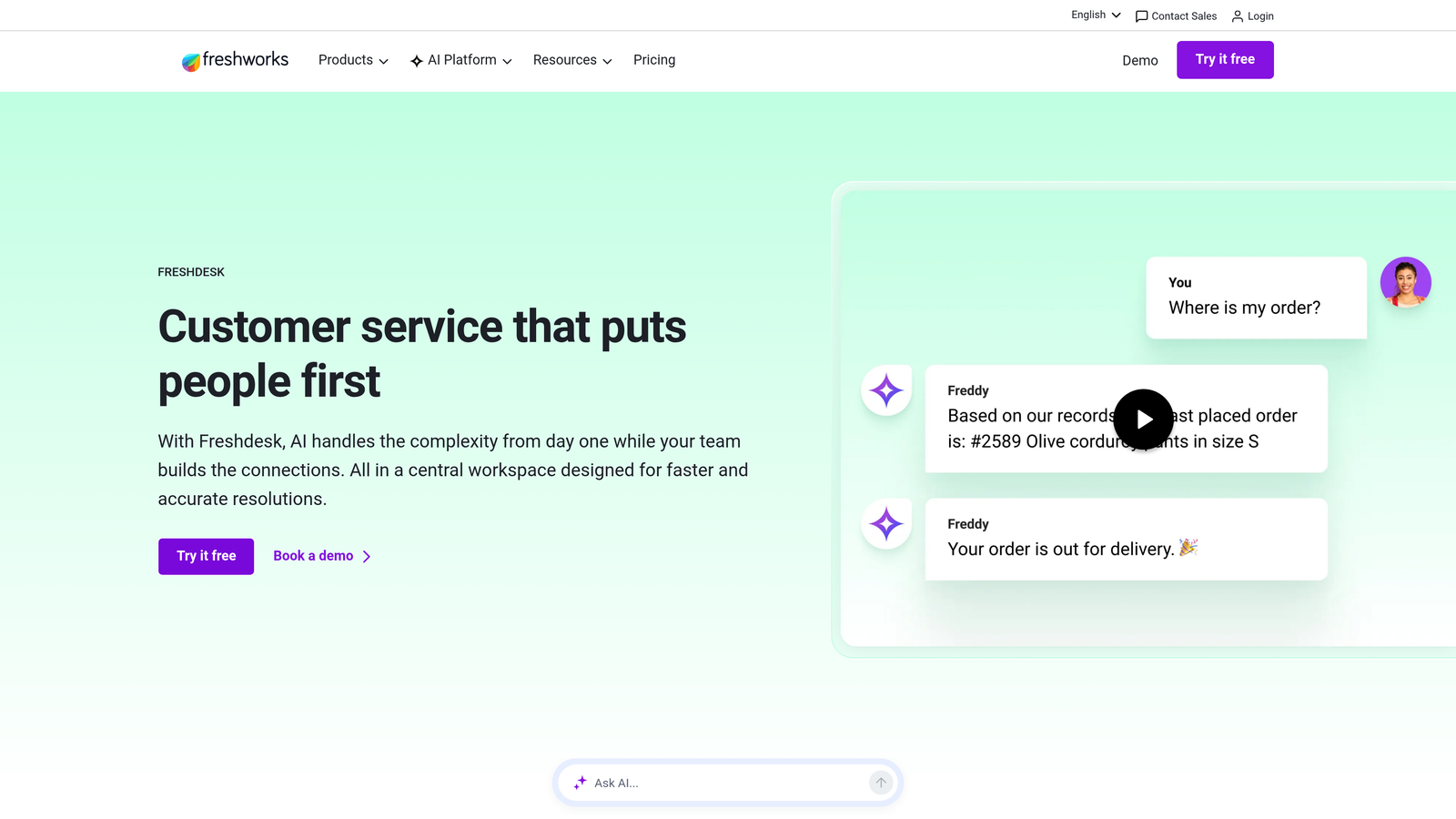
Freshdesk is a full-featured helpdesk platform where Freddy AI spans self-service, agent assistance, and support analytics across a single suite.
Where This Tool Shines
Freshdesk's value proposition is breadth at a competitive price point. Freddy covers three distinct layers: Freddy Self Service for AI-powered deflection, Freddy Copilot for agent assistance and response suggestions, and Freddy Insights for AI-generated analytics and trend detection. Getting all three in one platform without enterprise pricing is genuinely useful for teams scaling from 5 to 50 support staff.
The platform handles omnichannel support well across email, chat, phone, and social. It does not match the raw AI depth of purpose-built platforms, but for teams that need a reliable, full-featured helpdesk with solid AI augmentation, Freshdesk delivers strong value without the overhead of a Zendesk implementation.
Key Features
Freddy Self Service: AI-powered deflection and chatbot flows that resolve common queries before they reach an agent.
Freddy Copilot: Agent assist with response suggestions, ticket summarization, and next-action recommendations.
Freddy Insights: AI-generated analytics that surface trends, resolution gaps, and performance anomalies.
Omnichannel Support: Unified inbox covering email, chat, phone, and social channels.
Competitive Pricing: Accessible tiers compared to Zendesk and Intercom at comparable feature levels.
Best For
Growing SaaS teams that want a complete helpdesk solution with AI capabilities without committing to enterprise pricing. A strong fit for companies moving off basic ticketing systems and needing more structure.
Pricing
Free plan available. Paid plans from $15/agent/month. AI features are available on the Growth tier and above.
5. Forethought
Best for: Support ops teams wanting to improve the efficiency of an existing helpdesk without switching platforms
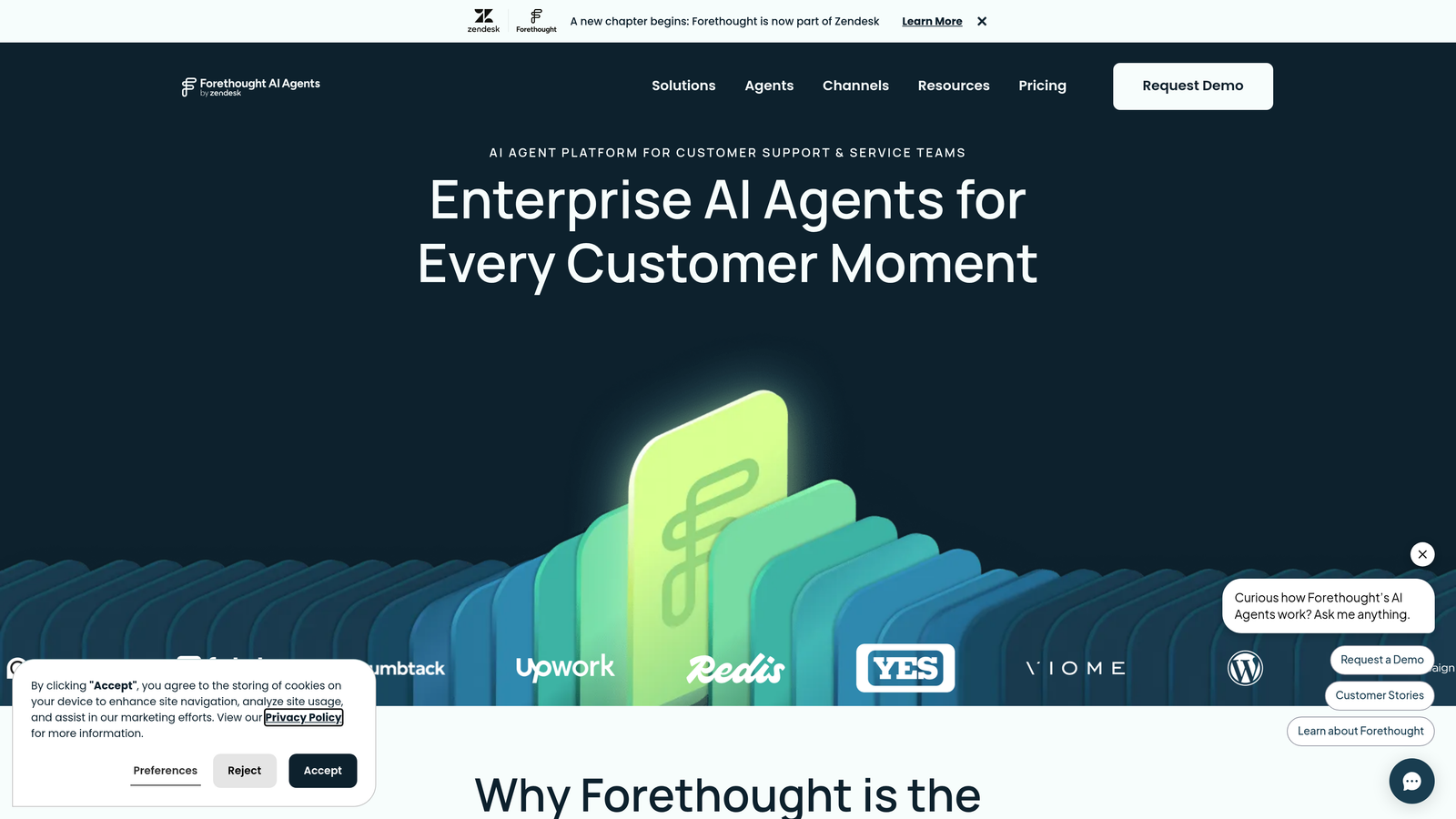
Forethought is an AI platform focused on support workflow efficiency: triage, routing, deflection, and agent augmentation layered on top of your current helpdesk.
Where This Tool Shines
Forethought's model is additive rather than replacement. If your team is committed to Zendesk, Salesforce, or ServiceNow but wants meaningfully better AI across triage and resolution, Forethought plugs in without requiring a platform migration. Its four-component structure, Triage, Solve, Assist, and Discover, covers the full support workflow from routing through resolution gap identification.
The Discover component is particularly useful for technical teams: it identifies where your knowledge base is failing users and surfaces opportunities to close those gaps proactively. For support ops leaders focused on efficiency metrics rather than platform replacement, this is a practical, lower-disruption path to better AI outcomes.
Key Features
Triage AI: Intelligent ticket classification and priority routing before tickets reach the queue.
Solve AI: Automated resolution of common queries using your existing knowledge base and documentation.
Assist AI: In-workflow suggestions and recommended responses for human agents handling open tickets.
Discover AI: Identifies resolution gaps and surfaces knowledge base improvement opportunities based on ticket patterns.
Helpdesk Integrations: Connects with Zendesk, Salesforce, ServiceNow, and other major platforms without replacing them.
Best For
Support operations teams invested in existing helpdesk infrastructure who want better AI without a platform switch. Particularly valuable for teams with large ticket volumes where triage and routing inefficiency is a measurable cost.
Pricing
Custom pricing. Contact Forethought directly for a quote based on volume and integration requirements.
6. Kustomer
Best for: High-volume, omnichannel tech support operations that benefit from a CRM-native customer timeline
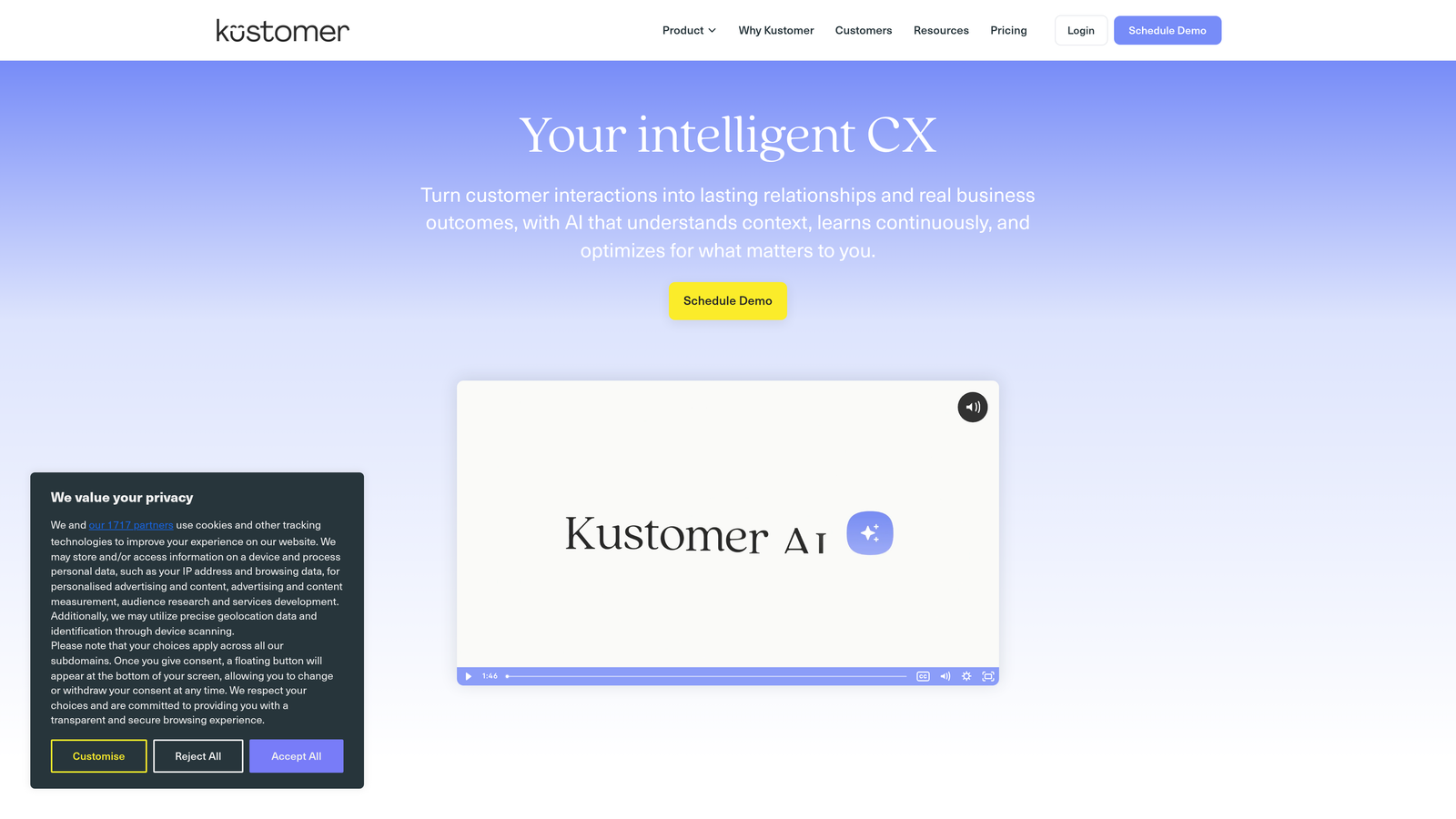
Kustomer is a CRM-native omnichannel support platform with AI embedded in the customer timeline, designed for high-volume multi-channel operations.
Where This Tool Shines
Kustomer's core differentiator is the unified customer timeline. Every interaction across email, chat, social, and voice is presented in a single chronological view, giving agents full context without switching between systems. For tech companies with complex customer histories or multi-product environments, this context layer can meaningfully improve resolution quality.
The built-in CRM eliminates the need for a separate customer data platform, which simplifies the stack for teams that would otherwise need to sync support data into HubSpot or Salesforce. Kustomer is less focused on pure technical SaaS support than some alternatives, but its omnichannel depth makes it a strong candidate for companies managing support across many channels simultaneously.
Key Features
Unified Customer Timeline: All interactions across channels presented in a single chronological view for full agent context.
AI-Powered Chatbots and Deflection: Automated deflection workflows with intelligent routing based on intent and customer history.
Intelligent Routing: Routes tickets based on customer history, intent signals, and agent expertise.
Built-In CRM: Customer data platform integrated natively, eliminating the need for a separate CRM sync.
Automation Builder: Visual workflow builder for complex, multi-step support automation.
Best For
Tech companies managing high-volume support across multiple channels who want CRM context baked into the support experience. Less suited for teams focused primarily on developer workflow integration or business intelligence from support data.
Pricing
Enterprise plans from $89/agent/month.
7. Ada
Best for: Enterprise tech companies needing action-oriented AI agents with strong security and compliance requirements
Ada is an enterprise-grade no-code AI agent platform that enables tech companies to deploy action-oriented support automation across web, mobile, and messaging channels.
Where This Tool Shines
Ada's emphasis on action over answers sets it apart from FAQ-style chatbots. Its agents can look up account status, reset passwords, update subscription details, and complete transactional tasks through API integrations, not just retrieve information from a knowledge base. For tech companies where users frequently need to do something rather than just learn something, this action capability is a significant step up.
The no-code builder makes it accessible to support and product teams without requiring engineering resources for every workflow change. Enterprise security credentials including SOC 2 Type II, GDPR compliance, and HIPAA readiness make it viable for regulated tech sectors. The tradeoff is enterprise pricing that puts it out of reach for smaller teams.
Key Features
No-Code AI Agent Builder: Build and modify action-capable AI agents without engineering involvement for most workflow changes.
Action-Oriented Automation: Agents complete transactional tasks like account lookups, password resets, and subscription updates via API integrations.
Multilingual Support: Handles conversations across 50+ languages for globally distributed user bases.
Enterprise Security: SOC 2 Type II certified, GDPR compliant, and HIPAA-ready for regulated industries.
Analytics Dashboard: Resolution rates, containment metrics, and conversation analytics to track AI performance over time.
Best For
Enterprise tech companies with compliance requirements and users who need to take actions through support, not just get answers. Well-suited for global product teams managing multilingual support at scale.
Pricing
Enterprise pricing. Contact Ada directly for a quote based on deployment scope and volume.
8. Tidio
Best for: Early-stage tech companies that need AI support up and running quickly without enterprise complexity
Tidio is an accessible AI chat platform featuring Lyro, its AI agent for automated query resolution, designed for teams that need results without a lengthy implementation.
Where This Tool Shines
Tidio's strongest attribute is speed to value. The platform is designed to deploy quickly, and Lyro can start resolving queries using your existing content without an extensive configuration process. For early-stage SaaS teams where support volume is growing but the team is not yet ready for an enterprise platform, Tidio provides a practical bridge.
The live chat with human fallback is well-implemented, and the visual chatbot builder allows non-technical team members to create custom flows without developer support. It does not offer the depth of integrations, business intelligence, or developer workflow connections that more specialized platforms provide, but for teams prioritizing simplicity and cost at early stages, those tradeoffs are often acceptable.
Key Features
Lyro AI Agent: Automated query resolution using your existing content and knowledge base with minimal setup required.
Live Chat with Human Fallback: Smooth handoff from AI to human agents when queries exceed Lyro's confidence threshold.
Visual Chatbot Builder: No-code flow builder for creating custom conversation paths and escalation logic.
Accessible Integrations: Connects with Shopify, WordPress, and basic SaaS tools for common use cases.
Transparent Pricing with Free Tier: Clear pricing structure with a free entry point, making it low-risk to evaluate.
Best For
Early-stage and bootstrapped tech companies that need AI-assisted support working quickly without committing to enterprise contracts. A solid starting point before migrating to a more specialized platform as support volume and complexity grow.
Pricing
Free plan available. Lyro AI from $29/month. Paid plans scale with usage and conversation volume.
9. Drift (Salesloft)
Best for: B2B SaaS companies where support and sales qualification overlap in a PLG or sales-assisted motion
Drift is a conversational AI platform that bridges support deflection and sales qualification, suited for B2B SaaS companies where revenue and support teams share the same customer conversation.
Where This Tool Shines
Drift's value is clearest for companies where the boundary between support and sales is intentionally blurry. A user asking a technical question might also be a qualified expansion opportunity, and Drift's intent-based playbooks can identify and route those conversations appropriately. The built-in meeting scheduling and rep routing add practical utility for teams running sales-assisted or product-led growth motions.
It is worth noting that since Drift's acquisition by Salesloft, the product roadmap has shifted more explicitly toward revenue teams. Teams evaluating Drift primarily for support automation should confirm that the support-focused capabilities remain a priority in the current roadmap before committing. At $2,500/month minimum, it is a meaningful investment that makes most sense when it serves both support and revenue functions simultaneously.
Key Features
AI-Powered Chat for Support and Sales: Handles both support deflection and sales qualification within the same conversation interface.
Meeting Scheduling and Rep Routing: Automatically books meetings and routes qualified prospects to the right sales rep.
Intent-Based Playbooks: Responds dynamically to user behavior signals with contextually relevant conversation flows.
CRM Integration: Deep connections with Salesforce, HubSpot, and Salesloft for revenue team workflows.
Account-Based Targeting: Personalizes conversations based on company and account data for enterprise B2B scenarios.
Best For
B2B SaaS companies with a sales-assisted or PLG motion where support conversations frequently overlap with expansion and qualification opportunities. Less suited for teams focused purely on support efficiency without a revenue-team use case.
Pricing
Premium plans from $2,500/month. Contact Drift for enterprise pricing.
Choosing the Right Tool for Your Team
The right choice depends less on feature checklists and more on where your team is today and where your support operation needs to go.
If you are an early-stage SaaS team that needs something working quickly, Tidio offers the lowest barrier to entry with transparent pricing and a fast deployment path. As your volume and complexity grow, you will likely outgrow it, but it earns its place as a starting point.
For teams already committed to a major helpdesk, Forethought adds meaningful AI without requiring a platform migration, while Zendesk AI and Freshdesk's Freddy layer are worth evaluating if you are already inside those ecosystems.
Intercom and Kustomer both serve omnichannel support well at mid-market scale. Intercom's Fin agent is mature and widely trusted; Kustomer's CRM-native timeline adds context that pure support tools lack. Ada is the enterprise choice when action-oriented automation and compliance requirements are non-negotiable.
Drift makes the most sense when support and sales qualification share the same conversation, particularly for PLG and sales-assisted B2B motions where revenue and support overlap.
For B2B SaaS teams that want AI built from the ground up for technical support, with page-aware context, auto bug ticket creation, developer workflow integrations, and business intelligence layered into the inbox, Halo AI is the purpose-built option on this list. It is designed for teams that want support to do more than resolve tickets: to surface product insights, feed engineering workflows, and improve with every interaction.
Your support team should not scale linearly with your customer base. AI agents can handle routine tickets, guide users through your product, and surface business intelligence while your team focuses on the complex issues that genuinely need a human. See Halo in action and discover how continuous learning transforms every interaction into smarter, faster support.