9 Best Customer Support AI Integration Tools in 2026
This comprehensive guide evaluates the 9 best customer support AI integration tools available in 2026, ranking each by integration depth, AI quality, deployment ease, and scalability. Whether you're a lean startup or an enterprise team managing high ticket volumes, this breakdown helps you identify the right AI-powered solution to deliver faster, more accurate customer support while reducing operational strain.
 Grant CooperFounder13 min read
B2B support teams are drowning in tickets while customers expect instant, accurate answers. AI integration tools have moved from nice-to-have to operational necessity, but the market is crowded with options that range from lightweight chatbots to full-stack intelligent agents.
This guide cuts through the noise. We evaluated tools on five criteria: depth of integrations, AI quality and learning capability, ease of deployment, analytics and business intelligence, and scalability for growing teams.
Whether you're running a lean startup support operation or managing enterprise-scale ticket volume, there's a right tool for your stack. Here are the best customer support AI integration tools available in 2026, ranked by overall capability and real-world utility.
1. Halo AI
Best for: Product-led SaaS teams that want AI connecting support to the entire business stack.
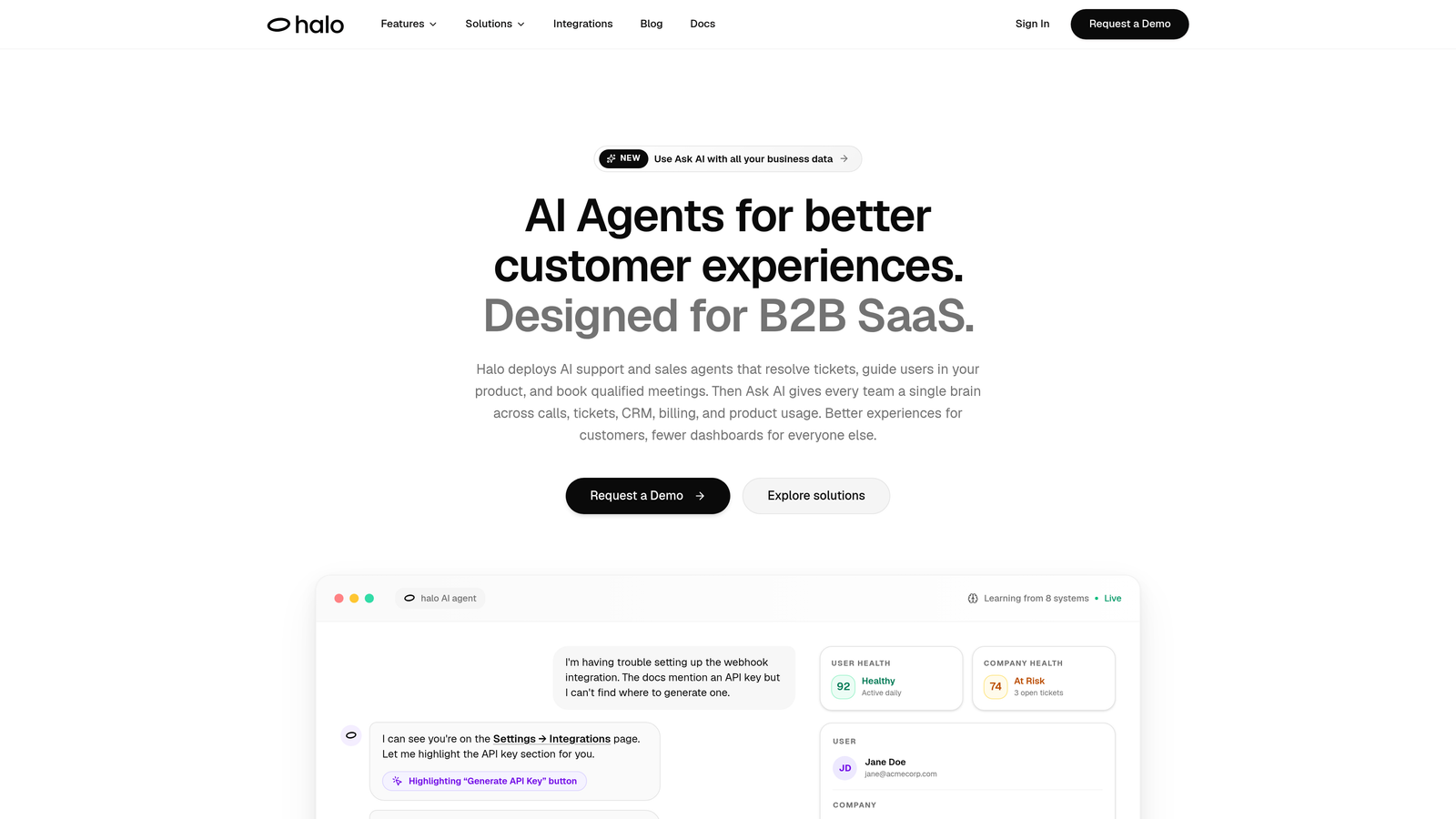
Halo AI is an AI-first customer support platform that deploys intelligent agents to resolve tickets, guide users through your product with page-aware context, and surface business intelligence while continuously learning from every interaction.
Where This Tool Shines
What separates Halo from most tools on this list is its architecture. Rather than bolting AI onto an existing helpdesk, Halo was built AI-first from the ground up. That distinction matters in practice: the AI isn't a layer on top of legacy infrastructure, it's the core of how the platform operates.
The page-aware chat widget is a standout capability. The AI sees exactly what the user sees, including the specific page they're on, enabling contextual UI guidance that generic chatbots simply can't deliver. Combine that with a smart inbox that surfaces customer health signals, revenue anomalies, and churn indicators, and you have a support tool that also functions as a business intelligence layer.
Key Features
Page-Aware Chat Widget: The AI understands the user's exact page context, enabling step-by-step UI guidance that's relevant to where they are in your product.
Intelligent Ticket Resolution: AI agents resolve tickets autonomously and continuously improve through learning from each interaction over time.
Auto Bug Ticket Creation: Automatically generates and routes bug reports directly into engineering workflows, closing the loop between support and product teams.
Smart Inbox with Business Intelligence: Surfaces customer health signals, revenue intelligence, and anomaly detection beyond standard support analytics.
Deep Integrations: Connects with Linear, Slack, HubSpot, Intercom, Stripe, Zoom, PandaDoc, and Fathom for a fully connected business stack.
Live Agent Handoff: Escalates to human agents with full conversation context preserved, so nothing gets lost in the transition.
Best For
Halo is the strongest fit for SaaS product teams that want their support AI to do more than deflect tickets. If you need a tool that connects support data to engineering, sales, and customer success workflows while learning from every interaction, this is built for that use case.
Pricing
Check haloagents.ai for current pricing details and plan options.
2. Intercom (Fin AI Agent)
Best for: Teams already on Intercom who want a native AI agent without platform migration.
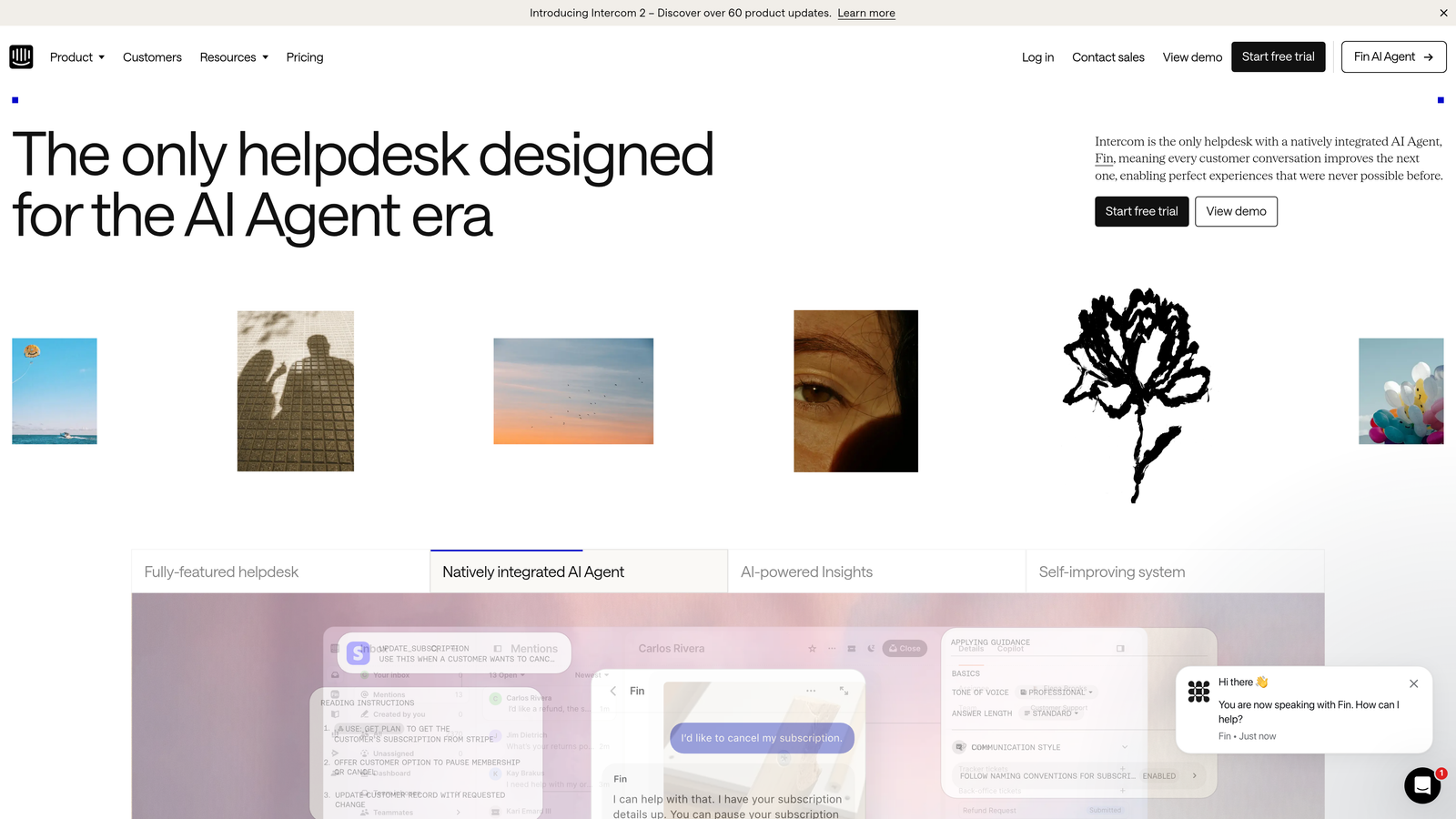
Intercom's Fin AI Agent is a conversational AI built on top of Intercom's customer messaging platform, handling support queries across chat, email, and help center with configurable knowledge sources.
Where This Tool Shines
Fin's biggest advantage is its native integration with the Intercom ecosystem. If your team is already using Intercom for customer messaging, deploying Fin means no migration, no new platform to learn, and no disruption to existing workflows. The adoption curve is genuinely smooth for existing users.
Fin handles full conversations autonomously and can be configured with custom instructions and proprietary knowledge bases, giving support teams meaningful control over how the AI represents their brand and responds to customers.
Key Features
Autonomous Conversation Handling: Fin manages complete support conversations across chat, email, and help center without requiring human intervention for routine queries.
Custom Knowledge Configuration: Teams can configure Fin with custom instructions and proprietary knowledge bases tailored to their product and policies.
Native Intercom Integration: No migration required for existing Intercom users; Fin operates within the platform teams already know.
Usage-Based Pricing: Billed per resolution, keeping costs directly tied to outcomes rather than seat count.
Seamless Human Handoff: Escalates to human agents within the same Intercom platform, maintaining conversation continuity.
Best For
Teams already invested in the Intercom platform who want to add AI agent capability without switching tools. Switching costs are real if you're not already on Intercom, so new adopters should evaluate the full platform fit before committing.
Pricing
Fin is included in Intercom plans and billed per resolution. Check intercom.com for current rates.
3. Zendesk AI
Best for: Large enterprise support organizations already running on the Zendesk Suite.
Zendesk AI embeds intelligent automation across the full Zendesk Suite, from AI agents and intelligent triage to agent copilot suggestions, making it the natural AI upgrade for enterprise teams already on Zendesk.
Where This Tool Shines
Zendesk AI's strength comes from depth of integration within its own ecosystem. Every AI feature, from triage to copilot to macro suggestions, is designed to work together across the Zendesk Suite. For large support teams with complex routing requirements, that coherence is genuinely valuable.
According to Zendesk's own stated positioning, their AI is trained on a large corpus of real customer service interaction data, which informs how the triage and intent detection models perform. For teams already running Zendesk at scale, the AI layer adds meaningful efficiency without requiring a platform change.
Key Features
AI Agents: Handle customer-facing conversations and ticket resolution autonomously across supported channels.
Intelligent Triage: Routes tickets automatically based on intent, sentiment, and priority signals detected in incoming messages.
Agent Copilot: Suggests next best actions and response drafts to help human agents work faster and more consistently.
Macro Suggestions: Automates repetitive reply workflows by identifying patterns in how agents respond to similar tickets.
Suite-Wide AI: AI capabilities span the entire Zendesk platform rather than being isolated to a single module.
Best For
Enterprise support teams with significant existing investment in the Zendesk ecosystem. Teams not already on Zendesk should weigh the platform migration cost carefully before choosing it primarily for the AI features.
Pricing
AI features are available on higher-tier Zendesk Suite plans; AI agents are billed per resolution. Check zendesk.com for current pricing.
4. Freshdesk Freddy AI
Best for: Mid-market teams wanting layered AI across customer, agent, and manager workflows at accessible pricing.
Freshdesk's Freddy AI is a three-layer AI system covering customer self-service, agent assistance, and management analytics, making AI-powered support accessible to mid-market teams without enterprise price tags.
Where This Tool Shines
Freddy's three-layer design is genuinely thoughtful. Most AI support tools focus on either the customer-facing bot or the agent copilot. Freddy addresses all three levels of the support operation simultaneously: customers get autonomous resolution, agents get drafting and summarization assistance, and managers get AI-generated insights and trend detection.
The Freshworks ecosystem connection adds additional value for teams using Freshsales CRM or Freshservice for IT support, enabling cross-platform context that improves AI response quality.
Key Features
Freddy Self Service: Customer-facing bot that resolves common queries autonomously using your knowledge base and configured responses.
Freddy Copilot: Drafts responses, summarizes long ticket threads, and surfaces relevant knowledge articles to help agents respond faster.
Freddy Insights: AI-generated analytics and trend detection gives support managers visibility into emerging issues and performance patterns.
Freshworks Suite Connectivity: Connects with Freshsales CRM and Freshservice ITSM for cross-functional context.
Accessible Pricing: More affordable than enterprise-tier competitors, making advanced AI features reachable for growing teams.
Best For
Mid-market support teams looking for comprehensive AI coverage across the full support operation without the enterprise pricing of Zendesk or Salesforce. Particularly strong for teams already using other Freshworks products.
Pricing
Freddy AI features are tiered across Freshdesk plans; most AI capabilities require the Growth plan or above. Check freshworks.com for current pricing.
5. Salesforce Agentforce
Best for: Enterprises where sales and support data are tightly integrated within the Salesforce ecosystem.
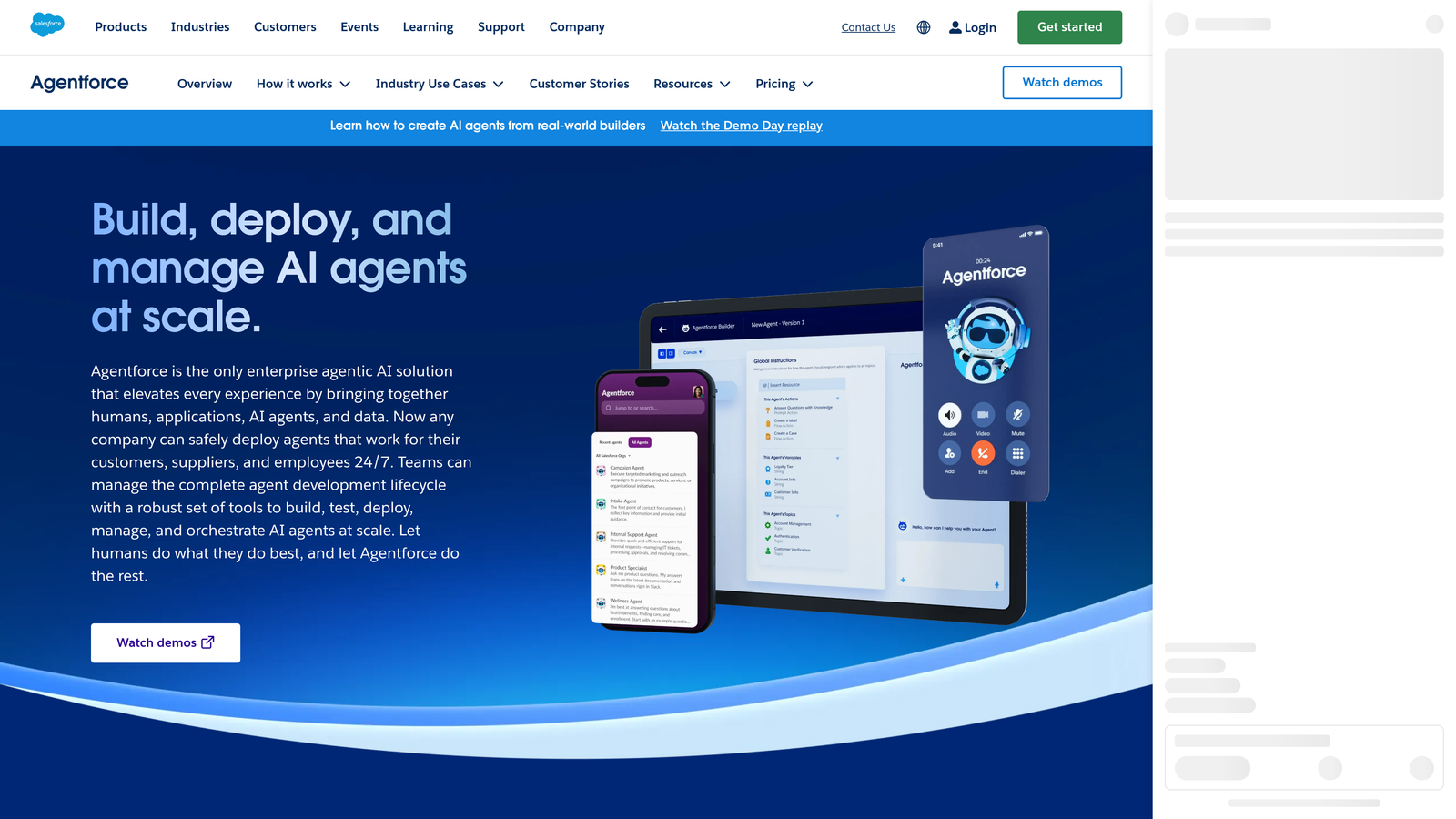
Salesforce Agentforce is an autonomous AI agent platform embedded in Service Cloud, pulling live CRM data to deliver highly personalized, context-rich support responses for enterprise operations.
Where This Tool Shines
Agentforce's core advantage is access to live Salesforce CRM data. When an AI agent can see a customer's full account history, open opportunities, past cases, and billing status in real time, the quality and personalization of responses improves substantially. For enterprises where sales and support are deeply intertwined, that context is hard to replicate with other tools.
Beyond basic query handling, Agentforce can manage case creation, order management queries, and appointment scheduling autonomously, covering a broader range of support scenarios than many conversational AI tools.
Key Features
Live CRM Data Access: Agents pull real-time Salesforce CRM data to deliver personalized responses based on account history and context.
Broad Task Handling: Manages case creation, order management queries, and appointment scheduling autonomously.
Deep Ecosystem Integration: Works across the full Salesforce platform including Sales Cloud, Service Cloud, and Marketing Cloud.
Configurable Agent Personas: Customizable action sets and personas for different support scenarios and customer segments.
Consumption-Based Pricing: Billed per conversation, scaling costs with actual usage rather than fixed seat counts.
Best For
Enterprises already running Salesforce as their primary business platform. Agentforce requires significant Salesforce infrastructure investment to deliver full value; it's not the right choice for teams without existing Salesforce deployment.
Pricing
Consumption-based pricing per conversation; requires existing Salesforce licensing. Check salesforce.com for current rates.
6. Tidio
Best for: Small businesses and e-commerce teams wanting fast setup and accessible AI without technical complexity.
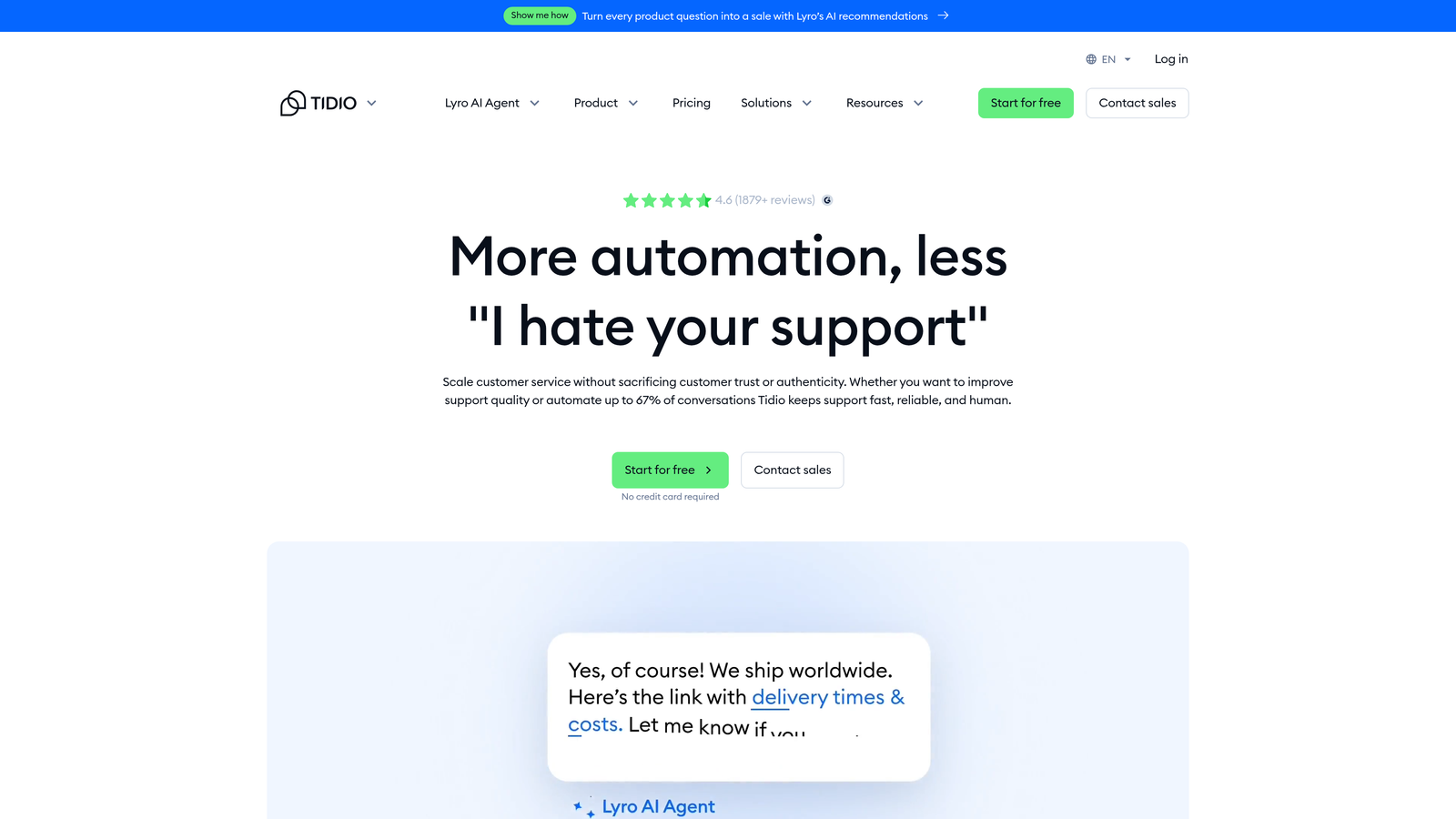
Tidio's Lyro AI makes conversational support automation accessible to small businesses and e-commerce teams, with a visual bot builder, fast setup, and native integrations with Shopify and WooCommerce.
Where This Tool Shines
Tidio removes the technical barriers that prevent smaller teams from adopting AI support tools. The visual drag-and-drop bot builder requires no coding knowledge, and teams can typically go live within hours rather than weeks. For resource-constrained teams, that deployment speed is a real competitive advantage.
The strong free tier also makes Tidio a low-risk starting point for early-stage startups exploring AI support for the first time, allowing teams to validate the value before committing to paid plans.
Key Features
Lyro AI: Handles customer conversations autonomously using your knowledge base, resolving common queries without human intervention.
Visual Bot Builder: Drag-and-drop interface for building conversation flows requires no coding or technical expertise.
E-Commerce Integrations: Native connections with Shopify, WooCommerce, and WordPress for seamless e-commerce support workflows.
Free Tier: Meaningful free plan makes Tidio accessible for early-stage startups and small teams testing AI support.
Unified Inbox: Live chat, email, and Messenger channels consolidated in a single inbox for agents.
Best For
Small businesses, e-commerce brands, and early-stage startups that need fast, affordable AI support without the complexity or cost of enterprise platforms. Less suited for large teams with complex routing requirements or deep CRM integration needs.
Pricing
Free plan available; Lyro AI has conversation-based pricing; paid plans start at accessible rates. Check tidio.com for current pricing.
7. Forethought AI
Best for: Mid-market teams wanting AI augmentation layered on top of their existing helpdesk without switching platforms.
Forethought is a specialized AI layer that plugs into existing helpdesks, including Zendesk, Salesforce, and ServiceNow, adding intelligent triage, autonomous resolution, and agent assist without requiring a platform migration.
Where This Tool Shines
Forethought's positioning is clear and genuinely useful: it's for teams that are happy with their current helpdesk but want to add AI intelligence on top. Rather than asking support teams to migrate to a new platform, Forethought connects to what's already in place and improves it. That's a practical approach for mid-market teams with established workflows they don't want to disrupt.
The three-module structure, covering triage, autonomous resolution, and agent assist, lets teams adopt the pieces most relevant to their current pain points rather than committing to a full platform overhaul.
Key Features
Triage Module: Intent-based routing automatically sends incoming tickets to the right team or queue based on detected topic and priority.
Autoflow: Handles autonomous ticket resolution for common, repeatable queries without human involvement.
Assist Module: AI copilot surfaces relevant knowledge and suggests responses to help human agents resolve tickets faster.
Helpdesk Agnostic: Works alongside Zendesk, Salesforce, ServiceNow, HubSpot, and other established platforms without replacing them.
Modular Adoption: Teams can implement individual modules based on specific needs rather than adopting the full platform at once.
Best For
Mid-market support teams with established helpdesk investments who want AI augmentation without the disruption and cost of a full platform switch. Strong fit when the existing helpdesk is working well but AI capabilities are clearly missing.
Pricing
Enterprise-focused pricing; contact for a quote. Check forethought.ai for details.
8. Kustomer
Best for: High-volume D2C and consumer brands needing omnichannel AI with a unified customer timeline.
Kustomer is a CRM-native customer service platform owned by Meta, with AI built in, offering a unified customer timeline across all channels and autonomous AI handling for high-volume consumer brands.
Where This Tool Shines
Kustomer's CRM-native architecture is its defining strength. Every AI action, whether routing, response suggestion, or autonomous resolution, is informed by the full customer history aggregated across chat, email, SMS, social, and voice. For consumer brands handling high interaction volumes across multiple channels, that unified context produces meaningfully better AI responses.
Meta's ownership creates potential for deeper social and messaging integrations over time, which is a relevant consideration for brands with significant customer engagement on WhatsApp, Instagram, or Facebook Messenger.
Key Features
Unified Customer Timeline: Aggregates all customer interactions across chat, email, SMS, social, and voice into a single chronological view.
AI Routing and Resolution: Handles routing, suggested responses, and autonomous resolution for common queries using full customer history as context.
CRM-Native Architecture: AI operates with complete customer context rather than isolated ticket-by-ticket information.
Omnichannel Coverage: Manages customer interactions across all major channels from a single platform.
Meta Integration Potential: Ownership by Meta positions Kustomer for deeper social and messaging channel integrations.
Best For
High-volume D2C brands and consumer companies with complex omnichannel support needs. Less suited for B2B SaaS teams whose primary support channels are email and in-app chat rather than social and SMS.
Pricing
Enterprise-focused; contact for pricing. Check kustomer.com for details.
9. Help Scout AI
Best for: Small teams and startups that want AI speed without losing the personal, human-first support tone.
Help Scout embeds AI quietly into its shared inbox with AI Summarize, AI Assist, and AI Drafts, giving small teams speed and consistency without sacrificing the personal touch they're known for.
Where This Tool Shines
Help Scout's philosophy is refreshingly honest: AI should make human agents better, not replace them. Rather than pushing autonomous resolution as the headline feature, Help Scout focuses on reducing the friction in how agents read, process, and respond to tickets. The result is a tool that feels like a natural extension of how support teams already work.
For teams whose brand identity is built on warm, human customer relationships, Help Scout's approach is a better cultural fit than tools that push full automation as the primary goal.
Key Features
AI Summarize: Condenses long email threads into quick context so agents can get up to speed without reading every message in a chain.
AI Assist: Refines tone, clarity, and length of agent-written replies before they're sent, improving consistency without removing the human voice.
AI Drafts: Suggests complete reply drafts based on conversation context, which agents can edit and personalize before sending.
Beacon with AI Article Suggestions: Help widget surfaces relevant knowledge base articles automatically, reducing inbound ticket volume.
Human-First Design: Every AI feature is designed to assist agents rather than replace them, preserving the personal support experience.
Best For
Small teams, startups, and companies where the personal quality of customer support is a core part of the brand. If your team's identity is built on human relationships, Help Scout's AI approach won't undermine that.
Pricing
AI features are included in paid Help Scout plans. Check helpscout.com for current pricing.
Which Tool Is Right for Your Team?
The right choice depends on your company size, existing stack, and what you actually need AI to do. Here's a quick framework to guide the decision.
Startups and early-stage teams: Halo AI is the strongest fit if you're building a SaaS product and want AI that connects support to your entire business stack from day one. Help Scout AI is the right call if you're prioritizing human-quality support with AI assistance rather than full automation.
Mid-market teams: Halo AI, Freshdesk Freddy, and Forethought are all strong options. Freddy works best if you're already in the Freshworks ecosystem. Forethought is ideal if you want AI layered on top of an existing helpdesk without migrating. Halo AI is the choice if you want AI-first architecture with deep integrations across your business stack.
Enterprise teams: Zendesk AI and Salesforce Agentforce are the natural choices for large organizations with significant existing platform investment. Agentforce wins when sales and support data are tightly integrated in Salesforce. Zendesk AI wins when you have a large, complex support operation already running on Zendesk.
E-commerce and SMB: Tidio is the fastest path to live AI support for small e-commerce businesses. Kustomer is the better fit for high-volume consumer brands with complex omnichannel needs.
Before you finalize any decision, ask three questions. Does the tool learn from your specific data, or is it relying entirely on generic LLM responses? How deeply does it integrate with your existing stack beyond basic ticketing? And can it escalate intelligently to human agents when a situation requires it? Tools that can't answer yes to all three are leaving real value on the table.
Your support team shouldn't scale linearly with your customer base. Let AI agents handle routine tickets, guide users through your product, and surface business intelligence while your team focuses on complex issues that need a human touch. See Halo in action and discover how continuous learning transforms every interaction into smarter, faster support.