9 Best Customer Support AI Platforms in 2026 (Honest Reviews)
These honest customer support AI platform reviews evaluate nine tools across AI quality, integrations, deployment ease, analytics, and scalability—helping businesses from lean startups to large enterprises identify the right solution to reduce ticket volume, improve response times, and scale support operations efficiently.
 Grant CooperFounder14 min read
Finding the right customer support AI platform is no longer a nice-to-have. It's a competitive differentiator that shapes response times, customer retention, and how efficiently your team scales. But the market is crowded, and most reviews either bury the important details or read like vendor brochures.
This guide cuts through the noise. We evaluated nine platforms across five dimensions: AI quality, integration depth, ease of deployment, analytics capability, and scalability. Whether you're a lean startup drowning in tickets or an enterprise team trying to reduce headcount pressure, there's a platform on this list built for your situation.
A quick note on methodology: Halo AI, which publishes this blog, is included as #1 — not because we're biased, but because it genuinely fits the use case this article targets. We've been equally direct about where competitors outperform us. Use the "Best For" labels to find your match quickly.
1. Halo AI
Best for: B2B SaaS teams that want an AI-native support platform with deep product context and business intelligence.
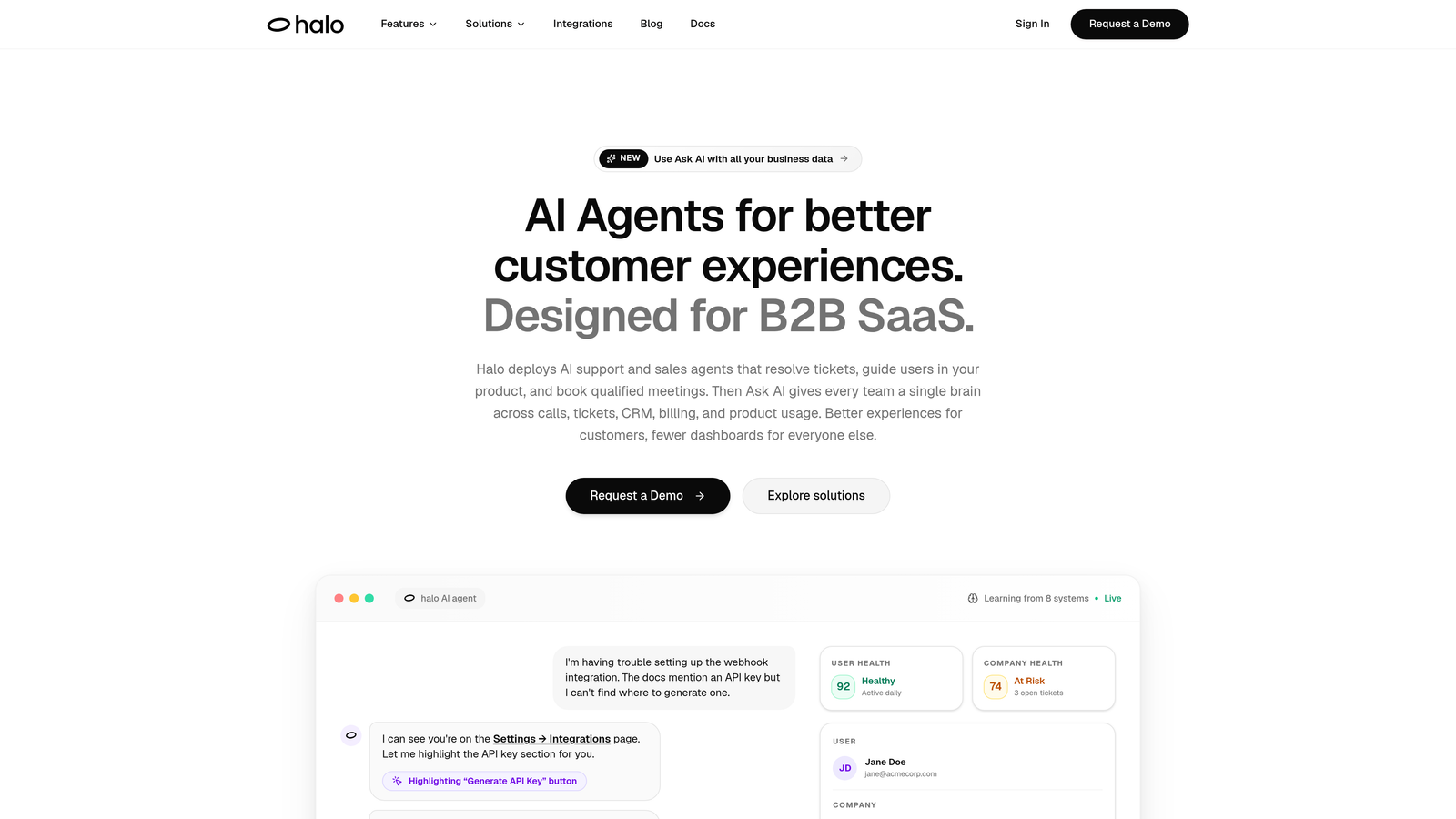
Halo AI is an AI-native customer support platform built specifically for B2B SaaS teams that need more than ticket deflection.
Where This Tool Shines
Halo's most distinctive capability is its page-aware chat widget. The AI understands what a user is currently looking at inside your product, which means it can provide contextually precise guidance rather than generic knowledge base responses. This is a meaningful differentiator for product-led growth companies where users need in-the-moment help.
Beyond support, Halo surfaces business intelligence signals from conversations: customer health indicators, revenue anomalies, and churn risk patterns. Most platforms stop at deflection metrics. Halo turns your support channel into a source of strategic insight your product and revenue teams can actually use.
Key Features
Page-Aware Chat Widget: The AI sees what the user sees, enabling contextually accurate guidance without the user needing to explain where they are in the product.
Intelligent AI Agents: Autonomous ticket resolution with well-designed human escalation logic for complex issues that genuinely need a person.
Smart Inbox with Business Intelligence: Customer health signals, revenue intelligence, and anomaly detection surfaced directly from support conversations.
Auto Bug Ticket Creation: Automatically identifies and routes bug reports to engineering tools like Linear, reducing the manual handoff between support and product teams.
Deep Integrations: Connects with Slack, HubSpot, Intercom, Stripe, Zoom, PandaDoc, and Fathom — covering the full B2B SaaS stack.
Continuous Learning: The AI improves from every resolved interaction, compounding accuracy over time rather than staying static.
Best For
Halo is the strongest fit for B2B SaaS companies using a product-led growth model, teams that want AI-native architecture rather than a bolt-on, and organizations where support data should be feeding product and revenue decisions — not just closing tickets.
Pricing
Visit haloagents.ai for current pricing details. Plans are designed for growing SaaS teams.
2. Intercom (Fin AI)
Best for: Teams already using Intercom who want a tightly integrated AI agent without switching platforms.
Intercom Fin is Intercom's native AI agent, built on advanced large language models and deeply embedded in the Intercom Messenger and knowledge hub ecosystem.
Where This Tool Shines
Fin's biggest strength is how seamlessly it lives inside the Intercom environment. If your team already runs customer communications through Intercom, adding Fin requires minimal configuration. The AI resolves conversations using your existing knowledge base and hands off to human agents within the same Intercom Inbox workflow your team already knows.
The consumption-based pricing model is worth understanding before you commit. Paying per resolution rather than per seat can be cost-effective at lower volumes, but organizations with high ticket counts should model the economics carefully before assuming it's cheaper than alternatives.
Key Features
Fin AI Agent: Resolves conversations autonomously by drawing on your connected knowledge base, with natural language understanding built on advanced LLMs.
Seamless Human Handoff: Escalates to live agents within Intercom Inbox without friction or context loss.
Per-Resolution Pricing: Charges approximately $0.99 per resolution rather than per seat, which can align costs with actual AI value delivered.
Multilingual Support: Handles conversations in multiple languages out of the box, without additional configuration.
Conversation Analytics and CSAT: Built-in tracking for resolution rates, customer satisfaction, and conversation quality.
Best For
Teams already invested in the Intercom ecosystem who want to activate AI without a platform migration. Less compelling as a standalone choice if you're not already using Intercom for customer communications.
Pricing
Fin AI charges approximately $0.99 per resolution on top of an Intercom base plan. Verify current pricing at intercom.com, as rates and plan requirements can change.
3. Zendesk AI
Best for: Large support organizations with complex routing logic that need AI layered onto an established helpdesk.
Zendesk AI adds intelligent triage, agent copilot assistance, and automated responses on top of the world's most widely deployed customer service platform.
Where This Tool Shines
Zendesk's AI capabilities are strongest in the triage and agent-assist categories. The platform's maturity means you can build sophisticated routing logic and quality assurance workflows that would take considerable effort to replicate elsewhere. For large support organizations managing thousands of tickets daily, this configurability is genuinely valuable.
The honest caveat: Zendesk AI remains more "assist" than "autonomous." It excels at helping agents work faster rather than replacing agent effort entirely. Teams expecting high autonomous resolution rates may find the AI layer more of an efficiency multiplier than a headcount reducer.
Key Features
AI Triage: Automatically categorizes, prioritizes, and routes incoming tickets before agents engage, reducing manual sorting overhead.
Agent Copilot: Suggests responses and next-best actions in real time as agents handle tickets, improving consistency and speed.
Automated Self-Service Bots: Handles common deflection scenarios before tickets reach the queue.
Advanced Analytics and QA: Robust reporting tools with quality assurance capabilities for monitoring agent and AI performance.
Extensive App Marketplace: Thousands of integrations available through the Zendesk marketplace for custom workflow requirements.
Best For
Enterprise and mid-market support teams already on Zendesk Suite who want AI capabilities without migrating platforms. Also strong for organizations where compliance, audit trails, and custom routing logic are non-negotiable.
Pricing
AI features are add-ons to Zendesk Suite plans; Suite starts around $55 per agent per month. Verify current pricing and add-on costs at zendesk.com.
4. Freshdesk Freddy AI
Best for: SMBs that want practical AI capabilities at an accessible price point without changing helpdesks.
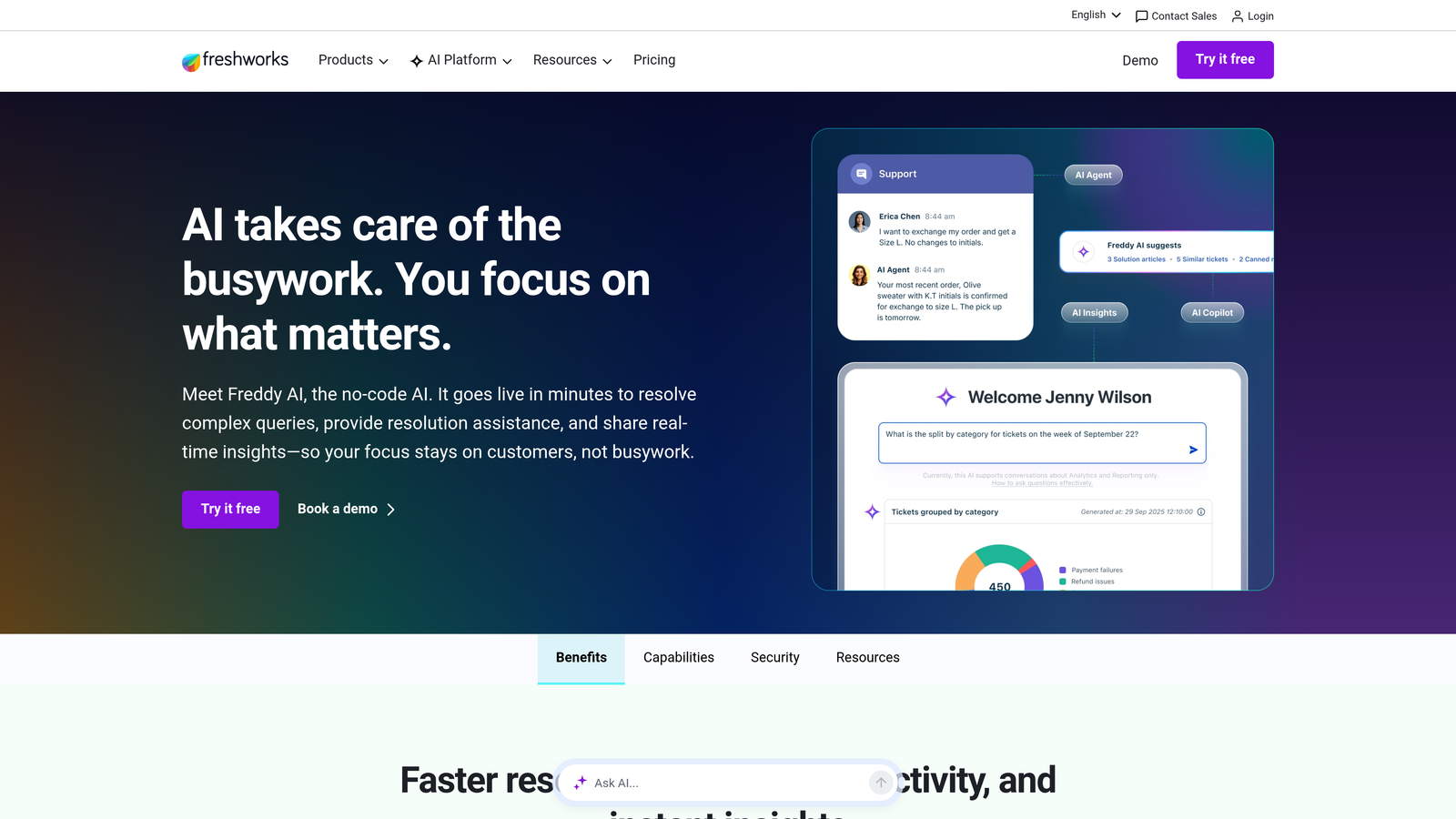
Freshdesk Freddy AI is Freshworks' AI suite, bringing agent assistance and customer self-service automation to the Freshdesk platform with a friendlier price tag than many enterprise alternatives.
Where This Tool Shines
Freddy's value proposition is accessibility. For teams that have budget constraints but still want meaningful AI capabilities, Freshworks delivers a practical combination of agent copilot and self-service deflection without requiring a platform overhaul. The no-code bot builder in particular lowers the barrier for teams without dedicated technical resources.
Freddy also benefits from native integration across the Freshworks ecosystem — Freshdesk, Freshchat, and Freshservice — which matters for teams using multiple Freshworks products. The tradeoff is that Freddy's AI depth doesn't match the LLM-native capabilities of purpose-built AI platforms.
Key Features
Freddy Copilot: Assists agents with suggested replies and ticket summaries, reducing time-to-response on routine interactions.
Freddy Self Service: AI-powered deflection bots that handle common questions before they reach the agent queue.
Native Freshworks Integration: Works across Freshdesk, Freshchat, and Freshservice without additional configuration.
Sentiment Analysis: Automatically detects sentiment on incoming tickets to help prioritize urgent or frustrated customers.
No-Code Bot Builder: Visual interface for creating self-service flows without engineering involvement.
Best For
SMBs and growing teams already using Freshdesk who want to add AI capabilities incrementally. A practical choice when budget is a primary constraint and the goal is efficiency improvement rather than full autonomous resolution.
Pricing
Freddy Copilot is available from the Growth plan, approximately in the $15-18 per agent per month range. Self Service is a separate add-on. Verify current pricing at freshworks.com.
5. Salesforce Agentforce
Best for: Enterprise organizations where support and CRM data must operate from a single source of truth.
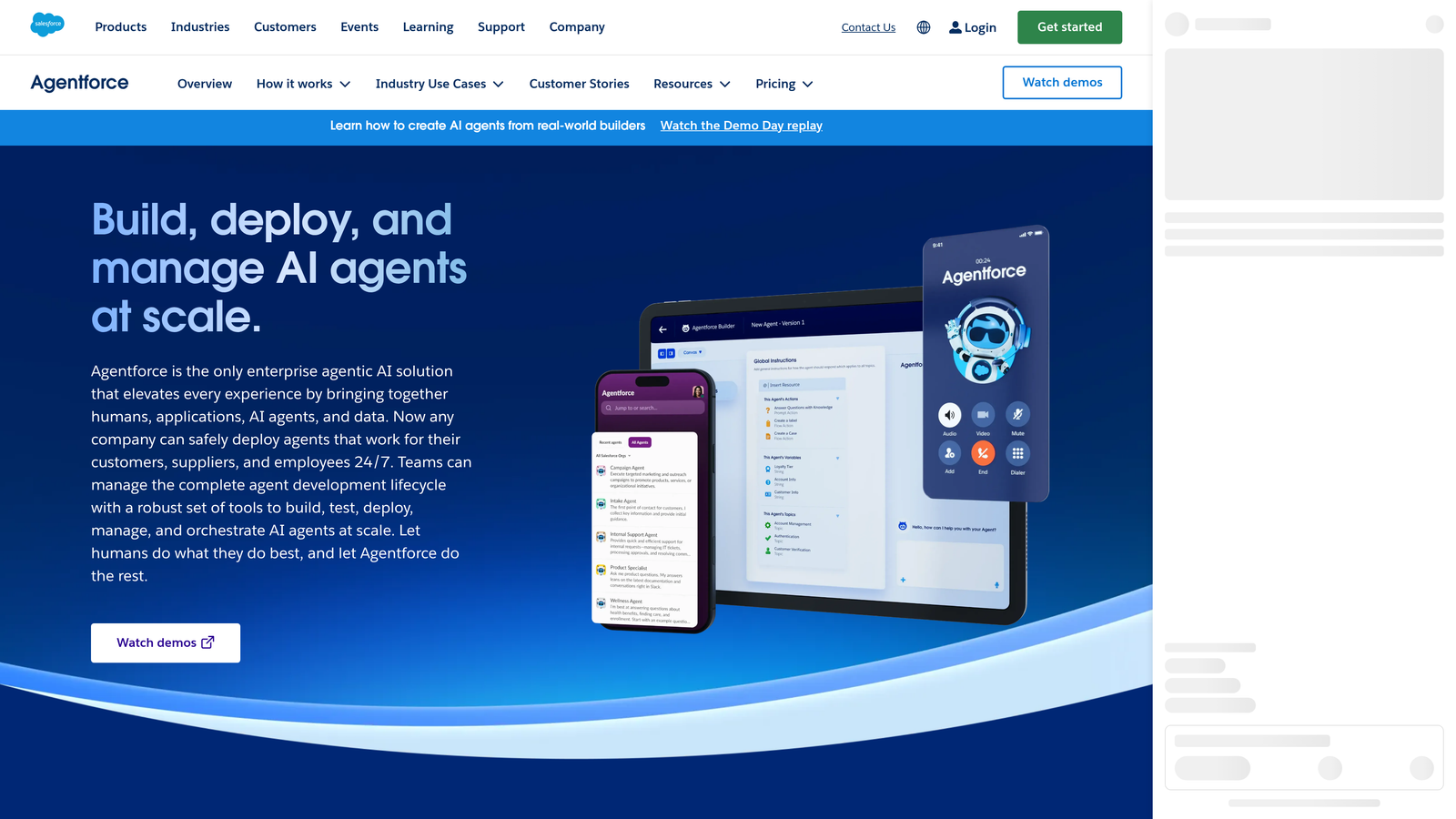
Salesforce Agentforce is Salesforce's enterprise AI agent platform, built natively into Service Cloud and backed by the full Salesforce data graph.
Where This Tool Shines
Agentforce's genuine differentiator is CRM data access. When an AI agent can reason across a customer's full account history, open opportunities, contract status, and service interactions simultaneously, the quality of responses in complex B2B scenarios improves substantially. For enterprises where sales and support data convergence is a strategic priority, this is hard to replicate with other platforms.
The tradeoff is implementation complexity and cost. Agentforce is not a tool you deploy in a week. Organizations without Salesforce expertise on staff should factor in significant professional services investment. It's purpose-built for large enterprises, and that shows in both capability and complexity.
Key Features
Native CRM Data Access: AI agents operate with full visibility into Salesforce CRM data, account history, and customer relationships.
Pre-Built Agent Templates: Ready-made templates for common service scenarios to accelerate deployment.
Cross-Cloud Integration: Deeply connected with Service Cloud, Sales Cloud, and Data Cloud for unified data reasoning.
Einstein AI Reasoning: Applies AI reasoning across customer history and account data to generate contextually informed responses.
Enterprise Security and Compliance: Enterprise-grade audit controls, permissions, and compliance frameworks built in.
Best For
Large enterprises already on Salesforce Service Cloud where support and sales data convergence is a priority. Not the right fit for SMBs or teams without existing Salesforce infrastructure.
Pricing
Service Cloud starts at approximately $75 per user per month; Agentforce is an additional cost on top. Enterprise pricing applies. Verify at salesforce.com.
6. Tidio
Best for: Small businesses and e-commerce stores that need fast deployment and native Shopify or WooCommerce integration.
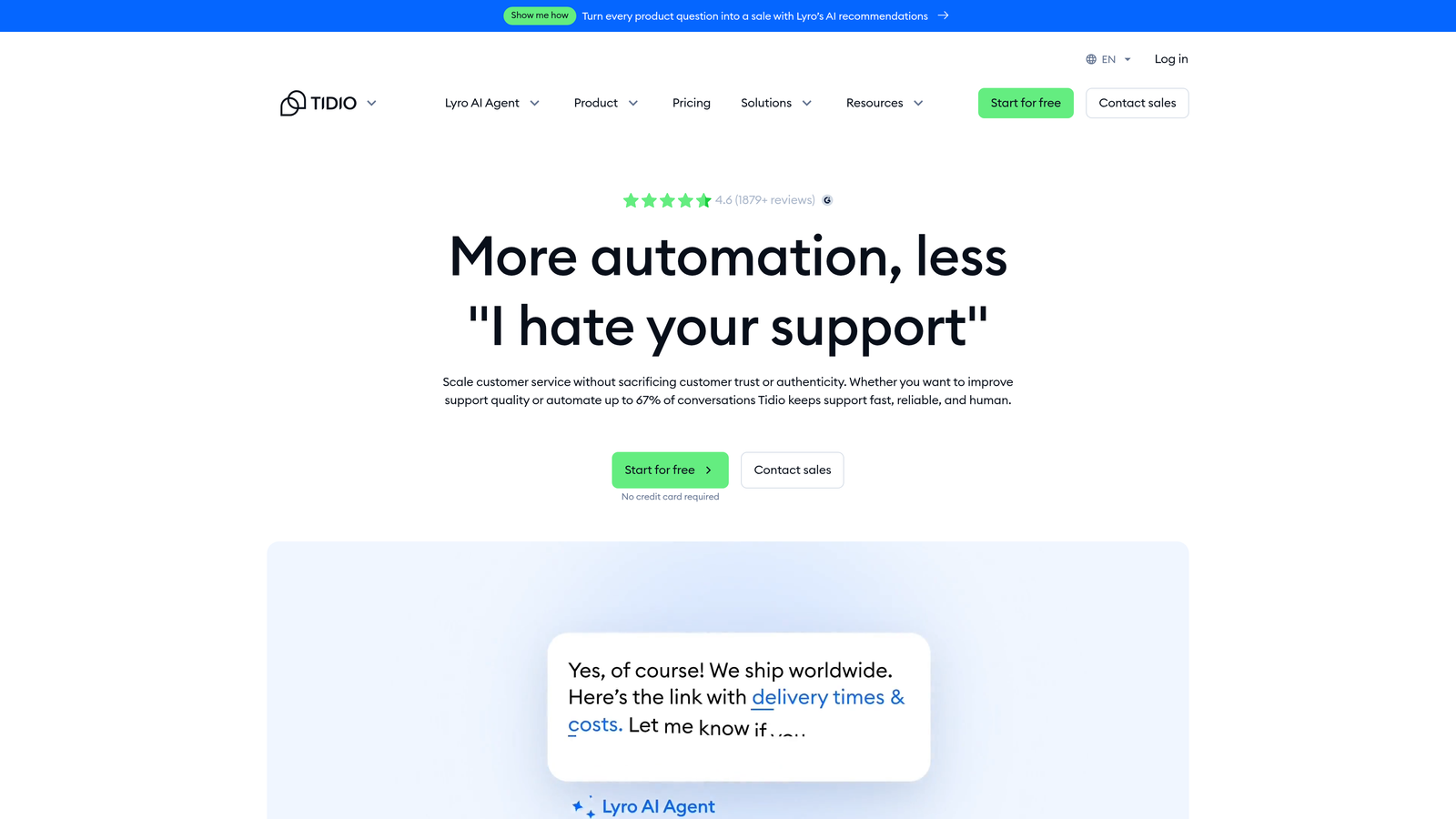
Tidio combines live chat, AI chatbots, and email in a single platform with a fast setup process and a free tier that makes it accessible for very small teams.
Where This Tool Shines
Tidio's speed-to-value is its strongest selling point. Teams can get a chatbot live in hours rather than days, and the visual drag-and-drop builder requires no coding knowledge. For small businesses that need something working quickly without a dedicated technical team, that matters.
The Lyro AI chatbot handles automated conversations and has improved meaningfully, though it's worth noting that Tidio's AI is more rules-augmented than LLM-native at its core. For straightforward e-commerce support scenarios — order status, return policies, product questions — it performs well. For complex reasoning or nuanced B2B conversations, the limitations become more apparent.
Key Features
Visual Bot Builder: Drag-and-drop chatbot creation with no coding required, enabling non-technical teams to build and iterate quickly.
Native E-Commerce Integrations: Direct integrations with Shopify and WooCommerce for order-aware support conversations.
Lyro AI Chatbot: Automated customer conversation handling for common questions and deflection scenarios.
Live Chat with Agent Desktop: Full live chat capability with both desktop and mobile agent apps.
Free Tier: A functional free plan for very small teams testing the platform before committing.
Best For
Small businesses, e-commerce stores, and early-stage startups that need a fast, affordable support solution with strong Shopify or WooCommerce integration. Less suited for B2B SaaS or complex support workflows.
Pricing
Free tier available; paid plans start around $29 per month. Verify current pricing and plan limits at tidio.com.
7. Kustomer
Best for: High-volume consumer brands managing support across email, chat, SMS, social, and voice from a single platform.
Kustomer is a CRM-first customer service platform with AI layered across every channel, built around a unified customer timeline that gives agents complete context before they type a single word.
Where This Tool Shines
Kustomer's unified customer timeline is its core differentiator. Rather than treating each support channel as a separate silo, Kustomer stitches together every interaction across email, chat, SMS, social, and voice into a single chronological view. For consumer brands managing high volumes across many touchpoints, this eliminates the frustrating "can you repeat your issue?" experience that erodes customer trust.
The built-in CRM also removes a common integration headache. Teams don't need to sync customer data from a separate CRM system — it's native to the platform. The AI routing and suggested responses layer on top of this data richness, giving agents and automation meaningful context to work from.
Key Features
Unified Customer Timeline: Every interaction across all channels consolidated into a single chronological view per customer.
AI-Powered Routing and Suggestions: Intelligent routing based on customer context, with AI-suggested responses for agents.
Proactive Outreach and Workflows: Automated workflows for proactive customer communication and follow-up.
Built-In CRM: Native customer relationship data without requiring a separate CRM integration.
Omnichannel Reporting: Robust analytics across all channels in a single reporting view.
Best For
Consumer brands and DTC companies with high support volumes across multiple channels. Less well-suited for B2B SaaS teams where the omnichannel breadth is less relevant than product context and business intelligence.
Pricing
Enterprise pricing, typically in the $89-139 per user per month range. Verify current pricing at kustomer.com.
8. Forethought
Best for: Ops teams that want AI-powered triage and deflection without replacing their existing helpdesk.
Forethought takes a distinct approach: rather than replacing your helpdesk, it acts as an AI intelligence layer that sits on top of platforms like Zendesk and Salesforce, improving efficiency without requiring a full migration.
Where This Tool Shines
Forethought's positioning is clever and genuinely useful for a specific buyer. If your team has significant investment in an existing helpdesk — custom workflows, trained agents, years of data — ripping and replacing is expensive and disruptive. Forethought lets you add meaningful AI capabilities on top of what you have, which dramatically lowers the switching cost and implementation risk.
The Discover AI module is particularly interesting: it analyzes ticket patterns to identify gaps in your knowledge base, surfacing what your customers are asking that your documentation doesn't currently answer. That's a proactive capability most platforms don't offer.
Key Features
Triage AI: Automatically categorizes and prioritizes tickets before agents see them, reducing manual sorting and improving routing accuracy.
Solve AI: Deflects repetitive questions with automated responses, reducing queue volume for common issues.
Assist AI: Surfaces relevant knowledge articles for agents mid-conversation, reducing time spent searching for answers.
Discover AI: Analyzes ticket patterns to identify knowledge base gaps and content opportunities.
Helpdesk Integrations: Works on top of Zendesk, Salesforce, ServiceNow, and other established platforms.
Best For
Mid-market and enterprise teams with existing helpdesk investments who want to improve AI-driven efficiency without a platform migration. Strong for ops-focused buyers who prioritize triage quality and knowledge base optimization.
Pricing
Custom pricing for mid-market and enterprise. Contact Forethought directly at forethought.ai for a quote.
9. Drift (by Salesloft)
Best for: B2B teams where support and sales conversations overlap and revenue routing matters as much as ticket resolution.
Drift, now part of Salesloft, blends conversational AI for both support and sales qualification in a single interface — a unique fit for organizations where the line between support and pipeline is genuinely blurry.
Where This Tool Shines
Drift's core strength is conversation routing that understands revenue intent. When a high-value prospect visits your pricing page and starts a chat, Drift can route that conversation to sales rather than support — automatically, based on account-level targeting. For B2B teams running account-based strategies, this kind of intelligent routing is difficult to replicate with a pure-play support tool.
It's worth being transparent about the post-acquisition context. Since Salesloft acquired Drift, the platform roadmap has shifted toward revenue workflow integration. Teams evaluating Drift purely as a customer support tool should consider whether the revenue-centric feature direction aligns with their primary use case. It's a strong platform, but its identity is increasingly sales-first.
Key Features
AI Chatbots for Support and Sales: Handles both deflection and sales qualification from a single conversational interface.
Revenue-Focused Routing: Connects high-intent visitors to the right sales or support resource based on behavioral and account signals.
Salesloft Revenue Platform Integration: Deep integration with Salesloft's broader revenue workflow and engagement tools.
Meeting Booking and Lead Routing: Automated meeting scheduling and lead assignment directly from chat conversations.
ABM Targeting: Personalizes conversations based on account identity, enabling tailored experiences for target accounts.
Best For
B2B companies where support and sales conversations genuinely overlap, particularly teams running account-based marketing programs. Less suited for organizations focused purely on support efficiency or high-volume consumer service.
Pricing
Custom enterprise pricing. Contact Salesloft directly for current Drift pricing at salesloft.com/drift.
Which Platform Is Right for Your Team?
After reviewing nine platforms, the honest answer is that there's no universal winner. The right choice depends on your team size, existing stack, and what you actually need AI to do.
Here's a quick orientation by use case:
For B2B SaaS teams that want AI-native architecture with product context and business intelligence: Halo AI is the strongest fit. The page-aware widget, continuous learning, and business intelligence signals are purpose-built for this use case.
For teams already on Intercom or Zendesk: Fin AI and Zendesk AI offer the lowest friction path to AI capabilities without a migration. Forethought is worth considering if you want to enhance either platform without replacing it.
For SMBs with budget constraints: Freshdesk Freddy AI and Tidio both offer accessible entry points. Tidio wins on speed and e-commerce fit; Freddy wins if you're already in the Freshworks ecosystem.
For enterprises with Salesforce as the center of gravity: Agentforce is the logical choice, provided you have the implementation resources to match.
For consumer brands managing omnichannel volume: Kustomer's unified timeline and built-in CRM are hard to beat for this specific scenario.
For B2B teams where support and sales blur: Drift's revenue-aware routing fills a niche that pure-play support tools don't address well.
One universal recommendation: trial before you commit. Most platforms offer demos or limited pilots. The gap between a polished demo and day-to-day performance is where real differentiation lives.
Your support team shouldn't scale linearly with your customer base. Let AI agents handle routine tickets, guide users through your product, and surface business intelligence while your team focuses on complex issues that need a human touch. See Halo in action and discover how continuous learning transforms every interaction into smarter, faster support.