9 Best Customer Support AI Platforms Compared for 2026
This in-depth Customer Support AI Platforms Comparison evaluates nine leading platforms — including Halo AI, Zendesk, and Intercom — across AI capability, integration breadth, deployment ease, and total value. Whether you're replacing a legacy helpdesk or building a support function from scratch, this guide gives you a clear, honest picture of which tool fits your stack, team size, and definition of "resolved."
 Grant CooperFounder14 min read
The customer support AI market has matured rapidly. Where teams once chose between a basic chatbot or a human agent, they now have access to platforms that autonomously resolve tickets, detect bugs, surface revenue signals, and hand off complex issues with minimal friction. The problem isn't a shortage of options. It's knowing which platform actually fits your stack, your team size, and how you define "resolved."
This comparison evaluates nine platforms on AI capability depth, integration breadth, ease of deployment, and total value. Whether you're replacing a legacy helpdesk, layering AI onto an existing Zendesk or Intercom setup, or building a support function from scratch, this guide gives you a clear picture of what each tool does well, who it's built for, and what it costs.
Halo AI is listed first because it's the platform behind this article. Every other tool earned its place on merit.
1. Halo AI
Best for: B2B SaaS teams that want AI-first support with business intelligence built in
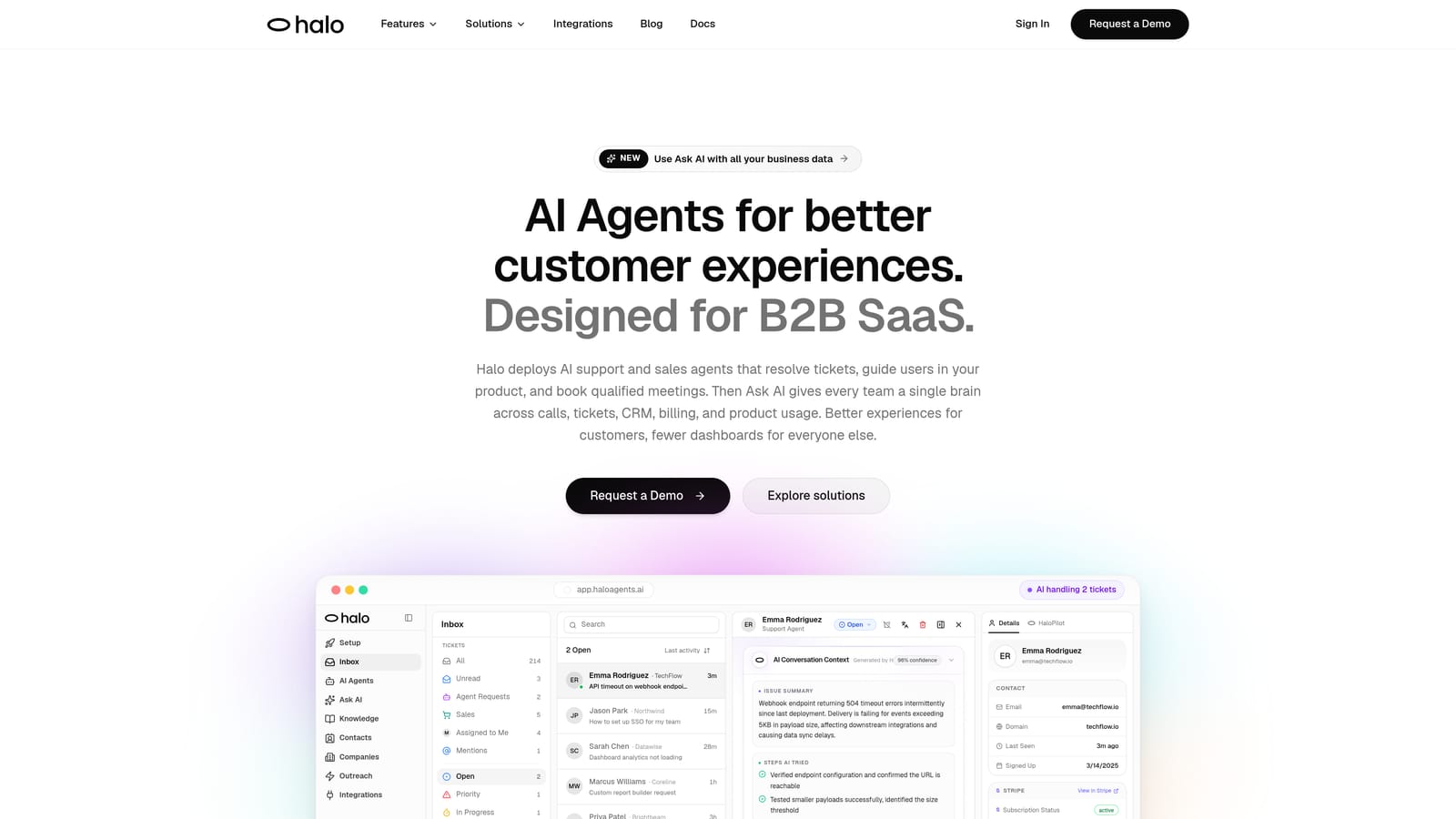
Halo AI is an AI-first customer support platform that autonomously resolves tickets, guides users through your product with page-aware context, and surfaces business intelligence signals while learning from every interaction.
Where This Tool Shines
Most AI support tools bolt onto an existing helpdesk. Halo was built from the ground up as an AI-first system, which means the intelligence isn't an add-on layer fighting against legacy architecture. The page-aware chat widget is a genuine differentiator: the AI sees what the user sees on screen, enabling it to provide contextual UI guidance rather than generic FAQ responses. That's a meaningful step beyond keyword matching.
The smart inbox goes further than most support platforms are willing to go. Beyond tracking ticket volume and response times, it surfaces customer health signals, revenue anomalies, and trend patterns. For product and support teams that want to understand what support data is really telling them about the business, that intelligence layer changes the value proposition entirely.
Key Features
Page-Aware Chat Widget: The AI understands which page a user is on and provides contextual UI guidance based on what they're actually seeing.
Autonomous Ticket Resolution: AI agents handle tickets end-to-end, with continuous learning from each resolved interaction to improve future performance.
Smart Inbox with Business Intelligence: Surfaces customer health signals, revenue anomalies, and support trend data alongside standard inbox management.
Auto Bug Ticket Creation: Automatically creates bug reports and routes them to Linear when issues are detected, reducing manual handoffs between support and engineering.
Live Agent Handoff: Escalates complex issues to human agents smoothly, with full conversation context preserved.
Broad Integration Stack: Connects with Slack, HubSpot, Intercom, Stripe, Zoom, PandaDoc, Fathom, and Linear.
Best For
B2B SaaS companies and product teams that want more than ticket deflection. Halo is particularly well-suited to teams that need their support platform to connect to their CRM, billing, and project management tools, and who want AI that learns continuously rather than requiring manual retraining cycles.
Pricing
Contact for pricing via a demo-first sales motion. Request a demo at haloagents.ai to discuss your specific use case and team size.
2. Intercom (Fin AI Agent)
Best for: Teams already invested in the Intercom ecosystem seeking autonomous AI resolution
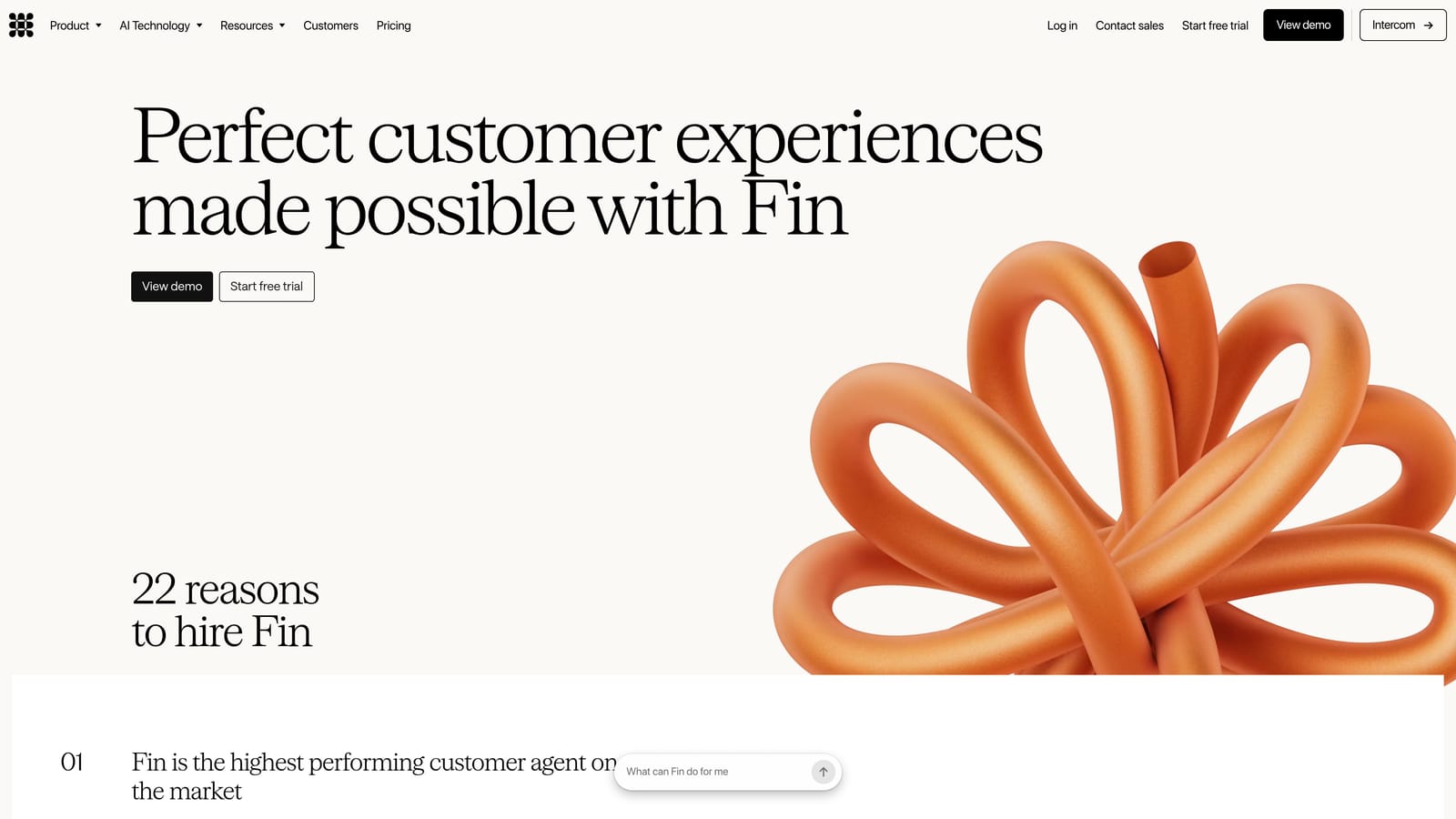
Intercom's Fin AI Agent is a dedicated AI resolution layer built on top of Intercom's messenger, trained on your existing help center content to handle multi-turn support conversations.
Where This Tool Shines
Fin's biggest strength is how naturally it extends an existing Intercom setup. If your team already uses Intercom's inbox, messenger, and help center, Fin slots in without requiring a separate deployment. The training process leverages content you've already written, which reduces setup friction considerably compared to platforms that require custom model training from scratch.
The resolution-based pricing model is worth noting. Rather than charging per seat or per conversation volume, Fin charges per successful resolution. For teams with high deflection rates on straightforward queries, this can work in their favor. For teams with complex, nuanced support needs, the economics deserve careful modeling before committing.
Key Features
Multi-Turn AI Conversations: Handles back-and-forth conversations rather than single-response lookups, trained on your existing help center content.
Native Intercom Integration: Fully embedded within Intercom's inbox, messenger, and help center without requiring separate configuration.
Resolution-Based Pricing: Charges per resolved conversation rather than per seat, aligning cost with actual AI performance.
Confidence-Based Handoff: Escalates to human agents when AI confidence drops below threshold, reducing the risk of bad automated responses.
Tone and Persona Customization: Allows teams to configure Fin's communication style to match their brand voice.
Best For
Teams already running Intercom as their primary support platform who want to add autonomous resolution without switching tools. Less compelling as a standalone choice if you're not already in the Intercom ecosystem, since the base Intercom plan is required.
Pricing
Charged per resolution on top of an existing Intercom plan. Pricing varies based on resolution volume. Visit Intercom's site for current rates.
3. Zendesk AI
Best for: High-volume enterprise support teams already operating within the Zendesk Suite
Zendesk AI embeds intelligent triage, agent copilot assistance, and automated workflow management across the Zendesk Suite for large-scale support operations.
Where This Tool Shines
Zendesk's AI capabilities are most powerful when you're already running a mature Zendesk implementation. The platform's scale is real: intelligent triage, auto-tagging, and routing work well when you're processing thousands of tickets per day and need consistent classification without manual intervention. Agent Copilot provides real-time suggestions and next-step guidance that can meaningfully reduce handle time for complex tickets.
The breadth of automation available through macros and triggers is genuinely impressive for enterprise teams. Where Zendesk AI sometimes falls short is in how native the intelligence feels. For teams coming to it fresh, the AI capabilities can feel layered onto a legacy system rather than built into its core, which affects both the setup experience and the ceiling of what's possible.
Key Features
AI Agents: Automated ticket deflection and self-service resolution for common queries, reducing inbound volume to human agents.
Agent Copilot: Real-time suggestions, reply recommendations, and next-step guidance for human agents during live interactions.
Intelligent Triage and Auto-Tagging: Automatically classifies and routes incoming tickets based on intent, sentiment, and content.
Macro and Trigger Automation: Extensive workflow automation built for high-volume environments with complex routing logic.
Native Suite Integration: AI features work across the full Zendesk Suite including Support, Chat, and Guide.
Best For
Enterprise support operations with high ticket volumes, complex routing requirements, and existing Zendesk infrastructure. Teams starting fresh or running smaller operations may find the implementation complexity and cost structure disproportionate to their needs.
Pricing
AI features are included in higher-tier Zendesk Suite plans. Pricing varies by plan and seat count. Enterprise pricing requires direct contact with Zendesk sales.
4. Freshdesk (Freddy AI)
Best for: SMB and mid-market teams using multiple Freshworks products who want AI across the full suite
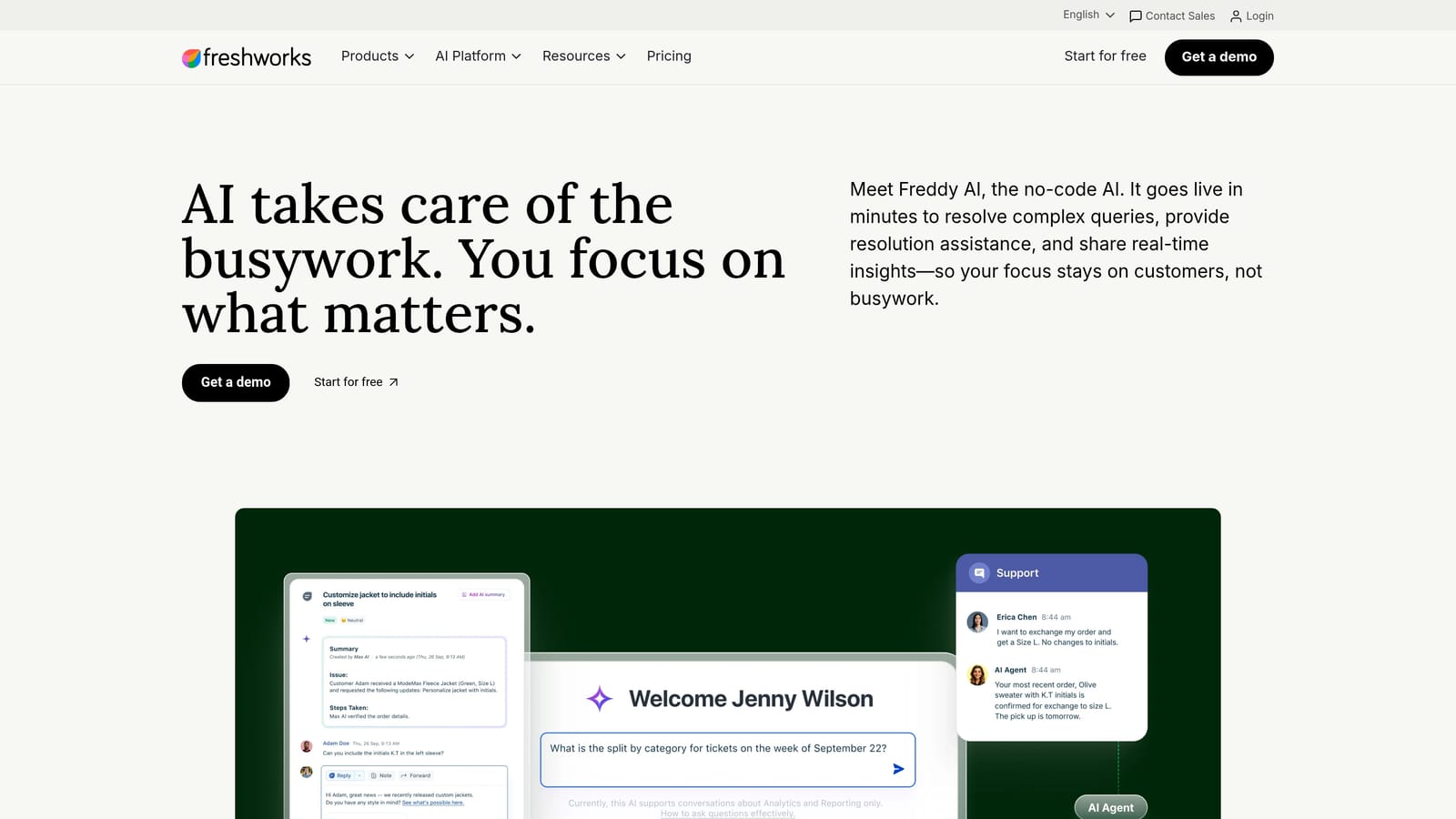
Freshdesk's Freddy AI spans Freshdesk, Freshchat, and Freshsales, offering bot deflection, agent assistance, and analytics across the Freshworks product family.
Where This Tool Shines
Freddy AI's value multiplies when you're already using multiple Freshworks products. The AI layer connects across Freshdesk for ticketing, Freshchat for live messaging, and Freshsales for CRM context, giving teams a unified AI experience without managing multiple vendor relationships. For SMBs looking for a cost-effective entry into AI-assisted support, the pricing structure is more accessible than Zendesk or Salesforce.
Freddy Insights is a useful addition for teams that want AI-generated analytics surfaced directly in their support workflow. It won't replace a dedicated BI tool, but for teams that don't have one, having performance reporting built in reduces the reporting burden on support managers.
Key Features
Freddy Self Service: AI-driven bot deflection that handles common queries before they reach a human agent.
Freddy Copilot: Reply suggestions and conversation summarization to help agents respond faster and more consistently.
Freddy Insights: AI-generated analytics and performance reporting surfaced within the Freshdesk interface.
Cross-Product Coverage: AI capabilities extend across Freshdesk, Freshchat, and Freshsales for teams using the full Freshworks suite.
SMB-Accessible Entry Points: More competitive pricing than enterprise-tier alternatives, with AI features available at lower plan tiers.
Best For
SMB and mid-market teams that are already in the Freshworks ecosystem or looking for a cost-effective all-in-one support and CRM solution with AI capabilities. Teams needing deep AI customization or complex integrations outside the Freshworks stack may find limitations.
Pricing
Freddy AI is included in select Freshdesk plans. Freddy Copilot is available as a paid add-on. Visit Freshworks for current plan details.
5. Salesforce Service Cloud (Einstein AI)
Best for: Enterprise teams where Salesforce is already the system of record for customer data
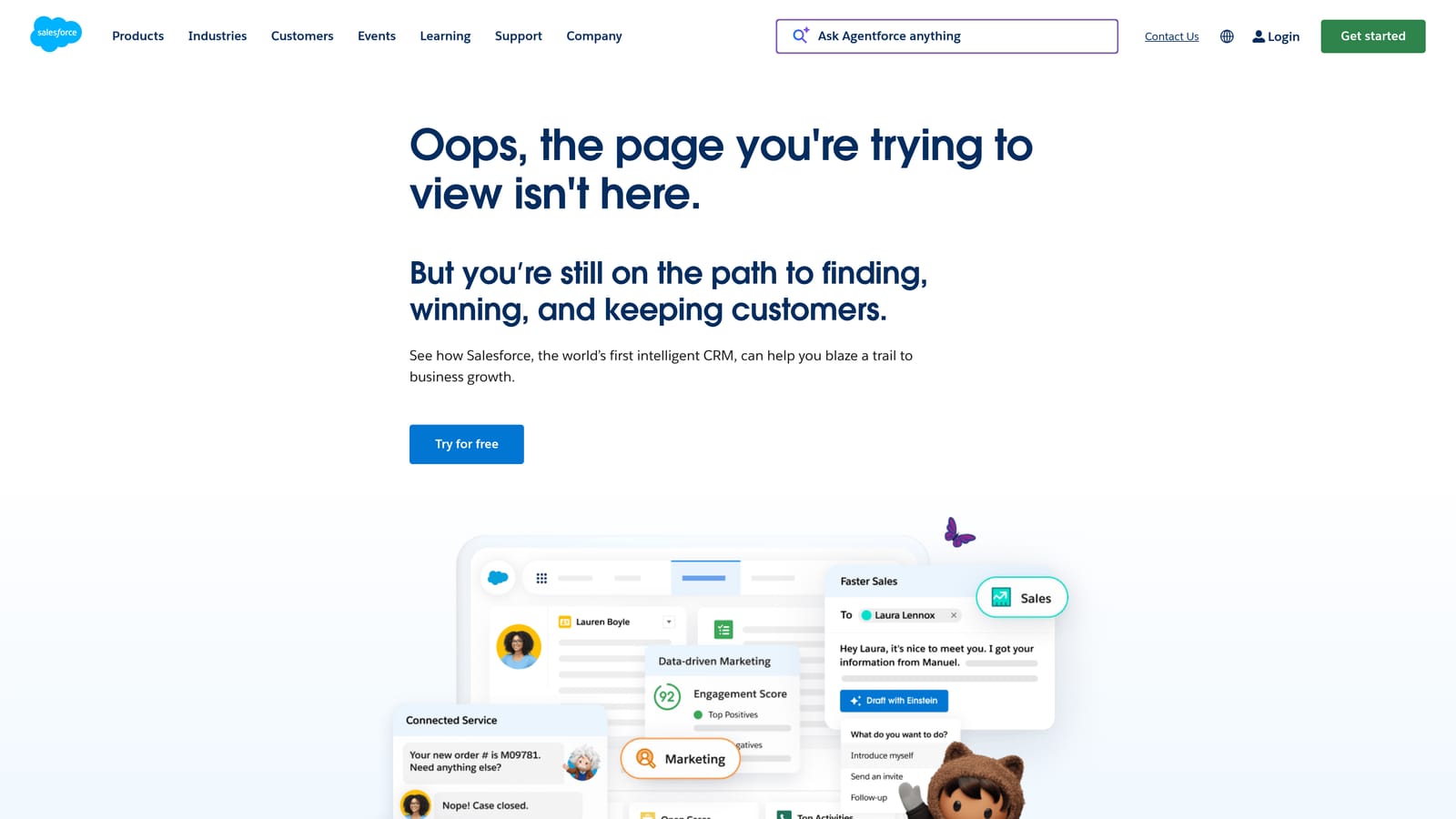
Salesforce Service Cloud integrates Einstein AI deeply with Salesforce CRM data, giving agents full customer context alongside AI-assisted next-best-action guidance.
Where This Tool Shines
The core advantage of Einstein AI is data access. When Salesforce is your CRM, every support interaction can be enriched with complete customer history, contract details, and account health data in real time. Einstein Copilot draws on that context to provide agents with genuinely relevant suggestions rather than generic responses pulled from a knowledge base. For enterprise teams managing high-value customer relationships, that context depth is hard to replicate elsewhere.
Case summarization and next-best-action recommendations reduce the cognitive load on agents handling complex, multi-touch cases. These features are most valuable in environments where cases span multiple interactions over days or weeks, a common pattern in enterprise B2B support.
Key Features
Einstein Copilot: AI-guided agent assistance that draws on full Salesforce CRM data to provide contextually relevant suggestions.
Case Summarization: Automatically condenses long case histories into concise summaries for agents picking up mid-conversation.
Next-Best-Action Recommendations: AI-driven guidance on optimal next steps based on customer data and case history.
Full CRM Integration: Every support interaction is connected to complete Salesforce customer records, contracts, and account data.
Enterprise Security and Compliance: Meets enterprise-grade security, data residency, and compliance requirements.
Best For
Large enterprises where Salesforce is already the primary system of record and support complexity justifies the investment. Teams not already in the Salesforce ecosystem will find the implementation cost and complexity difficult to justify relative to alternatives.
Pricing
Service Cloud plans start at $25/user/month. Einstein AI features require higher-tier plans. Full enterprise deployment costs are significantly higher. Contact Salesforce for accurate current pricing.
6. Tidio (Lyro AI)
Best for: E-commerce businesses and small teams handling high volumes of repetitive, FAQ-style queries
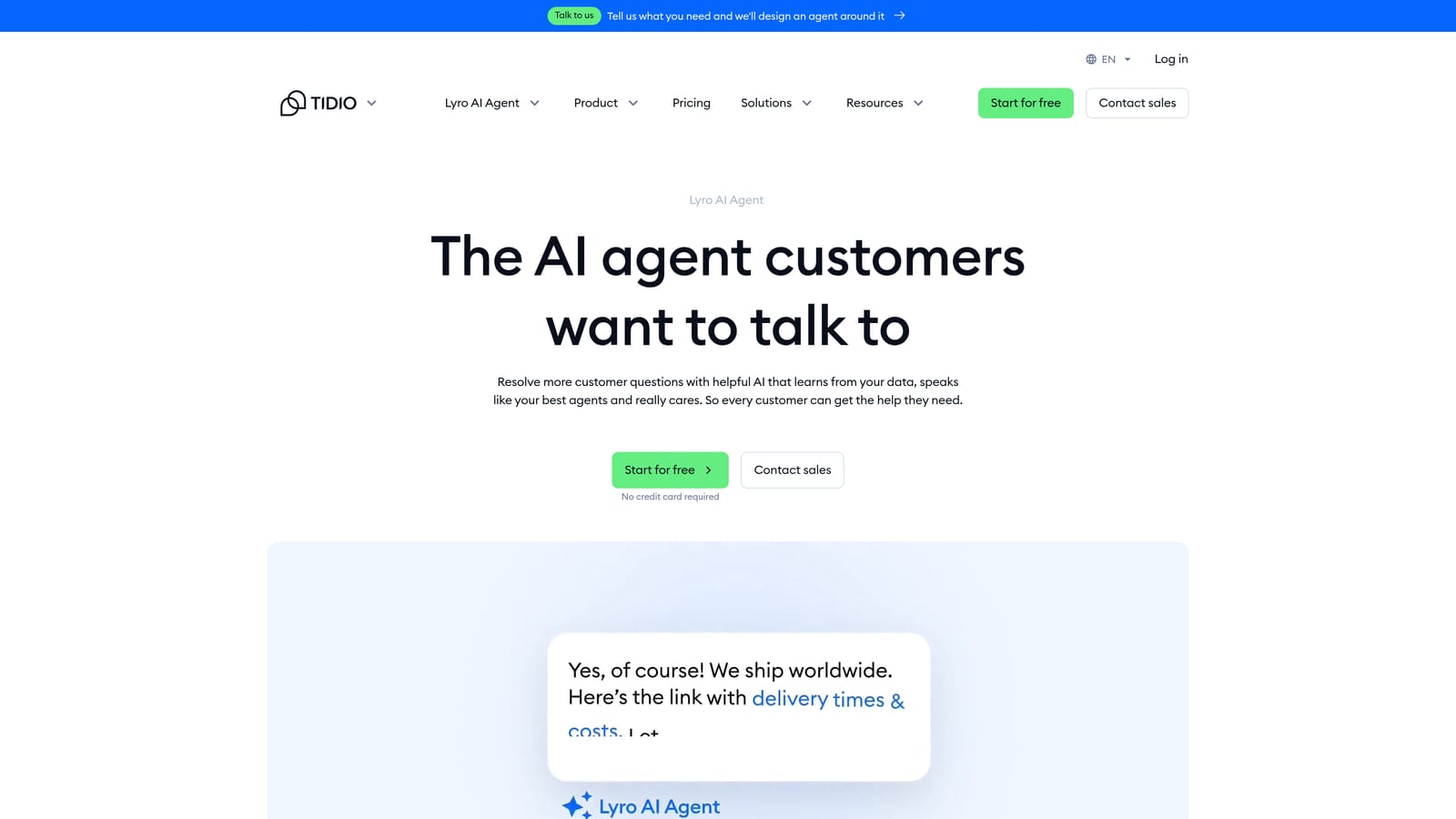
Tidio's Lyro AI is a conversational AI agent designed for fast deployment with minimal training data, purpose-built for e-commerce and small teams managing predictable query patterns.
Where This Tool Shines
Lyro's setup speed is genuinely fast compared to enterprise alternatives. Teams can get an AI agent handling common queries without weeks of training data preparation or complex configuration. For e-commerce businesses dealing with order status, return policies, and shipping questions at scale, that speed-to-value matters. The free tier also makes it accessible for smaller teams that want to experiment with AI support without upfront financial commitment.
The Shopify and WooCommerce integrations are well-built for the e-commerce use case, allowing Lyro to pull order information and provide personalized responses to transactional queries. Where Lyro reaches its ceiling is in complex, multi-step B2B support scenarios that require deep integration with CRM or billing systems.
Key Features
Fast Setup with Minimal Training Data: Deployable quickly without extensive knowledge base preparation, reducing time-to-value.
Autonomous FAQ Handling: Manages repetitive, predictable queries without human intervention, freeing agents for complex issues.
Live Chat Fallback: Seamlessly routes to human agents when queries exceed Lyro's resolution capability.
E-Commerce Integrations: Native connections to Shopify and WooCommerce for order-aware responses.
Free Tier Available: Entry-level access with no upfront cost, allowing small teams to test before committing.
Best For
E-commerce businesses, small SaaS teams, and consumer brands with high volumes of straightforward queries. Less suited to B2B companies needing deep integration with enterprise tools or AI that handles nuanced, multi-step support scenarios.
Pricing
Free tier available. Paid plans start at approximately $29/month. Lyro AI conversations are priced separately. Check Tidio's site for current conversation pricing.
7. Kustomer
Best for: Omnichannel enterprise support teams that need a unified customer timeline across every channel
Kustomer is a CRM-native support platform owned by Meta that unifies every customer interaction into a single timeline, with AI features layered across omnichannel support workflows.
Where This Tool Shines
Kustomer's unified customer timeline is the feature that sets it apart from traditional helpdesks. Every email, chat, social message, SMS, and WhatsApp interaction is logged against a single customer record, giving agents complete context regardless of which channel the conversation started on. For teams managing omnichannel support at scale, eliminating the "can you give me your order number again?" friction is a meaningful operational improvement.
AI-powered intent detection and routing work well in this context because the AI has access to richer customer history than most platforms can offer. Automated workflows with AI-suggested next steps reduce manual triage time, particularly for teams handling high volumes across multiple channels simultaneously.
Key Features
Unified Customer Timeline: Every interaction across all channels is consolidated into a single customer record for full agent context.
AI Intent Detection and Routing: Automatically identifies query intent and routes to the appropriate queue or agent.
Omnichannel Coverage: Supports email, live chat, social media, SMS, and WhatsApp from a single interface.
Automated Workflows with AI Suggestions: Reduces manual triage with AI-recommended next steps embedded in the workflow.
CRM-Native Architecture: Customer data is core to the platform rather than an integration layer, enabling richer AI context.
Best For
Enterprise and mid-market teams managing high-volume omnichannel support who need a unified customer view across every touchpoint. The pricing structure makes it less accessible for smaller teams, and the Meta ownership may be a consideration for some organizations.
Pricing
Enterprise pricing. Contact Kustomer directly for current rates and plan structure.
8. Help Scout
Best for: Teams that want AI to assist human agents rather than replace them
Help Scout is a human-first support platform with AI features deliberately designed to make agents faster and more effective, without removing human judgment from the resolution process.
Where This Tool Shines
Help Scout occupies a distinct position in this market: it's not trying to maximize autonomous resolution rates. The AI features, AI Drafts, AI Summarize, and AI Assist, are designed to reduce the friction of human-written responses rather than eliminate humans from the loop. For teams where brand voice, relationship quality, and nuanced judgment matter more than deflection rates, this philosophy resonates.
The platform's UX is consistently praised for its simplicity. The shared inbox interface is clean and intuitive in a way that enterprise platforms often aren't, and the Beacon widget enables in-app self-service without requiring significant technical configuration. For teams that have been burned by over-engineered support platforms, Help Scout's restraint is a feature.
Key Features
AI Drafts: Generates reply suggestions for agent review, reducing writing time while keeping humans in control of final responses.
AI Summarize: Condenses long conversation threads into quick context summaries for agents joining mid-conversation.
AI Assist: Improves tone, length, and clarity of agent-written replies before sending.
Clean Shared Inbox: Intuitive interface designed for team collaboration without the complexity of enterprise helpdesk platforms.
Beacon Widget: In-app self-service widget for proactive help content delivery without requiring a full chat implementation.
Best For
Support teams that prioritize relationship quality and human judgment over automation rates. Particularly well-suited to B2B companies with complex, high-touch customer relationships where autonomous AI resolution would be inappropriate. Not the right choice if your primary goal is reducing human agent involvement.
Pricing
Plans start at $50/month (Standard tier). AI features are included across paid plans. Visit Help Scout for current plan details.
9. Ada
Best for: Large enterprises automating high-volume, predictable interactions at global scale
Ada is an enterprise-grade no-code AI agent builder focused on automating high-volume, predictable customer interactions with strong multilingual support and enterprise security certifications.
Where This Tool Shines
Ada's no-code builder is genuinely accessible for non-technical teams, which matters in enterprise environments where support operations leaders often don't have dedicated engineering resources to build and maintain AI workflows. The ability to configure and iterate on AI agents without developer involvement reduces deployment time and ongoing maintenance overhead.
The multilingual capability is a real differentiator for global brands. Ada handles interactions across a broad range of languages without requiring separate agent configurations for each market, which simplifies operations for companies managing customer bases across multiple regions. The enterprise security and compliance certifications also make Ada a viable option in regulated industries where data handling requirements are strict.
Key Features
No-Code AI Agent Builder: Non-technical teams can build, configure, and iterate on AI agents without engineering support.
Multilingual Support: Handles customer interactions across multiple languages from a single configuration, suited for global operations.
Enterprise Security and Compliance: Certified for enterprise-grade data security and compliance requirements, including regulated industries.
CRM and Helpdesk Integrations: Connects with major platforms including Salesforce, Zendesk, and others for data access during interactions.
Resolution and Containment Analytics: Dashboard tracking resolution rates, containment rates, and AI performance over time.
Best For
Large consumer brands and global enterprises automating predictable, high-volume interactions at scale. Ada's implementation typically requires dedicated onboarding support, and the pricing reflects enterprise positioning. Teams needing deep customization or highly complex integrations may find the no-code approach limiting for edge cases.
Pricing
Enterprise pricing. Contact Ada directly for a custom quote based on volume and use case.
Which Platform Is Right for Your Team?
The right choice depends less on feature lists and more on where your team actually sits today and where you want to go.
If you're a B2B SaaS team that wants AI-first architecture with business intelligence built in, not just ticket deflection, Halo AI is worth a close look. The page-aware context, continuous learning, and smart inbox signals go meaningfully beyond what most platforms offer out of the box.
If you're already running Intercom and want to add autonomous resolution without switching platforms, Fin AI Agent is the natural extension. If Zendesk or Freshdesk is your current home, their native AI layers reduce migration risk even if they're not the most sophisticated AI-first options available.
For enterprise teams where Salesforce is the system of record, Einstein AI earns its complexity through CRM data depth. For global brands running high-volume, multilingual automation, Ada is purpose-built for that challenge. For teams that want AI to assist rather than replace human agents, Help Scout takes a deliberate and well-executed approach.
E-commerce and smaller teams with straightforward query volumes will find Tidio's Lyro fast to deploy and easy to justify. Omnichannel enterprise operations with complex customer timelines will find Kustomer's unified approach compelling.
Your support team shouldn't scale linearly with your customer base. AI agents should handle routine tickets, guide users through your product, and surface business intelligence while your team focuses on complex issues that need a human touch. See Halo in action and discover how continuous learning transforms every interaction into smarter, faster support.