9 Best Customer Support AI Software Tools Compared for 2026
This customer support AI software comparison evaluates nine leading platforms across automation depth, integration capabilities, analytics quality, and AI-to-human handoff performance to help B2B teams make informed decisions. Whether you're implementing your first AI support tool or upgrading an existing system, this breakdown covers everything from enterprise helpdesk add-ons to fully autonomous AI-first platforms designed to eliminate traditional ticket queues.
 Grant CooperFounder14 min read
Choosing the right customer support AI software has become one of the most consequential decisions a B2B team can make. The market is crowded with options ranging from bolt-on chatbot layers to fully autonomous AI agents, and the differences between them matter enormously at scale.
Whether you're evaluating your first AI support tool or replacing a system that's hit its ceiling, this comparison cuts through the noise. We've assessed nine platforms across key dimensions: automation depth, integration breadth, analytics quality, and how gracefully each handles the handoff between AI and human agents.
The tools span a range of use cases, from enterprise helpdesks adding AI layers to purpose-built AI-first platforms designed to replace ticket queues entirely. If you want a deeper primer before diving in, our guide on how AI agents work in customer support is a solid starting point. Let's get into the comparison.
1. Halo AI
Best for: B2B SaaS teams wanting autonomous ticket resolution and business intelligence in one platform
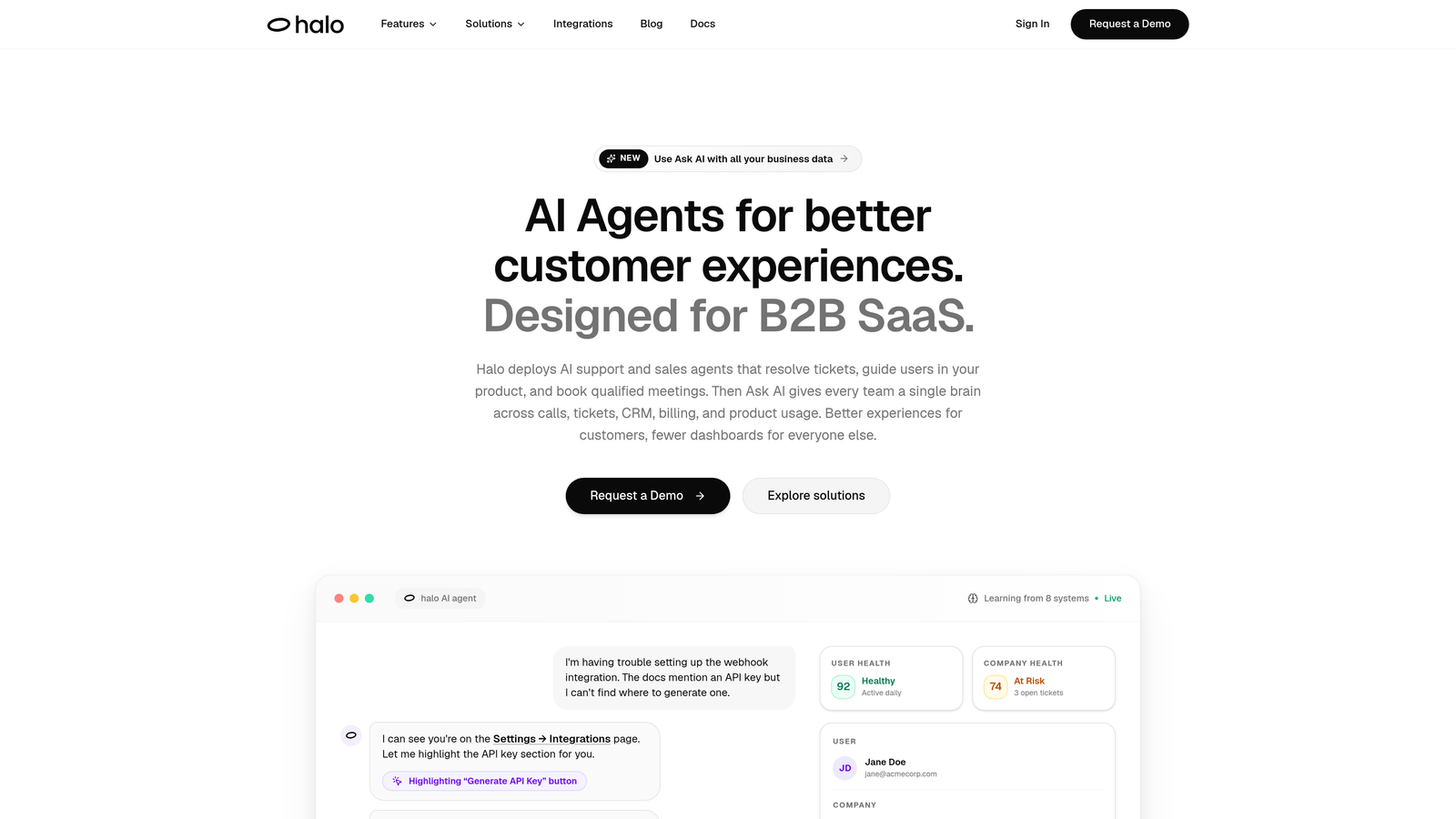
Halo AI is an AI-first customer support platform built from the ground up for B2B SaaS teams who need more than deflection.
Where This Tool Shines
Most AI support tools operate with limited context: they know what the user typed, and that's about it. Halo AI takes a fundamentally different approach with its page-aware chat widget, which sees exactly what the user sees inside your product. That means the AI can guide users through specific UI flows, identify when someone is stuck on a particular screen, and deliver contextually relevant help without the user having to describe their situation from scratch.
Beyond ticket resolution, Halo surfaces business intelligence signals that most support tools ignore entirely: customer health indicators, revenue anomalies, and churn signals derived from support interaction patterns. For B2B SaaS teams, this turns the support inbox from a cost center into a source of strategic insight.
Key Features
Page-Aware Chat Widget: The AI sees the user's current product state, enabling precise, context-specific guidance without requiring the user to explain where they are.
Autonomous Ticket Resolution: AI agents handle tickets end-to-end with intelligent escalation to human agents when complexity warrants it, keeping handoffs smooth rather than jarring.
Auto Bug Ticket Creation: When the AI detects a potential product issue, it automatically creates and routes a bug ticket to Linear or your preferred issue tracker, closing the loop between support and engineering.
Smart Inbox with Business Intelligence: The inbox surfaces customer health signals, revenue anomalies, and churn indicators derived from support patterns, giving leadership visibility beyond standard support metrics.
Deep Integration Stack: Connects natively with Slack, HubSpot, Intercom, Stripe, Zoom, PandaDoc, Fathom, and more, so the AI has full context from across your business stack.
Best For
B2B SaaS companies that want an AI-first support architecture rather than an AI layer bolted onto an existing helpdesk. Particularly strong for teams that need page-level product context, automated bug reporting, and business intelligence signals alongside standard ticket resolution. Less suited to pure e-commerce or high-volume consumer support contexts.
Pricing
Custom pricing based on your team's needs. Contact haloagents.ai directly for a quote and to see a live demo of the platform.
2. Zendesk AI
Best for: Teams already invested in the Zendesk ecosystem wanting to add AI capabilities
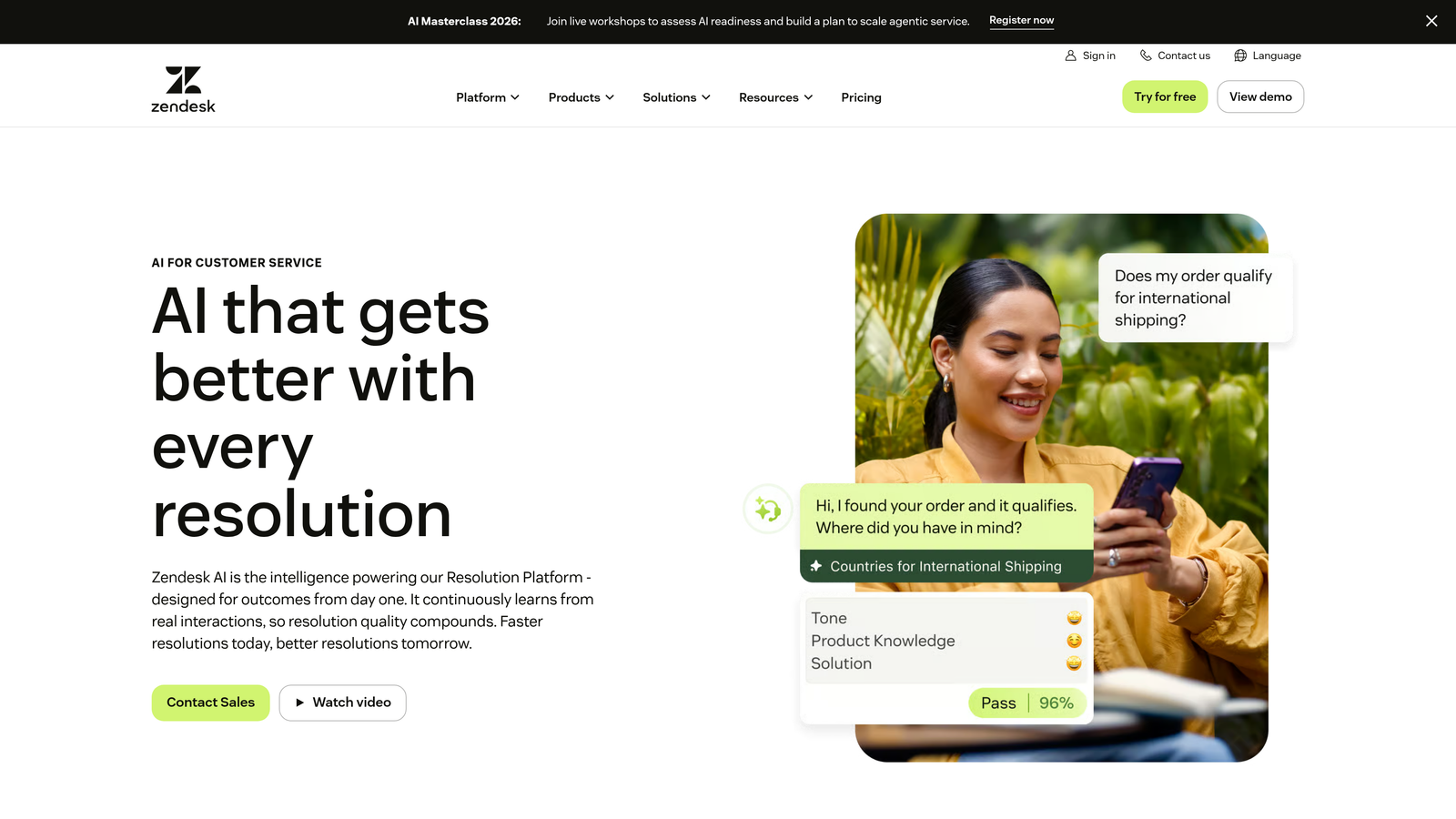
Zendesk AI is the native AI layer built into the Zendesk Suite, covering triage, agent assistance, self-service, and generative content tools.
Where This Tool Shines
Zendesk AI's biggest advantage is its depth of integration with the Zendesk platform itself. If your team lives in Zendesk, the AI features feel native rather than bolted on: triage happens automatically, suggested replies appear in the agent's existing workflow, and AI agents handle self-service without requiring a separate tool or interface.
The Agent Copilot feature is particularly useful for teams handling complex or nuanced queries. It surfaces relevant knowledge base content, suggests responses based on conversation history, and summarizes long ticket threads so agents can get up to speed quickly on escalated issues.
Key Features
AI-Powered Triage: Automatically detects intent, sentiment, and language for incoming tickets, routing them to the right team without manual intervention.
Zendesk AI Agents: Handles automated self-service resolution for common queries, drawing on your help center content and configured conversation flows.
Agent Copilot: Provides suggested responses, ticket summarization, and next-step recommendations directly within the agent's Zendesk workspace.
Generative AI Content Tools: Helps support teams create, update, and optimize knowledge base articles using AI-assisted writing and gap detection.
Native Suite Integration: AI features work across Zendesk's ticketing, messaging, voice, and analytics products without additional configuration overhead.
Best For
Organizations already running Zendesk as their primary helpdesk who want to add AI capabilities without switching platforms. Strong for mid-market and enterprise teams with established Zendesk workflows. Less compelling for teams evaluating AI-first architectures from scratch.
Pricing
AI features are included in Zendesk Suite plans, with advanced AI capabilities available at higher tiers. Verify current pricing and tier breakdowns at zendesk.com.
3. Intercom Fin
Best for: Teams using Intercom's messenger as their primary support surface
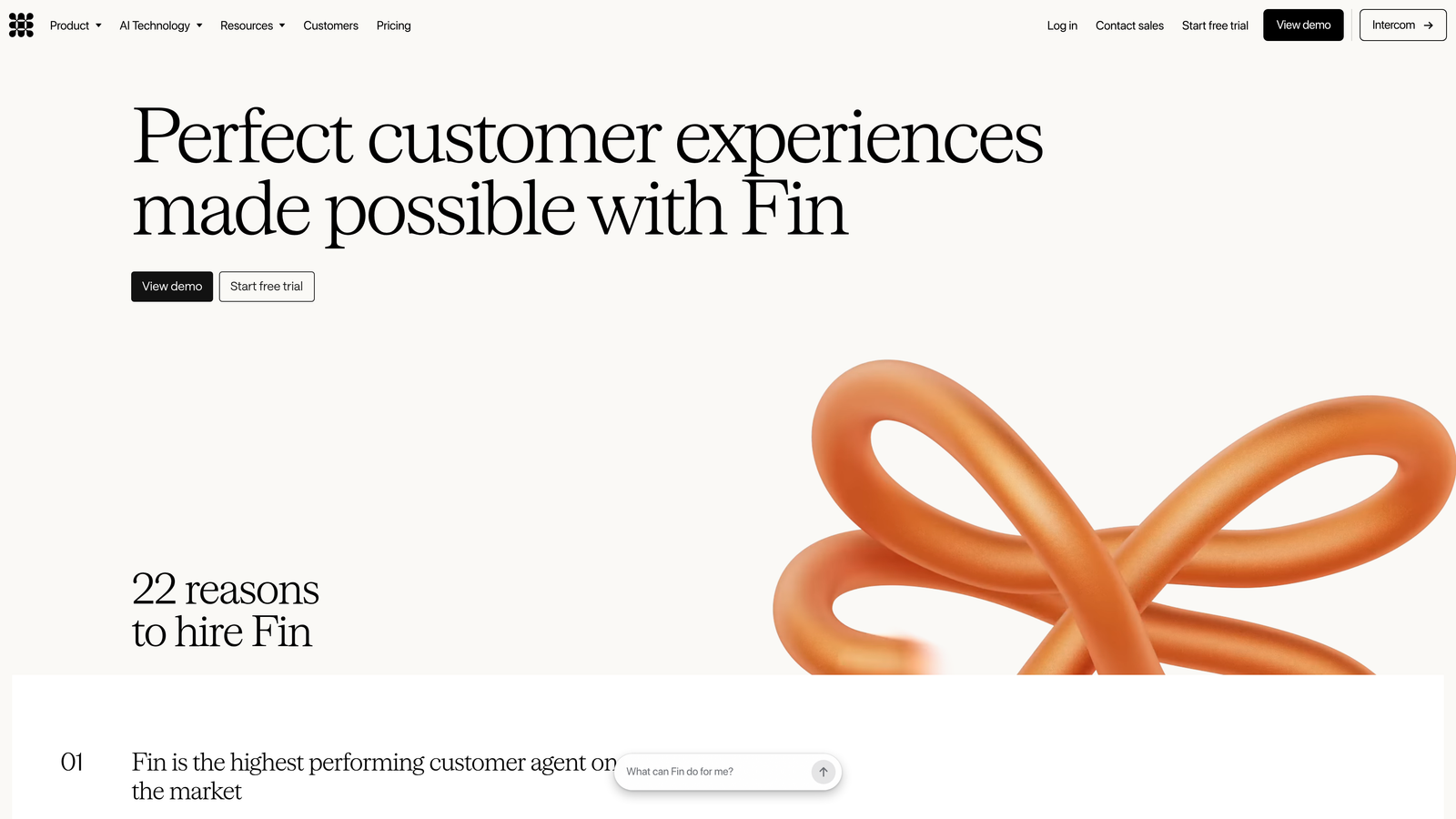
Intercom Fin is Intercom's LLM-powered AI agent, designed to resolve customer queries by drawing on your help center content and conversation history within the Intercom messenger.
Where This Tool Shines
Fin's conversational quality stands out. Built on GPT-4 class reasoning, it handles nuanced, multi-part queries with a level of coherence that earlier rule-based chatbots couldn't approach. Rather than matching keywords to canned responses, Fin synthesizes answers from your knowledge sources, which means it can handle novel phrasings of familiar questions without breaking down.
The per-resolution pricing model is also worth noting. Instead of paying for seats or monthly platform fees regardless of usage, you pay when Fin actually resolves a ticket. For teams with variable support volume, this aligns cost directly with value delivered.
Key Features
GPT-4 Class Reasoning: Handles nuanced, multi-step queries by synthesizing answers from your knowledge base rather than matching to scripted flows.
Custom Knowledge Sources: Train Fin on your help center, product documentation, and any additional content sources you specify.
Per-Resolution Pricing: You pay for successful resolutions rather than seats or flat monthly fees, creating a direct link between cost and outcome.
Seamless Human Handoff: When Fin reaches its confidence threshold, it hands off to a human agent within the same Intercom thread, preserving full conversation context.
Multilingual Support: Handles queries across major languages without requiring separate bot configurations for each.
Best For
Companies already using Intercom as their primary support and messaging platform. Strong for SaaS and tech companies with well-maintained help centers. The per-resolution model suits teams with predictable query types and high self-service potential.
Pricing
Per-resolution pricing on top of an existing Intercom plan. Current rates vary by plan and resolution volume; verify at intercom.com.
4. Freshdesk Freddy AI
Best for: SMB and mid-market teams on Freshdesk wanting bundled AI without additional procurement
Freshdesk Freddy AI is Freshworks' AI layer embedded across the Freshdesk support suite, covering both self-service deflection and agent assistance within familiar Freshdesk workflows.
Where This Tool Shines
Freddy AI's accessibility is its defining strength. Because it's bundled into Freshdesk's Growth, Pro, and Enterprise tiers, teams don't face a separate AI procurement process. If you're already paying for a Freshdesk plan at the right tier, Freddy is available to activate. This removes a significant barrier for smaller teams that want AI capabilities without a dedicated AI budget line.
The two-mode structure, Freddy Self Service for deflection and Freddy Copilot for agent assist, means you can deploy AI at the customer-facing layer, the agent-assist layer, or both, depending on your team's readiness and workflow.
Key Features
Freddy Self Service: Handles automated FAQ and knowledge base deflection, resolving common queries before they reach a human agent.
Freddy Copilot: Provides agents with suggested replies, ticket summarization, and next-step recommendations within their Freshdesk workspace.
Freddy Insights: Analytics and performance reporting on AI resolution rates, deflection trends, and agent productivity.
No-Code Bot Builder: Allows teams to create custom conversation flows without engineering involvement, useful for structured query types.
Bundled Availability: Included in paid Freshdesk tiers, reducing the procurement overhead of adding AI to an existing support stack.
Best For
SMBs and mid-market teams already using Freshdesk who want to activate AI capabilities without switching platforms or adding a separate vendor. Less suited for organizations wanting deep CRM integration or business intelligence beyond standard support analytics.
Pricing
Bundled with Freshdesk Growth, Pro, and Enterprise plans; Freddy Copilot available as an add-on at higher tiers. Confirm current pricing at freshworks.com.
5. Tidio Lyro
Best for: SMBs and e-commerce teams wanting fast AI deployment at accessible price points
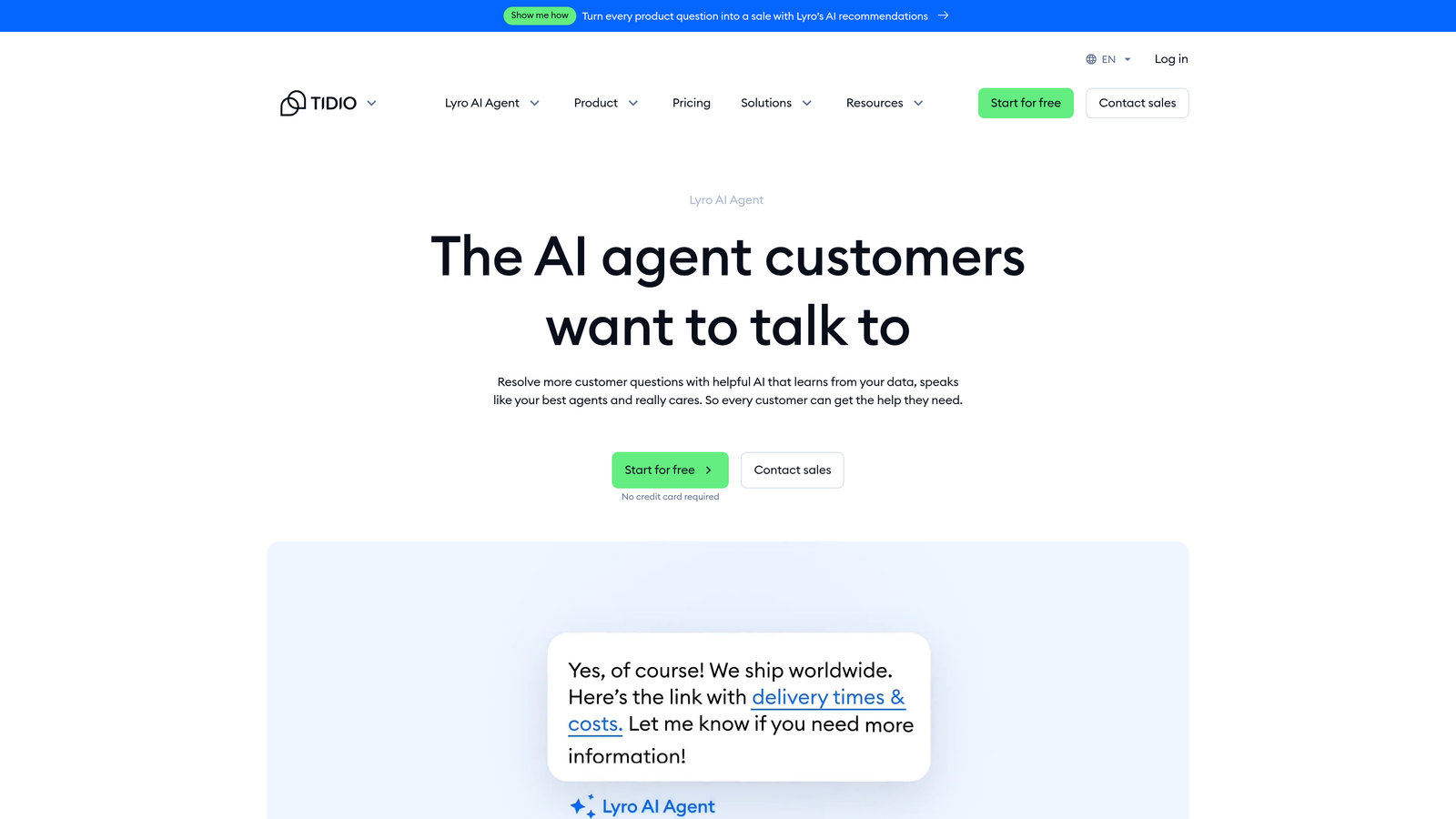
Tidio Lyro is a conversational AI agent designed for small and mid-sized businesses, trained on your FAQ and help content to handle repetitive queries autonomously.
Where This Tool Shines
Tidio Lyro's standout quality is its deployment speed. While enterprise AI implementations often involve weeks of configuration, training, and integration work, Lyro is typically live within hours. You point it at your existing FAQ content, and it starts handling queries. For teams that need AI coverage quickly without a lengthy onboarding process, that speed-to-value is genuinely useful.
The free tier also makes it one of the lowest-friction entry points in this comparison. Teams can test Lyro's capabilities on real customer queries before committing to a paid plan, which is a meaningful advantage when evaluating AI tools for the first time.
Key Features
Lyro AI Engine: Trained on your existing FAQ and support content, handling repetitive queries without requiring custom conversation flow design.
Per-Conversation Pricing: Transparent pricing tied to conversation volume, with a free tier to validate the tool before committing to paid plans.
Fast Deployment: Typically live within hours, making it accessible for teams without dedicated implementation resources.
Live Chat Fallback: Automatically hands off to a human agent when Lyro reaches its confidence threshold, preventing dead-end bot experiences.
E-Commerce Integrations: Native integrations with Shopify and WooCommerce make it particularly useful for online retail support workflows.
Best For
SMBs, e-commerce brands, and teams new to AI support tools who need fast deployment and predictable, low-entry pricing. Less suited for B2B SaaS teams needing deep CRM integration, business intelligence, or complex multi-system workflows.
Pricing
Free tier available; paid plans starting from approximately $29/month. Verify current rates and conversation limits at tidio.com.
6. Forethought
Best for: Operations teams wanting smarter triage and routing on top of an existing helpdesk
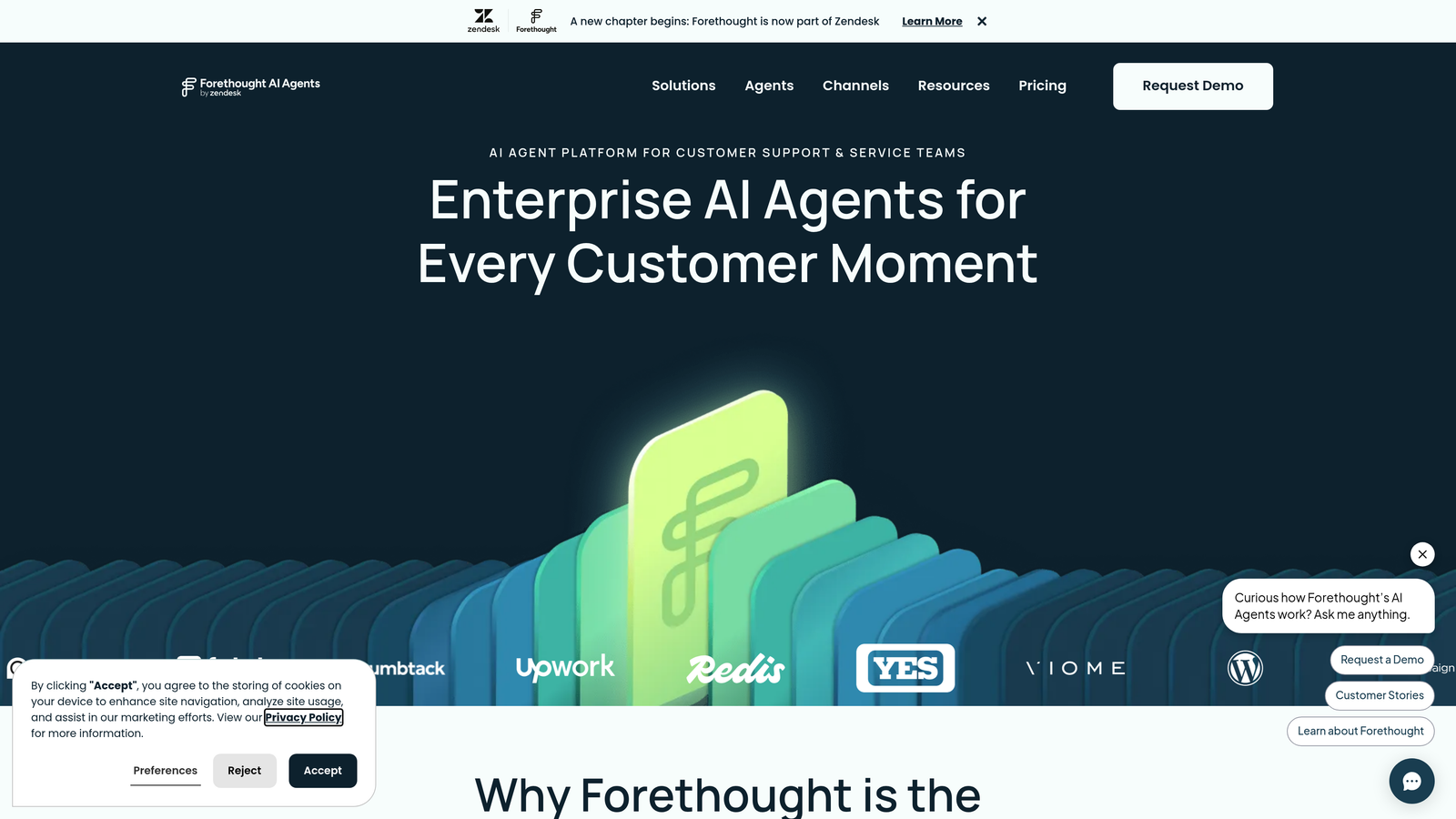
Forethought is an AI platform focused on intelligent ticket triage, routing, and agent assist, designed to layer on top of existing helpdesks rather than replace them.
Where This Tool Shines
Forethought's architectural philosophy is different from the other tools in this list. Rather than asking you to replace your helpdesk, it positions itself as an intelligence layer on top of Zendesk, Salesforce Service Cloud, and other established platforms. If your team has years of workflow investment in a particular helpdesk, Forethought lets you add AI capabilities without disrupting that foundation.
Its triage and routing capabilities are particularly strong. The AI doesn't just categorize tickets by keyword; it detects intent, urgency, and complexity to route tickets to the right team or agent with a level of precision that manual routing rules typically can't match at scale.
Key Features
Triage AI: Automatically detects intent and categorizes incoming tickets, reducing the manual overhead of ticket sorting for operations teams.
Routing AI: Directs tickets to the right team or individual agent based on intent, complexity, and configured routing logic.
Solve AI: Handles automated self-service deflection for queries that don't require human involvement.
Assist AI: Surfaces relevant knowledge and suggested responses within the agent's existing helpdesk workflow, without requiring context switching.
Helpdesk-Agnostic Layer: Works across Zendesk, Salesforce Service Cloud, and other major helpdesks, preserving existing workflow investments.
Best For
Mid-market and enterprise operations teams with established helpdesk infrastructure who want to add AI-powered triage, routing, and agent assist without a platform migration. Strong for teams where ticket routing accuracy is a measurable pain point.
Pricing
Custom enterprise pricing. Contact forethought.ai directly for a quote based on your team size and helpdesk environment.
7. Kustomer
Best for: Brands that need full CRM context embedded in every support interaction
Kustomer is a CRM-native customer support platform that combines a unified customer data timeline with AI-powered support features, giving agents and AI alike complete context for every interaction.
Where This Tool Shines
Kustomer's core differentiator is its CRM-native architecture. Rather than treating support tickets as isolated events, Kustomer builds a complete customer timeline: purchase history, past interactions, subscription status, and any other data you connect. When an AI or human agent picks up a ticket, they're not starting from zero; they have the full picture of that customer's relationship with your business.
This context depth makes Kustomer particularly effective for brands where support interactions are closely tied to commercial outcomes. An agent handling a billing complaint can immediately see the customer's subscription tier, renewal date, and previous escalations without switching tools or asking the customer to repeat themselves.
Key Features
Unified Customer Timeline: Combines purchase history, past interactions, CRM data, and support history into a single view for every customer.
AI-Powered Chatbots: Handles automated conversation flows for common queries, with full access to the customer's data context during the interaction.
KustomerIQ: Provides intelligent routing, suggested responses, and automated workflow triggers based on customer data and interaction patterns.
Omnichannel Support: Manages interactions across chat, email, SMS, social, and voice within a single unified platform.
Commerce and SaaS Integrations: Connects with e-commerce platforms and SaaS data sources to enrich the customer timeline with transactional context.
Best For
Brands in e-commerce, subscription, or SaaS contexts where customer lifetime value and purchase history are central to support decisions. Strong for teams that want CRM and support in a single platform rather than integrated separately.
Pricing
Per-agent monthly pricing. Current plan details and pricing tiers are available at kustomer.com.
8. Capacity
Best for: Organizations managing both customer-facing and internal employee support
Capacity is an AI-powered support automation platform that combines helpdesk, knowledge base, and conversational AI in a single system, serving both internal and external support use cases.
Where This Tool Shines
Capacity's distinguishing characteristic is its dual-audience design. Most support AI tools are built exclusively for customer-facing use cases. Capacity handles both: customer support on the external side, and IT or HR support for internal employees. For organizations managing multiple support audiences from a single platform, this reduces the need to maintain separate tools and knowledge bases for each.
The AI-suggested content gap feature is also worth highlighting. As the AI handles queries, it identifies areas where the knowledge base is thin or missing, and surfaces those gaps so content teams can address them proactively rather than discovering them when customers hit dead ends.
Key Features
AI Chat: Trained on your internal and external knowledge bases to handle queries from both customers and employees in the same platform.
Helpdesk Ticketing: Manages ticket creation, assignment, and resolution workflows with AI-assisted routing and suggested responses.
Knowledge Base Builder: Includes AI-suggested content gap detection to help teams identify and fill gaps before they become support failures.
Dual-Audience Support: Handles customer-facing and internal employee support (IT, HR) from a single system, reducing tool sprawl for larger organizations.
Enterprise Integrations: Connects with Salesforce, Zendesk, Slack, and Microsoft Teams for organizations with complex existing tech stacks.
Best For
Mid-market and enterprise organizations that need to support both external customers and internal employees from a single AI-powered platform. Particularly useful for companies with active IT or HR helpdesk functions alongside customer support.
Pricing
Custom pricing based on organization size and use case scope. Contact capacity.com for a tailored quote.
9. Gorgias
Best for: E-commerce brands, particularly Shopify merchants, with high-volume repetitive support
Gorgias is a support platform purpose-built for e-commerce brands, with AI features for intent detection, automated responses, and revenue-attributed support metrics tightly integrated with Shopify and other commerce platforms.
Where This Tool Shines
Gorgias does one thing exceptionally well: e-commerce support at scale. Its deep Shopify integration means the AI has access to order data, shipping status, and customer purchase history natively, without requiring custom API work. For brands handling thousands of "where is my order" queries per month, that integration depth translates directly into automation rates that generic support tools can't match.
The revenue statistics feature sets Gorgias apart from most support tools in a meaningful way. Rather than tracking support metrics in isolation, Gorgias attributes support interactions to conversion and retention outcomes, helping teams understand which support investments actually drive commercial results.
Key Features
AI Automate: Handles repetitive order, shipping, and return queries without agent involvement, drawing on live order data from connected commerce platforms.
Revenue Statistics: Links support interactions to conversion and retention metrics, giving teams visibility into the commercial impact of their support operation.
Commerce Platform Integrations: Deep native integrations with Shopify, BigCommerce, and Magento, with order data accessible directly within the support interface.
Intent and Sentiment Detection: Prioritizes tickets based on detected intent and customer sentiment, ensuring high-urgency or high-value interactions surface quickly.
Macros and Rules Engine: Powerful automation rules for high-volume e-commerce workflows, reducing the manual overhead of repetitive ticket handling.
Best For
E-commerce brands, particularly those on Shopify, with high volumes of order-related queries. Strong for DTC brands that want to understand the revenue impact of their support team. Less relevant for B2B SaaS or service businesses where order management isn't central to the support workflow.
Pricing
Per-ticket pricing with monthly plan options starting from approximately $10/month. Verify current plan structures and limits at gorgias.com.
Which Tool Is Right for Your Team?
The right choice depends heavily on where your team is today and where you're headed. Here's a quick orientation by team type.
Startups and early-stage SaaS teams should look at Tidio Lyro for fast, low-cost deployment, or Halo AI if you want an AI-first foundation that grows with you and surfaces business intelligence from day one.
Scaling B2B SaaS companies are the strongest fit for Halo AI, particularly if you need page-aware product context, automated bug reporting, and signals beyond standard support metrics. Intercom Fin is worth considering if your team is already deep in the Intercom ecosystem and your help center is well-maintained.
Enterprise teams with established helpdesks should evaluate Zendesk AI or Forethought first, depending on whether you want native AI within your existing platform or an intelligence layer that works across multiple systems. Kustomer is the right conversation if CRM context is central to how your support team operates.
E-commerce brands will find Gorgias the most purpose-fit option, with Tidio Lyro as a lighter-weight alternative for smaller operations.
Across all these options, the most important question isn't which tool has the longest feature list. It's which architecture fits how your team works and where you need the AI to operate autonomously versus assist humans.
Your support team shouldn't scale linearly with your customer base. Let AI agents handle routine tickets, guide users through your product, and surface business intelligence while your team focuses on complex issues that need a human touch. See Halo in action and discover how continuous learning transforms every interaction into smarter, faster support.