9 Best Customer Support AI Solution Providers in 2026
This guide evaluates the top customer support AI solution providers in 2026, comparing purpose-built AI agents against bolt-on chatbot tools across key criteria including autonomous resolution rates, integration depth, live agent handoff quality, and long-term learning capabilities—helping businesses find the right fit whether building from scratch or augmenting existing helpdesk platforms like Zendesk or Freshdesk.
 Matt PattoliFounder13 min read
The era of reactive, ticket-queue customer support is giving way to AI-first architectures that resolve issues before customers even escalate. But with dozens of vendors claiming "AI-powered" capabilities, choosing the right customer support AI solution provider is genuinely difficult. The differences between bolt-on chatbot features and purpose-built AI agents are significant, and those differences show up in ways that matter: resolution rates, escalation quality, and whether your platform gets smarter over time or just stays static.
This guide covers leading customer support AI solution providers evaluated on autonomous resolution capability, integration depth, learning and improvement over time, live agent handoff quality, and analytics beyond basic ticket metrics. Whether you're replacing a legacy helpdesk, augmenting an existing Zendesk, Freshdesk, or Intercom setup, or building AI support from scratch, this list will help you find the right fit.
Each tool was evaluated on AI sophistication, integration ecosystem, scalability, pricing transparency, and suitability for B2B SaaS teams.
1. Halo AI
Best for: B2B SaaS teams wanting AI-first architecture with business intelligence built in
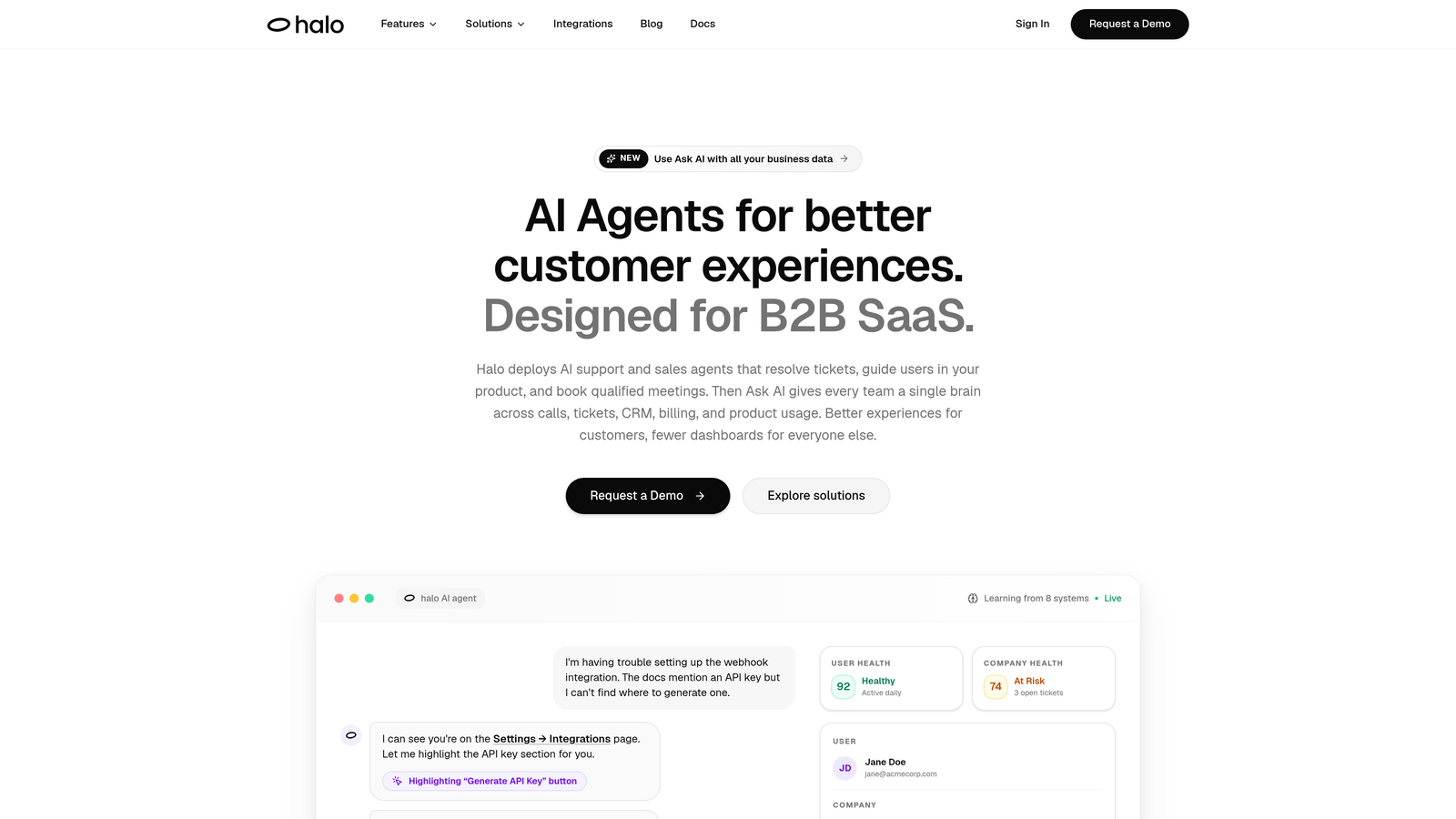
Halo AI is an AI-first customer support platform purpose-built for B2B SaaS teams, deploying intelligent agents that resolve tickets, guide users visually, and surface business intelligence signals.
Where This Tool Shines
What sets Halo apart from most tools on this list is its architecture. Rather than layering AI on top of a traditional helpdesk, Halo is built around autonomous resolution from the ground up. That distinction matters because the entire product experience, from how tickets are handled to how agents escalate, is designed for AI-first operation rather than human-agent workflows with AI assistance added later.
The standout capability is page-aware context. Halo's chat widget sees the user's current UI state, meaning the AI agent knows exactly where a customer is in your product and can provide visual, step-by-step guidance specific to that screen. Combined with continuous learning from every interaction, the system improves without requiring manual retraining.
Key Features
Page-Aware AI Agents: The AI sees the user's current page and UI state, enabling precise visual guidance rather than generic responses.
Autonomous Ticket Resolution: AI agents handle tickets end-to-end with continuous learning from every resolved interaction.
Auto Bug Ticket Creation: Automatically creates and routes bug reports integrated directly with Linear, reducing manual triage work.
Smart Inbox with Business Intelligence: Surfaces customer health signals, anomaly detection, and revenue intelligence beyond standard ticket metrics.
Live Agent Handoff: Full context preservation on escalation so agents never start a conversation cold.
Deep Integration Stack: Connects with Linear, Slack, HubSpot, Intercom, Stripe, Zoom, PandaDoc, and Fathom.
Best For
B2B SaaS companies that want more than ticket deflection. Halo is particularly well-suited to product teams that need support intelligence to feed back into product development, and to support leaders who want their AI to surface churn signals and revenue risk alongside resolution metrics.
Pricing
Contact for pricing. Visit haloagents.ai to book a demo and discuss your team's requirements.
2. Intercom (Fin AI)
Best for: Teams already invested in the Intercom ecosystem seeking native AI resolution
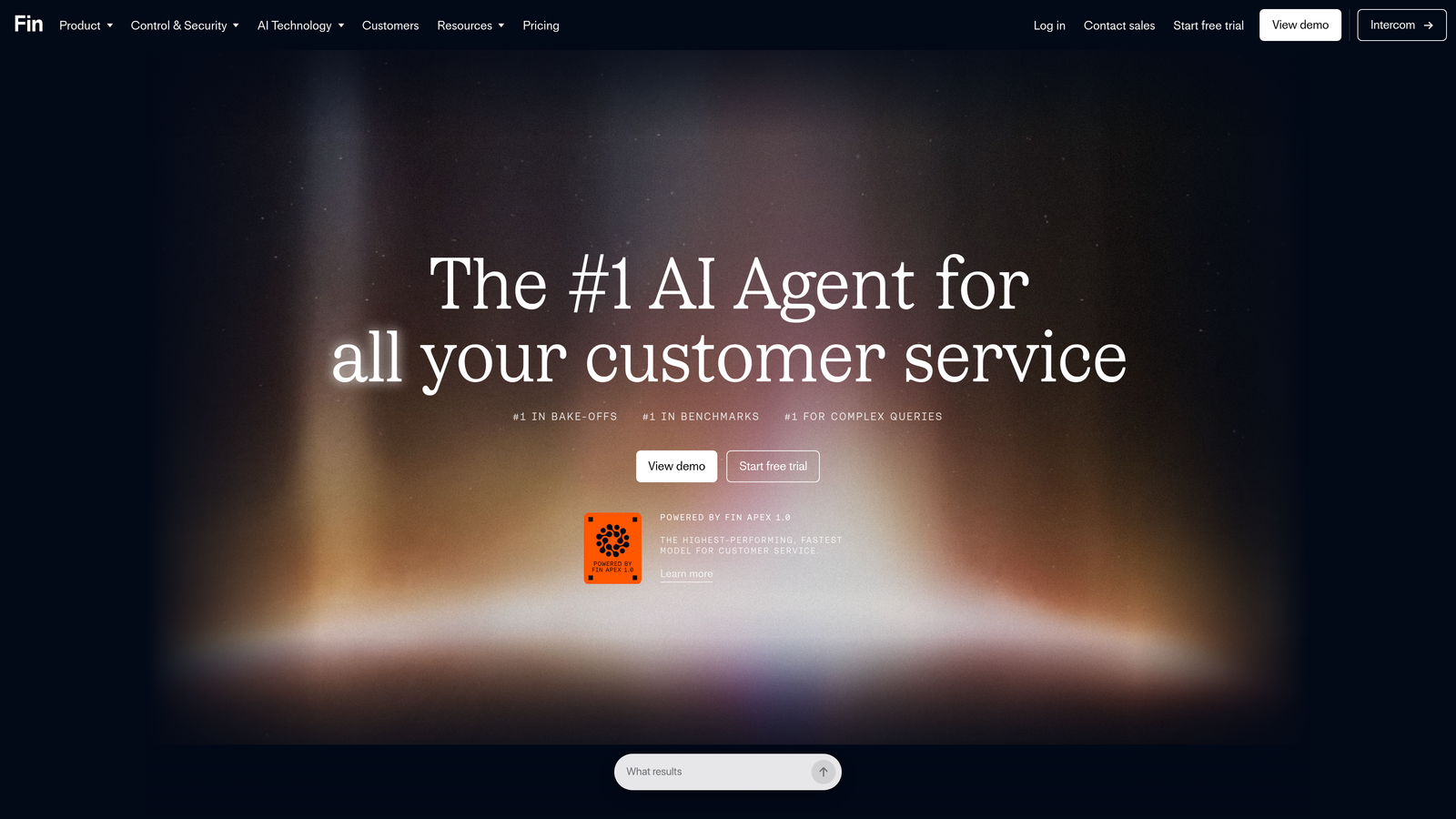
Intercom Fin is Intercom's native AI agent, resolving support queries autonomously using your existing help content and knowledge base.
Where This Tool Shines
Fin's biggest advantage is how seamlessly it fits into an existing Intercom setup. If your team already uses Intercom's messenger and inbox, Fin requires no separate integration. It trains directly on your help center and support documentation, which means time-to-value is relatively quick for teams with well-maintained content libraries.
The handoff experience is notably smooth. When Fin can't resolve a query, it passes the conversation to a human agent within the same thread, with full context intact. For teams that have invested in Intercom's broader platform, Fin is a natural extension rather than a new system to manage.
Key Features
Help Center Training: Trained directly on your existing help center and support documentation with no manual data mapping required.
Native Messenger Integration: Operates within Intercom's existing messenger interface without additional setup.
Multi-Step Conversations: Handles contextual follow-up questions within a single conversation thread.
In-Thread Human Handoff: Escalates to agents within the same conversation, preserving full context.
Usage-Based Pricing: Charged per resolution, which aligns cost with actual AI performance.
Best For
Companies already running Intercom as their primary support platform. Fin adds meaningful AI capability without requiring a platform migration. Less compelling for teams not already using Intercom, since the value is tightly coupled to the existing ecosystem.
Pricing
Fin charges per resolution on top of an existing Intercom base plan. Current pricing is available at intercom.com.
3. Zendesk AI
Best for: Large organizations with complex routing needs already on the Zendesk Suite
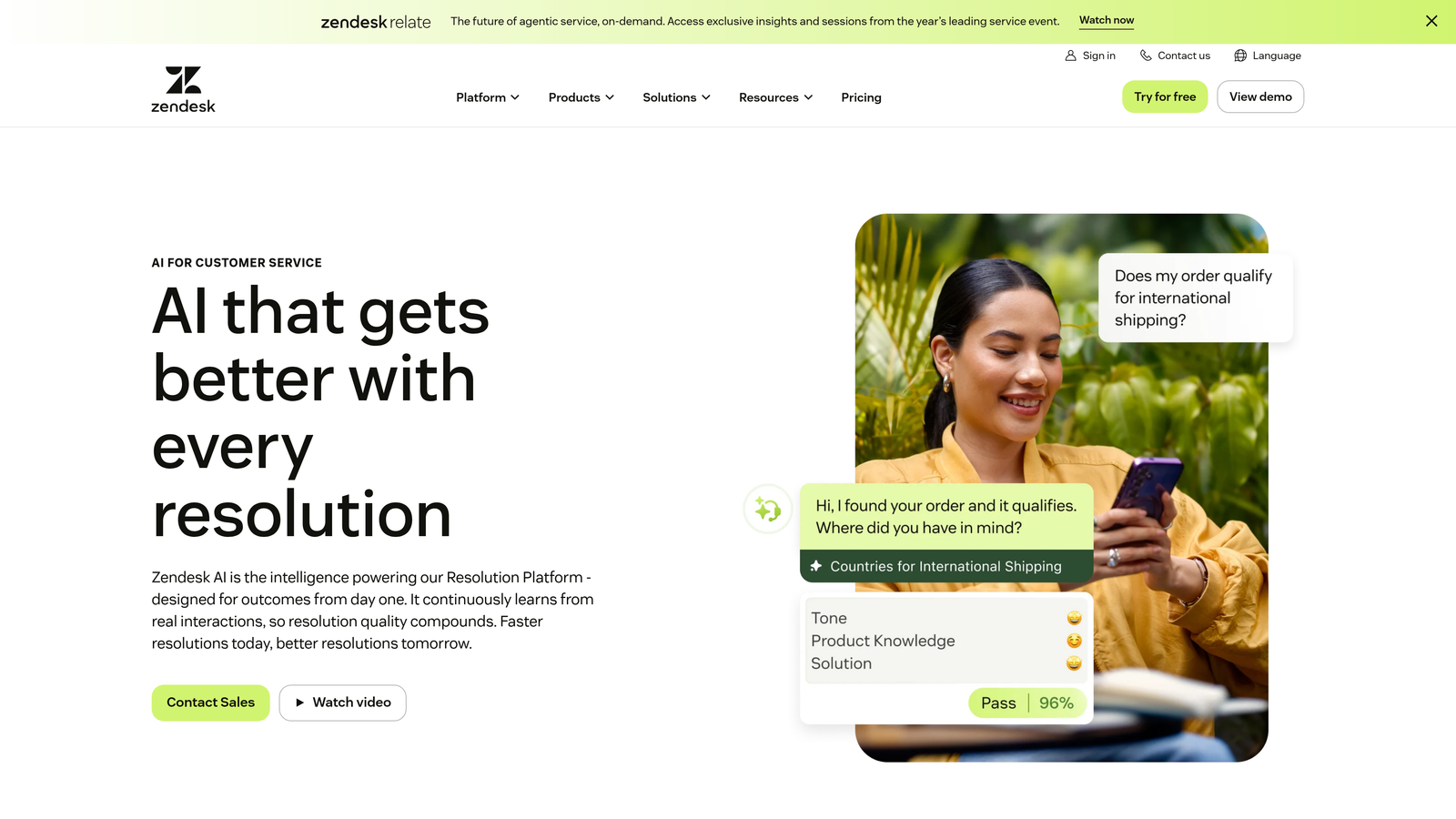
Zendesk AI layers intelligent capabilities across the full Zendesk Suite, covering triage, routing, agent copilot assistance, and automated self-service resolutions.
Where This Tool Shines
Zendesk's AI capabilities are broad by design. Rather than a single AI agent product, Zendesk AI spans the entire support workflow: intelligent triage at the point of ticket creation, routing based on intent and urgency, agent copilot suggestions during live conversations, and AI Agents for self-service resolution. For large teams managing high volumes across multiple channels, that breadth is genuinely useful.
The Advanced AI add-on unlocks deeper automation and analytics for organizations that need more than the baseline. The tradeoff is complexity: getting the most from Zendesk AI typically requires investment in configuration and ongoing management.
Key Features
Intelligent Triage and Routing: Classifies and routes tickets based on detected intent and urgency at the point of submission.
AI Agents for Self-Service: Handles common queries autonomously without human agent involvement.
Agent Copilot: Provides real-time suggestions and response drafts to agents during live conversations.
Omnichannel Coverage: Works across email, chat, voice, and social channels within one platform.
Advanced AI Add-On: Unlocks deeper automation, analytics, and customization beyond the base Suite.
Best For
Enterprises and mid-market teams already operating on Zendesk Suite who want to extend their existing investment with AI capabilities rather than migrate to a new platform. Teams starting fresh may find the configuration overhead significant.
Pricing
Core AI features are included in Zendesk Suite plans. The Advanced AI add-on is available as a paid upgrade. Current pricing is available at zendesk.com.
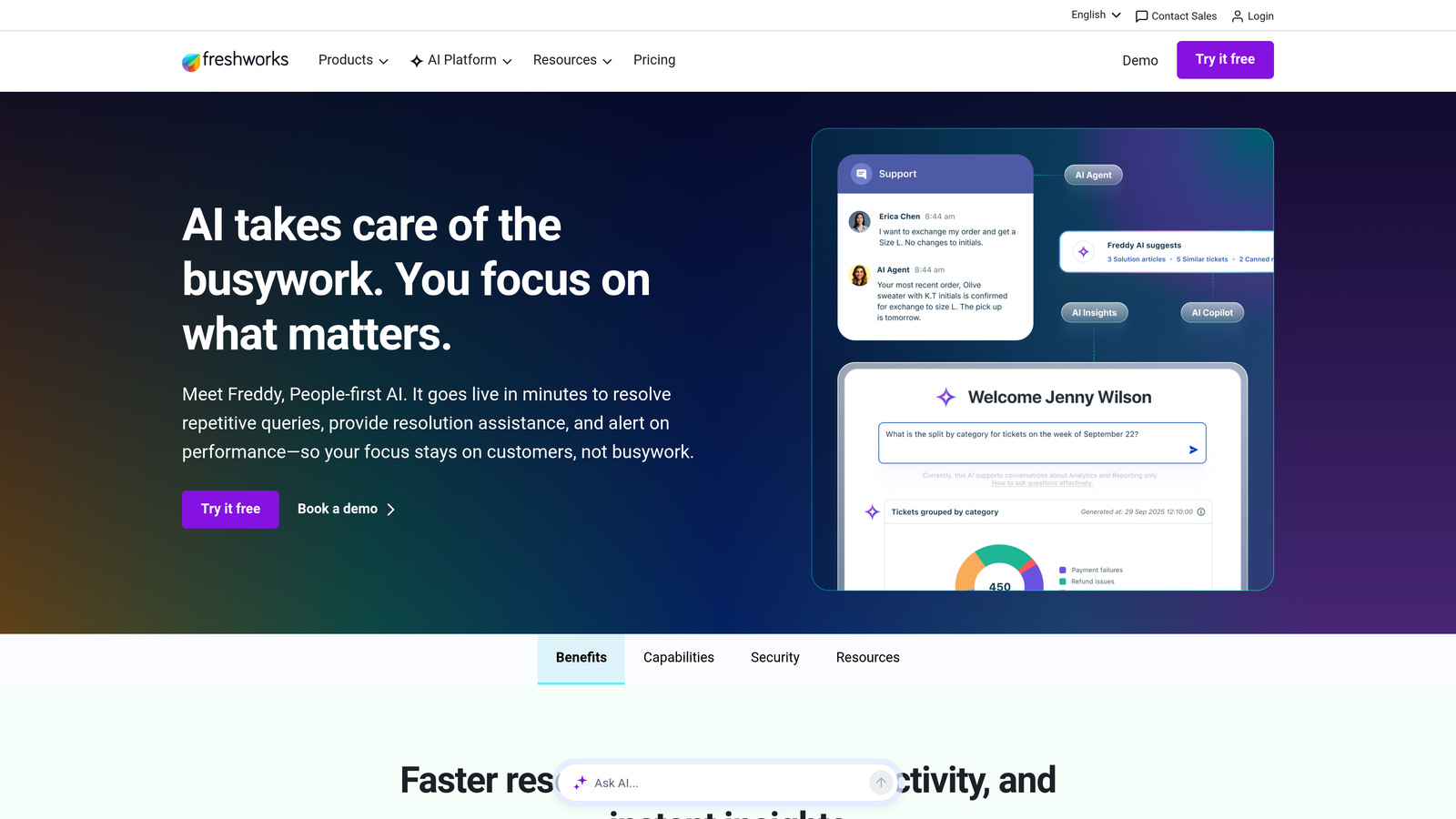
4. Freshdesk Freddy AI
Best for: SMBs and growing teams seeking accessible AI support without enterprise pricing
Freshdesk Freddy AI is Freshworks' AI layer for Freshdesk, spanning self-service chatbots, agent assist, and analytics under a unified umbrella.
Where This Tool Shines
Freddy AI is structured around three distinct components that address different parts of the support workflow: Freddy Self Service for customer-facing resolution, Freddy Copilot for agent assistance, and Freddy Insights for analytics and trend detection. That modularity means teams can adopt what they need without paying for capabilities they won't use immediately.
Relative to Zendesk and Intercom, Freshdesk tends to offer more accessible pricing at comparable feature tiers. For SMBs and teams in growth mode, that price-to-capability ratio is a real differentiator.
Key Features
Freddy Self Service: AI chatbot for autonomous customer-facing resolution of common queries.
Freddy Copilot: In-context suggestions and response drafts for agents during active conversations.
Freddy Insights: AI-powered analytics with trend detection and performance reporting.
Freshworks Ecosystem Native: Connects natively with Freshworks CRM, ITSM, and sales products.
Accessible Pricing Tiers: AI features distributed across plan tiers, making entry-level adoption affordable.
Best For
SMBs, startups, and growing support teams that want capable AI features without committing to enterprise-level pricing. Also a strong fit for teams already using other Freshworks products who want a unified ecosystem.
Pricing
Freddy AI features are tiered across Freshdesk plans. Copilot and advanced capabilities are available on higher tiers. See freshworks.com for current plan details.
5. Tidio
Best for: E-commerce brands and small businesses needing fast deployment with minimal technical overhead
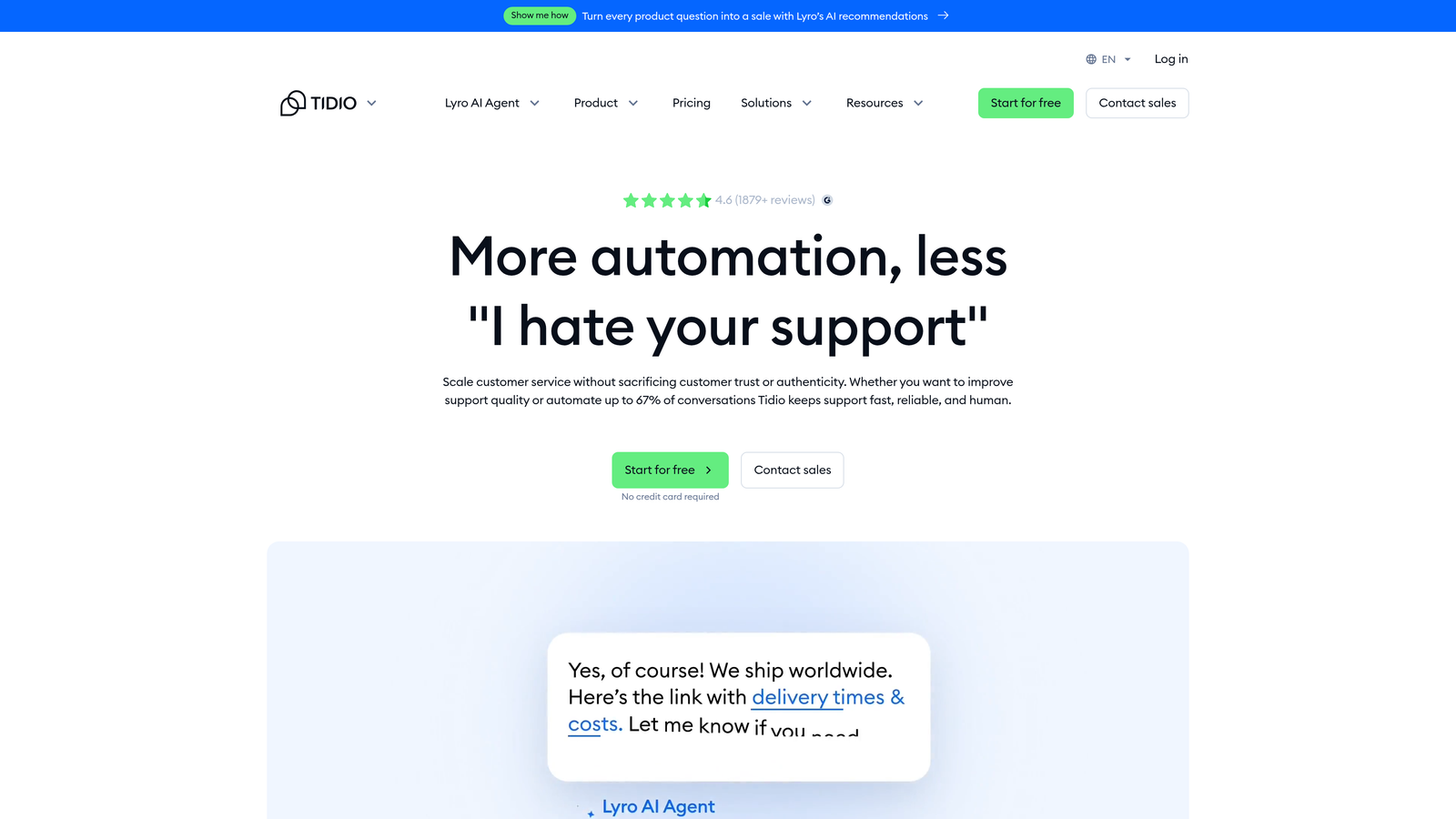
Tidio is a lightweight AI support platform featuring Lyro AI, designed for fast deployment and ease of use with particular strength in e-commerce environments.
Where This Tool Shines
Tidio's defining characteristic is speed to value. Lyro AI can be operational within hours, handling common customer queries conversationally without requiring significant setup or technical resources. For small teams that need something working quickly, that matters more than enterprise-grade configurability.
The visual no-code flow builder makes it accessible to non-technical teams, and native Shopify integration means e-commerce businesses can connect their store data without custom development. When Lyro reaches the edge of its capabilities, the live chat fallback ensures customers aren't left without a path to resolution.
Key Features
Lyro AI Chatbot: Handles common queries conversationally with minimal training or configuration required.
No-Code Flow Builder: Visual automation builder accessible to non-technical teams.
Shopify and E-Commerce Integrations: Native integrations for online retail use cases.
Live Chat Fallback: Seamless handoff to human agents when Lyro can't resolve a query.
Fast Deployment: Can be live and handling conversations within hours of setup.
Best For
E-commerce businesses, small teams, and anyone who needs a functional AI support layer without a lengthy implementation process. Less suited to complex B2B support scenarios that require deep product context or multi-system integrations.
Pricing
Free tier available. Lyro AI conversations are priced per usage. Paid plans start at accessible price points. Full details at tidio.com.
6. Salesforce Einstein for Service
Best for: Enterprise organizations where Salesforce is the primary system of record
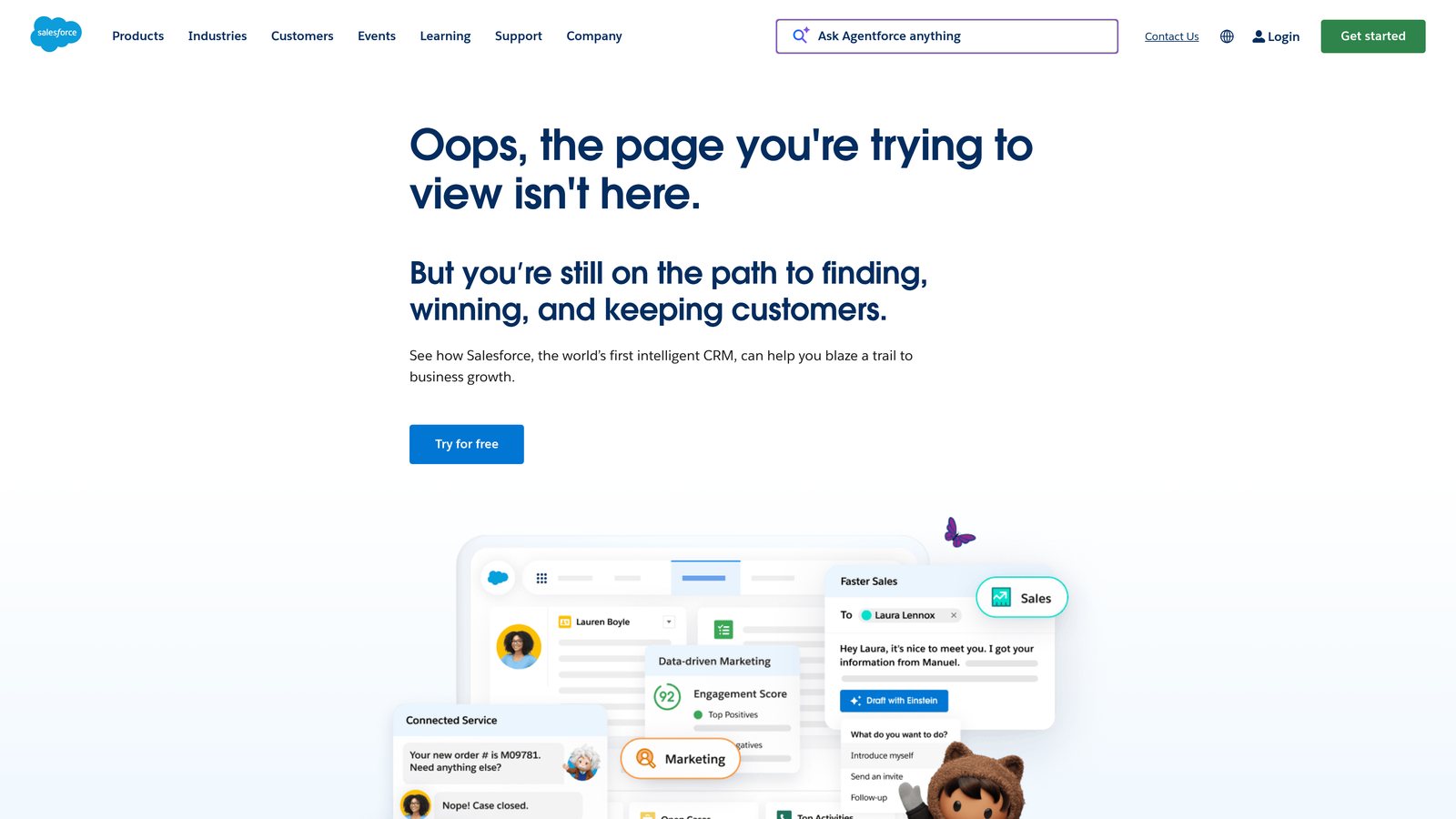
Salesforce Einstein for Service embeds AI across Salesforce Service Cloud, leveraging full CRM data to power personalized, context-rich support automation at enterprise scale.
Where This Tool Shines
Einstein's core advantage is access to the full Salesforce data model. When your CRM contains years of customer interactions, purchase history, account health data, and sales activity, an AI agent that can draw on all of that context can deliver meaningfully more personalized support than one working only from a help center. For enterprises where Salesforce is already the system of record, that depth of context is difficult to replicate elsewhere.
Einstein Copilot provides real-time agent guidance during live conversations, while Einstein Bots handle self-service interactions with access to the same rich customer data. The unified view across sales, service, and marketing is a genuine differentiator for large organizations managing complex customer relationships.
Key Features
Einstein Copilot: Real-time agent guidance using full CRM context during live support conversations.
Einstein Bots: Self-service automation with deep access to customer data from across the Salesforce platform.
CRM-Powered Routing: Case classification and routing informed by historical customer data and account attributes.
Unified Customer View: Single view spanning sales, service, and marketing interactions.
Enterprise Compliance: Enterprise-grade security, data residency, and compliance controls.
Best For
Large enterprises already operating Salesforce as their core CRM and service platform. Implementation complexity and pricing make it less practical for teams not already in the Salesforce ecosystem.
Pricing
Priced as part of Salesforce Service Cloud licensing. Enterprise pricing; contact Salesforce directly for current quotes.
7. Kustomer
Best for: High-volume consumer brands needing omnichannel support with a unified customer timeline
Kustomer is an omnichannel customer service platform with AI automation built around a unified customer timeline, designed for high-volume consumer support operations.
Where This Tool Shines
Kustomer's unified customer timeline is its most distinctive feature. Rather than treating each support interaction as an isolated ticket, Kustomer builds a complete interaction history across every channel, giving both AI and human agents full context on who the customer is and what they've experienced. For consumer brands managing high volumes across chat, email, social, SMS, and voice, that unified view reduces the friction that typically comes with omnichannel support.
AI automation handles routing, classification, and response suggestions, while the workflow engine manages repetitive processes that don't require human judgment. The reporting and CSAT tracking tools give support leaders visibility into performance across the full operation.
Key Features
Unified Customer Timeline: Complete interaction history across all channels in a single view for agents and AI.
AI-Powered Routing and Classification: Automated ticket routing and classification based on content and customer context.
Omnichannel Coverage: Handles chat, email, social, SMS, voice, and WhatsApp in one platform.
Workflow Automation: Automates repetitive support processes and follow-up tasks.
CSAT Tracking and Reporting: Built-in customer satisfaction tracking and performance analytics.
Best For
High-volume consumer brands managing support across multiple channels where a unified customer view is essential. The platform is designed for scale, making it less suited to small teams or B2B SaaS companies with lower ticket volumes and more complex product support needs.
Pricing
Enterprise pricing. Contact Kustomer directly for current plan details at kustomer.com.
8. Ada
Best for: Enterprise CX teams that need brand-controlled AI agents without engineering dependency
Ada is a no-code AI agent builder that lets CX teams create, customize, and deploy AI support agents without engineering involvement, with strong emphasis on brand control.
Where This Tool Shines
Ada's no-code approach is genuinely differentiated. Most AI support platforms require engineering resources to configure, maintain, and update AI behavior. Ada is built so that CX teams can own the entire process: building the agent, adjusting tone and persona, setting escalation rules, and iterating on performance without filing a ticket to the engineering team. For organizations where CX and product teams operate independently, that autonomy has real operational value.
Ada also functions as an AI front-end layer over existing helpdesks, meaning companies don't need to rip out their current infrastructure. It integrates with major platforms and handles the customer-facing AI layer while the underlying helpdesk manages agent workflows.
Key Features
No-Code Agent Builder: CX teams configure and update AI agents independently without engineering involvement.
Brand Customization: Full control over tone, persona, and escalation behavior to match brand standards.
Helpdesk Integration Layer: Operates as an AI front-end over existing helpdesk infrastructure.
Multilingual Support: Handles multiple languages for global customer bases.
Containment Analytics: Tracks containment rates and resolution quality to measure AI performance.
Best For
Enterprise companies with strong brand standards and CX teams that want ownership over AI agent behavior. Particularly useful for organizations that have existing helpdesk investments they want to preserve while adding a sophisticated AI layer on top.
Pricing
Enterprise pricing. Contact Ada directly for a quote at ada.cx.
9. Drift (Salesloft)
Best for: B2B companies where support and sales conversations overlap significantly
Drift is a conversational AI platform that blends support and revenue conversations, routing interactions based on customer intent across support needs and sales opportunities.
Where This Tool Shines
Drift occupies a unique position on this list because it doesn't treat support as a separate function from revenue. Its AI intent detection identifies whether an incoming conversation is a support request or a sales opportunity, and routes accordingly. For B2B companies where the line between a customer needing help and a customer ready to expand their contract is often blurry, that routing intelligence has real business value.
Now part of Salesloft, Drift's integration with broader revenue workflows means support interactions can feed directly into sales plays. Meeting scheduling and sales handoff are built into the platform, making it practical for teams where customer success and sales operate in close proximity.
Key Features
AI Intent Detection: Automatically routes conversations to support or sales based on detected customer intent.
Real-Time AI Chat: Handles website visitors and in-app users with conversational AI.
Account-Based Targeting: Identifies and prioritizes high-value accounts for tailored conversation routing.
Salesloft Integration: Unified workflows connecting support conversations to revenue operations.
Meeting Scheduling: Built-in scheduling and sales handoff for conversations that convert to opportunities.
Best For
B2B companies where customer support and sales development overlap, particularly those already using Salesloft for revenue operations. Less suited to pure support use cases where revenue routing isn't relevant.
Pricing
Enterprise and growth plans available. Current pricing at drift.com.
Which Platform Is Right for Your Team
The right choice depends less on which platform has the longest feature list and more on where you are today and where you're trying to go.
SMBs on a budget: Tidio and Freshdesk Freddy both offer accessible entry points with genuine AI capability. Tidio wins on deployment speed; Freddy wins if you want a broader Freshworks ecosystem connection.
Existing Zendesk or Intercom users: Start with the native AI tiers before evaluating alternatives. Both platforms have invested significantly in their AI layers, and the integration cost of switching is real. Fin AI for Intercom users and Zendesk AI for Zendesk users are logical first steps.
Enterprise Salesforce shops: Einstein for Service is the natural choice when Salesforce is already your system of record. The CRM context advantage is difficult to replicate outside the Salesforce ecosystem.
High-volume consumer brands: Kustomer's unified customer timeline and omnichannel depth are purpose-built for this use case.
Enterprise teams with brand control requirements: Ada's no-code builder and customization depth make it the strongest option when CX teams need to own AI behavior independently.
Revenue and support hybrid: Drift is the only platform on this list built around the intersection of support and sales intent, making it the right call for B2B teams where those functions blur.
B2B SaaS teams wanting AI-first architecture with business intelligence: Halo AI is purpose-built for this scenario. The page-aware context, continuous learning, auto bug ticket creation, and business intelligence signals go well beyond what legacy helpdesks with AI layers can offer. It's the difference between a support tool that got smarter and a platform designed from the start to operate autonomously.
Your support team shouldn't scale linearly with your customer base. Let AI agents handle routine tickets, guide users through your product, and surface business intelligence while your team focuses on complex issues that need a human touch. See Halo in action and discover how continuous learning transforms every interaction into smarter, faster support.