9 Best Customer Support AI Solutions in 2026: Honest Reviews & Comparisons
This guide delivers honest, hands-on Customer Support AI Solution Reviews for nine leading platforms in 2026, evaluating each on ticket resolution quality, integrations, learning capabilities, and total value. Whether you're scaling a B2B SaaS helpdesk or managing a high-volume support team, these comparisons help you find the right tool without wading through endless demos.
 Matt PattoliFounder13 min read
The customer support AI market has matured rapidly. Where teams once debated whether AI could handle real tickets, the conversation has shifted to which platform handles them best — and what else it can do beyond deflection. This list cuts through the noise with honest reviews of nine leading customer support AI solutions, evaluated on ticket resolution quality, integrations, learning capabilities, escalation handling, and total value.
Whether you're a B2B SaaS team outgrowing your current helpdesk, a product team drowning in bug reports, or a support leader trying to scale without headcount, there's a right tool for your situation. Each review covers what the platform genuinely does well, who it's built for, and where it falls short — so you can make a confident decision without booking a dozen demos first.
1. Halo AI
Best for: B2B SaaS teams wanting AI-native support with business intelligence and deep integrations
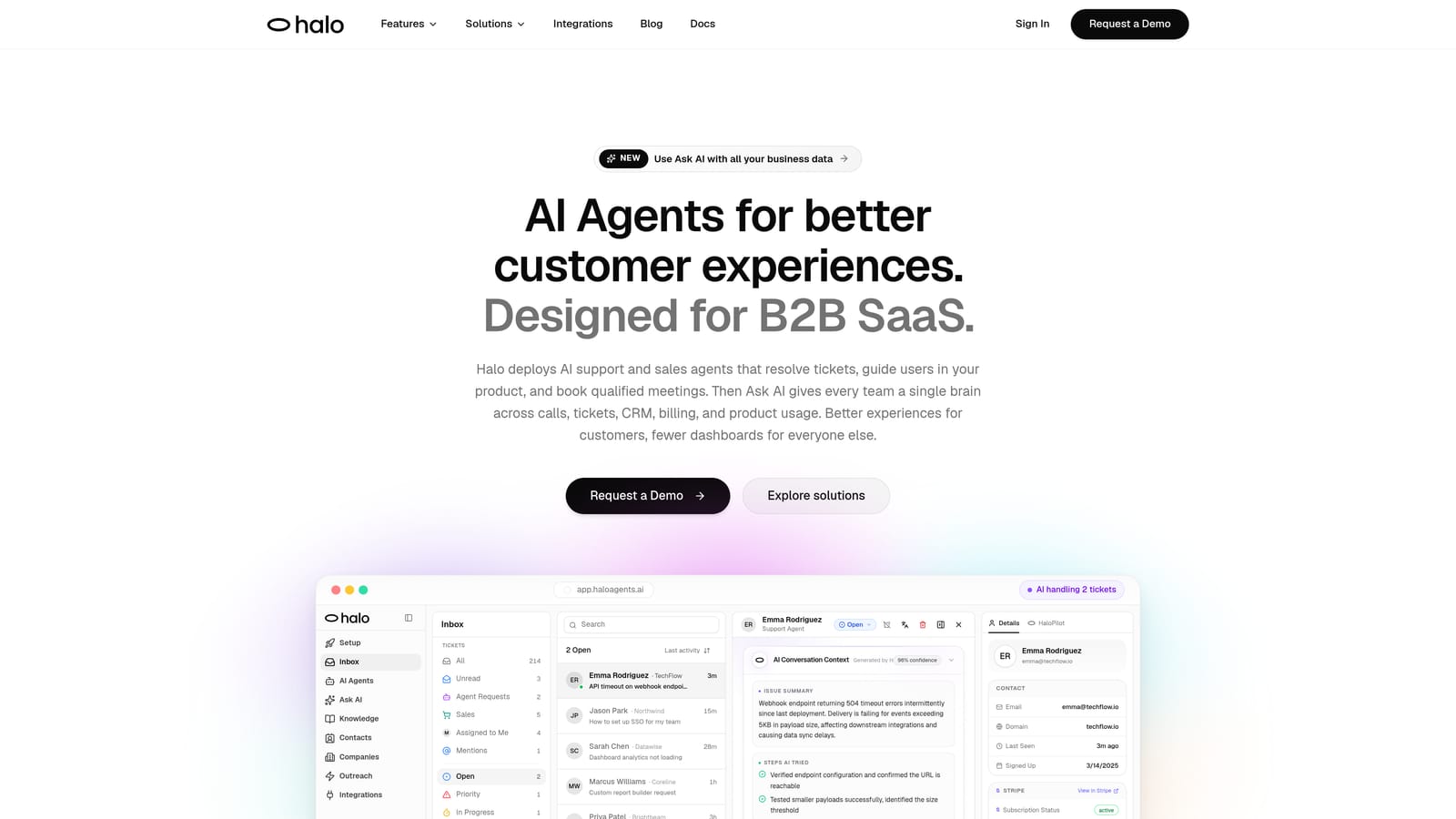
Halo AI is an AI-native customer support platform built from the ground up for autonomous ticket resolution, contextual user guidance, and business intelligence — not a helpdesk with AI features layered on top.
Where This Tool Shines
Halo's most distinctive capability is its page-aware chat widget. Unlike most support AI that operates with only the user's typed message to work from, Halo's widget sees what the user sees — their current page, product state, and context — enabling guidance that's genuinely relevant to where someone is stuck, not just what they typed.
The platform also goes well beyond ticket resolution. Its smart inbox surfaces business intelligence from support interactions: customer health signals, revenue anomalies, and patterns that matter to product and revenue teams, not just support managers. For B2B SaaS companies where every churning customer is a significant loss, that signal layer adds real strategic value.
Key Features
Page-Aware Chat Widget: Sees the user's current product context to deliver guidance that matches exactly where they are in your application.
Autonomous Ticket Resolution: AI agents resolve tickets end-to-end with continuous learning from every interaction, improving over time without manual retraining.
Auto Bug Ticket Creation: Automatically identifies product issues from support conversations and routes bug tickets directly to engineering via Linear integration.
Smart Inbox with Business Intelligence: Surfaces customer health signals, anomaly detection, and revenue intelligence from support data — visibility that most platforms don't offer.
Live Agent Handoff: Escalates to human agents with full conversation context preserved, so customers never have to repeat themselves.
Integration Stack: Connects to Linear, Slack, HubSpot, Intercom, Stripe, Zoom, PandaDoc, and Fathom — spanning engineering, sales, and customer success workflows.
Best For
Product-led B2B SaaS companies that want AI handling routine support while surfacing intelligence across the business. Particularly strong for teams that need support, product, and revenue teams working from the same signals — and for engineering teams tired of manually triaging bug reports from support queues.
Pricing
Contact Halo AI directly for pricing. Given the AI-native architecture and integration depth, expect enterprise-tier positioning with custom quotes based on volume and team size.
2. Intercom Fin
Best for: Teams already on Intercom who want fast AI deployment within their existing setup
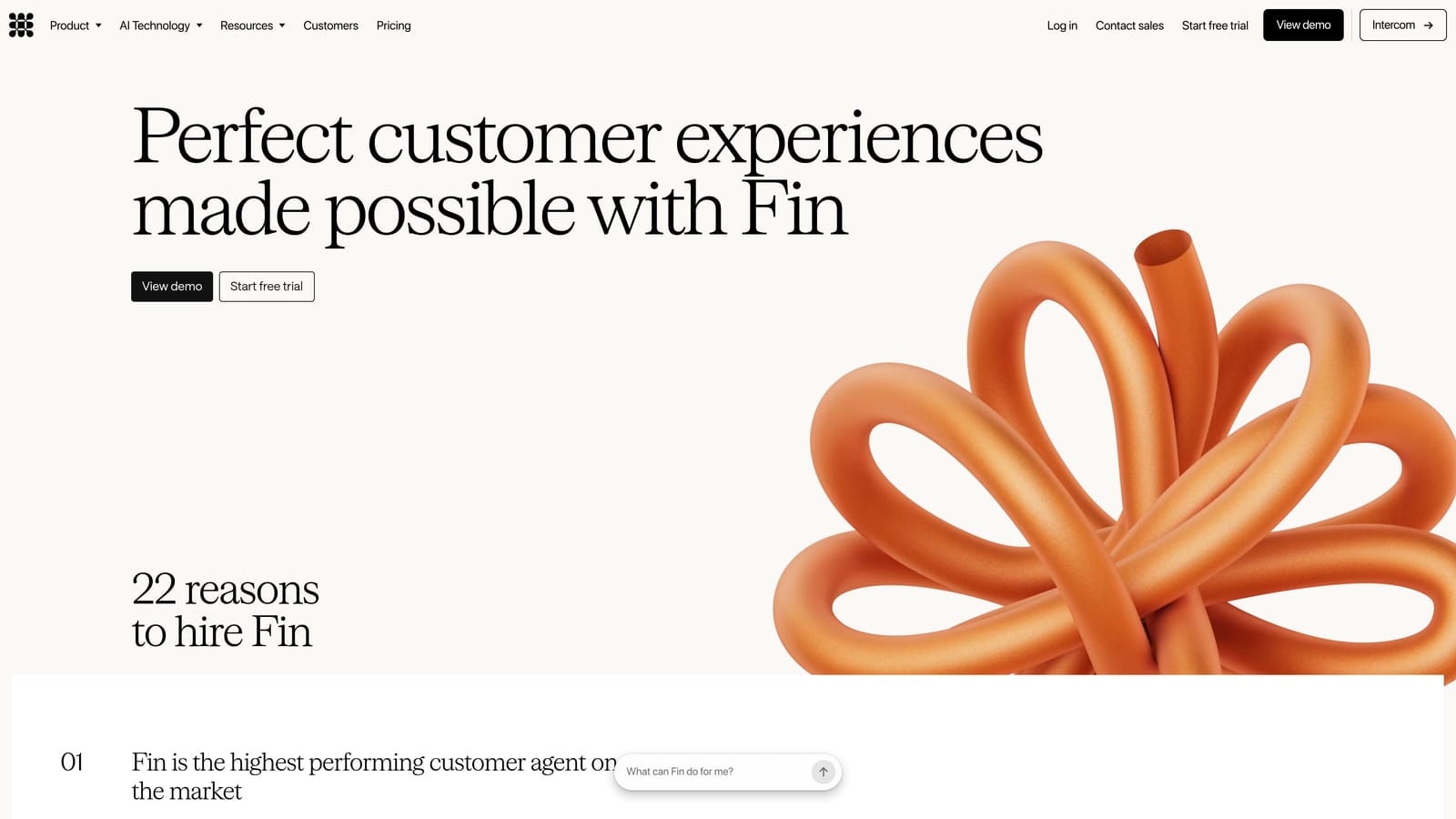
Intercom Fin is Intercom's GPT-powered AI agent that resolves support conversations natively within the Intercom messenger and inbox.
Where This Tool Shines
If your team already lives in Intercom, Fin is genuinely easy to activate. It learns from your existing Intercom knowledge base content, which means teams with well-maintained help documentation can get meaningful resolution rates without significant setup effort. The native integration with Intercom's messenger, inbox, and help center creates a seamless experience for both users and agents.
Fin handles multilingual conversations well, which is useful for support teams serving international user bases without maintaining separate language-specific workflows.
Key Features
Native Intercom Integration: Works directly within Intercom's messenger, inbox, and help center — no additional configuration layer required.
Knowledge Base Learning: Trains on existing Intercom help content, reducing setup time for teams with established documentation.
Usage-Based Pricing: Charges per resolution rather than per seat, which aligns cost with actual value delivered.
Human Handoff: Seamless escalation to human agents within the Intercom environment when AI cannot resolve the query.
Multilingual Support: Handles conversations across multiple languages without manual configuration per language.
Best For
Teams already committed to the Intercom ecosystem who want AI resolution without switching platforms. Less compelling for teams not on Intercom, since Fin's value is deeply tied to the parent platform's data model and infrastructure.
Pricing
Usage-based pricing charged per resolution. Requires an existing Intercom plan, so total cost combines the base Intercom subscription with Fin resolution fees — worth modeling at your expected volume before committing.
3. Zendesk AI
Best for: Enterprise support teams with complex routing, SLA requirements, and existing Zendesk investment
Zendesk AI is a suite of AI capabilities layered across the Zendesk platform, covering triage, routing, agent copilot, and self-service deflection for large-scale support operations.
Where This Tool Shines
Zendesk AI is strongest in enterprise environments where ticket volume is high, routing logic is complex, and SLA management is non-negotiable. The agent copilot feature is genuinely useful: it surfaces relevant knowledge articles and suggests replies in real time, helping agents handle tickets faster without requiring full AI autonomy.
The breadth of Zendesk's integration ecosystem is also a real advantage for enterprises with complex tech stacks. If your organization already has Zendesk deeply embedded, the AI layer adds meaningful efficiency without requiring a platform migration.
Key Features
Intelligent Triage and Routing: AI classifies and routes incoming tickets based on intent, sentiment, and priority — reducing manual triage effort.
Agent Copilot: Surfaces suggested replies and relevant knowledge articles to agents in real time during live tickets.
Self-Service Bot: Automated deflection bot handles common queries before they reach the human queue.
Advanced Analytics and SLA Management: Enterprise-grade reporting with SLA tracking built into the platform.
Enterprise Integration Ecosystem: Broad connectivity with CRM, ITSM, and business tools expected at enterprise scale.
Best For
Large enterprise support teams with high ticket volume, complex routing rules, and existing Zendesk infrastructure. Less compelling for teams evaluating AI-native platforms from scratch, where the "AI bolted onto helpdesk" architecture may feel limiting compared to purpose-built alternatives.
Pricing
Included in Zendesk Suite plans; pricing varies by tier and seat count. Enterprise tiers carry significant per-seat costs — total cost of ownership should be evaluated carefully at scale.
4. Freshdesk Freddy AI
Best for: SMBs on Freshdesk looking for accessible AI without additional licensing complexity
Freshdesk Freddy AI is Freshworks' AI layer for Freshdesk, offering self-service bots, agent assist, and analytics at pricing points accessible to smaller teams.
Where This Tool Shines
Freddy AI's strongest selling point is bundled pricing. For teams already on Freshdesk's growth plans, AI capabilities arrive without a separate add-on purchase — a genuine advantage for cost-conscious SMBs who want AI assistance without budget gymnastics. The three-component structure (Freddy Self Service, Freddy Copilot, Freddy Insights) covers the main use cases without requiring separate products.
Freddy Copilot is particularly useful for agent productivity: reply suggestions and ticket summaries reduce the cognitive load on agents handling high volumes of straightforward queries.
Key Features
Freddy Self Service: Deflection bot that handles FAQ-style queries and common support requests before they reach agents.
Freddy Copilot: Agent-side reply suggestions, ticket summaries, and knowledge surfacing to speed up resolution time.
Freddy Insights: Support analytics covering ticket trends, agent performance, and common query categories.
Bundled Pricing: AI capabilities included in Freshdesk plans at lower tiers — no separate AI add-on required for basic functionality.
Freshworks Suite Integration: Connects across Freshdesk, Freshsales, and other Freshworks products for teams using the broader suite.
Best For
SMBs already on Freshdesk who want AI capabilities without additional licensing overhead. Less suited for complex B2B SaaS support scenarios where nuanced product knowledge and deep integrations outside the Freshworks ecosystem are required.
Pricing
Bundled with Freshdesk plans; the Growth plan starts at approximately $15 per agent per month. Higher-tier Freddy capabilities may require upgraded plans — review current plan tiers on the Freshworks site for specifics.
5. Tidio Lyro
Best for: SMBs and e-commerce teams needing fast AI deployment for high-volume, lower-complexity queries
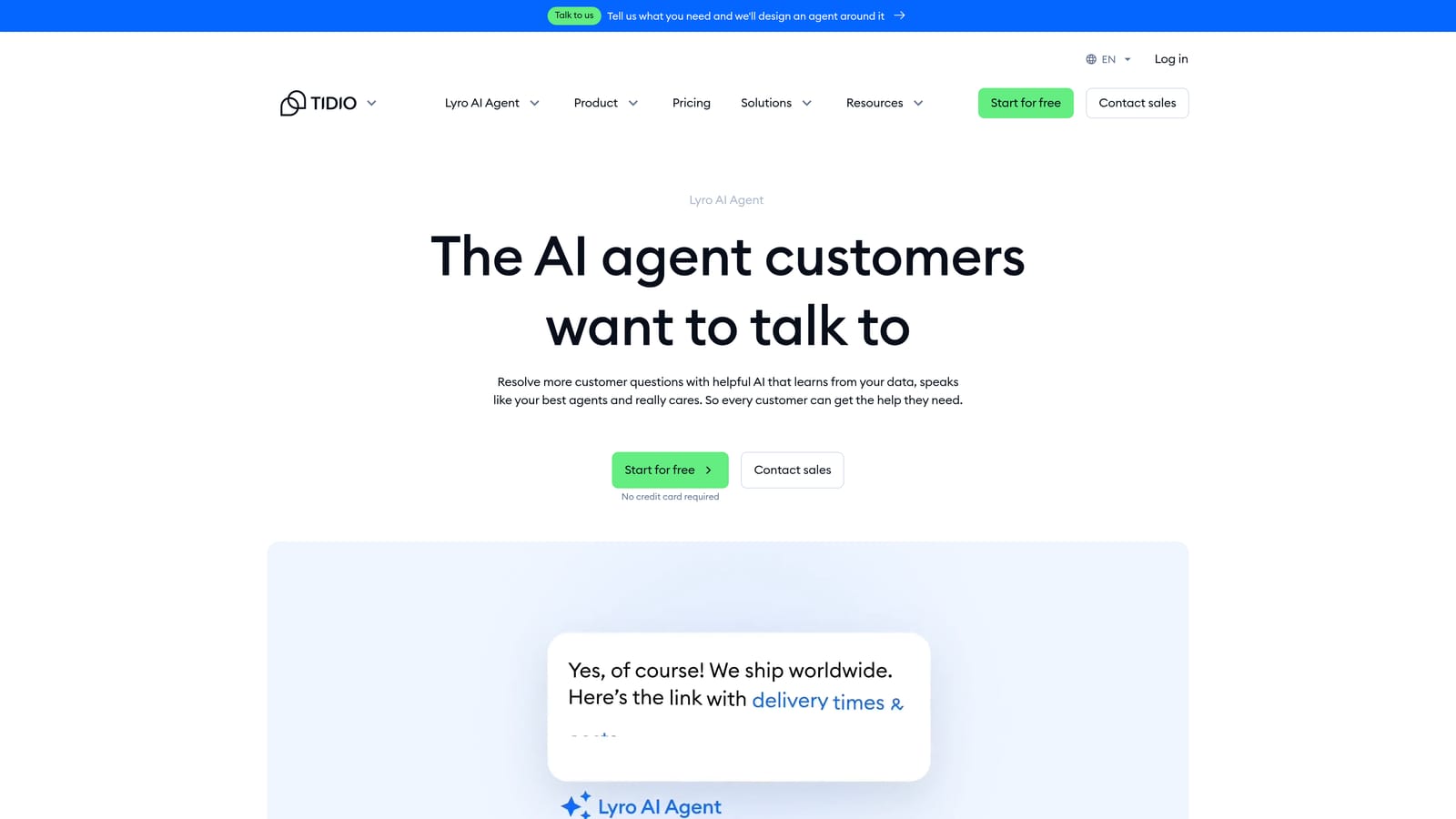
Tidio Lyro is a conversational AI agent designed for smaller businesses and e-commerce operations, with emphasis on quick setup and handling repetitive customer queries at volume.
Where This Tool Shines
Lyro's speed to deployment is a genuine differentiator for resource-constrained teams. It learns from existing FAQ and help content without requiring technical configuration, meaning a small team can have AI handling common queries within hours rather than weeks. For e-commerce use cases — order status, returns, basic troubleshooting — Lyro handles the pattern well.
The free tier with conversation limits is also a meaningful entry point. Teams can validate AI performance on their actual query mix before committing to a paid plan, which reduces adoption risk for smaller businesses evaluating AI for the first time.
Key Features
FAQ-Based Learning: Lyro learns from existing help content and FAQ documentation — no custom training required.
Quick Deployment: No technical setup needed; teams can activate AI resolution in hours.
E-Commerce Query Handling: Purpose-built for order status, returns, and common troubleshooting workflows.
Free Tier: Available with conversation limits, allowing teams to test before purchasing.
Live Chat Fallback: Escalates to human agents via live chat when AI cannot resolve the query.
Best For
SMBs and e-commerce businesses with high volumes of repetitive queries and limited technical resources. Not designed for complex B2B SaaS support, enterprise-scale operations, or teams requiring deep integrations with engineering or revenue tools.
Pricing
Free tier available with conversation limits; paid plans start at approximately $29 per month. Accessible pricing makes it one of the most affordable entry points in the AI support category.
6. Ada
Best for: Enterprise consumer brands needing multilingual AI at scale in retail, telecom, or financial services
Ada is an enterprise no-code AI bot platform with strong multilingual capabilities, built primarily for high-volume consumer support in industries like retail, telecom, and financial services.
Where This Tool Shines
Ada's multilingual support is a genuine technical strength. For global consumer brands managing support across many markets and languages, Ada handles the complexity without requiring separate deployments per language. The no-code bot builder also makes it accessible to non-technical teams, which matters in large enterprises where support operations often sit outside engineering's bandwidth.
Ada has evolved from primarily rule-based conversation flows toward more generative AI capabilities, giving teams the structure of playbook-driven conversations with the flexibility of AI-generated responses where appropriate.
Key Features
No-Code Bot Builder: Accessible to non-technical support and operations teams without engineering involvement.
Multilingual Support: Handles conversations across many languages — a genuine differentiator for global consumer brands.
Generative AI Layer: AI capabilities layered onto structured conversation flows for more natural, flexible responses.
Enterprise Security and Compliance: Enterprise-grade data handling and compliance features for regulated industries.
CRM and Helpdesk Integrations: Connects with major CRM and helpdesk platforms for data continuity.
Best For
Large consumer-facing brands in telecom, retail, financial services, and utilities with multilingual support needs and non-technical operations teams. Less suited for complex B2B SaaS product support where deep product context and engineering integrations are priorities.
Pricing
Enterprise pricing with custom quotes required. Expect significant investment appropriate for large-scale consumer support operations — not positioned as an SMB solution.
7. Forethought
Best for: Teams where full AI autonomy isn't viable and agent augmentation is the priority
Forethought is an AI platform differentiated by its emphasis on helping human agents work faster and more accurately, rather than replacing them entirely with autonomous resolution.
Where This Tool Shines
Forethought's four-component structure (Solve, Triage, Assist, Discover) covers the full support workflow in a way that's particularly well-suited to teams where product complexity makes full AI autonomy impractical. The Assist product — an agent copilot that surfaces relevant knowledge during live tickets — is where Forethought tends to deliver the most consistent value.
The Discover analytics component is also worth noting: it identifies knowledge gaps and ticket trends, helping support leaders understand where documentation needs improvement and where recurring product issues are hiding in the ticket queue.
Key Features
Solve: AI deflection bot for self-service resolution of common queries before they reach agents.
Triage: Intelligent ticket classification and routing based on intent and priority signals.
Assist: Agent copilot that surfaces relevant knowledge and suggested responses during live ticket handling.
Discover: Analytics layer identifying knowledge gaps, ticket trends, and recurring issues across the support queue.
Helpdesk Integrations: Connects with Zendesk, Salesforce, Freshdesk, and other major platforms.
Best For
Support teams with complex products where full AI autonomy isn't realistic, but agent efficiency gains are still a priority. Also well-suited for organizations that want analytics to drive continuous documentation improvement alongside AI assistance.
Pricing
Mid-to-enterprise pricing; contact Forethought directly for a quote. Positioned above SMB price points, so budget planning should account for enterprise-tier investment.
8. Kustomer
Best for: D2C, subscription, and retail brands needing AI with full customer purchase and interaction history
Kustomer is a CRM-first customer service platform with AI automation built on a unified customer timeline, owned by Meta.
Where This Tool Shines
Kustomer's defining architectural decision is the unified customer timeline: a single view combining purchase history, past interactions, subscription data, and support conversations. When AI responds to a customer in Kustomer, it has access to that full context — not just the current ticket. For subscription businesses and D2C brands where customer history heavily influences the right response, this is a meaningful advantage over ticket-centric platforms.
KustomerIQ handles automation, routing, and deflection on top of this rich data layer, enabling more personalized automated responses than platforms working from ticket data alone.
Key Features
Unified Customer Timeline: Combines purchase history, past support interactions, and subscription data into a single customer view accessible to AI and agents.
KustomerIQ: AI layer handling automation, routing, and deflection with full customer context.
Omnichannel Support: Handles email, chat, social, and voice within a single platform.
Context-Aware AI Responses: AI draws on full customer history rather than responding to the isolated current ticket.
Meta Ownership: Worth noting for teams with data privacy requirements — evaluate Meta's data handling policies against your compliance obligations before committing.
Best For
D2C brands, subscription businesses, and retailers where customer history is central to support quality. Less suited for pure B2B SaaS teams or organizations with strict data privacy requirements that make Meta ownership a concern.
Pricing
Per-agent enterprise pricing; contact Kustomer for a quote. Positioned at the enterprise tier with pricing that reflects the CRM plus AI platform scope.
9. Drift (Salesloft)
Best for: B2B teams where support conversations frequently cross into sales territory
Drift, now part of Salesloft, is a conversational AI platform originally built for sales and marketing that has expanded into support — best suited for B2B teams where support and revenue conversations overlap.
Where This Tool Shines
Drift's unique value in a support context is its ability to handle both support and sales intent within the same conversation. For B2B teams where a customer asking a product question might also be a candidate for an upsell, expansion, or renewal conversation, Drift's routing logic can direct that conversation to the right team without losing momentum. The integration with Salesloft's revenue intelligence platform adds useful context for teams already using Salesloft for sales operations.
Real-time notifications for high-intent conversations are also a practical feature for teams that want human involvement when an important customer or prospect engages.
Key Features
Cross-Intent Routing: AI qualifies and routes conversations across support and sales intent within the same platform.
Salesloft Integration: Connects with Salesloft's revenue intelligence platform for teams using the broader Salesloft ecosystem.
Playbook-Based Conversation Flows: Structured conversation routing to direct queries to the right team or agent.
Meeting Booking and Sales Handoff: Enables meeting scheduling and sales team handoff within the same conversation thread.
High-Intent Notifications: Real-time alerts when important customers or high-value prospects engage in a conversation.
Best For
B2B companies where support and sales conversations overlap frequently, and where revenue intelligence from Salesloft is already part of the tech stack. Less specialized than dedicated support AI platforms for teams whose primary need is pure support automation and ticket resolution.
Pricing
Enterprise pricing; contact Drift or Salesloft directly for a quote. Positioned at the enterprise tier consistent with the broader Salesloft platform pricing.
Which Tool Is Right for Your Team?
The most important distinction in this category is architectural: AI-native platforms versus AI features added to existing helpdesk infrastructure. That choice shapes everything from learning velocity to integration depth to the business intelligence you can extract from support data.
For teams starting fresh or actively evaluating a platform change, Halo AI stands out as the strongest option for B2B SaaS companies that want more than ticket deflection. The page-aware context, auto bug ticket creation, and business intelligence layer address problems that most support AI tools don't even attempt to solve. If you're a product-led company where support, engineering, and revenue teams need to work from shared signals, Halo is built for exactly that.
For teams already embedded in a specific ecosystem: Intercom Fin is the natural choice for Intercom shops, Zendesk AI for enterprise Zendesk teams, and Freshdesk Freddy for SMBs on Freshdesk who want accessible AI without additional cost. Ada is the strongest option for global consumer brands with multilingual complexity. Forethought fits teams where agent augmentation matters more than full autonomy. Kustomer serves D2C and subscription businesses where customer history drives support quality. Tidio Lyro is the right entry point for SMBs with simple, high-volume queries. And Drift makes sense for B2B teams where support and sales conversations are genuinely intertwined.
Your support team shouldn't scale linearly with your customer base. Let AI agents handle routine tickets, guide users through your product, and surface business intelligence while your team focuses on complex issues that need a human touch. See Halo in action and discover how continuous learning transforms every interaction into smarter, faster support.