9 Best Customer Support AI Vendors Compared in 2026
This customer support AI vendor comparison evaluates nine leading platforms across deployment models, integration depth, autonomy levels, and business intelligence capabilities, helping SaaS companies and product teams identify the right solution to improve resolution rates, reduce ticket volume, and minimize agent burnout without compromising customer experience.
 Grant CooperFounder14 min read
Choosing the right AI vendor for customer support is no longer a nice-to-have decision. It's a strategic one. The market has matured rapidly, and the gap between a well-implemented AI support platform and a poorly-fitted one shows up directly in resolution rates, churn, and agent burnout.
This guide cuts through the noise with a side-by-side comparison of nine leading customer support AI vendors, evaluated on deployment model, integration depth, autonomy level, and business intelligence capabilities. Whether you're a scaling SaaS company looking to deflect tickets without sacrificing quality, or a product team trying to reduce support overhead while improving the customer experience, this list gives you a clear picture of what each platform actually does well — and where it falls short.
We've structured each entry consistently so you can compare apples to apples. Let's get into it.
1. Halo AI
Best for: B2B SaaS teams that want AI-native support with business intelligence built in
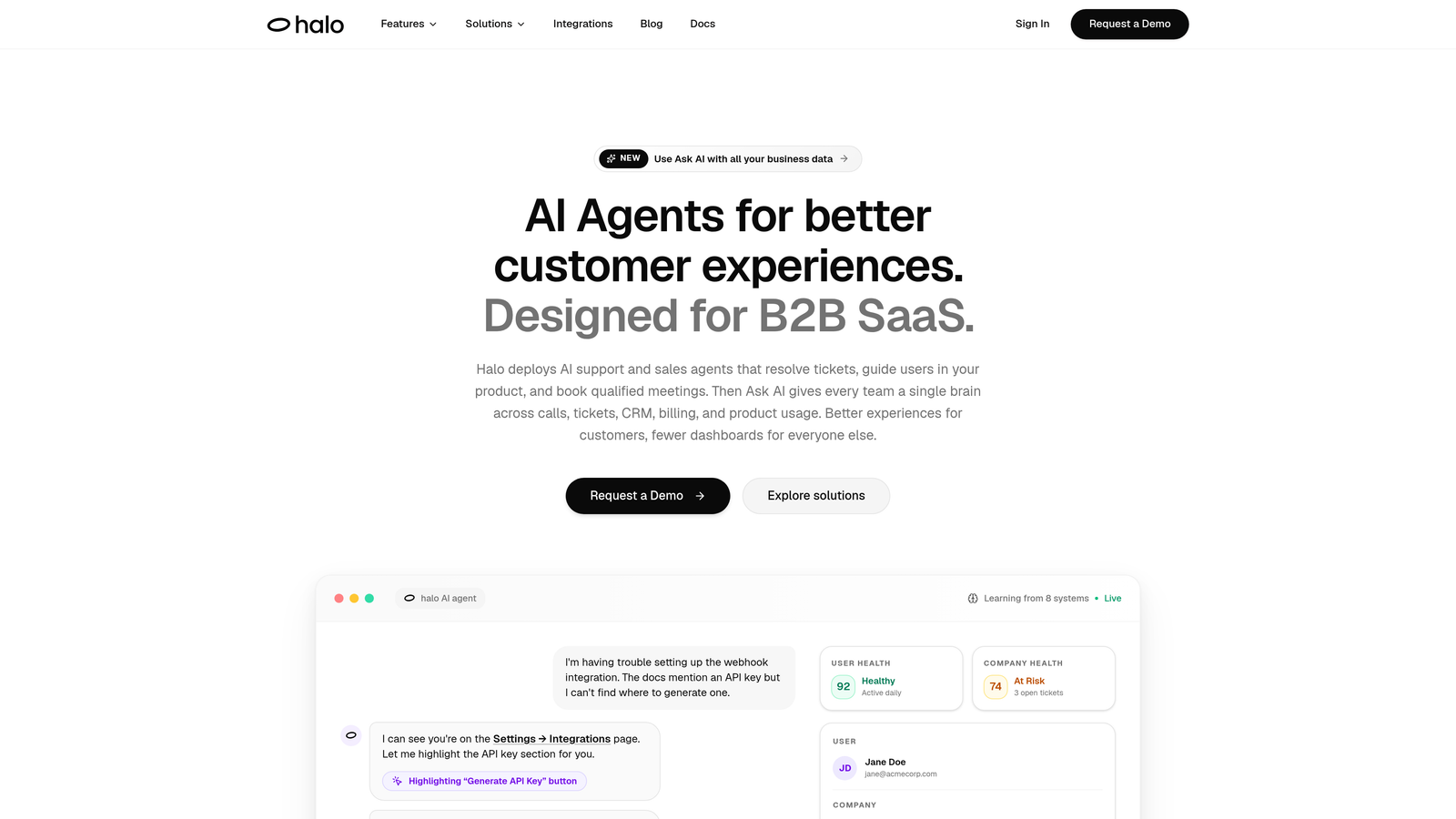
Halo AI is an AI-first customer support platform that resolves tickets, guides users visually through your product, and surfaces business intelligence signals — all while learning from every interaction.
Where This Tool Shines
What sets Halo apart from most vendors on this list is the architecture. AI isn't bolted onto an existing helpdesk — it's the foundation. That distinction matters because it means the system is designed from the ground up to operate autonomously, learn continuously, and surface insights that go beyond support.
The page-aware capability is particularly compelling for SaaS teams. Halo's agent sees what the user sees on screen, enabling contextual guidance that's actually relevant to the moment rather than generic knowledge base responses. Pair that with a smart inbox that surfaces customer health signals and revenue anomalies, and you're getting business intelligence as a byproduct of support — not just ticket deflection.
Key Features
Page-Aware AI Agents: The AI sees the user's current screen context, enabling visual guidance and highly relevant responses without the user needing to explain where they are in the product.
Smart Inbox with Business Intelligence: Surfaces customer health signals, revenue anomalies, and product feedback trends directly from support interactions — giving product and CS teams actionable data.
Auto Bug Ticket Creation: Automatically generates bug reports routed to Linear with full conversation context, closing the loop between support and engineering without manual handoffs.
Live Agent Handoff: Escalates to human agents seamlessly with full conversation history preserved, so customers never have to repeat themselves.
Native Integration Stack: Connects with Slack, HubSpot, Intercom, Stripe, Zoom, PandaDoc, and Fathom — covering the full B2B SaaS toolchain rather than requiring custom API work.
Continuous Learning: The system improves from every resolved interaction automatically, with no manual retraining required.
Best For
B2B SaaS companies and product teams that want more than ticket deflection. If you need AI that integrates with your full business stack, surfaces intelligence beyond support, and improves without constant manual intervention, Halo is built for that context specifically.
Pricing
Contact for pricing. Halo offers custom plans based on usage and integration requirements. Reach out via haloagents.ai for a tailored quote.
2. Intercom Fin
Best for: Teams already on Intercom who want AI resolution without switching platforms
Intercom Fin is Intercom's native AI resolution agent, powered by large language models to answer customer questions directly from your knowledge base.
Where This Tool Shines
Fin's biggest advantage is how frictionless it is for existing Intercom customers. There's no new UI to deploy, no migration headache, and no retraining your team on a different platform. You're extending a system you already know. For teams where Intercom is already the hub of customer communication, Fin is the natural next step.
The per-resolution pricing model is also worth noting. Rather than a flat seat-based fee, you pay for outcomes — which aligns costs with actual deflection. That said, Fin's effectiveness is closely tied to the quality of your existing knowledge base, and its flexibility outside the Intercom ecosystem is limited.
Key Features
LLM-Powered Resolution: Answers customer queries by drawing from your existing Intercom knowledge base using large language models, without requiring separate AI training.
Seamless Human Handoff: Escalates to live agents within the Intercom inbox when the AI can't resolve a query, with full conversation context intact.
Multilingual Support: Handles conversations across major languages without additional configuration.
Fin Insights Dashboard: Shows resolution rates and surfaces common unresolved topics so teams can identify knowledge gaps and improve content.
Native Messenger Integration: Deploys within Intercom's existing messenger, so there's no new widget or interface for customers to encounter.
Best For
Companies already using Intercom as their primary support channel who want to add AI resolution quickly and without vendor complexity. Less suited to teams seeking AI capabilities that extend beyond the Intercom ecosystem.
Pricing
Charged per resolution. Current pricing is available on Intercom's website, as rates are updated periodically.
3. Zendesk AI
Best for: Enterprise support teams deeply embedded in the Zendesk Suite
Zendesk AI is the AI layer built into the Zendesk Suite, offering intelligent triage, agent copilot assistance, and automated self-service for large-scale support operations.
Where This Tool Shines
Zendesk AI is a strong choice when your organization is already running the Zendesk Suite and you want to add AI capabilities without changing your core infrastructure. The triage and routing features are particularly mature, automatically categorizing and prioritizing tickets before agents ever see them — which has a meaningful impact on queue management at scale.
The enterprise compliance and security controls are also a differentiator for regulated industries. If your procurement process requires SOC 2, GDPR, and robust audit trails, Zendesk's AI layer inherits those controls from the broader platform. The trade-off is that the AI capabilities are shaped by the Zendesk paradigm, which may feel limiting if you're looking for more autonomous, AI-native behavior.
Key Features
Intelligent Triage: Automatically categorizes, routes, and prioritizes incoming tickets based on content, intent, and historical patterns.
Agent Copilot: Suggests responses, next best actions, and relevant knowledge articles in real time as agents work through tickets.
AI-Powered Self-Service: Deflects common queries through Zendesk's help center and bot interface before tickets are created.
Enterprise Compliance Controls: Robust security, audit logging, and compliance features suitable for regulated industries and large enterprises.
Deep Analytics: Comprehensive reporting within the Zendesk ecosystem covering resolution times, deflection rates, and agent performance.
Best For
Enterprise support teams with existing Zendesk investments who want AI to enhance their current workflows without platform migration. Not ideal for teams seeking AI-first architectures or capabilities outside the Zendesk environment.
Pricing
Included in select Zendesk Suite plans; advanced AI features are available on higher tiers. Check zendesk.com for current pricing, as tiers are updated regularly.
4. Freshdesk Freddy AI
Best for: SMBs and growing teams on Freshdesk looking for affordable AI assistance
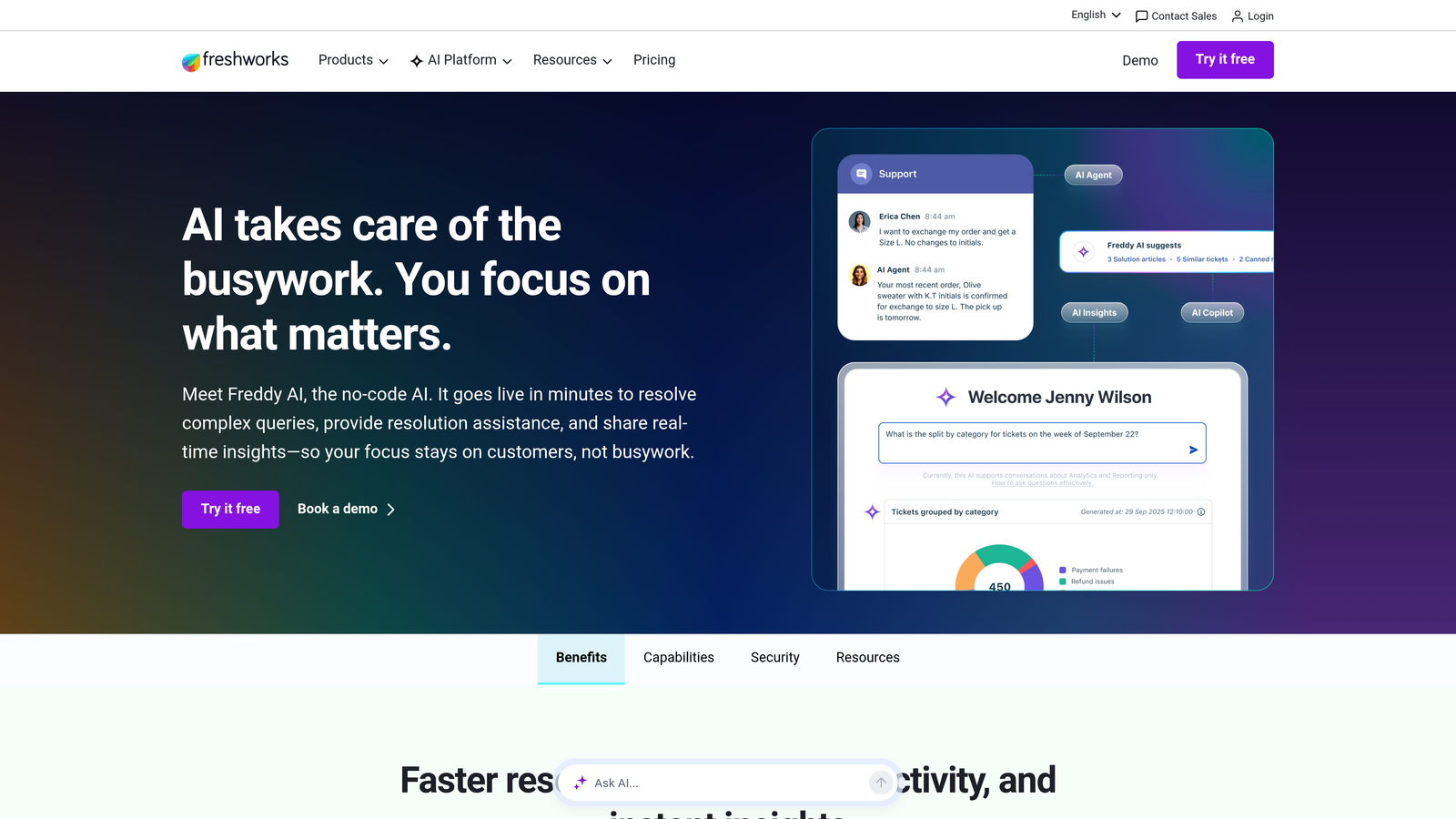
Freshdesk Freddy AI is Freshworks' AI assistant suite, offering customer-facing deflection and agent-side assistance bundled into Freshdesk's existing plans.
Where This Tool Shines
Freddy AI's strongest selling point is accessibility. For teams that are already on Freshdesk and don't want to add another vendor contract or integration layer, Freddy is included in their existing plan structure. That makes the AI adoption decision much simpler from a budget and procurement standpoint.
The split between Freddy Self Service (customer-facing) and Freddy Copilot (agent-facing) gives teams flexibility to deploy AI where it's most needed first. The AI maturity is improving steadily, though teams with complex support workflows or advanced autonomy requirements may find dedicated AI-native platforms more capable.
Key Features
Freddy Self Service: Customer-facing AI bot that handles common query deflection before tickets reach the queue.
Freddy Copilot: Provides agents with AI-generated response suggestions, conversation summaries, and draft replies within the inbox.
Freddy Insights: AI-generated analytics and trend summaries that give managers a high-level view of support patterns without manual report-building.
Freshworks Suite Integration: Works across Freshworks products including CRM and ITSM, making it useful for teams using the broader Freshworks ecosystem.
Bundled Pricing: Core Freddy features are included in Freshdesk Growth and above plans, reducing the vendor overhead of adding AI.
Best For
SMBs and mid-market teams already on Freshdesk who want AI capabilities without a separate vendor relationship. Teams with complex B2B SaaS support needs may outgrow Freddy's current capabilities.
Pricing
Freddy AI features are included in Freshdesk Growth plans and above; Freddy Copilot is available as an add-on. See freshworks.com for current pricing details.
5. Tidio Lyro
Best for: E-commerce and small business teams that need AI chat running quickly
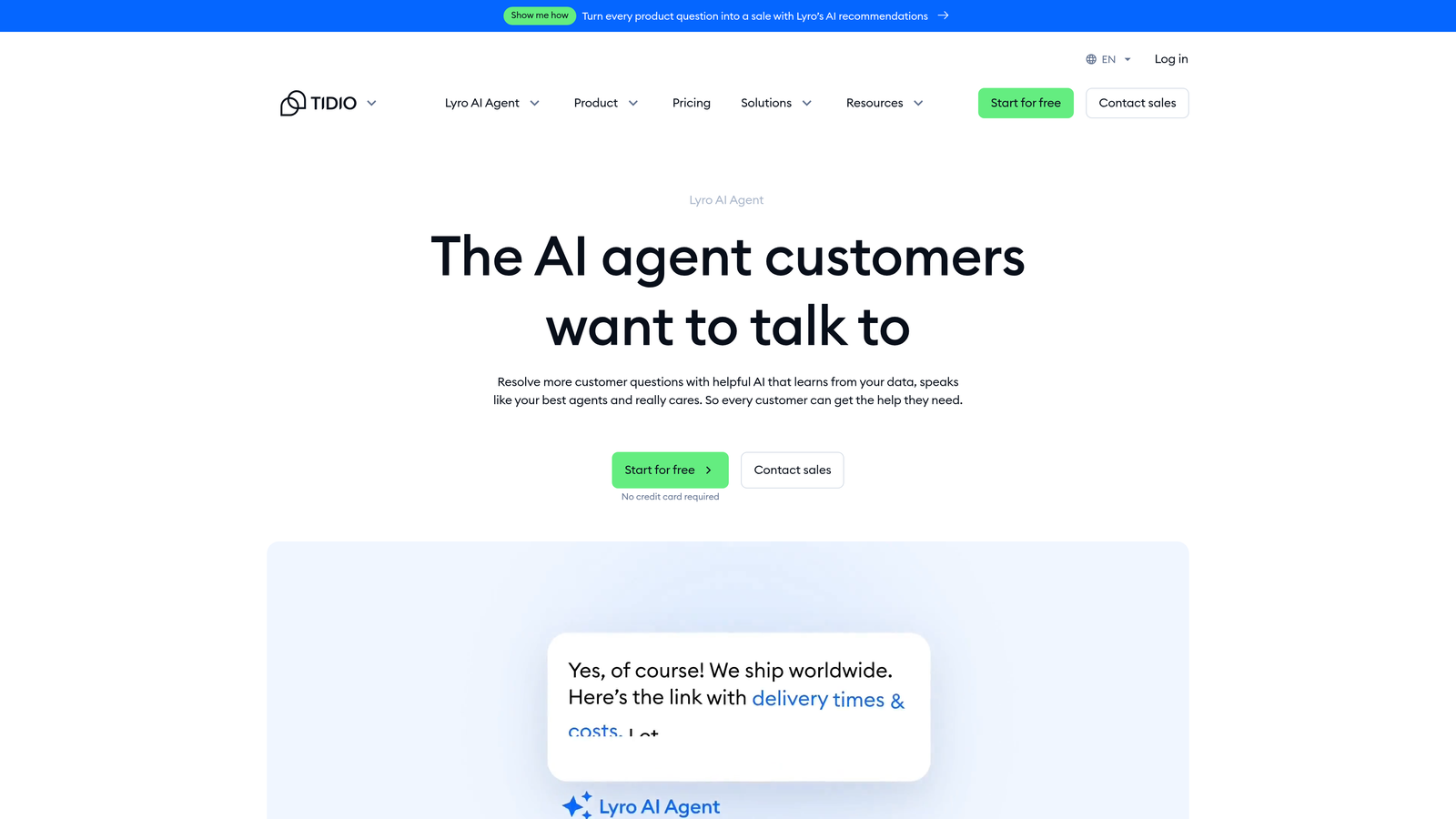
Tidio Lyro is a conversational AI agent designed for fast deployment, with minimal configuration required to get up and running.
Where This Tool Shines
Speed to deployment is Lyro's defining characteristic. For teams that don't have weeks to spend on AI configuration, Lyro trains on your existing FAQ and support content and starts handling conversations quickly. That's genuinely valuable for small business owners and e-commerce operators who need something working now, not after a lengthy implementation process.
The Shopify and WordPress integrations make it a natural fit for retail and direct-to-consumer brands. Lyro Tasks, which can perform actions like checking order status on behalf of customers, adds a layer of practical utility beyond simple Q&A. That said, Lyro isn't purpose-built for complex B2B SaaS support workflows, and teams with sophisticated routing or intelligence requirements will likely find it limiting.
Key Features
Quick Setup: Trains on your FAQ and support content with minimal configuration, enabling fast deployment without engineering resources.
Autonomous Query Handling: Handles common questions independently and escalates to live agents when queries exceed its knowledge or confidence threshold.
E-Commerce Integrations: Native connections with Shopify, WordPress, and major e-commerce platforms for retail-focused use cases.
Lyro Tasks: Performs actions on behalf of customers, such as checking order status, rather than just providing text responses.
Simple Monitoring Dashboard: Lets teams review conversations and adjust AI responses without technical expertise.
Best For
E-commerce businesses, small business teams, and anyone who needs conversational AI running quickly without heavy configuration. Not the right fit for B2B SaaS teams with complex support workflows or enterprise integration requirements.
Pricing
Lyro is available from approximately $29/month, with pricing scaling based on conversation volume. Verify current pricing at tidio.com.
6. Forethought AI
Best for: Enterprise teams that want AI triage and routing layered on top of their existing helpdesk
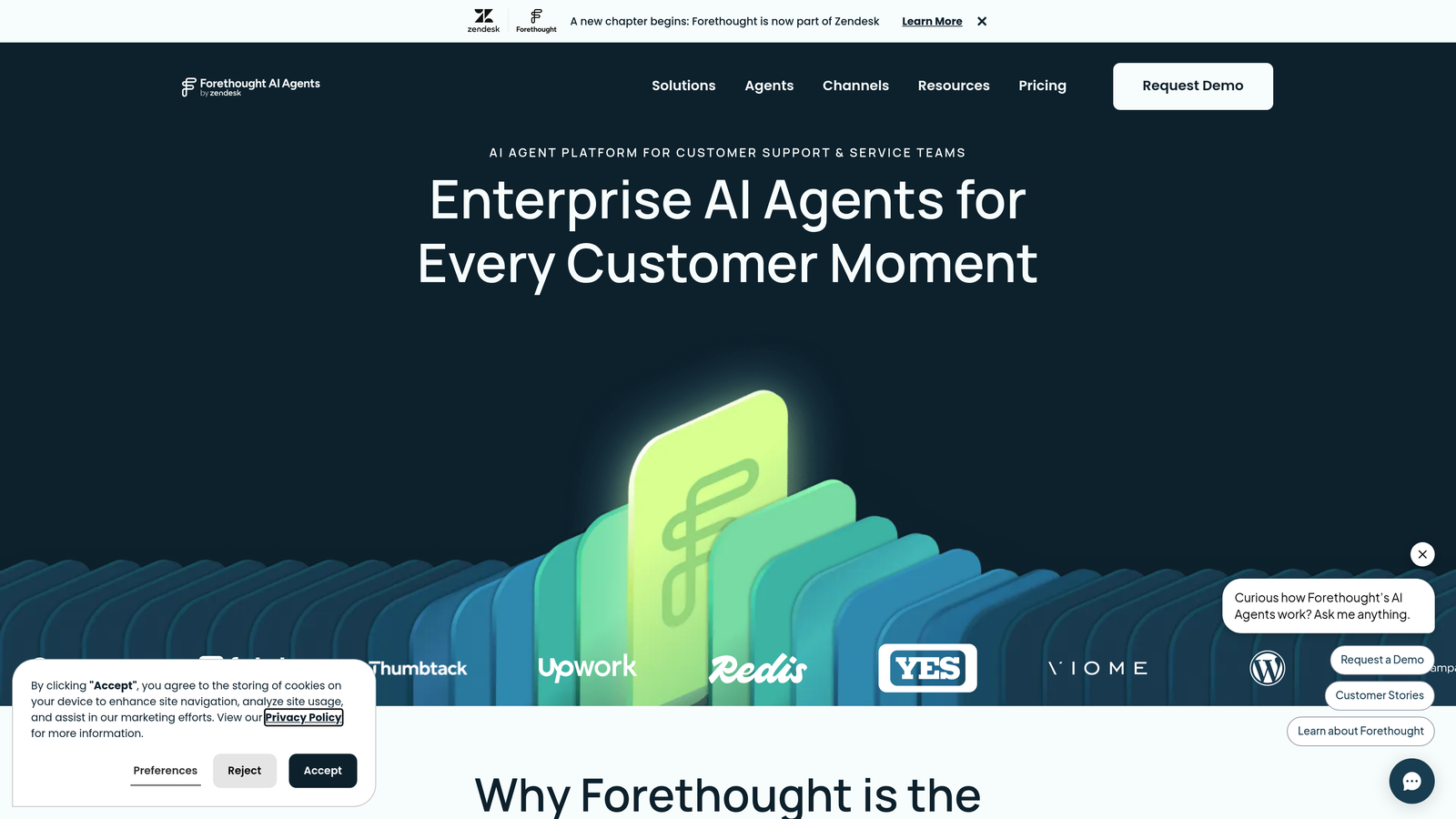
Forethought AI is an enterprise-focused platform specializing in support triage, intelligent routing, and agent assist — designed to work alongside your current helpdesk rather than replace it.
Where This Tool Shines
Forethought's approach is deliberately additive. If your organization has invested heavily in Zendesk, Salesforce Service Cloud, or Freshdesk and isn't ready to migrate, Forethought layers AI capabilities on top of those systems rather than asking you to start over. That's a practical fit for enterprises where platform migration is politically or technically complex.
The Triage product is particularly strong: it predicts ticket categories, priorities, and routing before agents see them, which can meaningfully reduce the time agents spend on sorting and administrative work. The Solve product handles customer-facing deflection, and Assist surfaces relevant knowledge for agents in real time. The modular structure means teams can adopt the pieces that address their most pressing pain points first.
Key Features
Solve: Customer-facing AI resolution layer that deflects common queries before they reach the agent queue.
Triage: Predictive AI that categorizes, prioritizes, and routes tickets automatically before agents engage, reducing manual sorting overhead.
Assist: Real-time AI suggestions and knowledge surfacing for live agents as they work through conversations.
Multi-Helpdesk Integration: Connects with Zendesk, Salesforce Service Cloud, Freshdesk, and other major platforms without requiring migration.
Workflow Automation: Supports multi-step support process automation for complex enterprise workflows.
Best For
Enterprise support organizations that want AI capabilities layered on their existing helpdesk infrastructure, particularly those with complex routing logic or multi-team workflows. Less suited to teams looking for a standalone AI-native platform.
Pricing
Enterprise pricing model. Contact Forethought directly for a custom quote based on your use case and volume.
7. Ada
Best for: Enterprise CX teams that need brand control and no-code conversation design
Ada is a no-code AI agent builder that gives enterprise teams full control over conversation design, brand voice, and governance without requiring engineering resources.
Where This Tool Shines
Ada's strength is in governance and control. For enterprise organizations where brand consistency, compliance, and content approval workflows matter, Ada provides a structured environment for building and managing AI conversations that most platforms don't match. Conversation designers can build complex support flows visually, and the approval and version control features mean changes go through proper review processes before going live.
The multilingual support across dozens of languages is also a genuine differentiator for global brands. Ada does require more upfront configuration than plug-and-play options, but that investment pays off for organizations that need precise control over what their AI says and how it behaves. Teams looking for a fully autonomous, self-learning system may find Ada's more structured approach a different trade-off than they're expecting.
Key Features
No-Code Conversation Builder: Visual interface for designing complex support flows without writing code, accessible to conversation designers and CX teams.
Multilingual AI Support: Handles conversations across dozens of languages, making it viable for global customer bases.
Enterprise Governance Tools: Includes approval workflows, version control, and content permissions for organizations that need formal change management.
Coaching Mode: Allows teams to review AI responses and provide feedback to improve conversation quality over time.
API-Based Integrations: Connects with major CRMs, helpdesks, and data sources through API, enabling data-driven personalization within conversations.
Best For
Large enterprise CX teams with dedicated conversation designers who need brand control, multilingual capabilities, and formal governance over AI behavior. Not ideal for teams looking for rapid out-of-the-box deployment.
Pricing
Enterprise pricing. Contact Ada directly for a custom quote tailored to your conversation volume and requirements.
8. Kustomer AI
Best for: Consumer brands with rich customer history who want AI built on a unified CRM timeline
Kustomer AI delivers AI support capabilities built on top of Kustomer's unified CRM platform, giving both AI and human agents full context from a single customer timeline.
Where This Tool Shines
Kustomer's defining feature is the unified customer timeline. Every past interaction, order, touchpoint, and piece of customer data lives in one place — and both the AI and human agents operate from that same context. For consumer brands handling high volumes of order-related, account-specific, or history-dependent queries, this is a significant advantage over platforms that treat each conversation as isolated.
The omnichannel reach across email, chat, social, and SMS means customers can move between channels without losing context, and the AI routing logic takes customer history and intent into account rather than just ticket content. Kustomer is less commonly adopted in pure B2B SaaS contexts, where the CRM-centric model may be more than what's needed.
Key Features
Unified Customer Timeline: Aggregates all interactions, orders, and touchpoints into a single view that AI and agents both operate from, enabling highly contextual responses.
AI-Powered Conversation Routing: Routes conversations based on customer history, intent, and sentiment rather than just ticket category.
Automated Workflows: Triggers automated actions based on customer events or sentiment signals detected during interactions.
Omnichannel Support: Handles email, chat, social, and SMS within a single platform, maintaining context across channels.
AI-Assisted Agent Responses: Surfaces suggested replies and relevant knowledge articles for agents in real time.
Best For
Consumer brands and high-volume retail or subscription businesses with rich customer history across multiple channels. Less common in B2B SaaS contexts where a full CRM-based support platform may exceed what's needed.
Pricing
Starts at approximately $89/user/month for enterprise plans. Verify current pricing at kustomer.com, as rates are subject to change.
9. Drift (Salesloft)
Best for: B2B teams where support, sales, and marketing conversations overlap significantly
Drift, now part of Salesloft, is an AI-powered conversational platform that spans sales, marketing, and support — making it a distinctive option for B2B revenue teams where these functions share a channel.
Where This Tool Shines
Drift's positioning is unique on this list because it doesn't treat support as a standalone function. If you're a B2B company where the same website chat handles inbound sales inquiries and support questions, Drift's AI can handle both intelligently — routing based on intent signals rather than requiring separate widgets for each function. That convergence is genuinely useful for teams running lean GTM operations.
The integration depth with Salesforce, HubSpot, and Marketo reflects its roots as a revenue tool. Conversation intelligence across the full funnel gives revenue leaders visibility into how support interactions relate to deal progression and customer health. For teams where support is purely a cost center and not connected to revenue workflows, Drift may be more platform than the use case requires.
Key Features
Unified AI Chat: Handles support queries alongside sales qualification in a single interface, with intent-based routing to the right team.
Intent-Based Routing: Analyzes conversation signals to determine whether a visitor needs support, sales, or marketing engagement and routes accordingly.
Playbooks: Structured conversation flows for common support and sales scenarios that teams can build and customize without engineering resources.
GTM Tool Integrations: Native connections with Salesforce, HubSpot, and Marketo, making it a natural fit for B2B revenue teams.
Conversation Intelligence: Analytics across the full revenue funnel, connecting support and sales conversation data for leadership visibility.
Best For
B2B companies where support, sales, and marketing share a conversational channel and where revenue intelligence across all three functions is valuable. Teams looking for a dedicated, pure-play support AI platform will likely find more purpose-built options elsewhere on this list.
Pricing
Enterprise pricing. Contact Salesloft/Drift directly for current packages, as pricing is customized based on team size and feature requirements.
Which Tool Is Right for Your Team?
Every platform on this list solves a real problem. The question is which problem matches yours.
If you're a B2B SaaS team that wants AI-native architecture, business intelligence beyond support, and deep integrations with your full product stack, Halo AI is built specifically for that context. The page-aware agents, smart inbox, and continuous learning loop are designed for teams that want support to be a source of product and revenue intelligence, not just a cost center.
For teams already embedded in a specific helpdesk ecosystem, the native AI options are the path of least resistance. Intercom Fin for Intercom shops, Zendesk AI for enterprise Zendesk deployments, and Freshdesk Freddy AI for SMBs on Freshworks all offer solid AI capabilities without requiring a new vendor relationship.
Forethought is the right call when you need AI triage and routing layered on top of existing infrastructure without migration. Ada fits enterprise teams that need formal governance over AI conversation design. Kustomer AI serves consumer brands with rich cross-channel customer histories. Drift is the standout choice when support and revenue conversations share the same channel. And Tidio Lyro is the fastest path to working conversational AI for e-commerce and small business teams.
Your support team shouldn't scale linearly with your customer base. Let AI agents handle routine tickets, guide users through your product, and surface business intelligence while your team focuses on complex issues that need a human touch. See Halo in action and discover how continuous learning transforms every interaction into smarter, faster support.