9 Best Customer Support AI Vendors in 2026
This guide evaluates nine leading customer support AI vendors across key dimensions including resolution quality, integration depth, analytics, and total cost of ownership, helping B2B teams distinguish genuine AI-first platforms from legacy tools with AI bolted on. Whether you're a lean startup or managing enterprise-scale ticket volumes, this comparison provides the clarity needed to choose the right customer support AI vendor for your stack.
 Matt PattoliFounder13 min read
Choosing the right customer support AI vendor is one of the most consequential decisions a B2B team makes today. The market has matured significantly. Gone are the days of simple rule-based chatbots. Today's vendors offer autonomous ticket resolution, deep integrations, business intelligence, and seamless human handoff.
But with dozens of platforms competing for your budget, how do you separate genuine AI-first platforms from legacy tools with AI bolted on? That distinction matters more than most vendors will admit.
This guide evaluates nine leading customer support AI vendors across the dimensions that actually matter: resolution quality, integration depth, analytics capabilities, ease of deployment, and total cost of ownership. Whether you're running a lean startup support team or managing enterprise-scale ticket volumes, there's a right fit for your stack. For broader context on what to look for, see our guides to automated customer support and AI customer service.
1. Halo AI
Best for: B2B SaaS teams that want AI-first support with deep product context and business intelligence.
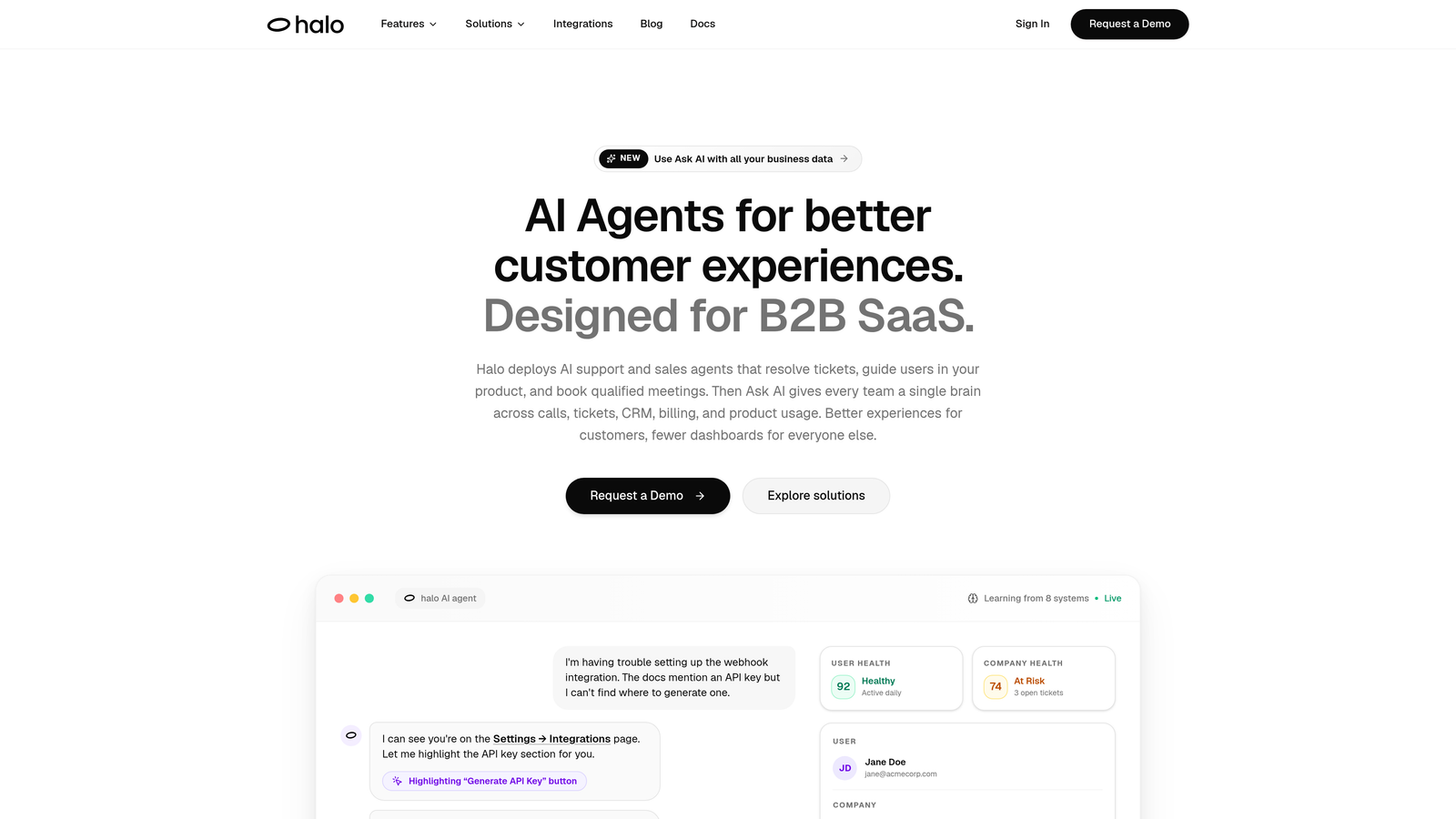
Halo AI is an AI-first customer support platform built specifically for B2B SaaS teams who need more than a chatbot.
Where This Tool Shines
What separates Halo from most vendors on this list is its architecture. Rather than layering AI onto an existing helpdesk, Halo was built from the ground up with autonomous resolution as the primary goal. Its page-aware context engine means the AI actually understands what a user is looking at in your product at the moment they reach out — not just what they typed.
The other standout capability is the smart inbox. Beyond resolving tickets, Halo surfaces business intelligence: customer health signals, revenue anomalies, and early churn indicators. For product-led growth companies, this transforms support from a cost center into a genuine intelligence layer across the business.
Key Features
Page-Aware Chat Widget: Sees what users see inside your product and provides visual UI guidance in context, not just generic help articles.
Continuous Learning AI Agents: Improve resolution quality over time by learning from every interaction specific to your product and customer base.
Smart Inbox with Business Intelligence: Surfaces customer health signals, revenue anomalies, and churn indicators alongside standard support metrics.
Auto Bug Ticket Creation: Automatically creates and routes bug reports to Linear and connected dev tools without manual intervention.
Live Agent Handoff: Escalates to human agents with full conversation context preserved, so customers never have to repeat themselves.
Broad Integration Stack: Connects natively with Linear, Slack, HubSpot, Intercom, Stripe, Zoom, PandaDoc, and Fathom.
Best For
Halo is purpose-built for B2B SaaS companies and product-led growth teams that need AI to understand product context, not just search a knowledge base. It's particularly well-suited for teams that want support intelligence to feed back into product, revenue, and customer success workflows.
Pricing
Contact for pricing. Visit haloagents.ai for current plans and to request a demo tailored to your team's scale and stack.
2. Intercom Fin
Best for: Teams already on Intercom who want to add AI resolution without changing platforms.
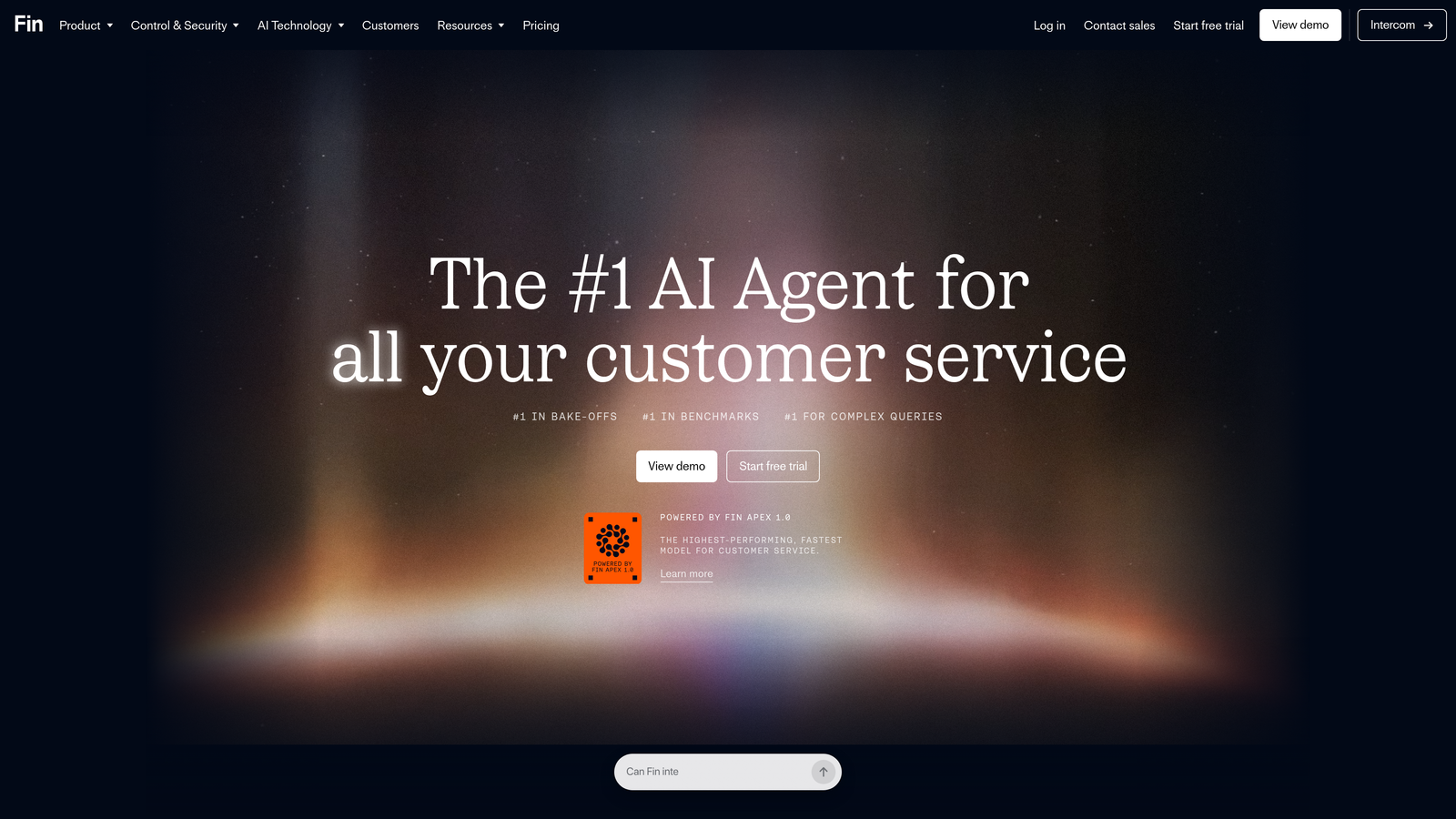
Intercom Fin is Intercom's native AI agent, powered by large language models, that resolves customer questions directly within the Intercom messenger.
Where This Tool Shines
Fin's biggest advantage is how seamlessly it fits into an existing Intercom setup. If your team already lives in Intercom's inbox, deploying Fin requires no separate platform, no new integration work, and no major workflow changes. It uses your existing help center content and custom answers to resolve questions automatically.
The per-resolution pricing model is also worth noting. Rather than paying for seats or platform access regardless of performance, you pay for outcomes. For teams with variable ticket volumes, this can make cost forecasting more predictable.
Key Features
Native Intercom Integration: Works directly within Intercom's messenger and inbox with no separate setup required.
Help Center-Powered Answers: Resolves questions using your existing help center articles and custom content without manual retraining.
Contextual Human Handoff: Passes full conversation context to human agents when escalation is needed.
Per-Resolution Pricing: You pay for successful resolutions, not agent seats or platform licenses.
Multi-Language Support: Handles conversations across multiple languages without separate configuration.
Best For
Teams already invested in the Intercom ecosystem who want to add AI resolution capabilities quickly, without adopting a new platform or disrupting existing workflows. Less ideal for teams looking to move away from Intercom or needing deep integrations outside the Intercom stack.
Pricing
Charged per resolution; requires an active Intercom subscription. Visit Intercom's pricing page for current resolution rates and plan requirements.
3. Zendesk AI
Best for: Large enterprise support teams deeply embedded in the Zendesk Suite ecosystem.
Zendesk AI is an AI layer embedded across Zendesk Suite, offering intelligent triage, agent copilot features, automated ticket summarization, and macro suggestions.
Where This Tool Shines
Zendesk AI excels in environments where complexity and scale are the primary challenges. Its intelligent triage capabilities — detecting intent, sentiment, and language automatically — are particularly valuable for large teams handling thousands of tickets across multiple product lines or regions. When you have dozens of agents and complex routing logic, the AI's ability to classify and direct tickets accurately has real operational impact.
The agent copilot features are also strong. Real-time suggestions, ticket summarization, and generative reply drafting help experienced agents work faster without removing them from the loop — which matters for enterprise teams that aren't ready for full automation.
Key Features
Intelligent Triage: Automatically detects intent, sentiment, and language to route tickets to the right team or workflow.
Agent Copilot: Provides real-time suggestions, ticket summarization, and AI-assisted reply drafting during live conversations.
Macro and Workflow Recommendations: Suggests automation improvements based on observed ticket patterns.
Generative Reply Drafting: Helps agents compose responses faster using AI-generated draft content.
Advanced AI Add-On: Available as an add-on to existing Zendesk Suite plans, keeping the upgrade path familiar for existing customers.
Best For
Enterprise support organizations already running Zendesk Suite at scale. The AI capabilities are genuinely powerful, but they're designed to augment Zendesk's existing workflow rather than replace it — so teams looking for a standalone AI-first platform will find this limiting.
Pricing
Advanced AI is an add-on to existing Zendesk Suite plans. Contact Zendesk directly for current add-on rates, as pricing varies by plan tier and team size.
4. Freshdesk Freddy AI
Best for: SMB and mid-market teams wanting AI features at accessible price points.
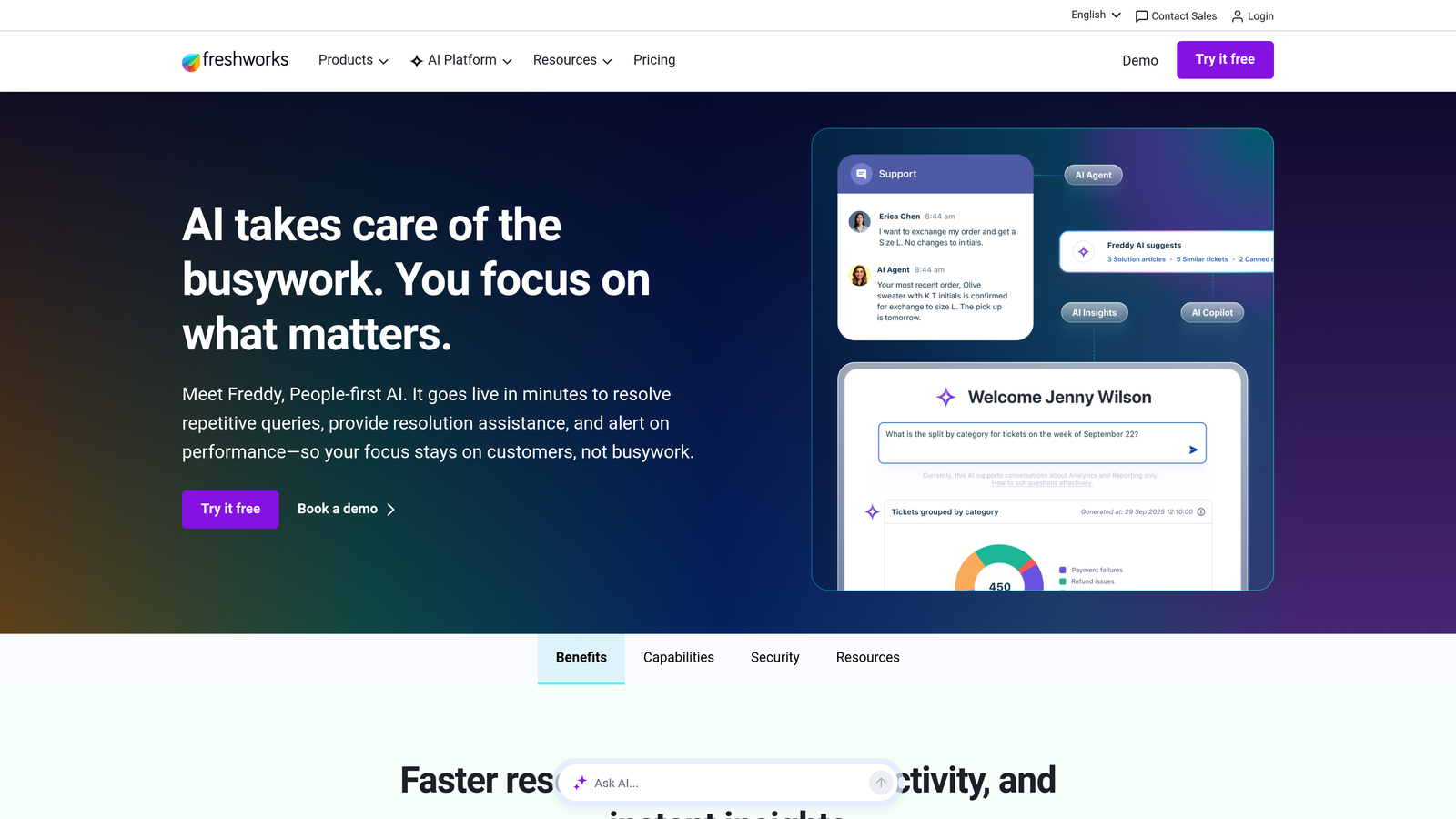
Freshdesk Freddy AI is Freshworks' AI suite spanning Freshdesk and Freshchat, offering self-service chatbots, agent copilot features, and AI-powered analytics.
Where This Tool Shines
Freddy AI's strongest argument is value for money. Freshworks has historically positioned itself as the more accessible alternative to Zendesk, and the AI layer reflects that philosophy. Teams that need solid AI capabilities — deflection, agent assist, and analytics — without enterprise-level pricing will find Freddy a compelling option.
The three-tier structure of Freddy (Self Service, Copilot, and Insights) also gives teams flexibility to adopt AI incrementally rather than committing to a full platform overhaul from day one.
Key Features
Freddy Self Service: Conversational AI chatbot that deflects common questions before they reach a human agent.
Freddy Copilot: Real-time agent assist with suggested replies, ticket summaries, and next-step recommendations.
Freddy Insights: AI-powered analytics that surfaces performance trends and improvement recommendations.
Omnichannel Coverage: Handles email, chat, phone, and social interactions within a unified inbox.
Accessible Pricing Tiers: AI features are available across Growth, Pro, and Enterprise plans, not locked behind a premium add-on.
Best For
SMB and mid-market support teams that want a capable, well-rounded AI suite without the pricing complexity of enterprise platforms. Also a natural fit for teams already using Freshworks products across sales, IT, or HR.
Pricing
Freddy AI features are included across Freshdesk Growth, Pro, and Enterprise plans. Pricing starts at SMB-friendly tiers; visit Freshworks' pricing page for current rates.
5. Tidio
Best for: E-commerce and small business teams that need fast deployment and accessible pricing.
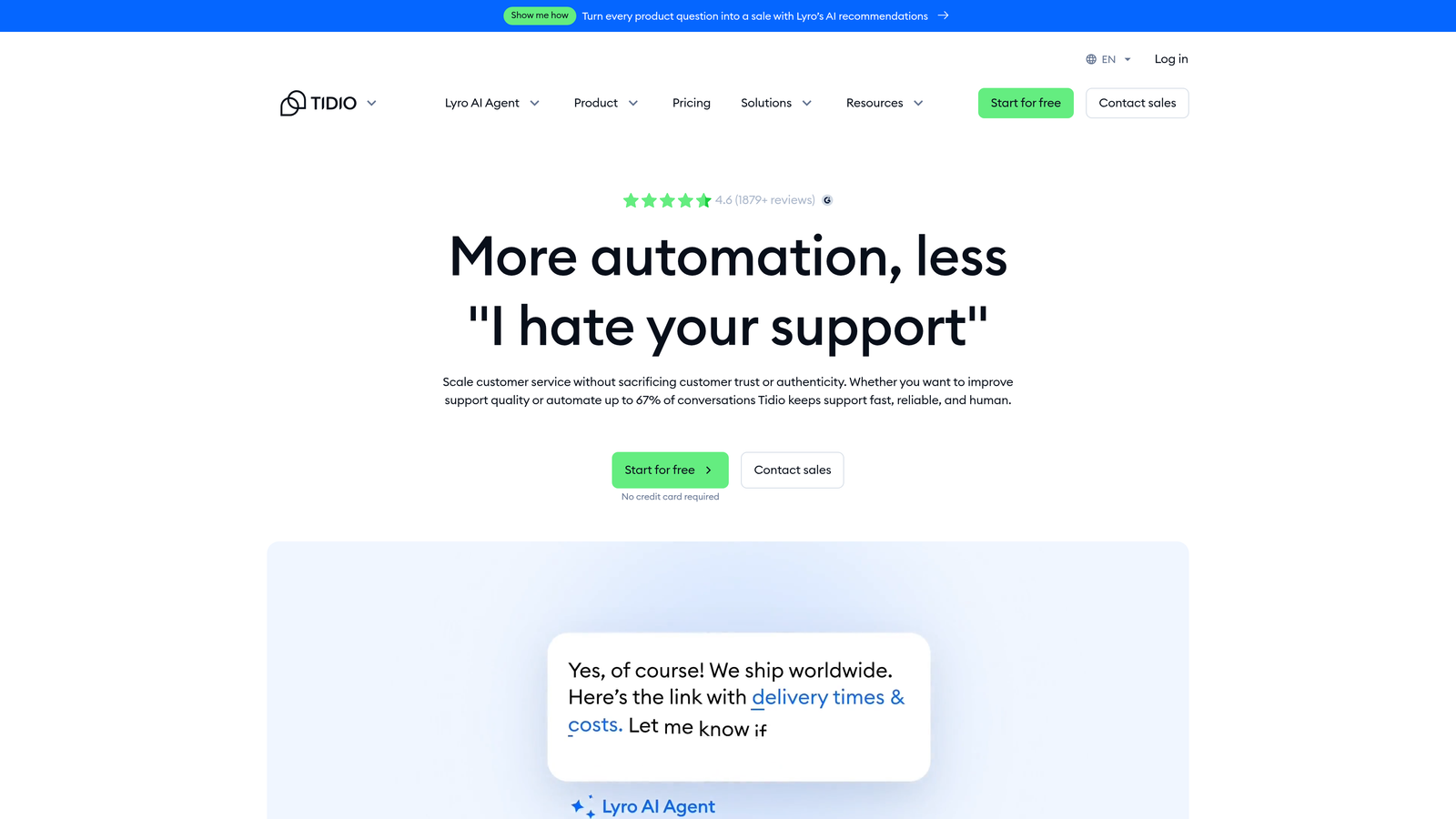
Tidio is a conversational AI platform offering Lyro AI for automated customer conversations alongside a visual chatbot builder designed for quick deployment.
Where This Tool Shines
Tidio's standout quality is speed to value. Most teams can have a working chatbot or Lyro AI deployment running within hours, not weeks. For small businesses and e-commerce stores without dedicated technical resources, that matters enormously. The visual drag-and-drop flow builder means non-technical team members can build and modify conversation flows without developer support.
Lyro AI, Tidio's conversational AI product, handles a solid range of common customer questions and integrates well with major e-commerce platforms including Shopify, WooCommerce, and BigCommerce.
Key Features
Lyro AI: Conversational AI trained on your support content to automatically handle common customer questions.
Visual Chatbot Builder: Drag-and-drop interface for building conversation flows without coding or technical skills.
E-Commerce Integrations: Native connections to Shopify, WooCommerce, and BigCommerce for order and product context.
Live Chat with AI Handoff: Smooth transition from AI to human agents when conversations require a personal touch.
Fast Setup: Deployable in hours, with minimal technical configuration required.
Best For
Small businesses and e-commerce teams that prioritize fast setup and ease of use over deep customization. Tidio is less suited for complex B2B support workflows or teams that need sophisticated integrations beyond the e-commerce stack.
Pricing
A free plan is available. Lyro AI starts at approximately $29/month, with paid plans scaling based on conversation volume. Visit Tidio's pricing page for current tier details.
6. Drift (Salesloft)
Best for: B2B revenue teams where support, sales, and marketing conversations intersect.
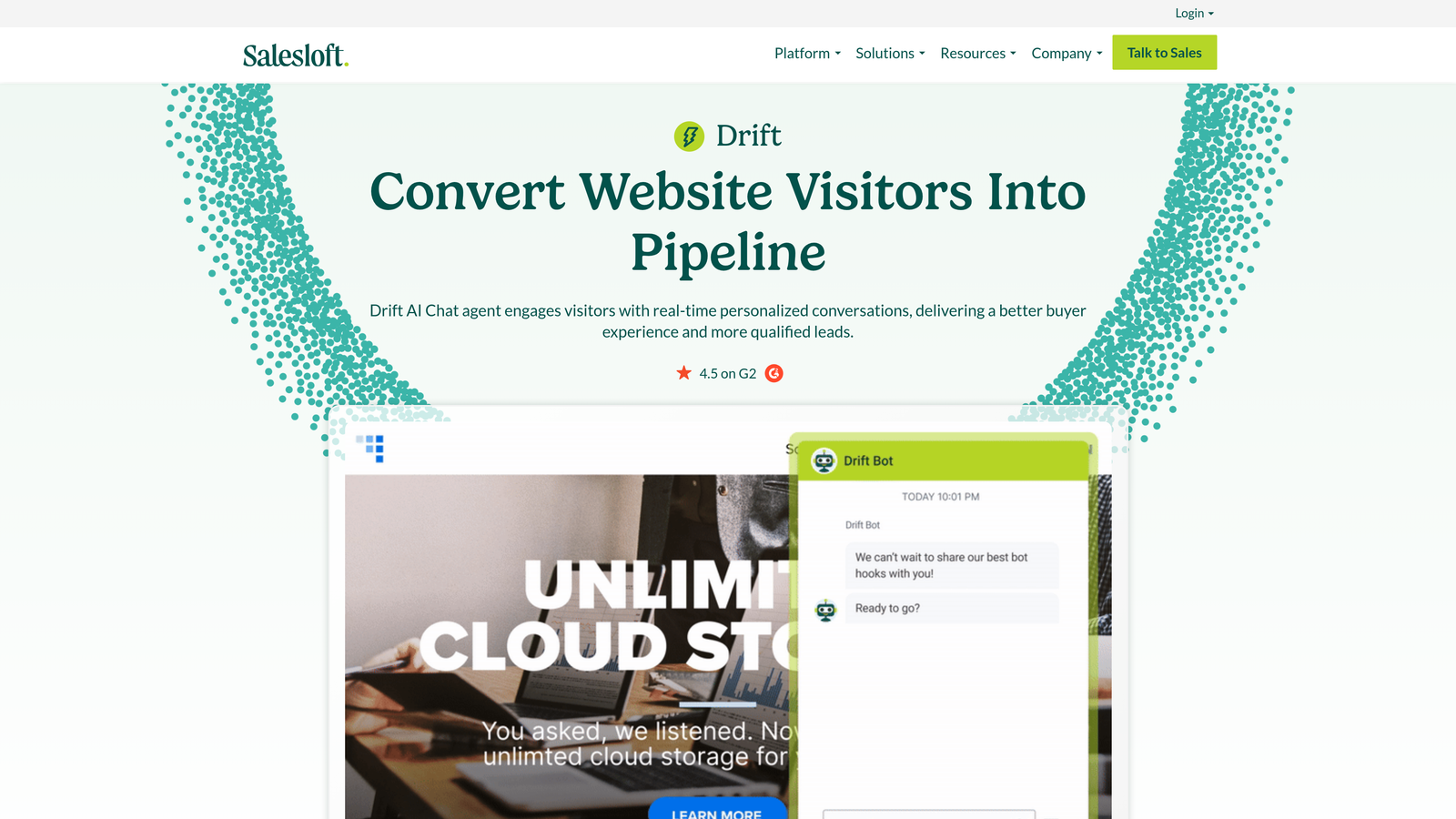
Drift, now part of Salesloft's revenue intelligence suite, is a conversational AI platform built for B2B teams where website and in-product conversations span both support and sales.
Where This Tool Shines
Drift's core strength has always been at the intersection of support and revenue. For B2B companies where a support conversation can turn into a sales opportunity, or where a prospect's question needs to reach the right account executive immediately, Drift's combination of AI-powered conversation routing and buyer intent signals is genuinely useful.
Since joining Salesloft, Drift has deeper connections to the broader revenue platform, making it a natural fit for teams that want a unified view of customer conversations across the entire go-to-market motion.
Key Features
AI Conversational Bots: Handles support and sales qualification simultaneously within a single conversation flow.
Real-Time Buyer Intent Signals: Identifies high-intent visitors and routes them to the right team or representative instantly.
Meeting Scheduling and Routing: Books meetings and routes conversations to the right person without leaving the chat interface.
Salesloft Platform Integration: Connects natively with Salesloft's broader revenue intelligence and engagement tools.
Account-Based Targeting: Personalizes conversation experiences based on account data and visitor identity.
Best For
B2B companies where the boundary between support and sales is intentionally blurred, particularly teams already using Salesloft for revenue operations. Less ideal for pure support automation use cases where sales context is irrelevant.
Pricing
Contact Drift or Salesloft for current pricing. Historically enterprise-oriented; expect pricing that reflects the combined platform's positioning.
7. Kustomer
Best for: High-volume consumer brands managing complex order histories and support interactions.
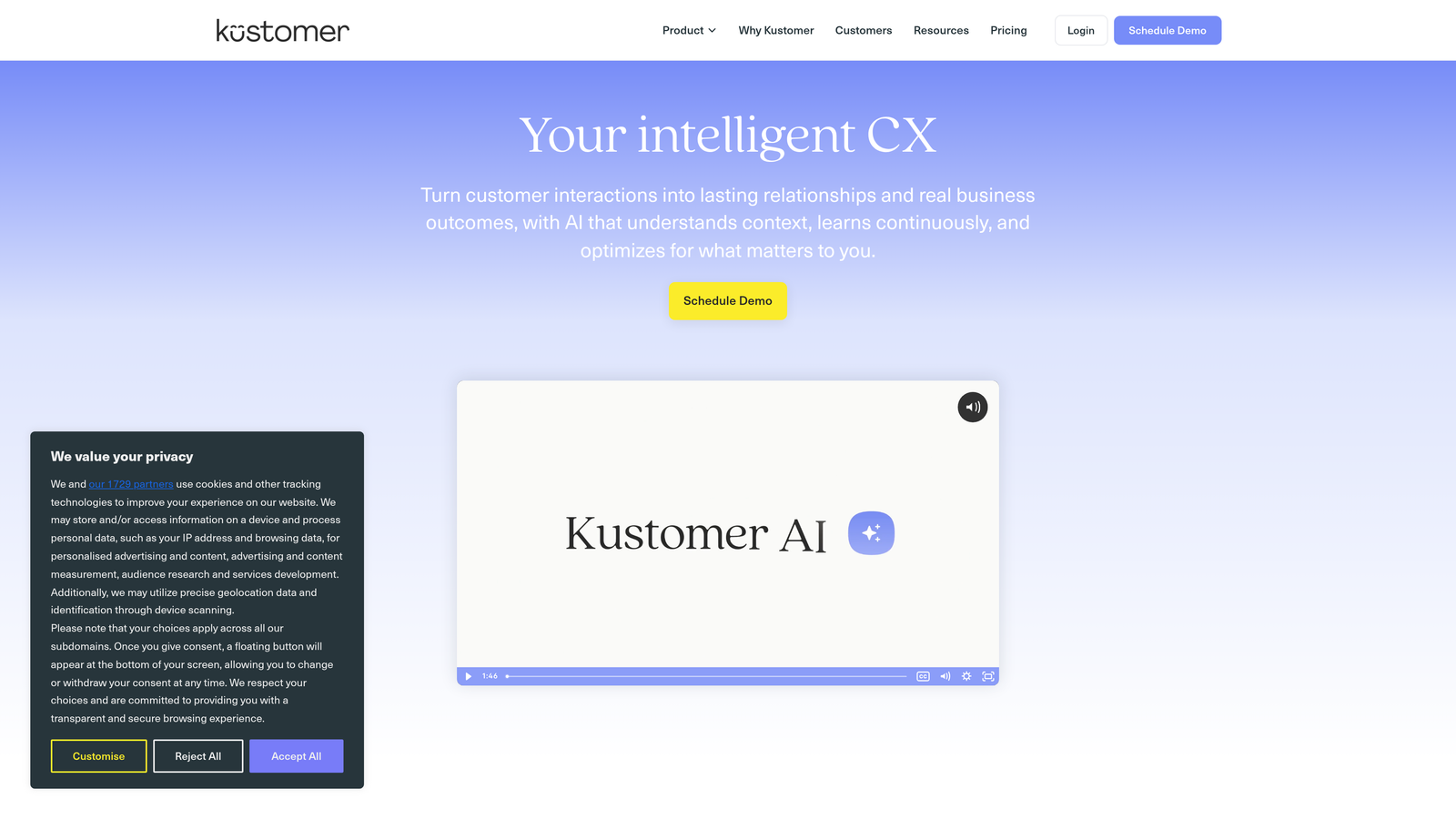
Kustomer is a CRM-native customer service platform that layers AI across a unified customer timeline, built for brands managing high interaction volumes with rich customer history.
Where This Tool Shines
Kustomer's unified customer timeline is its defining feature. Rather than treating each support ticket as an isolated event, Kustomer aggregates CRM data, order history, previous interactions, and behavioral signals into a single view. When AI is making decisions — routing tickets, suggesting replies, triggering automations — it's working with the full picture of who that customer is, not just the current message.
This makes Kustomer particularly powerful for consumer-facing brands where context is everything: a customer asking about a return is a very different conversation depending on their order history, lifetime value, and previous support interactions.
Key Features
Unified Customer Timeline: Combines CRM data, order history, and all support interactions into a single continuous view per customer.
AI Intent Detection: Identifies the purpose of incoming messages and routes them to the appropriate workflow automatically.
Behavior-Triggered Automations: Workflows that fire based on customer history and behavior, not just message content.
Omnichannel Inbox: Manages email, chat, SMS, social, and voice conversations within a unified interface.
Suggested Replies: AI-generated response suggestions informed by the full customer timeline, not just the current ticket.
Best For
Direct-to-consumer and consumer-facing brands with high interaction volumes, complex order histories, and a need for full customer context at the point of every support interaction. Less suited to pure B2B SaaS support workflows.
Pricing
Enterprise plan starts at approximately $89/user/month. Contact Kustomer for volume pricing and current plan details.
8. Ada
Best for: Enterprise teams that need brand-controlled, policy-governed AI agents without engineering dependency.
Ada is an enterprise-grade no-code AI agent builder that allows support teams to create, customize, and govern AI behavior without requiring engineering involvement.
Where This Tool Shines
Ada's core value proposition is control. For large enterprises where brand consistency, regulatory compliance, and policy enforcement are non-negotiable, Ada gives support and operations teams the ability to define exactly how the AI behaves — its persona, its tone, what it will and won't say — without filing engineering tickets to make changes.
The multilingual capability across 50+ languages is also a meaningful differentiator for global enterprise teams managing support across multiple regions and regulatory environments.
Key Features
No-Code AI Agent Builder: Non-technical support teams can build, modify, and govern AI behavior without developer involvement.
Customizable AI Persona and Policy Guardrails: Define tone, brand voice, and behavioral boundaries at a granular level.
Multilingual Support: Handles conversations across 50+ languages with consistent behavior and brand standards.
Enterprise Integrations: Connects with Zendesk, Salesforce, Shopify, and other major platforms.
Enterprise Security and Compliance: Built to meet the governance, security, and compliance requirements of large organizations.
Best For
Large enterprise organizations where support teams need to control AI behavior independently, particularly those in regulated industries or operating across multiple global markets with strict brand standards.
Pricing
Enterprise pricing only. Contact Ada for a custom quote based on your organization's scale and requirements.
9. Forethought
Best for: Teams that want AI to augment human agents rather than replace them with full automation.
Forethought is an AI platform focused on intelligent triage, ticket routing, and agent augmentation — a strong fit for organizations that want AI to make human agents significantly faster without committing to full autonomous resolution.
Where This Tool Shines
Forethought takes a deliberately measured approach to AI in support. Rather than positioning the AI as a replacement for human agents, it positions AI as an accelerator. The Triage product's predictive routing is particularly strong, directing tickets to the right agent or team based on predicted complexity, topic, and agent skill — reducing misroutes and handle time simultaneously.
For teams that have organizational or cultural resistance to full AI automation, Forethought offers a credible middle path: meaningful efficiency gains without removing humans from the resolution process.
Key Features
Solve: AI-powered deflection that answers common questions before a ticket is created, reducing overall volume.
Triage: Predictive routing that sends incoming tickets to the right agent, team, or queue based on AI classification.
Assist: Real-time agent copilot that surfaces suggested responses and relevant knowledge base articles during live conversations.
Multi-Platform Integrations: Works with Zendesk, Salesforce Service Cloud, Freshdesk, and other major helpdesks.
Deflection and Handle Time Focus: Built around measurable improvements to deflection rate and average handle time as primary success metrics.
Best For
Mid-market to enterprise teams that want to improve support efficiency through AI augmentation rather than full automation. Particularly well-suited for organizations already invested in Zendesk or Salesforce Service Cloud who want AI capabilities without switching platforms.
Pricing
Contact Forethought for pricing. Typically positioned at mid-market to enterprise, with pricing based on ticket volume and product configuration.
Which Tool Is Right for Your Team
The right customer support AI vendor depends heavily on where you are, what you're building, and what kind of intelligence you want from your support layer. Here's a quick framework for thinking through the decision.
For B2B SaaS and product-led growth teams: Halo AI is the strongest fit. Its page-aware context, continuous learning, and business intelligence capabilities are purpose-built for companies where support conversations are deeply tied to product usage, customer health, and revenue signals. No other vendor on this list surfaces churn indicators and revenue anomalies as part of the core support workflow.
For teams already on Intercom or Zendesk: Intercom Fin and Zendesk AI are the lowest-friction paths to adding AI resolution. You're not switching platforms, and the AI capabilities are genuinely solid. The tradeoff is that you're working within the constraints of those ecosystems rather than getting a purpose-built AI layer.
For SMBs and e-commerce teams: Freshdesk Freddy AI and Tidio offer accessible pricing and fast deployment. Tidio is particularly strong for e-commerce; Freddy is the better choice for teams that need omnichannel coverage across email, chat, and phone.
For enterprise teams with strict governance requirements: Ada's no-code agent builder and policy control capabilities make it the standout choice. If your legal or compliance team needs to sign off on every AI behavior, Ada gives operations teams the control they need without constant engineering involvement.
For revenue-focused B2B teams: Drift within Salesloft makes sense when support and sales conversations are intentionally intertwined. For pure support automation, it's not the first choice, but for teams where a support conversation can become a pipeline opportunity, it's uniquely positioned.
For teams augmenting human agents rather than replacing them: Forethought's triage and assist capabilities are the most focused on this use case. If your organization isn't ready for full automation, Forethought delivers real efficiency gains while keeping humans central to the resolution process.
Your support team shouldn't scale linearly with your customer base. Let AI agents handle routine tickets, guide users through your product, and surface business intelligence while your team focuses on complex issues that need a human touch. See Halo in action and discover how continuous learning transforms every interaction into smarter, faster support.