9 Best Customer Support AI Vendors Compared in 2026
This customer support AI vendors comparison evaluates nine leading platforms across resolution quality, integration depth, and scalability to help B2B product teams make informed decisions. Whether you're replacing a legacy helpdesk or building an AI-first support operation, the guide provides honest assessments of each vendor's strengths, ideal use cases, and pricing to cut through market noise.
 Grant CooperFounder13 min read
Choosing the right customer support AI vendor is one of the most consequential decisions a B2B product team can make. The market has matured significantly, and the gap between a bolt-on chatbot and a genuinely intelligent support agent is now enormous. Picking the wrong vendor means months of wasted implementation time and frustrated customers.
This comparison covers nine leading customer support AI vendors evaluated across resolution quality, integration depth, business intelligence capabilities, and scalability. Whether you're replacing a legacy helpdesk, augmenting a human support team, or building an AI-first support operation from scratch, this guide cuts through the vendor noise.
We've focused on platforms purpose-built for B2B SaaS environments where context, accuracy, and seamless handoffs to human agents aren't optional. For each vendor, you'll find honest assessments of where they genuinely shine, who they're best suited for, and transparent pricing context.
1. Halo AI
Best for: B2B SaaS teams wanting AI-first support that generates business intelligence, not just deflection metrics.
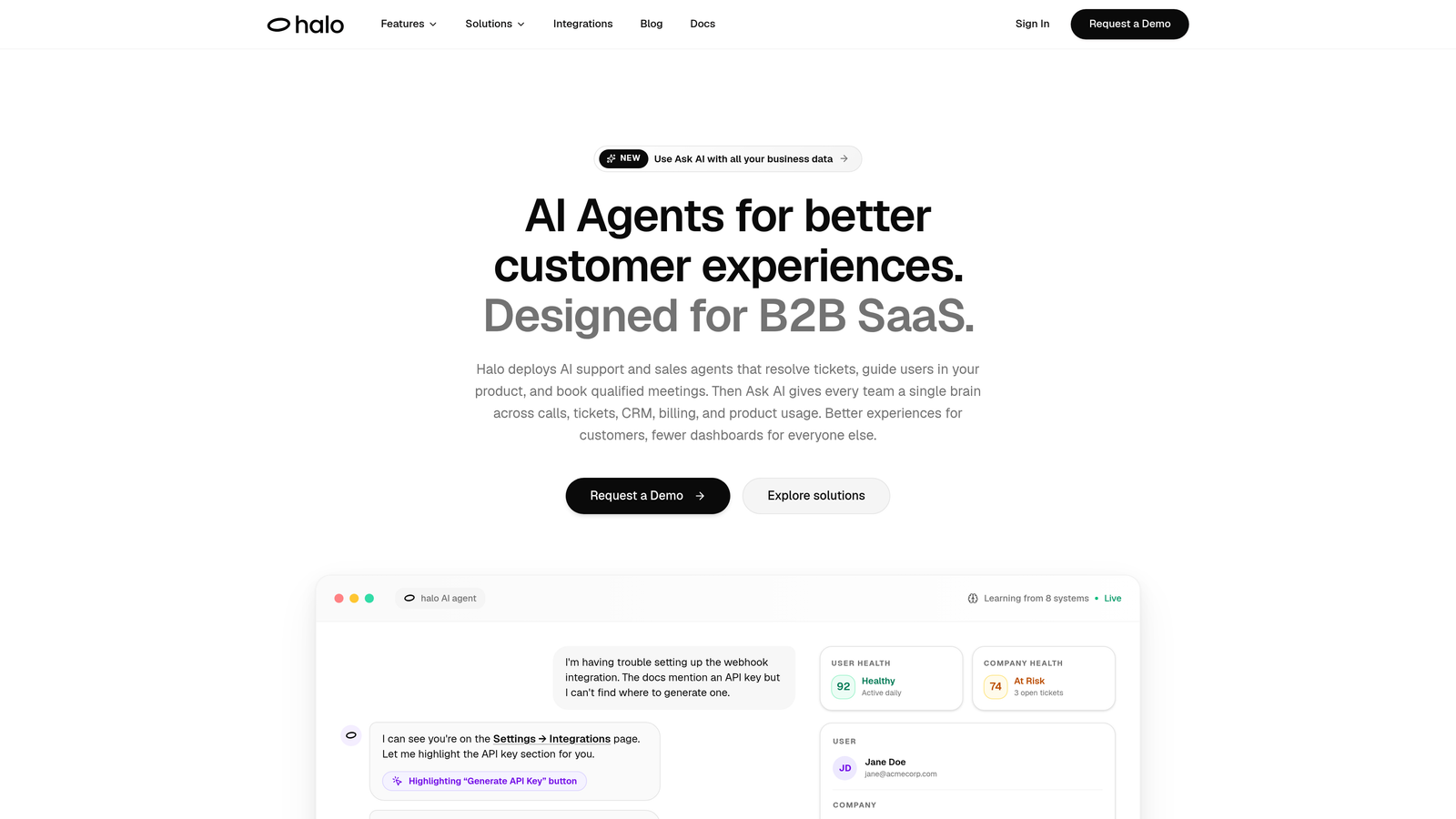
Halo AI is an AI-first customer support platform that deploys intelligent agents to resolve tickets, guide users through your product with page-aware context, auto-create bug reports, and surface business intelligence signals while learning from every interaction.
Where This Tool Shines
Halo's most distinctive capability is its page-aware chat widget. Unlike conventional support tools that operate without knowing where a user is in your product, Halo's agent sees what the user sees, providing visual UI guidance in context. This is a meaningful architectural difference, not a marketing distinction.
The platform also goes beyond support metrics into genuine business intelligence. The smart inbox surfaces customer health signals, revenue anomalies, and churn indicators alongside ticket data, turning your support operation into a source of strategic insight rather than a cost center.
Key Features
Page-Aware Chat Widget: The AI agent understands the user's current location within your product and delivers contextually relevant guidance, not generic answers pulled from a knowledge base.
Autonomous Ticket Resolution with Smart Handoff: Halo handles routine tickets end-to-end and escalates complex issues to live agents with full conversation context preserved.
Auto Bug Ticket Creation: Identified bugs are automatically routed to Linear or Jira without requiring human triage, closing the loop between support and engineering.
Smart Inbox with Business Intelligence: Customer health signals, revenue anomalies, and churn indicators are surfaced directly in the inbox alongside standard support data.
Full-Stack Integrations: Connects across Linear, Slack, HubSpot, Intercom, Stripe, Zoom, PandaDoc, and Fathom, making it a connective layer across your entire business stack rather than an isolated support tool.
Best For
B2B SaaS product teams building AI-first support operations, particularly those who want their support layer to generate revenue intelligence alongside ticket resolution. Teams already using Linear, HubSpot, or Stripe will find the integration depth especially valuable.
Pricing
Contact for pricing. Halo is designed for B2B SaaS teams and does not publish public per-seat tiers. Reach out directly via haloagents.ai for a tailored quote.
2. Intercom Fin
Best for: Teams already on Intercom who want native AI resolution without additional tooling.
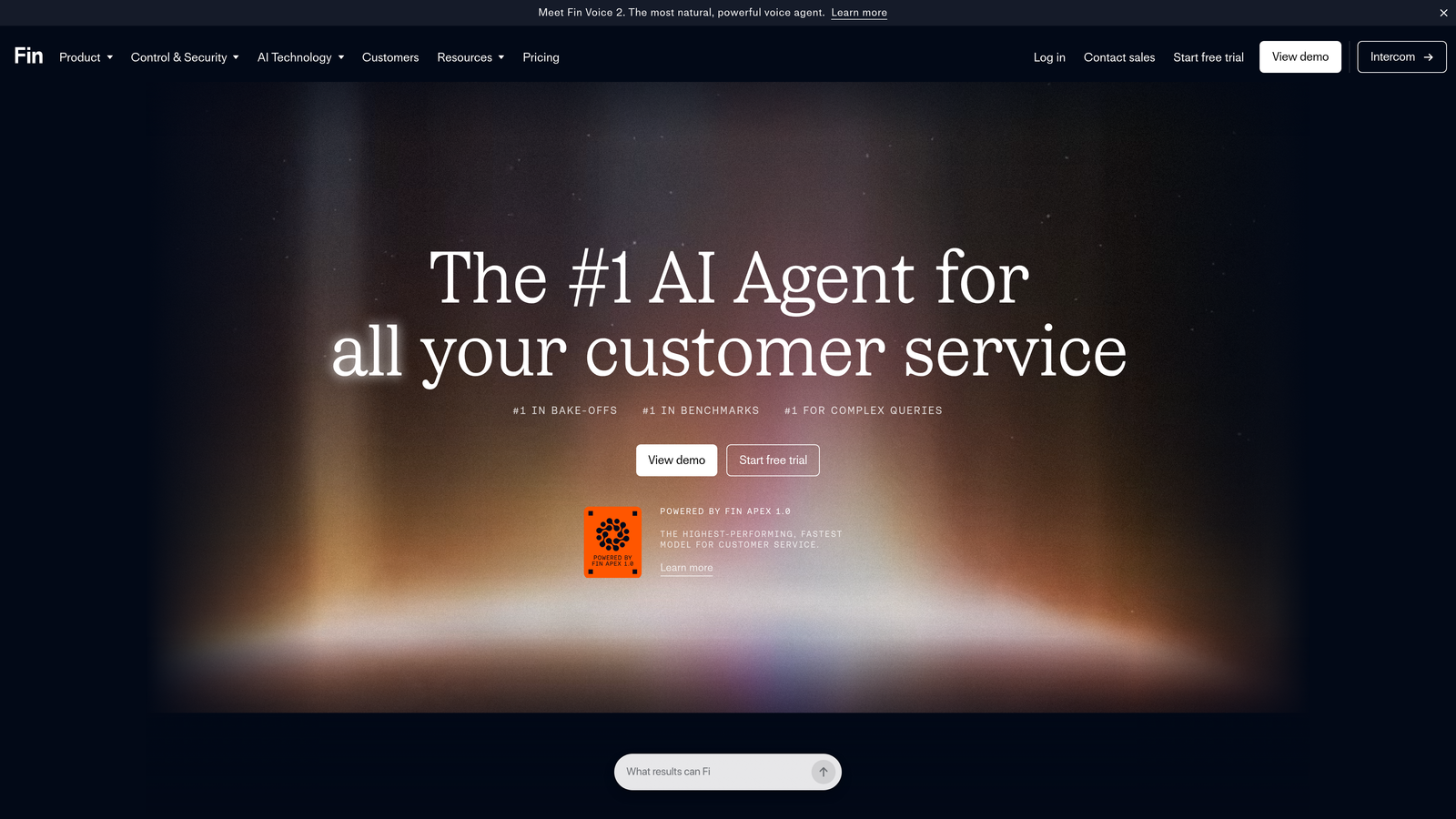
Intercom Fin is Intercom's native AI agent built on large language models, designed to resolve customer conversations directly within the Intercom messenger.
Where This Tool Shines
Fin's biggest advantage is its seamless integration with the Intercom inbox. If your team already lives in Intercom, there's no separate deployment, no data migration headache, and no context fragmentation. The setup experience is genuinely smooth for existing Intercom customers.
The resolution-based pricing model is also worth noting. You only pay for conversations Fin fully resolves, which aligns vendor incentives with actual outcomes rather than seat counts or conversation volumes.
Key Features
Native Intercom Integration: Fin operates directly within the Intercom messenger and inbox, requiring no separate setup for existing customers.
Resolution-Based Pricing: Charges apply only when Fin fully resolves a conversation, creating a performance-aligned cost structure.
Multilingual Support: Handles conversations across major languages without additional configuration.
Context-Preserving Handoff: When escalating to human agents, full conversation context is passed through without the user needing to repeat themselves.
Customizable Tone and Persona: Teams can configure Fin's communication style to match their brand voice.
Best For
Companies already using Intercom as their primary support and messaging platform. Fin is less compelling as a standalone layer for teams not already embedded in the Intercom ecosystem, where its tight coupling becomes a constraint rather than an advantage.
Pricing
Resolution-based pricing: charged per AI-resolved conversation. An Intercom base plan is required, so total cost depends on your existing Intercom tier plus Fin resolution volume.
3. Zendesk AI
Best for: Enterprise teams with mature ticketing operations needing AI triage and agent copilot capabilities.
Zendesk AI is the AI layer built into Zendesk's enterprise support suite, offering intelligent triage, agent copilot assistance, and automated workflows on top of its well-established ticketing infrastructure.
Where This Tool Shines
Zendesk AI benefits from years of enterprise-grade infrastructure beneath it. The compliance posture, audit capabilities, and security controls are genuinely mature, which matters significantly for regulated industries or large organizations with strict data governance requirements.
The agent copilot feature, which suggests responses and next-best actions in real time, is practically useful for teams handling high ticket volumes where agent efficiency gains compound quickly.
Key Features
AI-Powered Triage and Routing: Classifies incoming tickets by intent, sentiment, and language to route them to the right team or queue automatically.
Agent Copilot: Surfaces suggested responses and recommended next steps to agents during live conversations, reducing handle time without removing human judgment.
Automated Workflows: AI classification triggers workflow automations, reducing manual routing and tagging work.
Enterprise Compliance and Security: Mature audit logging, data residency options, and compliance certifications suited to enterprise procurement requirements.
Zendesk Marketplace Integrations: Access to a broad ecosystem of third-party integrations built around the Zendesk platform.
Best For
Large enterprises already invested in Zendesk's ticketing infrastructure who want to layer AI onto existing workflows rather than replace them. Teams evaluating Zendesk AI as a greenfield choice should weigh the setup complexity against AI-native alternatives.
Pricing
Seat-based pricing starting at the Suite Team tier; AI features are available on higher plans. Contact Zendesk sales for enterprise pricing. Costs can scale significantly at larger seat counts.
4. Freshdesk Freddy AI
Best for: SMB and mid-market teams in the Freshworks ecosystem looking for accessible AI at a competitive price point.
Freshdesk Freddy AI is Freshworks' AI assistant embedded across Freshdesk and Freshchat, offering automated responses, agent suggestions, and omnichannel support coverage.
Where This Tool Shines
Freddy's strongest selling point is value density relative to cost. For teams already in the Freshworks ecosystem, Freddy adds meaningful AI capability without a significant budget increase. The omnichannel coverage across email, chat, social, and phone in a single platform is genuinely useful for teams managing diverse support channels.
Freddy Insights, the AI-generated reporting component, surfaces anomaly detection on support metrics and can help teams identify recurring issues without manual analysis.
Key Features
Freddy Self Service: AI bot that deflects common queries across chat and email before they reach a human agent.
Freddy Copilot: Provides real-time response suggestions and ticket summarization to support agents during active conversations.
Freddy Insights: AI-generated reporting that identifies anomalies and trends in support metrics automatically.
Omnichannel Coverage: Unified inbox across email, chat, social media, and phone channels.
Competitive Pricing: Accessible price points designed for SMB and mid-market teams, not just enterprise budgets.
Best For
Teams already using Freshdesk or Freshchat who want AI augmentation without platform migration. Also a strong choice for SMBs needing omnichannel coverage with AI assistance at a manageable cost. Teams with complex B2B support scenarios may find AI resolution quality limiting compared to AI-native platforms.
Pricing
Base Freshdesk plans start around $15 per agent per month. Freddy AI is available as an add-on or included in higher tiers. Check Freshworks directly for current plan structures as pricing evolves.
5. Tidio Lyro
Best for: Small businesses and early-stage teams needing fast AI deployment for FAQ deflection with minimal setup.
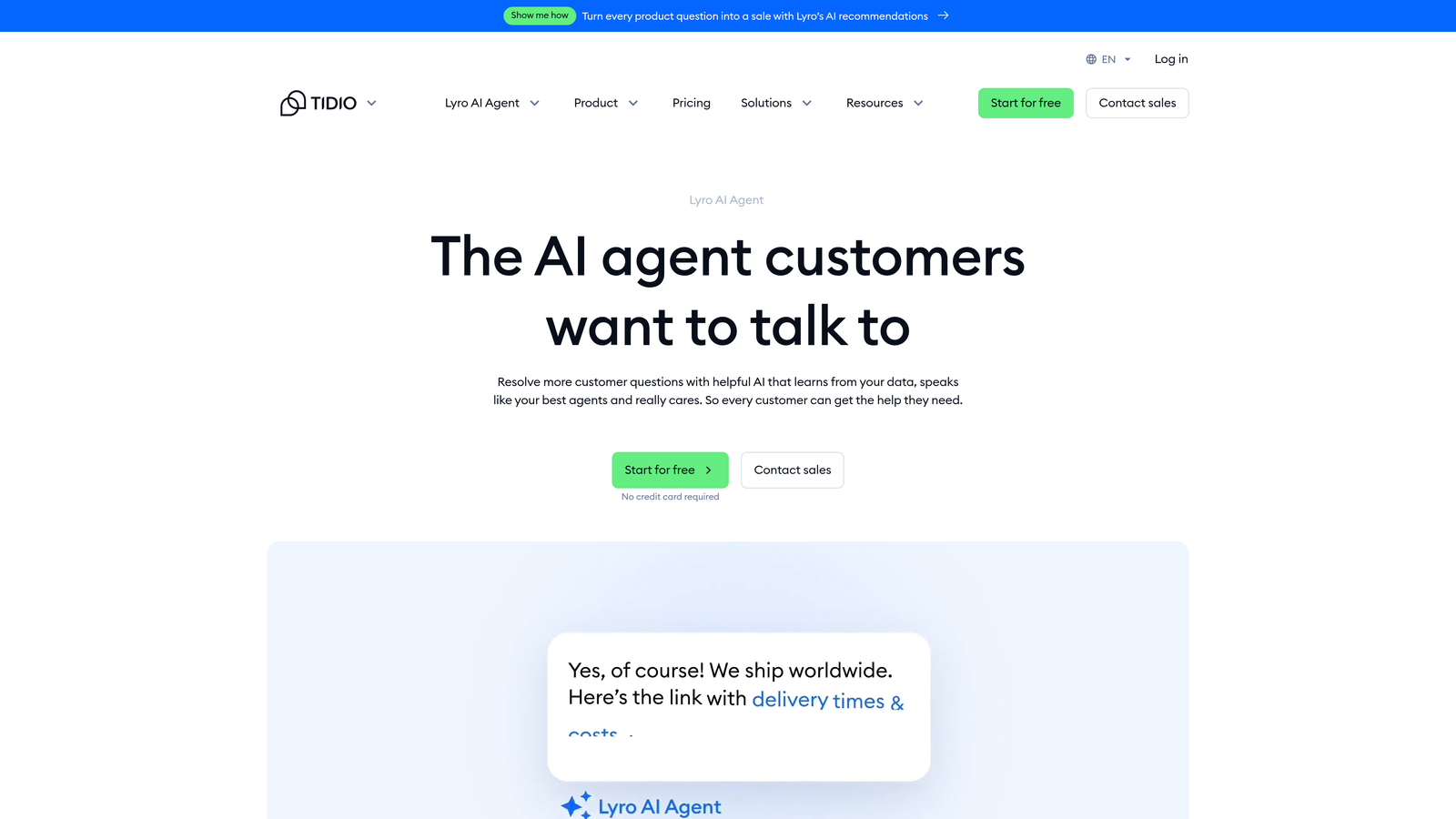
Tidio Lyro is a conversational AI designed for small-to-mid-sized businesses, handling frequently asked questions and common support queries autonomously with minimal configuration.
Where This Tool Shines
Lyro's standout quality is its speed to value. Teams can typically have it live within hours by training it on existing help content, which is a genuine advantage for resource-constrained teams who can't afford lengthy implementation cycles.
The free tier with conversation limits makes Lyro accessible for teams testing AI deflection before committing budget, which is a meaningful differentiator at the SMB end of the market.
Key Features
Autonomous FAQ Resolution: Trained on your existing help content to handle common queries without human intervention.
Fast Setup: Typically live within hours rather than weeks, with minimal technical configuration required.
Low-Confidence Escalation: Automatically hands off to human agents when Lyro's confidence in a response falls below a threshold.
Conversation Analytics: Shows deflection rates and patterns in unresolved queries to identify content gaps.
Free Tier Available: Entry-level access with conversation limits allows teams to test before purchasing.
Best For
Small businesses, e-commerce teams, and early-stage SaaS companies needing quick AI deflection for high-frequency, low-complexity queries. Lyro is not well-suited for complex B2B support scenarios involving multi-step resolutions or deep product context.
Pricing
Free tier available with conversation limits. Paid Lyro plans start around $29 per month with conversation-based usage limits. Pricing scales with conversation volume.
6. Kustomer
Best for: High-volume consumer support operations needing unified CRM and omnichannel conversation management.
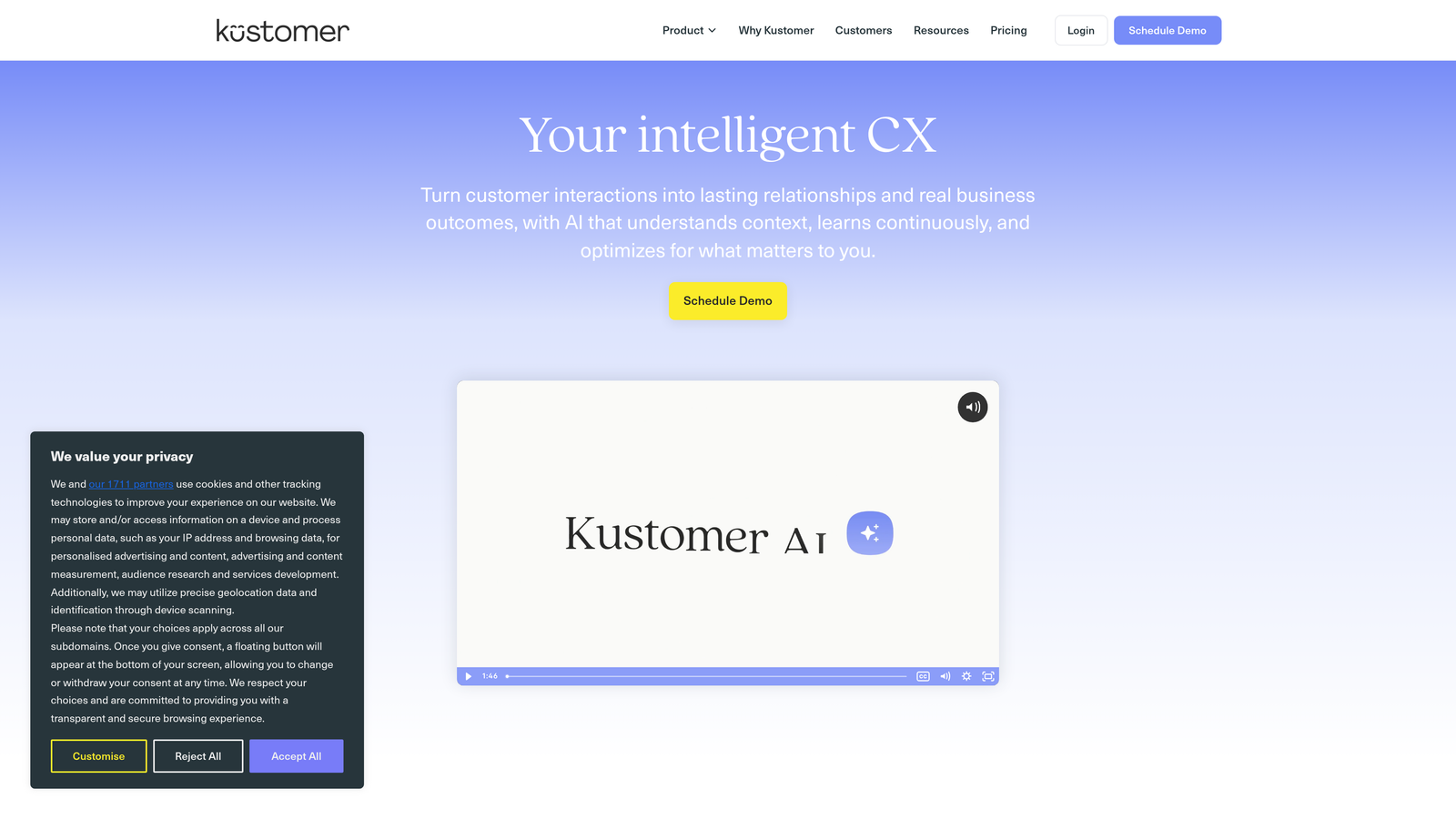
Kustomer is a CRM-native customer service platform that combines omnichannel conversation management with AI-driven automation, with particular strength in high-volume B2C support environments.
Where This Tool Shines
Kustomer's unified customer timeline is its most distinctive feature. By combining full CRM history with live support conversations in a single view, the AI has richer context to inform routing and response suggestions than platforms operating only on support data.
For teams handling large volumes of consumer interactions where customer lifetime value and purchase history are relevant to support outcomes, this CRM-native approach creates meaningful efficiency gains.
Key Features
Unified Customer Timeline: CRM history and live support conversations combined in a single view, giving agents and AI full customer context.
AI-Powered Routing and Suggestions: Routing and response suggestions informed by complete customer history, not just the current ticket.
Omnichannel Inbox: Email, chat, SMS, social, and voice managed in a single unified interface.
Workflow Automation: Automates repetitive resolution paths to reduce manual handling for predictable query types.
Customer Lifetime Value Reporting: Deep reporting connecting support interactions to revenue impact and customer value metrics.
Best For
B2C companies and high-volume consumer support operations where CRM context significantly improves support quality. B2B SaaS teams should evaluate carefully, as Kustomer's architecture and feature priorities are optimized for consumer-facing use cases rather than complex B2B product support.
Pricing
Seat-based pricing starting around $89 per agent per month. Enterprise plans are available. Contact Kustomer directly for volume pricing.
7. Drift (by Salesloft)
Best for: Revenue-focused teams wanting to blend support automation with sales qualification in a single conversation layer.
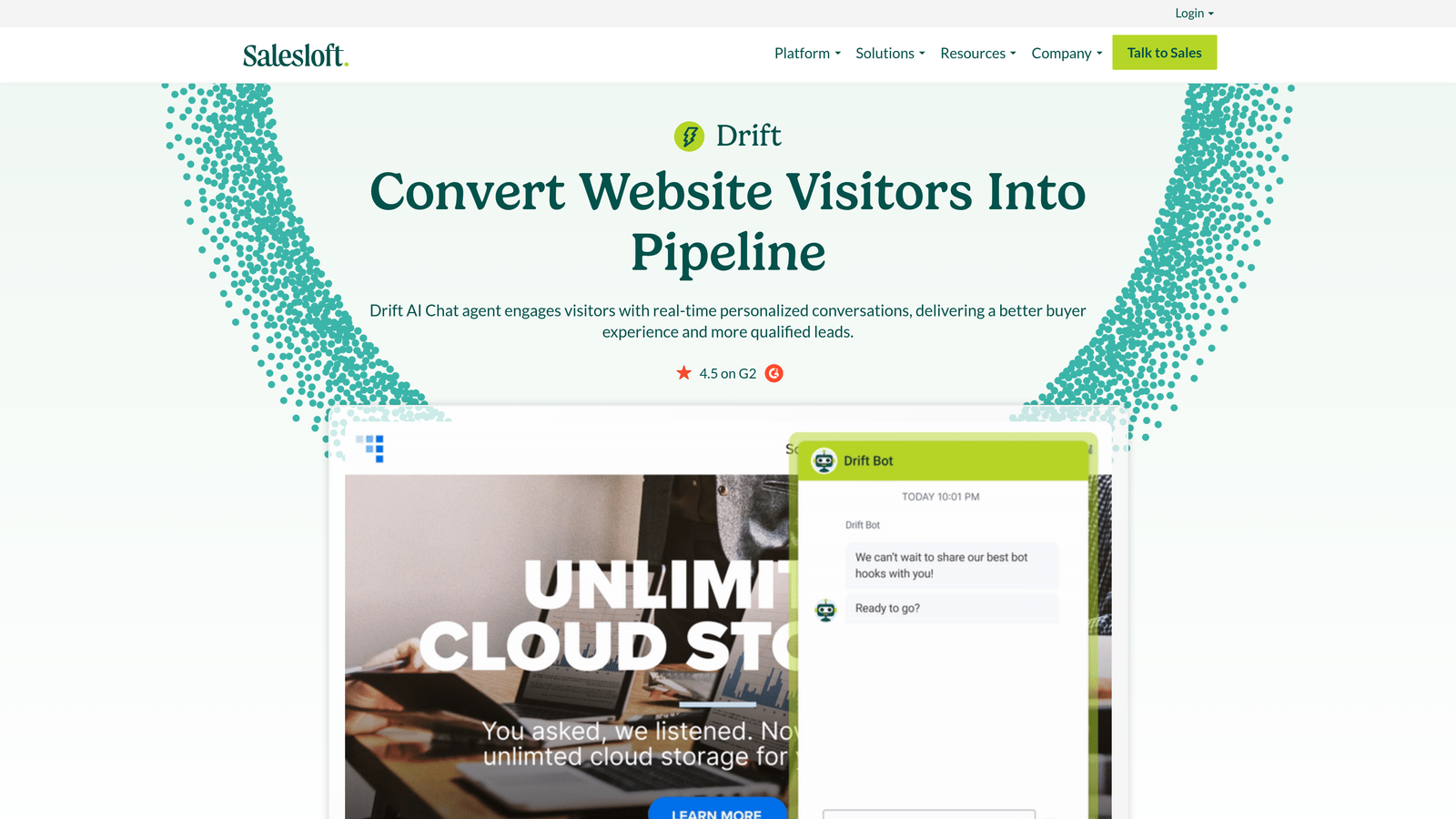
Drift, now part of Salesloft, is a conversational AI platform that blends support and sales qualification, helping revenue teams manage pipeline conversations alongside customer queries.
Where This Tool Shines
Drift's real strength is at the intersection of support and sales. If your team needs to qualify inbound website visitors, book meetings, and handle support queries within the same conversation interface, Drift's architecture handles this better than most dedicated support platforms.
The real-time buyer intent signals surfaced to sales reps during conversations add a revenue intelligence layer that pure support tools don't offer.
Key Features
Blended Support and Sales Qualification: Handles support queries and sales qualification simultaneously within a single conversation flow.
Buyer Intent Signals: Surfaces real-time intent data to sales reps during live conversations to inform engagement strategy.
Meeting Booking and Routing: Integrated calendar booking and rep routing built directly into conversation flows.
CRM Integrations: Native integrations with Salesforce, HubSpot, and other major CRM platforms.
Revenue Funnel Analytics: Conversation analytics spanning the full revenue funnel, not just support resolution metrics.
Best For
Revenue teams and pipeline-focused organizations where support and sales conversations overlap significantly. Drift is not the right choice for teams building a dedicated support operation focused on ticket resolution quality and customer experience depth.
Pricing
Enterprise pricing negotiated directly with Salesloft. No public pricing is listed. Contact the Salesloft team for a custom quote based on your team size and use case.
8. Ada
Best for: Non-technical support teams needing to build sophisticated multilingual automation without engineering resources.
Ada is a no-code AI agent builder that enables non-technical teams to deploy sophisticated, multilingual support automation across web, mobile, and messaging channels.
Where This Tool Shines
Ada's no-code conversation builder is genuinely accessible. Support teams can build, test, and iterate on complex conversation flows without filing engineering tickets or waiting for development cycles. For organizations where support operations run independently of engineering, this autonomy is practically valuable.
The multilingual coverage across 50+ languages is among the strongest in the market, making Ada a compelling choice for global support operations serving diverse language markets.
Key Features
No-Code Conversation Builder: Support teams build and modify conversation flows without engineering involvement.
50+ Language Support: Multilingual capability across more than 50 languages out of the box, without additional configuration per language.
AI Reasoning for Complex Resolutions: Handles multi-step resolutions that go beyond simple FAQ matching.
Helpdesk Integrations: Native integrations with Zendesk, Salesforce, Freshdesk, and other major platforms.
Containment and CSAT Reporting: Detailed analytics on containment rates and customer satisfaction scores to measure automation effectiveness.
Best For
Global organizations and enterprise support teams needing multilingual automation at scale, particularly where non-technical ownership of conversation flows is a priority. Teams seeking LLM-native resolution rather than structured conversation flows may find Ada's approach feels more constrained.
Pricing
Enterprise pricing negotiated based on conversation volume. Contact Ada directly for a custom quote. No public pricing tiers are listed.
9. Forethought
Best for: Teams wanting to augment human agents with AI triage and intelligent routing rather than pursue full autonomous resolution.
Forethought is an AI platform focused on intelligent triage, smart routing, and real-time response suggestions, designed to make human agents faster and more effective rather than replace them entirely.
Where This Tool Shines
Forethought's Assist product, which surfaces relevant knowledge suggestions to agents mid-conversation, is particularly well-executed. Rather than generating responses autonomously, it gives agents the right information at the right moment, reducing research time without removing human judgment from the loop.
The Discover analytics component identifies knowledge gaps and recurring issue patterns, helping teams improve both their documentation and their AI's effectiveness over time.
Key Features
AI Triage: Classifies, prioritizes, and routes incoming tickets before any agent touches them, reducing manual sorting work significantly.
Solve: Autonomous AI responses for straightforward, high-confidence queries that don't require human involvement.
Assist: Real-time knowledge suggestions surfaced to agents during live conversations to reduce handle time.
Discover: Analytics that identify knowledge gaps and recurring issues to guide content and training improvements.
Native Integrations: Direct integrations with Zendesk, Salesforce, and ServiceNow, fitting into existing enterprise toolchains.
Best For
Enterprise teams with established human support operations who want meaningful AI efficiency gains without a full autonomous resolution strategy. Forethought is the right choice when augmenting your team is the goal, not replacing it. Teams looking for end-to-end autonomous resolution should evaluate AI-native platforms instead.
Pricing
Volume-based pricing. Contact Forethought directly for a custom quote based on ticket volume and feature requirements.
Which Vendor Is Right for Your Team
The honest answer is that the right vendor depends less on feature lists and more on your architectural starting point and your definition of success.
If you're building an AI-first support operation for a B2B SaaS product and want your support layer to generate business intelligence alongside ticket resolution, Halo AI's page-aware context, smart inbox, and full-stack integrations make it the strongest purpose-built option in this comparison.
If you're already deeply embedded in the Intercom or Freshworks ecosystem and want AI augmentation without platform migration, Intercom Fin and Freddy AI offer the lowest-friction path forward. For enterprise organizations with mature Zendesk infrastructure and strict compliance requirements, Zendesk AI layers onto existing workflows without forcing a rethink.
For teams focused on agent efficiency over autonomous resolution, Forethought's triage and assist capabilities stand out. For global operations needing multilingual no-code automation, Ada is hard to beat. And for small businesses needing fast, affordable deflection for common queries, Tidio Lyro delivers genuine value at a price point that makes sense.
Here's a quick selection guide by use case:
AI-first B2B SaaS support with business intelligence: Halo AI
Teams already on Intercom: Intercom Fin
Enterprise ticketing with compliance requirements: Zendesk AI
SMB teams in the Freshworks ecosystem: Freshdesk Freddy AI
Small business FAQ deflection on a budget: Tidio Lyro
High-volume B2C with CRM context: Kustomer
Revenue teams blending support and sales: Drift by Salesloft
Global multilingual automation, no-code: Ada
Augmenting human agents without replacing them: Forethought
Your support team shouldn't scale linearly with your customer base. Let AI agents handle routine tickets, guide users through your product, and surface business intelligence while your team focuses on complex issues that need a human touch. See Halo in action and discover how continuous learning transforms every interaction into smarter, faster support.