9 Best Customer Support Automation Tools for Scaling Companies in 2026
As support volume outpaces team capacity, customer support automation for scaling companies has become a core infrastructure decision. This guide evaluates 9 AI-powered platforms on depth of automation, integration ecosystem, and genuine ticket resolution — helping B2B teams find the right tool for their stack and growth stage.
 Matt PattoliFounder13 min read
As your company grows, your support volume grows with it — but your team's capacity doesn't scale at the same rate. Customer support automation has shifted from a nice-to-have to a core infrastructure decision for scaling B2B companies. The right platform can resolve the majority of incoming tickets autonomously, surface product intelligence, and free your human agents to focus on high-value conversations.
This list covers tools purpose-built or well-suited for scaling teams. We evaluated each based on AI capability depth, integration ecosystem, scalability, ease of deployment, and how well they move beyond simple deflection into genuine resolution. Whether you're running on Zendesk, Intercom, Freshdesk, or building your own stack, there's a fit here for your stage and use case.
1. Halo AI
Best for: B2B SaaS companies that want AI-first support with deep product and business context
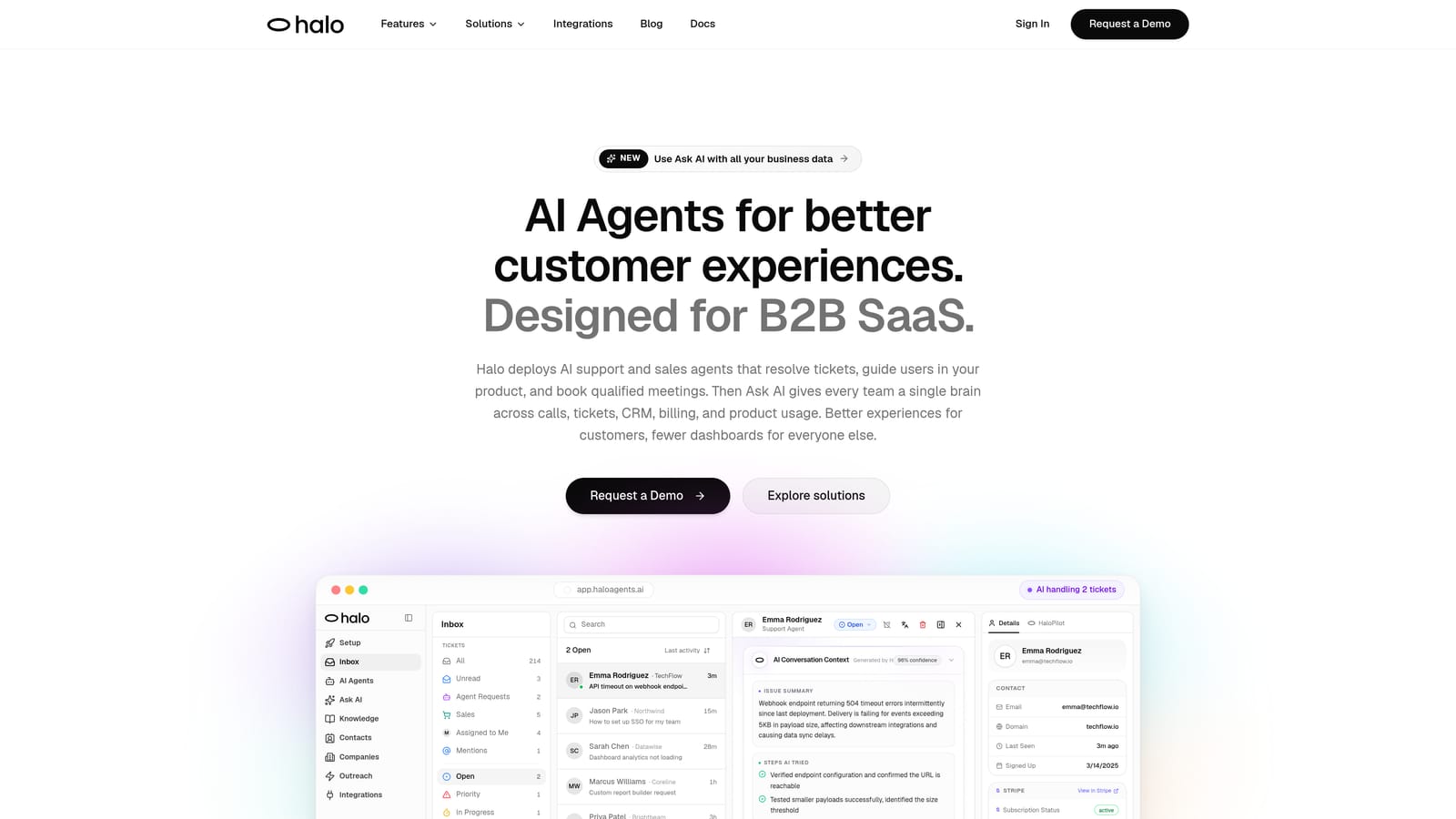
Halo AI is an AI-first customer support platform that deploys intelligent agents to resolve tickets, guide users through your product, and surface business intelligence — all while learning from every interaction.
Where This Tool Shines
Most support platforms were built as ticketing systems first and had AI layered on top later. Halo is architected the other way around. The AI isn't an add-on; it's the foundation. That distinction matters when you're evaluating how deeply a tool can actually understand and resolve issues rather than just deflect them.
The standout capability is page-aware context. Halo's chat widget understands what page a user is on and what they're looking at in your product, which means it can provide visual UI guidance rather than generic answers. That's a meaningful difference for SaaS products where the answer to "how do I do X" depends entirely on where the user currently is in the interface.
Key Features
Page-Aware AI Agents: The AI understands the user's current product context and delivers guidance specific to what they're seeing on-screen, not just what they typed.
Smart Inbox with Business Intelligence: Goes beyond support metrics to surface customer health signals, revenue anomalies, and product gap detection directly in the inbox view.
Auto Bug Ticket Creation: Automatically logs issues to Linear when a conversation reveals a potential bug, closing the loop between support and engineering without manual handoff.
Live Agent Handoff: Escalates to human agents with full conversation context preserved, so agents never have to ask customers to repeat themselves.
Continuous Learning: Every resolved interaction feeds back into the model, so the AI gets measurably smarter over time rather than staying static after initial deployment.
Full Stack Integrations: Connects to Slack, HubSpot, Stripe, Linear, Zoom, Intercom, PandaDoc, and Fathom, making it a genuine part of your business stack rather than a siloed support tool.
Best For
Scaling B2B SaaS teams that want autonomous resolution, not just deflection. Particularly well-suited for product-led growth companies where support conversations are closely tied to product adoption, and for teams that want their support platform to surface business intelligence beyond ticket volume.
Pricing
Contact for pricing. A demo is available at haloagents.ai to see the platform in action before committing.
2. Intercom
Best for: Teams wanting a mature, all-in-one messaging platform with a capable native AI agent
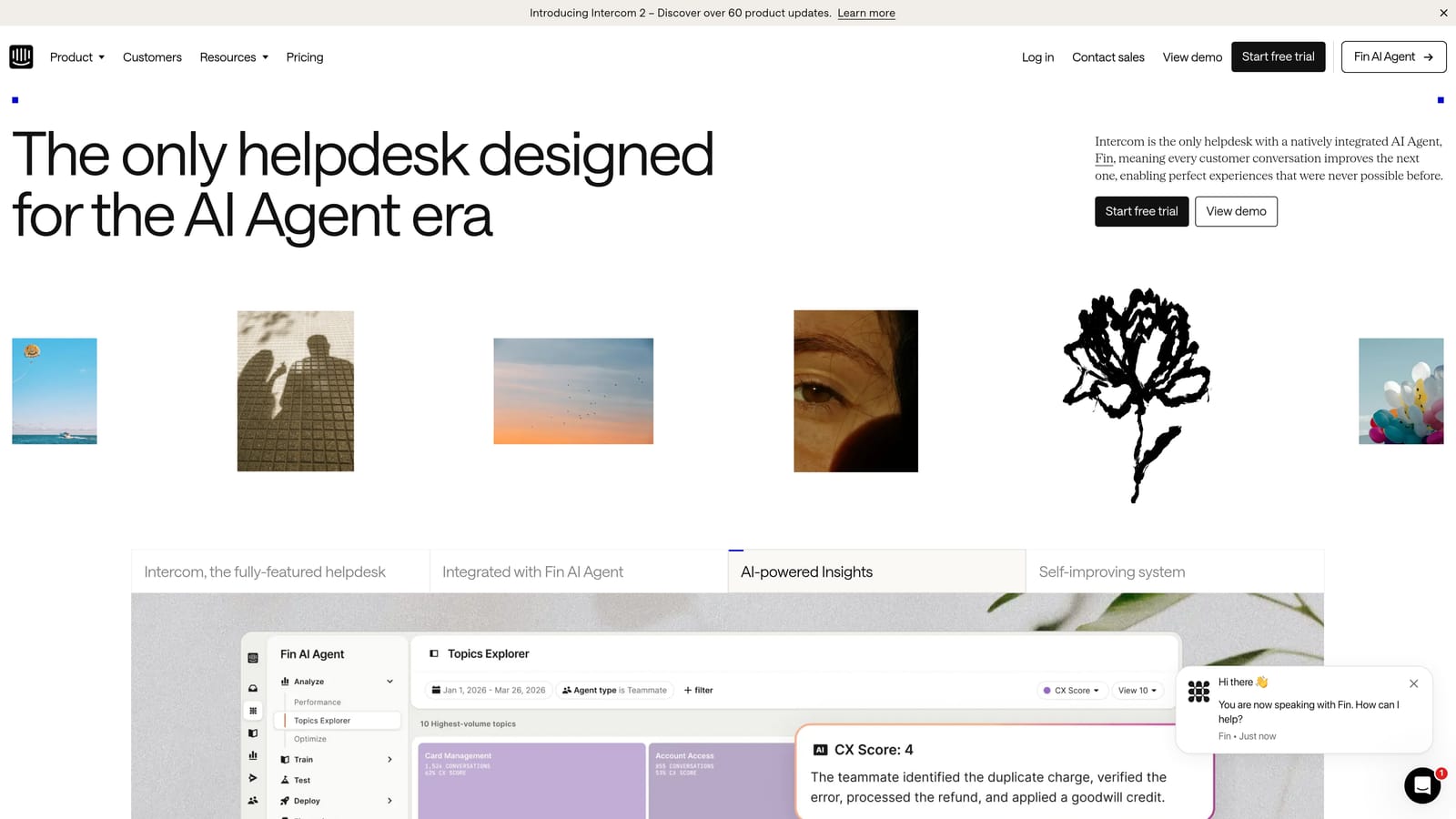
Intercom is a mature customer messaging platform with a native AI agent called Fin, built for autonomous resolution across chat, email, and in-app channels.
Where This Tool Shines
Intercom has been building toward AI-assisted support for years, and Fin represents the most polished version of that investment. It operates on top of your help center content and can handle a broad range of common questions without human involvement. For teams that already have strong documentation, Fin can deliver meaningful autonomous resolution out of the box.
Beyond Fin, Intercom's broader platform is genuinely mature. The unified inbox, proactive messaging tools, and in-app tour capabilities make it a strong choice for teams that want to handle both support and onboarding workflows in a single platform.
Key Features
Fin AI Agent: Handles common questions autonomously using your help center content, with the ability to add custom answers for edge cases.
Unified Inbox: Consolidates customer conversations across chat, email, and in-app messaging into a single workspace for agents.
Proactive Messaging and Tours: Lets teams send targeted in-app messages and build onboarding flows without leaving the platform.
Conversation Analytics: Provides reporting on conversation volume, resolution rates, and team performance.
App Marketplace: A large ecosystem of integrations for connecting Intercom to the rest of your stack.
Best For
Growth-stage and mid-market SaaS teams that want a proven platform with strong messaging capabilities and a capable AI agent. Teams that also need in-app onboarding flows will find the combination particularly useful.
Pricing
Seat-based plans start at approximately $39/seat/month. Fin AI usage is billed separately per resolution, so costs can scale with volume.
3. Zendesk
Best for: Enterprise teams that need maximum configurability and a large integration ecosystem
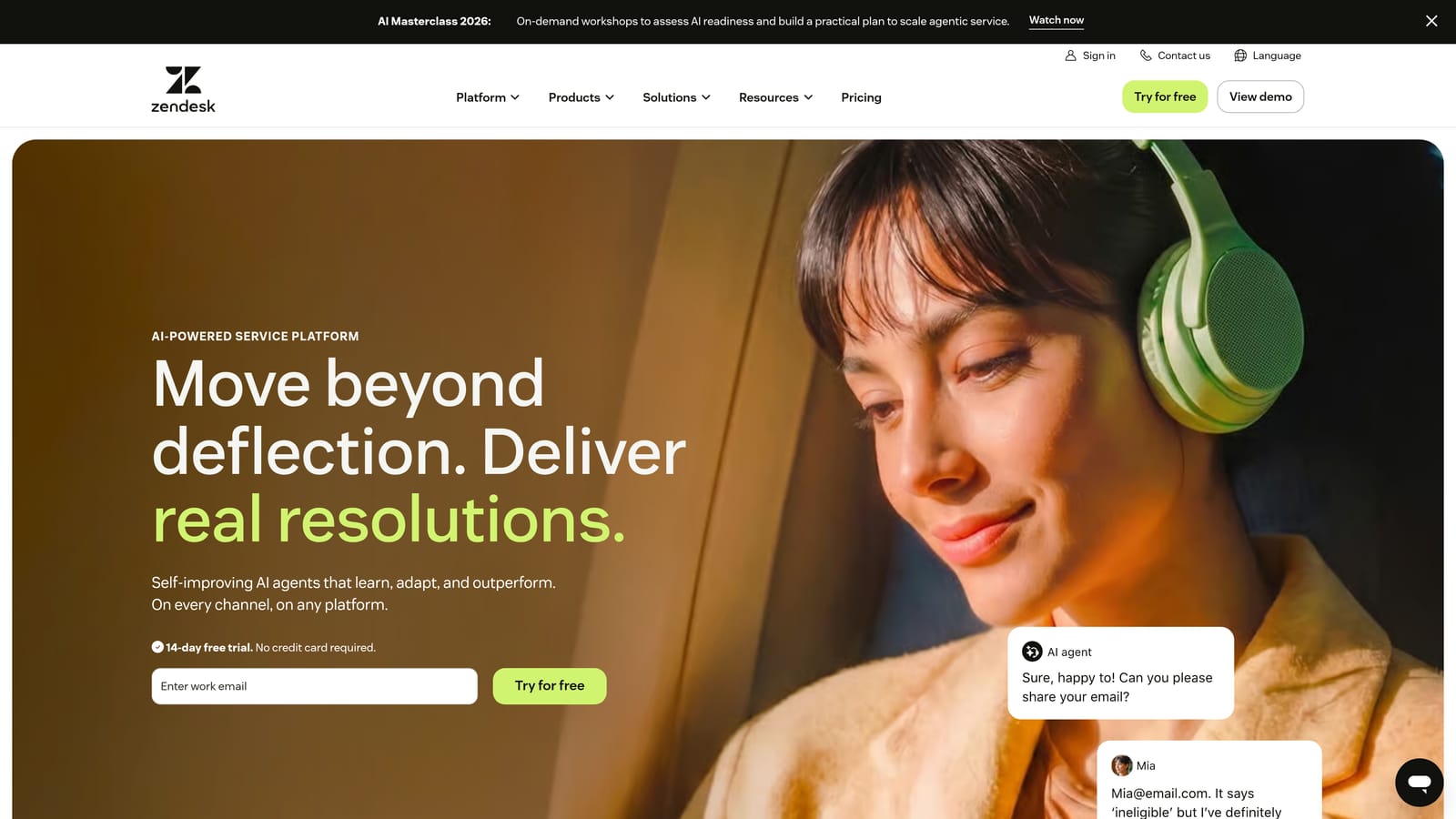
Zendesk is the industry-standard enterprise ticketing platform with AI capabilities available as an add-on, offering extensive configurability and one of the largest support ecosystems available.
Where This Tool Shines
Zendesk's core strength is configurability. If you have complex routing logic, multi-brand support needs, strict SLA requirements, or a large agent team with specialized workflows, Zendesk can likely accommodate it. The platform has been refined over many years and the depth of its configuration options reflects that.
The tradeoff is complexity. Zendesk often requires a dedicated administrator to manage effectively, and the AI capabilities (intelligent triage, suggested replies, agent copilot) are available as an add-on rather than baked into the core product. For teams evaluating AI-first support, that architecture is worth factoring into the decision.
Key Features
Ticket Routing and Automation: Highly configurable triggers, routing rules, and automation workflows that can handle complex support operations.
Zendesk AI Add-On: Adds intelligent triage, suggested replies, and an agent copilot layer for teams that need AI-assisted support.
App Marketplace: Over 1,000 integrations available, covering virtually every tool in a modern support stack.
SLA Management: Robust SLA tracking and reporting for teams with contractual response time obligations.
Multi-Brand and Multi-Language Support: Well-suited for organizations supporting multiple product lines or global customer bases.
Best For
Enterprise teams with complex operational requirements, dedicated support administrators, and existing Zendesk investments. Less ideal for teams looking for AI-first architecture from the ground up.
Pricing
Suite plans start around $55/agent/month. The AI add-on is priced separately, so full AI-enabled costs are higher than the base rate suggests.
4. Freshdesk
Best for: Teams wanting an accessible price point with solid AI features and a broader CRM ecosystem
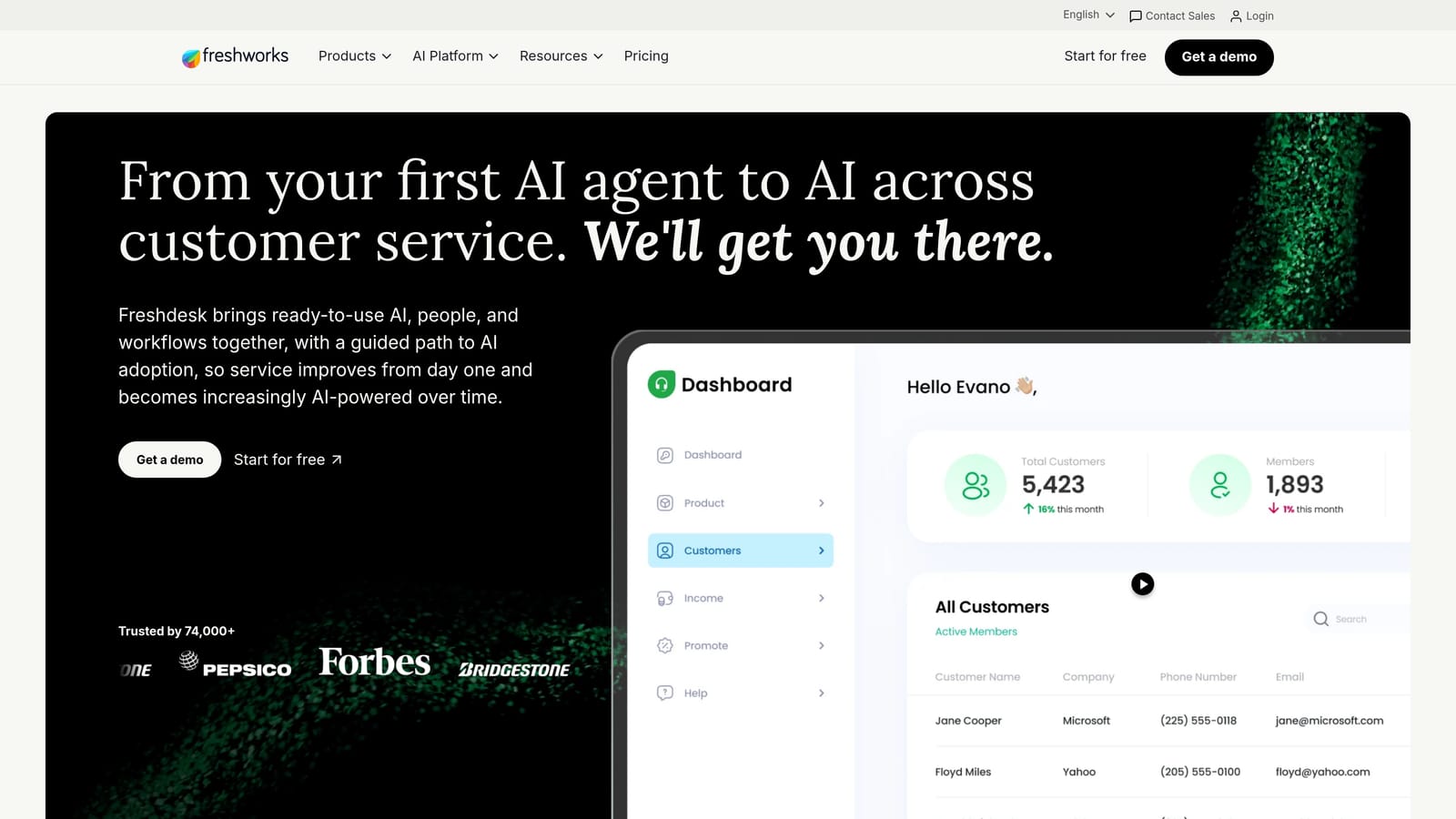
Freshdesk is a helpdesk platform from Freshworks with Freddy AI integrated across ticketing, self-service, and agent assist — at a generally more accessible price point than enterprise alternatives.
Where This Tool Shines
Freshdesk occupies a useful middle ground: more capable than entry-level tools, more affordable than enterprise platforms. Freddy AI covers a meaningful range of use cases including ticket summarization, suggested responses, and a self-service bot that can deflect common questions before they reach an agent.
For teams already using other Freshworks products like Freshsales (CRM) or Freshservice (ITSM), Freshdesk integrates naturally into that ecosystem. The cross-product data sharing can add real value for teams that want customer context to flow between sales, support, and IT.
Key Features
Freddy AI: Covers ticket summarization, suggested responses, a self-service bot, and agent assist capabilities across the platform.
Omnichannel Support: Handles email, chat, phone, and social channels from a unified inbox.
Collision Detection: Prevents multiple agents from responding to the same ticket simultaneously.
Freshworks Suite Integration: Connects naturally with Freshsales, Freshservice, and other Freshworks products for cross-functional data sharing.
Free Tier: A free plan is available for small teams getting started, which lowers the barrier to evaluation.
Best For
Growing teams that want solid AI-assisted support at a competitive price, particularly those already in the Freshworks ecosystem or evaluating a broader CRM and helpdesk bundle.
Pricing
Free plan available for small teams. Paid plans start around $15/agent/month, with AI features available on higher tiers.
5. Gorgias
Best for: E-commerce brands running on Shopify, Magento, or BigCommerce
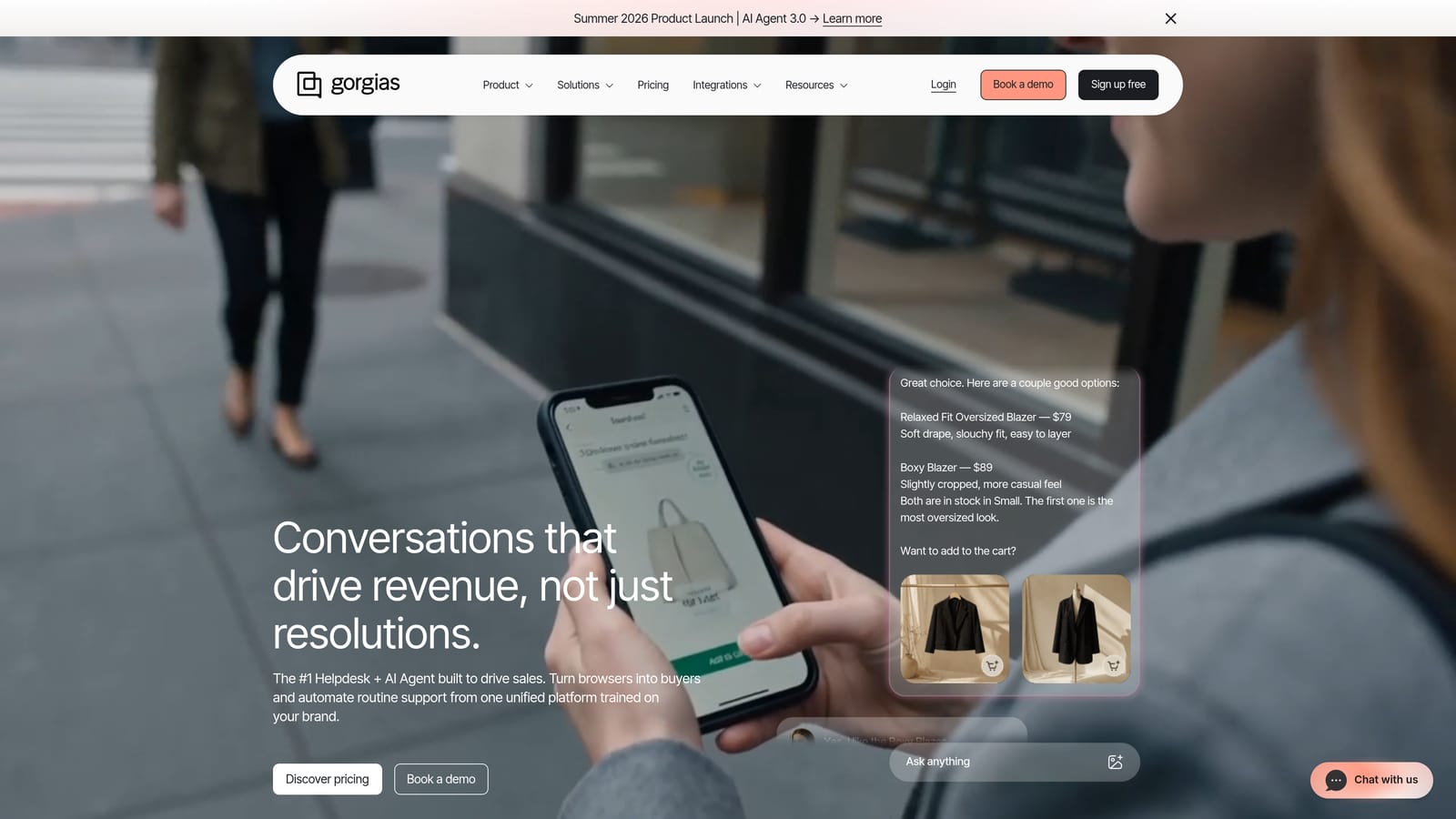
Gorgias is a support platform purpose-built for e-commerce brands, with deep integrations tied directly to order data and revenue metrics.
Where This Tool Shines
Gorgias does something most support platforms don't: it connects support tickets directly to revenue. You can see the order value associated with a conversation, automate responses based on order status or return logic, and track how your support team's activity correlates with revenue outcomes. For e-commerce teams, that context is genuinely useful.
The platform's automation capabilities are designed around transactional support patterns — order status questions, return requests, shipping inquiries — which represent a large share of e-commerce support volume. If that's your world, Gorgias is purpose-built for it in a way that general-purpose platforms aren't.
Key Features
E-Commerce Integrations: Native Shopify, Magento, and BigCommerce integrations that pull order data directly into conversation views.
Revenue Statistics: Links support tickets to order values, giving teams visibility into the revenue impact of support interactions.
Automated Order Responses: Automation rules triggered by order status, return logic, and other transactional events.
Macros and Rules: Templated responses and automation rules designed for high-volume transactional support.
Unified Inbox: Consolidates email, chat, social, and SMS into a single workspace.
Best For
E-commerce brands with high transactional support volume, particularly those running on Shopify. Less relevant for pure B2B SaaS teams, but worth considering for any company with a significant e-commerce component.
Pricing
Starter plans begin around $10/month, with pricing scaling based on ticket volume rather than seat count.
6. Tidio
Best for: Early-stage companies that need quick automation deployment without heavy implementation
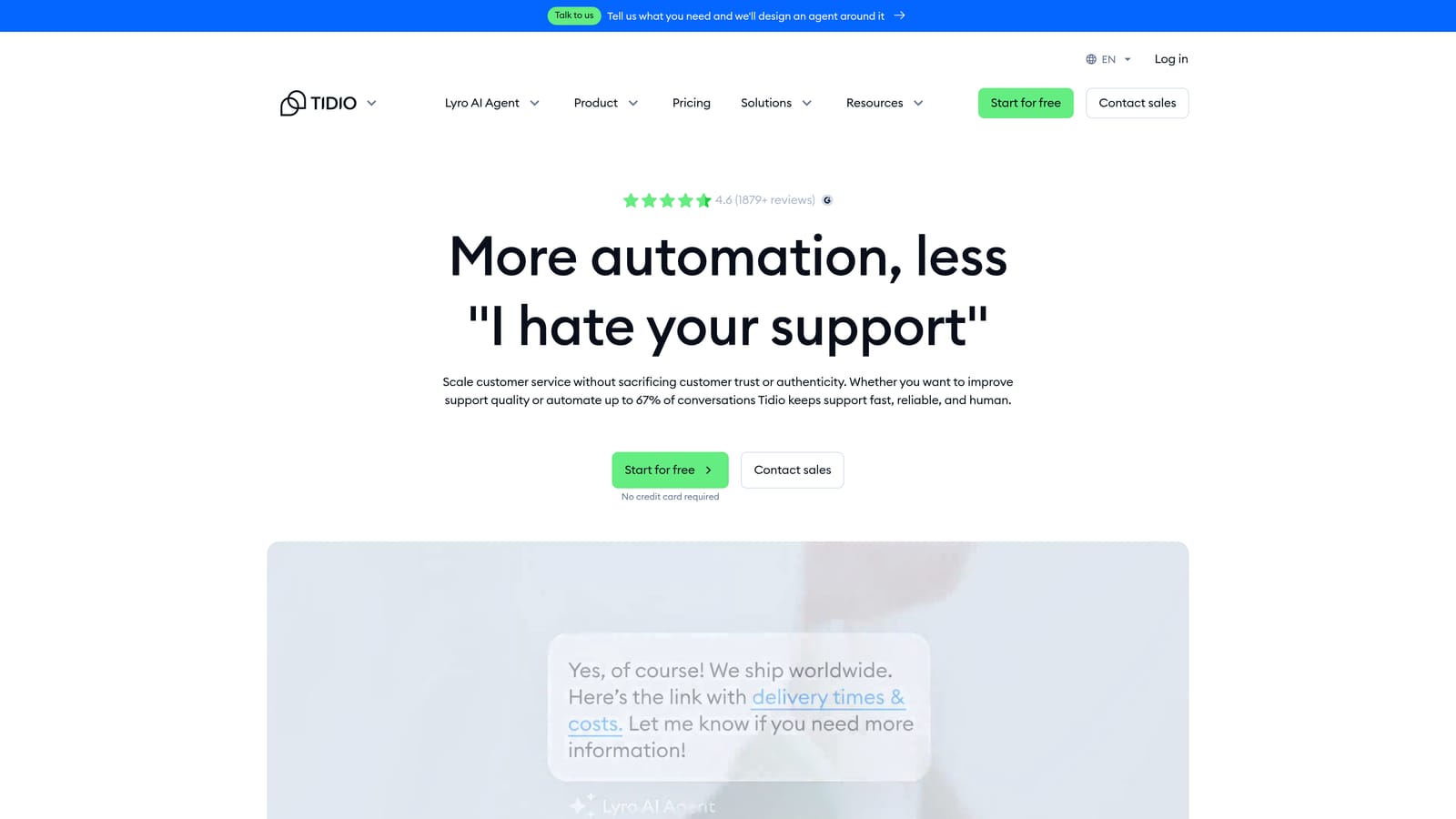
Tidio is a fast-to-deploy live chat and AI chatbot platform with Lyro AI for basic deflection, well-suited for teams that need automation without a complex setup process.
Where This Tool Shines
Tidio's primary advantage is speed to value. The setup is genuinely fast, the configuration is no-code, and Lyro AI can start handling common questions using your existing website content and help documentation without a lengthy training process. For a team that needs something working this week, Tidio delivers.
The tradeoff is depth. Tidio works well for handling frequently asked questions and routing conversations, but it doesn't offer the deep integration ecosystem or business intelligence capabilities that scaling companies eventually need. It's a strong starting point, not necessarily a long-term platform for high-growth teams.
Key Features
Lyro AI Chatbot: Trained on your website and help content to handle common questions without agent involvement.
No-Code Setup: Live chat and chatbot configuration that doesn't require technical resources to deploy.
Visitor Behavior Triggers: Proactive chat triggers based on visitor behavior, such as time on page or exit intent.
Email and Messenger Integration: Extends beyond chat to handle email and Facebook Messenger conversations.
Mobile App: Lets agents respond to conversations from mobile devices when away from a desktop.
Best For
Early-stage companies and SMBs that need basic automation quickly and at low cost. Teams that anticipate significant scale should plan for a platform migration as their needs grow.
Pricing
Free plan available. Paid plans start around $29/month. Lyro AI conversations are billed separately based on volume.
7. Kustomer
Best for: High-volume operations where full customer history needs to inform every support interaction
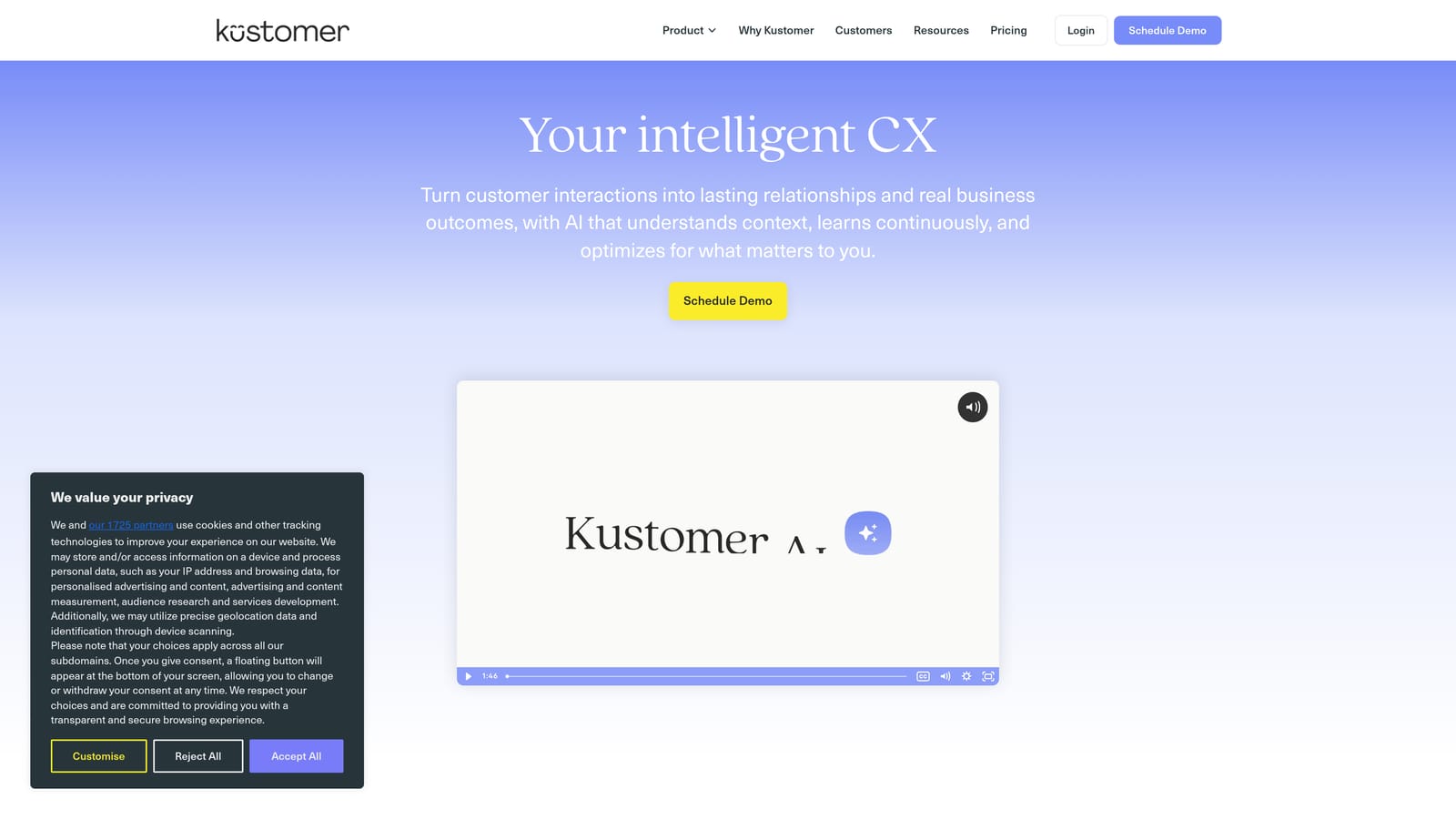
Kustomer is a CRM-first customer service platform that builds a unified customer timeline across all channels, with AI automation informed by complete customer history rather than just the current conversation.
Where This Tool Shines
Kustomer's defining characteristic is the customer timeline. Every interaction a customer has had across email, chat, social, and SMS appears in a single chronological view. When an agent (or the AI) picks up a conversation, they're working with the full context of that customer's relationship with your company, not just the current ticket.
Acquired by Meta, Kustomer has benefited from significant AI investment. The automation capabilities are built on top of that full customer history, which means the AI can make more informed decisions about routing, prioritization, and response than a system that only sees the current conversation thread.
Key Features
Unified Customer Timeline: Every interaction across all channels consolidated into a single chronological customer view.
History-Informed AI: Automation and AI routing decisions built on full customer context, not just the current conversation.
Intelligent Routing: Routes conversations based on customer attributes, history, and behavioral signals.
Custom Objects: Flexible data model that can accommodate complex business data beyond standard support fields.
Meta AI Investment: Ongoing AI development backed by Meta's resources since the acquisition.
Best For
High-volume operations with complex customer histories, particularly B2C companies or those with long-term customer relationships where historical context significantly affects support quality.
Pricing
Plans start around $89/agent/month. Enterprise pricing available for larger teams.
8. Help Scout
Best for: Customer-centric teams that prioritize a human-feeling support experience over autonomous deflection
Help Scout is an email-native support platform that prioritizes a human-feeling experience, with AI features focused on assisting agents rather than replacing them.
Where This Tool Shines
Help Scout occupies a deliberate philosophical position: support should feel human, even when AI is involved. The AI features (Summarize, Assist, and Drafts) are designed to make agents faster and more effective rather than to operate autonomously. If your brand voice and customer relationships depend on that human touch being present in every interaction, Help Scout is built with that priority in mind.
The platform is clean, intuitive, and genuinely easy to use. The shared inbox interface is email-native, which means agents who are comfortable with email workflows don't face a steep learning curve. The Docs knowledge base and Beacon widget round out a well-integrated self-service layer.
Key Features
AI Summarize, Assist, and Drafts: Agent-productivity AI that summarizes threads, suggests next steps, and drafts responses for agent review.
Email-Native Shared Inbox: A clean, familiar interface that minimizes the learning curve for new agents.
Docs Knowledge Base: Built-in knowledge base builder that integrates with the Beacon widget for self-service.
Beacon Widget: In-app help widget that surfaces relevant documentation and enables chat without leaving the product.
Customer Satisfaction Ratings: Built-in CSAT collection and reporting for tracking customer sentiment over time.
Best For
Teams where brand voice and relationship quality are paramount, and where the goal is to make human agents more effective rather than to maximize autonomous resolution rates.
Pricing
Plans start around $22/user/month. A free trial is available to evaluate the platform before committing.
9. Drift (Salesloft)
Best for: B2B teams where support conversations frequently surface sales or expansion opportunities
Drift, now part of Salesloft, is a conversational AI platform that bridges support and pipeline, useful for B2B teams where the line between support and sales is frequently blurry.
Where This Tool Shines
Drift was originally built for conversational sales, and that heritage is still its strongest differentiator. The AI can identify when a conversation that starts as a support question is actually a buying signal or expansion opportunity, and route it accordingly. For B2B teams where support and revenue are closely connected, that intent-detection capability has real value.
The integration with Salesloft means that high-intent conversations can flow directly into revenue workflows without manual handoff. If your support team regularly surfaces upsell opportunities or your sales team needs visibility into product conversations, Drift's positioning at the intersection of those functions is worth considering.
Key Features
Intent-Based Routing: AI identifies whether a conversation is a support issue or a sales opportunity and routes it to the appropriate team.
Playbooks: Automated conversation flows for qualification, meeting booking, and common support scenarios.
Salesloft Integration: Direct connection to Salesloft's revenue workflow for seamless handoff from support to sales.
Real-Time Notifications: Alerts for high-intent visitors so sales and support teams can engage at the right moment.
ABM Targeting: Account-based targeting for enterprise teams running account-specific engagement strategies.
Best For
Mid-market and enterprise B2B teams where support and revenue teams need to work from shared conversation data, and where identifying expansion opportunities within support interactions is a meaningful business priority.
Pricing
Premium pricing available on request. Generally positioned for mid-market and enterprise buyers rather than early-stage teams.
Which Tool Is Right for Your Stage and Use Case
The most important distinction in this category isn't feature count — it's architecture. AI-first platforms are built from the ground up to understand, reason, and resolve. Bolt-on AI layers sit on top of legacy ticketing infrastructure and are constrained by it. As you scale, that architectural difference compounds.
Here's a quick-reference guide based on use case and stage:
AI-first autonomous resolution for B2B SaaS: Halo AI. Purpose-built for this, with page-aware context and business intelligence that goes well beyond support deflection.
Mature messaging platform with proven AI agent: Intercom. Strong fit for teams that want a well-established platform with solid Fin AI capabilities and proactive messaging.
Enterprise configurability and ecosystem depth: Zendesk. The right choice when operational complexity and integration breadth are the primary requirements.
Accessible pricing with solid AI features: Freshdesk. Good fit for growing teams, especially those already in the Freshworks ecosystem.
E-commerce with revenue-linked support: Gorgias. The clear choice for Shopify-native brands with high transactional volume.
Fast deployment for early-stage teams: Tidio. Quick to deploy, but plan for migration as you scale.
Full customer history driving every interaction: Kustomer. Strong for high-volume operations where historical context is critical.
Human-first agent productivity: Help Scout. Best when brand voice and relationship quality take priority over deflection rate.
Support-to-revenue bridge for B2B: Drift. Relevant when support and sales need to operate from shared conversation intelligence.
One final note worth making explicit: deflection rate is a misleading metric for scaling companies on its own. What matters is resolution quality, the intelligence surfaced from interactions, and whether your platform is getting smarter over time. A tool that deflects tickets without genuinely resolving them just moves frustration downstream.
See Halo in action and discover how continuous learning transforms every interaction into smarter, faster support — without scaling your headcount alongside your customer base.