9 Best Customer Support Automation Tools for Tech Companies in 2026
This guide evaluates the 9 best customer support automation tools for tech companies in 2026, comparing platforms on AI capability, SaaS integrations, and ability to handle complex technical queries. From growing SaaS teams managing ticket overload to enterprise support operations, it identifies solutions that go beyond basic chatbots to autonomously resolve issues, intelligently route tickets, and seamlessly escalate to human agents when needed.
 Grant CooperFounder14 min read
Tech companies face a support challenge that most helpdesk vendors weren't originally built to solve. Your users are technical, your product ships fast, and a ticket backlog doesn't just frustrate customers — it slows down product feedback loops and burns out your support team. Simple chatbots that deflect FAQs aren't enough anymore.
Customer support automation has matured considerably. Today's best platforms resolve tickets autonomously, understand product context, route issues intelligently, and hand off to humans only when complexity demands it. The tools on this list were evaluated specifically for tech company environments: depth of AI capability, integration ecosystems relevant to SaaS stacks, how well they handle technical queries, and whether they're built for B2B complexity or better suited to simpler use cases.
Whether you're a growing SaaS team drowning in tickets or an enterprise with a dedicated support ops function, here are the top customer support automation tools worth your attention in 2026.
1. Halo AI
Best for: B2B SaaS and product-led growth teams that need autonomous resolution with product intelligence.
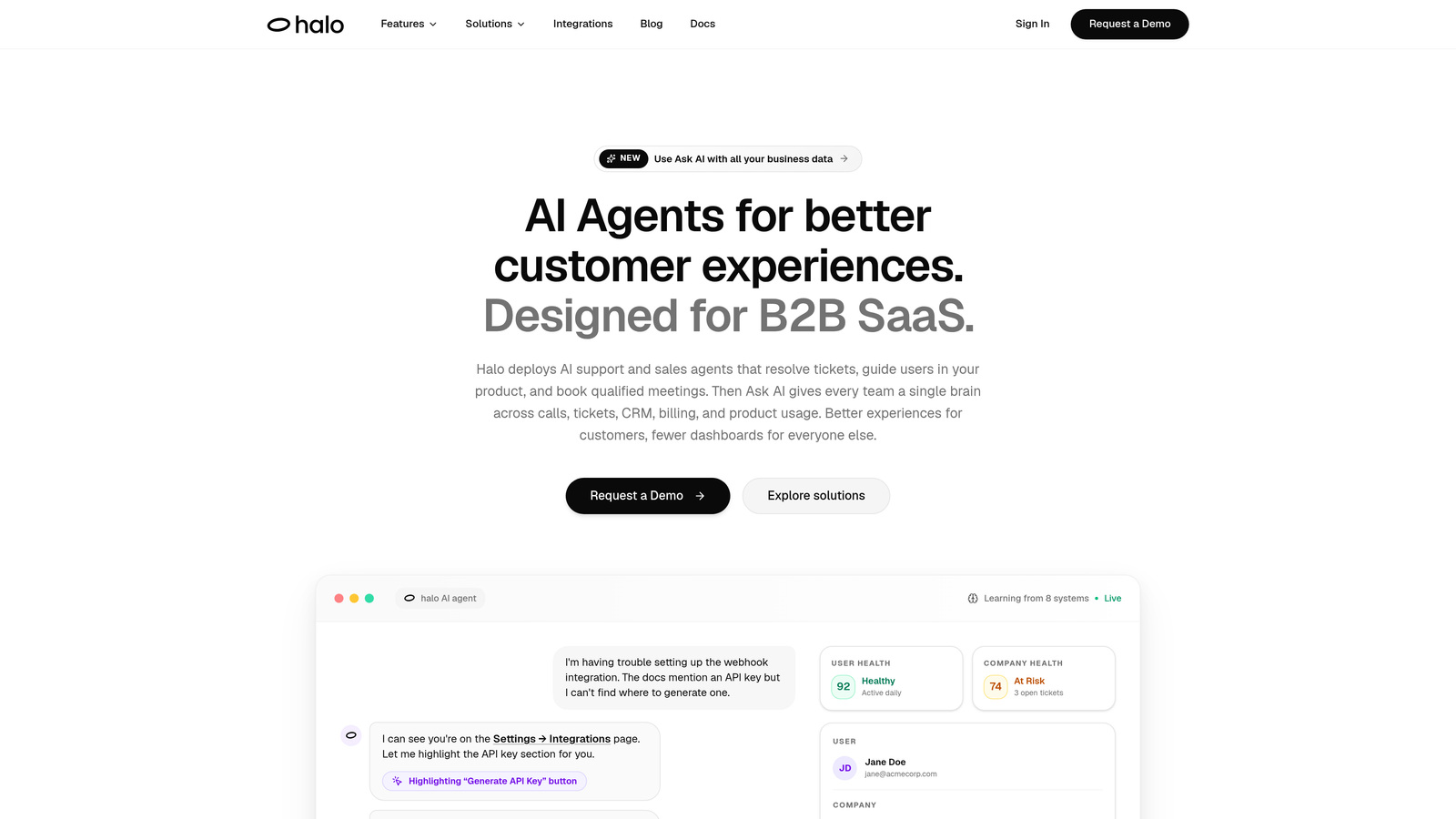
Halo AI is an AI-first customer support platform built specifically for SaaS and B2B tech teams, deploying autonomous agents that resolve tickets, guide users visually through your product, and surface business intelligence — all while continuously learning from every interaction.
Where This Tool Shines
What separates Halo from most support tools is that AI isn't a feature bolted onto a helpdesk — it's the foundation. The platform's page-aware chat widget understands exactly what screen a user is on and can provide contextual, visual guidance tailored to that moment. For SaaS products with complex UIs, this is a meaningful differentiator: instead of generic answers, users get help that matches what they're actually looking at.
Halo also goes beyond support deflection. Its smart inbox surfaces customer health signals, revenue intelligence, and anomaly detection, turning your support channel into a source of strategic product insight. When a bug pattern emerges across multiple tickets, Halo auto-creates a bug report and routes it directly to Linear or your engineering workflow — closing the loop between customer experience and product development without manual handoffs.
Key Features
Page-Aware Chat Widget: Understands the user's current screen and delivers contextual, visual guidance specific to that page or workflow.
Autonomous Ticket Resolution with Continuous Learning: AI agents resolve tickets and improve accuracy over time without requiring manual retraining after every product update.
Auto Bug Ticket Creation: Automatically generates bug reports from support interactions and routes them to Linear or your engineering workflow.
Smart Inbox with Business Intelligence: Surfaces customer health signals, revenue intelligence, and anomaly detection beyond standard support metrics.
Live Agent Handoff and Integrations: Escalates complex issues to human agents seamlessly; connects with Linear, Slack, HubSpot, Stripe, Zoom, Intercom, PandaDoc, and Fathom.
Best For
B2B SaaS companies and product teams that have outgrown bolt-on helpdesk AI and need a platform where intelligence is foundational rather than retrofitted. Particularly strong for teams where support, product, and engineering need to stay tightly connected.
Pricing
Contact for pricing. Visit haloagents.ai for current plans and to book a demo.
2. Intercom
Best for: Mid-market SaaS teams wanting support, onboarding, and product messaging in one platform.
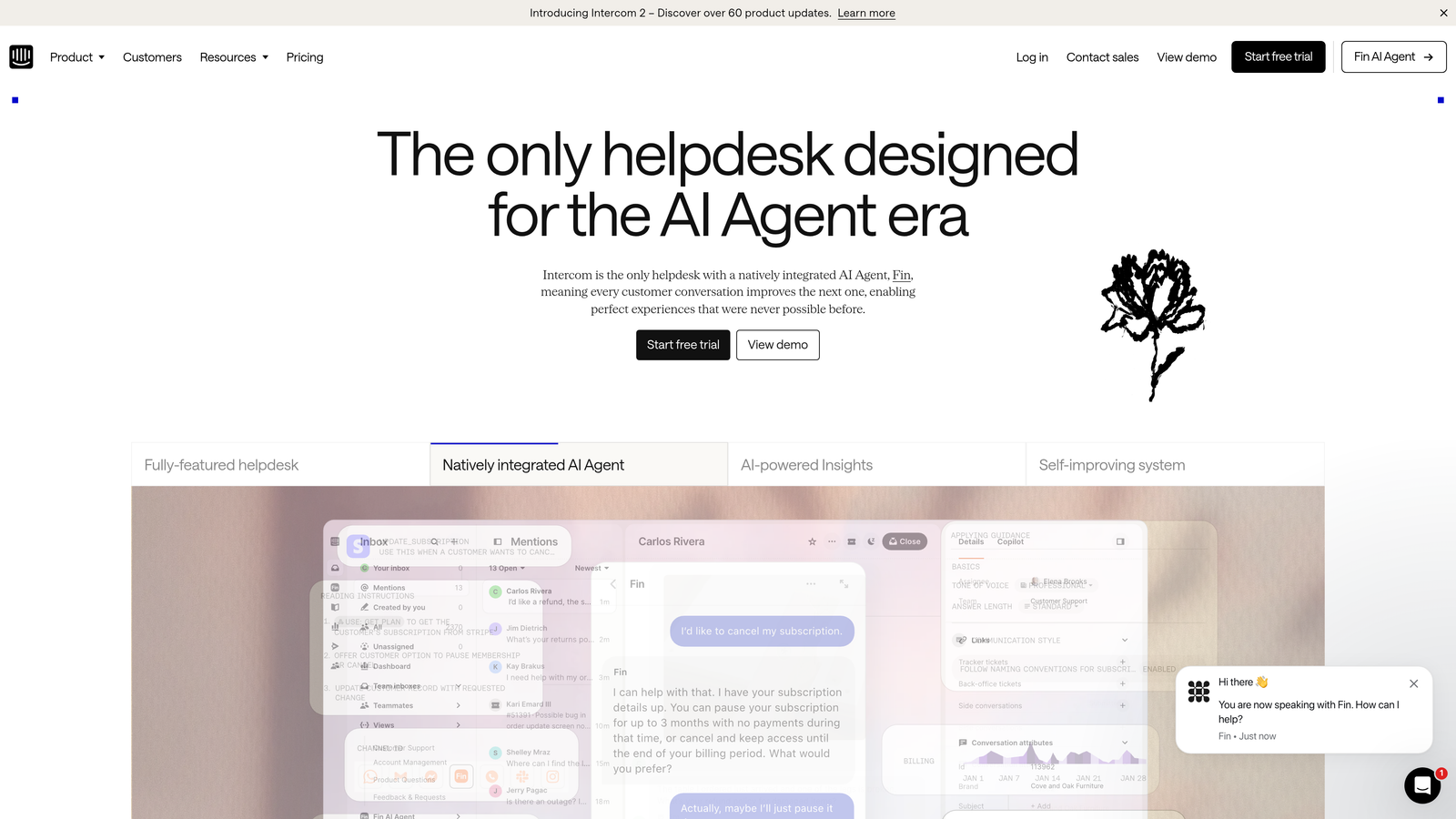
Intercom is a conversational support platform with a mature AI agent called Fin and a strong customer data layer that enriches automation with real user context.
Where This Tool Shines
Intercom's strength is breadth. It combines support automation, in-product messaging, onboarding flows, and product tours in a single platform, which is appealing for teams that don't want to stitch together multiple point solutions. Fin, its AI agent, handles a meaningful share of inbound queries autonomously across chat and email.
The CRM-lite customer data platform is a genuine asset for automation. Because Intercom knows who the user is, what plan they're on, and how they've engaged with your product, it can route and personalize conversations in ways that purely ticket-focused tools can't match out of the box.
Key Features
Fin AI Agent: Handles autonomous query resolution across chat and email using your existing knowledge base and documentation.
Customer Data Platform: CRM-lite layer enriches automation with user attributes, plan data, and behavioral context.
Workflows Builder: Visual tool for building multi-step automation sequences across channels without engineering involvement.
In-Product Messaging and Tours: Supports onboarding and feature adoption alongside reactive support in the same platform.
App Marketplace and API: Extensive integration library with broad API access for custom connections.
Best For
Mid-market SaaS companies that want a unified platform for support, onboarding, and product messaging. Teams that prioritize user context in automation will find the customer data layer particularly valuable. Note that pricing scales with usage volume, which can become significant at higher tiers.
Pricing
Starts at $39/seat/month; Fin AI usage is billed separately per resolution, so total cost scales with conversation volume.
3. Zendesk
Best for: Larger tech companies with complex, multi-channel support operations and dedicated support ops teams.
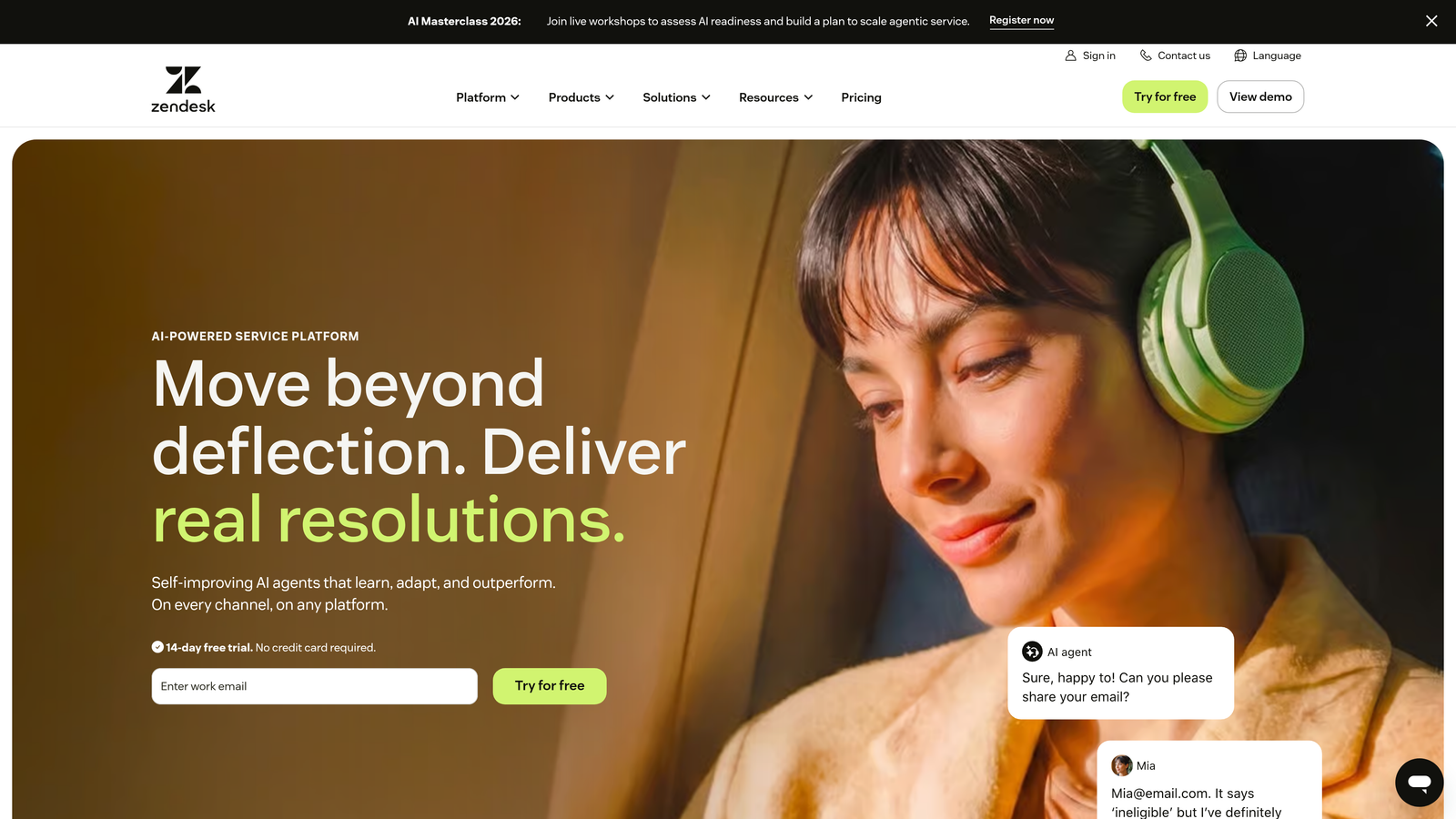
Zendesk is an enterprise-grade helpdesk with one of the largest ecosystems in the industry and an AI Copilot designed to assist human agents across every channel.
Where This Tool Shines
Zendesk's primary advantage is maturity and scale. Its app marketplace, compliance capabilities, and SLA management tools are hard to match, making it a natural fit for larger organizations with established support operations. The AI Copilot layer adds suggested replies, conversation summaries, and next-best-action recommendations that help agents work faster without removing them from the loop.
The Explore analytics module gives support ops teams deep reporting capabilities and custom dashboards. If your team runs on data and needs granular visibility into performance across channels, Zendesk delivers that infrastructure. The tradeoff is implementation complexity — getting the most out of Zendesk typically requires dedicated resources and ongoing administration.
Key Features
AI Copilot: Provides agents with suggested replies, conversation summaries, and next-best-action guidance in real time.
Intelligent Triage and Routing: AI-powered ticket classification and routing across email, chat, voice, and social channels.
Zendesk Explore: Advanced analytics platform with custom reporting, dashboards, and deep performance visibility.
Enterprise Compliance and SLA Management: Robust tooling for organizations with strict compliance requirements and complex SLA structures.
Large App Marketplace: Hundreds of integrations across CRM, engineering, and communication tools.
Best For
Larger tech companies with dedicated support operations teams, multi-channel complexity, and the internal resources to implement and maintain an enterprise helpdesk. Less suited to lean teams looking for fast deployment.
Pricing
Suite plans from approximately $55/agent/month; advanced AI features are available on higher tiers at additional cost.
4. Freshdesk
Best for: Mid-market tech teams wanting solid AI automation at more accessible price points.
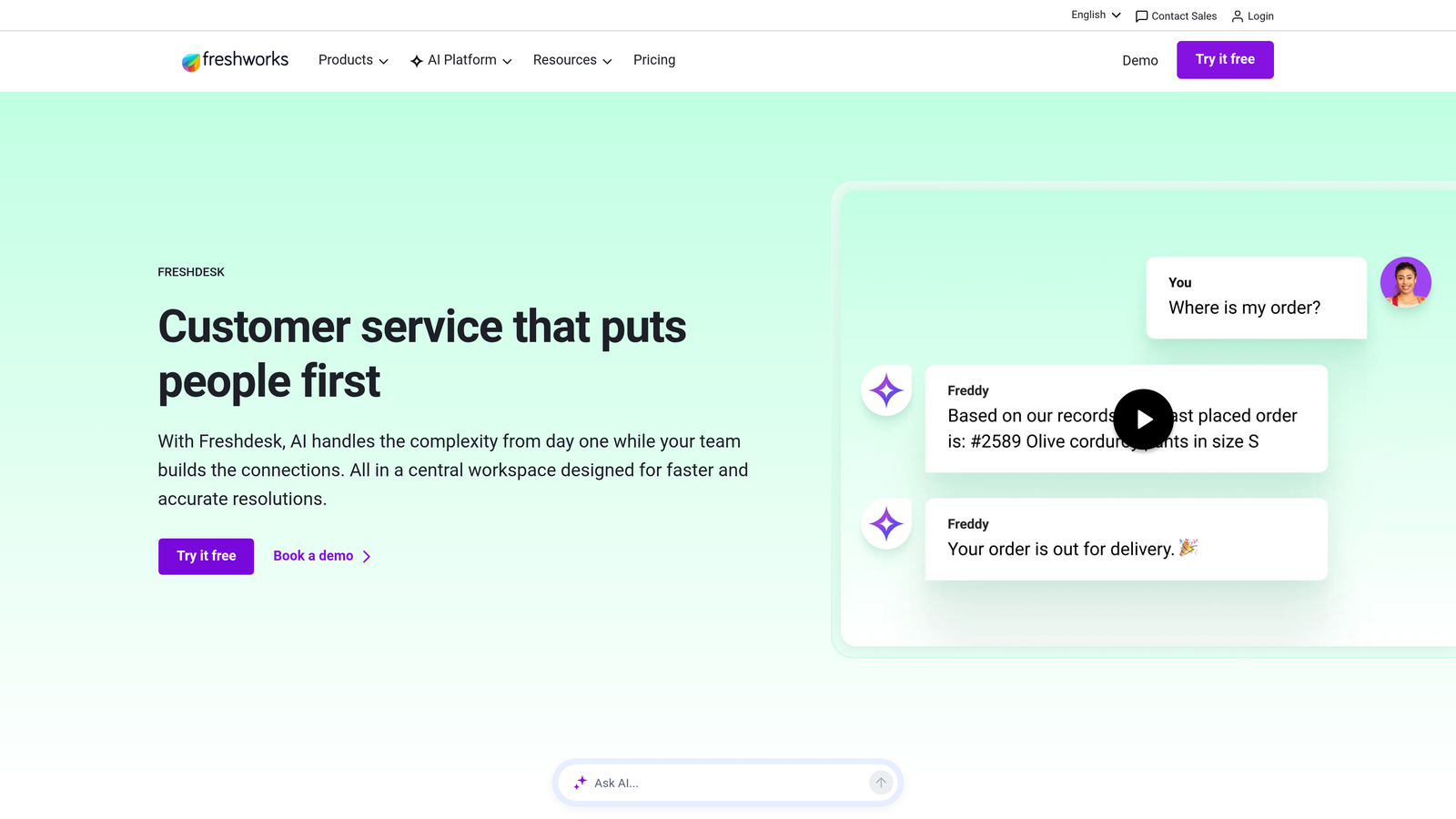
Freshdesk is a mid-market helpdesk with Freddy AI covering triage, agent assistance, and self-service, offering a capable automation layer without the enterprise price tag.
Where This Tool Shines
Freshdesk occupies a practical middle ground: more capable than lightweight tools, more accessible than enterprise platforms. Freddy AI handles automated ticket categorization, routing, and agent suggestions out of the box, and the self-service answer bot can deflect common queries using your existing knowledge base. Onboarding is notably faster than enterprise alternatives, which matters for teams that can't dedicate weeks to implementation.
The native integration with Freshsales CRM is useful for teams that want support and sales data in the same ecosystem. Freddy Copilot and Freddy Insights tiers add more advanced AI capabilities for teams that grow into them over time.
Key Features
Freddy AI: Automated ticket categorization, intelligent routing, and suggested responses for agents.
Freddy Copilot and Insights: Advanced agent assistance and analytics available on higher tiers.
Self-Service Answer Bot: Deflects common queries using your knowledge base content without agent involvement.
Native Freshsales CRM Integration: Connects support and sales data within the Freshworks ecosystem.
Clean UI with Fast Onboarding: Relatively quick to configure and deploy compared to enterprise-tier helpdesks.
Best For
Mid-market tech companies that need solid helpdesk automation without enterprise pricing or implementation overhead. Teams already using Freshsales will find the native CRM connection particularly convenient.
Pricing
Free plan available; paid plans from approximately $15/agent/month; Freddy AI capabilities are priced as add-ons on higher tiers.
5. Tidio
Best for: Early-stage tech companies or lean product teams needing fast, affordable chat automation.
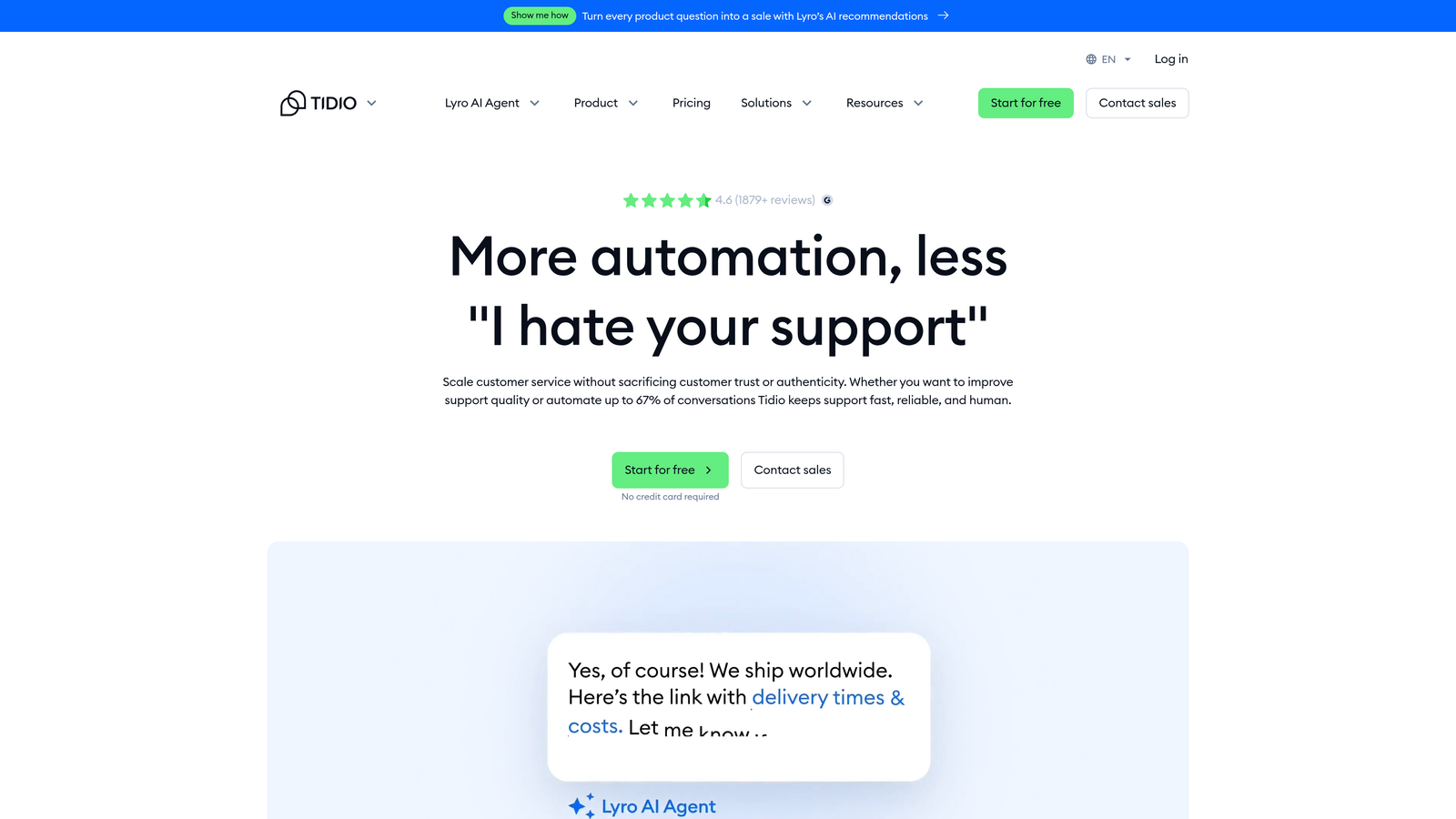
Tidio is a lightweight AI chat automation platform with fast setup and accessible pricing, making it a practical starting point for teams with simpler support needs.
Where This Tool Shines
Tidio's standout quality is speed to value. Teams frequently cite going from sign-up to live chat in hours rather than weeks, which is a genuine differentiator when you need something working quickly. Lyro, its AI agent, handles conversational queries using your existing knowledge base content without requiring significant configuration work upfront.
For early-stage companies or product teams where support volume is manageable and queries are relatively straightforward, Tidio covers the essentials without the complexity or cost of larger platforms. It's worth noting that Tidio is better suited to this starting point than to complex B2B SaaS environments with high technical query volume.
Key Features
Lyro AI Agent: Handles conversational queries autonomously using your existing knowledge base content.
Fast Setup: Typically live within hours, with minimal configuration required to get started.
Unified Interface: Live chat, chatbot, and email support managed in a single interface.
Visual Chatbot Flow Builder: Drag-and-drop flow builder accessible to non-technical team members.
Integrations: Connects with e-commerce platforms and basic SaaS tools; integration depth is more limited than enterprise alternatives.
Best For
Early-stage tech companies, startups, or lean product teams where support volume is manageable and speed of deployment matters more than deep technical capability. Teams expecting significant growth or complex B2B queries will likely outgrow it.
Pricing
Free plan available; Lyro AI from approximately $29/month; higher tiers unlock more conversations and advanced features.
6. Forethought
Best for: Tech companies that want smarter AI without migrating away from Zendesk or Salesforce Service Cloud.
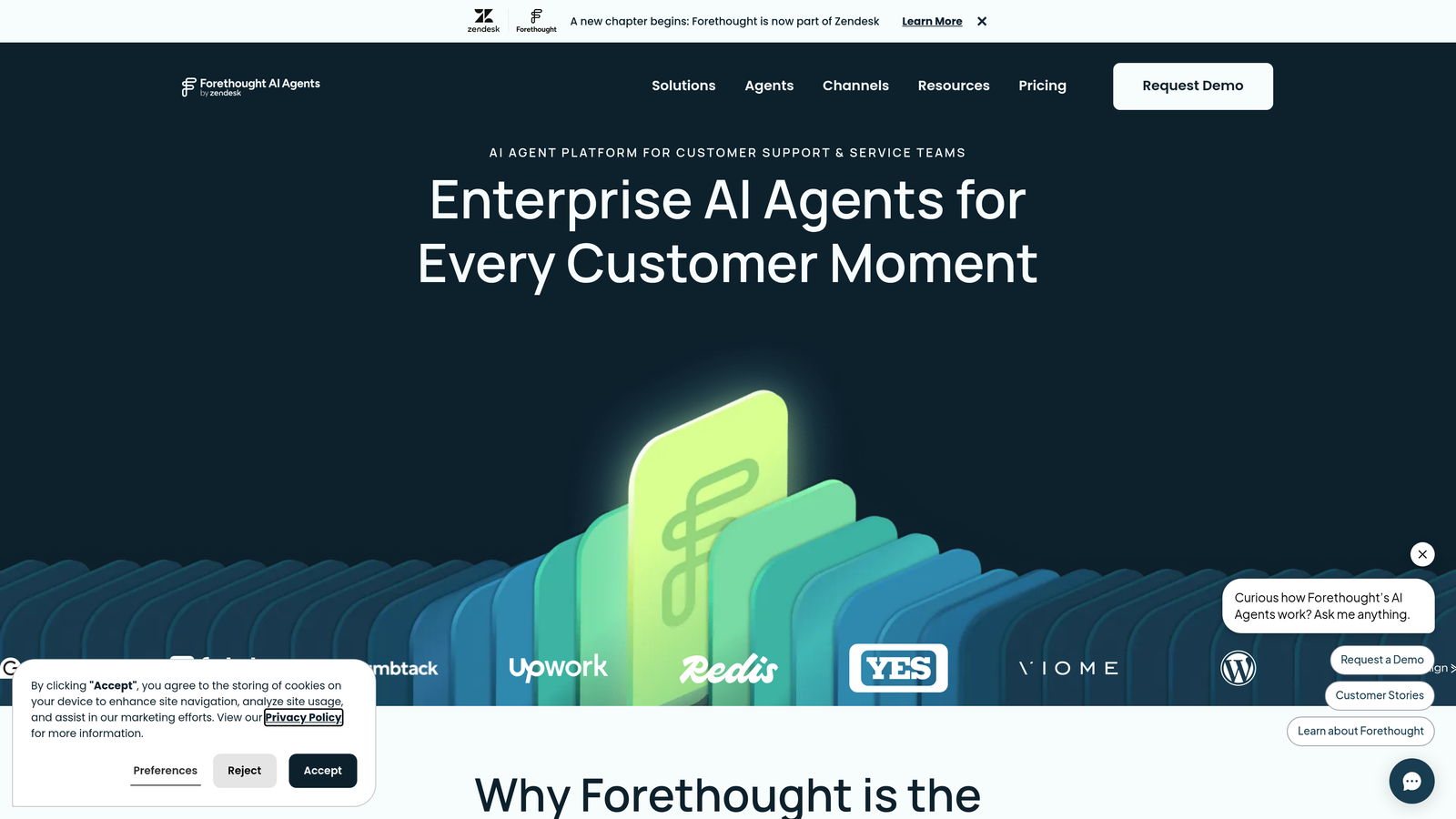
Forethought is an AI intelligence layer that sits on top of existing helpdesks, adding autonomous resolution, intelligent routing, and agent assistance without requiring a platform migration.
Where This Tool Shines
Forethought solves a specific problem elegantly: you've invested heavily in Zendesk or Salesforce, your team knows the platform, and you don't want to start over — but the AI capabilities feel insufficient. Forethought layers on top of your existing setup, adding genuine intelligence without disrupting established workflows or requiring data migration.
The three-product structure (Solve, Triage, Assist) gives teams flexibility to adopt capabilities incrementally. You can start with intelligent routing and agent suggestions, then expand to autonomous resolution as confidence in the AI grows. This modular approach reduces the risk typically associated with AI adoption.
Key Features
Solve: Autonomous ticket resolution using your existing knowledge base and historical ticket data.
Triage: Intelligent routing and prioritization before tickets reach agents, reducing manual sorting.
Assist: AI-generated response suggestions that help agents reply faster and more consistently.
Helpdesk Compatibility: Works alongside Zendesk, Salesforce Service Cloud, and other major platforms without replacing them.
No Migration Required: Adds AI capability to your existing stack, preserving your current workflows and historical data.
Best For
Tech companies with significant existing investment in Zendesk or Salesforce Service Cloud that want meaningfully better AI without the disruption of platform migration. Less relevant for teams starting fresh or wanting a unified platform from the ground up.
Pricing
Custom pricing — contact Forethought directly for a quote based on your volume and use case.
7. Kustomer
Best for: Consumer-facing tech companies with high interaction volumes across multiple channels.
Kustomer is a CRM-native support platform owned by Meta, built around a unified customer timeline and strong omnichannel automation for high-volume consumer tech environments.
Where This Tool Shines
Kustomer's architecture starts from the customer record rather than the ticket, which changes how support conversations feel. Every interaction — chat, email, SMS, social, voice — appears in a single unified timeline, giving agents complete context without switching tools or hunting through systems. For consumer-facing tech companies handling large volumes across many channels, this unified view meaningfully reduces handle time.
The CRM-native foundation means customer history actively informs automation decisions. Routing, tagging, and resolution flows can all be personalized based on who the customer is and what their history looks like, rather than treating every inbound ticket as a blank slate.
Key Features
Unified Customer Timeline: All interactions across every channel aggregated into a single chronological view per customer.
Omnichannel Support: Chat, email, SMS, social, and voice managed in one interface without channel switching.
AI Automation: Handles routing, tagging, and standard resolution flows using customer data and interaction history.
CRM-Native Architecture: Customer history and attributes inform every automation decision, not just ticket content.
Workflow Automation: Multi-step automation for complex support processes that span multiple touchpoints.
Best For
Consumer-facing tech companies, marketplaces, and consumer SaaS products with high interaction volumes across SMS, social, chat, and email. Less commonly the right choice for pure B2B SaaS environments with lower volume but higher technical complexity.
Pricing
Enterprise pricing starting around $89/agent/month; contact Kustomer for volume pricing and current plan details.
8. Help Scout
Best for: Developer tools companies and open-source projects where support quality matters as much as deflection rate.
Help Scout is a deliberately human-feeling support platform with selective AI assistance, favored by teams where brand voice and support quality are competitive differentiators.
Where This Tool Shines
Help Scout takes a different philosophical stance than most tools on this list. Rather than maximizing deflection, it's designed to help human agents work faster and better. AI Summarize, AI Assist, and AI Drafts reduce the cognitive load on agents without removing them from the conversation — which matters enormously for developer tools companies and open-source projects where users expect thoughtful, precise responses from real people.
The shared inbox model is simple, beloved by smaller teams, and scales without adding administrative complexity. The Beacon widget brings contextual in-product help to users, and Docs provides a clean self-service knowledge base. If your support is part of your brand identity, Help Scout's approach preserves that quality intentionally.
Key Features
AI Summarize, Assist, and Drafts: AI tools that help agents work faster — summarizing conversations, suggesting language, and drafting replies — without replacing the human in the loop.
Shared Inbox Model: Clean, collaborative inbox that scales without complexity or heavy administration.
Beacon Widget: In-product contextual help that surfaces relevant documentation and support options to users.
Docs: Self-service knowledge base integrated with the support platform for consistent content management.
Team Performance Reporting: Clean reporting focused on team metrics and customer satisfaction rather than deflection-first analytics.
Best For
Developer tools companies, open-source projects, and teams where support quality is a brand differentiator. Not the right fit for teams whose primary goal is maximum autonomous deflection rate at scale.
Pricing
Starts at approximately $22/user/month; higher tiers unlock additional AI features and advanced reporting capabilities.
9. Drift (Salesloft)
Best for: B2B tech companies where support and sales conversations overlap and pipeline impact matters.
Drift, now part of Salesloft, is a conversational platform that blends support automation with revenue intelligence, designed for B2B tech environments where a support conversation can directly influence a deal or renewal.
Where This Tool Shines
Drift's differentiation is the connection it draws between conversations and revenue outcomes. AI playbooks route incoming conversations based on account data and intent signals, ensuring that high-value accounts get the right response immediately. Real-time notifications alert sales reps when target accounts engage, turning what might have been a support ticket into a pipeline conversation.
For B2B tech companies running enterprise sales motions alongside a support function, this overlap is genuinely valuable. Drift isn't primarily a ticket resolution tool — it's a revenue-aligned conversation platform that happens to include support automation. Teams looking for pure ticket deflection will find better options elsewhere on this list, but for those where support and sales blur together, Drift fills a distinct role.
Key Features
AI Playbooks: Route conversations based on account data, firmographics, and intent signals rather than just query content.
Conversation Intelligence: Connects support and chat interactions to pipeline outcomes and revenue data.
Real-Time Sales Alerts: Notifies sales reps immediately when target accounts engage in a conversation.
Meeting Scheduling Automation: Embeds calendar booking directly into chat flows, removing friction from high-value conversations.
CRM Integrations: Connects with Salesforce, HubSpot, and major CRM platforms to keep conversation data in sync with pipeline records.
Best For
B2B tech companies with enterprise sales motions where support conversations frequently touch renewal, expansion, or new pipeline opportunities. Teams focused purely on support ticket resolution will find more purpose-built options in this list.
Pricing
Custom pricing — contact Drift or Salesloft directly for current plans and packaging.
Choosing the Right Tool for Your Tech Team
The right platform depends heavily on where you are as a company and what you need support automation to do for you beyond answering tickets.
If you want AI-first autonomous resolution with product intelligence: Halo AI is purpose-built for this. The page-aware context, continuous learning, and business intelligence layer make it the strongest fit for B2B SaaS teams that need support to connect directly to product and engineering workflows.
If you need a unified platform for support plus onboarding and messaging: Intercom covers all three in one place and is a natural choice for mid-market SaaS teams that want to reduce the number of tools they manage.
If you're an enterprise with complex multi-channel operations: Zendesk's ecosystem and compliance infrastructure are hard to match, provided you have the resources to implement and maintain it properly.
If you want smarter AI without migrating your helpdesk: Forethought layers onto Zendesk or Salesforce without disruption, which is the lowest-friction path for teams with significant existing investment.
If support quality is your brand: Help Scout's human-first approach is the right philosophical fit for developer tools companies and open-source teams where thoughtful responses matter more than deflection rates.
If you're early-stage and need something running fast: Tidio gets you live quickly at an accessible price point, with room to graduate to a more capable platform as you scale.
Your support team shouldn't scale linearly with your customer base. Let AI agents handle routine tickets, guide users through your product, and surface business intelligence while your team focuses on complex issues that need a human touch. See Halo in action and discover how continuous learning transforms every interaction into smarter, faster support.