9 Best Customer Support Automation Platform Features to Look For in 2026
Choosing the right customer support automation platform features can make or break your team's efficiency, and this guide evaluates the top 2026 platforms—from AI-first tools like Halo AI to established helpdesks—across key criteria including ticket resolution rates, contextual awareness, integrations, and seamless human handoff. Whether you're upgrading a legacy system or selecting your first AI-powered solution, this comparison helps you identify which platform best fits your support goals.
 Grant CooperFounder12 min read
Not all customer support automation platforms are built the same. Some bolt AI onto an existing ticketing system. Others are built AI-first from the ground up. The difference shows up fast: in resolution rates, in agent workload, and in how quickly your team can scale without hiring.
This guide breaks down the platforms worth evaluating in 2026, assessed on what actually matters: ticket resolution capability, contextual awareness, integrations, analytics, and the ability to hand off to humans without friction. Whether you're migrating from a legacy helpdesk or evaluating your first AI-powered support tool, each platform below has been reviewed on the same criteria so you can compare apples to apples.
1. Halo AI
Best for: B2B SaaS teams wanting AI-first support that resolves tickets and surfaces business intelligence
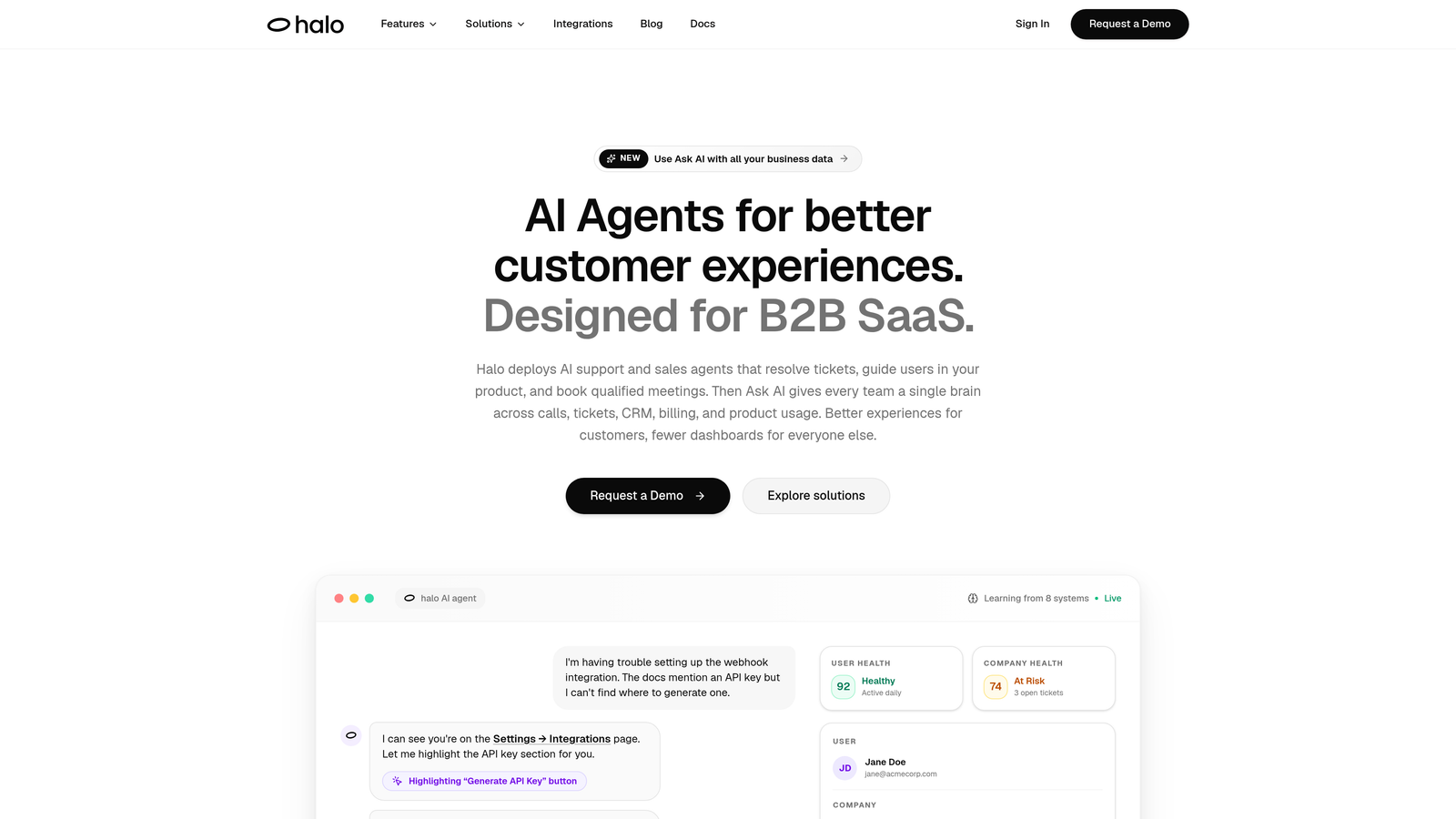
Halo AI is an AI-first customer support platform that resolves tickets, guides users through your product with page-aware context, and continuously learns from every interaction.
Where This Tool Shines
Halo AI's most distinctive capability is page-aware context: the AI agent understands where a user is inside your product at the moment they ask for help. This isn't just reading the URL. It sees what users see, which means guidance is specific to their current state rather than generic documentation links.
Beyond ticket resolution, Halo surfaces business intelligence that most support platforms never touch: customer health signals, anomaly detection, and revenue-correlated issues. For product teams, this turns the support layer into an early warning system for churn, bugs, and friction points.
Key Features
Page-Aware Chat Widget: Provides visual UI guidance based on exactly where the user is in your product, not just what they typed.
Intelligent Ticket Resolution: AI agents resolve tickets autonomously rather than simply deflecting users to a knowledge base article.
Auto Bug Ticket Creation: Detects bug-related conversations and routes tickets directly to engineering tools like Linear without manual intervention.
Smart Inbox with Business Intelligence: Surfaces customer health signals, anomaly detection, and revenue intelligence alongside standard support metrics.
Live Agent Handoff: Escalates to human agents with full conversation context preserved, so nothing gets repeated or lost in the transition.
Broad Integration Ecosystem: Connects with Linear, Slack, HubSpot, Intercom, Stripe, Zoom, PandaDoc, and Fathom.
Best For
B2B SaaS companies and product-led growth teams that want support automation to do more than deflect tickets. Particularly valuable for teams where support insights feed directly into product decisions and where the AI-to-human handoff experience significantly impacts customer trust.
Pricing
Contact for pricing. Enterprise and growth plans are available at haloagents.ai. Custom pricing based on team size and use case.
2. Zendesk
Best for: Large enterprises needing a mature, highly customizable helpdesk with broad ecosystem support
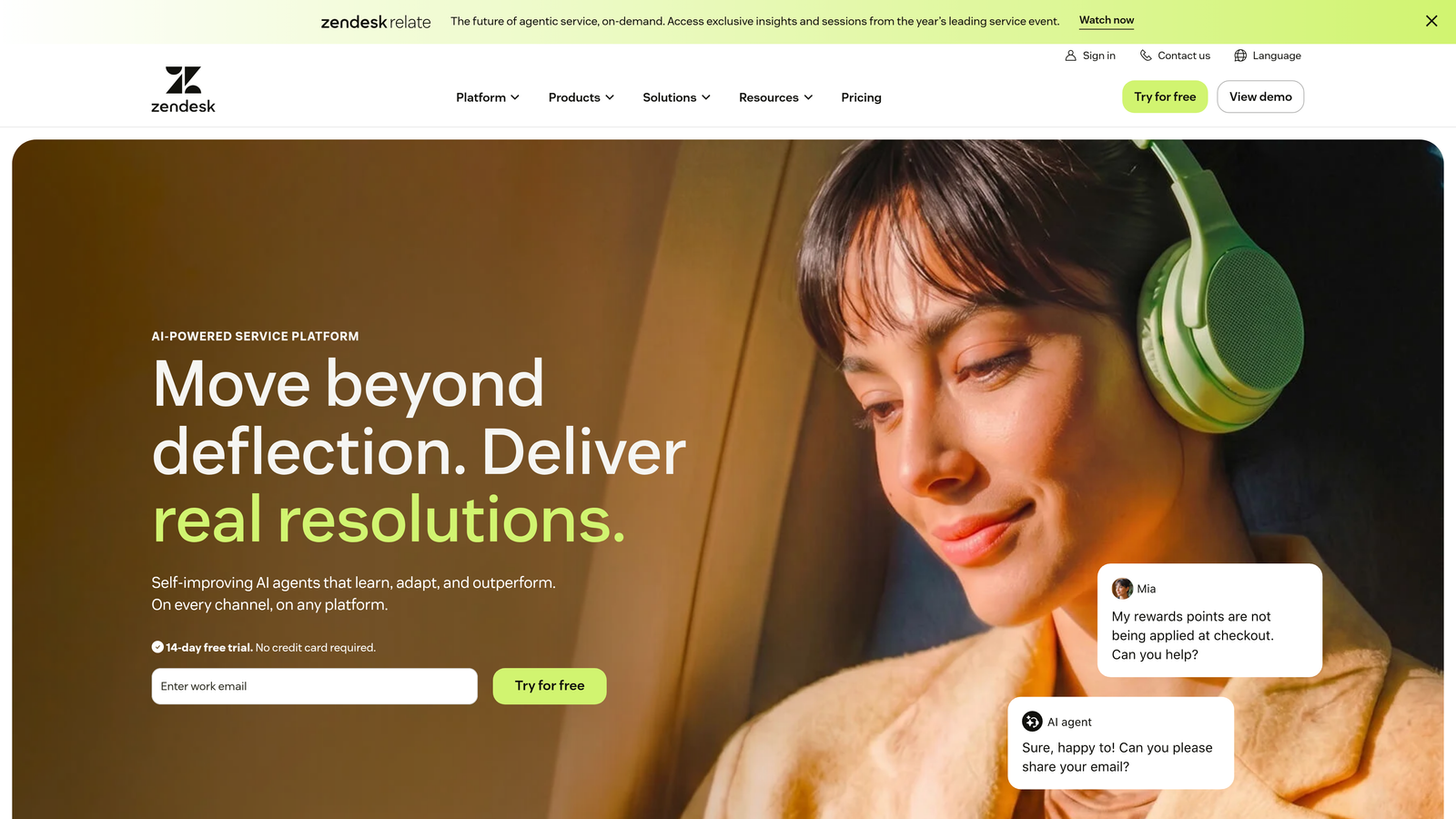
Zendesk is a long-established enterprise helpdesk platform with AI automation features layered via Zendesk AI, offering deep workflow customization and an extensive integration marketplace.
Where This Tool Shines
Zendesk's strength is its maturity. After years of enterprise deployment, it has one of the most configurable workflow engines in the market. Routing logic, SLA management, and escalation rules can be tuned to match complex organizational structures.
The AI layer, powered by an OpenAI partnership, adds ticket triage, suggested replies, and agent assist features. These are genuinely useful, though they feel additive to the core platform rather than foundational to how it operates.
Key Features
AI-Powered Ticket Triage: Automatically categorizes and routes incoming tickets based on intent and priority signals.
Agent Assist: Surfaces suggested replies and relevant articles to agents during live conversations.
Extensive Reporting Suite: Deep analytics on ticket volume, resolution time, CSAT, and agent performance.
Large Integration Marketplace: Hundreds of third-party integrations across CRM, e-commerce, and productivity tools.
Multi-Channel Support: Handles email, chat, voice, and social from a unified workspace.
Best For
Enterprise support organizations with complex routing requirements, large agent teams, and existing investments in the Zendesk ecosystem. Teams that need extensive customization and are comfortable with the configuration overhead that comes with it.
Pricing
Suite plans start at approximately $55/agent/month billed annually. AI features are available on higher-tier plans. Costs can scale significantly for large teams.
3. Intercom
Best for: SaaS companies wanting to combine support automation with product messaging and lifecycle engagement
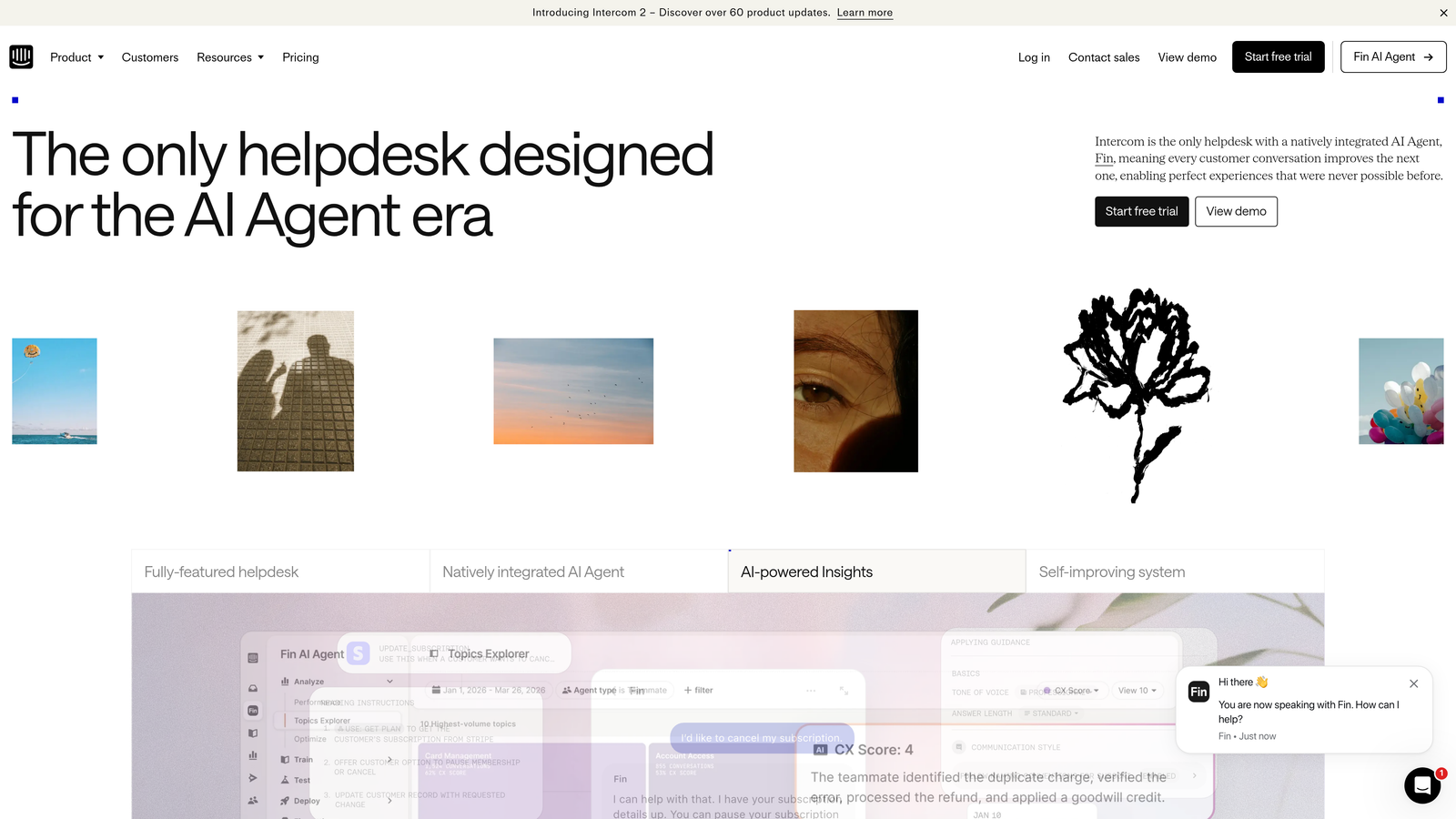
Intercom is a customer communications platform that pairs AI-powered support via its Fin AI agent with product tours, onboarding flows, and proactive messaging.
Where This Tool Shines
Intercom's Fin AI agent can resolve queries autonomously by drawing on your existing knowledge base, which reduces the setup burden compared to platforms that require extensive training data. The conversational UI is polished, and the shared inbox experience for human agents is well-designed.
Where Intercom stands apart from pure-play helpdesks is its lifecycle layer. You can trigger proactive messages based on user behavior, run product tours, and manage onboarding sequences alongside support. For SaaS teams, this integration of support and engagement in one platform has real operational appeal.
Key Features
Fin AI Agent: Resolves customer queries autonomously using your knowledge base content without requiring manual training for each use case.
AI Summaries and Suggested Replies: Helps agents respond faster with context-aware drafts and conversation summaries.
Product Tours and In-App Messaging: Enables onboarding flows and feature announcements within the same platform.
Proactive Support: Triggers outbound messages based on user behavior to prevent tickets before they're submitted.
CRM Integrations: Connects with Salesforce, HubSpot, Stripe, and others for cross-functional context.
Best For
SaaS companies that want to manage customer communication across the full lifecycle, not just reactive support. Teams where product marketing, customer success, and support share tooling will find the combined platform particularly useful.
Pricing
Essential plan starts at approximately $39/seat/month. Fin AI resolution is charged per resolution on some plans, so costs can vary significantly depending on automation volume.
4. Freshdesk
Best for: SMBs and mid-market teams wanting omnichannel support with accessible AI features at competitive pricing
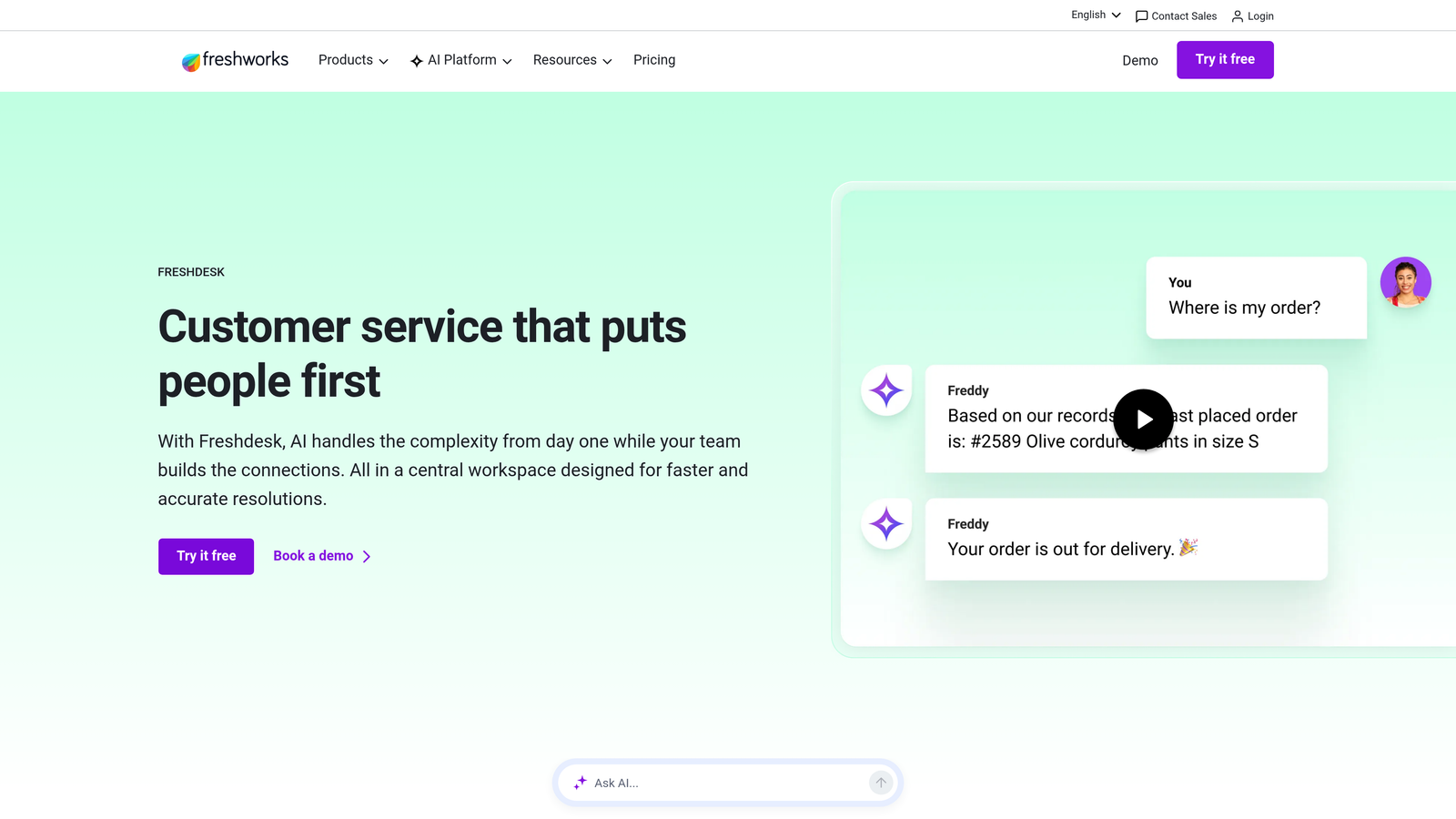
Freshdesk is a helpdesk platform from Freshworks with Freddy AI providing automation across ticket classification, agent assist, and customer-facing self-service.
Where This Tool Shines
Freshdesk's pricing structure makes AI-assisted support accessible to teams that can't justify enterprise-tier spend. Freddy AI handles ticket categorization, sentiment detection, and suggested responses without requiring deep technical configuration to get started.
Being part of the broader Freshworks ecosystem is a meaningful advantage for teams that also use Freshsales (CRM) or Freshservice (ITSM). Data flows between products, which reduces context-switching and gives agents a more complete view of the customer.
Key Features
Freddy AI: Handles ticket categorization, sentiment detection, and agent response suggestions across channels.
Freddy Self Service: Customer-facing AI bot for handling common queries without agent involvement.
Omnichannel Inbox: Manages email, chat, phone, and social conversations from a unified workspace.
Collision Detection: Prevents multiple agents from working the same ticket simultaneously.
Freshworks Ecosystem Integration: Connects natively with Freshsales CRM and Freshservice ITSM for cross-product data sharing.
Best For
SMB and mid-market teams looking for a solid omnichannel helpdesk with AI features at a price point that doesn't require enterprise budget approval. Also a strong fit for teams already using other Freshworks products.
Pricing
Free plan available for small teams. Paid plans start at approximately $15/agent/month. AI features are available on higher-tier plans.
5. Tidio
Best for: E-commerce and SMB teams wanting fast AI chatbot deployment with minimal configuration overhead
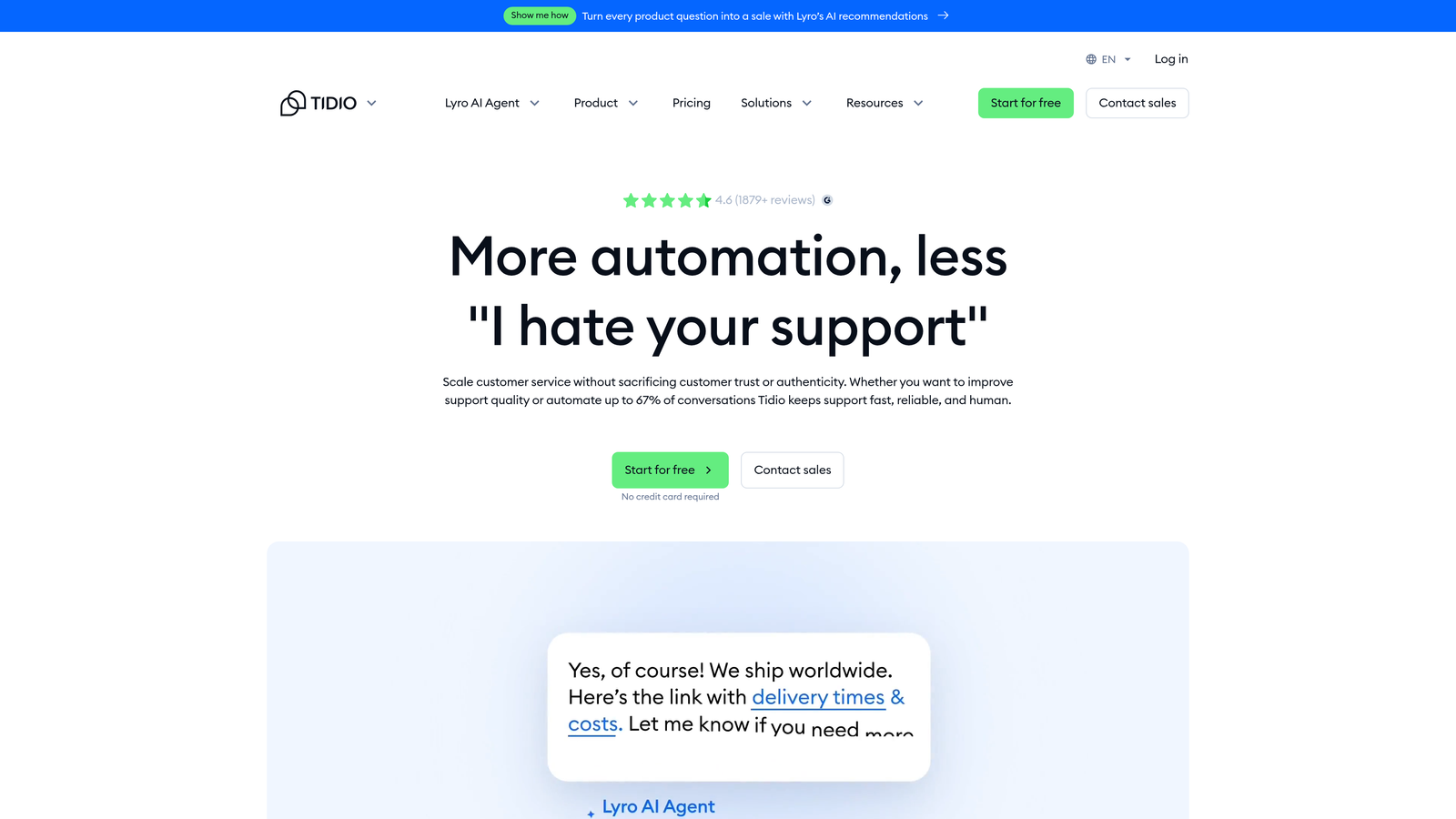
Tidio is a live chat and AI chatbot platform featuring Lyro, an AI agent designed to handle common customer queries with low setup friction and strong e-commerce integrations.
Where This Tool Shines
Tidio's biggest selling point is speed to value. Lyro can start resolving queries using your existing FAQ content without extensive training or configuration. For small teams and e-commerce operators, this matters: you want automation running quickly, not after weeks of implementation work.
The visual chatbot flow builder gives non-technical users control over conversation logic, and the native Shopify and WooCommerce integrations mean order-related queries can be addressed without leaving the chat window.
Key Features
Lyro AI Chatbot: Resolves common queries autonomously using your existing FAQ and help content.
E-Commerce Integrations: Native connections to Shopify, WooCommerce, and Wix for order-context conversations.
Visual Flow Builder: Drag-and-drop interface for building custom automation sequences without coding.
Visitor Tracking: Monitors site behavior and triggers proactive chat based on user actions.
Fast Deployment: Designed to be live in hours, not days, with minimal configuration required.
Best For
E-commerce brands and SMBs that want a functional AI chatbot quickly. Less suited for complex B2B SaaS environments where deep product context and multi-system integrations are required.
Pricing
Free plan available. Lyro AI plans start at approximately $29/month, scaling with conversation volume rather than agent seats.
6. Drift (Salesloft)
Best for: B2B revenue teams blending support automation with sales qualification in a single conversational workflow
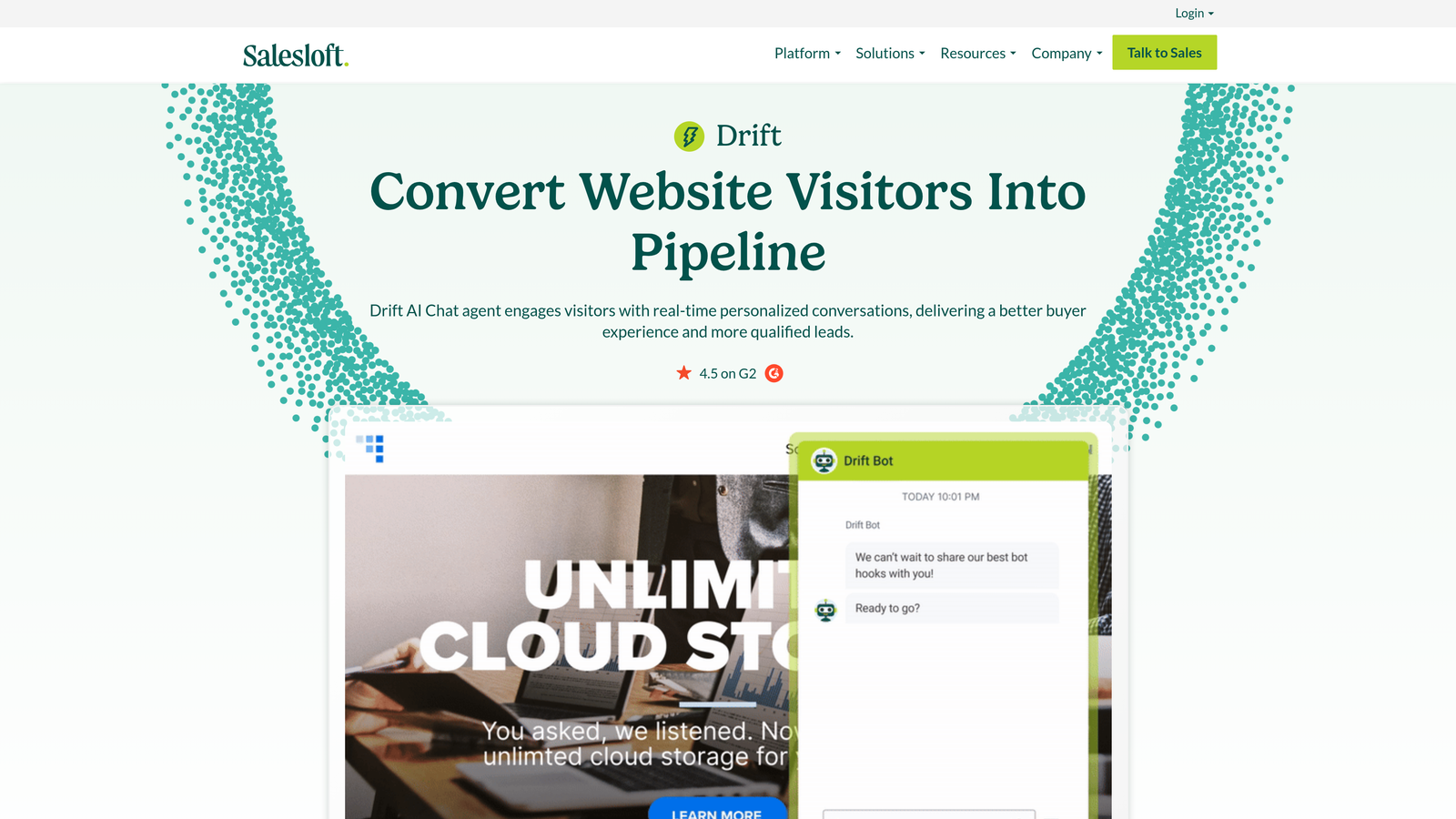
Drift, now part of Salesloft, is a conversational platform that combines support deflection with lead qualification, meeting scheduling, and account-based targeting for B2B go-to-market teams.
Where This Tool Shines
Drift was built for revenue teams first, and that heritage shows. The ability to qualify a lead, route them to the right sales rep, and schedule a meeting within the same chat flow is genuinely differentiated. For B2B companies where the website is a key demand generation channel, this is valuable.
The support automation side handles deflection reasonably well, but Drift's core strength is the intersection of support and sales. If your team needs pure support depth, other platforms serve that better. If you need the support and revenue motions unified, Drift is worth evaluating.
Key Features
AI-Powered Chatbot: Handles lead qualification, support deflection, and routing within a single conversation flow.
Meeting Scheduling: Embeds calendar booking directly into chat, eliminating back-and-forth for sales handoffs.
Account-Based Targeting: Personalizes conversation triggers based on company identity and intent signals.
Revenue Attribution: Connects conversation data to pipeline and revenue outcomes for go-to-market reporting.
CRM Integration: Deep connections with Salesforce, HubSpot, and Marketo for cross-team visibility.
Best For
Mid-market and enterprise B2B teams where marketing, sales, and support share the same customer-facing chat layer. Less ideal for teams with pure support needs and no significant website-based sales motion.
Pricing
Premium plans with pricing available on request. Typically positioned for mid-market and enterprise B2B budgets.
7. Kustomer
Best for: High-volume consumer support teams needing a unified customer timeline combining CRM and support history
Kustomer is a CRM-native customer service platform that unifies the full customer timeline, including purchases, interactions, and support history, giving agents and AI complete context for every conversation.
Where This Tool Shines
Kustomer's unified timeline is its core differentiator. Rather than treating each support ticket as an isolated event, every conversation sits within the full history of that customer's relationship with your brand. Agents see previous orders, past interactions, and behavioral data without switching tools.
The AI layer uses this rich context to power more relevant deflection and suggested responses. When the AI has access to full purchase and interaction history, its recommendations are more specific and more likely to resolve the issue without escalation.
Key Features
Unified Customer Timeline: Combines CRM data, purchase history, and support interactions in a single view for agents and AI.
AI-Powered Deflection: Uses full customer context to provide more relevant automated responses than standard knowledge-base-only bots.
Omnichannel Support: Manages conversations across email, chat, social, and messaging apps with intelligent routing.
Workflow Automation: Automates repetitive support tasks including tagging, routing, and status updates.
E-Commerce and CRM Integrations: Deep connections with Shopify, Salesforce, and other platforms for data enrichment.
Best For
High-volume consumer support teams, particularly in e-commerce and subscription businesses, where full customer context meaningfully improves resolution quality and agent efficiency.
Pricing
Enterprise pricing. Plans start at approximately $89/agent/month. Contact Kustomer for full pricing based on team size and feature requirements.
8. Gorgias
Best for: E-commerce brands needing deep order data integration directly inside support tickets
Gorgias is a helpdesk built specifically for e-commerce, pulling live order, refund, and shipping data directly into support conversations so agents and AI can resolve order-related queries without switching platforms.
Where This Tool Shines
Gorgias solves a specific and common pain point for e-commerce support teams: agents spend significant time jumping between the helpdesk and the order management system to answer basic questions. Gorgias eliminates that by surfacing live order data inside the ticket itself.
The AI agent layer is built around this same context, meaning automated responses to "where is my order?" or "how do I return this?" can reference actual order data rather than generic instructions. For high-volume e-commerce support, this specificity makes a meaningful difference in resolution quality.
Key Features
Deep E-Commerce Integration: Native connections to Shopify, BigCommerce, and Magento with live order, refund, and shipping data inside tickets.
AI Agent for E-Commerce Queries: Automates common requests like order status, returns, and shipping updates using real order data.
Macros and Rules: High-speed ticket automation for repetitive responses and workflows at scale.
Revenue Statistics: Ties support interactions to revenue outcomes, showing which conversations drive or recover sales.
Omnichannel Inbox: Manages email, chat, social, and SMS from a unified workspace.
Best For
E-commerce brands with high ticket volume driven by order-related queries. Not well-suited for B2B SaaS or service businesses where order data isn't the primary support context.
Pricing
Starter plan from approximately $10/month. Pricing scales by ticket volume rather than agent seats, which works well for teams with variable support demand.
9. Help Scout
Best for: Small SaaS teams and mission-driven companies wanting clean, human-feeling support without enterprise complexity
Help Scout is a shared inbox and customer support platform with a Beacon chat widget and AI-assisted drafting, designed for teams that want effective support without the overhead of a full enterprise helpdesk.
Where This Tool Shines
Help Scout's reputation is built on simplicity and a human feel. The interface is clean, onboarding is fast, and the product doesn't overwhelm small teams with configuration options they'll never use. This is a deliberate design choice, and it resonates strongly with teams that have been burned by over-engineered helpdesks.
Recent AI additions, including AI Drafts for suggested replies and AI summaries, add meaningful efficiency without changing the platform's fundamental character. The Beacon widget handles in-app chat and surfaces relevant Docs articles before a ticket is even submitted, which reduces inbound volume in a lightweight, unobtrusive way.
Key Features
Shared Inbox: Clean collaborative inbox with collision detection and private notes for team coordination.
Beacon Widget: In-app chat and self-service documentation widget that surfaces relevant articles proactively.
AI Drafts: Generates suggested reply drafts for agents based on conversation context and previous responses.
Docs Knowledge Base: Built-in knowledge base with instant answers surfaced inside Beacon before users submit tickets.
Simple Reporting: Straightforward analytics on response times, team performance, and customer satisfaction without overwhelming complexity.
Best For
Small to mid-sized SaaS teams, nonprofits, and mission-driven companies that prioritize a warm, human support experience over deep automation. Teams that want to get up and running quickly without a dedicated implementation project.
Pricing
Standard plan from approximately $22/user/month. Plus and Pro plans are available for teams needing additional features and higher usage limits.
Which Platform Is Right for Your Team?
The right choice depends less on feature lists and more on your specific context: your team size, your customer type, and how deeply you want AI embedded in your support workflow.
For B2B SaaS teams: Halo AI is the strongest fit if you want AI that understands product context, resolves tickets rather than deflecting them, and surfaces business intelligence alongside support data. Intercom is a solid alternative if lifecycle messaging alongside support is a priority.
For e-commerce brands: Gorgias is purpose-built for order-heavy support. Tidio works well for smaller e-commerce operations that need fast deployment. Kustomer makes sense for high-volume consumer brands needing full CRM context in every conversation.
For enterprise teams: Zendesk's depth of customization and ecosystem breadth makes it the default choice for large organizations with complex routing and compliance requirements. Kustomer is worth evaluating if unified customer data is the primary driver.
For SMBs and growing teams: Freshdesk offers the best combination of omnichannel coverage and accessible pricing. Help Scout is the right call if simplicity and a human feel matter more than automation depth.
For B2B revenue teams: Drift's combination of support deflection and sales qualification is unique. If your website chat needs to serve both functions, it belongs in your evaluation.
Your support team shouldn't scale linearly with your customer base. Let AI agents handle routine tickets, guide users through your product, and surface business intelligence while your team focuses on complex issues that need a human touch. See Halo in action and discover how continuous learning transforms every interaction into smarter, faster support.