9 Best Customer Support Automation Platforms in 2026
This guide evaluates nine leading customer support automation platforms for 2026, comparing AI-first solutions capable of autonomous ticket resolution with traditional helpdesks enhanced by automation layers. Whether you're a lean SaaS startup or an enterprise operation, the breakdown covers AI capability, integrations, deployment ease, and pricing to help you find the right fit for scaling support without scaling costs.
 Grant CooperFounder14 min read
Customer support teams are under more pressure than ever. Ticket volumes keep climbing, customer expectations have risen sharply, and headcount rarely scales fast enough to keep up. The good news is that customer support automation platforms have matured well beyond basic chatbots: today's solutions can resolve tickets autonomously, surface business intelligence, guide users through your product in real time, and hand off gracefully to human agents when complexity demands it.
This list covers nine platforms worth evaluating in 2026, ranging from AI-first architectures built for autonomous resolution to established helpdesk systems with automation layers added on top. Whether you're a lean SaaS team drowning in repetitive tickets or an enterprise operation looking to scale support without scaling costs, there's a fit here.
Selection criteria: depth of AI capability, integration ecosystem, ease of deployment, pricing transparency, and suitability for B2B SaaS environments. Halo AI appears first as our own platform, followed by leading alternatives evaluated on their own merits.
1. Halo AI
Best for: B2B SaaS teams that want AI-first autonomous support with deep product and business stack integration.
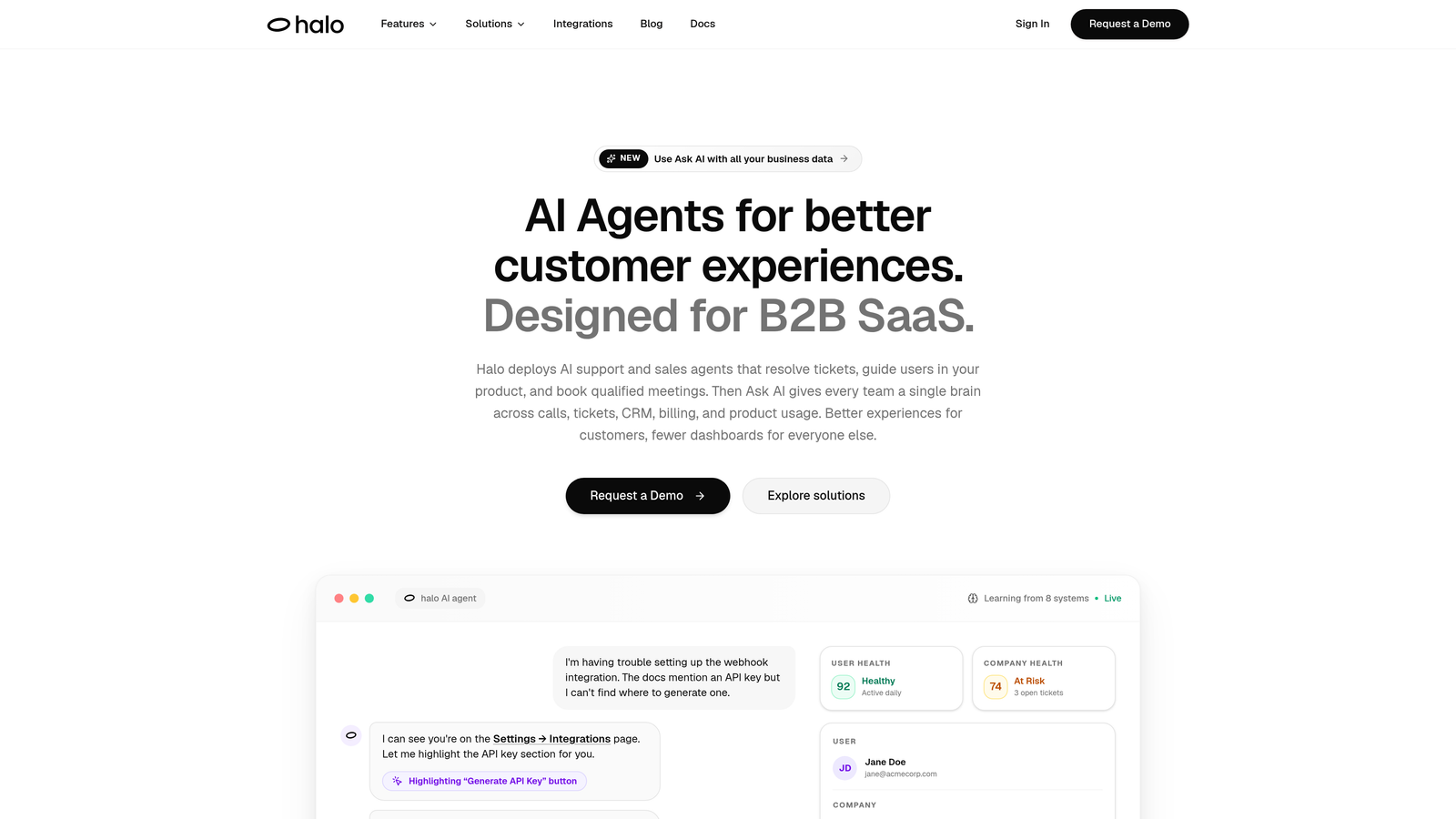
Halo AI is an AI-first customer support platform that deploys intelligent agents to resolve tickets, guide users through your product with page-aware context, create bug reports automatically, and surface business intelligence — all while learning from every interaction.
Where This Tool Shines
What separates Halo from most platforms on this list is that the AI isn't bolted onto an existing helpdesk. It's the foundation. The page-aware chat widget sees exactly what a user is looking at inside your product, so guidance is contextual and specific rather than generic FAQ retrieval. That distinction matters enormously when your customers are navigating complex SaaS workflows.
The business intelligence layer is another standout. Beyond ticket counts and CSAT scores, Halo's smart inbox surfaces customer health signals, revenue intelligence, and anomaly detection. Support stops being a cost center and starts feeding real insight back into the business.
Key Features
Page-Aware Chat Widget: Sees what users see in real time, delivering contextual UI guidance rather than generic answers.
Autonomous Ticket Resolution: AI agents handle routine tickets end-to-end, with smart handoff to live agents for complex issues.
Auto Bug Ticket Creation: Support interactions that reveal bugs automatically generate tickets routed to Linear, connecting support directly to engineering workflows.
Smart Inbox with Business Intelligence: Customer health signals, revenue intelligence, and anomaly detection built into the support inbox.
Full Business Stack Integrations: Connects to Linear, Slack, HubSpot, Intercom, Stripe, Zoom, PandaDoc, and Fathom out of the box.
Continuous Learning Architecture: Resolution quality improves with every interaction rather than remaining static after initial configuration.
Best For
B2B SaaS product teams and customer success operations that need more than ticket deflection. Halo is particularly well-suited for teams where support insights should feed back into product development, customer health monitoring, and revenue workflows. If you're still treating support as an isolated function, Halo is built to change that.
Pricing
Contact for pricing. Enterprise and team plans are available at haloagents.ai. Custom quotes based on team size and integration requirements.
2. Intercom
Best for: Mid-market SaaS teams with existing Intercom investment seeking LLM-powered first-line resolution.
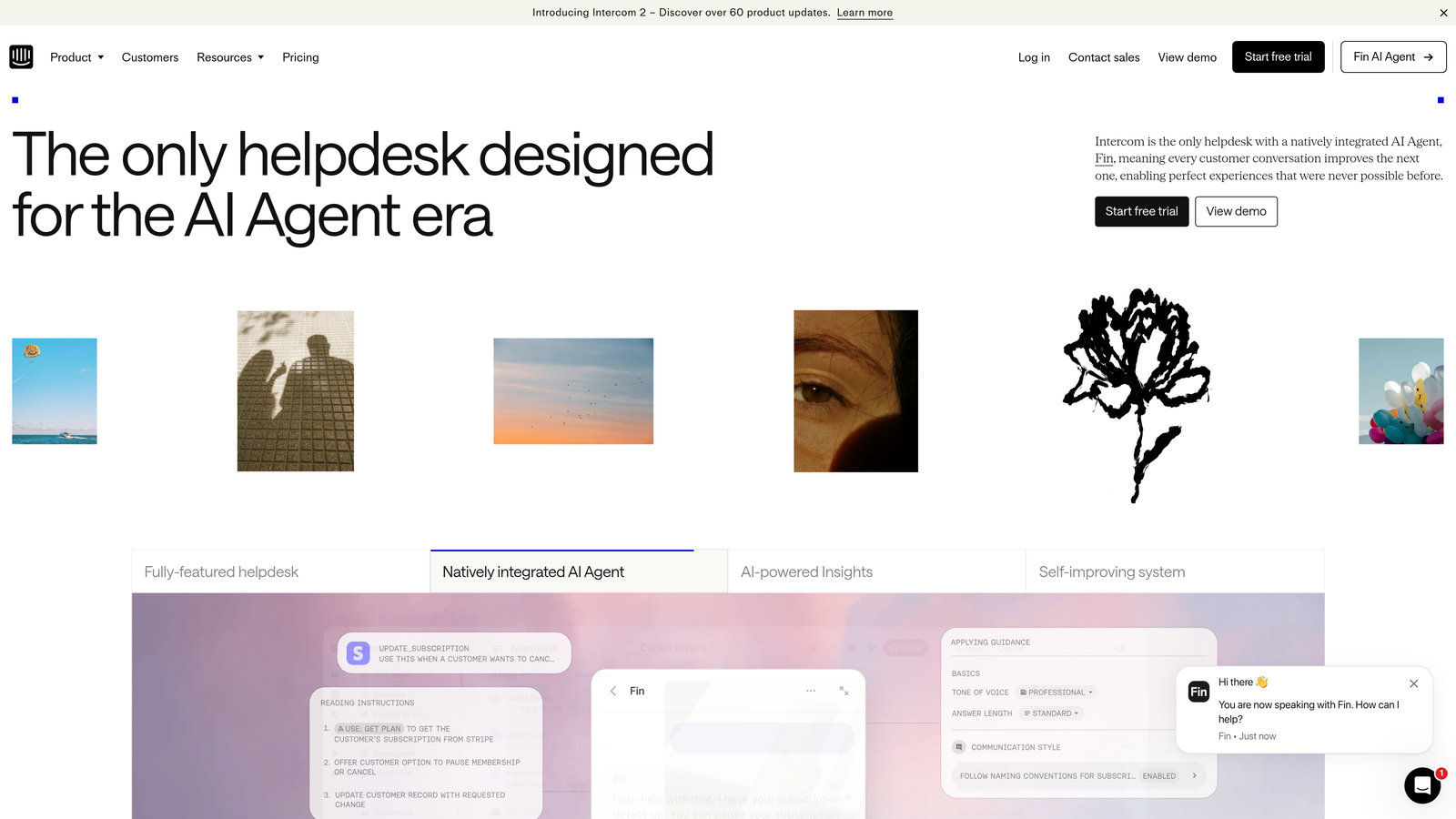
Intercom is a mature conversational support platform with Fin, its LLM-powered AI agent, sitting at the front of the support funnel to resolve common questions before routing to human agents.
Where This Tool Shines
Intercom's Fin AI agent is widely regarded as one of the more capable LLM-powered support bots available. Trained on your knowledge base, it handles first-line resolution conversationally and routes to human agents when it can't confidently resolve an issue. The quality of the handoff is generally smooth.
The customer data platform underneath Intercom is genuinely strong. Behavioral segmentation, lifecycle tracking, and proactive messaging give support teams the context they need to personalize interactions. For teams already embedded in the Intercom ecosystem, adding Fin is a natural upgrade path.
Key Features
Fin AI Agent: LLM-powered autonomous resolution trained on your knowledge base and support content.
In-App Messenger: Behavioral targeting and proactive messaging to engage users at the right moment.
Customer Data Platform: Rich segmentation and lifecycle tracking across the customer journey.
AI-Assisted Reply Suggestions: Shared inbox with response recommendations to speed up human agent workflows.
Integration Ecosystem: Strong public API and broad third-party integrations.
Best For
Mid-market SaaS companies already using Intercom for customer messaging who want to add autonomous resolution without switching platforms. Less compelling as a greenfield choice if you're optimizing purely for AI-first architecture and business intelligence output.
Pricing
Starts at approximately $39 per seat per month. Fin AI usage is billed per resolution, which can add up quickly at scale. Pricing has increased meaningfully in recent years, so model your expected resolution volume before committing.
3. Zendesk
Best for: Enterprise teams needing a mature ticketing infrastructure with AI triage and routing layered on top.
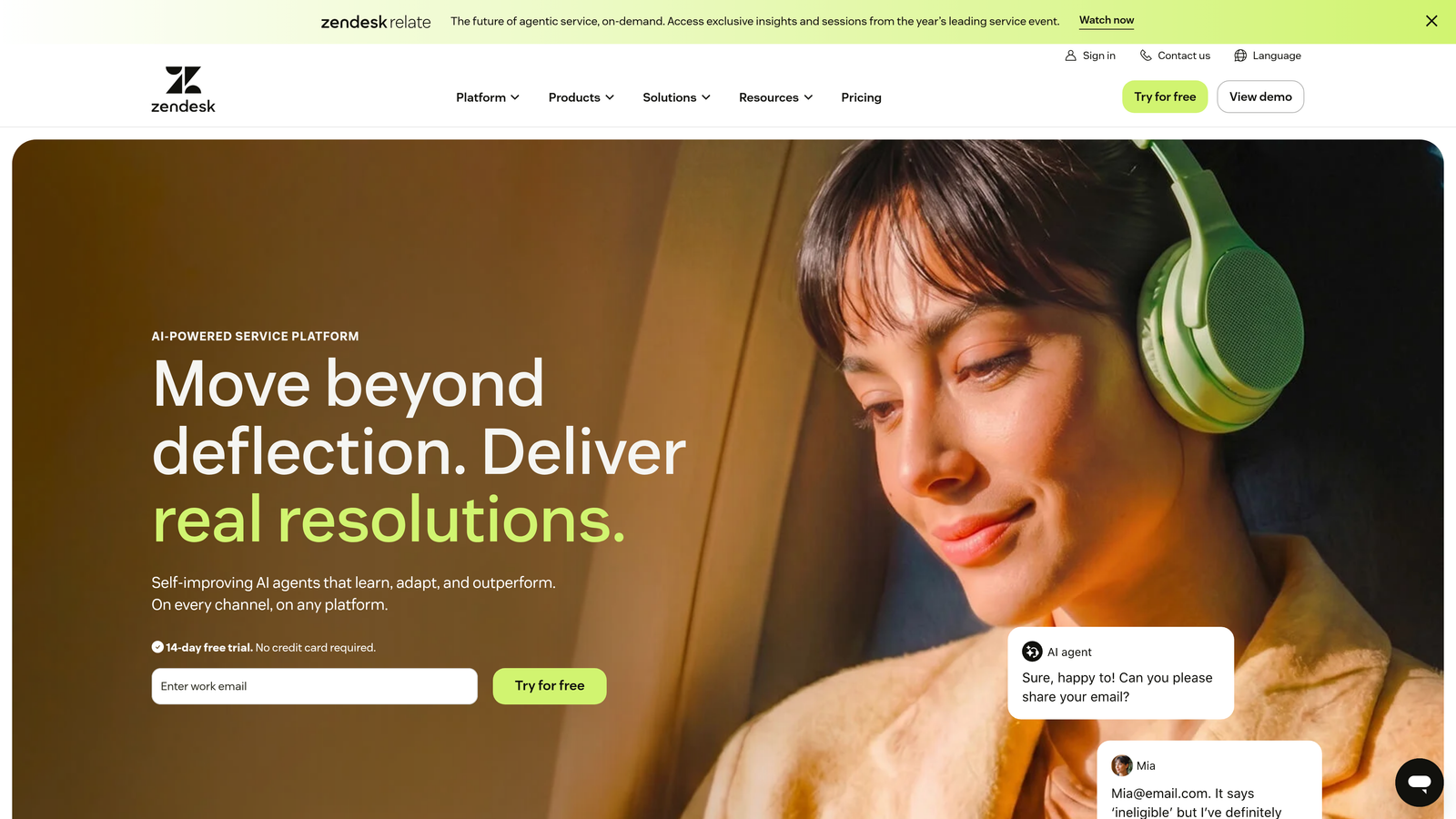
Zendesk is the dominant enterprise helpdesk platform, now with AI-powered triage, intelligent routing, and agentic capabilities layered onto its mature ticketing infrastructure.
Where This Tool Shines
Zendesk's strength is its depth. The ticketing system, SLA management, reporting, and workflow tools are battle-tested across thousands of enterprise deployments. The integration marketplace with over 1,000 apps means it connects to virtually any tool in your stack. If your organization has complex routing logic, multi-tier support structures, or strict SLA requirements, Zendesk handles that complexity well.
The AI additions, including intelligent triage, suggested macros, and the agentic capabilities from Zendesk AI, have improved meaningfully. That said, these features feel like additions to an existing foundation rather than a ground-up AI architecture. Teams evaluating Zendesk for AI-first autonomous resolution should test thoroughly before assuming parity with purpose-built AI platforms.
Key Features
AI-Powered Triage: Automatic categorization and intelligent routing of incoming tickets.
Suggested Macros and Response Recommendations: AI-assisted suggestions to help human agents resolve tickets faster.
Zendesk AI (Agentic): Autonomous resolution capabilities across channels for common query types.
Extensive Marketplace: Over 1,000 integrations covering CRM, billing, project management, and more.
Advanced Reporting and SLA Management: Granular analytics and compliance tools for enterprise operations.
Best For
Enterprise organizations with complex support operations, large agent teams, and existing Zendesk investments. Also suitable for teams that need deep customization and a proven ticketing backbone. Less ideal for lean SaaS teams where setup complexity and cost would outpace the benefit.
Pricing
Suite plans start at approximately $55 per agent per month. AI features are available on higher-tier plans, which can push total cost significantly higher for large teams. Pricing scales steeply with agent count and feature requirements.
4. Freshdesk
Best for: Growing teams wanting a capable helpdesk with AI features at a competitive price point.
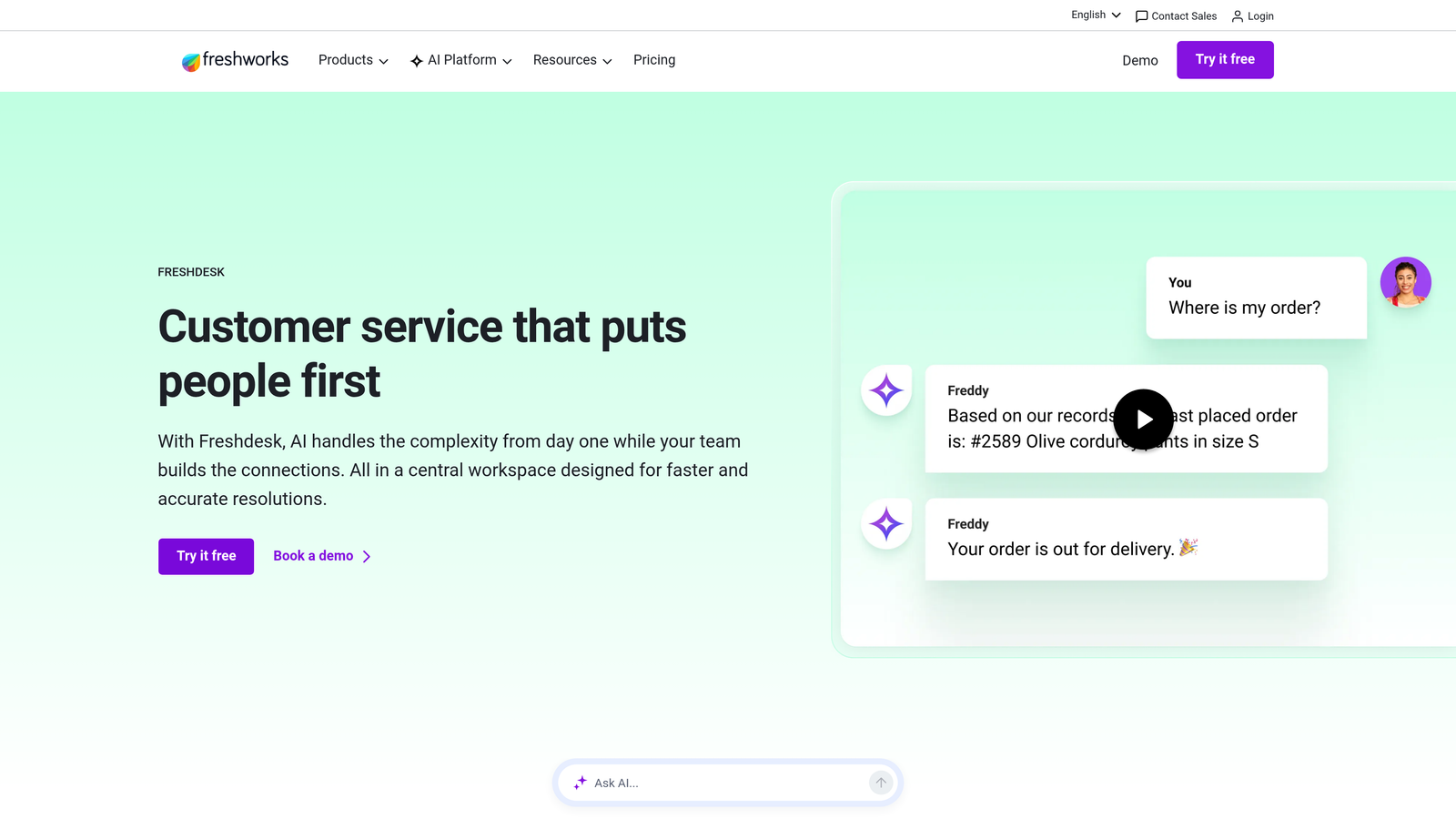
Freshdesk is a full-featured helpdesk from Freshworks with Freddy AI providing auto-triage, sentiment detection, and response suggestions at a price point accessible to growing teams.
Where This Tool Shines
Freshdesk hits a practical sweet spot: more AI capability than basic ticketing tools, more affordable than Zendesk, and backed by a broader Freshworks ecosystem that includes CRM and ITSM. For teams that want a single vendor covering multiple business functions, the Freshworks suite is genuinely convenient.
Freddy AI handles auto-categorization, routing, and response suggestions competently. Sentiment detection to flag frustrated or high-priority customers is a useful addition that helps teams prioritize without manual triage. The AI capabilities are generally considered less mature than Intercom's Fin or Zendesk AI, but they're improving and the price difference often justifies the trade-off for mid-market teams.
Key Features
Freddy AI Auto-Triage: Automatic categorization, routing, and response suggestions for incoming tickets.
Sentiment Detection: Flags high-priority or frustrated customers for faster human intervention.
Freddy Self Service: Chatbot for deflecting common queries before they reach the support queue.
Omnichannel Support: Email, chat, phone, and social channels managed in a single inbox.
Freshworks Ecosystem: Native integration with Freshworks CRM, ITSM, and sales tools.
Best For
SMB and mid-market teams looking for a cost-effective helpdesk with solid AI augmentation. Particularly well-suited for organizations already using or considering other Freshworks products. Less compelling for B2B SaaS teams that need deep product integration or advanced business intelligence output.
Pricing
Free plan available for small teams. Paid plans start at approximately $15 per agent per month, making it one of the more accessible options on this list for budget-conscious teams.
5. Tidio
Best for: Small businesses and e-commerce teams needing fast deployment and affordable AI chat.
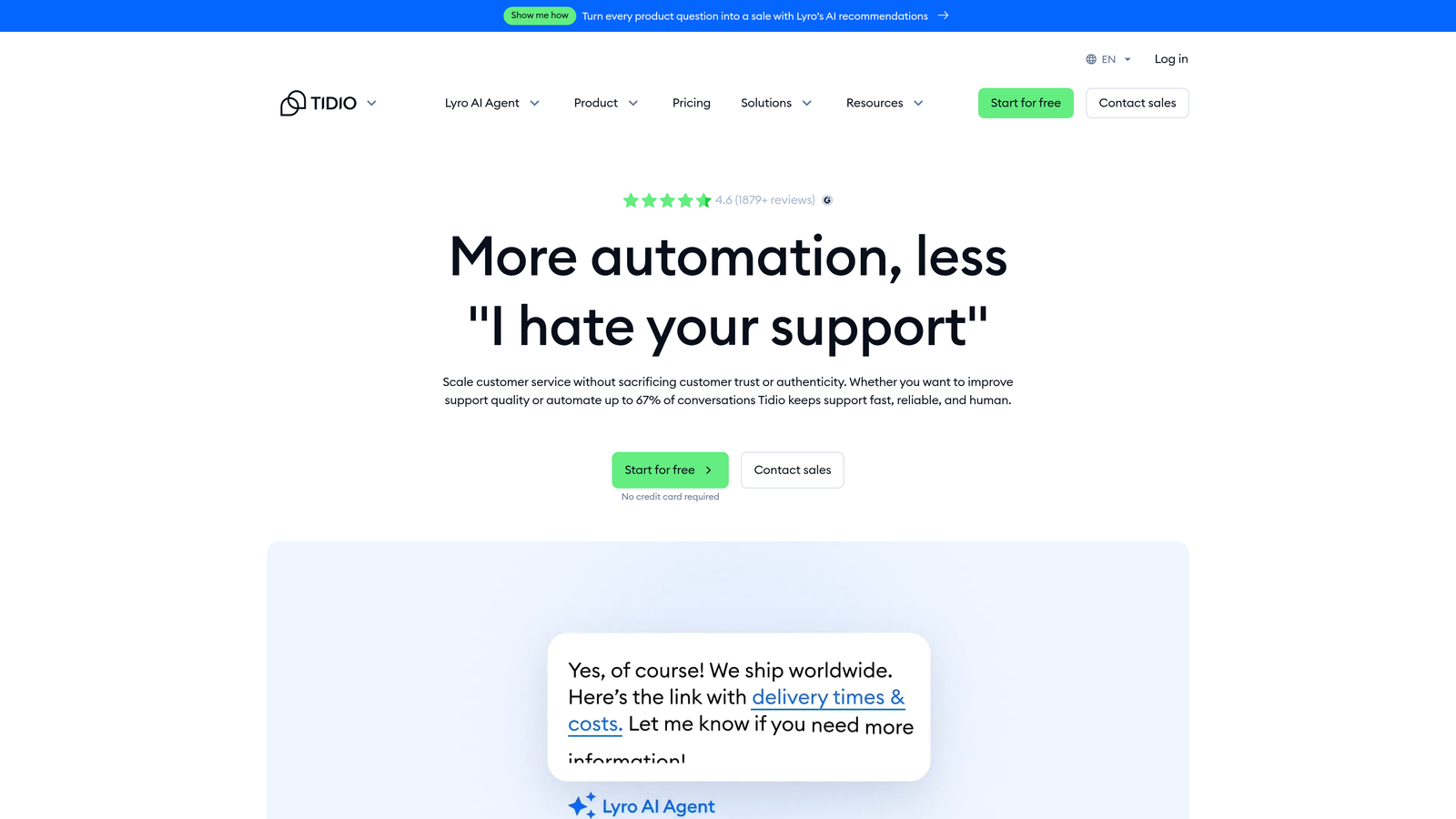
Tidio is a fast-to-deploy chat and automation platform featuring Lyro, its AI chatbot, designed primarily for small businesses and e-commerce teams that need quick wins without heavy implementation overhead.
Where This Tool Shines
Tidio's biggest advantage is speed. You can have a working AI chatbot live on your site in hours, not weeks. The no-code visual flow builder makes it accessible to non-technical teams, and native Shopify and WooCommerce integrations mean e-commerce teams get relevant context without custom development.
Lyro handles FAQ-style queries conversationally and covers the most common deflection use cases well. For small teams where the alternative is no automation at all, Tidio delivers meaningful value quickly. The trade-off is depth: Tidio isn't built for complex B2B SaaS workflows, multi-step resolution tasks, or enterprise-grade integrations.
Key Features
Lyro AI Chatbot: Automated FAQ resolution with conversational responses trained on your support content.
Visual Flow Builder: No-code chatbot builder for creating custom conversation flows without engineering resources.
E-Commerce Integrations: Native Shopify and WooCommerce integrations for order-aware support.
Live Chat with Mobile App: Agents can respond on the go through Tidio's mobile application.
Visitor Tracking and Triggered Messaging: Proactive chat triggers based on visitor behavior.
Best For
Small businesses, e-commerce stores, and early-stage teams that need affordable, fast-to-deploy chat automation. Not recommended for B2B SaaS companies with complex product workflows or teams that need deep CRM and engineering tool integrations.
Pricing
Free plan available. Paid plans start at approximately $29 per month. Lyro AI conversations are billed separately, so model your expected conversation volume to understand total cost.
6. Drift (Salesloft)
Best for: Teams where customer support and revenue generation overlap in the same conversation.
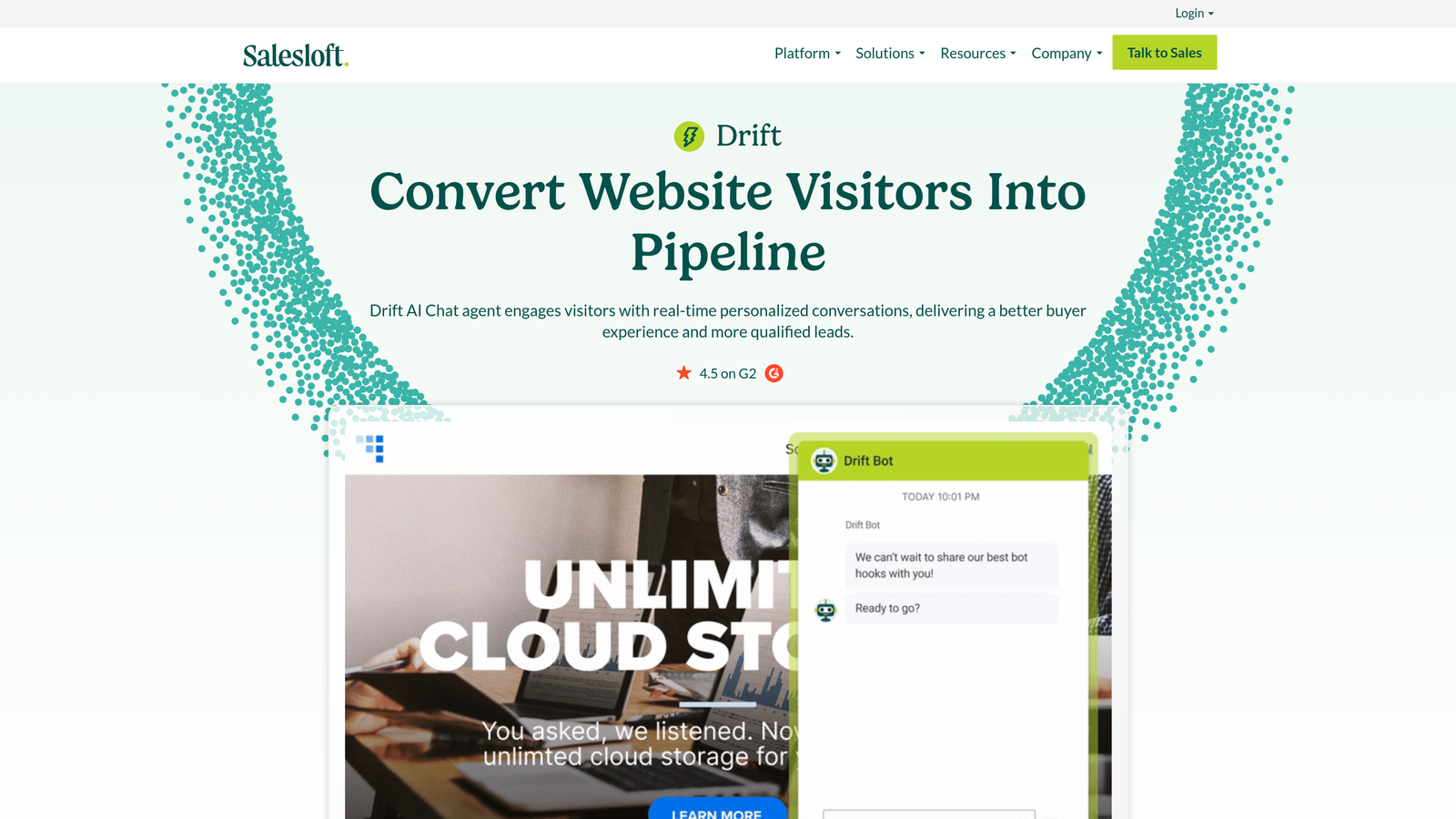
Drift, now part of Salesloft, is a conversational platform that bridges customer support and revenue generation, using AI playbooks and buyer intent signals to route conversations toward resolution or sales engagement.
Where This Tool Shines
Drift's core differentiator is its ability to handle conversations that start as support inquiries and evolve into sales opportunities. AI playbooks can detect intent signals mid-conversation and route accordingly, whether that means resolving an issue, scheduling a meeting, or handing off to a sales rep. For companies with a PLG or sales-assisted motion, that flexibility is genuinely useful.
The acquisition by Salesloft has deepened the revenue platform integration, which is a meaningful advantage for teams already in that ecosystem. However, teams evaluating Drift purely for support automation should note that the product roadmap has increasingly tilted toward revenue use cases since the acquisition.
Key Features
AI Conversational Playbooks: Automated workflows handling support and sales hybrid conversations based on intent signals.
Buyer Intent Detection: Real-time identification of high-value visitors for prioritized routing.
Meeting Scheduling and Sales Handoff: Built-in calendar booking and smooth transitions to sales reps within chat flows.
Bionic Chatbots: Combines AI-generated and human-authored responses for nuanced conversations.
Salesloft Integration: Deep connection to the Salesloft revenue platform for unified pipeline visibility.
Best For
Mid-market and enterprise B2B companies where the support and sales teams share responsibility for customer conversations. Less suitable for pure-play support automation use cases or teams that don't need the revenue platform overlay.
Pricing
Premium pricing available on request. Drift is positioned for mid-market and enterprise buyers, so expect pricing to reflect that. Contact Drift directly for current package details.
7. Ada
Best for: Enterprise teams in regulated industries needing action-oriented AI agents with compliance controls.
Ada is an enterprise-grade no-code AI agent platform focused on action-oriented automation. Ada's agents can complete tasks, not just answer questions, with strong compliance controls designed for regulated industries.
Where This Tool Shines
The distinction between answering questions and completing actions is significant. Ada's agents can process refunds, update account information, perform lookups, and execute multi-step resolution tasks autonomously. For enterprises where support means doing things rather than just saying things, that capability is a meaningful differentiator.
The no-code builder makes Ada accessible to enterprise teams without dedicated engineering resources for chatbot maintenance. Compliance controls, audit logging, and enterprise-grade security make it suitable for financial services, healthcare, and other regulated sectors where most platforms struggle to meet requirements.
Key Features
Action-Based AI Agents: Autonomously completes tasks like refunds, account updates, and data lookups rather than just providing answers.
No-Code Builder: Enterprise-accessible configuration without requiring engineering involvement for ongoing management.
Multi-Channel Deployment: Web, mobile, phone, and messaging app support from a single platform.
Enterprise Compliance Controls: Audit logging, security certifications, and governance tools for regulated industries.
Deep Enterprise Integrations: Connects to CRM systems and backend platforms common in enterprise environments.
Best For
Large enterprises in regulated industries where autonomous task completion and compliance controls are non-negotiable. Ada's implementation timelines tend to be longer than lighter platforms, so it's better suited to organizations with resources for a proper deployment process.
Pricing
Enterprise pricing with custom quotes. Contact Ada directly for current packaging. Expect pricing consistent with enterprise software investment levels.
8. Kustomer
Best for: High-volume consumer support operations that need a CRM-native unified customer view.
Kustomer is a CRM-native customer service platform that unifies customer history across all touchpoints, with AI-powered routing and workflow automation built around full customer context.
Where This Tool Shines
Kustomer's unified customer timeline is its defining feature. Every interaction a customer has had, across every channel, is visible in a single view. That context makes AI routing smarter and human agents significantly more effective. When an agent picks up a conversation, they're not starting from scratch.
The built-in CRM eliminates the need for a separate customer database, which simplifies the tech stack for high-volume consumer operations. Workflow automation handles repetitive resolution steps, reducing manual effort at scale. Kustomer went through an acquisition by Meta and subsequent divestiture, so prospective buyers should evaluate product roadmap continuity as part of their due diligence.
Key Features
Unified Customer Timeline: All interactions across all channels aggregated in a single view per customer.
AI-Powered Routing: Routing decisions informed by customer history, intent, and behavioral context.
Workflow Automation: Automated resolution steps for repetitive ticket types and common workflows.
Built-In CRM: Customer database built into the platform, eliminating separate CRM requirements.
Omnichannel Coverage: Email, chat, SMS, social, and voice managed from a unified interface.
Best For
High-volume consumer-facing businesses where customer history context drives resolution quality. Less suited for B2B SaaS teams with complex product-led workflows or teams that need deep engineering tool integrations like Linear or Jira.
Pricing
Starts at approximately $89 per agent per month, positioning it toward mid-market and enterprise buyers rather than early-stage teams.
9. Gorgias
Best for: E-commerce businesses running on Shopify, BigCommerce, or Magento that need order-aware support automation.
Gorgias is a support platform purpose-built for e-commerce, with deep Shopify and BigCommerce integrations that allow agents and AI to resolve tickets using live order data.
Where This Tool Shines
Gorgias does one thing exceptionally well: e-commerce support. The live order data integration means that when a customer asks about their shipment, the AI or agent already has the order status, tracking information, and return eligibility visible in the ticket. Automated responses triggered by order events handle the most common queries without any human involvement.
The revenue-per-ticket analytics are a genuinely useful addition, helping support teams demonstrate business impact beyond resolution speed. For e-commerce operators, this is a strong platform. For B2B SaaS teams, it's essentially irrelevant — the product is built around a use case that doesn't translate outside of retail and direct-to-consumer commerce.
Key Features
Native E-Commerce Integrations: Deep Shopify, BigCommerce, and Magento connections with live order data surfaced in every ticket.
Order-Triggered Automated Responses: Automatic replies based on order status, shipping events, and return requests.
Revenue Statistics per Ticket: Analytics showing the revenue impact of individual support interactions.
AI Agent: Autonomous resolution of common e-commerce queries like order status, returns, and refunds.
Macros and Rules: High-volume repetitive ticket handling through templated responses and routing rules.
Best For
E-commerce businesses of any size running on major commerce platforms. Gorgias is purpose-built for this vertical and excels within it. If you're not an e-commerce operation, look elsewhere on this list.
Pricing
Starts at approximately $10 per month for 50 tickets, with pricing scaling by ticket volume rather than agent count. One of the more accessible entry points on this list for smaller e-commerce operations.
Which Platform Is Right for Your Team
The right choice depends on what you're actually trying to solve and where your team operates today.
If you're a B2B SaaS company that wants AI-first autonomous support with genuine business intelligence output, Halo AI is built specifically for that use case. The page-aware context, continuous learning, and integration with your full business stack make it a different category of tool from helpdesks with AI added on top.
For teams already invested in Intercom, adding Fin AI is the most natural upgrade path. For enterprises with complex ticketing infrastructure and large agent teams, Zendesk remains the default choice. Freshdesk is the smart pick for growing teams that want solid AI augmentation at a price that doesn't require a budget conversation.
Drift makes sense when support and sales share the same conversation funnel. Ada is the right call for regulated enterprises that need action-oriented agents with compliance controls. Kustomer fits high-volume consumer operations where unified customer history drives resolution quality. Gorgias is the clear winner for e-commerce, and Tidio is the fastest path to basic chat automation for small teams.
The broader principle: don't buy a platform for the features it has today. Evaluate how it learns, what it surfaces beyond ticket counts, and how well it connects support to the rest of your business. The platforms that treat support as an isolated function are falling behind the ones that treat every interaction as a source of intelligence.
Your support team shouldn't scale linearly with your customer base. Let AI agents handle routine tickets, guide users through your product, and surface business intelligence while your team focuses on complex issues that need a human touch. See Halo in action and discover how continuous learning transforms every interaction into smarter, faster support.