9 Best Customer Support Chatbots for SaaS in 2026
This guide ranks the 9 best customer support chatbot for SaaS options in 2026, evaluating each on SaaS-specific criteria including ticket deflection quality, helpdesk integrations, live agent handoff, and contextual awareness. Whether you run a lean startup or a scaling product team, it cuts through the noise to match you with the right AI-powered support tool.
 Grant CooperFounder14 min read
SaaS support teams are under constant pressure: more users, more tickets, less time. A well-deployed customer support chatbot can resolve common issues instantly, surface product insights, and free your team to focus on high-value work. But not every chatbot is built for SaaS.
Some are glorified FAQ widgets. Others are genuinely intelligent agents that learn, escalate, and integrate with your entire stack. The difference matters enormously when you're trying to scale support without scaling headcount.
This list cuts through the noise. We evaluated tools on SaaS-specific criteria: helpdesk integrations, ticket deflection quality, live agent handoff, contextual awareness, and business intelligence beyond basic support. Whether you're running a lean startup or scaling a product team, there's a right tool here.
1. Halo AI
Best for: B2B SaaS teams wanting an AI-first support platform with business intelligence built in
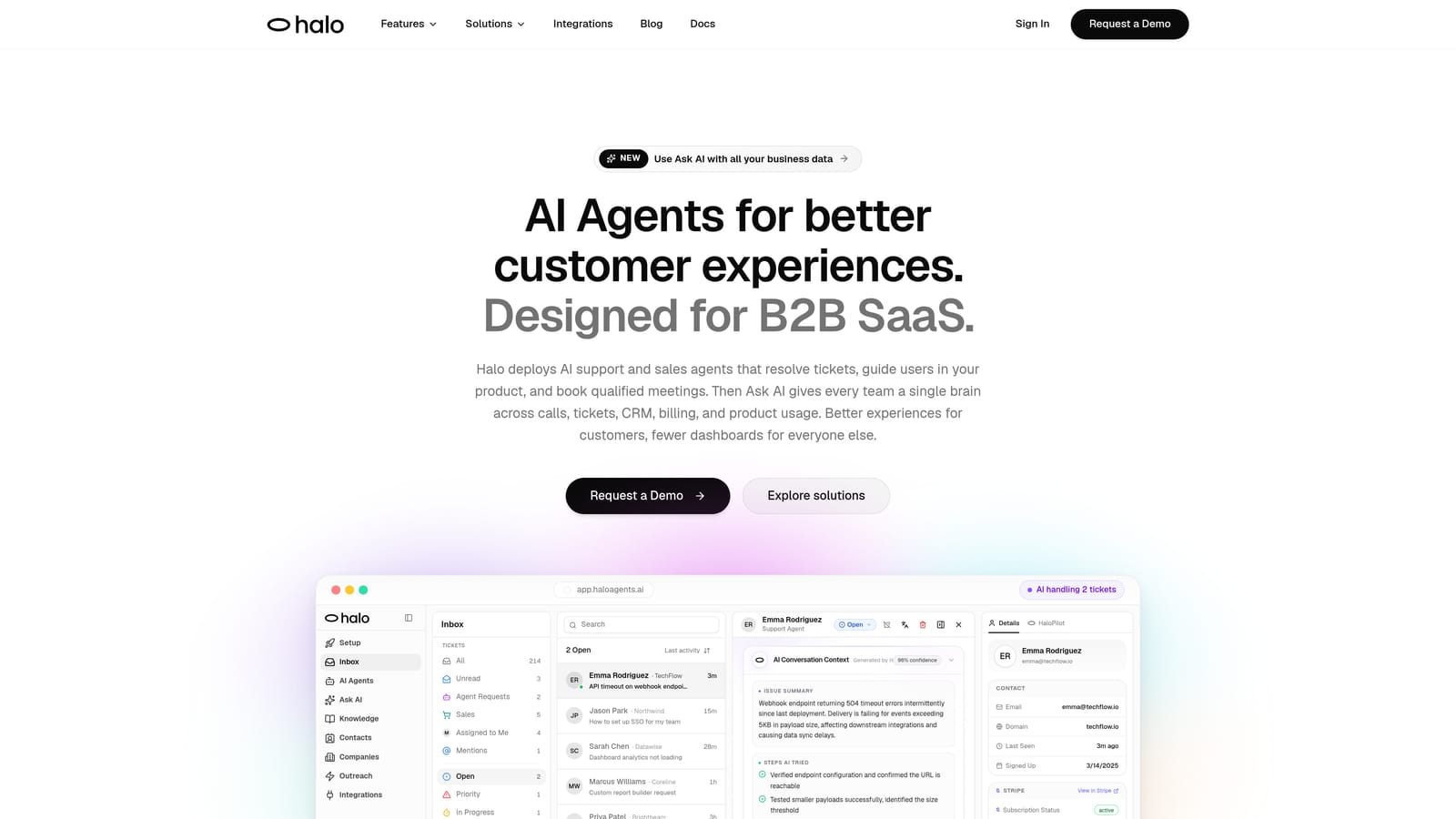
Halo AI is an AI-first customer support platform built specifically for SaaS teams, deploying intelligent agents that resolve tickets, guide users visually through your product, auto-create bug reports, and surface business intelligence from every conversation.
Where This Tool Shines
What separates Halo from most chatbots on this list is the architectural difference: it's not AI layered onto a helpdesk. It's built AI-first, which means the learning loops are tighter, the integrations run deeper, and the system gets meaningfully smarter with every resolved interaction rather than just logging data.
The page-aware chat widget is a genuine differentiator. When a user opens the chat, Halo already knows which screen they're on, which workflow they're in, and can provide visual UI guidance specific to that context. That's a fundamentally different experience from a generic chatbot asking "how can I help you today?"
Key Features
Page-Aware Contextual Chat: The chat widget understands which product screen the user is on and delivers contextual visual UI guidance rather than generic responses.
Autonomous Ticket Resolution with Live Handoff: Halo handles routine tickets end-to-end and escalates complex issues to human agents with full conversation context preserved.
Auto Bug Ticket Creation: When a support conversation surfaces a product bug, Halo automatically creates a structured bug ticket, reducing the manual work of triaging user-reported issues.
Smart Inbox with Business Intelligence: Beyond support metrics, the inbox surfaces customer health signals, anomaly detection, and revenue intelligence drawn from support conversation patterns.
Deep Stack Integrations: Native connections to Linear, Slack, HubSpot, Intercom, Stripe, Zoom, PandaDoc, and Fathom mean support data flows into your entire business stack, not just a helpdesk silo.
Best For
Product-led and sales-led SaaS teams that want support to do more than deflect tickets. Particularly well-suited for teams where support conversations contain valuable signals about product friction, churn risk, and customer health that currently go untracked.
Pricing
Contact Halo AI directly for pricing. Given the AI-first architecture and business intelligence capabilities, this positions as an enterprise SaaS solution rather than a self-serve subscription.
2. Intercom
Best for: Mid-market to enterprise SaaS teams wanting an all-in-one messaging and support platform
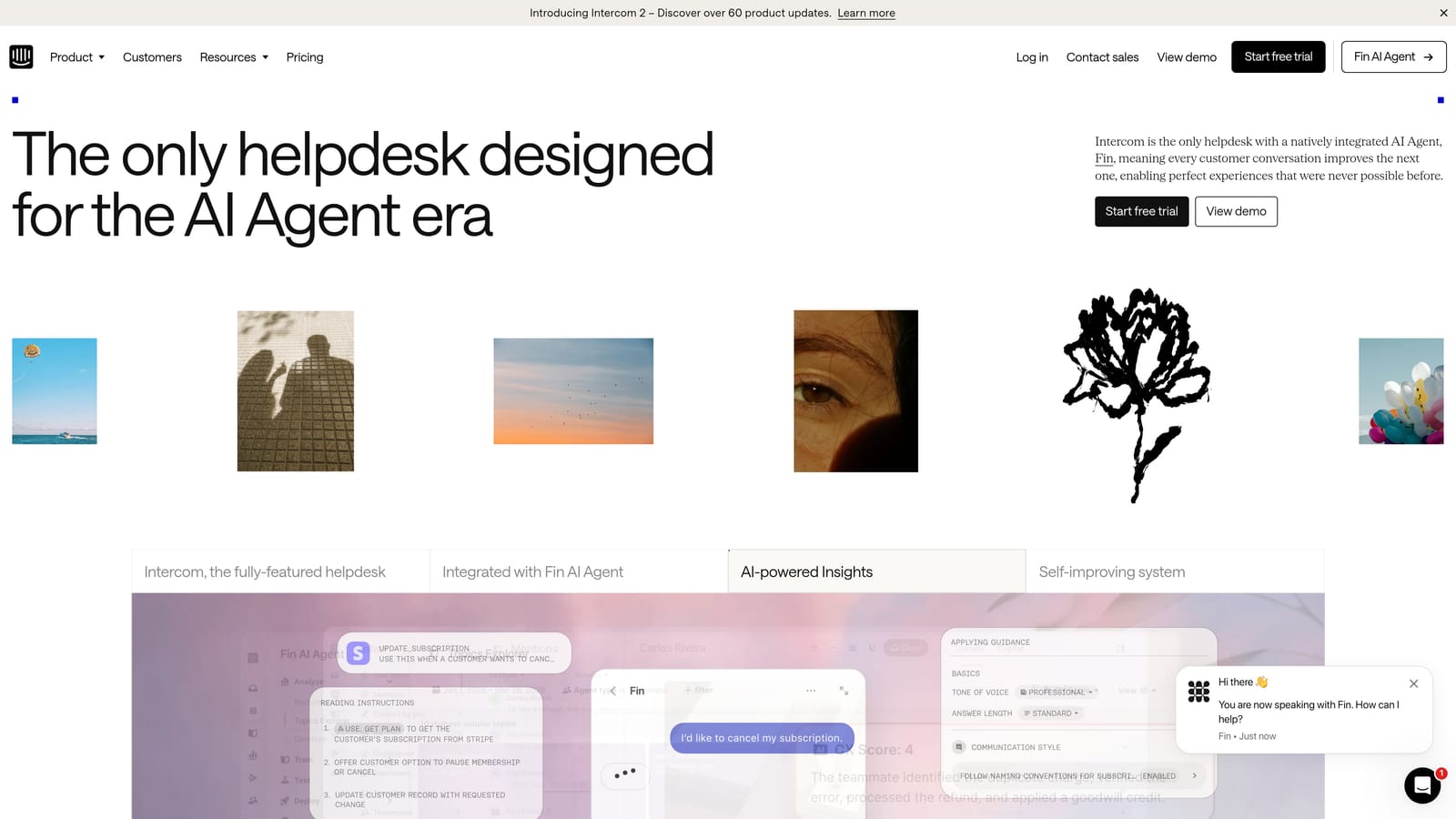
Intercom is a mature all-in-one customer messaging platform featuring Fin, its GPT-4-powered AI agent that handles support queries autonomously before escalating to human agents.
Where This Tool Shines
Intercom's strength is breadth. It's not just a support chatbot — it's a full customer communications platform that handles onboarding, activation, lifecycle messaging, and support in one place. For SaaS teams that want to consolidate tools, that's a compelling proposition.
Fin, Intercom's AI agent, handles a meaningful share of support volume autonomously across chat, email, and social channels. The quality of deflection is generally strong, and the handoff to human agents is smooth with full conversation context intact.
Key Features
Fin AI Agent: GPT-4-powered autonomous support across chat, email, and social with intelligent escalation to human agents.
Lifecycle Messaging: Onboarding, activation, and retention messaging alongside support, reducing the need for separate tools.
Large App Marketplace: Hundreds of integrations covering CRMs, analytics platforms, and productivity tools.
AI-Powered Agent Assist: Suggests responses and surfaces knowledge base articles to human agents during live conversations.
Conversation Analytics and CSAT Tracking: Detailed reporting on support performance, conversation volume, and customer satisfaction.
Best For
SaaS teams at the mid-market stage and above that want a single platform for support, onboarding, and customer communications. Less ideal for early-stage teams where Intercom's pricing can feel steep relative to the features actually used.
Pricing
Starter plans begin at approximately $39 per seat per month, with Fin AI usage-based pricing added on top. Costs can scale significantly as volume and seat count grow. Check the Intercom pricing page for current figures.
3. Freshdesk (Freddy AI)
Best for: Teams wanting helpdesk and AI bundled together at competitive pricing
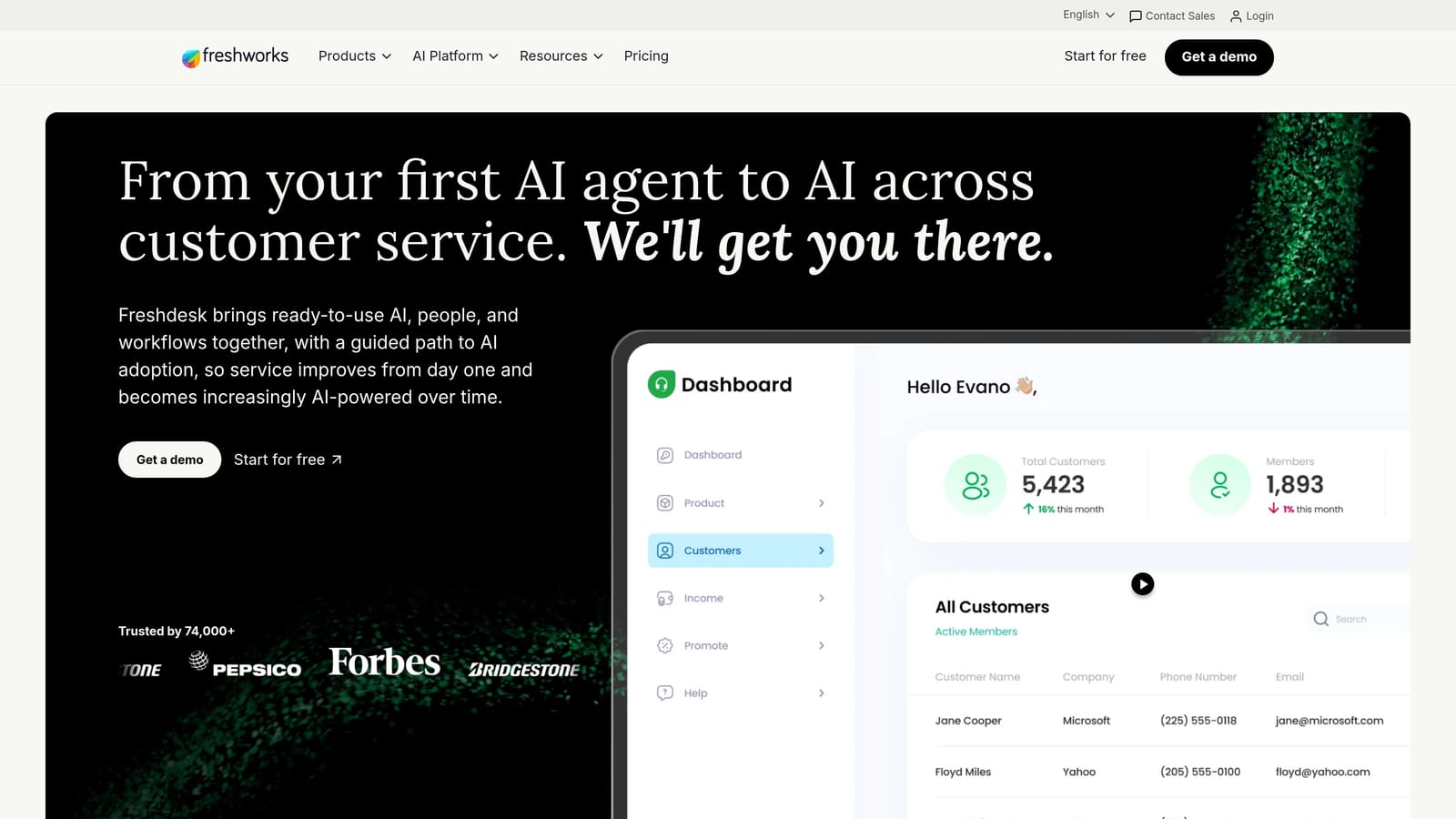
Freshdesk is Freshworks' helpdesk suite with Freddy AI built in, handling ticket auto-resolution, agent assist, and predictive analytics within a unified support platform.
Where This Tool Shines
Freshdesk hits a sweet spot for SaaS teams that want a capable helpdesk with AI features without paying Zendesk or Intercom prices. Freddy AI handles ticket auto-resolution and surfaces suggested responses to agents, which meaningfully reduces handle time even when full automation isn't possible.
The omnichannel coverage is solid: chat, email, phone, and social all route into a unified inbox. For teams managing support across multiple channels without a large ops team, that consolidation reduces a lot of operational friction.
Key Features
Freddy AI for Ticket Auto-Resolution: Handles common queries autonomously and suggests responses for agents handling more complex issues.
AI-Powered Knowledge Base Surfacing: Freddy surfaces relevant help articles to agents and customers during conversations.
Omnichannel Support: Unified inbox for chat, email, phone, and social without separate platform subscriptions.
Freddy Insights: Analytics layer that identifies support trends, recurring issues, and team performance patterns.
Competitive Pricing: Significantly more affordable than enterprise alternatives with a free tier for small teams getting started.
Best For
Growing SaaS teams that need a full-featured helpdesk with AI capabilities but aren't ready to commit to enterprise pricing. Also a strong choice for teams migrating from basic email support who want to add structure and automation in one move.
Pricing
Free tier available. Growth plans start at approximately $15 per agent per month. Freddy AI add-on pricing varies by feature set. Verify current pricing on the Freshdesk website.
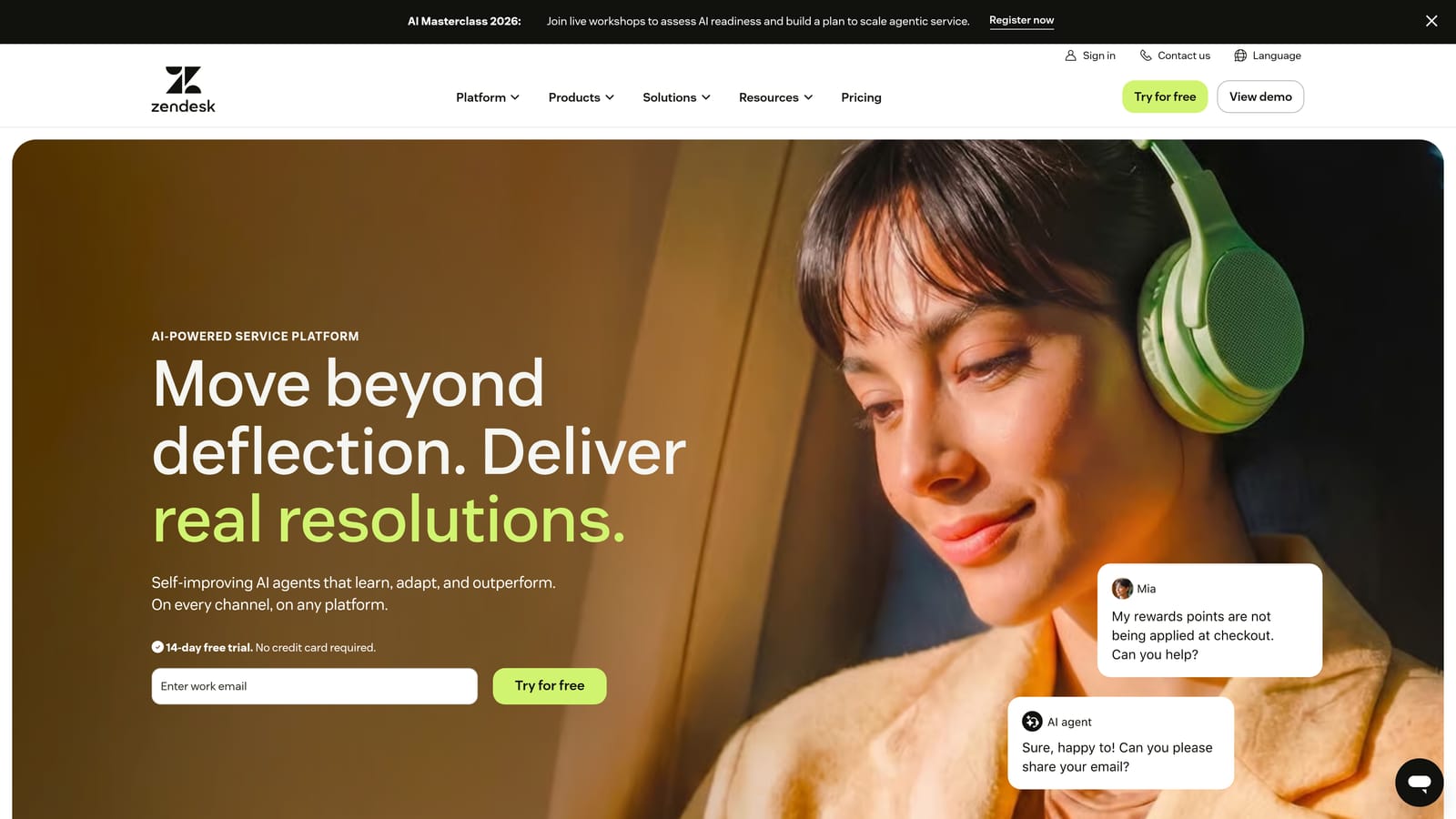
4. Zendesk AI
Best for: Large SaaS support operations already invested in the Zendesk ecosystem
Zendesk AI is enterprise-grade AI support built into the Zendesk Suite, including Answer Bot, intelligent triage, and intent detection designed for high-volume SaaS support operations.
Where This Tool Shines
Zendesk's AI capabilities have matured considerably. Answer Bot handles ticket deflection via chat and email, while intelligent triage automatically categorizes incoming tickets by intent, sentiment, and language — a significant time-saver for support teams processing hundreds of tickets daily.
Where Zendesk excels is compliance, reporting depth, and workflow automation. For enterprise SaaS teams with complex routing rules, SLA requirements, and security standards, Zendesk's infrastructure is hard to match. The tradeoff is that the AI layer feels more like an enhancement to existing helpdesk workflows than a fundamentally intelligent agent.
Key Features
Answer Bot: Automated ticket deflection via chat and email using AI-powered knowledge base matching.
Intelligent Triage: Automatically detects intent, sentiment, and language to route and prioritize incoming tickets.
AI-Powered Agent Workspace: Suggests macros, next-best actions, and knowledge articles to agents during live interactions.
Enterprise Compliance and Security: Advanced security certifications, data residency options, and compliance reporting.
Extensive Workflow Automation: Sophisticated routing rules, triggers, and automation that handle complex support operations at scale.
Best For
Large SaaS companies with established Zendesk deployments looking to add AI capabilities without migrating platforms. Less compelling as a greenfield choice for teams that haven't already invested in the Zendesk ecosystem.
Pricing
Suite Team plans start at approximately $55 per agent per month. AI features are available in higher tiers. Check Zendesk's pricing page for current plan structures, as these have changed frequently.
5. Drift
Best for: SaaS teams where sales and support conversations overlap significantly
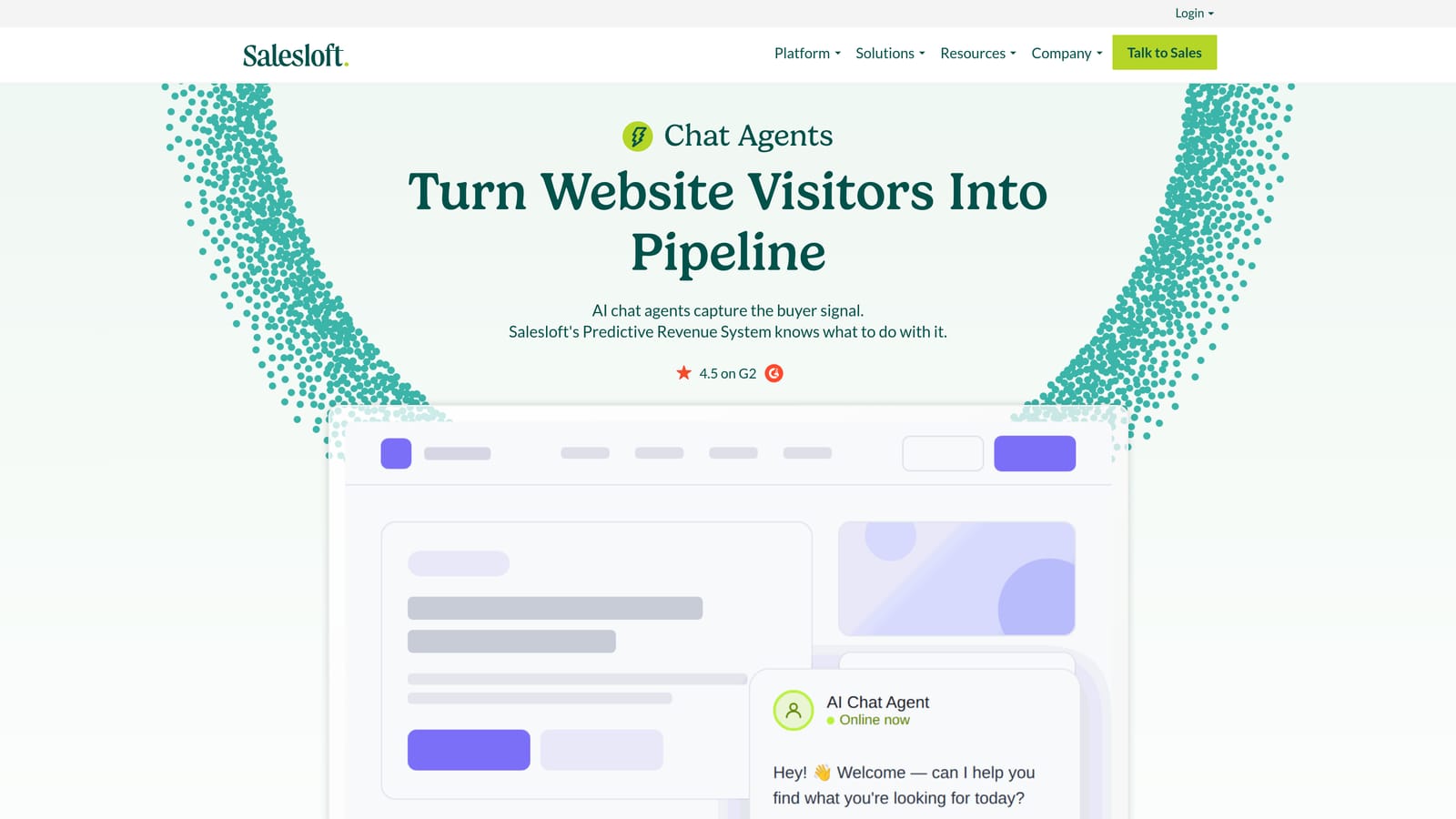
Drift is a conversational platform that sits at the intersection of sales and support, routing chat conversations intelligently between revenue and support teams based on visitor context.
Where This Tool Shines
Drift's core insight is that in SaaS, a chat conversation can be a support request, a sales opportunity, or both simultaneously. The platform routes conversations intelligently based on visitor signals: known account, deal stage, page visited, and behavioral data. That means a high-value prospect hitting the pricing page gets a different experience than a current customer reporting a bug.
For product-led growth companies or sales-led SaaS where pipeline and support overlap at the chat layer, Drift is one of the few tools that handles that complexity natively rather than forcing you to choose between sales chat and support chat tools.
Key Features
Intelligent Sales and Support Routing: Routes conversations to the right team based on visitor signals, account status, and behavioral context.
AI-Powered Chatbot: Qualifies and deflects conversations autonomously before routing to the appropriate human team.
Account-Based Targeting: Personalizes chat experiences for known accounts based on CRM data.
Integrated Meeting Booking: Allows prospects to book sales meetings directly within the chat flow.
Revenue Reporting: Ties chat conversations to pipeline and revenue outcomes, not just support metrics.
Best For
SaaS companies running account-based go-to-market motions or PLG models where support and sales conversations naturally overlap. Less suited for teams focused purely on support ticket resolution at volume.
Pricing
Custom pricing. Drift is now part of Salesloft, so pricing structure may have changed. Contact Salesloft directly for current plans.
6. Tidio
Best for: Early-stage SaaS and SMB teams that need a fast, affordable chatbot deployment
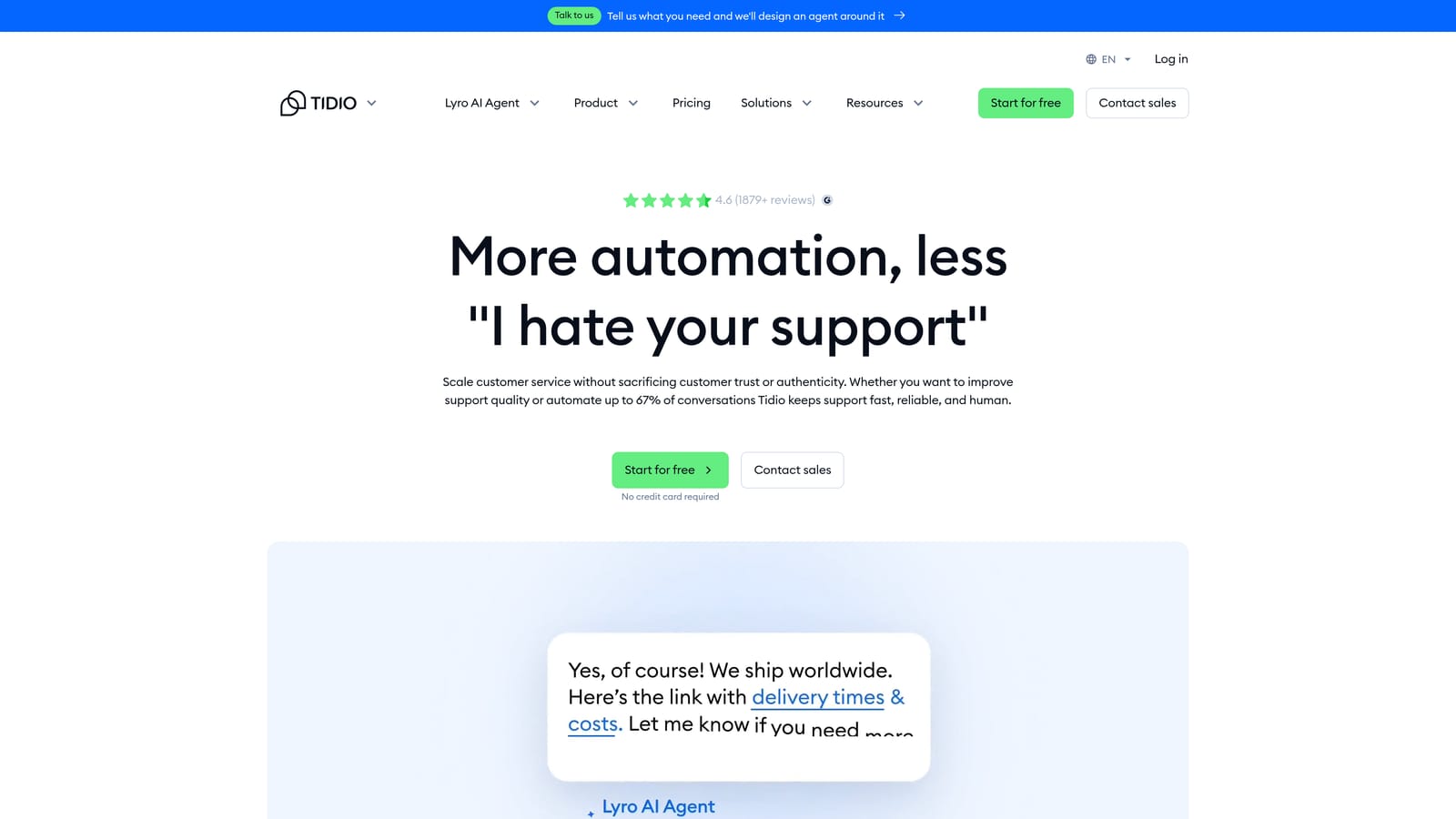
Tidio is an accessible live chat and AI chatbot platform featuring Lyro, its conversational AI that handles common support queries autonomously and is popular with early-stage SaaS and SMB teams.
Where This Tool Shines
Tidio's main advantage is speed to value. The setup is low-code, the templates cover most common support scenarios, and Lyro AI starts handling FAQ-type queries almost immediately. For a team of two or three people managing support alongside other responsibilities, that matters a lot.
The pricing is accessible enough that early-stage teams can justify it without a formal procurement process. It's not the most sophisticated AI on this list, but for teams whose primary need is deflecting repetitive questions and having a live chat option, Tidio delivers reliably.
Key Features
Lyro AI: Conversational AI that handles FAQs and common support queries autonomously without requiring rule-based flows.
Low-Code Chatbot Builder: Pre-built templates and a visual builder that get teams live quickly without developer resources.
Live Chat with Mobile App: Agents can manage conversations on mobile, useful for small teams without dedicated support staff.
Helpdesk Integrations: Connects with major helpdesk platforms, Shopify, and WordPress for teams managing support across channels.
Affordable Entry Pricing: Free tier available, with Lyro AI accessible at pricing that makes sense for early-stage budgets.
Best For
Early-stage SaaS teams, SMBs, and founders managing support themselves who need something live quickly without a large budget or technical setup overhead.
Pricing
Free tier available. Lyro AI starts at approximately $29 per month. Check Tidio's pricing page for current tier details.
7. Zoho SalesIQ
Best for: SaaS teams already running on the Zoho ecosystem
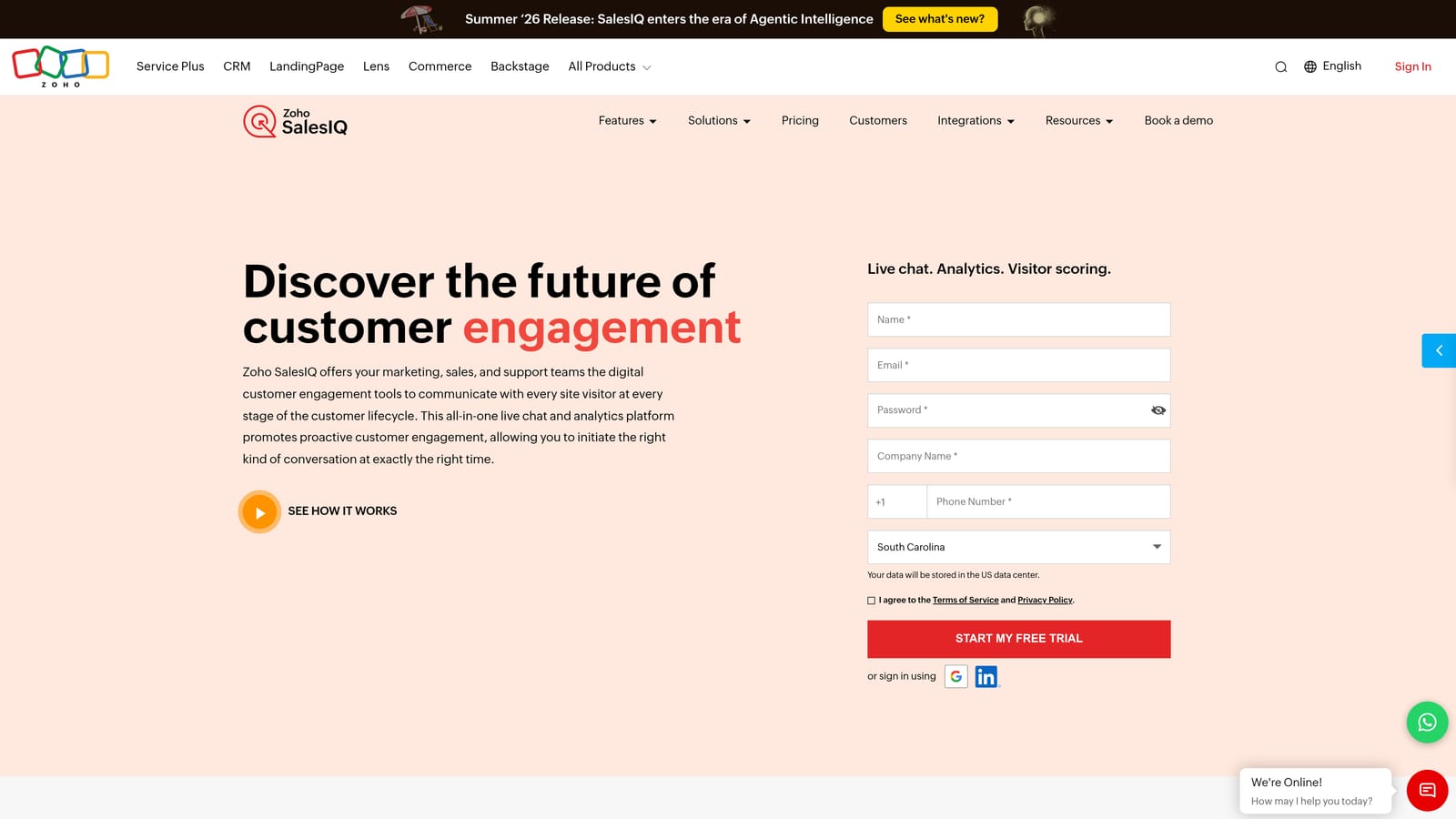
Zoho SalesIQ is a live chat and AI chatbot tool with built-in visitor tracking and lead scoring, designed for SaaS teams already using Zoho CRM or Zoho Desk.
Where This Tool Shines
SalesIQ's value proposition is strongest when you're already in the Zoho ecosystem. The native integration with Zoho CRM and Zoho Desk means visitor data, contact history, and support tickets all live in one place without custom connectors or middleware. For teams that have standardized on Zoho, this eliminates a meaningful amount of integration overhead.
The visitor tracking and behavioral triggers are genuinely useful: you can set up proactive chat based on time on page, specific URLs, or lead score thresholds. That's more sophisticated than many tools at this price point.
Key Features
Zobot AI Chatbot Builder: Supports both no-code visual flows and code-based customization for technical teams.
Real-Time Visitor Tracking: See which pages visitors are on and trigger proactive chat based on behavioral signals.
Native Zoho Integrations: Deep connections to Zoho CRM and Zoho Desk without third-party connectors.
Lead Scoring and Routing: Automatically scores and routes visitors based on activity and firmographic data.
Generous Free Tier: Includes meaningful functionality at no cost, making it accessible for small teams.
Best For
SaaS teams already using Zoho CRM, Zoho Desk, or other Zoho products who want a chat and chatbot solution that integrates natively rather than through workarounds. Less compelling as a standalone choice outside the Zoho ecosystem.
Pricing
Free tier available. Paid plans start at approximately $7 per operator per month. Verify current pricing on the Zoho SalesIQ website.
8. HubSpot Live Chat and Chatbot Builder
Best for: SaaS teams centralizing their stack around HubSpot CRM
HubSpot Live Chat and Chatbot Builder is HubSpot's native chat and bot tool, included in the Service Hub, that leverages CRM context to personalize conversations without requiring a separate chatbot platform.
Where This Tool Shines
The core advantage here is CRM context. When a contact starts a chat, the bot already knows their deal stage, lifecycle status, recent activity, and contact history. That means routing and personalization happen automatically based on data your team has already captured, without any additional configuration.
For HubSpot-centric SaaS teams, this is often the most practical choice: it eliminates a tool, reduces integration complexity, and keeps all customer data in one place. The chatbot builder itself is relatively straightforward rather than deeply sophisticated, but for routing and FAQ deflection it works reliably.
Key Features
CRM-Native Context: Chatbot automatically accesses deal stage, lifecycle, and contact history to personalize conversations.
No-Code Chatbot Builder: Visual builder with branching logic for creating routing and FAQ flows without developer resources.
Unified Inbox: Chat, email, and form submissions in a single inbox with full contact context visible.
Seamless Service Hub Ticketing: Conversations convert directly to Service Hub tickets without manual handoff steps.
Included with HubSpot CRM: Live chat is available on the free CRM, making it a natural consolidation choice for HubSpot teams.
Best For
SaaS teams that have standardized on HubSpot and want to add chat and basic bot capabilities without adopting another platform. Not the right choice if you need sophisticated AI resolution or complex multi-turn conversation handling.
Pricing
Live chat is free with HubSpot CRM. Advanced chatbot features and automation are available in Starter plans from approximately $20 per month. Check HubSpot's current pricing for Service Hub tier details.
9. Kommunicate
Best for: Technical SaaS teams that want to bring their own AI model
Kommunicate is a developer-friendly chatbot platform that lets technical SaaS teams integrate their own AI, supporting GPT, Dialogflow, AWS Lex, and custom NLP backends.
Where This Tool Shines
Kommunicate's "bring your own AI" architecture is the defining characteristic. Rather than locking you into a proprietary AI model, it acts as the deployment and conversation management layer while you control the intelligence underneath. That's a meaningful distinction for teams with specific AI requirements, existing model investments, or compliance constraints that rule out certain AI providers.
The omnichannel deployment options are broad: web, mobile, WhatsApp, and more, all managed through a single platform. For technical teams that want control over the AI layer without building the entire chat infrastructure from scratch, Kommunicate fills that gap effectively.
Key Features
Bring-Your-Own-AI Architecture: Integrate GPT, Dialogflow, AWS Lex, or custom NLP models rather than being locked into a proprietary AI layer.
Omnichannel Deployment: Deploy across web, mobile, WhatsApp, and other channels from a single platform.
Live Agent Handoff: Smooth escalation from bot to human agent with full conversation context and an agent dashboard.
Bot Analytics and Flow Reporting: Track conversation flows, drop-off points, and resolution rates to optimize bot performance.
Codeless Builder Alongside API Access: Non-technical team members can build flows visually while developers access the full API for custom integrations.
Best For
Technical SaaS teams with existing AI model investments, specific compliance requirements around AI providers, or product teams that want to deploy a custom-trained model rather than relying on a vendor's proprietary AI.
Pricing
Plans start at approximately $100 per month for small teams, with custom enterprise pricing available. Verify current pricing on the Kommunicate website before committing.
Which Tool Is Right for Your SaaS Team?
The right customer support chatbot depends on one fundamental question: do you need AI bolted onto an existing helpdesk, or an AI-first system designed to learn and scale from the ground up? That distinction shapes almost every other tradeoff on this list.
Here's a quick orientation by use case:
Early-stage SaaS with a lean budget: Start with Tidio or HubSpot. Both offer free tiers, fast setup, and enough capability to handle common queries without a formal procurement process.
Helpdesk-native teams: If your team is already deeply invested in Zendesk or Freshdesk, adding their respective AI layers (Zendesk AI or Freddy AI) is the lowest-friction path to automation.
Sales-support hybrid: Drift is the clearest choice when your chat conversations span pipeline and support simultaneously, particularly for account-based or PLG motions.
Zoho ecosystem: Zoho SalesIQ delivers the best value for teams already standardized on Zoho, with native integrations that eliminate connector overhead.
Custom AI stack: Kommunicate is the right fit for technical teams that want to deploy their own model rather than depend on a vendor's proprietary AI.
All-in-one mature platform: Intercom remains a strong choice for mid-market and enterprise SaaS teams that want support, onboarding, and lifecycle messaging in a single platform.
AI-first with business intelligence: Halo AI stands apart for teams that want support to do more than deflect tickets. The page-aware context, auto bug ticket creation, and smart inbox that surfaces customer health signals and revenue intelligence represent a genuinely different approach to what support software can do.
Your support team shouldn't scale linearly with your customer base. Let AI agents handle routine tickets, guide users through your product, and surface business intelligence while your team focuses on complex issues that need a human touch. See Halo in action and discover how continuous learning transforms every interaction into smarter, faster support.