9 Best Customer Support Integration Software Tools in 2026
Customer support integration software connects your helpdesk, CRM, product tools, and communication channels into a unified workflow — eliminating siloed data and dropped handoffs. This guide reviews the 9 best platforms of 2026, evaluated on native integration depth, automation capabilities, ease of setup, and how well each tool connects support data to the broader business stack.
 Matt PattoliFounder13 min read
When your support stack is siloed, tickets live in one place, CRM data in another, and product bugs get lost somewhere in a Slack thread your team will never find again. The result is agents who spend more time hunting for context than actually helping customers. Customer support integration software solves this by connecting your helpdesk, CRM, product tools, and communication channels into a unified workflow: faster resolutions, fewer dropped handoffs, and support data that actually informs the rest of the business.
The tools below range from AI-native platforms built around integrations from day one, to established helpdesks with robust connector ecosystems, to a no-code automation layer that bridges gaps when native integrations fall short. Whether you're a lean product team handling support in-house or a scaling B2B company looking to automate ticket resolution across multiple systems, there's an option here worth considering.
Each tool was evaluated on depth of native integrations, automation capabilities, ease of setup, and how well it connects support data to the broader business stack.
1. Halo AI
Best for: AI-native support automation with full-stack business integration
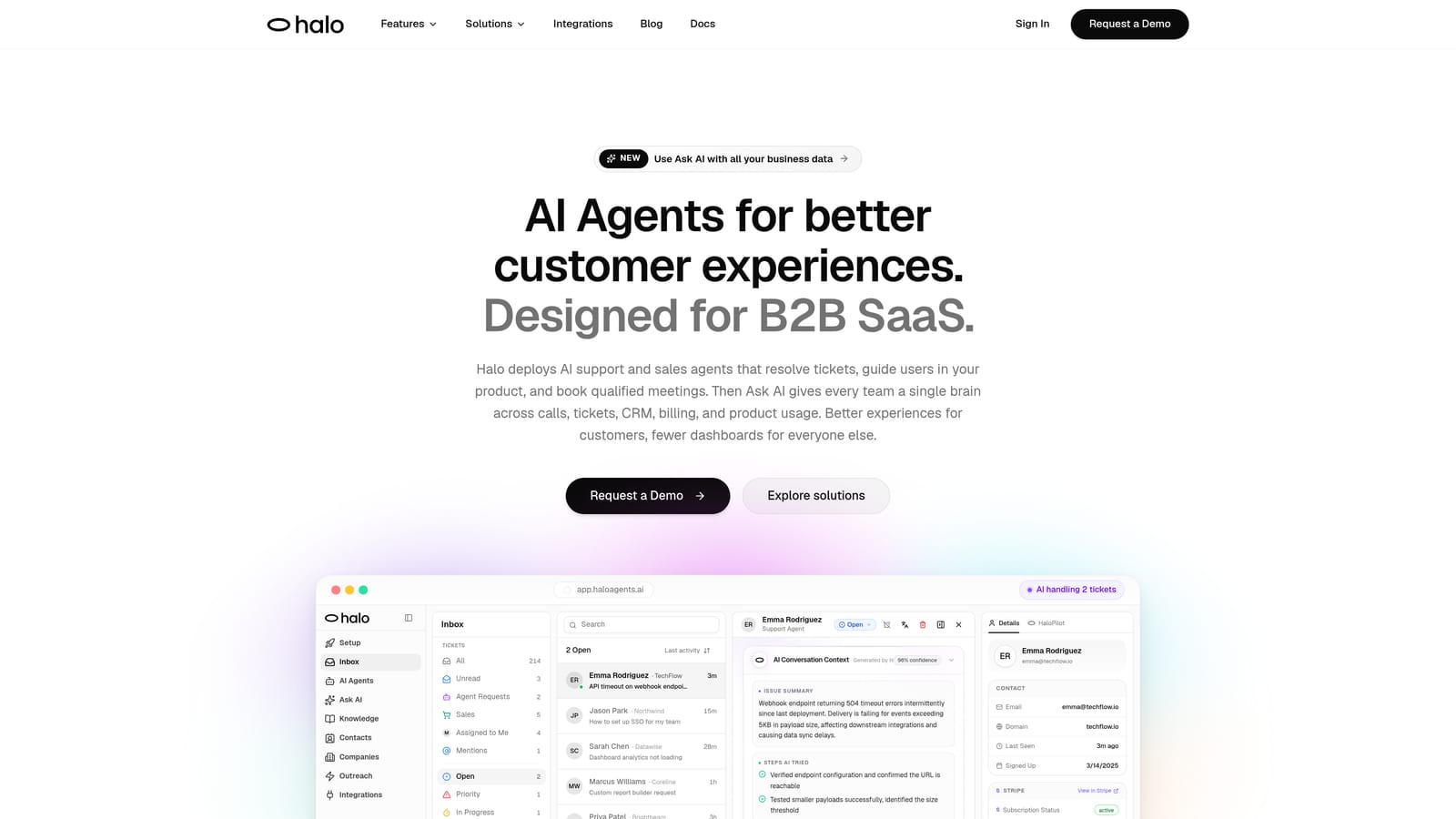
Halo AI is an AI-first customer support platform that deploys intelligent agents to resolve tickets, guide users through your product, and create bug reports while connecting to your entire business stack.
Where This Tool Shines
Most helpdesks bolt AI on top of an existing ticketing architecture. Halo was built the other way around: the AI agent is the foundation, not a feature. That distinction matters because it means integrations aren't just about pulling data into a ticket view. They're about giving the AI the context it needs to actually resolve issues, route bugs to engineering, and surface signals that matter to sales and product teams.
The page-aware chat widget is a standout capability. The agent sees what the user sees in the product UI, which means it can provide visual, contextual guidance rather than generic documentation links. Over time, the system learns from every interaction, improving resolution quality without manual retraining.
Key Features
Continuously Learning AI Agents: Agents improve resolution quality from every interaction, getting smarter about your product and your customers over time.
Page-Aware Chat Widget: The AI sees the user's current product context, enabling precise visual guidance rather than generic responses.
Auto Bug Ticket Creation: Product issues are automatically identified and routed to Linear or other engineering tools, closing the loop between support and development.
Smart Inbox with Business Intelligence: Goes beyond support metrics to surface customer health signals, churn indicators, and revenue anomalies directly in the inbox.
Native Integration Suite: Connects out of the box with Linear, Slack, HubSpot, Intercom, Stripe, Zoom, PandaDoc, and Fathom.
Live Agent Handoff: Complex issues escalate to human agents with full conversation context preserved, so nothing gets repeated or dropped.
Best For
B2B SaaS companies and product teams that want AI handling routine ticket resolution while surfacing business intelligence across the stack. Particularly well-suited for teams that are already using tools like Linear, HubSpot, and Slack and want their support layer to connect meaningfully to all of them.
Pricing
Contact Halo AI directly for pricing. Given the AI-native architecture and integration depth, it's positioned for teams serious about automating support at scale.
2. Zendesk
Best for: Enterprise teams needing a mature helpdesk with a broad integration marketplace
Zendesk is one of the most established helpdesk platforms on the market, offering a large integration ecosystem and enterprise-grade ticketing infrastructure.

Where This Tool Shines
Zendesk's biggest strength is breadth. With over 1,000 marketplace integrations, it connects to virtually every tool in a modern support stack, from Salesforce and HubSpot to Jira and Slack. For large teams with complex workflows, that ecosystem depth is hard to match.
Its SLA management and reporting capabilities are mature and well-documented, making it a reliable choice for operations-heavy support organizations that need visibility into team performance and compliance metrics.
Key Features
1,000+ Marketplace Integrations: Covers Salesforce, Slack, Jira, HubSpot, and hundreds of other tools across categories.
AI-Assisted Routing and Suggestions: Zendesk AI helps classify tickets and surface relevant responses, reducing manual triage work.
Robust SLA Management: Configurable SLA policies with escalation rules and reporting for compliance-sensitive teams.
Omnichannel Support: Handles email, chat, voice, and social from a single agent workspace.
Best For
Mid-market to enterprise support teams that need a proven, stable helpdesk with extensive integration options. Less ideal for teams looking for AI-native automation, where Zendesk's AI capabilities can feel like add-ons rather than core architecture.
Pricing
Suite Team starts at approximately $55 per agent per month. Enterprise plans scale significantly from there, and AI add-ons carry additional costs.
3. Intercom
Best for: SaaS companies wanting conversational support with in-app messaging and AI
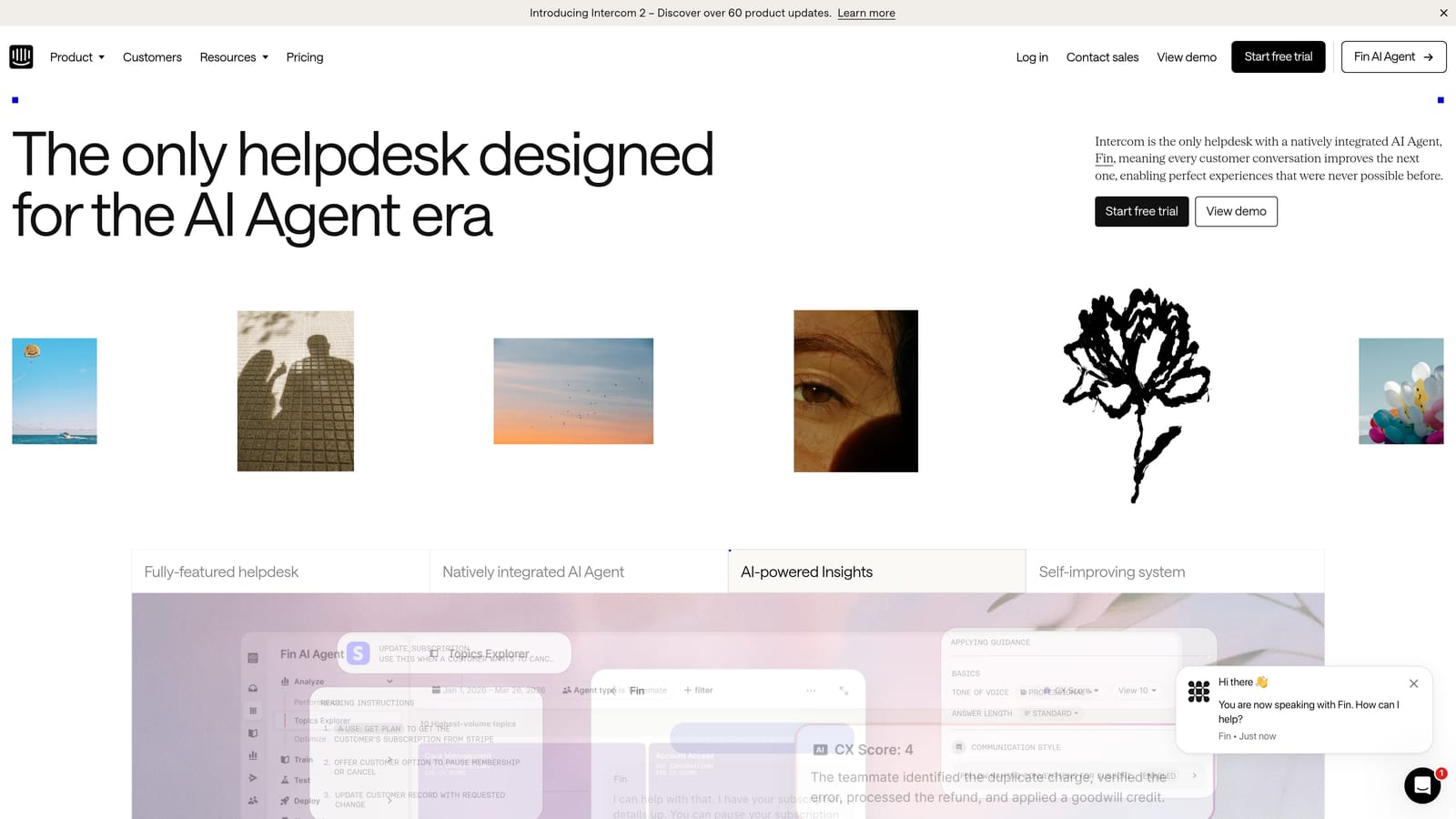
Intercom is a conversational support platform combining live chat, an AI agent called Fin, and product tours in one connected system.
Where This Tool Shines
Intercom excels at proactive, in-app support. Rather than waiting for customers to open a ticket, it lets teams reach users inside the product with targeted messages, onboarding flows, and contextual help. Fin, its AI agent, handles a meaningful share of inbound queries autonomously across chat and email.
The integration with product analytics tools and CRMs means support agents get customer context, including usage behavior and lifecycle stage, directly in the conversation view. That context makes resolutions faster and more personalized.
Key Features
Fin AI Agent: Handles inbound queries autonomously across chat and email, with the ability to escalate to human agents when needed.
In-App Messaging and Product Tours: Enables proactive support and onboarding directly inside the product interface.
CRM and Analytics Integrations: Surfaces customer data from connected tools to give agents full context in every conversation.
Shared Inbox with Team Collaboration: Includes assignment, internal notes, and team views for coordinated support.
Best For
SaaS companies with a strong product-led growth motion, where in-app messaging and proactive onboarding support are as important as reactive ticket resolution. Teams with high ticket volumes and complex workflows may find the pricing model scales steeply.
Pricing
Starts at approximately $39 per seat per month, with usage-based pricing for Fin AI resolution volume. Costs can increase significantly at scale.
4. Freshdesk
Best for: Budget-conscious teams needing multi-channel support with solid integration depth
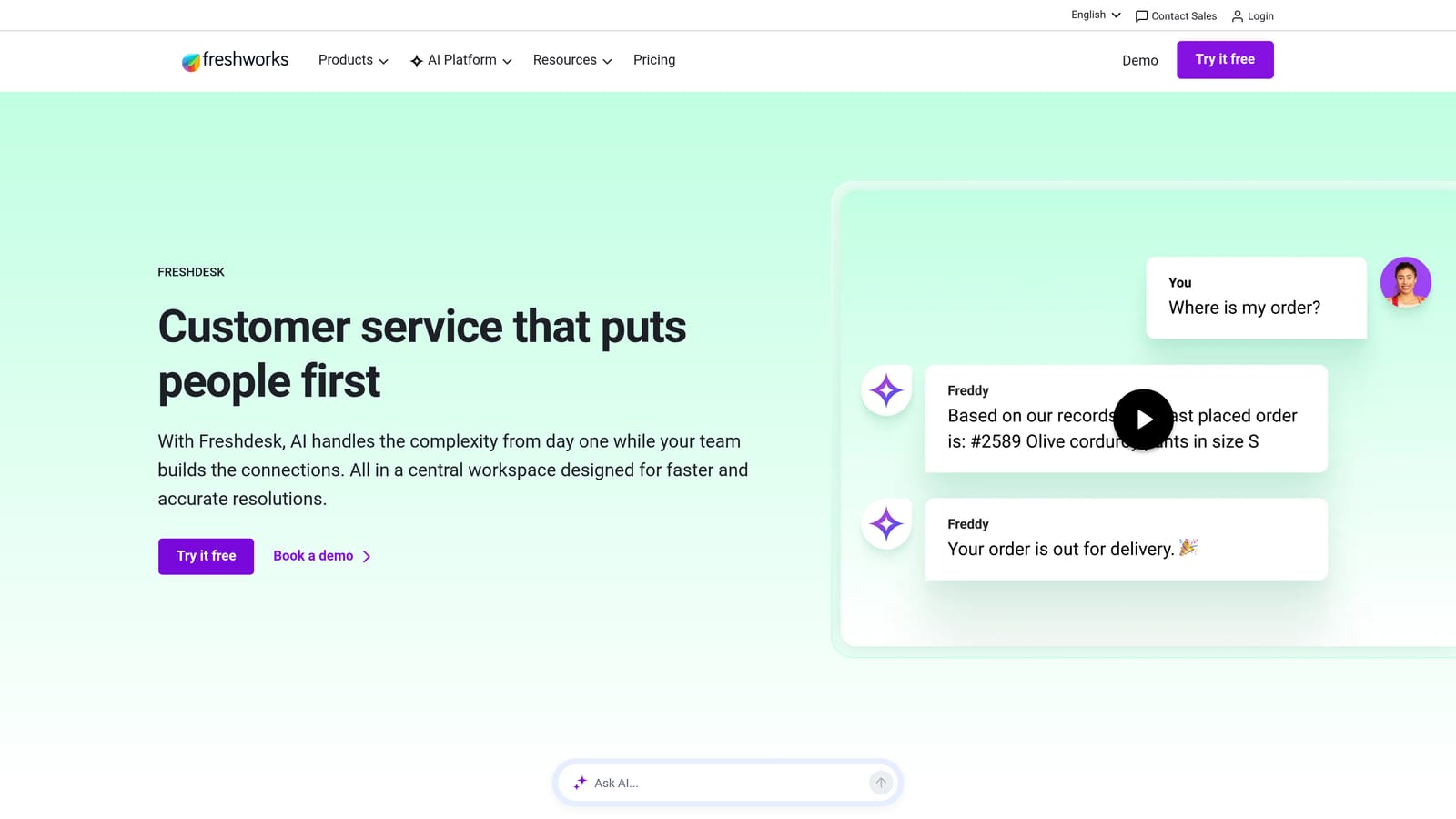
Freshdesk is a multi-channel helpdesk from Freshworks offering strong integration options at a more accessible price point than most enterprise alternatives.
Where This Tool Shines
Freshdesk positions itself as the practical middle ground: enough integration depth to connect your core stack, enough automation to reduce manual work, and pricing that doesn't require a procurement process to justify. The Freddy AI layer adds automated responses, sentiment analysis, and ticket suggestions without requiring significant configuration.
Its marketplace covers the tools most support teams actually use: Slack, Jira, HubSpot, Salesforce, and Shopify, among others. For teams that need reliable multi-channel coverage across email, phone, chat, and social without a large budget, Freshdesk delivers consistently.
Key Features
Freddy AI: Provides automated responses, sentiment analysis, and ticket suggestions to reduce agent workload.
Multi-Channel Support: Covers email, phone, chat, social media, and WhatsApp from a unified inbox.
Marketplace Integrations: Native connectors for Slack, Jira, HubSpot, Salesforce, Shopify, and more.
Collision Detection: Prevents two agents from working the same ticket simultaneously, reducing duplicate effort.
Best For
Small to mid-market teams that need multi-channel helpdesk functionality and solid integrations without enterprise pricing. Note that more advanced AI and automation features are gated behind higher-tier plans.
Pricing
Free plan available for small teams. Paid plans start at approximately $15 per agent per month, scaling with features and volume.
5. HubSpot Service Hub
Best for: Teams already in HubSpot wanting support connected to CRM, sales, and marketing
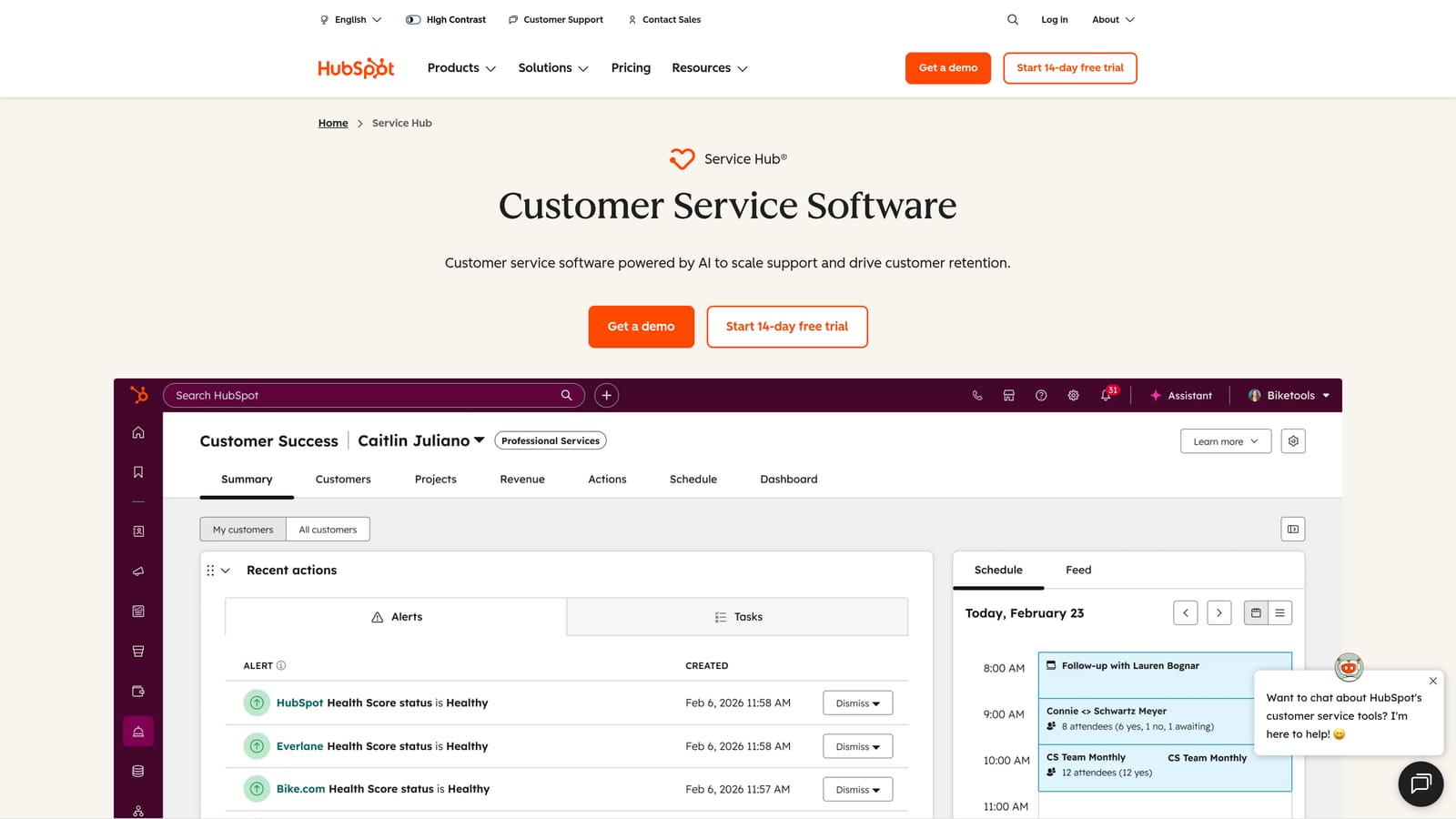
HubSpot Service Hub is support software built natively inside HubSpot's CRM platform, giving teams full visibility into contact history, deal stage, and marketing interactions alongside every ticket.
Where This Tool Shines
The core value proposition is the CRM connection. Every support ticket is automatically tied to a contact record, deal history, and lifecycle stage. That means a support agent can see whether the customer is in renewal discussions, what marketing emails they've received, or whether they're a high-value account before sending a single response.
For revenue teams that want support data to inform sales and marketing decisions, and vice versa, this native integration eliminates the sync delays and data inconsistencies that plague teams trying to connect separate platforms.
Key Features
Native CRM Integration: Every ticket automatically linked to contact and deal records with no manual syncing required.
Knowledge Base and Customer Portal: Self-service tools included in the platform alongside ticketing.
Cross-Team Handoff: Seamless transitions between marketing, sales, and support within a single platform.
Conversation Intelligence and Reporting: Analytics across the full customer lifecycle, not just support interactions.
Best For
Companies already using HubSpot for CRM and marketing automation. Teams that aren't in the HubSpot ecosystem may find the support-specific features less mature than dedicated helpdesk tools.
Pricing
Free tools available. Starter plans from approximately $15 per month. Professional plans from approximately $90 per month with more advanced automation and reporting.
6. Salesforce Service Cloud
Best for: Large enterprises with complex support workflows deeply embedded in Salesforce
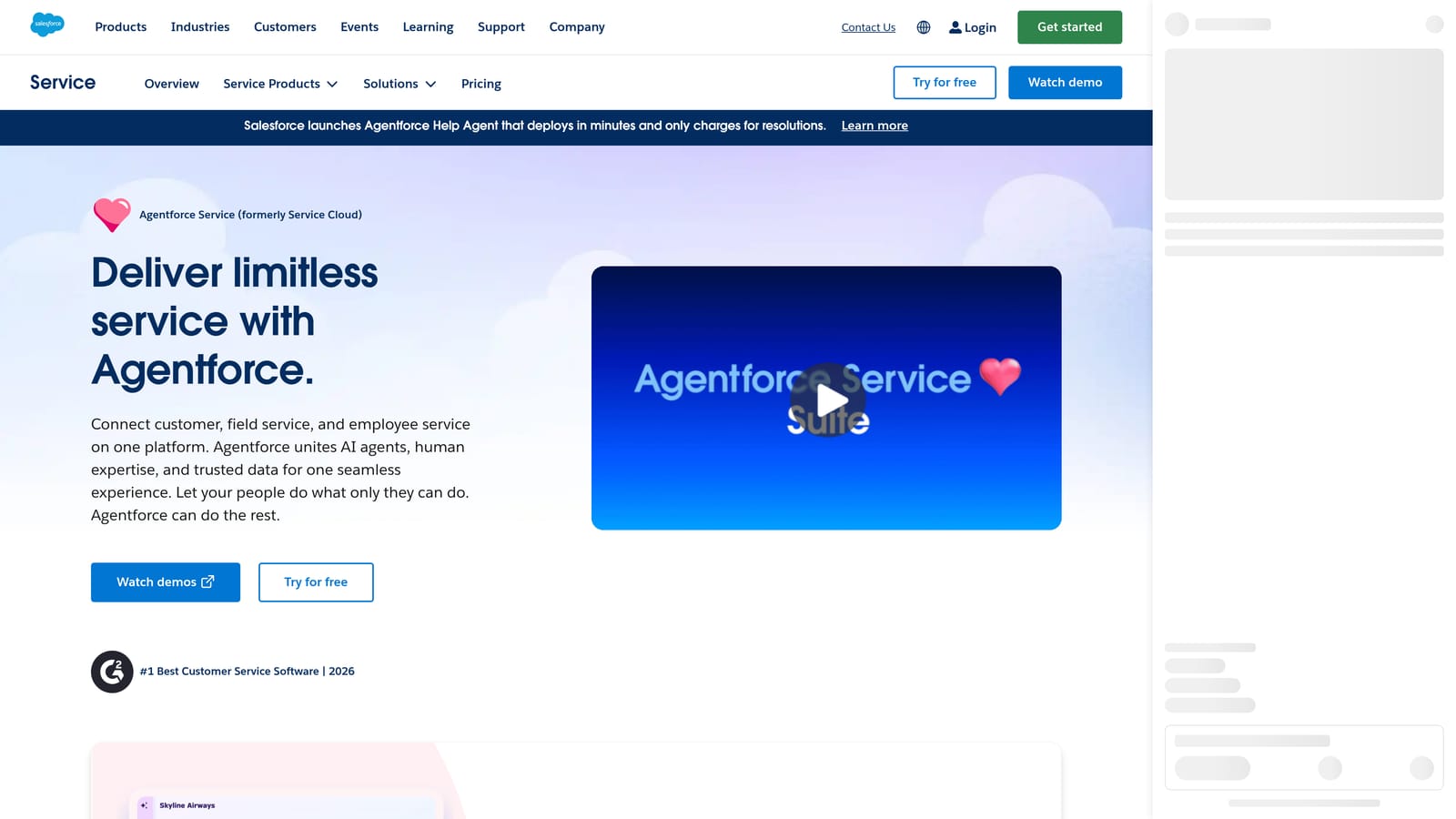
Salesforce Service Cloud is an enterprise support platform deeply integrated with Salesforce CRM, built for organizations with sophisticated workflows and large support operations.
Where This Tool Shines
When your organization runs on Salesforce, Service Cloud is the natural support layer. The integration isn't a connector or a sync: it's native, which means case data, account history, and opportunity records are all accessible in context without any middleware. For enterprise teams managing complex escalation paths, approval workflows, and compliance requirements, that depth of integration is genuinely difficult to replicate elsewhere.
Einstein AI adds case classification, next-best-action recommendations, and knowledge suggestions, though the AI capabilities require meaningful configuration to deliver value at scale.
Key Features
Native Salesforce CRM Integration: Full access to account, contact, and opportunity data within every support case.
Einstein AI: Case classification, next-best-action guidance, and knowledge recommendations powered by Salesforce's AI layer.
Highly Customizable Workflows: Configurable case management, escalation trees, and approval processes for complex operations.
Enterprise Compliance and Security: Audit trails, role-based access, and compliance features suited to regulated industries.
Best For
Large enterprises already invested in the Salesforce ecosystem. Implementation complexity and cost make it a poor fit for smaller teams or those without existing Salesforce expertise.
Pricing
Starter plans from approximately $25 per user per month. Enterprise plans from approximately $165 per user per month. Implementation costs can add significantly to total cost of ownership.
7. Gorgias
Best for: E-commerce brands on Shopify, Magento, or BigCommerce
Gorgias is a customer support platform purpose-built for e-commerce, with deep native integrations into the major e-commerce platforms and tools built specifically for order-related support workflows.

Where This Tool Shines
The Shopify integration is the headline feature, and it's genuinely deep. Order data, shipping status, refund history, and customer lifetime value are all visible directly in the ticket view, without switching tabs or querying a separate system. That context allows agents to resolve order status and return requests in seconds rather than minutes.
Automation rules handle the most common e-commerce queries without agent involvement at all. Revenue attribution tracking is a notable differentiator: Gorgias connects support interactions to actual conversions and repeat purchases, helping teams demonstrate the business impact of good support.
Key Features
Deep Shopify Integration: Order data, shipping status, and refund options visible directly in the ticket view.
E-Commerce Automation Rules: Handles order status, return requests, and common queries without agent involvement.
Revenue Attribution: Tracks the impact of support interactions on conversions and repeat purchase behavior.
Multi-Channel Coverage: Email, chat, social media, and SMS from a unified inbox.
Best For
E-commerce brands that run primarily on Shopify, Magento, or BigCommerce. Gorgias is highly specialized and delivers significant value in that context. Outside of e-commerce, the platform's strengths don't translate well.
Pricing
Starter plans from approximately $10 per month for 50 tickets. Pricing scales with ticket volume rather than seat count, which suits seasonal e-commerce businesses.
8. Front
Best for: High-touch B2B teams managing relationships through email
Front is a shared inbox platform that transforms email into a collaborative, CRM-connected support channel, particularly well-suited for B2B teams where relationships and context matter as much as speed.
Where This Tool Shines
Front's strength is in making email feel like a proper support tool without losing the relationship-centric nature of email communication. Internal commenting, assignment, and collision detection turn a shared inbox into a coordinated team environment. For accounts where a customer expects to hear from a named person rather than a support queue, Front preserves that experience while adding operational structure behind the scenes.
The integrations with Salesforce, HubSpot, Linear, and GitHub mean technical and account teams can surface customer context and engineering status directly in the email thread, without leaving the inbox.
Key Features
Collaborative Shared Inbox: Internal commenting, assignment, and collision detection built into the email workflow.
CRM Integrations: Salesforce and HubSpot contact data visible in every thread for informed, personalized responses.
Workflow Automation: Routing rules, tagging, and SLA tracking without requiring a full helpdesk migration.
Developer Tool Integrations: Linear and GitHub connections for technical support teams managing product-related requests.
Best For
B2B companies with high-touch customer relationships where email is the primary support channel. Teams that need deep chat or ticketing automation may find Front's capabilities more limited than purpose-built helpdesk tools.
Pricing
Starter plans from approximately $19 per seat per month. Higher tiers unlock more advanced automation and analytics features.
9. Zapier
Best for: Bridging integration gaps between support tools when native connectors don't exist
Zapier is a no-code automation platform that connects support tools to the rest of your stack, useful when native integrations fall short or don't exist at all.
Where This Tool Shines
Zapier isn't a support tool in the traditional sense. It's the connective tissue between tools that don't talk to each other natively. If you need to route a Typeform submission into Zendesk, sync Intercom conversations to HubSpot, or trigger a Slack alert when a ticket hits a certain SLA threshold, Zapier can do it without writing a line of code.
With connections to over 7,000 apps, the breadth of what's possible is genuinely impressive. Multi-step Zaps with conditional logic, filters, and delays allow for nuanced workflows that go well beyond simple trigger-action pairs. For non-technical teams, it's often the fastest path to a working integration.
Key Features
7,000+ App Connections: Covers virtually every support, CRM, communication, and productivity tool in use today.
Multi-Step Zaps with Conditional Logic: Filters, delays, and branching logic for complex automation workflows without code.
Tables and Interfaces: Lightweight data management tools that complement automations when you need simple structured data alongside workflows.
Accessible for Non-Technical Users: Visual builder makes automation approachable for operations and support teams without engineering support.
Best For
Teams that need to bridge gaps between existing tools quickly, or organizations experimenting with workflow automation before committing to deeper integrations. Zapier works best as a complement to native integrations, not a replacement. Complex multi-step Zaps can become brittle over time, and costs scale with automation volume.
Pricing
Free plan available with basic automation. Paid plans from approximately $19.99 per month, scaling with the number of tasks and Zaps required.
Which Tool Is Right for Your Stack?
The best customer support integration software depends on where your biggest gap actually lives. Here's a quick way to think through it.
If you want AI handling routine ticket resolution while surfacing business intelligence across your product, CRM, and revenue tools, Halo AI is the strongest option. It's the only platform here built AI-first from the ground up, with integrations designed to give the AI meaningful context rather than just populate a ticket view.
For enterprise teams that need a proven, stable helpdesk with the broadest possible integration marketplace, Zendesk or Salesforce Service Cloud are the natural choices, with the caveat that both carry significant cost and implementation complexity at scale.
Conversational support for SaaS: Intercom, particularly if in-app messaging and proactive onboarding are priorities alongside reactive support.
Budget-conscious mid-market teams: Freshdesk delivers solid multi-channel coverage and integration depth without enterprise pricing.
CRM-connected revenue teams already in HubSpot: HubSpot Service Hub removes the integration complexity entirely by keeping everything in one platform.
E-commerce brands on Shopify or Magento: Gorgias is purpose-built for this context and genuinely hard to beat within it.
High-touch B2B email support: Front brings structure and CRM context to email without sacrificing the relationship feel.
Bridging gaps between tools with no native connector: Zapier is the fastest path to a working integration when native options don't exist.
Your support team shouldn't scale linearly with your customer base. AI agents can handle routine tickets, guide users through your product, and surface business intelligence while your team focuses on complex issues that need a human touch. See Halo in action and discover how continuous learning transforms every interaction into smarter, faster support.