9 Best Customer Support Platforms with Integrations in 2026
This guide ranks the 9 best customer support platform with integrations options for 2026, evaluated across native integration depth, AI capabilities, setup ease, and B2B scalability — covering everything from AI-first agents to traditional helpdesks so teams can build a fully connected support operation.
 Matt PattoliFounder14 min read
When your support platform can't talk to your CRM, your billing system, or your product analytics tool, your agents are flying blind. They're switching between tabs, piecing together context from memory, and losing time that should be spent actually solving problems. The result: slower resolutions, frustrated customers, and a support team that's constantly playing catch-up.
The platforms below were selected based on four criteria: depth of native integrations, AI capabilities (native versus bolt-on), ease of setup, and scalability for B2B teams. The list spans AI-first agents to traditional helpdesks, so whether you're building a modern support stack from scratch or upgrading an existing one, there's a fit here. If you're exploring what a truly connected support operation looks like, it's worth reading up on modern customer support solutions and what an AI helpdesk actually means before diving in.
1. Halo AI
Best for: B2B SaaS teams that want AI-first support connected to their entire business stack
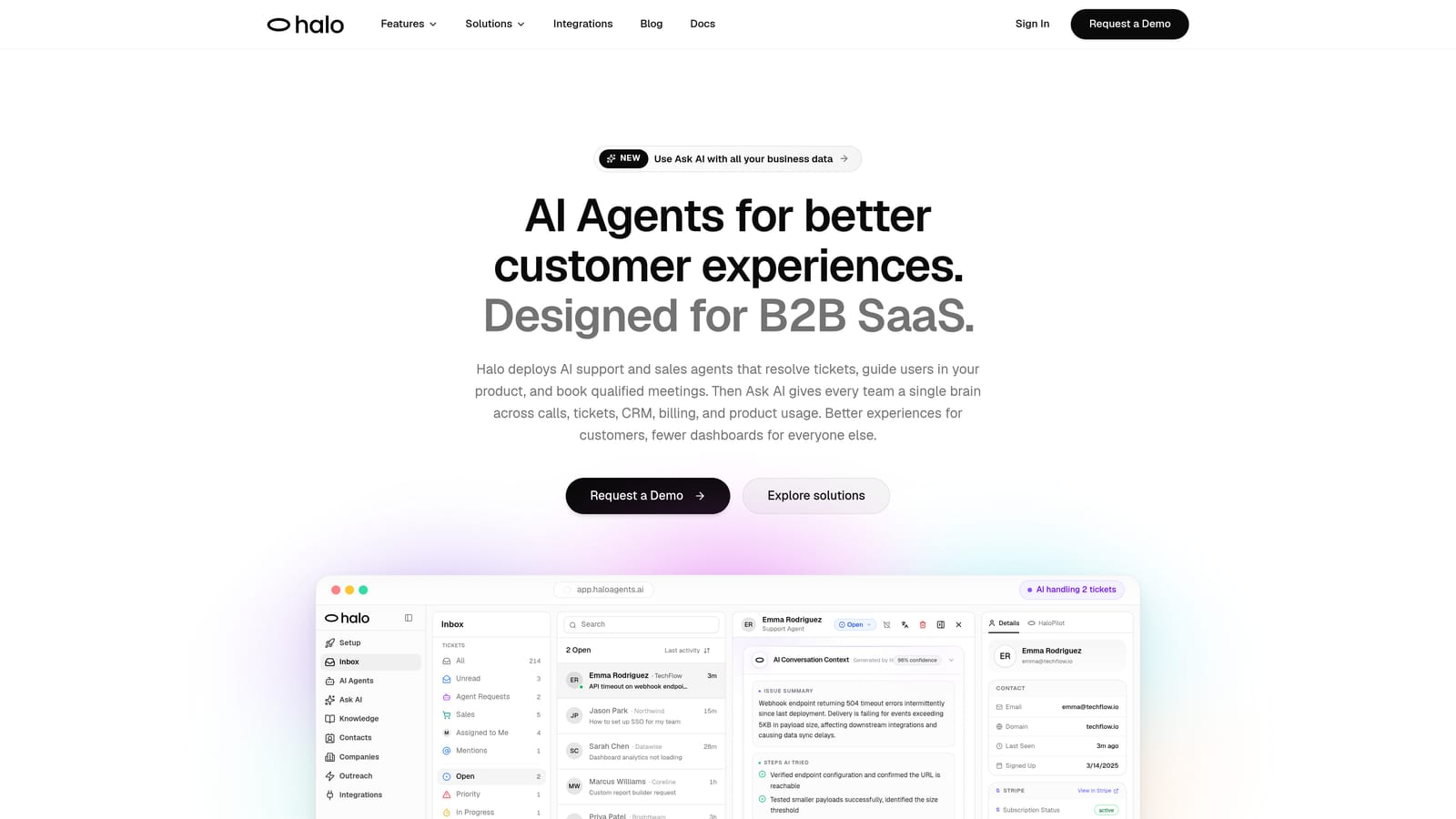
Halo AI is an AI-native customer support platform that deploys intelligent agents to resolve tickets, guide users through your product with page-aware context, and connect your entire business stack — not just your helpdesk.
Where This Tool Shines
Most support platforms started as ticketing systems and added AI later. Halo was built the other way around. The AI isn't a feature you enable — it's the foundation. Every interaction feeds a continuous learning loop, which means the agents handling your tickets today are measurably better than the ones you deployed six months ago.
The page-aware chat widget is genuinely different from what most platforms offer. Rather than serving generic help content, Halo's agent sees exactly what the user is looking at and provides contextual guidance tied to that specific view. Combined with a smart inbox that surfaces churn risk, customer health signals, and revenue anomalies, it functions less like a helpdesk and more like a business intelligence layer built on top of your support data.
Key Features
Page-Aware AI Agents: The chat widget reads the user's current page context and delivers guidance specific to what they're actually looking at, not generic FAQ responses.
Native Integrations: Connects out of the box with Linear, Slack, HubSpot, Intercom, Stripe, Zoom, PandaDoc, and Fathom, so support data flows into the tools your product and revenue teams already use.
Smart Inbox with Business Intelligence: Surfaces customer health signals, churn risk indicators, and revenue anomalies directly within the support workflow, giving agents context that goes well beyond the ticket itself.
Auto Bug Ticket Creation: When an issue looks like a bug, Halo automatically creates a ticket routed to engineering tools like Linear, closing the loop between support and product without manual handoffs.
Live Agent Handoff: Complex issues escalate seamlessly to human agents with full conversation context preserved, so customers never have to repeat themselves.
Best For
B2B SaaS product teams that want to stop treating support as a cost center and start treating it as a source of product and revenue intelligence. Particularly well-suited for teams already using tools like HubSpot, Slack, Linear, or Stripe who want those systems genuinely connected rather than loosely integrated.
Pricing
Contact for pricing. Halo is designed for B2B SaaS teams and tailors its offering accordingly. Reach out via haloagents.ai to discuss your team's needs.
2. Zendesk
Best for: Large enterprise support organizations that need maximum configurability and marketplace breadth
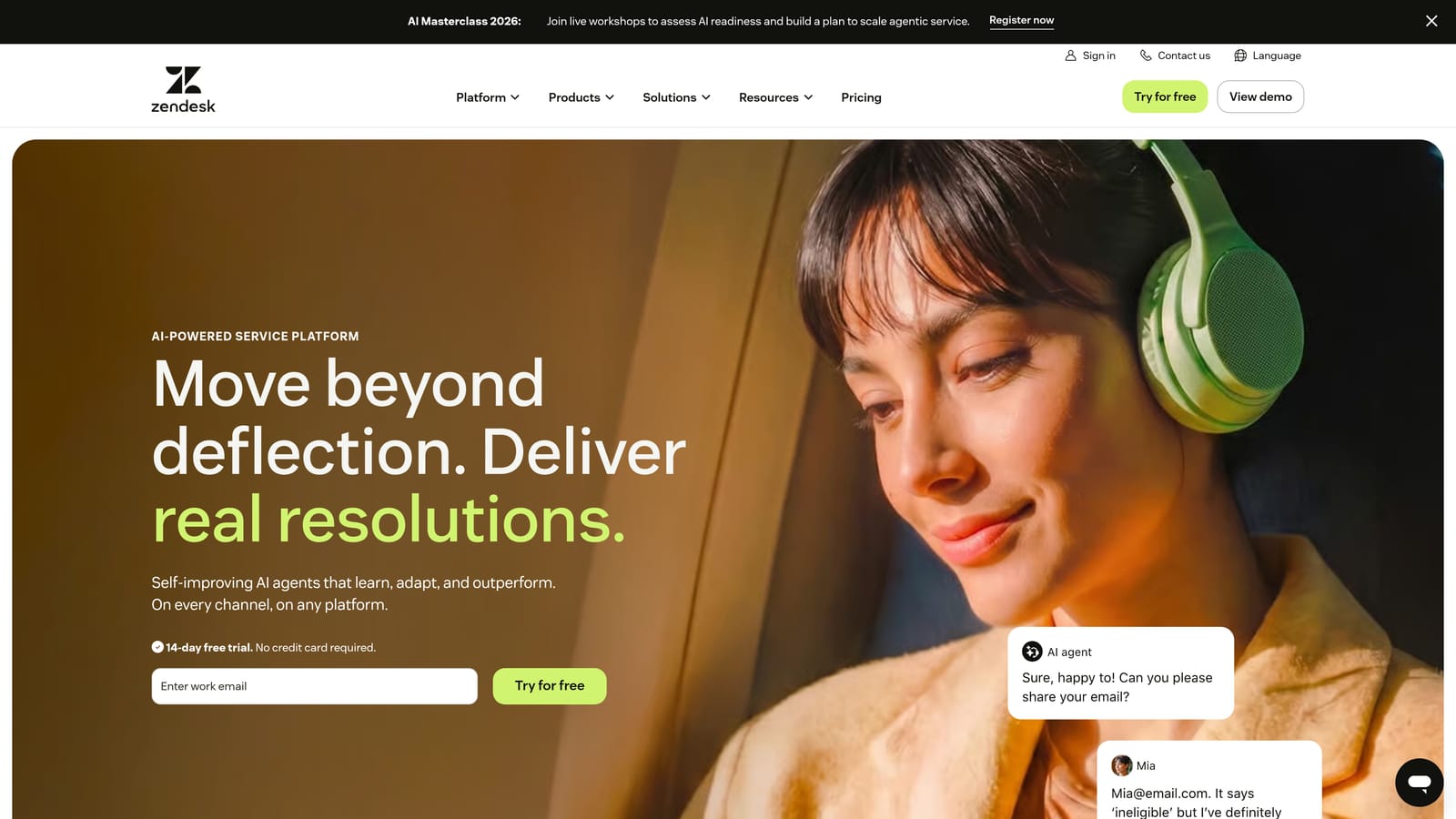
Zendesk is a market-leading enterprise helpdesk with one of the largest integration marketplaces in the industry, offering deep configurability for large support organizations.
Where This Tool Shines
If integration breadth is your primary buying criterion, Zendesk is hard to beat. The Zendesk Marketplace covers over 1,000 apps spanning CRM, analytics, e-commerce, communication, and more. For enterprise teams with complex, multi-tool environments, that catalog is a genuine asset.
Zendesk AI adds ticket classification, suggested replies, and agent assist capabilities on top of the core platform. It's worth noting that these AI features are layered onto a system originally designed for human-managed workflows, so teams evaluating AI depth should test carefully against their specific use cases.
Key Features
Zendesk Marketplace: 1,000+ apps covering CRM, analytics, e-commerce, and communication tools, with a robust REST API for custom integrations beyond the marketplace.
Zendesk AI: Handles ticket classification, suggested replies, and agent assist to reduce manual triage and speed up resolution times.
Omnichannel Support: Manages conversations across email, chat, voice, social media, and messaging from a unified workspace.
Advanced Reporting: SLA management, CSAT tracking, and customizable dashboards for operations-focused support leaders.
Configurable Workflows: Triggers, automations, and macros give operations teams granular control over ticket routing and agent workflows.
Best For
Enterprise support teams with dedicated operations and admin resources who need maximum flexibility and a large app ecosystem. Less ideal for smaller teams who may find the configuration overhead significant relative to their needs.
Pricing
Suite Team starts at approximately $55/agent/month. Enterprise pricing is available on request and scales significantly with added features and seat count.
3. Intercom
Best for: SaaS teams that prioritize in-app conversational support and proactive messaging
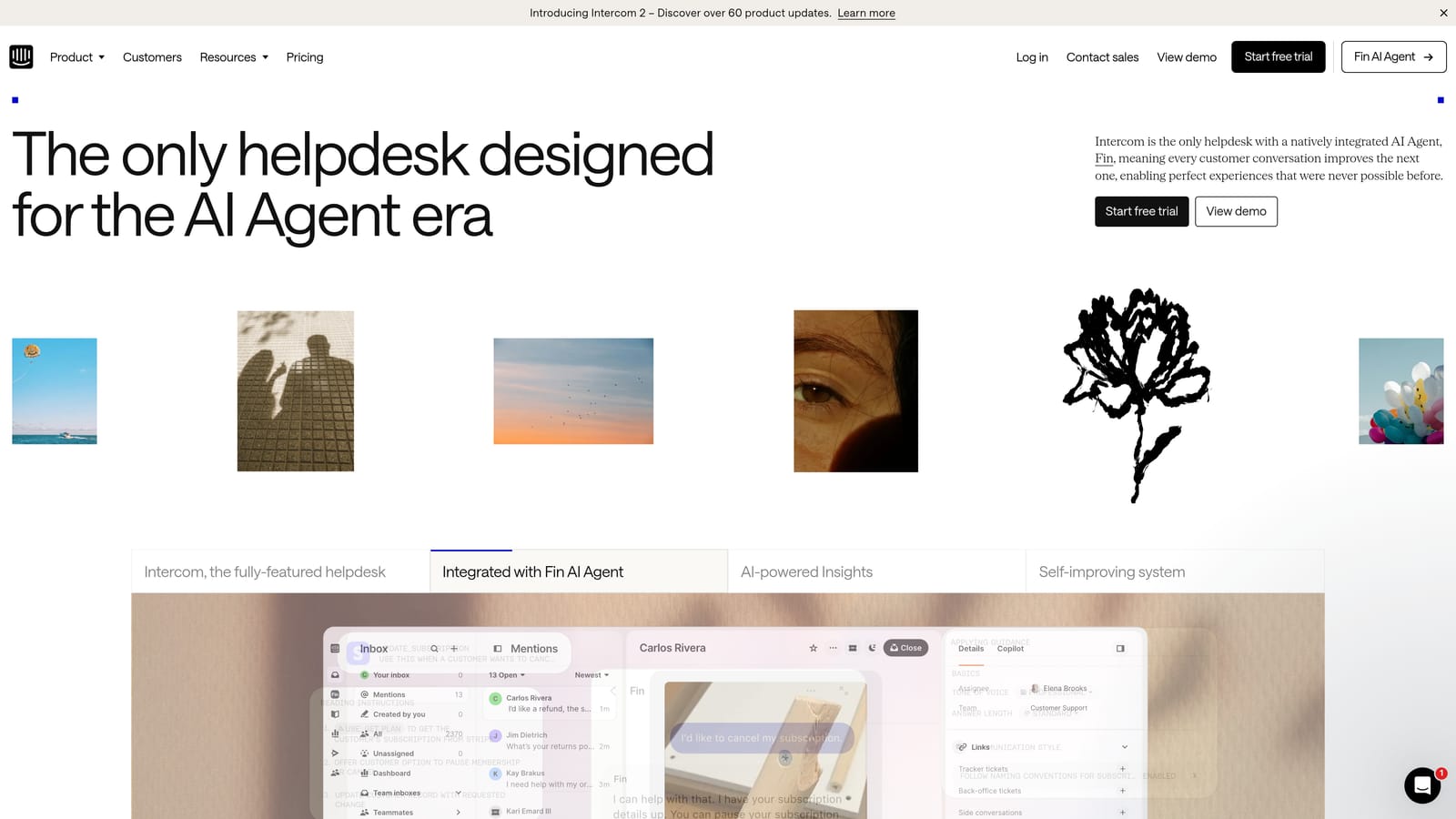
Intercom is a conversational support platform combining an in-app messenger, AI agent (Fin), and helpdesk with strong native CRM and SaaS tool integrations.
Where This Tool Shines
Intercom's in-app messenger is one of the most polished in the market, and Fin, their AI agent, is purpose-built to resolve tickets using your existing help content. For SaaS teams that want proactive support — reaching users before they file a ticket — Intercom's product tours and behavioral messaging tools are genuinely useful.
The native integrations with Salesforce, HubSpot, Stripe, Slack, and GitHub mean that customer context from your CRM and billing system is available inside conversations. That said, Fin's AI capabilities are largely tied to your help center content, so teams with sparse documentation may find resolution rates lower than expected until that content is built out.
Key Features
Fin AI Agent: Resolves tickets automatically using your help center content, with billing based on successful resolutions rather than flat per-seat fees.
Native SaaS Integrations: Connects with Salesforce, HubSpot, Stripe, Slack, and GitHub for cross-functional context inside conversations.
In-App Messenger: Supports product tours, proactive messages, and behavioral triggers for reaching users at the right moment in their journey.
Customer Data Platform: Event tracking and behavioral data surface relevant context for agents handling complex conversations.
Shared Inbox: Conversation routing, assignment rules, and team inboxes for structured agent workflows.
Best For
SaaS companies that want a blend of proactive in-app messaging and reactive support, particularly those already invested in Intercom's broader product engagement features.
Pricing
Starts at approximately $39/seat/month. Fin AI usage is billed per resolution, so costs scale with AI activity rather than just seat count.
4. Freshdesk
Best for: Mid-market teams looking for competitive pricing with access to a full Freshworks suite
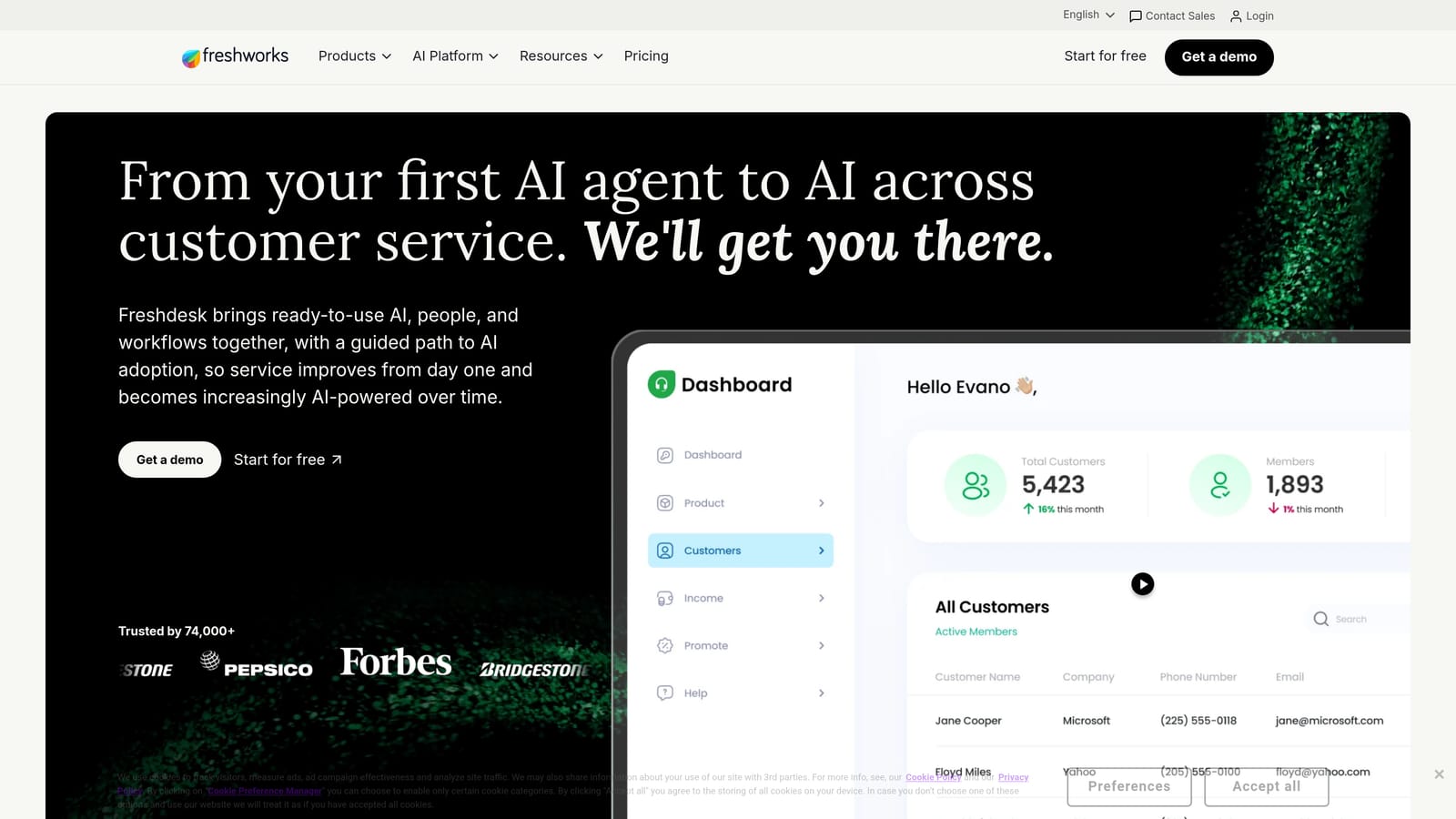
Freshdesk is a cost-competitive helpdesk from Freshworks that integrates natively with the broader Freshworks suite and a wide third-party marketplace.
Where This Tool Shines
Freshdesk's strongest value proposition is its position inside the Freshworks ecosystem. If your team is using or considering Freshsales for CRM or Freshservice for IT service management, the native connections between those products are meaningfully tighter than what you'd get stitching together third-party tools.
For teams not yet on Freshworks, the third-party marketplace still covers Slack, HubSpot, Salesforce, and Jira. Freddy AI handles ticket classification and suggested responses, making it a practical entry point into AI-assisted support without enterprise-level pricing.
Key Features
Freshworks Suite Integration: Native connections with Freshsales CRM, Freshservice ITSM, and Freshchat for a unified Freshworks stack.
Freddy AI: Provides ticket classification, suggested responses, and canned reply recommendations to speed up agent workflows.
Third-Party Marketplace: Integrates with Slack, HubSpot, Salesforce, Jira, and more for teams outside the Freshworks ecosystem.
Omnichannel Support: Manages email, chat, phone, and social conversations from a unified inbox.
Collision Detection: Prevents multiple agents from working the same ticket simultaneously, reducing duplicated effort and conflicting responses.
Best For
Mid-market teams that want accessible pricing, a solid feature set, and the option to expand into a broader Freshworks stack as they grow. Also a strong fit for teams transitioning from basic email-based support to a structured helpdesk for the first time.
Pricing
A free plan is available for small teams. Paid plans start at approximately $15/agent/month, making it one of the more accessible options on this list for budget-conscious teams.
5. HubSpot Service Hub
Best for: Teams already using HubSpot CRM who want support built natively into that system
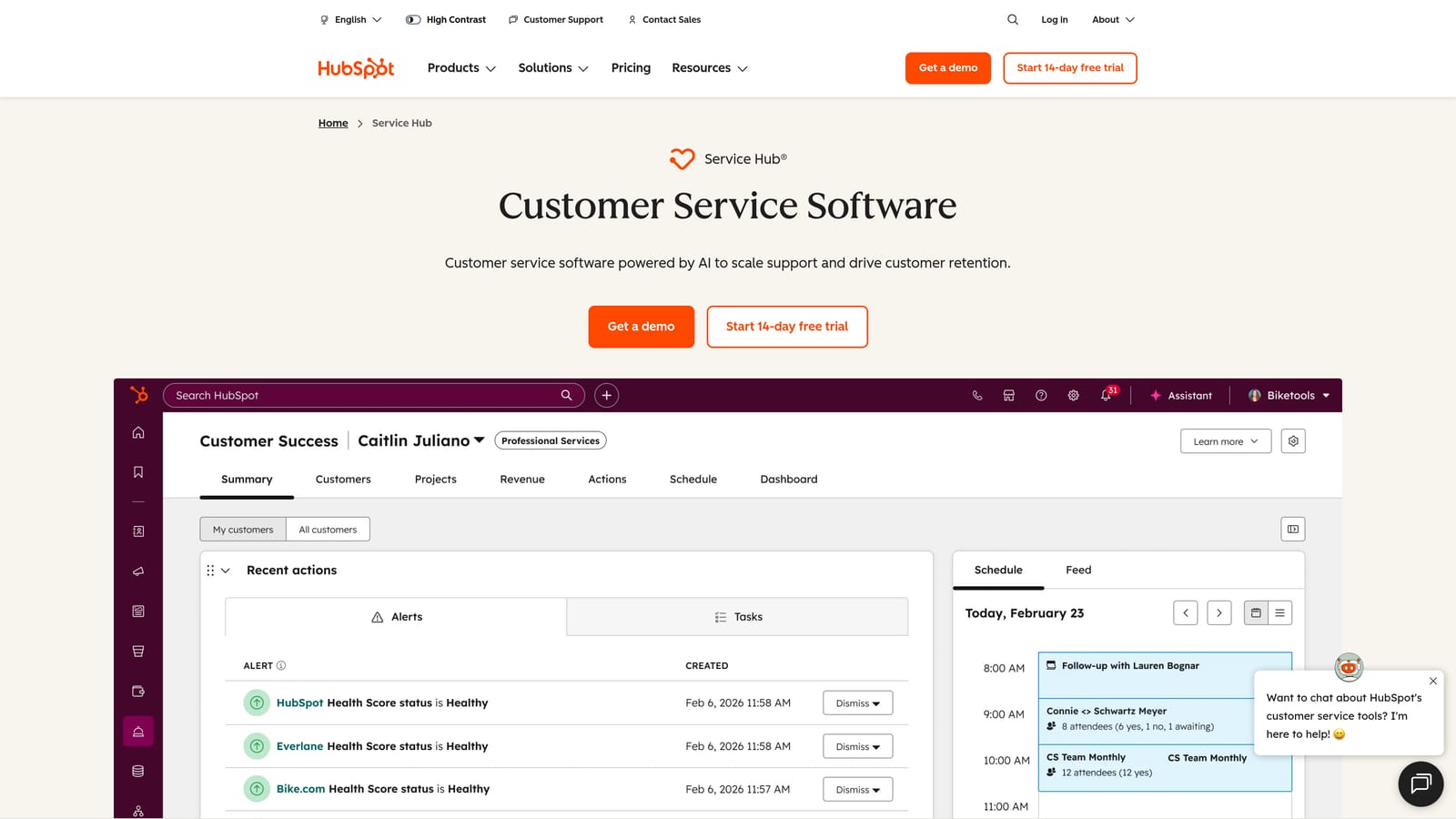
HubSpot Service Hub is customer support built natively inside the HubSpot CRM platform, giving support teams full visibility into contact records, deal history, and marketing touchpoints on every ticket.
Where This Tool Shines
The core advantage here is data unification. When every support ticket is automatically linked to a HubSpot contact and company record, agents don't need to look anything up. They can see the customer's deal stage, recent marketing interactions, and full contact history before they type a single word.
For teams already paying for HubSpot Sales Hub or Marketing Hub, Service Hub adds meaningful support capabilities without introducing a separate platform or another integration to maintain. Breeze AI adds conversation summaries and suggested responses to help agents move faster through their queues.
Key Features
Native CRM Integration: Every ticket is tied directly to HubSpot contact and company records, with deal history and marketing touchpoints visible in the ticket view.
Breeze AI: Generates conversation summaries and suggested responses to reduce time spent on repetitive writing tasks.
Built-In Feedback Tools: CSAT and NPS surveys are native to the platform, no third-party survey tool required.
Knowledge Base and Customer Portal: Self-service tools built directly into the HubSpot ecosystem for consistent branding and reporting.
Cross-Hub Integration: Native connections with HubSpot Sales Hub, Marketing Hub, and Operations Hub for a fully unified go-to-market stack.
Best For
Teams already on HubSpot who want to consolidate their stack. The value compounds significantly the more HubSpot products you use. Less compelling as a standalone purchase if you're not already invested in the HubSpot ecosystem.
Pricing
Starter plans begin at approximately $15/seat/month. Professional plans start at approximately $90/seat/month with more advanced automation and reporting capabilities.
6. Salesforce Service Cloud
Best for: Enterprise organizations with existing Salesforce infrastructure and complex support workflows
Salesforce Service Cloud is enterprise-grade customer service built on the Salesforce platform, offering unmatched CRM depth, Einstein AI capabilities, and thousands of AppExchange integrations.
Where This Tool Shines
For organizations already on Salesforce, Service Cloud is the natural extension. Every case is linked to account, opportunity, and contact data from the core CRM, giving support agents a level of customer context that standalone helpdesks simply can't replicate without significant integration work.
Einstein AI adds case classification, next-best-action recommendations, and agent assist. The AppExchange marketplace provides thousands of third-party integrations. The tradeoff is implementation complexity and cost: Service Cloud typically requires dedicated Salesforce admins and a meaningful implementation investment, which makes it a better fit for enterprise teams than for growing startups.
Key Features
Full Salesforce CRM Integration: Every ticket is linked to account, opportunity, and contact data, giving agents complete customer context without switching platforms.
Einstein AI: Handles case classification, next-best-action recommendations, and agent assist for faster, smarter resolution.
AppExchange Marketplace: Thousands of third-party integrations available, covering virtually every enterprise tool category.
Omnichannel Routing: Routes conversations across email, chat, phone, social, and field service based on configurable rules and agent availability.
Flow Automation: Complex multi-step support workflows built without custom code using Salesforce's visual automation builder.
Best For
Enterprise organizations that are already deeply invested in the Salesforce platform and need support tightly coupled with their CRM, sales, and field service operations. Not the right fit for teams without existing Salesforce infrastructure or dedicated admin resources.
Pricing
Starter plans begin at approximately $25/user/month. Enterprise plans start at approximately $165/user/month, with implementation costs often adding significantly to the total investment.
7. Gorgias
Best for: E-commerce brands running on Shopify, Magento, BigCommerce, or WooCommerce
Gorgias is a helpdesk purpose-built for e-commerce brands, with deep native integrations into Shopify, Magento, and BigCommerce that surface order data directly in the ticket view.
Where This Tool Shines
Gorgias does one thing exceptionally well: it puts order data directly inside the support ticket. Agents can view, edit, and issue refunds on Shopify orders without leaving the conversation. For e-commerce teams where the majority of tickets are order status, shipping, and return questions, that eliminates a significant amount of tab-switching and manual lookup.
The platform also ties revenue statistics to support interactions, which gives managers visibility into how support activity correlates with purchasing behavior. Integrations with Klaviyo, Yotpo, and Recharge extend that context into email marketing and subscription data.
Key Features
Deep Shopify Integration: View, edit, and refund orders directly from the ticket view without switching to the Shopify admin.
Multi-Platform E-Commerce Support: Native integrations with Magento, BigCommerce, and WooCommerce alongside Shopify.
AI Agent: Automates responses to common order and shipping questions, reducing ticket volume for repetitive inquiries.
Revenue Attribution: Ties support interactions to revenue statistics so teams can measure the commercial impact of their support work.
E-Commerce Tool Integrations: Connects with Klaviyo, Yotpo, Recharge, and other e-commerce tools for broader customer context.
Best For
E-commerce brands where order management is the core of support work. Gorgias is purpose-built for this use case and delivers on it well. It's not designed for B2B SaaS teams and doesn't pretend to be.
Pricing
Starts at approximately $10/month for 50 tickets, with pricing scaling by ticket volume rather than seat count, which suits e-commerce teams with variable support loads.
8. Help Scout
Best for: Small to mid-sized teams that want a clean, simple shared inbox without enterprise complexity
Help Scout is a clean, human-feeling shared inbox platform that keeps support simple while connecting to key tools like HubSpot, Salesforce, Slack, and Jira via native integrations and Zapier.
Where This Tool Shines
Help Scout's biggest differentiator is its deliberate simplicity. Where Zendesk and Salesforce can require dedicated admins to configure and maintain, Help Scout is designed to be set up quickly and used intuitively. For teams that want to get out of email chaos without committing to an enterprise platform, it's a genuinely practical choice.
The Beacon widget brings in-app help and proactive messaging to the mix, and AI Summarize and AI Assist help agents move faster through their queue. It won't replace a dedicated AI-first platform for teams with sophisticated automation needs, but for SMBs and growing teams, it strikes a useful balance.
Key Features
Shared Inbox: Collision detection, internal notes, tagging, and assignment workflows keep team communication organized without overcomplicating the agent experience.
Beacon Widget: Delivers in-app help content and proactive messaging without requiring a separate tool or significant engineering work.
Native Integrations: Connects with HubSpot, Salesforce, Slack, Jira, and Zapier for teams that need their helpdesk to talk to the rest of their stack.
AI Assist and AI Summarize: Helps agents draft replies faster and summarize long conversation threads without reading every message from scratch.
Knowledge Base (Docs): Built-in documentation tool with search and in-widget delivery for self-service support.
Best For
SMBs and growing teams that value simplicity and a clean user experience over deep configurability. A strong first helpdesk for teams graduating from shared email inboxes.
Pricing
Standard plans start at approximately $22/user/month, with transparent pricing that doesn't require a sales call to understand.
9. Kustomer
Best for: High-volume omnichannel teams that need a unified customer timeline across every channel
Kustomer is a CRM-native omnichannel helpdesk that unifies every customer touchpoint — email, chat, social, SMS, and voice — into a single timeline view, with integrations across e-commerce, CRM, and communication tools.
Where This Tool Shines
Kustomer's customer timeline is its signature feature. Rather than treating each support interaction as an isolated ticket, the platform aggregates every touchpoint — across every channel — into a chronological view of the full customer relationship. For high-volume teams handling customers across many channels simultaneously, that unified context reduces the time agents spend piecing together history.
The platform supports email, chat, voice, SMS, WhatsApp, and social media from a single workspace. AI-powered routing, sentiment analysis, and suggested replies add automation to what would otherwise be a manual triage process at scale.
Key Features
Customer Timeline View: Aggregates all interactions across channels and integrated data sources into a single chronological customer record.
True Omnichannel Support: Handles email, chat, voice, SMS, WhatsApp, and social media from one unified workspace.
AI-Powered Workflows: Routing, sentiment analysis, and suggested replies reduce manual triage for high-volume support operations.
Broad Integrations: Connects with Shopify, Salesforce, Slack, Segment, and more to pull customer data from across the business into the timeline.
Workflow Automation: Multi-step automation for complex support processes that go beyond simple ticket routing rules.
Best For
High-volume B2C and omnichannel teams where customers interact across many channels and agents need unified context to respond effectively. Less optimized for B2B SaaS teams with lower ticket volumes and more complex product-specific support needs.
Pricing
Enterprise plans start at approximately $89/user/month. Contact Kustomer directly for volume pricing on larger teams.
Which Platform Is Right for Your Team?
The right customer support platform with integrations isn't the one with the most apps in its marketplace. It's the one that connects most naturally to where your team's data already lives and how your agents actually work.
Here's a quick orientation by use case to help you narrow it down:
AI-first B2B SaaS: Halo AI. Built from the ground up as an AI platform, not a helpdesk with AI bolted on. Page-aware context, continuous learning, and business intelligence built into the support workflow make it the strongest fit for product-led SaaS teams.
Already on Salesforce: Salesforce Service Cloud. The CRM depth is unmatched for organizations already invested in the Salesforce ecosystem. Just budget for implementation accordingly.
Already on HubSpot: HubSpot Service Hub. The native CRM connection makes it a natural extension of a stack you're already paying for.
E-commerce: Gorgias. Purpose-built for Shopify and adjacent platforms, with order management built directly into the ticket view.
Budget-conscious mid-market: Freshdesk. Competitive pricing, a solid feature set, and room to grow into the broader Freshworks suite.
Simplicity-first SMB: Help Scout. Clean, intuitive, and easy to set up without dedicated admin resources.
Whatever platform you choose, the underlying principle is the same: your support data should flow into your product, revenue, and engineering workflows, not stay siloed in a helpdesk. For teams ready to move beyond bolt-on AI and treat support as a source of business intelligence, See Halo in action and explore what a genuinely AI-first architecture looks like in practice.
You can also explore Halo's full integration library or learn more about modern customer support solutions to see how the pieces fit together for your team.