9 Best Customer Support Scaling Solutions in 2026
This guide reviews the 9 best customer support scaling solutions for B2B SaaS companies in 2026, covering AI-first platforms, high-volume helpdesks, and self-service tools that help growing teams handle dramatically more ticket volume without proportional headcount increases. Each solution is evaluated on automation depth, integration ecosystem, and suitability for teams at every growth stage.
 Matt PattoliFounder14 min read
As B2B SaaS companies grow, support volume rarely grows linearly. It explodes. A team that handled 500 tickets a month at Series A can find itself drowning in 5,000 by Series B, with no proportional headcount budget to match. The answer isn't always more agents.
The right customer support scaling solution lets you handle dramatically more volume without sacrificing response quality or burning out your team. This list covers the tools best equipped to help you scale: from AI-first platforms that autonomously resolve tickets, to helpdesk systems built for high-volume teams, to self-service and workforce management tools that reduce inbound load before it hits your queue.
We've evaluated each based on automation depth, integration ecosystem, ease of deployment, and suitability for B2B product teams. Whether you're running lean with a two-person support team or managing a global operation, there's a fit here for your stage and stack.
1. Halo AI
Best for: B2B SaaS teams that need AI-first autonomous ticket resolution with business intelligence built in.
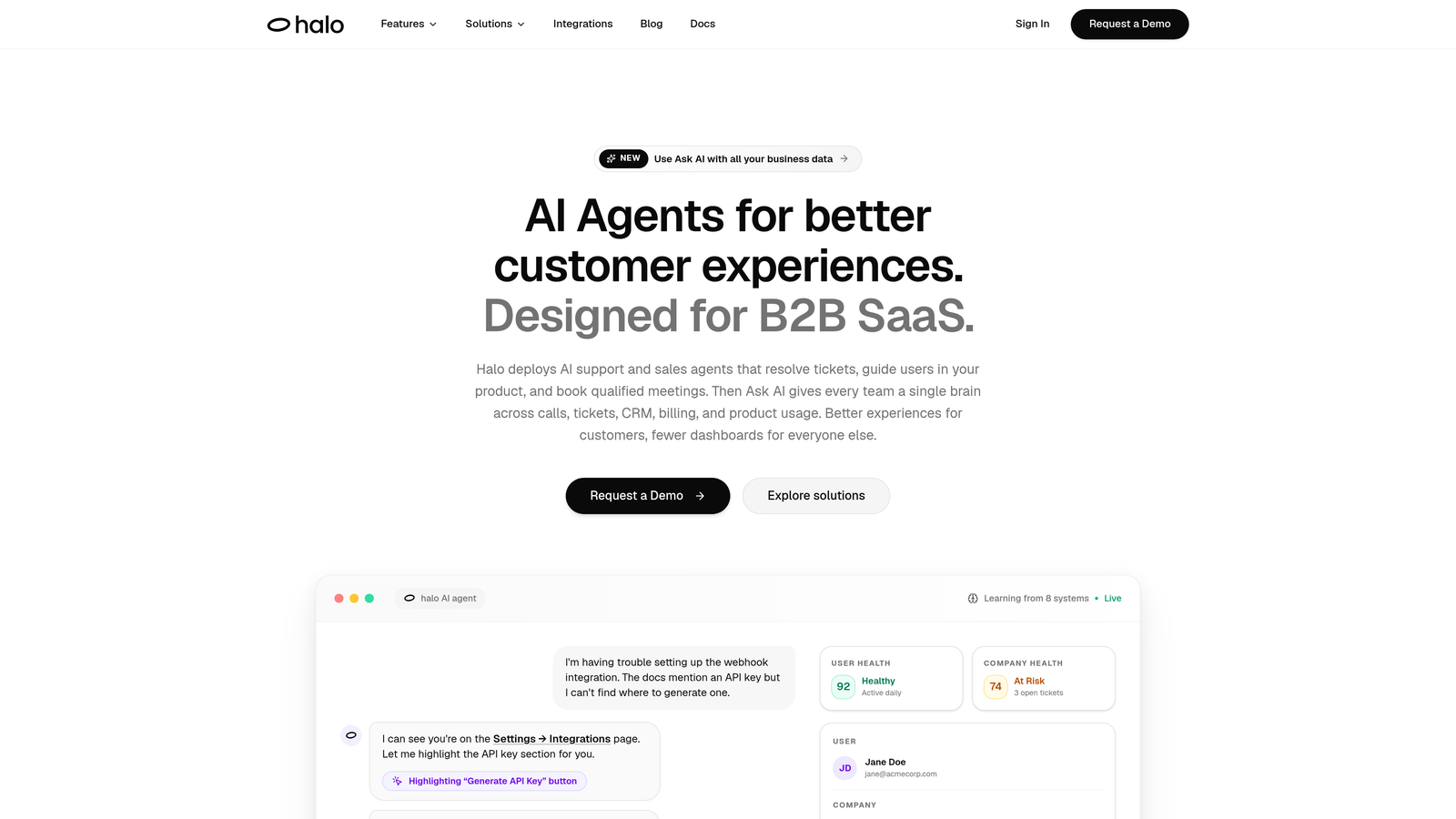
Halo AI is an AI-native customer support platform that resolves tickets end-to-end, guides users through your product with page-aware context, and surfaces business intelligence from every support interaction.
Where This Tool Shines
What separates Halo from most AI support tools is that it isn't a chatbot bolted onto an existing helpdesk. It's built AI-first, which means the intelligence layer is central to how the platform works, not a feature toggle you activate after setup. The AI agents learn continuously from every resolved interaction, meaning the system gets meaningfully smarter over time rather than staying static.
The page-aware chat widget is a standout capability. It understands what screen or page the user is currently on and can provide contextual UI guidance, essentially seeing what the user sees. For SaaS product teams, this is the difference between a generic FAQ bot and a support experience that feels genuinely helpful.
Key Features
Autonomous Ticket Resolution: AI agents handle tickets end-to-end, not just deflect them to a knowledge base article.
Page-Aware Chat Widget: Understands the user's current screen context to provide relevant, visual UI guidance in real time.
Smart Inbox with Business Intelligence: Surfaces customer health signals, revenue anomalies, and product feedback patterns from support data, going well beyond ticket management.
Auto Bug Ticket Creation: Automatically logs product issues to Linear or your preferred bug tracker without agent intervention.
Live Agent Handoff: Escalates complex issues to human agents with full conversation context preserved, so nothing gets repeated.
Deep Integrations: Connects with Slack, HubSpot, Intercom, Stripe, Zoom, PandaDoc, Fathom, and more, fitting into your existing stack rather than replacing it.
Best For
Halo is particularly well-suited for B2B SaaS product teams that want AI to do real work, not just suggest articles. It's a strong fit for companies scaling rapidly where headcount can't keep pace with ticket volume, and for operations leaders who want support data to inform product and revenue decisions, not just sit in a helpdesk queue.
Pricing
Pricing is not publicly listed. Contact the team directly at haloagents.ai for a demo and pricing details tailored to your team size and use case.
2. Zendesk
Best for: Mid-market and enterprise teams needing omnichannel support with deep customization and enterprise-grade structure.
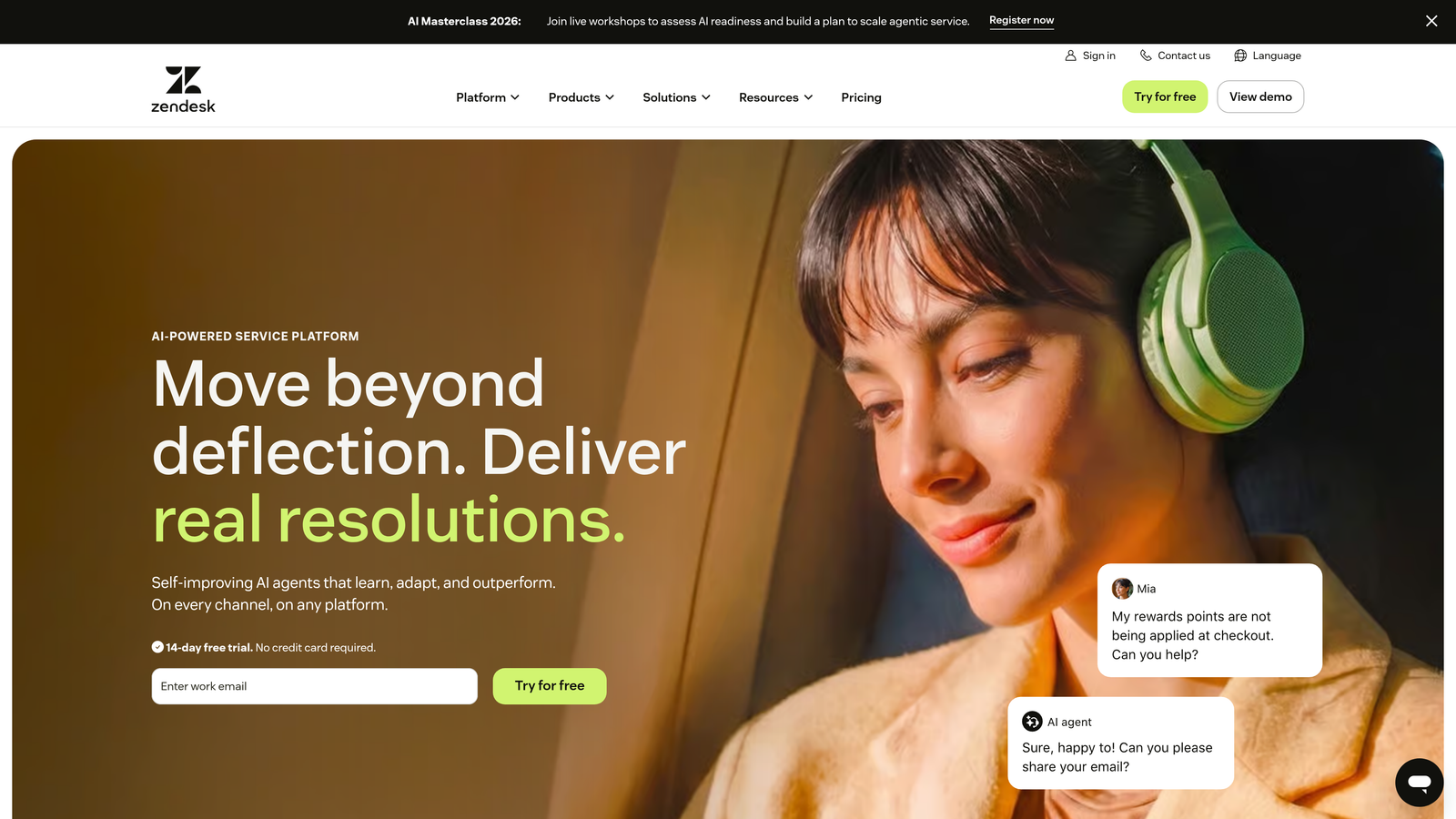
Zendesk is one of the most established helpdesk platforms available, offering omnichannel ticket management, a large integration marketplace, and an AI layer for teams that need proven, scalable infrastructure.
Where This Tool Shines
Zendesk's core strength is breadth. It handles email, chat, voice, social, and messaging in a single queue, and its routing and SLA management capabilities are among the most mature in the market. For operations teams that need granular control over how tickets flow, escalate, and get reported on, Zendesk provides the tooling to build almost any workflow.
The app marketplace is also a genuine differentiator. With over 1,000 integrations available, Zendesk connects to virtually any tool in a modern support stack. The tradeoff is that this breadth can come with complexity: configuration takes time, and the platform can feel heavy for smaller teams that don't need everything it offers.
Key Features
Omnichannel Queue: Email, chat, voice, social, and messaging managed from a unified agent interface.
Advanced Routing and SLA Management: Granular rules for ticket assignment, escalation, and service level tracking.
Zendesk AI: Automated triage, suggested replies, and intent detection to reduce manual agent work.
Marketplace Integrations: 1,000+ apps covering CRMs, analytics, communication, and more.
Custom Reporting: Detailed dashboards and reporting tools for tracking team and channel performance.
Best For
Zendesk is best suited for mid-market to enterprise teams with dedicated support operations staff who can configure and maintain the platform. It's a strong choice when you need proven infrastructure, regulatory compliance, and a wide integration ecosystem.
Pricing
Suite Team starts at $19/agent/month. Enterprise plans are priced significantly higher and vary based on feature requirements and scale.
3. Intercom
Best for: SaaS teams that want conversational support tightly integrated with product usage and customer lifecycle data.
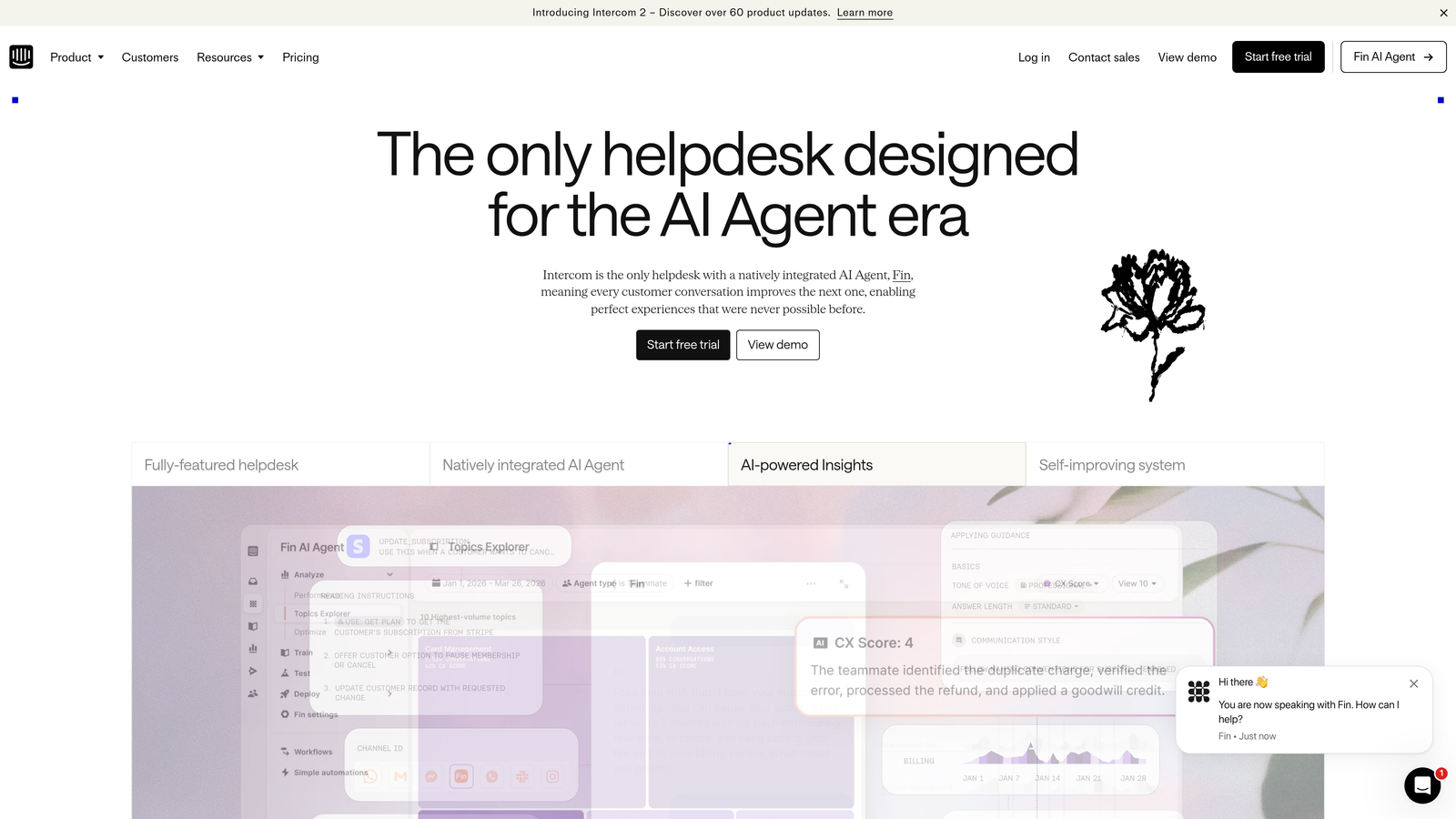
Intercom combines live chat, an AI agent called Fin, a help center, and a customer data platform into a single product, making it particularly strong for teams where support and product experience are closely connected.
Where This Tool Shines
Intercom's differentiator is context. Because it sits on top of customer data including plan type, usage behavior, and lifecycle stage, support interactions can be personalized and proactive rather than purely reactive. Fin, Intercom's AI agent, can autonomously handle common queries, and the platform supports proactive in-app messaging based on what users are doing in your product.
The help center builder is solid, and AI-assisted content suggestions make it easier to keep documentation current. That said, Intercom's pricing has historically been a point of friction for smaller teams, particularly since Fin's usage is billed per resolution on top of seat costs.
Key Features
Fin AI Agent: Autonomous resolution of common queries using your help center and connected knowledge sources.
In-App Messaging: Proactive support messages triggered by user behavior inside your product.
Customer Data Platform: Plan, usage, and lifecycle context available to agents during every interaction.
Shared Inbox: Assignment, snoozing, tagging, and collaboration tools for support teams.
Help Center Builder: Create and maintain customer-facing documentation with AI-assisted content suggestions.
Best For
Intercom is a strong fit for SaaS companies that want support integrated with product analytics and customer lifecycle data. It works especially well for teams already using Intercom for marketing or onboarding who want to extend it to support.
Pricing
Starts at $39/seat/month. Fin AI usage is billed separately per resolution, so total costs scale with AI interaction volume.
4. Freshdesk
Best for: Growing teams that need a full-featured helpdesk at an accessible price point, with room to scale into more advanced automation.
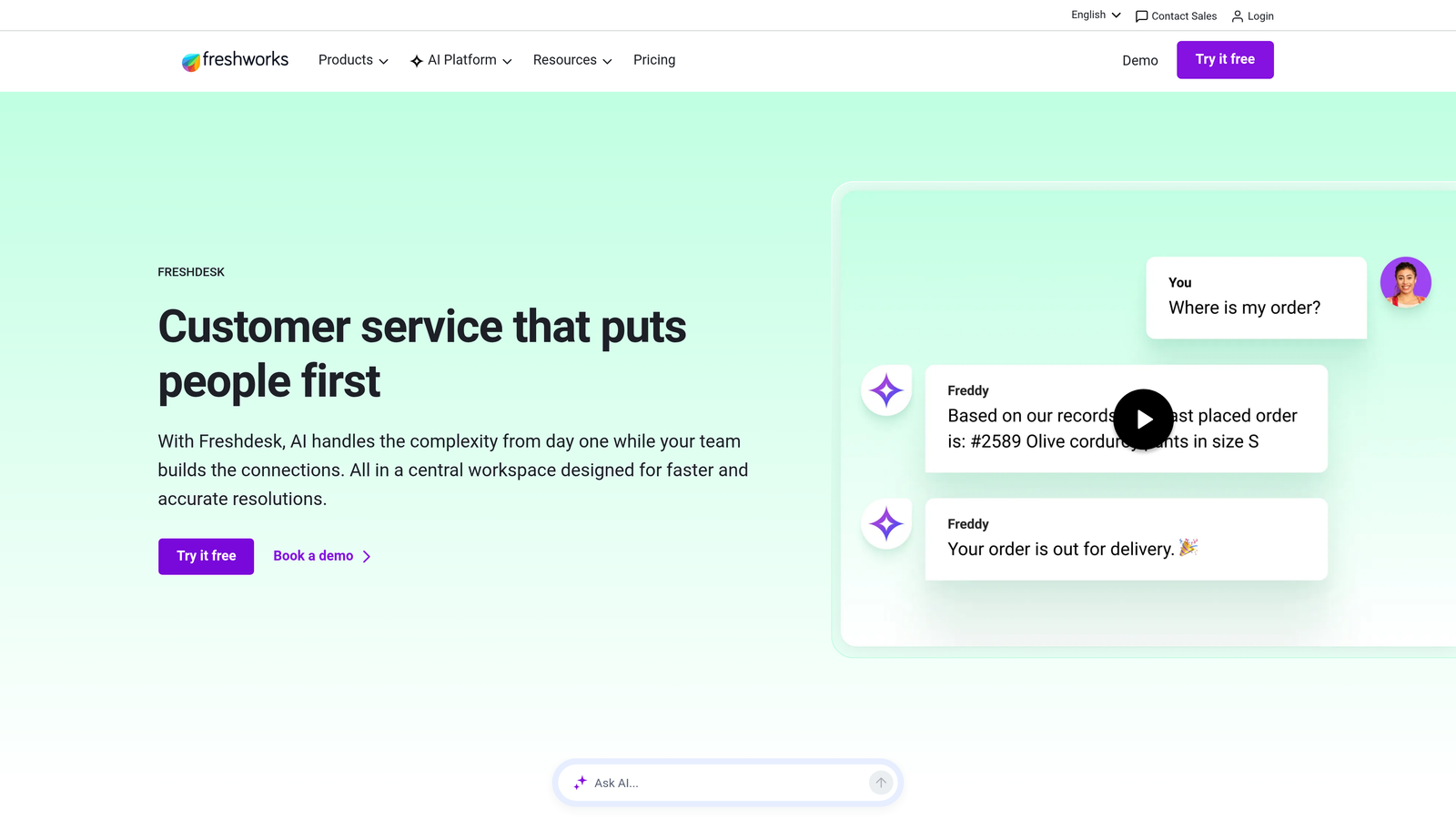
Freshdesk is a full-featured helpdesk from Freshworks that offers strong automation, multi-channel support, and a pricing model that makes it accessible for teams not yet ready for enterprise-tier platforms.
Where This Tool Shines
Freshdesk hits a sweet spot between capability and cost. The free Sprout plan gives small teams a real starting point, and the paid tiers add meaningful automation through Freddy AI, which handles ticket triage, suggests responses, and powers bot flows. Collision detection is a practical feature that prevents two agents from working the same ticket simultaneously, a real operational problem as teams grow.
For teams migrating from basic email-based support to a proper helpdesk, Freshdesk's onboarding is relatively approachable. It covers email, chat, phone, and social in one platform without the configuration overhead that Zendesk can require at comparable tiers.
Key Features
Free Tier: The Sprout plan gives small teams access to core helpdesk functionality at no cost.
Freddy AI: Handles ticket triage, suggested responses, and automated bot flows for common queries.
Multi-Channel Support: Email, chat, phone, and social media managed from a unified interface.
Collision Detection: Prevents duplicate agent responses by showing when another agent is viewing or replying to a ticket.
Marketplace Integrations: Connects with CRMs, billing tools, and communication platforms through the Freshworks marketplace.
Best For
Freshdesk is ideal for SMB and mid-market teams that need a capable, multi-channel helpdesk without enterprise pricing. It's also a natural fit for companies already using other Freshworks products like Freshsales or Freshchat.
Pricing
Free plan available. Paid plans start at $15/agent/month, scaling up with additional AI and automation features.
5. Guru
Best for: Teams that want to reduce ticket volume through better self-service and faster agent knowledge retrieval.
Guru is an AI-powered knowledge management platform that surfaces the right answer inside agents' existing workflows, reducing time-to-resolution and enabling customers to self-serve before they ever submit a ticket.

Where This Tool Shines
Guru addresses a scaling problem that often gets overlooked: agents spending too much time hunting for answers rather than resolving tickets. By surfacing relevant knowledge cards directly inside Slack, Chrome, and helpdesk tools, Guru shortens the gap between question and answer without requiring agents to leave their workflow. This is especially valuable for teams with complex, frequently updated product knowledge.
The verification workflow is a genuinely useful feature. It ensures that knowledge cards are periodically reviewed and marked accurate, which prevents the common problem of teams relying on outdated documentation. The analytics layer also identifies knowledge gaps based on what agents and customers are searching for most frequently.
Key Features
In-Workflow Knowledge Cards: AI-surfaced answers appear inside Slack, Chrome, and helpdesk tools without requiring a context switch.
Verification Workflows: Periodic review cycles keep knowledge accurate and flag outdated content for updates.
Customer-Facing Knowledge Base: Self-service portal for customers to find answers before submitting tickets.
Knowledge Gap Analytics: Tracks what's being searched and not found, highlighting where documentation needs to be created.
Helpdesk Integrations: Connects with Zendesk, Salesforce, Intercom, and Slack.
Best For
Guru works best for teams where knowledge fragmentation is a real bottleneck, whether that's agents spending too long searching for answers or customers failing to find self-service resources. It complements rather than replaces a helpdesk.
Pricing
Free for up to 3 users. Paid plans start at $10/user/month, making it one of the more accessible knowledge management options available.
6. Gorgias
Best for: E-commerce brands on Shopify, WooCommerce, or Magento that need support automation built around orders, returns, and shipping.
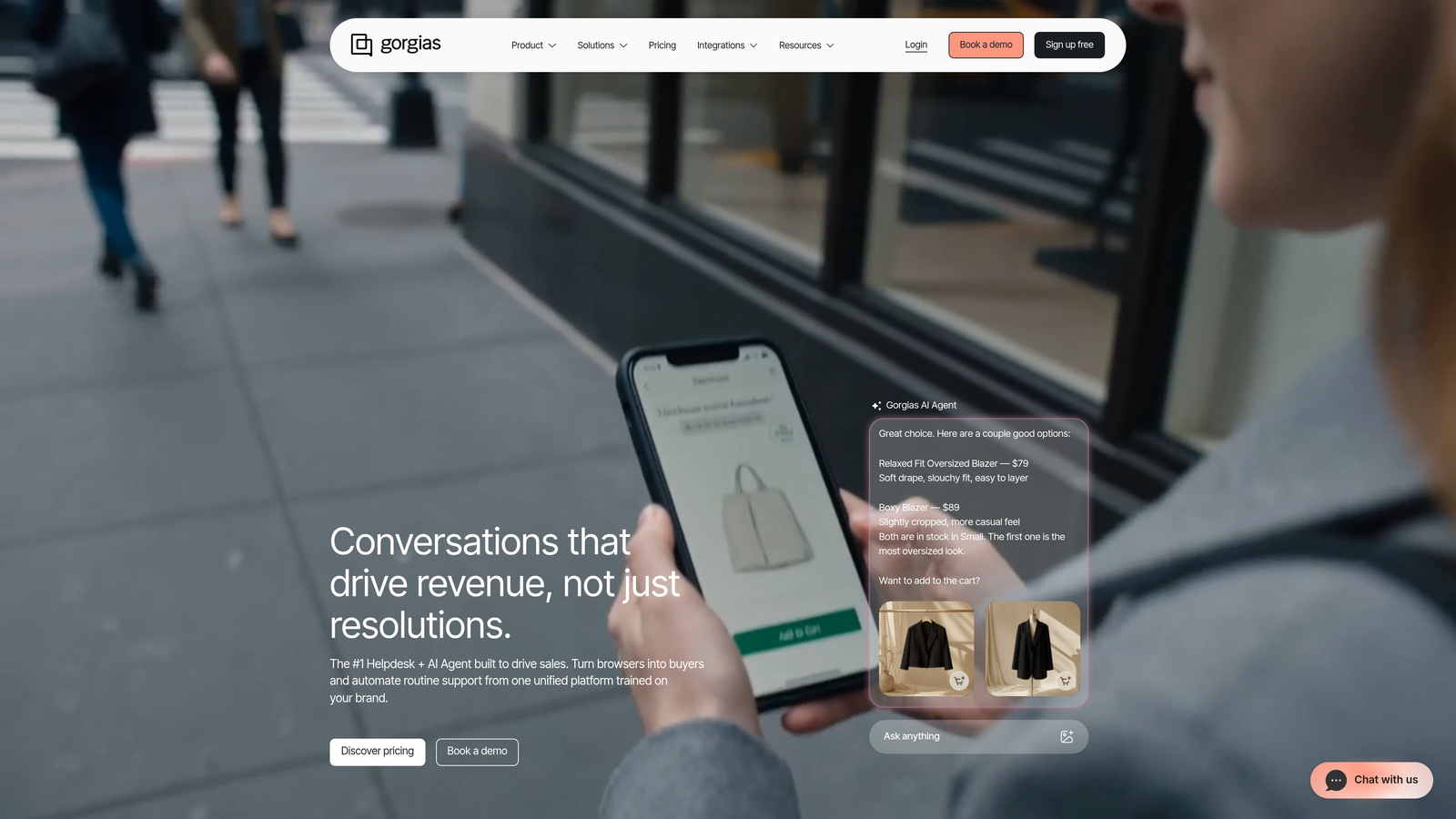
Gorgias is a support helpdesk purpose-built for e-commerce, with deep integrations into major commerce platforms and automation rules designed specifically around the queries that dominate retail support queues.
Where This Tool Shines
Gorgias is a vertical-specific tool, and that specificity is its greatest strength. Rather than building generic automation and asking e-commerce teams to customize it, Gorgias ships with workflows built around order status, returns, and shipping queries out of the box. The Shopify integration in particular is deeply native, pulling order data directly into the agent interface so reps don't need to switch tabs.
The revenue attribution feature is notable. By tying support conversations to sales outcomes, Gorgias gives support leaders a way to demonstrate the revenue impact of their team, not just cost metrics. Its AI agent handles routine e-commerce queries autonomously, and ticket-volume-based pricing means costs scale predictably with business growth rather than headcount.
Key Features
Native Commerce Integrations: Deep connections to Shopify, WooCommerce, and Magento with order data surfaced in the agent view.
Macro-Based Automation: Pre-built and customizable macros for high-frequency order and return queries.
Revenue Attribution: Links support conversations to sales outcomes for clearer ROI reporting.
AI Agent: Autonomous resolution of routine e-commerce queries within defined parameters.
Volume-Based Pricing: Costs tied to ticket volume rather than agent seats, which suits seasonal businesses.
Best For
Gorgias is the right choice for e-commerce brands, particularly those on Shopify, where support volume is dominated by transactional queries. It's less suited for pure B2B SaaS environments where support complexity tends to be higher.
Pricing
Starts at $10/month for up to 50 tickets. Pricing scales with ticket volume, with higher tiers available for larger operations.
7. Tidio
Best for: Smaller teams and SMBs that need live chat and AI chatbot capabilities without complexity or a large budget.
Tidio combines live chat, an AI chatbot called Lyro, and email support in one accessible platform, with a visual no-code bot builder that makes automation achievable without technical resources.
Where This Tool Shines
Tidio's appeal is its accessibility. The visual drag-and-drop bot builder means teams without engineering resources can create meaningful automation flows quickly. Lyro AI handles common questions autonomously by drawing from your knowledge base, and the platform consolidates live chat, email, and Messenger in a single inbox without a steep learning curve.
Visitor tracking and proactive chat triggers let teams engage users before they get frustrated, which can reduce ticket volume by intercepting questions early. Tidio is less suited for complex B2B support scenarios with nuanced technical queries, but for teams with predictable, repeatable support patterns, it delivers solid value at a low entry cost.
Key Features
Lyro AI Chatbot: Autonomous handling of common questions based on your existing knowledge base content.
Visual Bot Builder: Drag-and-drop chatbot flow creation with no coding required.
Unified Inbox: Live chat, email, and Messenger managed from one interface.
Proactive Chat Triggers: Visitor tracking enables automated outreach based on user behavior on your site.
E-Commerce Integrations: Native connections to Shopify and WordPress for retail use cases.
Best For
Tidio is well-matched for small businesses, early-stage startups, and e-commerce teams that need live chat and basic AI automation without the cost or complexity of enterprise platforms. It's a practical starting point before teams outgrow it.
Pricing
Free plan available. Lyro AI starts at $29/month, with additional tiers for higher conversation volumes and team sizes.
8. Assembled
Best for: Support operations leaders who need to optimize agent scheduling, demand forecasting, and workforce capacity as volume grows.
Assembled is a workforce management platform built specifically for support teams, addressing the human capacity side of scaling rather than the AI resolution side.
Where This Tool Shines
Most scaling tools focus on reducing ticket volume through automation. Assembled takes a different angle: it helps you deploy your existing human agents more effectively. Demand forecasting based on historical ticket patterns means you're staffing the right number of agents at the right times, reducing both overstaffing costs and understaffing gaps that hurt response times.
Real-time adherence monitoring lets managers see during live support hours whether agents are on schedule, which is particularly valuable for distributed or remote teams. For operations leaders where scheduling and capacity planning is the primary scaling bottleneck, rather than automation depth, Assembled fills a gap that most helpdesks don't address well.
Key Features
Demand Forecasting: Predicts ticket volume based on historical patterns to inform staffing decisions.
Agent Scheduling: Shift management, time-off tracking, and coverage planning in one interface.
Real-Time Adherence: Live monitoring of whether agents are following their scheduled assignments.
Performance Reporting: Team and channel-level reporting across time periods for operational visibility.
Helpdesk Integrations: Connects with Zendesk, Salesforce, Intercom, and Slack to pull volume data for forecasting.
Best For
Assembled is best suited for mid-market to enterprise support teams where scheduling complexity and workforce planning are genuine operational challenges. It's most valuable when used alongside a primary helpdesk rather than as a standalone solution.
Pricing
Pricing is available on request and is targeted at mid-market to enterprise organizations. Contact Assembled directly for a quote based on team size and requirements.
9. Plain
Best for: Developer-first companies and technical teams that want a clean, API-native support platform that fits naturally into engineering workflows.
Plain is a modern, API-native support platform designed for developer-first companies, offering Slack-native workflows, deep programmatic customization, and a minimal interface that resonates with technical teams.
Where This Tool Shines
Plain exists because traditional helpdesks often feel over-engineered for technical teams that live in Slack and expect everything to be programmable. The Slack-native workflow means support can happen where engineers already work, without forcing a context switch to a separate tool. The API-first architecture enables deep custom integrations that go well beyond what marketplace plugins typically allow.
The customer timeline view gives agents full interaction history at a glance, and webhooks enable programmatic triage for engineering-led support operations. Plain is growing in adoption among developer tools companies, infrastructure providers, and API-first SaaS teams who find that conventional helpdesks introduce more friction than they solve.
Key Features
Slack-Native Workflows: Support interactions handled directly within Slack for teams already working there.
API-First Architecture: Deep programmatic customization and integration capabilities beyond standard marketplace plugins.
Clean, Minimal Interface: Designed specifically for technical support scenarios without unnecessary complexity.
Customer Timeline View: Full interaction history for each customer visible in a single, organized view.
Webhooks and Programmatic Triage: Engineering-led automation for routing, prioritization, and escalation.
Best For
Plain is the right fit for developer tools companies, API-first SaaS businesses, and technical teams where the support team and engineering team overlap significantly. If your team finds Zendesk or Intercom unnecessarily complex for your use case, Plain is worth a close look.
Pricing
Starts at $16/user/month. A free trial is available to explore the platform before committing.
Which Tool Is Right for Your Team?
The best customer support scaling solution depends on where your bottleneck actually is. Not every team has the same problem, and picking a tool that solves the wrong constraint won't move the needle.
Here's a quick way to think through the options by use case:
AI-first autonomous resolution: Halo AI is built for this. It resolves tickets end-to-end, learns continuously, and surfaces business intelligence from support data, making it the strongest fit for B2B SaaS teams scaling rapidly without proportional headcount growth.
Enterprise helpdesk with deep customization: Zendesk remains the benchmark for teams that need mature routing, SLA management, and a vast integration ecosystem with dedicated ops resources to configure it.
In-app conversational support tied to product data: Intercom is the natural choice for SaaS teams that want support integrated with customer lifecycle context and proactive in-product messaging.
Budget-conscious growing teams: Freshdesk offers the best balance of features and accessible pricing at SMB and mid-market scale. Tidio is the right starting point for very small teams or straightforward use cases that don't yet justify a full helpdesk investment.
Knowledge deflection and faster agent resolution: Guru addresses the knowledge fragmentation problem directly, reducing ticket volume through better self-service and putting answers in front of agents without requiring a workflow change.
E-commerce support: Gorgias is purpose-built for this and outperforms general-purpose helpdesks for brands on Shopify, WooCommerce, or Magento.
Workforce planning and scheduling: Assembled solves the human capacity side of scaling, making it valuable for operations leaders where staffing efficiency is the primary constraint.
Developer-first technical teams: Plain fits naturally into engineering-led support operations where API customization and Slack-native workflows matter more than traditional helpdesk features.
Your support team shouldn't scale linearly with your customer base. Let AI agents handle routine tickets, guide users through your product, and surface business intelligence while your team focuses on complex issues that need a human touch. See Halo in action and discover how continuous learning transforms every interaction into smarter, faster support.