8 Best AI Support Platforms vs Drift: Which One Actually Resolves Tickets in 2026?
Comparing drift vs ai support platforms, this guide evaluates Drift against seven AI-native alternatives built specifically for autonomous ticket resolution and scalable B2B support. It covers honest trade-offs across pricing, integration capabilities, and AI resolution quality to help product and support teams determine whether Drift's marketing-first approach still meets their needs in 2026.
 Grant CooperFounder13 min read
Drift built its reputation on conversational marketing and live chat, but as AI-native support platforms have matured, many B2B teams are asking a sharper question: is Drift still the right tool for customer support, or has the category moved on?
This comparison cuts through the noise. We evaluated Drift alongside seven AI support platforms specifically built for ticket resolution, autonomous agent behavior, and scalable B2B support. Whether you're frustrated with Drift's pricing, its marketing-first focus, or simply want a platform that does more than route conversations, this list covers the honest trade-offs.
Selection criteria: We prioritized platforms with genuine AI resolution (not just deflection), meaningful integrations with modern SaaS stacks, transparent pricing, and suitability for product and support teams, not just marketing teams.
1. Halo AI
Best for: B2B SaaS teams that want autonomous ticket resolution with business intelligence built in
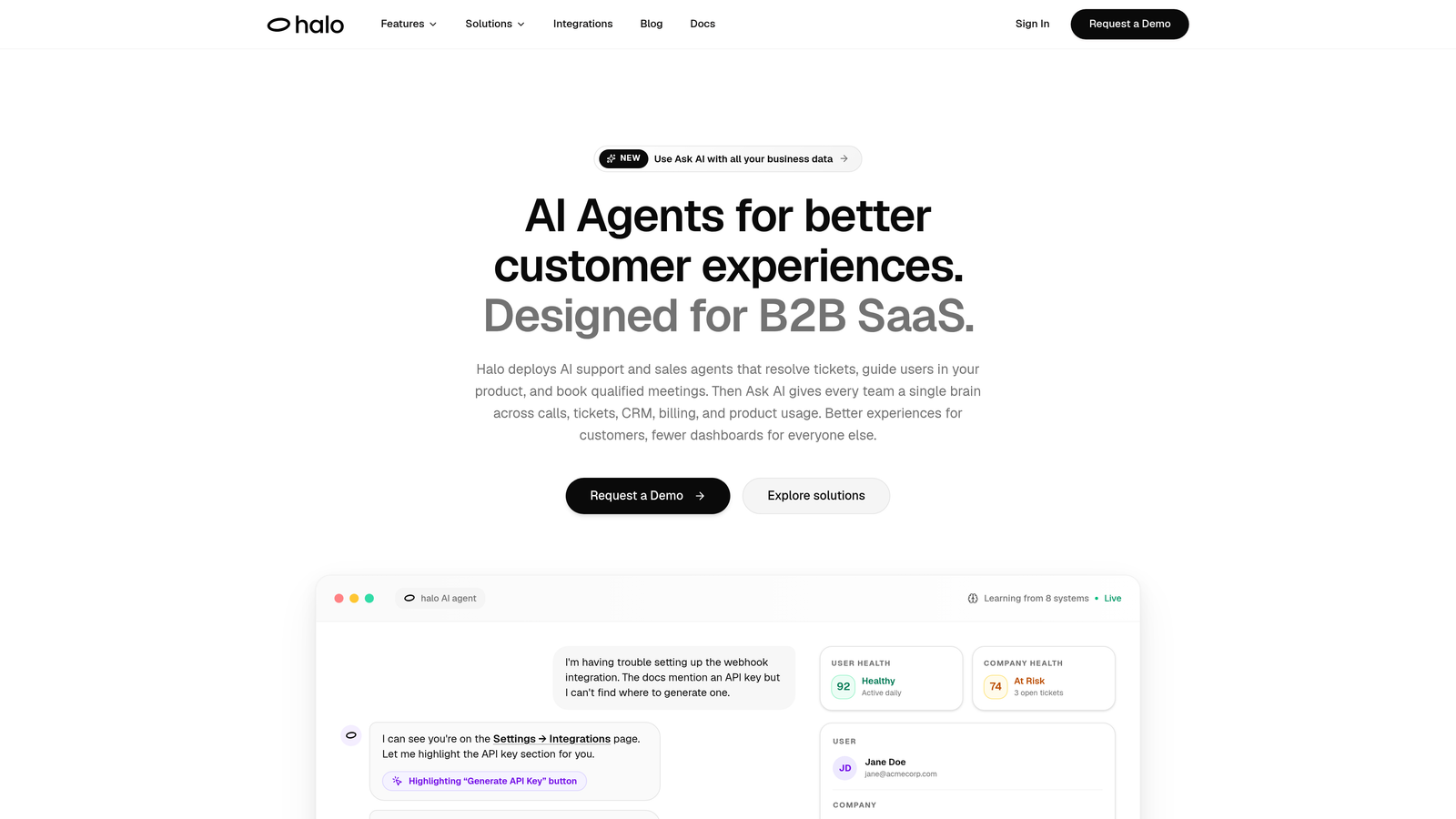
Halo AI is an AI-first customer support platform that deploys intelligent agents to resolve tickets, guide users through your product, and surface business intelligence, all while learning from every interaction.
Where This Tool Shines
What separates Halo from most tools on this list is its architecture. It wasn't built by bolting AI onto an existing helpdesk. The entire platform is designed around autonomous agent behavior from the ground up, which means the AI doesn't just suggest responses, it resolves tickets independently and gets smarter with every interaction.
The page-aware chat widget is a genuine differentiator. It understands what a user is looking at inside your product, so the AI agent can provide contextually relevant guidance rather than generic answers pulled from a knowledge base. For SaaS teams supporting complex products, that context changes everything.
Key Features
Page-Aware Chat Widget: The AI sees what your user sees in-product, enabling precise, contextual guidance without requiring users to describe their screen.
Autonomous Ticket Resolution: AI agents handle routine tickets end-to-end with continuous learning, improving resolution quality over time without manual retraining.
Auto Bug Ticket Creation: Automatically generates and routes bug tickets to Linear or your preferred issue tracker when users report product issues, closing the loop between support and engineering.
Smart Inbox with Business Intelligence: Goes beyond support metrics to surface customer health signals, revenue anomalies, and usage patterns that inform product and success decisions.
Live Agent Handoff: Escalates to human agents with full conversation context preserved, so agents never start from scratch on complex issues.
Full-Stack Integrations: Connects to Linear, Slack, HubSpot, Intercom, Stripe, Zoom, PandaDoc, and Fathom, making it a genuine hub rather than an isolated support tool.
Best For
B2B SaaS product and support teams that want AI to handle routine tickets autonomously while also getting business intelligence signals from support interactions. Particularly strong for teams where support, product, and customer success overlap significantly.
Pricing
Contact for pricing. Designed specifically for B2B SaaS teams. Visit haloagents.ai to request a demo and get details tailored to your team size.
2. Drift
Best for: Revenue teams running ABM plays and routing high-value website visitors to sales reps
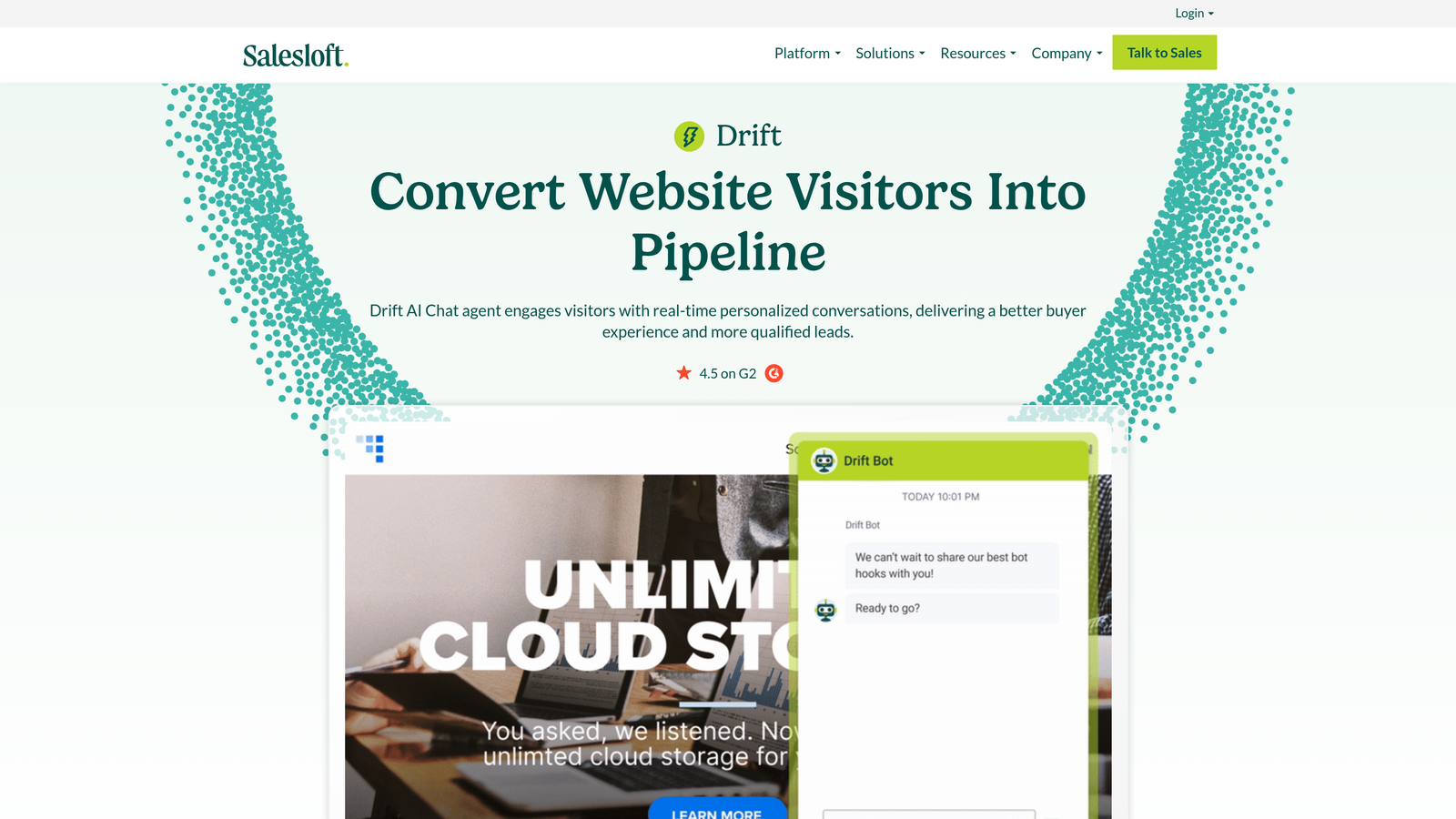
Drift is a conversational marketing and sales platform, now part of Salesloft, built primarily for pipeline generation and sales engagement rather than customer support resolution.
Where This Tool Shines
Drift genuinely excels at one thing: connecting the right website visitor to the right sales rep at the right moment. Its playbook system, account-based targeting, and Salesforce integration make it a compelling choice for revenue teams running enterprise ABM campaigns.
Since its 2023 acquisition by Salesloft, Drift's roadmap has leaned further into revenue intelligence and sales engagement. If your primary use case is pipeline acceleration, that's not a problem. If you need customer support resolution, it's a significant gap. Drift lacks native helpdesk ticketing, SLA management, and the kind of knowledge-base-driven autonomous resolution that dedicated support platforms provide.
Key Features
Playbook-Based Conversation Routing: Configurable conversation flows that qualify leads and route them to the right sales rep based on company, behavior, or intent signals.
Salesforce and Salesloft Integration: Deep native sync with both platforms, making it a natural fit for sales teams already in that ecosystem.
AI Meeting Scheduling: Automates meeting booking directly within chat conversations, reducing friction in the sales handoff process.
ABM Targeting and Personalization: Identifies target accounts visiting your site and delivers personalized messaging based on firmographic and intent data.
Conversation Intelligence: Surfaces insights from sales conversations to help revenue teams refine messaging and improve conversion rates.
Best For
Enterprise sales and marketing teams running account-based programs who need to convert website traffic into pipeline. Not recommended for teams whose primary need is customer support automation or ticket resolution.
Pricing
Enterprise pricing, not publicly listed. Requires a sales conversation to get a quote, which can be a friction point for teams in evaluation mode.
3. Intercom
Best for: Teams wanting an all-in-one messenger, inbox, and AI agent on mature, proven infrastructure
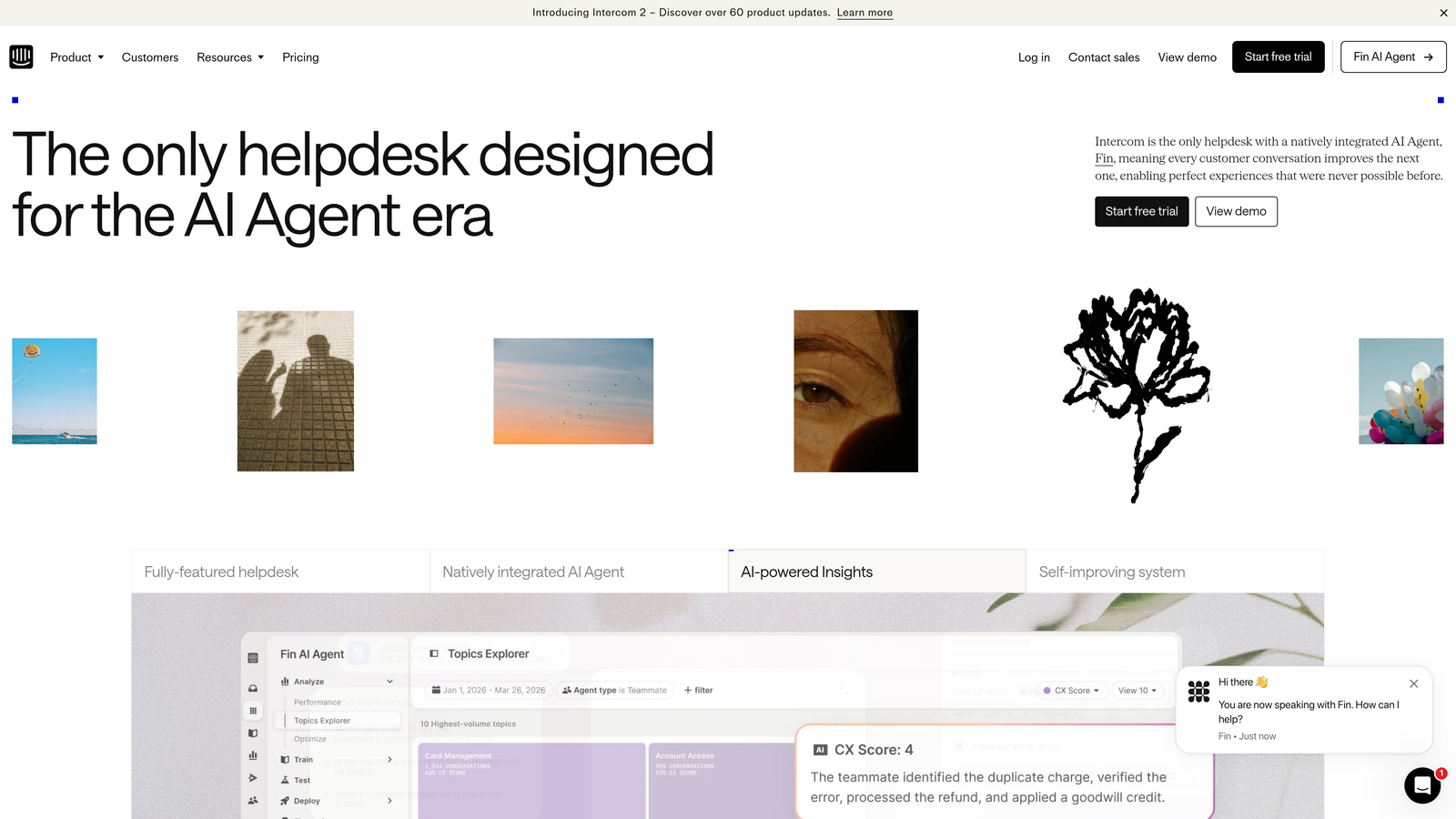
Intercom is an established customer messaging platform with Fin AI, its AI agent, layered on top of a mature messenger and inbox foundation that many SaaS teams already rely on.
Where This Tool Shines
Intercom's strength is its maturity. The messenger, inbox, and workflow tooling have been refined over years, and Fin AI benefits from that stable foundation. For teams already embedded in the Intercom ecosystem, adding Fin feels natural rather than disruptive.
Fin resolves queries by referencing your help center content, which means resolution quality scales with the quality of your documentation. Teams with well-maintained knowledge bases will see strong results. Teams with sparse or outdated docs will need to invest in content before the AI delivers meaningful deflection.
Key Features
Fin AI Agent: Resolves customer queries by referencing help center articles, with the ability to escalate to human agents when confidence is low.
Unified Inbox: Combines live chat, email, and in-app messaging into a single agent workspace with shared views and assignment rules.
Workflow Automation: Configurable automations for ticket routing, tagging, and escalation based on conversation attributes.
Product Tours and Onboarding: In-app onboarding sequences that guide new users through product features, useful for reducing early-stage support volume.
Third-Party Integrations: Broad marketplace of integrations covering CRM, analytics, and helpdesk tools.
Best For
SaaS teams already using Intercom for customer messaging who want to add AI resolution without switching platforms. Also strong for teams with well-maintained help centers looking to automate first-line support.
Pricing
Starts at $39/month for core features. Fin AI resolution is charged per resolved conversation at scale, so costs can grow significantly with volume. Verify current pricing at intercom.com before budgeting.
4. Zendesk AI
Best for: Large enterprise support organizations with complex routing, compliance, and SLA requirements
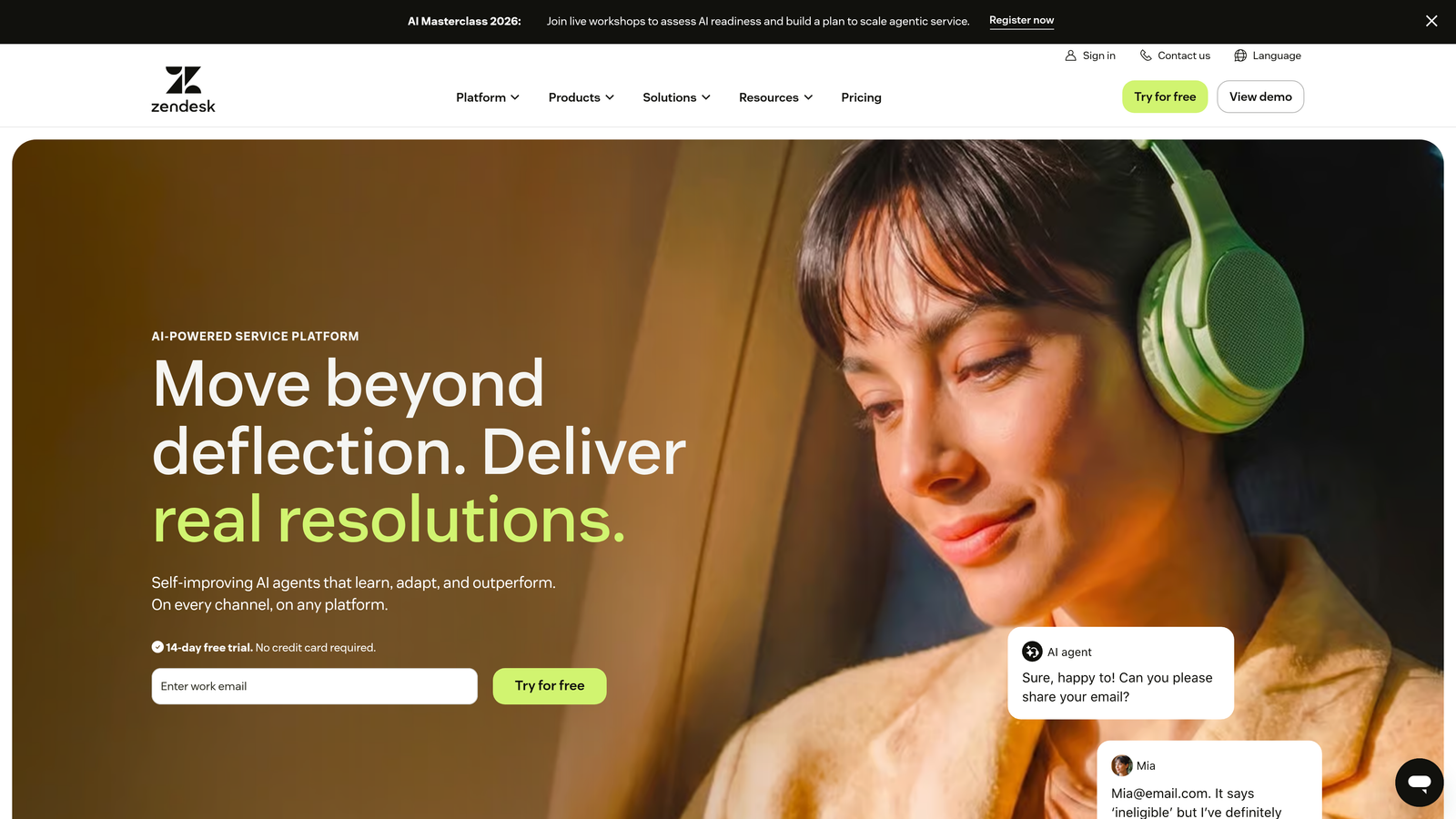
Zendesk is an enterprise helpdesk platform with AI features for intelligent triage, agent assistance, and automated responses layered onto its traditional ticketing foundation.
Where This Tool Shines
Zendesk's depth is unmatched for enterprise support operations. Its SLA management, compliance reporting, and workflow customization handle the complexity that large support teams deal with daily. The AI features, including intelligent triage, suggested replies, and bot deflection, add meaningful efficiency without requiring you to rethink your entire support architecture.
The honest caveat: Zendesk is AI-augmented, not AI-first. The underlying system is a traditional ticketing platform, and the AI sits on top of that. For teams that need enterprise-grade compliance and workflow control, that's fine. For teams wanting autonomous resolution as the default behavior, the architecture shows its age.
Key Features
Intelligent Triage: AI classifies and routes incoming tickets based on intent, sentiment, and content, reducing manual sorting for large-volume teams.
Zendesk Bots: Automated first-response flows that deflect common queries before they reach a human agent.
Agent Copilot: Suggests replies and macro recommendations to agents based on ticket content and historical resolutions.
SLA Management: Comprehensive SLA tracking, breach alerts, and compliance reporting built for enterprise accountability.
Marketplace Integrations: Extensive ecosystem of third-party integrations covering virtually every tool in the enterprise stack.
Best For
Large support organizations with high ticket volumes, strict SLA requirements, and complex routing logic. Teams with dedicated Zendesk admins who can manage configuration and customization will get the most value.
Pricing
Suite plans start at approximately $55/agent/month. AI add-ons are priced separately, so total cost scales with both headcount and AI feature usage. Confirm current pricing at zendesk.com.
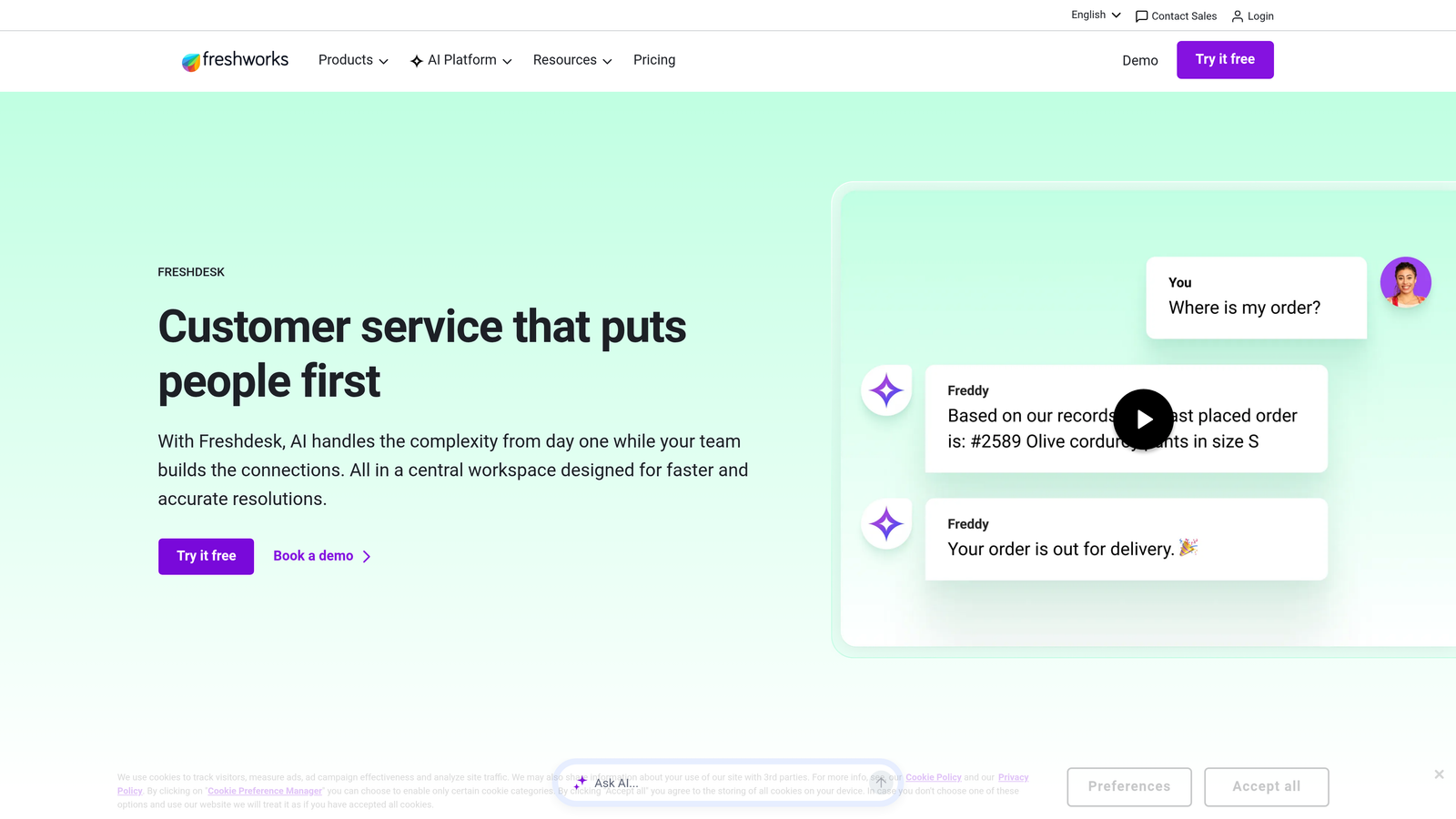
5. Freshdesk Freddy AI
Best for: Teams in the Freshworks ecosystem looking for strong value across self-service, agent assist, and analytics
Freshdesk is Freshworks' helpdesk platform with Freddy AI spanning customer-facing chatbots, agent copilot features, and support analytics, all at pricing that undercuts most enterprise alternatives.
Where This Tool Shines
Freshdesk's value proposition is clear: you get a capable helpdesk with AI features at a price point that makes Zendesk look expensive. For growing teams that aren't ready for enterprise-tier investment, Freshdesk offers a practical on-ramp to AI-assisted support.
Freddy AI covers three distinct modes: self-service deflection, agent assistance, and analytics insights. That breadth is useful, though teams coming from more AI-native platforms may find Freddy's resolution capabilities less sophisticated than purpose-built AI agents. The Freshworks ecosystem integration is a genuine advantage for teams already using Freshworks CRM or ITSM.
Key Features
Freddy Self Service: AI-powered chatbot for customer-facing query deflection, pulling from knowledge base articles and FAQs.
Freddy Copilot: Agent-assist suggestions, conversation summarization, and response drafting to speed up human agent workflows.
Freddy Insights: Support analytics with anomaly detection to surface trends, bottlenecks, and performance issues.
Freshworks Ecosystem Integration: Native connections across Freshworks CRM, ITSM, and sales tools for teams using the broader suite.
Affordable Tier Structure: Free plan available for small teams, with AI features unlocking on higher tiers.
Best For
Small to mid-market teams already using Freshworks products, or teams that need a cost-effective helpdesk with AI features and don't require enterprise-grade customization.
Pricing
Free plan available. Growth tier starts at approximately $15/agent/month. Freddy AI capabilities are available on higher tiers. Verify current tier details at freshworks.com.
6. Tidio
Best for: Small teams and e-commerce businesses that need fast deployment and affordable AI chat
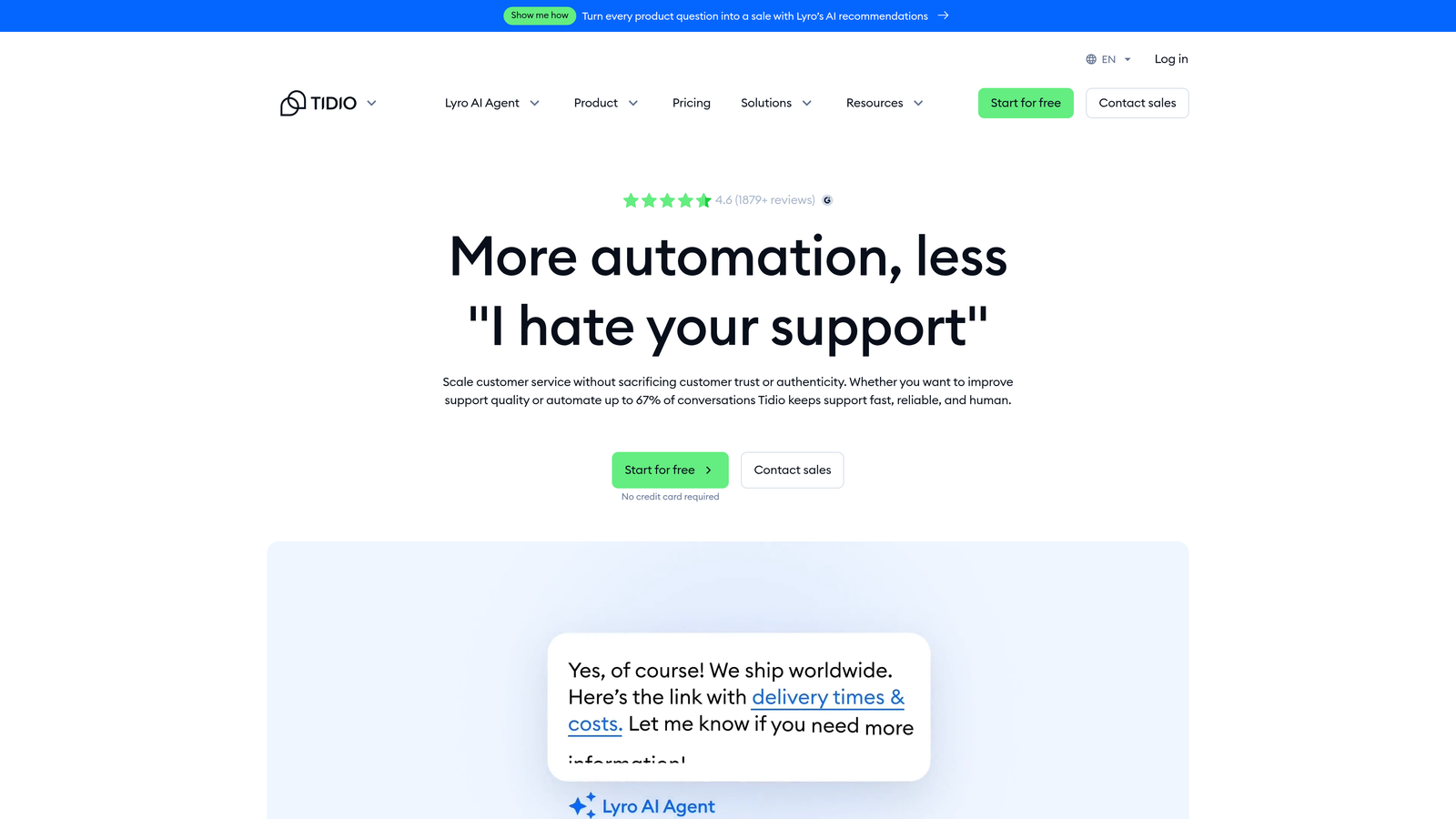
Tidio is a lightweight AI chat platform with Lyro AI chatbot, designed for quick setup and accessible pricing rather than enterprise-grade complexity.
Where This Tool Shines
Tidio's strength is speed to value. You can have Lyro AI handling customer queries within hours, not weeks. For small teams that don't have a dedicated support operations function, that simplicity is genuinely valuable.
The platform is well-suited to e-commerce support scenarios: order status, returns, product questions. For complex B2B SaaS support with multi-step workflows, technical integrations, and nuanced product questions, Tidio's capabilities start to show limits. It's a strong choice for the use case it was built for, which is straightforward customer queries at volume.
Key Features
Lyro AI Chatbot: Automated query resolution that handles common customer questions using your existing FAQ and support content.
Live Chat: Quick-setup live chat with minimal configuration required, accessible even for non-technical teams.
E-Commerce Integrations: Native integrations with Shopify and WooCommerce for order-aware support conversations.
Visual Flow Builder: Drag-and-drop chatbot builder for creating custom conversation flows without code.
Multi-Channel Support: Email and Messenger channel support alongside live chat.
Best For
Small businesses, e-commerce operators, and early-stage SaaS teams that need affordable AI chat without complex setup. Not the right fit for B2B teams with enterprise support requirements.
Pricing
Free plan available. Lyro AI starts at approximately $29/month and scales with conversation volume. Transparent, publicly listed pricing is one of Tidio's genuine advantages.
7. Forethought
Best for: High-volume support teams that want AI intelligence layered on top of their existing helpdesk
Forethought is an AI platform purpose-built for support teams, focusing on triage, classification, routing, and resolution intelligence that works alongside Zendesk, Freshdesk, and Salesforce Service Cloud.
Where This Tool Shines
Forethought occupies a specific and useful niche: it makes your existing helpdesk smarter without replacing it. If you've invested heavily in Zendesk configuration and don't want to migrate, but you do want better AI triage and resolution, Forethought slots in as an intelligence layer rather than a platform replacement.
Its Triage AI is particularly strong for teams drowning in misrouted or mislabeled tickets. Intelligent classification at intake reduces the manual work that burns out support teams, and the Discover analytics layer helps identify systemic gaps that no amount of triage can fix on its own.
Key Features
Triage AI: Intelligently classifies and prioritizes incoming tickets based on content, intent, and urgency, reducing manual sorting overhead.
Solve AI: Automated resolution of common queries, surfacing relevant knowledge base content before routing to a human agent.
Assist AI: Agent copilot that surfaces relevant knowledge and suggests responses during live conversations.
Discover Analytics: Identifies support trends, knowledge gaps, and recurring issues to inform content and product decisions.
Helpdesk Compatibility: Works natively alongside Zendesk, Salesforce Service Cloud, and Freshdesk without requiring a platform migration.
Best For
Mid-market and enterprise teams with high ticket volume and an existing helpdesk investment they want to preserve. Particularly strong for teams where ticket misrouting and classification errors are a known operational problem.
Pricing
Custom enterprise pricing. Requires a demo and sales conversation to get a quote. No self-serve trial available.
8. Kustomer
Best for: Teams where full customer history and lifetime value context should inform every support interaction
Kustomer is a CRM-native customer support platform where every conversation is enriched with complete customer history, and AI automation is built on top of that rich contextual data.
Where This Tool Shines
Kustomer's architecture is fundamentally different from traditional helpdesks. Instead of tickets as the primary object, Kustomer centers the customer timeline, meaning every interaction, purchase, complaint, and conversation is visible in a single view. For support teams where knowing a customer's history changes how you respond, that context is transformative.
The AI automation layer benefits from this data richness. Routing, tagging, and response suggestions are informed by customer attributes, not just ticket content. After being acquired by Meta in 2022 and subsequently sold back to its founders in 2023, Kustomer has continued to develop its platform independently, though teams should evaluate its current roadmap carefully during the sales process.
Key Features
CRM-First Architecture: Every conversation surfaces the full customer timeline, including purchase history, prior interactions, and account attributes.
AI-Powered Automation: Routing, tagging, and response suggestions informed by customer data rather than ticket content alone.
Omnichannel Inbox: Unified workspace handling chat, email, SMS, social, and voice in a single agent view.
Business Rules Engine: Flexible automation for complex workflow logic, escalation paths, and SLA management.
KustomerIQ: Predictive and proactive support actions based on customer behavior patterns and historical data.
Best For
B2C and B2B teams where customer lifetime value, purchase history, and relationship context are central to support decisions. Strong for high-touch support environments where generic ticket responses fall short.
Pricing
Enterprise pricing starting at approximately $89/agent/month. Contact Kustomer directly for full details, as pricing varies with feature set and team size.
Which Platform Is Right for Your Team?
The honest answer depends on what problem you're actually trying to solve. These tools aren't competing in the same category, even when they appear on the same comparison lists.
Stay on Drift if: Your primary use case is pipeline generation, ABM targeting, and routing website visitors to sales reps. Drift does that well, and its Salesloft integration makes it a natural fit for revenue teams in that ecosystem. It is not a support platform, and trying to use it as one will create gaps.
Move to a dedicated support platform if: You need autonomous ticket resolution, SLA management, knowledge-base-driven AI, or business intelligence from support interactions. Every other tool on this list was built with support as the core use case, not a secondary feature.
For enterprise support organizations with complex routing and compliance requirements, Zendesk AI or Kustomer are the most mature options. Forethought is worth evaluating if you want to augment an existing Zendesk investment rather than replace it.
For teams in the Freshworks ecosystem or those with tighter budgets, Freshdesk Freddy AI offers strong value without the enterprise price tag.
For small teams and e-commerce operators who need fast deployment and simple AI chat, Tidio's transparent pricing and quick setup make it an accessible starting point.
For B2B SaaS product and support teams that want AI to resolve tickets autonomously, understand what users are doing inside the product, and surface intelligence beyond support metrics, Halo AI is the most purpose-built option on this list. Its page-aware context, continuous learning architecture, auto bug ticket creation, and full-stack integrations address the specific pain points that SaaS support teams face when outgrowing basic chatbot tools.
Your support team shouldn't scale linearly with your customer base. AI agents should handle routine tickets, guide users through your product, and surface business intelligence while your team focuses on complex issues that genuinely need a human. See Halo in action and discover how continuous learning transforms every interaction into smarter, faster support.