9 Best Enterprise AI Customer Service Platforms in 2026
This guide evaluates the 9 best Enterprise AI Customer Service Platforms available in 2026, comparing each on autonomous ticket resolution, integration depth, scalability, and business intelligence. Whether you lead a lean SaaS support team or a global enterprise operation, it cuts through the noise to help you choose a platform built for real-world performance.
 Grant CooperFounder13 min read
Enterprise support teams are under more pressure than ever: resolve more tickets, faster, with lean teams and rising customer expectations. The good news is that AI customer service platforms have evolved well beyond simple chatbots. Today's solutions can autonomously resolve tickets, surface business intelligence, route complex issues to human agents, and integrate across an entire business stack.
But not all platforms are built the same. Some are AI layers bolted onto legacy helpdesks. Others are AI-first from the ground up. The difference matters enormously when you're evaluating autonomy, integration depth, and the intelligence a platform brings beyond just deflecting tickets.
This guide covers the top enterprise AI customer support platforms available in 2026, evaluated on autonomous resolution capability, integration depth, scalability, and business intelligence. Whether you're running a lean support team at a fast-growing SaaS company or managing a global enterprise operation, there's a platform here built for your needs.
1. Halo AI
Best for: B2B SaaS teams that want AI-first support with deep product and business stack integration.
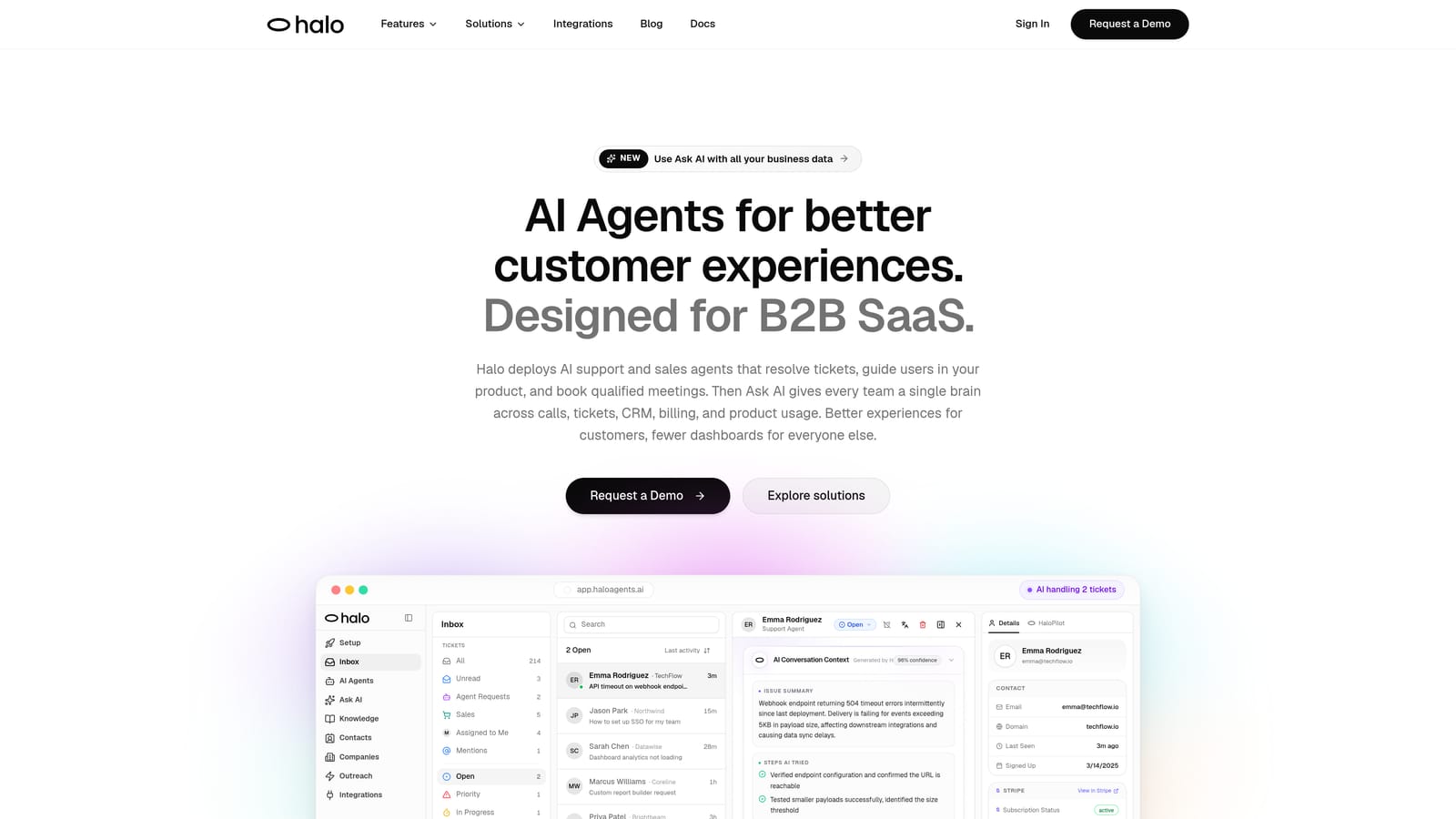
Halo AI is an AI-first customer support platform built specifically for B2B SaaS teams, deploying intelligent agents that resolve tickets, guide users visually through your product, auto-create bug reports, and surface business intelligence across every interaction.
Where This Tool Shines
What separates Halo from most platforms on this list is its architecture. It was built AI-first, not retrofitted onto an existing helpdesk. That distinction shows up in features like the page-aware chat widget, which understands the exact page a user is on and provides in-context visual UI guidance rather than generic help center links. It sees what your users see.
The business intelligence layer is another genuine differentiator. Halo's smart inbox surfaces customer health signals, revenue intelligence, and anomaly detection, turning your support channel into a source of strategic insight rather than just a cost center. Every interaction feeds back into the system, so the AI gets smarter over time without manual retraining.
Key Features
Page-Aware Chat Widget: Understands the user's current page context and delivers visual UI guidance in real time, not just generic documentation links.
Autonomous Ticket Resolution: AI agents handle routine tickets end-to-end, with smart live agent handoff when complexity requires a human touch.
Auto Bug Ticket Creation: Automatically identifies and routes bug reports directly to Linear, eliminating manual triage between support and engineering.
Smart Inbox with Business Intelligence: Surfaces customer health signals, revenue intelligence, and anomaly detection so support data drives business decisions.
Deep Integration Stack: Connects natively with HubSpot, Intercom, Slack, Stripe, Zoom, PandaDoc, Fathom, and Linear across your full business stack. Explore all integrations on the Halo site.
Best For
Halo is the strongest fit for B2B SaaS companies that want an AI-first platform rather than an AI add-on. If you're a product-led growth company where users need in-product guidance, or a team that wants support data to inform retention and revenue decisions, Halo is built precisely for that use case. The customer support agent capabilities are especially well-suited for teams scaling without scaling headcount.
Pricing
Custom pricing with a demo required. You can book directly at haloagents.ai/demo. Pricing is not publicly listed, which is typical for enterprise AI platforms at this capability level.
2. Salesforce Einstein Service Cloud
Best for: Large enterprises already deeply invested in the Salesforce ecosystem.
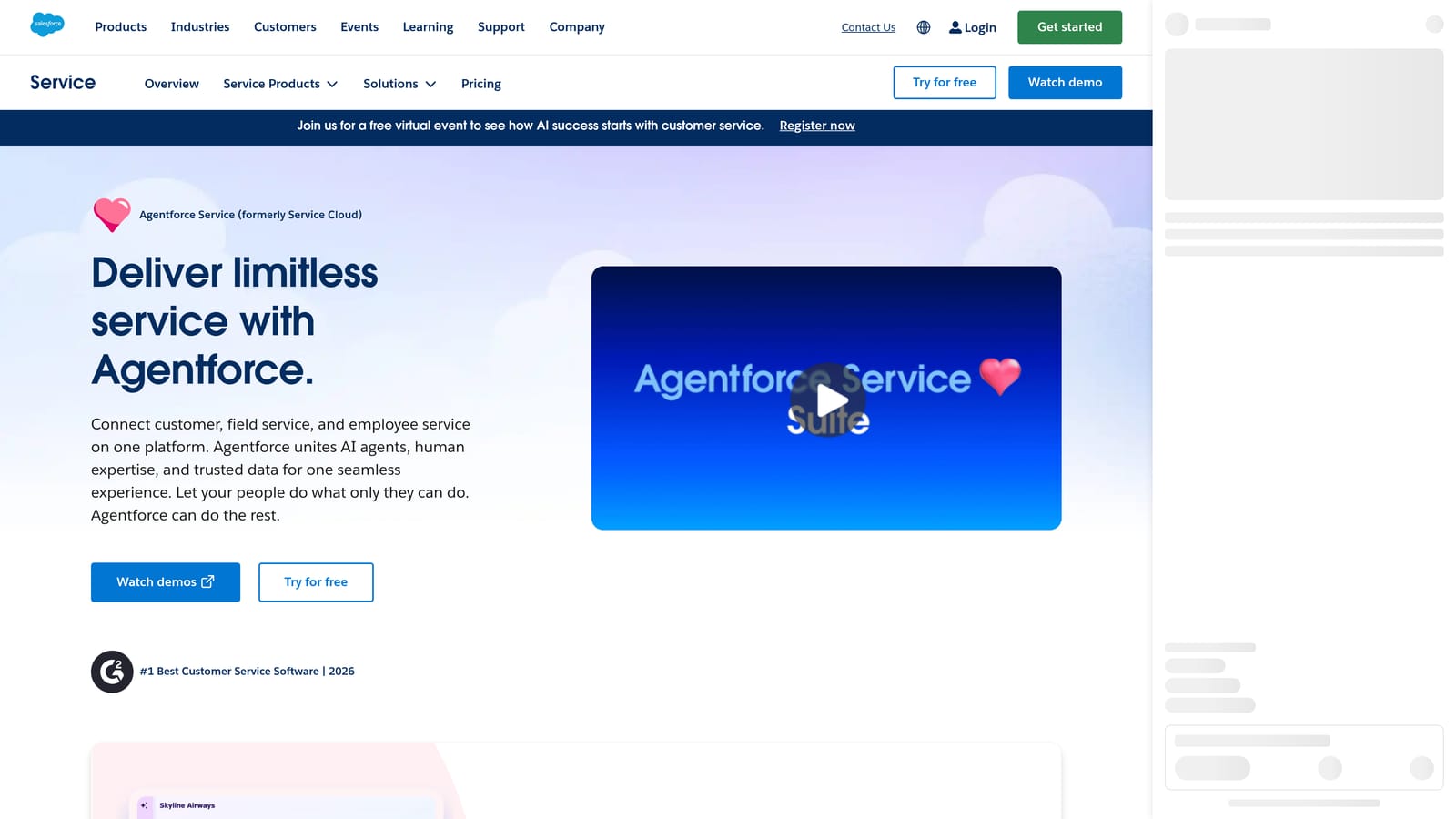
Salesforce Einstein Service Cloud is an enterprise service platform with deeply embedded AI capabilities, including Einstein Copilot for agents, automated case classification, and next-best-action recommendations, all native to the Salesforce CRM.
Where This Tool Shines
If your organization already runs on Salesforce, Einstein Service Cloud is a natural extension. The CRM-native context is genuinely powerful: AI recommendations are informed by the full customer record, including purchase history, open opportunities, and previous interactions across sales and service. That level of context is hard to replicate with a standalone support tool.
The omnichannel capabilities are mature and enterprise-grade, covering email, chat, phone, and social in a unified interface. For organizations where customer service is tightly coupled with sales and account management, this integration depth is a real advantage.
Key Features
Einstein Copilot: AI assistant for human agents with suggested responses, knowledge retrieval, and case summarization drawn from CRM context.
Automated Case Classification: Routes and prioritizes cases automatically based on CRM data and historical patterns.
Next-Best-Action Recommendations: Surfaces contextual recommendations for agents based on the full customer relationship record.
Omnichannel Support: Unified handling across email, chat, phone, and social media channels.
Native Cloud Integration: Deep connectivity with Sales Cloud, Marketing Cloud, and Commerce Cloud for cross-functional workflows.
Best For
Enterprises already running Salesforce as their CRM will find the most value here. For organizations not already on Salesforce, the cost of entry and implementation complexity make it a harder sell compared to more focused alternatives.
Pricing
Enterprise pricing with custom quotes required. Salesforce is typically among the higher-cost options in the market, with significant implementation and licensing costs for large deployments.
3. Zendesk AI
Best for: Teams already on Zendesk looking to add AI capabilities without migrating platforms.
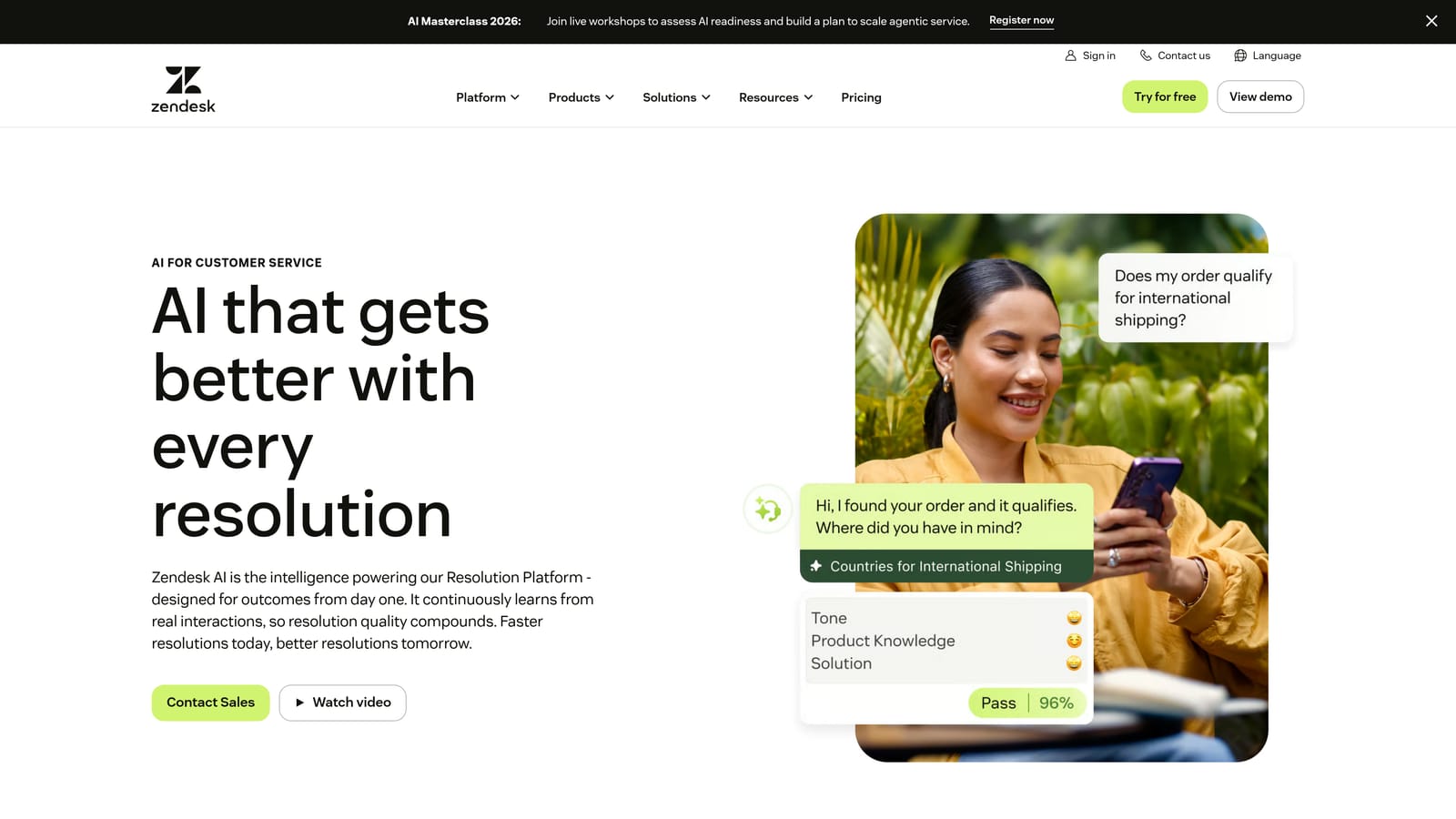
Zendesk AI is an AI layer built on top of Zendesk's established helpdesk platform, offering intelligent triage, automated responses, agent copilot features, and self-service automation for teams already invested in the Zendesk ecosystem.
Where This Tool Shines
Zendesk has made significant AI investments in recent years, and the results show in features like intelligent triage, automated responses using help center content, and the Agent Copilot for suggested replies and ticket summarization. For teams already running Zendesk, these capabilities extend an existing investment rather than requiring a platform change.
The app marketplace is one of Zendesk's strongest assets, with hundreds of integrations available. If your stack is already connected to Zendesk, adding AI features is relatively low friction. That said, it's worth noting that Zendesk AI is fundamentally an add-on to a traditional helpdesk rather than an AI-native architecture. If you're evaluating whether an AI-first platform might serve you better, this comparison is worth reading.
Key Features
AI-Powered Triage: Automatic intent detection and ticket routing to reduce manual classification work.
Automated Responses: Generates responses to common queries using existing help center content.
Agent Copilot: Suggested replies, ticket summarization, and macro recommendations for human agents.
Advanced Bots: Self-service deflection bots that intercept common questions before tickets are created.
App Marketplace: Hundreds of integrations available for extending the platform across your business stack.
Best For
Zendesk AI is the right choice if you're already on Zendesk and want to add AI without a full platform migration. For teams evaluating from scratch, the AI-first alternatives on this list may offer more autonomous resolution capability out of the box.
Pricing
AI features are add-ons to existing Zendesk plans, placing the total cost in the mid-to-enterprise range depending on the tier and add-ons selected.
4. Intercom Fin AI
Best for: SaaS products with strong in-app messaging needs and self-serve support models.
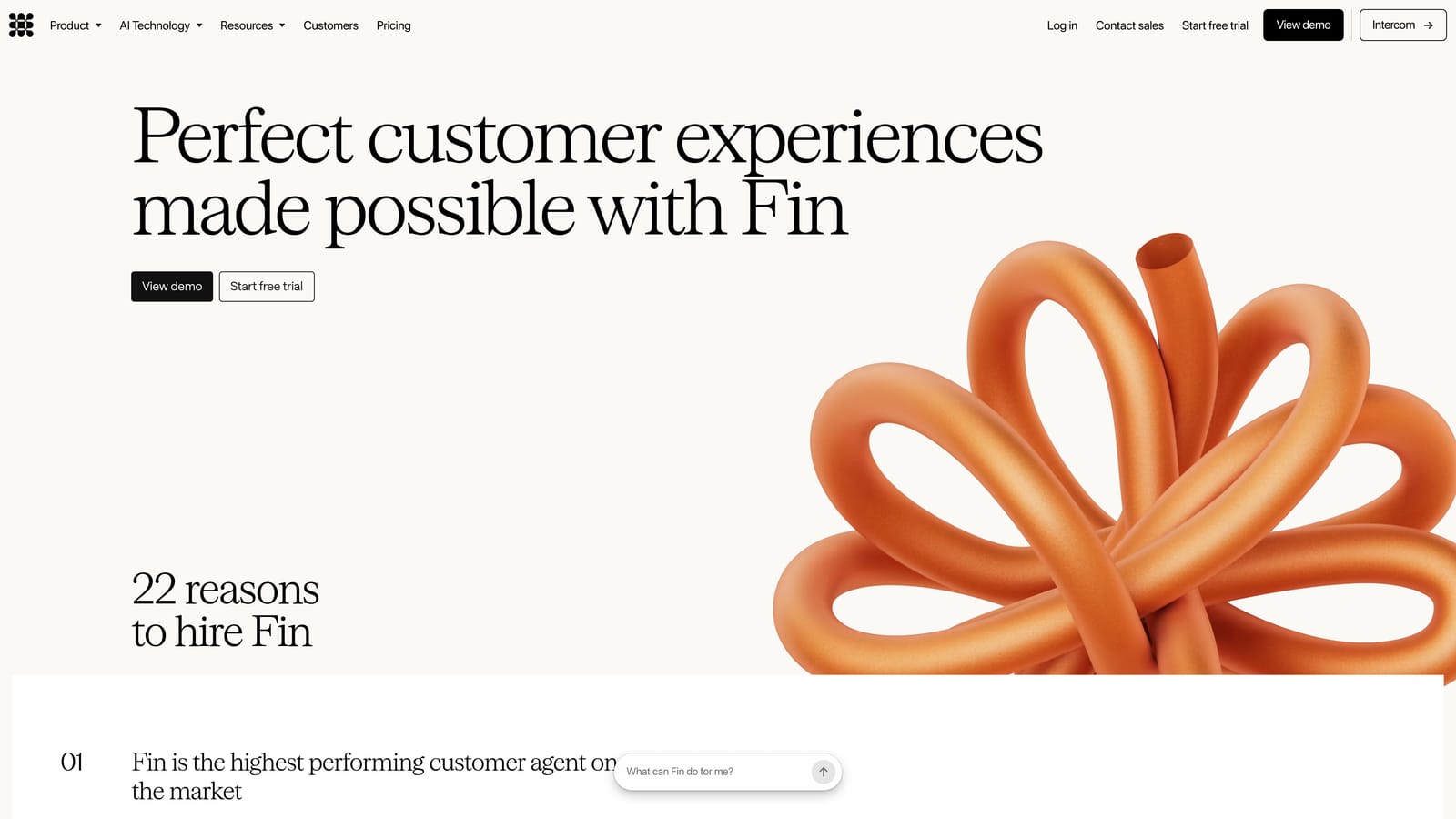
Intercom Fin AI is a GPT-powered AI agent designed to autonomously resolve customer questions using your help content, with strong in-app messaging integration and a resolution-based pricing model that's unique in the market.
Where This Tool Shines
Fin's strength is in-product support. If your users primarily interact with support through an in-app messenger, Fin is deeply integrated into that surface and can resolve a meaningful portion of common queries without human involvement. The resolution-based pricing model is conceptually appealing: you pay per resolved conversation rather than per seat or per message.
The Fin AI Copilot extends AI assistance to human agents in real time, pulling relevant content and suggesting responses during live conversations. Multi-language support and customizable tone settings make it adaptable for global teams.
Key Features
Fin AI Agent: Autonomous resolution using your existing help center content, without requiring custom training data.
Resolution-Based Pricing: Pay per resolved conversation rather than per seat, aligning cost with outcomes.
In-App Messenger Integration: Deep integration with Intercom's messenger for product-surface support.
Fin AI Copilot: Real-time AI assistance for human agents during live conversations.
Multi-Language Support: Customizable tone and persona settings with support across multiple languages.
Best For
Product-led SaaS companies with active in-app messaging and a strong help center will get the most from Fin. Teams with very high conversation volumes should model the resolution-based pricing carefully, as costs can scale quickly at volume.
Pricing
Resolution-based pricing layered on top of Intercom seat plans. The model is attractive in principle but requires careful volume modeling to predict total cost at scale.
5. Freshdesk Freddy AI
Best for: Growing teams that need solid AI capabilities at a more accessible price point.
Freshdesk Freddy AI is Freshworks' AI layer across the Freshdesk support suite, covering ticket automation, suggested responses, self-service bots, and agent assist at a more accessible price point than most enterprise alternatives.
Where This Tool Shines
Freddy AI's primary advantage is accessibility. For teams that need meaningful AI functionality without the cost and complexity of Salesforce or enterprise Zendesk, Freshdesk offers a capable suite at a lower price point. Implementation is generally faster, and the platform is more self-serve friendly for teams without large IT resources.
Freddy Insights adds an analytics layer that generates AI-powered performance recommendations, which is useful for support managers looking to optimize team performance without building custom reporting.
Key Features
Freddy Self Service: AI-powered bot for self-serve deflection before tickets are created.
Freddy Copilot: Ticket summarization, suggested responses, and tone adjustment for human agents.
Freddy Insights: AI-generated analytics and performance recommendations for support managers.
Auto-Triage: Intelligent ticket routing based on intent and historical patterns.
Best For
Mid-market teams and growing companies that need solid AI support capabilities without enterprise-level budgets or implementation complexity. Teams that prioritize ease of setup over maximum AI autonomy will find Freshdesk a practical choice.
Pricing
Tiered plans with Freddy AI features available on the Growth tier and above, making it one of the more accessible options on this list compared to Salesforce or enterprise Zendesk.
6. ServiceNow Customer Service Management
Best for: Large enterprises where customer issues require cross-departmental resolution workflows.
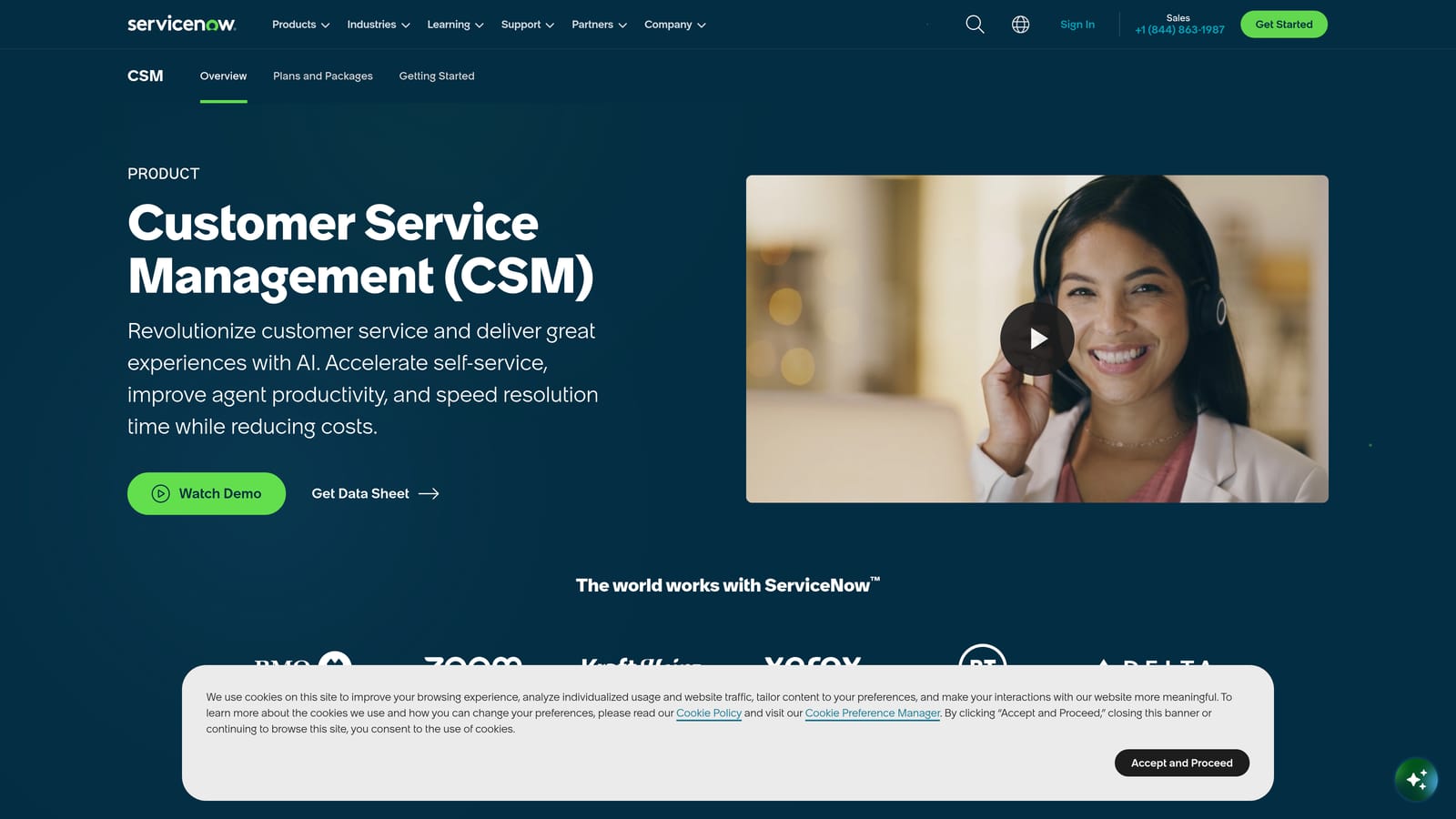
ServiceNow Customer Service Management extends ServiceNow's established ITSM foundation into customer-facing support, with deep workflow automation, cross-departmental case routing, and AI-powered Virtual Agent capabilities.
Where This Tool Shines
ServiceNow's core strength is workflow automation at enterprise scale. When a customer issue requires involvement from finance, engineering, legal, or operations, ServiceNow's cross-departmental routing and case management capabilities are genuinely best-in-class. It's built for organizations where support is a complex, multi-team function rather than a single-department operation.
The proactive customer service capabilities, including integrations with IoT and monitoring systems, allow ServiceNow to surface and resolve issues before customers even report them. For enterprises with complex infrastructure, this predictive capability is a meaningful differentiator.
Key Features
Virtual Agent: AI-powered chatbot with natural language understanding for self-service resolution.
Predictive Intelligence: Automated case classification and routing based on historical data and AI models.
Cross-Departmental Workflows: Connects support to finance, engineering, and operations for complex issue resolution.
Case Summarization: AI-assisted knowledge management and case documentation.
Proactive Service: IoT and monitoring integrations that surface issues before customers report them.
Best For
Large enterprises with complex, multi-departmental support workflows. ServiceNow is overkill for lean SaaS teams but genuinely powerful for organizations where customer issues routinely span multiple internal teams.
Pricing
Enterprise-only with custom quotes required. ServiceNow is typically among the highest-cost options in the market, reflecting its enterprise scope and implementation complexity.
7. Kustomer
Best for: High-volume consumer support teams that need a unified customer conversation timeline.
Kustomer is a CRM-native customer service platform that unifies all customer interactions into a single timeline, with AI-powered workflows, intent detection, and automated routing built for high-volume consumer support operations.
Where This Tool Shines
Kustomer's unified timeline model is its defining feature. Rather than treating each support interaction as an isolated ticket, agents see the complete customer history across every channel: email, chat, social, SMS, and voice, all in one chronological view. For high-volume consumer brands where context is everything, this model significantly reduces the time agents spend reconstructing customer history.
KustomerIQ, the platform's AI layer, adds sentiment analysis, CSAT prediction, and workflow automation on top of that rich conversation history. The combination of deep customer context and AI-driven automation makes it well-suited for teams handling large volumes of emotionally complex interactions.
Key Features
Unified Customer Timeline: All channels consolidated into a single chronological view per customer.
AI Intent Detection: Automated conversation routing based on detected intent and customer context.
Automated Workflows: Triggered by customer behavior and CRM data for consistent handling at scale.
Agent Assist: Suggested responses powered by full conversation history and customer record.
KustomerIQ: AI layer for sentiment analysis, CSAT prediction, and intelligent automation.
Best For
High-volume B2C support operations where customer context across channels is critical. Kustomer is particularly strong for retail, e-commerce, and consumer subscription businesses handling large volumes of emotionally sensitive interactions.
Pricing
Per-agent pricing with enterprise-focused plans. Custom quotes are available for larger teams, and pricing reflects the platform's premium positioning in the CRM-native support category.
8. Gladly
Best for: Premium consumer brands that prioritize relationship quality over ticket volume metrics.
Gladly is a people-centric customer service platform built around conversations rather than tickets, with AI capabilities including Sidekick for autonomous self-service and Assist for agent copilot support, designed specifically for premium consumer brands.
Where This Tool Shines
Gladly's philosophical difference from most platforms on this list is worth understanding. It's built around the customer as a person rather than a ticket number. Agents see a continuous conversation thread with each customer across all channels and all time, not a series of isolated support cases. For brands where the quality of customer relationships is a competitive differentiator, this model creates meaningfully different agent behavior.
The Sidekick AI agent handles self-service resolution across voice, chat, email, and SMS, while Assist provides real-time AI recommendations for human agents during live interactions. The combination gives teams flexibility to automate routine interactions while keeping high-value conversations in human hands.
Key Features
Conversation-Centric Model: Agents see a continuous thread per customer, not isolated tickets, across all channels and time.
Sidekick AI Agent: Autonomous self-service resolution across voice, chat, email, and SMS channels.
Assist: Real-time AI recommendations and next-best-action guidance for human agents.
Unified Customer Profile: Complete customer view visible across all channels and all agents simultaneously.
Proactive Outreach: Task automation and proactive communication capabilities for high-touch service models.
Best For
Premium consumer brands, luxury retailers, and subscription businesses where customer relationship quality drives retention. Gladly is less suited for teams primarily optimizing for ticket deflection volume and better suited for those optimizing for customer lifetime value.
Pricing
Per-agent pricing with enterprise-focused plans. Custom quotes are available for larger deployments, and the platform is positioned at the premium end of the market.
9. Forethought AI
Best for: Enterprises that want better AI without migrating away from their existing helpdesk.
Forethought AI is an AI platform designed to sit on top of existing helpdesks, including Zendesk, Salesforce, Freshdesk, and ServiceNow, adding autonomous resolution, intelligent triage, and agent copilot capabilities without requiring a platform migration.
Where This Tool Shines
Forethought occupies a unique position in this list: it's explicitly designed to enhance your existing helpdesk rather than replace it. If your organization has significant investment in Zendesk or Salesforce and can't justify a full migration, Forethought adds a meaningful AI layer on top of what you already have. The helpdesk-agnostic architecture is genuinely flexible.
The Solve product handles autonomous ticket resolution using existing knowledge base content, while Triage adds intelligent routing and priority scoring. The workflow builder allows support teams to create custom automation without engineering resources, which matters for teams that need to move quickly without IT bottlenecks.
Key Features
Solve: Autonomous AI agent that resolves tickets using existing knowledge base content without custom training.
Triage: AI-powered intent detection, routing, and priority scoring across incoming ticket volume.
Assist: Agent copilot with suggested responses, ticket summarization, and knowledge retrieval.
Helpdesk-Agnostic Integration: Connects with Zendesk, Salesforce, Freshdesk, and ServiceNow without requiring migration.
Workflow Builder: Custom automation builder accessible to support teams without engineering resources.
Best For
Enterprises locked into existing helpdesk contracts or with significant process investment in platforms like Zendesk or Salesforce. Forethought is the pragmatic choice when migration isn't feasible but AI capability improvement is urgent.
Pricing
Custom enterprise pricing with a sales conversation required. Pricing is not publicly listed and is structured for enterprise-scale deployments.
Which Platform Is Right for Your Team?
The right platform depends heavily on where you're starting from and what you're optimizing for. Here's a quick guide to cut through the noise.
If you're a B2B SaaS company that wants an AI-first platform with deep product integration, business intelligence, and continuous learning, Halo AI is the strongest purpose-built option. Its page-aware context, bug routing, and revenue intelligence capabilities go well beyond what most platforms on this list offer.
If you're already deeply embedded in Salesforce, Einstein Service Cloud is the natural extension. For existing Zendesk customers not ready to migrate, Zendesk AI adds meaningful capability to an existing investment. And if you want AI on top of your current helpdesk without migrating, Forethought is the pragmatic choice.
For high-volume consumer support, Kustomer and Gladly stand out, with Kustomer optimizing for context at scale and Gladly for relationship quality. Intercom Fin is strong for product-led SaaS with active in-app messaging. Freshdesk is the most accessible entry point for teams with tighter budgets. And ServiceNow is purpose-built for enterprises with complex, cross-departmental support workflows.
Your support team shouldn't scale linearly with your customer base. Let AI agents handle routine tickets, guide users through your product, and surface business intelligence while your team focuses on complex issues that need a human touch. See Halo in action and discover how continuous learning transforms every interaction into smarter, faster support.