9 Best Enterprise AI Customer Service Solutions in 2026
This comprehensive guide evaluates the 9 best enterprise AI customer service solutions in 2026, comparing platforms on autonomous ticket resolution, integration capabilities, scalability, and overall value to help support teams handle growing demand without proportional headcount increases.
 Grant CooperFounder15 min read
Enterprise support teams are under more pressure than ever: resolve more tickets, faster, without a proportional headcount increase. The good news is that a new generation of AI customer service platforms has moved well beyond basic chatbots. Today's best tools autonomously resolve tickets, surface business intelligence, integrate with your entire tech stack, and hand off to human agents when it genuinely matters.
Whether you're running a 50-person support organization or a global operation spanning multiple time zones, the right enterprise AI solution can fundamentally change what your team is capable of. This guide covers the top enterprise AI customer service solutions available in 2026, evaluated on depth of AI capability, integration breadth, scalability, and total value.
The list includes tools suited to different organizational needs: AI-first platforms built for autonomous resolution, established helpdesk giants adding AI layers, and specialized tools for specific industries. Use the breakdown below to find the right fit for your team's specific requirements.
1. Halo AI
Best for: B2B SaaS teams that want an AI-first support platform, not an AI add-on
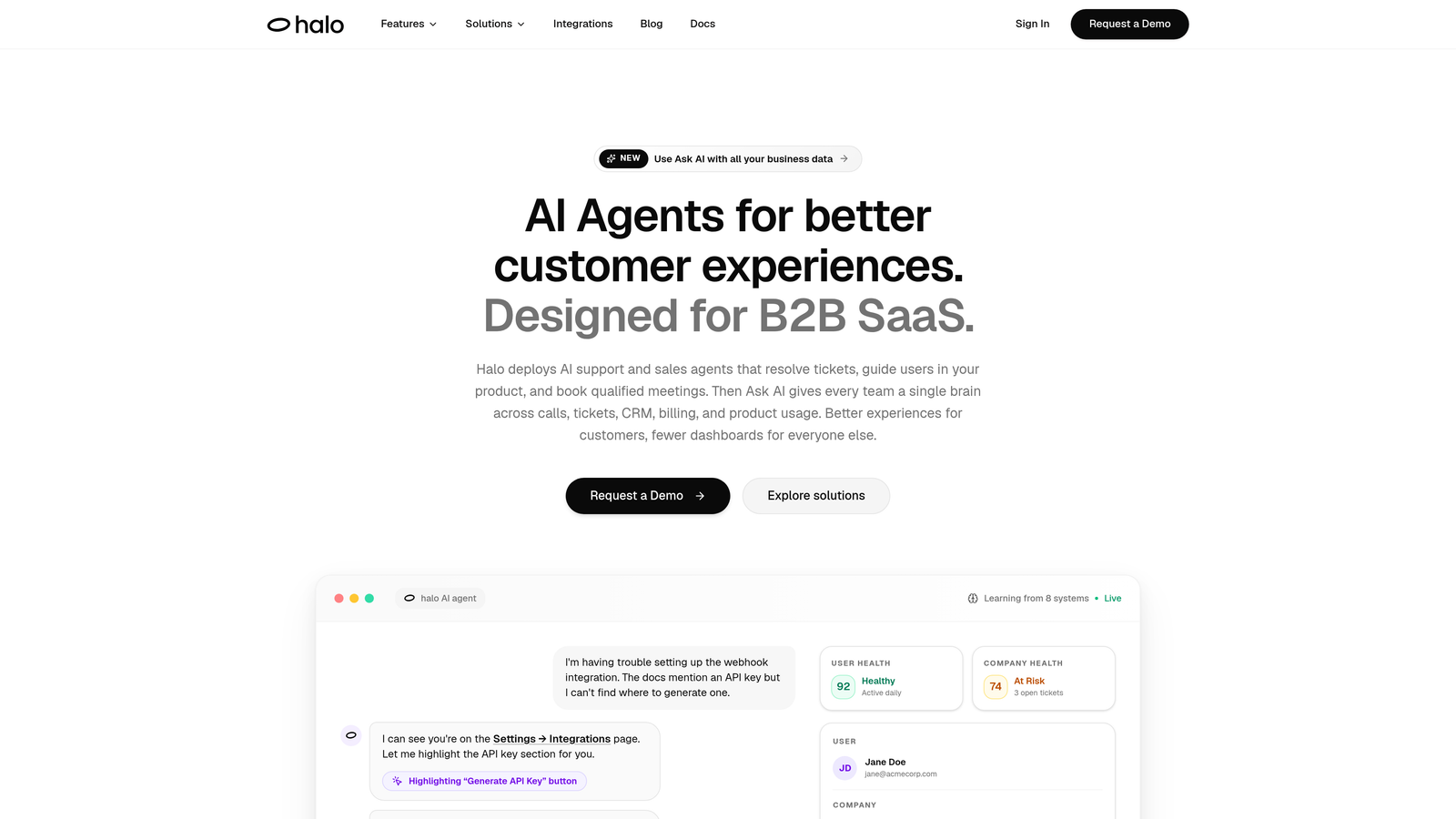
Halo AI is an AI-first customer support platform purpose-built for B2B SaaS companies that want genuine ticket resolution, not just deflection.
Where This Tool Shines
What sets Halo apart from the field is its page-aware architecture. The AI agent doesn't just read what a user types; it sees where they are in your product and provides in-context visual UI guidance based on their exact screen state. That's a meaningful difference when your users are troubleshooting something specific and need step-by-step help, not a generic knowledge base article.
Halo is also not a layer on top of an existing helpdesk. The platform is the helpdesk, built AI-first from the ground up. That distinction matters for teams that want continuous learning baked into every interaction rather than bolted on afterward. Every resolved ticket makes the system smarter, and the smart inbox surfaces business intelligence signals like customer health, revenue anomalies, and churn indicators that would otherwise get buried in ticket queues.
Key Features
Page-Aware AI Agents: The AI sees what users see in real time, delivering visual UI guidance and in-context support based on the user's current product state.
Autonomous Ticket Resolution: AI agents resolve support tickets end-to-end with continuous learning from every interaction, improving accuracy over time without manual retraining.
Auto Bug Ticket Creation: Automatically identifies and routes bug reports directly to Linear or Jira, eliminating manual triage for engineering-bound issues.
Smart Inbox with Business Intelligence: Surfaces customer health signals, revenue anomalies, and churn indicators from support interactions, turning your inbox into a source of product intelligence.
Live Agent Handoff: Escalates to human agents with full conversation context preserved, so agents never start from scratch.
Native Integrations: Connects natively with Linear, Slack, HubSpot, Intercom, Stripe, Zoom, PandaDoc, and Fathom.
Best For
Halo is the strongest fit for B2B SaaS companies that want an AI-first support architecture rather than AI features layered onto a legacy helpdesk. It's particularly well-suited to product-led teams where support, product feedback, and customer health signals all need to flow into the same system. Teams that rely heavily on Linear or Jira for engineering workflows will find the auto bug ticket creation especially valuable.
Pricing
Contact for enterprise pricing at haloagents.ai. Custom packages available based on team size and integration requirements.
2. Salesforce Agentforce
Best for: Large enterprises already deeply invested in the Salesforce ecosystem
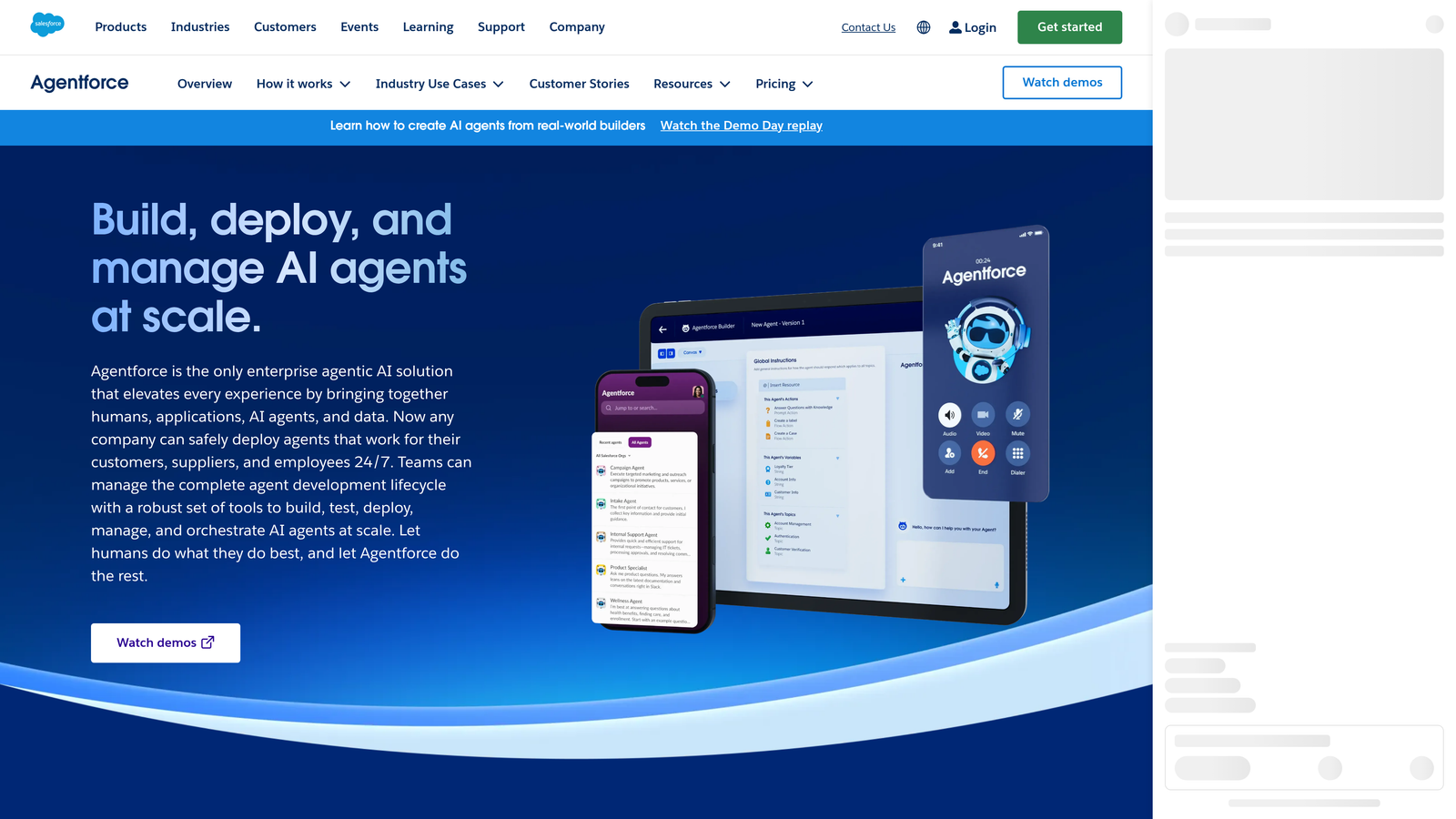
Salesforce Agentforce is Salesforce's autonomous AI agent platform, built natively into Service Cloud and powered by Einstein AI and Salesforce Data Cloud.
Where This Tool Shines
Agentforce's biggest advantage is native CRM data access. Because it lives inside Salesforce, AI agents can draw on the full customer record: purchase history, open opportunities, prior cases, and more. That context depth is hard to replicate with a standalone AI tool plugged into a CRM via API.
For enterprises already running Service Cloud, Sales Cloud, and Salesforce Data Cloud, Agentforce can feel like a natural extension rather than a new tool to manage. The pre-built agent templates for common enterprise support workflows reduce time to deployment, and the human escalation path preserves full CRM context when a case moves to a live agent.
Key Features
Einstein AI-Powered Agents: Autonomous agents built on Einstein AI with direct access to Salesforce CRM data across the customer lifecycle.
Cross-Cloud Integration: Deep native integration across Service Cloud, Sales Cloud, and Salesforce Data Cloud with no additional connectors required.
Pre-Built Agent Templates: Ready-to-deploy templates for common enterprise support workflows, reducing configuration time.
Human Escalation with CRM Context: Escalations pass full CRM context to human agents, maintaining continuity across the interaction.
Enterprise Security and Compliance: Built on Salesforce's enterprise-grade security infrastructure with compliance controls appropriate for regulated industries.
Best For
Agentforce is purpose-built for large enterprises running Salesforce as their CRM backbone. If your support, sales, and customer success teams all live in Salesforce, the unified data model is a genuine advantage. It's a harder sell for organizations not already committed to the Salesforce ecosystem, given the cost and complexity involved.
Pricing
Custom enterprise pricing as part of Salesforce Service Cloud packages. Contact Salesforce directly for current rates.
3. Zendesk AI
Best for: Existing Zendesk users who want AI capabilities without migrating their helpdesk
Zendesk AI layers intelligent automation across the Zendesk Suite, including triage, agent copilot suggestions, automated routing, and self-service deflection.
Where This Tool Shines
The strongest argument for Zendesk AI is zero migration friction. If your team is already running Zendesk, you get AI capabilities layered onto your existing workflows, your existing ticket data, and your existing agent training. That's a meaningful advantage when you're evaluating the real cost of switching platforms.
The agent copilot is a practical productivity tool: suggested responses, next-best-action guidance, and automated knowledge base surfacing help agents work faster without requiring them to change how they operate. The CSAT prediction and quality assurance features are useful for support leaders who want AI-assisted coaching at scale.
Key Features
AI-Powered Triage and Routing: Automatically categorizes and routes incoming tickets based on intent, priority, and customer data.
Agent Copilot: Provides real-time suggested responses and next-best-action guidance to help agents resolve tickets faster.
Knowledge Base Automation: Surfaces relevant articles to customers and agents, and assists with generating new knowledge base content.
CSAT Prediction and QA: Predicts customer satisfaction scores and flags conversations for quality review before they escalate.
No Migration Required: All AI features work within existing Zendesk Suite workflows and ticket history.
Best For
Teams already running Zendesk Suite who want incremental AI improvements without a platform change. It's a strong fit for organizations with large existing knowledge bases and established Zendesk workflows. Teams looking for a ground-up AI-first architecture may find the additive approach limiting over time.
Pricing
AI features are available as add-ons to Zendesk Suite plans. Zendesk Suite starts at approximately $55 per agent per month; verify current pricing at zendesk.com.
4. Intercom Fin AI
Best for: SaaS and product-led growth companies wanting polished conversational AI
Intercom Fin is Intercom's AI agent, designed to resolve customer queries through multi-source knowledge synthesis with a conversational interface that matches modern SaaS brand expectations.
Where This Tool Shines
Fin's multi-source knowledge synthesis is one of its defining capabilities. Rather than pulling from a single knowledge base, Fin can draw on multiple content sources to construct accurate, contextual responses to complex queries. This matters for SaaS products where the answer often lives across documentation, FAQs, and product guides simultaneously.
Intercom has also invested heavily in brand customization, allowing teams to define the AI's persona and tone to align with their product's voice. For product-led growth companies where the support experience is part of the brand, that level of polish is worth noting.
Key Features
Multi-Source Knowledge Synthesis: Draws from multiple content sources to resolve complex queries with contextually accurate responses.
Customizable AI Persona: Configurable tone and persona to match your brand voice across customer interactions.
Seamless Human Handoff: Transitions to human agents within the Intercom inbox with full conversation history intact.
Per-Resolution Pricing: Usage-based pricing model available, aligning cost directly to AI-resolved interactions.
Native Intercom Integration: Deep integration with Intercom's messenger, inbox, and customer data platform.
Best For
SaaS companies and product-led growth organizations already using Intercom, or those prioritizing a polished conversational AI experience. The per-resolution pricing model can be attractive for teams wanting cost tied directly to AI performance. Less suited to organizations outside the Intercom ecosystem or those needing deep ITSM capabilities.
Pricing
Usage-based per-resolution pricing is available. Intercom plans start at approximately $74 per month; verify current pricing at intercom.com.
5. Freshdesk Freddy AI
Best for: Teams in the Freshworks ecosystem seeking AI coverage across support, CRM, and ITSM
Freshdesk Freddy AI is Freshworks' AI layer spanning Freshdesk, Freshsales, and Freshservice, delivering broad AI coverage for organizations running multiple Freshworks products.
Where This Tool Shines
Freddy AI's breadth is its primary differentiator. For companies running Freshdesk for support, Freshsales for CRM, and Freshservice for ITSM, Freddy provides a unified AI layer across all three without requiring separate AI tools for each function. That consolidation can simplify vendor management and reduce the integration overhead that comes with stitching together multiple AI platforms.
Freshworks has also historically positioned itself as the accessible alternative to enterprise-tier pricing, and Freddy AI continues that pattern. AI capabilities are included in higher Freshdesk tiers rather than priced as a significant separate add-on, making it a practical option for mid-market teams watching budget carefully.
Key Features
Auto-Triage and Routing: Automatically tags, categorizes, and routes incoming tickets based on content and priority signals.
Freddy Self Service: Customer-facing AI deflection that resolves common queries before they reach the support queue.
Agent Assist: Provides suggested responses, ticket summarization, and contextual knowledge surfacing to help agents resolve issues faster.
Cross-Product AI Coverage: Spans Freshdesk (support), Freshsales (CRM), and Freshservice (ITSM) within the Freshworks platform.
Accessible Pricing: AI features included in higher-tier plans without enterprise-level pricing requirements.
Best For
Organizations already running multiple Freshworks products who want consistent AI capabilities across their entire customer-facing stack. Also a strong option for mid-market teams that need solid AI functionality at a price point below Salesforce or ServiceNow.
Pricing
Freddy AI features are included in higher Freshdesk tiers. Plans start at approximately $15 per agent per month; verify current pricing at freshworks.com.
6. ServiceNow Now Assist
Best for: Large enterprises running IT and HR service management at scale
ServiceNow Now Assist brings generative AI capabilities to case summarization, knowledge generation, and workflow automation across the ServiceNow platform.
Where This Tool Shines
ServiceNow is the dominant platform in enterprise ITSM, and Now Assist extends that dominance into generative AI. The case summarization capability is particularly valuable for large IT and HR service teams where agents frequently need to get up to speed on complex, multi-touch cases quickly. AI-generated summaries reduce the time agents spend reading case history before they can contribute meaningfully.
The knowledge article creation and gap identification features address a chronic problem in large enterprises: knowledge bases that are outdated, incomplete, or inconsistently maintained. Now Assist can identify where knowledge gaps exist and assist in generating new content to fill them, which compounds in value over time.
Key Features
Generative AI Case Summarization: Automatically summarizes complex cases and resolution notes, reducing agent ramp-up time on multi-touch issues.
AI-Assisted Knowledge Creation: Identifies knowledge base gaps and assists in generating new articles to address them.
Natural Language Workflow Configuration: Allows teams to configure and modify workflows using natural language rather than technical configuration tools.
Cross-Module Coverage: Spans IT service management, HR service delivery, and customer service management modules.
Enterprise Governance: Built-in compliance controls and governance frameworks appropriate for large regulated enterprises.
Best For
Large enterprises already running ServiceNow for ITSM or HR service delivery who want to add generative AI without introducing a new platform. Less commonly used for traditional customer-facing support; strongest in internal IT and HR service contexts.
Pricing
Custom enterprise pricing as part of ServiceNow platform licensing. Contact ServiceNow directly for current rates.
7. Kustomer
Best for: High-volume B2C brands with complex customer data and e-commerce integrations
Kustomer is a CRM-native customer service platform with AI built around the full customer timeline, combining purchase history, prior interactions, and sentiment in a single view.
Where This Tool Shines
Kustomer's unified customer timeline is the feature that makes it genuinely different from a traditional helpdesk. Instead of seeing only the current ticket, agents and AI alike have access to the full picture: every prior interaction, order history, sentiment trends, and channel touchpoints. For B2C brands where a single customer might have dozens of interactions across multiple channels, that context is operationally significant.
The AI capabilities are built on top of that rich data model, which means intent detection and routing decisions are informed by more than just the current message. Proactive AI outreach based on customer signals is a particularly useful capability for brands that want to get ahead of issues rather than simply react to them.
Key Features
Unified Customer Timeline: Combines support interactions, order history, and channel touchpoints into a single customer view accessible to both agents and AI.
AI Intent Detection and Sentiment Analysis: Identifies customer intent and sentiment across interactions to inform routing and prioritization.
Automated Conversation Routing: Routes conversations based on full customer data context, not just ticket content.
Proactive AI Outreach: Triggers outbound engagement based on customer signals before issues escalate to inbound tickets.
E-Commerce Integrations: Strong native integrations with e-commerce and retail platforms for order and fulfillment data.
Best For
High-volume B2C brands in e-commerce, retail, and consumer services where support agents need full customer context to resolve issues efficiently. Less suited to B2B SaaS companies or organizations where ITSM is the primary use case.
Pricing
Enterprise pricing; contact Kustomer directly for current rates at kustomer.com.
8. Forethought AI
Best for: Enterprises that want AI ROI without migrating their existing helpdesk
Forethought AI is a helpdesk-agnostic AI layer that adds intelligent triage, deflection, and resolution capabilities on top of existing platforms like Zendesk, Salesforce Service Cloud, and Freshdesk.
Where This Tool Shines
The core value proposition is straightforward: you don't have to change your helpdesk to get meaningful AI capabilities. For enterprises locked into existing platforms due to data, workflow, or contract reasons, Forethought provides a path to AI-powered triage and deflection without the disruption and cost of a full platform migration.
The triage and routing capabilities improve over time by learning from historical ticket data, which means the system gets more accurate as it processes more of your organization's actual support patterns. That historical learning is a meaningful advantage over generic AI tools that start from scratch with no context about your product or customer base.
Key Features
Helpdesk-Agnostic Architecture: Deploys on top of Zendesk, Salesforce Service Cloud, Freshdesk, and other major platforms without requiring migration.
Historical Data-Driven Triage: AI routing and triage that improves continuously based on your organization's historical ticket patterns.
Self-Service Deflection: Conversational AI that resolves common queries before they reach the agent queue.
Agent Assist: Surfaces contextually relevant knowledge to agents in real time during active conversations.
Broad Integration Support: Connects with Zendesk, Salesforce, Freshdesk, and additional enterprise helpdesk platforms.
Best For
Enterprises committed to their current helpdesk platform that want to add AI capabilities quickly and without platform disruption. Also useful as a bridge solution for organizations evaluating a full AI-first migration over a longer timeline.
Pricing
Custom pricing based on ticket volume and integrations. Contact Forethought for enterprise rates at forethought.ai.
9. Ada CX
Best for: Consumer-facing enterprises needing action-oriented AI that can execute transactions, not just answer questions
Ada CX is an enterprise AI agent platform focused on action-oriented automation, capable of executing transactions and account changes rather than simply providing informational responses.
Where This Tool Shines
Most AI support tools answer questions. Ada executes actions. The platform can process refunds, update account details, modify subscriptions, and complete other transactional workflows autonomously, which is a fundamentally different capability than knowledge-based deflection. For consumer-facing enterprises in telecom, fintech, and large retail, that distinction translates directly into resolution rates and cost per interaction.
Ada's no-code customization model is another practical strength. Non-technical teams can configure and adjust AI behavior without engineering involvement, which matters in large organizations where engineering bandwidth is a constant constraint. The multilingual support across major languages also makes Ada viable for global consumer brands with diverse customer bases.
Key Features
Action-Oriented AI Agents: Executes transactions including refunds, account updates, and subscription changes autonomously without human intervention.
No-Code AI Customization: Non-technical teams can configure, adjust, and extend AI behavior without engineering involvement.
Multilingual Support: Supports customer interactions across major languages for global enterprise deployments.
Enterprise Back-End Integrations: Deep integrations with enterprise systems enabling the transactional capabilities that differentiate Ada from informational AI tools.
Proven Enterprise Deployments: Strong track record in telecom, fintech, and large consumer brand environments.
Best For
Consumer-facing enterprises in telecom, fintech, insurance, and large retail where AI needs to complete transactions, not just answer questions. Less suited to B2B SaaS environments where the support use case is more product guidance than transactional execution.
Pricing
Custom enterprise pricing. Contact Ada directly for current rates at ada.cx.
Which Tool Is Right for Your Team
There's no single winner here because the right tool depends heavily on your existing stack, your customer base, and what you actually need AI to do. Here's a quick way to cut through the options.
AI-first B2B SaaS teams: Halo AI is the strongest fit if you want a platform built for autonomous resolution from the ground up, with page-aware context, business intelligence from support data, and deep integrations with the tools your product and engineering teams already use.
Salesforce-native enterprises: Agentforce is the natural choice if your entire customer-facing operation already runs on Salesforce and you want AI that draws directly on your CRM data without additional connectors.
Existing Zendesk users: Zendesk AI delivers incremental improvement without migration friction. If your team is productive in Zendesk and you're not ready to rearchitect your support stack, it's the lowest-risk path to AI capabilities.
Polished SaaS conversational AI: Intercom Fin is a strong choice for product-led growth companies that prioritize a branded, conversational AI experience and are already in the Intercom ecosystem.
Freshworks ecosystem teams: Freddy AI provides the broadest AI coverage across support, CRM, and ITSM for organizations running multiple Freshworks products, at a price point that works for mid-market teams.
Enterprise ITSM and IT service management: ServiceNow Now Assist is the clear choice for large enterprises where the primary use case is internal IT and HR service delivery rather than customer-facing support.
High-volume B2C support: Kustomer's unified customer timeline and AI built on full customer data make it the strongest option for e-commerce and retail brands dealing with high interaction volumes and complex order histories.
Helpdesk-agnostic AI layer: Forethought is the right call for enterprises that need AI ROI quickly but can't or won't migrate their existing helpdesk platform.
Action-oriented enterprise AI: Ada CX stands apart for consumer-facing enterprises in telecom, fintech, and large retail where the AI needs to execute transactions, not just surface answers.
Your support team shouldn't scale linearly with your customer base. Let AI agents handle routine tickets, guide users through your product, and surface business intelligence while your team focuses on complex issues that need a human touch. See Halo in action and discover how continuous learning transforms every interaction into smarter, faster support.