9 Best Enterprise AI Helpdesk Solutions in 2026
The best enterprise AI helpdesk solutions in 2026 go beyond basic automation, offering autonomous ticket resolution, real-time contextual intelligence, and seamless human handoffs that allow support teams to handle growing volume without scaling headcount. This guide evaluates the top platforms on AI capability, integration depth, scalability, and analytics to help enterprises replace legacy systems with solutions built for modern support demands.
 Matt PattoliFounder14 min read
Enterprise support teams are under more pressure than ever: faster resolutions, fewer escalations, and zero tolerance for tickets falling through the cracks. Traditional helpdesks were built for a different era, and the gap between what they offer and what modern enterprises need has never been wider.
AI-native helpdesk solutions are closing that gap. The best platforms in 2026 combine autonomous ticket resolution, real-time contextual intelligence, and deep integrations to handle volume at scale without proportionally scaling headcount. The shift is no longer about AI helping agents work faster. It is about AI resolving tickets independently and escalating selectively.
This list covers the top enterprise AI helpdesk solutions available right now, evaluated on AI capability depth, integration ecosystem, scalability, analytics intelligence, and how cleanly each platform handles the handoff between automation and human agents. Whether you are replacing a legacy system or layering intelligence onto an existing stack, this guide will help you find the right fit.
Note: Halo AI, the company behind this blog, is featured first because it genuinely fits this category. Every tool on this list is evaluated on its own merits.
1. Halo AI
Best for: B2B SaaS teams wanting AI-native ticket resolution with continuous learning and business intelligence built in.
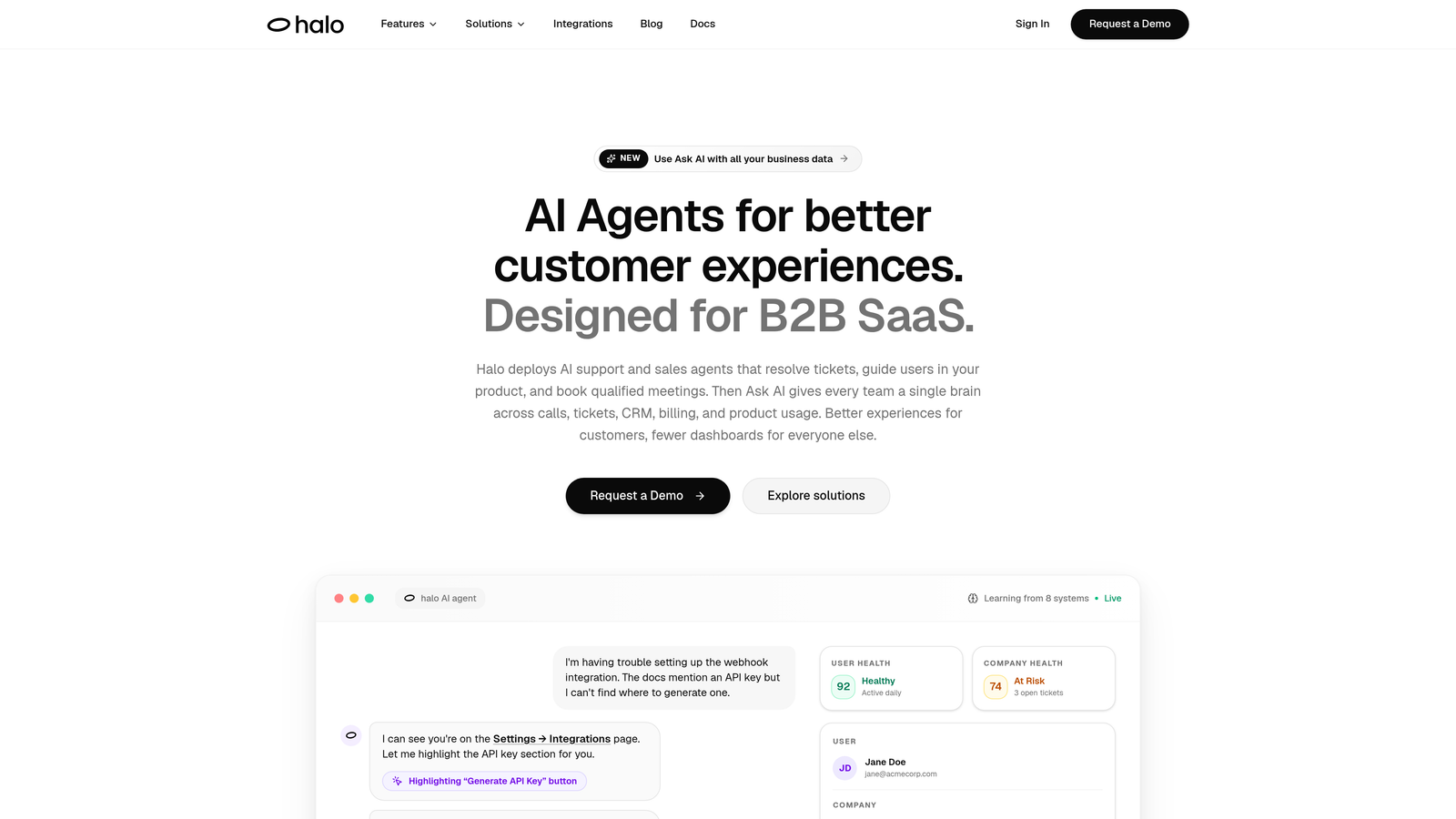
Halo AI is an AI-native customer support platform that deploys autonomous AI agents for ticket resolution, product guidance, and bug reporting.
Where This Tool Shines
Halo AI is built from the ground up as an AI-first architecture, not a traditional helpdesk with AI features bolted on afterward. This distinction matters more than it might seem. When the entire platform is designed around autonomous resolution and continuous learning, every interaction makes the system smarter rather than just adding to a ticket queue.
The standout differentiator is page-aware context. Halo's chat widget actually sees what the user sees on screen, enabling it to provide visual, step-by-step guidance that is specific to exactly where someone is in your product. Combined with a smart inbox that surfaces business intelligence signals (customer health, revenue anomalies, churn indicators) rather than just support metrics, Halo operates less like a helpdesk and more like an intelligent layer across your entire customer relationship.
Key Features
Page-Aware Chat Widget: The AI sees the user's current screen context, enabling precise visual guidance rather than generic responses.
Autonomous Ticket Resolution with Live Agent Handoff: AI handles routine tickets end-to-end and escalates complex issues to human agents with full context preserved.
Smart Inbox with Business Intelligence: Surfaces customer health signals, anomaly detection, and revenue intelligence beyond standard support metrics.
Auto Bug Ticket Creation: Automatically generates and routes bug reports directly to engineering tools like Linear, removing manual steps from the support-to-engineering pipeline.
Deep Integration Stack: Connects natively with Slack, HubSpot, Intercom, Stripe, Zoom, PandaDoc, and Fathom for a fully connected business stack.
Continuous Learning Loop: Every resolved interaction improves the AI's future performance, compounding value over time.
Best For
Halo AI is purpose-built for B2B SaaS product and support teams that want more than a helpdesk. It is particularly well-suited for companies where support intelligence needs to flow into product development, customer success, and revenue teams rather than staying siloed in a ticket system.
Pricing
Custom enterprise pricing. Contact the team directly at haloagents.ai to book a demo and get a quote tailored to your team's scale and requirements.
2. Zendesk AI
Best for: Large enterprises wanting proven AI capabilities on top of the industry's most widely deployed helpdesk platform.
Zendesk AI is the AI layer built into the industry's most widely deployed enterprise helpdesk, adding intelligent automation to a mature, compliance-ready platform.
Where This Tool Shines
Zendesk's AI capabilities have matured considerably. Intelligent Triage classifies and routes tickets automatically, while AI agents handle self-service resolution before tickets ever reach a human queue. For enterprises that have already invested heavily in Zendesk workflows, knowledge bases, and integrations, the AI layer extends that investment rather than replacing it.
The breadth of the Zendesk marketplace (over 1,000 integrations) and its enterprise-grade compliance posture make it a low-friction choice for regulated industries or organizations with complex procurement requirements. The tradeoff is that AI sits on top of a ticket-first architecture rather than being the foundation, which can limit how deeply the learning loop compounds over time.
Key Features
Intelligent Triage: Automatically classifies, tags, and routes incoming tickets without manual intervention.
AI Agents: Handle self-service resolution for common queries before routing to human agents.
Generative AI for Agents: Drafts replies and surfaces relevant knowledge base articles in real time as agents work.
Extensive Marketplace: Over 1,000 pre-built integrations covering virtually every enterprise tool category.
Enterprise Compliance: Strong security posture with certifications and controls suited for regulated industries.
Best For
Enterprises already running Zendesk who want to activate AI capabilities without migrating platforms, or organizations that prioritize compliance, marketplace breadth, and vendor maturity over AI-first architecture.
Pricing
Suite plans start at $55 per agent per month. AI add-on pricing varies by tier. Enterprise plans are custom-quoted.
3. Intercom Fin
Best for: Product-led growth companies wanting autonomous AI resolution natively inside the Intercom Messenger.
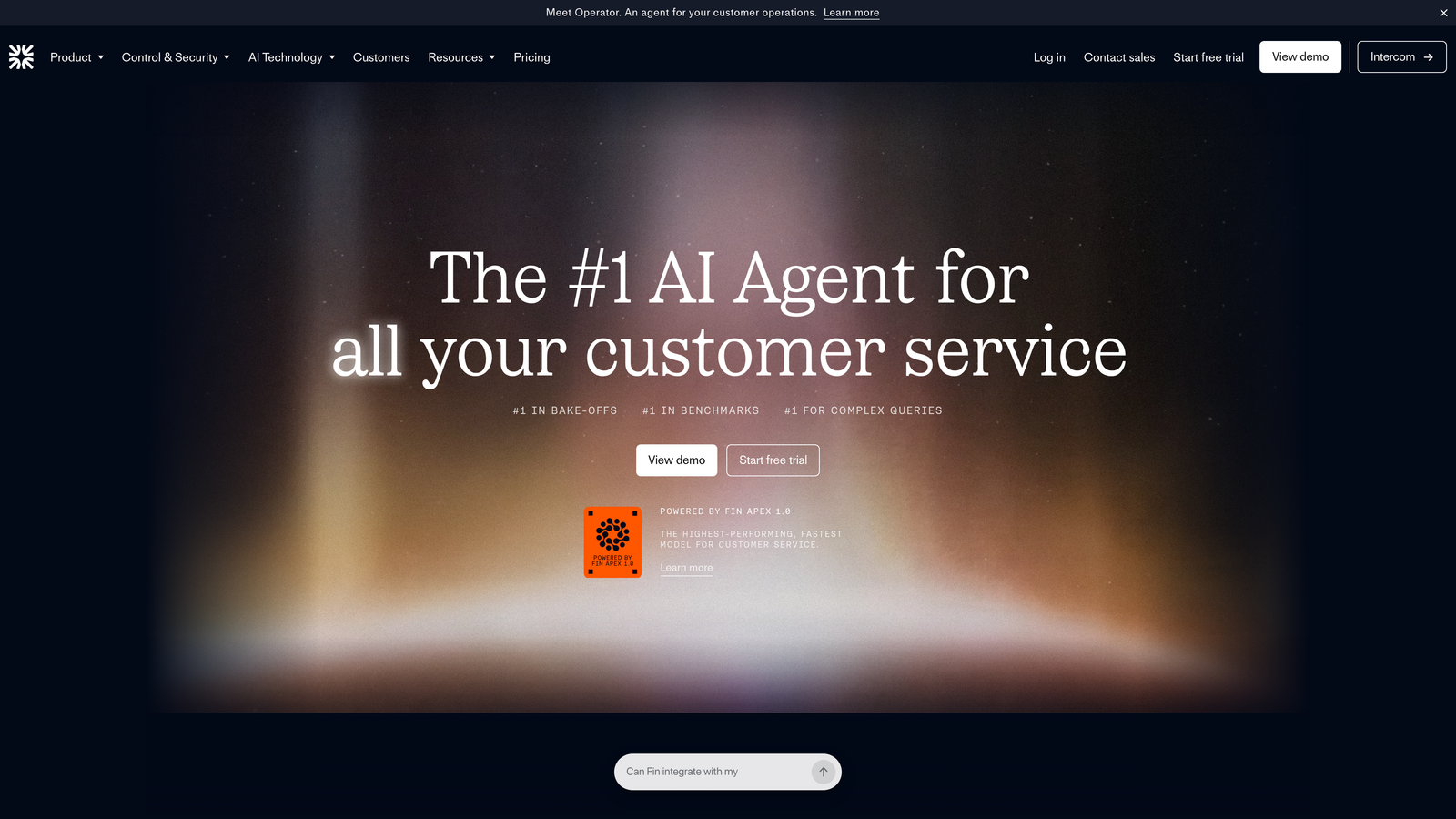
Intercom Fin is Intercom's GPT-4-powered AI agent designed to resolve support conversations autonomously before routing to human agents.
Where This Tool Shines
Fin's core strength is how naturally it fits within the Intercom ecosystem. Because it is native to Intercom Messenger, there is no separate deployment, no parallel system to manage, and no context lost between AI and human handoff. Fin grounds its responses across multiple knowledge sources, which reduces hallucination risk and keeps answers accurate even across complex product documentation.
The Fin Insights dashboard gives support leaders visibility into resolution rates and knowledge gaps, making it easier to identify where the AI is falling short and where documentation needs improvement. Fin 2, released in 2024, improved resolution accuracy and added multi-source knowledge grounding, making it a meaningfully stronger product than its predecessor.
Key Features
Autonomous Resolution: Handles support conversations end-to-end grounded across multiple knowledge sources for accuracy.
Seamless Human Handoff: Routes to live agents when AI confidence is low, with full conversation context preserved.
Native Messenger Integration: No separate deployment required; Fin operates directly inside Intercom Messenger.
Fin Insights Dashboard: Tracks resolution rates and surfaces knowledge gaps for continuous improvement.
Multi-Language Support: Handles conversations across multiple languages without separate configuration.
Best For
Companies already on Intercom, particularly product-led growth SaaS businesses where support volume is high and the Messenger is already the primary customer touchpoint.
Pricing
Fin is priced per resolution. Intercom base plans start at $74 per month. Enterprise pricing is custom-quoted based on volume and features.
4. Freshdesk Freddy AI
Best for: Enterprises wanting AI across the full support lifecycle within the Freshworks ecosystem.
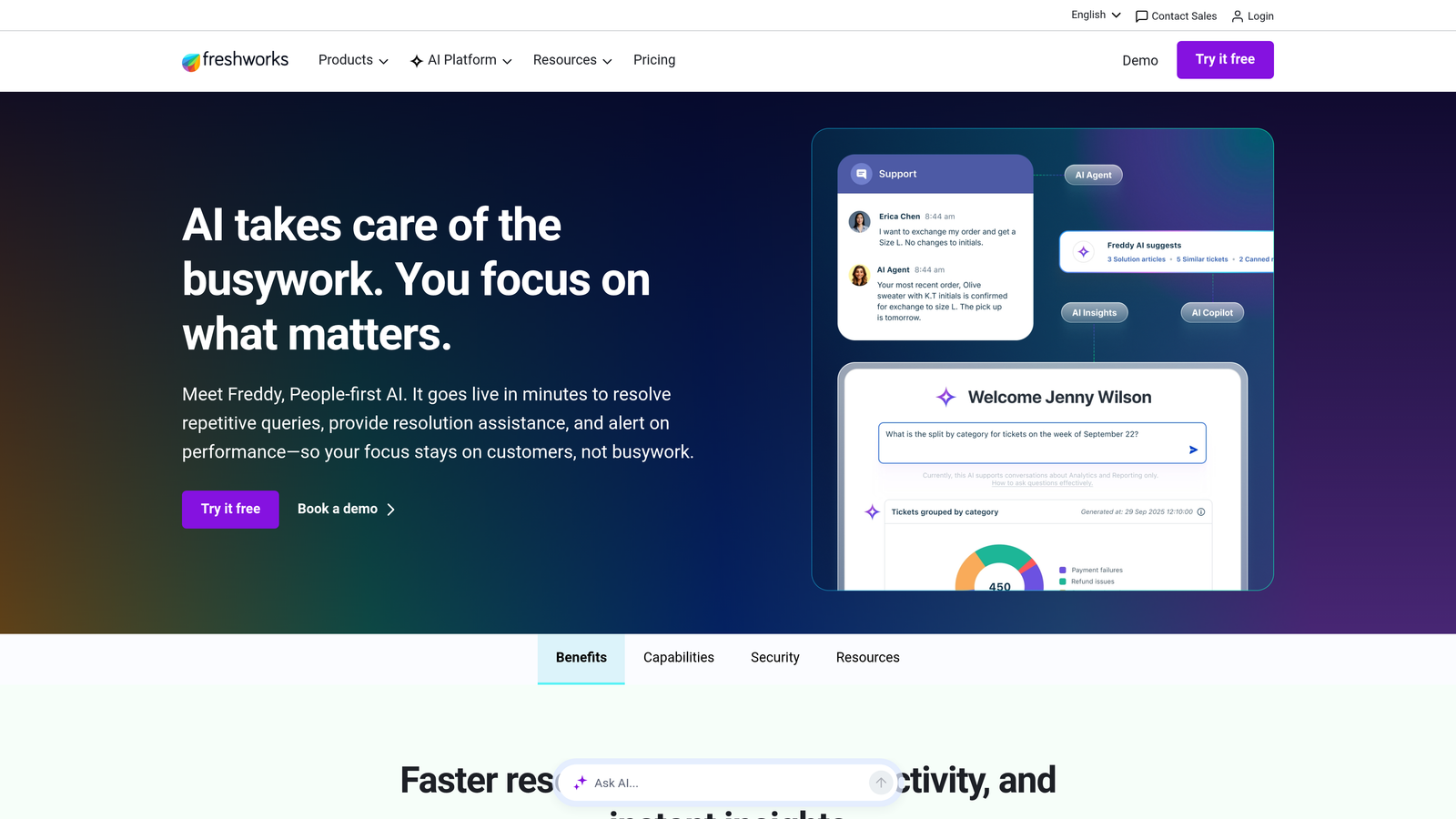
Freshdesk Freddy AI is Freshworks' AI suite spanning self-service, agent assist, and analytics across the Freshdesk platform and broader Freshworks product line.
Where This Tool Shines
Freddy AI's strength is its coverage across the entire support workflow. Rather than focusing on a single layer (resolution, or assist, or analytics), Freddy spans all three: customer-facing self-service, real-time agent assistance, and AI-driven analytics. For enterprises that want a unified AI approach without stitching together multiple vendors, this breadth is genuinely valuable.
The no-code bot builder makes it accessible for support operations teams that want to customize conversation flows without engineering involvement. And because Freshworks spans CRM, ITSM, and sales products, enterprises already in the Freshworks ecosystem get AI capabilities that extend beyond customer support into adjacent workflows.
Key Features
Freddy Self Service: AI chatbot for autonomous customer-facing resolution before tickets are created.
Freddy Copilot: Real-time agent assist with suggested replies, ticket summaries, and next-step recommendations.
Freddy Insights: AI-driven analytics that surface trends, anomalies, and performance signals across the support operation.
No-Code Bot Builder: Allows custom conversation flow creation without engineering resources.
Freshworks Ecosystem Integration: Native connection across Freshdesk, Freshsales, and Freshservice for cross-functional AI coverage.
Best For
Enterprises already invested in the Freshworks ecosystem, or teams that want a single vendor covering self-service, agent assist, and analytics without managing separate AI tooling.
Pricing
Freddy AI features are included in the Growth plan starting at $15 per agent per month. Freddy Copilot is available as an add-on with separate pricing. Enterprise tiers are custom-quoted.
5. Salesforce Service Cloud Einstein
Best for: Enterprises running Salesforce who want AI-powered service capabilities with full CRM data context.
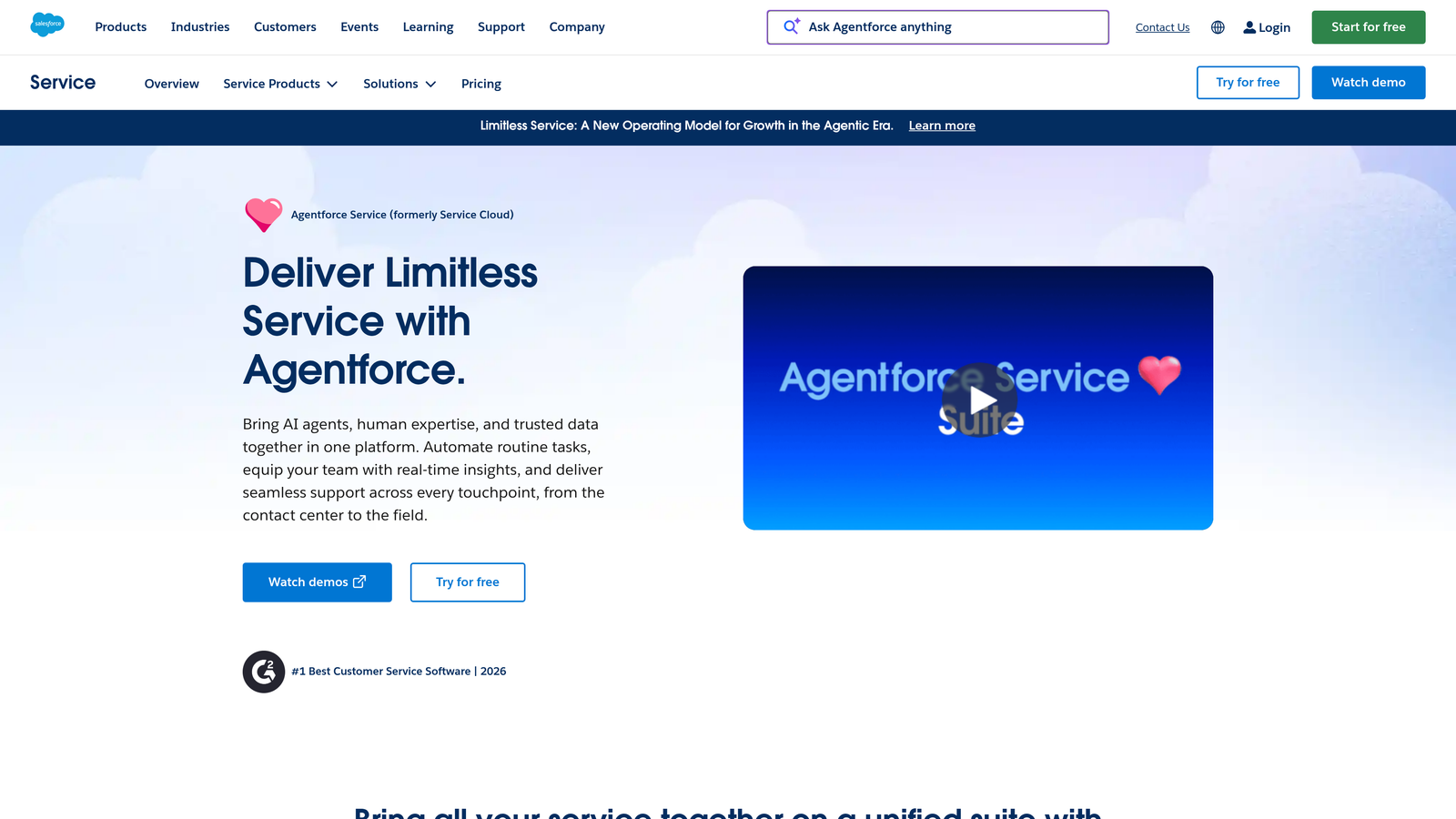
Salesforce Service Cloud Einstein is AI-powered service capability embedded within the world's largest enterprise CRM and Service Cloud platform.
Where This Tool Shines
The defining advantage of Einstein for Service is access to the full Salesforce data model. Case classification, routing, and next-best-action recommendations are all informed by a customer's complete history across sales, marketing, and service touchpoints. For enterprises where support is deeply intertwined with account management and renewals, this level of context is difficult to replicate elsewhere.
Agentforce, Salesforce's autonomous AI agent framework, extends this further by enabling AI agents to operate across service workflows with the same data access as human agents. The tradeoff is well-documented: Salesforce implementations are complex, expensive, and typically require dedicated admin resources to configure and maintain effectively.
Key Features
CRM-Informed Case Routing: Classifies and routes cases using full customer history across sales, service, and marketing data.
Einstein Copilot: Generative AI for reply drafting, case summarization, and knowledge article suggestions within the agent workspace.
Next-Best-Action Recommendations: Surfaces contextual recommendations based on customer history and case patterns.
Agentforce: Framework for deploying autonomous AI agents across service workflows with full Salesforce data access.
Unified Customer Data: Single view of the customer across sales, service, and marketing for richer agent context.
Best For
Large enterprises already on Salesforce where support, sales, and customer success teams need to share a unified customer data layer. Less suited for teams without existing Salesforce infrastructure.
Pricing
Service Cloud plans start at $25 per user per month. Einstein AI add-ons are priced separately. Full enterprise implementations are typically custom-quoted and can involve significant additional costs for configuration and licensing.
6. ServiceNow Now Assist
Best for: Enterprises with complex multi-department service workflows spanning IT, HR, and customer service.
ServiceNow Now Assist is generative AI embedded across ServiceNow's ITSM, HR Service Delivery, and Customer Service Management modules.
Where This Tool Shines
ServiceNow is the dominant platform for internal enterprise service management, and Now Assist brings generative AI into that world in a way that feels native rather than grafted on. Case summarization, resolution notes, and knowledge article generation are all handled by AI within existing ServiceNow workflows, reducing the manual documentation burden that typically slows enterprise IT and HR teams.
Proactive issue detection and predictive intelligence help service teams get ahead of problems rather than simply reacting to them. For organizations with complex multi-department service workflows, the ability to apply consistent AI capabilities across IT, HR, and customer service from a single platform is a meaningful operational advantage. That said, Now Assist is not typically the first choice for external customer-facing support at scale.
Key Features
Generative AI for Documentation: Automatically creates case summaries, resolution notes, and knowledge articles from resolved interactions.
AI-Powered Virtual Agent: Self-service resolution across IT, HR, and customer service workflows without human intervention.
Proactive Issue Detection: Predictive intelligence that surfaces potential problems before they escalate into incidents.
Cross-Platform Coverage: Consistent AI capabilities across ITSM, HR Service Delivery, and Customer Service Management.
Enterprise Governance Controls: Strong compliance and governance framework suited for regulated enterprise environments.
Best For
Large enterprises with existing ServiceNow investments that need AI capabilities across internal IT and HR service workflows, particularly those managing complex multi-department service operations.
Pricing
Custom enterprise pricing. Now Assist requires an existing ServiceNow platform subscription. Contact ServiceNow directly for pricing based on modules and user scale.
7. Kustomer
Best for: High-volume B2C support teams where customer history context is central to resolution quality.
Kustomer is a CRM-native helpdesk platform built around customer timelines rather than ticket numbers, with AI automation designed for high-volume consumer support operations.
Where This Tool Shines
Kustomer's people-first data model is its most distinctive feature. Instead of organizing support around ticket IDs, every interaction is tied to a unified customer profile and displayed as a continuous timeline. For support teams handling customers with complex histories across multiple channels and touchpoints, this view makes context-aware resolution significantly faster.
AI-powered routing and triage use that same customer history to match conversations to the right agent and surface suggested responses. The result is a platform that feels less like a ticket queue and more like a customer relationship tool with support capabilities built in. Kustomer is particularly strong for brands where relationship continuity and customer lifetime value are central to the support philosophy.
Key Features
Unified Customer Timeline: All interactions across every channel tied to a single customer profile rather than individual ticket records.
AI-Powered Routing and Triage: Routes conversations and surfaces suggested responses using full customer history as context.
Omnichannel Support: Handles email, chat, SMS, social, and voice within a single unified inbox.
Workflow Automation: Automates repetitive resolution patterns to reduce manual handling at scale.
Rich Timeline View: Gives agents full relationship context before and during every interaction.
Best For
High-volume B2C support operations, particularly retail, e-commerce, and subscription brands where customer history depth directly improves resolution quality and agent efficiency.
Pricing
Enterprise plan starts at $89 per user per month. Ultimate plan at $139 per user per month. Custom pricing available for larger deployments.
8. Forethought (Agatha)
Best for: Enterprises that want AI triage, deflection, and agent assist without migrating away from an existing helpdesk.
Forethought is an AI layer designed to sit on top of existing enterprise helpdesks, adding intelligent triage, deflection, and agent assist without requiring a platform migration.
Where This Tool Shines
Forethought occupies a specific and genuinely useful position in the market: it makes existing helpdesks smarter without replacing them. For enterprises that have invested heavily in Zendesk, Salesforce, or ServiceNow configurations and cannot justify a full migration, Forethought adds AI capabilities as an intelligent overlay rather than asking you to start over.
The three-layer approach (Solve for deflection, Assist for agent support, Discover for analytics) covers the full support workflow without requiring a single platform to handle everything. Discover is particularly useful for support operations leaders who need to understand the root causes of ticket volume rather than just managing it reactively.
Key Features
AI Triage: Automatically classifies, tags, and routes incoming tickets across the existing helpdesk infrastructure.
Solve: AI deflection layer that resolves common queries before they become tickets, reducing inbound volume.
Assist: Real-time agent suggestions surfaced directly inside the existing helpdesk UI without workflow disruption.
Discover: AI analytics that identify top ticket drivers, knowledge gaps, and deflection opportunities.
Multi-Platform Integration: Works natively with Zendesk, Salesforce Service Cloud, ServiceNow, and other major platforms.
Best For
Enterprises committed to existing helpdesk investments that want to add AI capabilities incrementally, particularly teams where a full platform migration is not feasible in the near term.
Pricing
Custom pricing based on ticket volume and the specific modules selected. Contact Forethought directly for a quote tailored to your current helpdesk environment.
9. Gladly
Best for: Premium consumer brands that prioritize relationship continuity and high-quality customer experiences over ticket throughput.
Gladly is a people-based support platform that replaces ticket IDs with continuous customer relationships, with AI embedded throughout agent workflows and self-service.
Where This Tool Shines
Gladly's philosophical difference from most helpdesks is immediately apparent: there are no ticket numbers. Every customer has a single, continuous conversation history across all channels, and agents see the full relationship rather than an isolated incident. For brands where the quality of the support experience is itself a competitive differentiator, this model creates a meaningfully different agent and customer experience.
Sidekick, Gladly's AI agent, handles self-service resolution before conversations reach human agents. AI-powered routing matches customers to agents based on history and skill fit rather than simple availability queuing. The platform is intentionally positioned for premium consumer brands rather than high-volume transactional support, and that focus shows in the feature design and pricing.
Key Features
People-Based Model: No ticket numbers; every interaction is part of a continuous customer relationship across all channels.
AI-Powered Routing: Matches customers to agents based on conversation history, customer value, and agent skill profile.
Sidekick: AI agent for self-service resolution before conversations reach the human agent queue.
Omnichannel Inbox: Email, chat, voice, SMS, and social all managed within a single unified agent view.
Relationship-First Design: Every feature is oriented around relationship continuity rather than ticket throughput metrics.
Best For
Premium consumer brands in retail, fashion, travel, and subscription categories where the support experience is part of the brand promise and customer lifetime value justifies higher per-agent investment.
Pricing
Hero plan at $150 per agent per month. Superhero plan at $180 per agent per month. Custom enterprise pricing available for larger teams.
Matching the Right Platform to Your Needs
The right enterprise AI helpdesk depends heavily on where you are starting from and what problem you are actually trying to solve.
If you need an AI-native platform that learns continuously, surfaces business intelligence beyond support metrics, and connects deeply across your B2B SaaS stack, Halo AI is the strongest fit. Its page-aware context and autonomous resolution capabilities are purpose-built for product and support teams that want AI to do real work, not just assist.
If you are already on Zendesk or Freshdesk and want to activate AI without migrating, the native AI layers on those platforms are the lowest-friction path forward. If you cannot migrate at all, Forethought sits on top of whatever you already have and adds meaningful intelligence without disruption.
For Salesforce-centric enterprises, Einstein and Agentforce are the natural choice given the CRM data advantage. For complex internal service operations spanning IT and HR, ServiceNow Now Assist is in a category of its own. And for premium consumer brands where relationship quality is the product, Gladly's people-based model is worth the premium price point.
The broader shift happening across all of these platforms is the same: support is moving from reactive ticket management to proactive, intelligent resolution. The tools that are built around that shift from the ground up will compound in value faster than those still adapting to it.
Your support team shouldn't scale linearly with your customer base. Let AI agents handle routine tickets, guide users through your product, and surface business intelligence while your team focuses on complex issues that need a human touch. See Halo in action and discover how continuous learning transforms every interaction into smarter, faster support.