9 Best Enterprise AI Support Platforms in 2026
This guide evaluates nine leading enterprise AI support platforms purpose-built to help large-scale support teams autonomously resolve high ticket volumes, featuring in-depth comparisons across AI autonomy, system integrations, analytics, security, and scalability to help enterprises choose the right solution for replacing legacy helpdesks.
 Matt PattoliFounder13 min read
Enterprise support teams face a unique scaling challenge: as customer bases grow into the tens of thousands, ticket volume and complexity outpace headcount. Traditional helpdesks were built for human agents to manage queues, not for AI to autonomously resolve issues, surface business intelligence, or learn from every interaction. A new generation of enterprise AI support platforms changes that equation entirely.
These platforms go beyond simple chatbot deflection. They combine large language models, deep integrations with business systems, and intelligent routing to resolve tickets autonomously while escalating edge cases to human agents. In this guide, we evaluate nine platforms purpose-built (or significantly evolved) for enterprise-scale AI support, assessing each on autonomy and resolution capabilities, integration depth, analytics and business intelligence, security posture, and scalability under high-volume conditions.
Whether you're replacing a legacy helpdesk or augmenting your existing stack, here are the platforms worth evaluating.
1. Halo AI
Best for: B2B SaaS teams that need autonomous ticket resolution with deep product context and business intelligence.
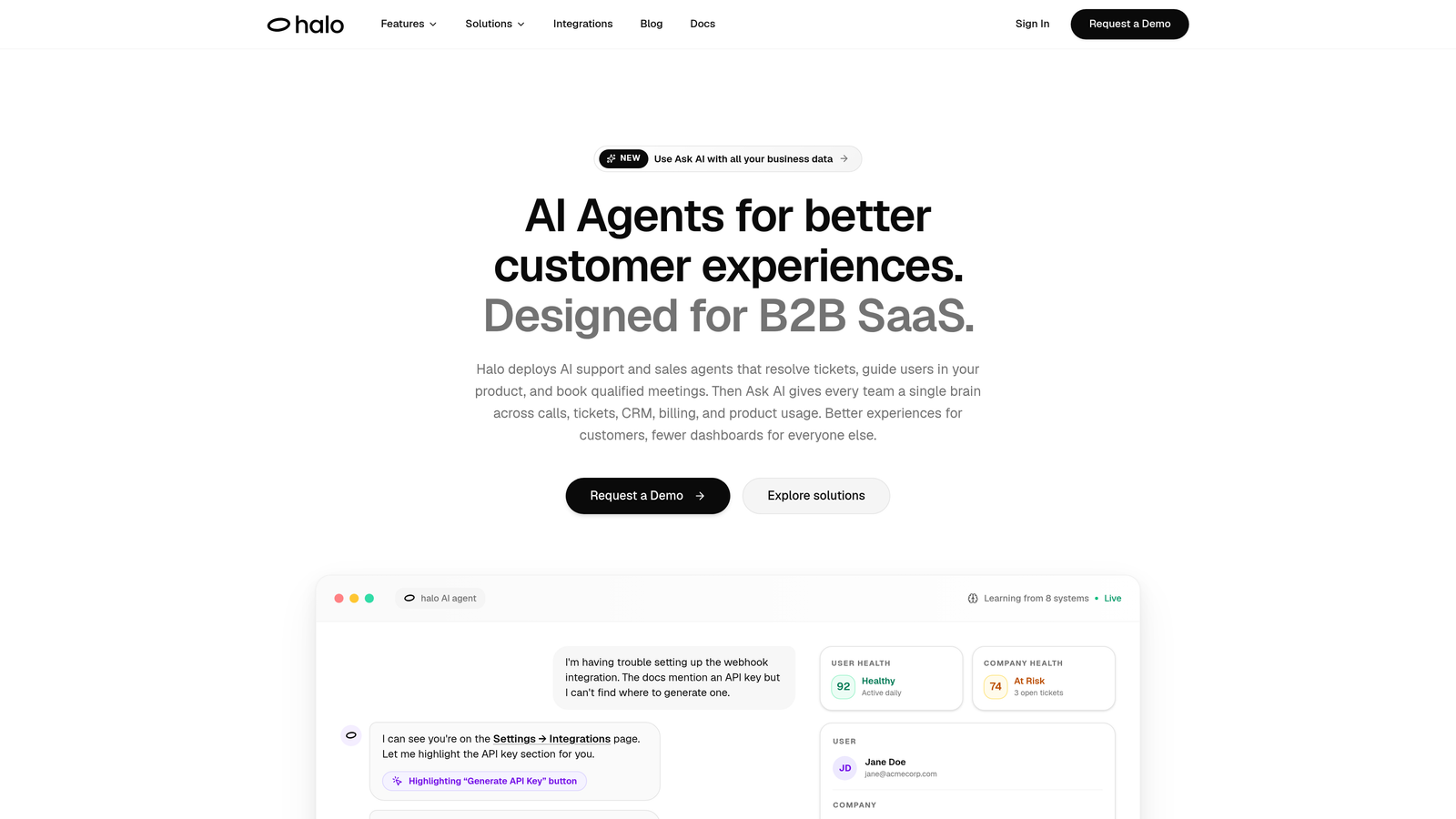
Halo AI is an AI-first customer support platform that deploys autonomous agents to resolve tickets, guide users through product interfaces, and surface business intelligence from every support interaction.
Where This Tool Shines
What separates Halo from legacy helpdesks that have bolted AI on top is its architecture. Halo was built around autonomous agents from day one, which means the entire platform, from routing logic to analytics to integrations, is designed to support AI-led resolution rather than AI-assisted human workflows.
The standout capability is page-aware context. Halo's agents can see exactly what a user is seeing within your product, enabling step-by-step visual guidance that goes far beyond a static knowledge base article. Pair that with continuous learning from every resolved ticket, and the platform gets meaningfully smarter over time rather than staying static.
Key Features
Page-Aware AI Agents: Agents understand the user's current location in your product UI, delivering contextual guidance rather than generic answers.
Continuous Learning Engine: Every resolved interaction feeds back into the model, improving resolution quality without manual retraining.
Smart Inbox with Business Intelligence: The inbox surfaces churn signals, revenue intelligence, and anomaly detection, turning support data into insights for your entire business.
Auto Bug Ticket Creation: When agents detect recurring product issues, they automatically create bug reports and route them to engineering workflows.
Deep Integration Stack: Native connections to Linear, Slack, HubSpot, Intercom, Stripe, Zoom, PandaDoc, and Fathom enable agents to take real actions, not just answer questions.
Live Agent Handoff: Complex issues escalate seamlessly to human agents with full context preserved, so customers never have to repeat themselves.
Best For
Halo is best suited for B2B SaaS companies and product teams that want AI agents capable of taking action across their business stack, not just deflecting tickets. It's particularly strong for teams where support data has untapped strategic value, such as identifying at-risk accounts or surfacing product feedback trends.
Pricing
Contact for enterprise pricing. A demo is available at haloagents.ai.
2. Zendesk AI
Best for: Enterprises already invested in the Zendesk ecosystem seeking AI capabilities without a platform migration.
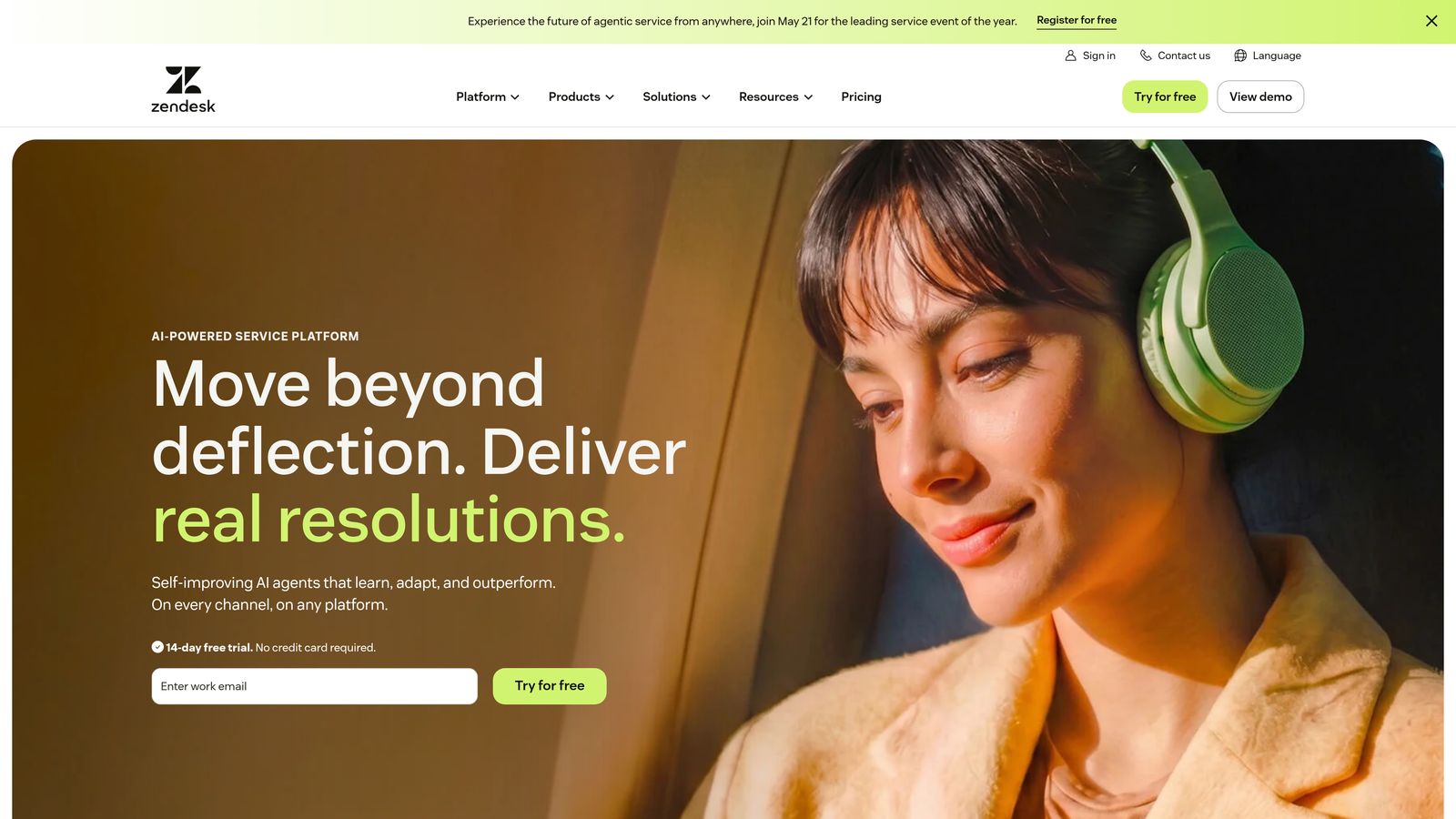
Zendesk AI layers intelligent automation, AI agents, and agent assist tools onto one of the most widely deployed helpdesk platforms in the enterprise market.
Where This Tool Shines
Zendesk's primary advantage is its maturity. With decades of enterprise deployments, the platform brings a level of reliability, compliance coverage, and integration breadth that newer entrants are still building toward. For teams already running Zendesk, the AI capabilities slot in without requiring a rip-and-replace migration.
The intelligent triage layer is particularly strong, automatically classifying tickets by intent, language, and sentiment before routing them to the right queue or AI agent. The agent copilot feature helps human agents work faster by surfacing relevant knowledge and suggesting draft responses in real time.
Key Features
AI Agents: Automated resolution across chat, email, and messaging channels with configurable escalation rules.
Intelligent Triage: Automatic classification of intent, language, and sentiment at ticket intake.
Agent Copilot: Real-time response suggestions and knowledge surfacing for human agents during live interactions.
Integration Marketplace: Over 1,500 app integrations covering CRM, billing, engineering, and communication tools.
Enterprise Security: SOC 2, HIPAA, and FedRAMP compliance options for regulated industries.
Best For
Organizations already standardized on Zendesk that want to incrementally add AI capabilities without disrupting existing workflows, agent training, or integrations. Less ideal for teams looking for an AI-first architecture built around autonomous resolution from the ground up.
Pricing
Suite Enterprise starts at $150 per agent per month. AI add-on pricing varies based on usage and feature tier.
3. Intercom Fin
Best for: Product-led growth companies that prioritize conversational, in-app support experiences.
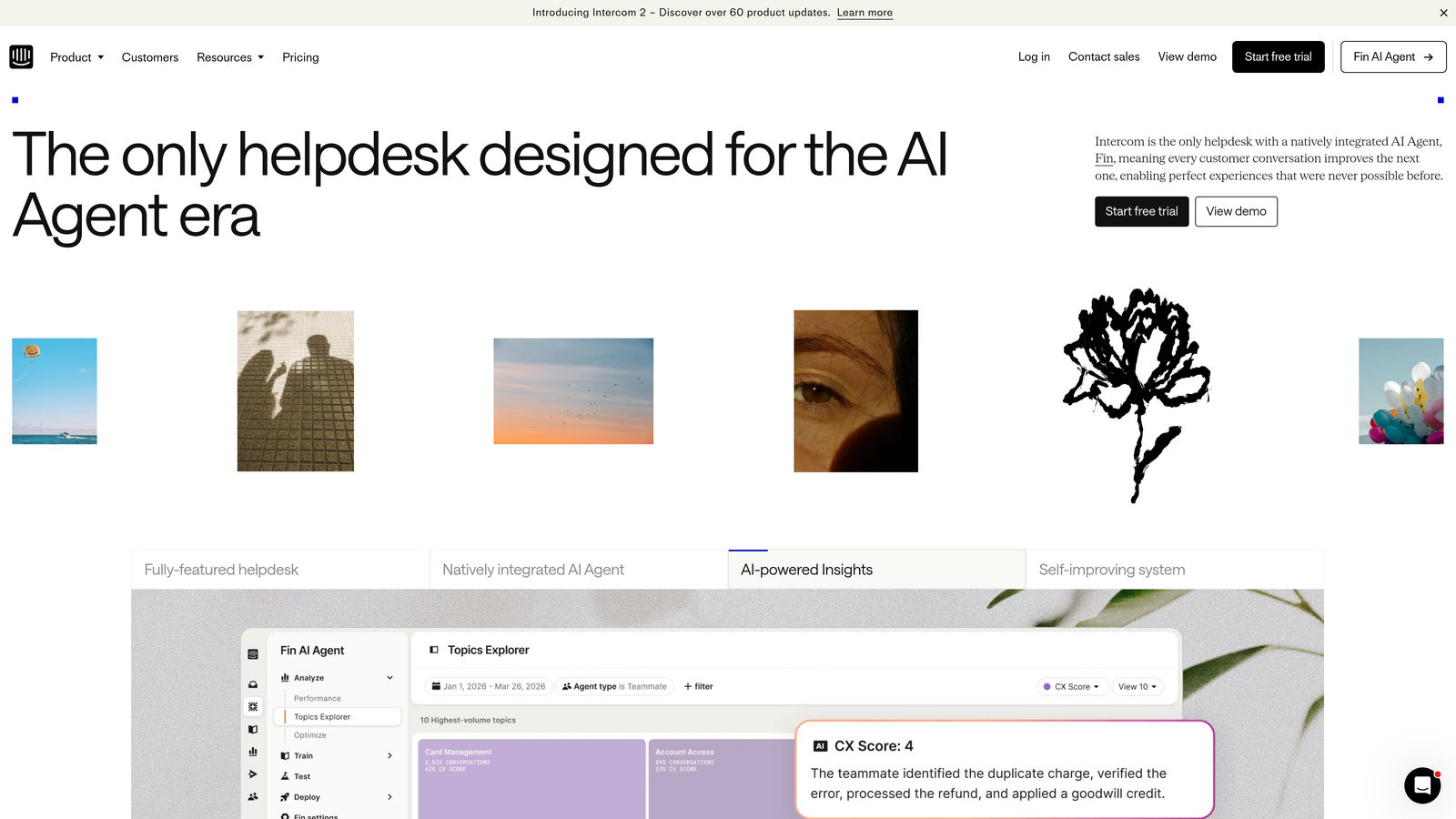
Intercom Fin is a conversational AI agent trained on your help center content to resolve customer questions with natural, human-quality responses within Intercom's messaging-first platform.
Where This Tool Shines
Fin's strength is the quality of its conversational output. Rather than producing robotic, template-driven responses, Fin generates answers that feel natural and contextually aware, drawing directly from your existing help center without requiring custom training pipelines. For teams where tone and user experience matter as much as resolution rate, this is a meaningful differentiator.
Intercom's proactive messaging capabilities also extend Fin's value beyond reactive support. The platform can trigger contextual in-app messages based on user behavior, which means AI can engage customers before they even open a ticket.
Key Features
Fin AI Agent: Trained directly on your help center and knowledge base for accurate, on-brand responses.
Conversational UX: Natural, human-like tone with follow-up handling and clarifying question support.
Customizable AI Behaviors: Configure tone, answer sources, and escalation rules without engineering involvement.
Proactive Messaging: Trigger in-app support and guidance based on user behavior signals.
Workflow Automation: Multi-step automations for complex scenarios beyond simple Q&A resolution.
Best For
SaaS companies with product-led growth motions, strong existing help centers, and teams that prioritize conversational quality and in-app engagement over deep backend integrations or business intelligence capabilities.
Pricing
Fin AI agent is charged per resolution. Platform plans start at $29 per seat per month, with enterprise pricing available for larger deployments.
4. Salesforce Einstein Service Cloud
Best for: Large enterprises with complex CRM workflows and existing Salesforce infrastructure.
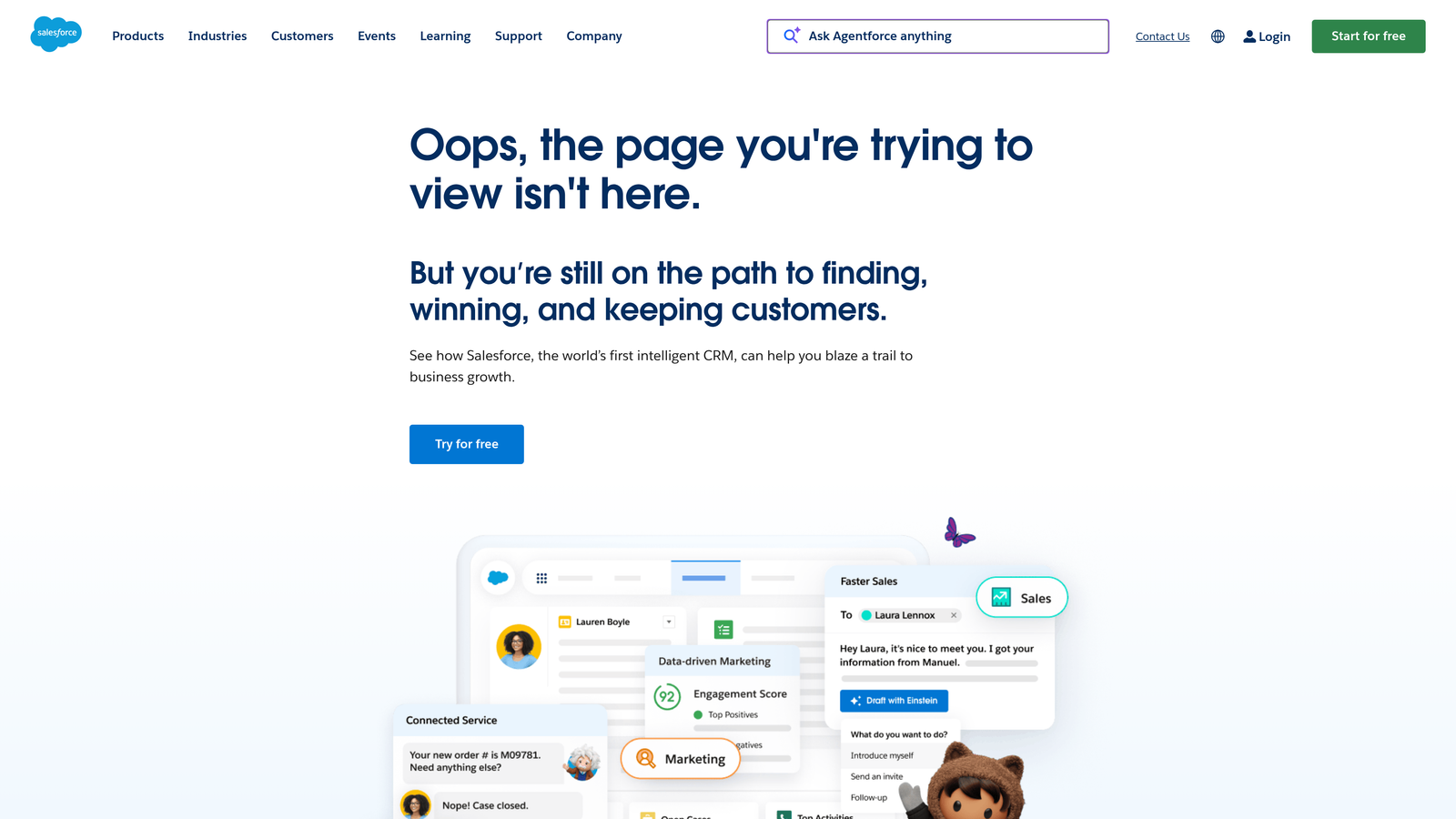
Salesforce Einstein Service Cloud is an AI-powered service platform that leverages deep CRM data to deliver contextual, intelligent customer support across every channel at enterprise scale.
Where This Tool Shines
The defining advantage of Einstein Service Cloud is CRM depth. Because Salesforce owns the full customer record, including purchase history, account status, open opportunities, and prior interactions, its AI agents can make decisions and recommendations with a level of customer context that standalone support platforms simply can't match.
For enterprises running Sales Cloud and Marketing Cloud alongside Service Cloud, the unified data model creates powerful omnichannel experiences. Support agents and AI bots can see the full customer journey, not just the current ticket.
Key Features
Einstein AI Bots and Agent Assist: AI-powered automation and suggestions grounded in full CRM customer context.
Case Classification and Routing: Automatic classification with next-best-action recommendations for both AI and human agents.
Omnichannel Support: Unified experience across voice, chat, email, social, and messaging channels.
Cross-Cloud Analytics: Deep integration with Tableau and Marketing Cloud for unified business reporting.
Enterprise Compliance: FedRAMP, HIPAA, and robust data residency options for regulated industries.
Best For
Large enterprises already running Salesforce as their CRM backbone, where unifying support data with sales and marketing context is a strategic priority. The cost and complexity make it less suitable for teams not already in the Salesforce ecosystem.
Pricing
Enterprise tier starts at $165 per user per month. Einstein AI features may require additional licensing depending on the capabilities needed.
5. Ada
Best for: High-volume enterprises focused on maximizing automated resolution rates across multiple channels.
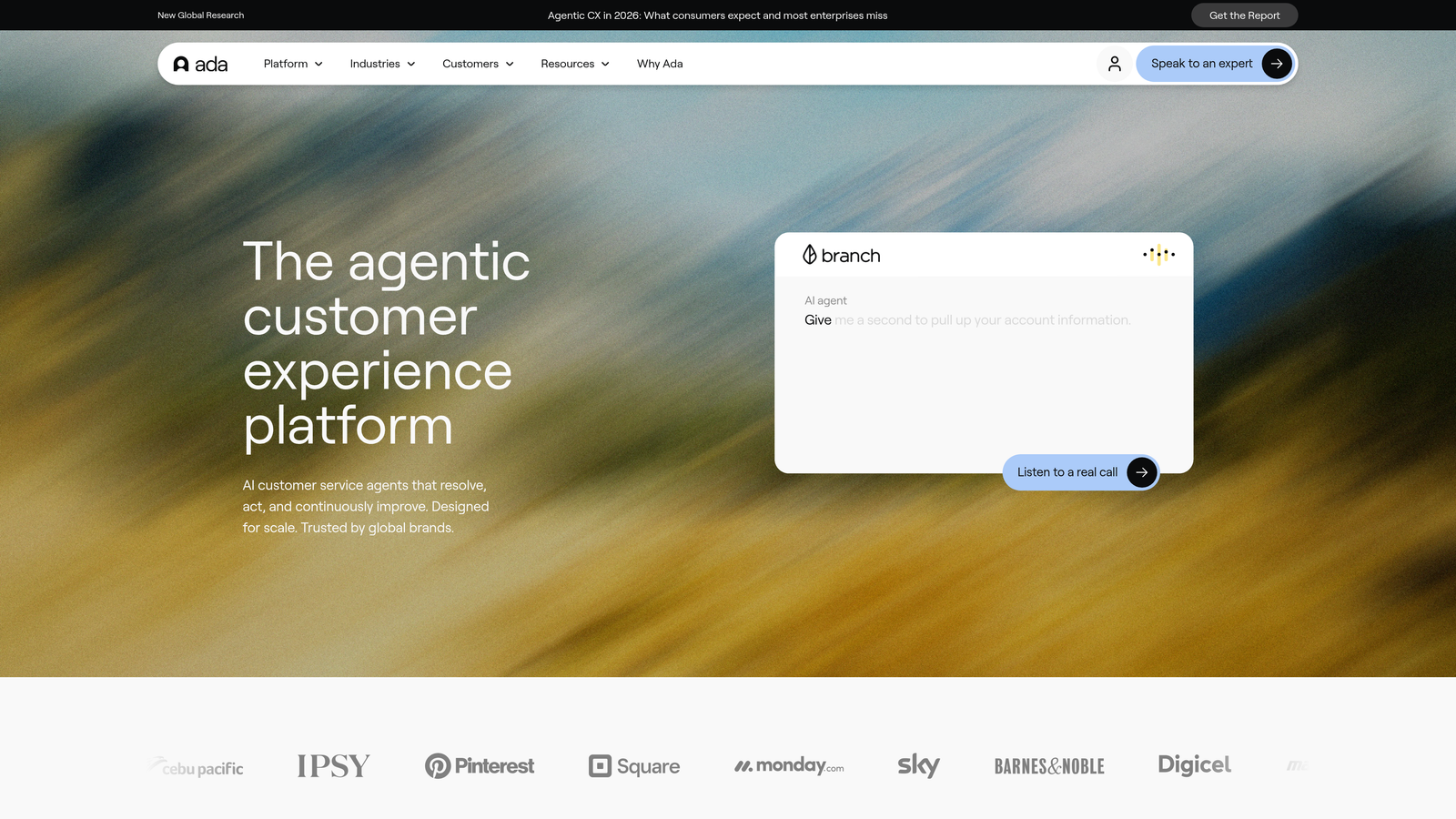
Ada is an AI-native customer service automation platform built specifically for enterprises that need to resolve a large percentage of customer inquiries without human intervention, across chat, email, voice, and social.
Where This Tool Shines
Ada's design philosophy centers on resolution, not deflection. The platform is built around the idea that AI should fully close tickets, not just push customers toward self-service and hope they don't come back. That distinction shapes everything from how workflows are built to how success is measured.
The reasoning engine is a notable technical differentiator. Rather than relying purely on LLM generation, Ada combines generative AI with deterministic business rules and live API actions, which means the AI can process real transactions, look up order statuses, and take account-level actions rather than just answering questions.
Key Features
Autonomous AI Agent: Resolves complex queries end-to-end rather than deflecting to knowledge base articles.
No-Code Automation Builder: Create multi-step resolution workflows without engineering resources.
Multichannel Deployment: Web, mobile, social, SMS, and email from a single platform.
Reasoning Engine: Combines LLMs with business rules and API integrations for action-taking, not just answering.
Resolution-Focused Analytics: Measurement dashboard built around automated resolution rate as the primary success metric.
Best For
High-volume consumer and B2B enterprises where maximizing the percentage of tickets resolved without human touch is the primary objective. Particularly strong for teams with complex backend actions like order management, billing, and account changes.
Pricing
Custom enterprise pricing. Contact Ada directly for a quote based on volume and deployment needs.
6. Freshdesk Freddy AI
Best for: Mid-market and enterprise teams seeking AI-powered support at a more competitive price point than Zendesk or Salesforce.
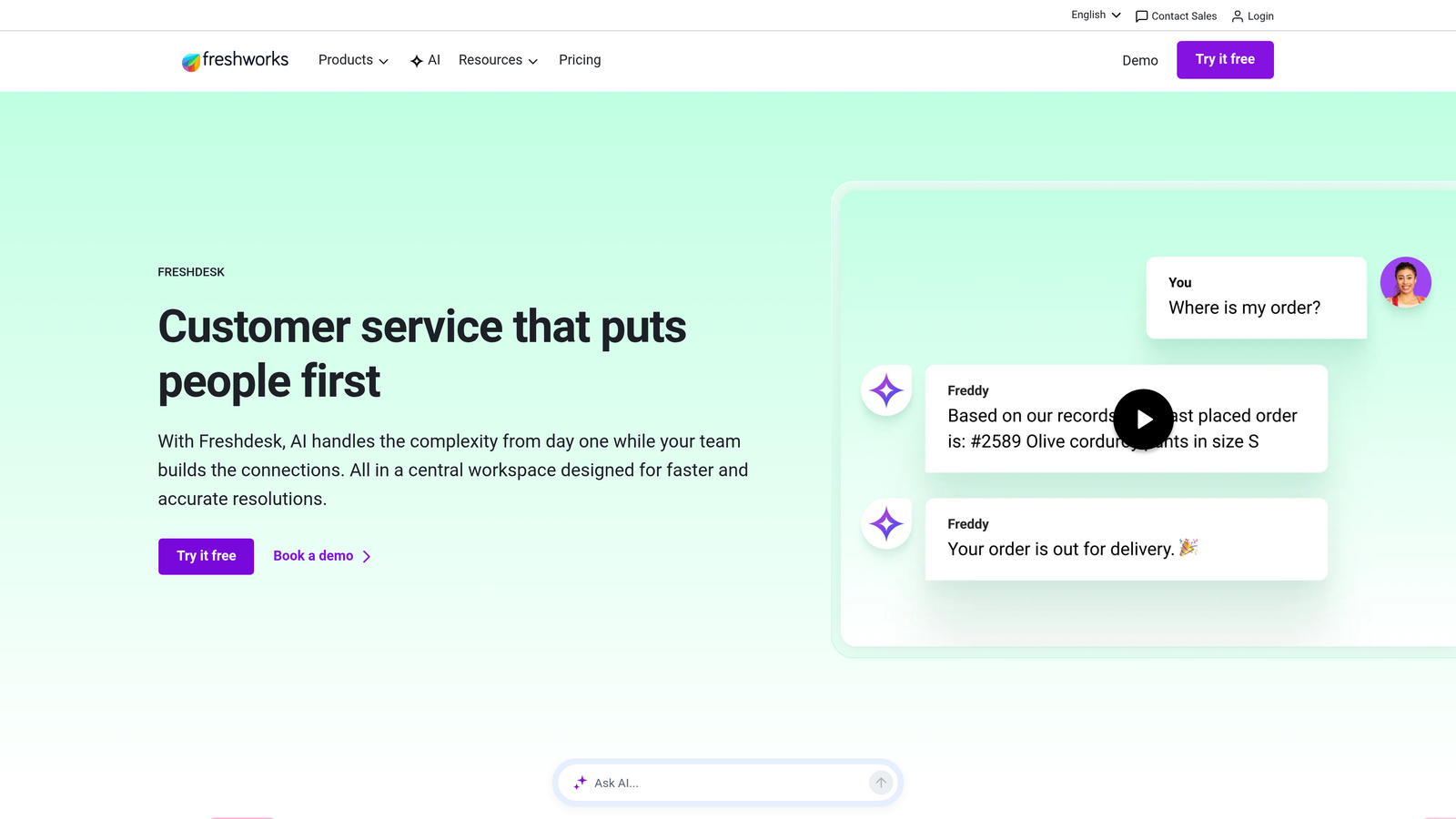
Freshdesk Freddy AI embeds AI capabilities across the Freshworks customer service platform, offering AI agents, agent copilot tools, and analytics within a unified, competitively priced suite.
Where This Tool Shines
Freshdesk's value proposition is breadth at a reasonable price. Freddy AI spans three distinct layers: customer-facing resolution (Freddy AI Agent), agent-facing assistance (Freddy Copilot), and analytics (Freddy Insights). Getting all three within a single platform at a lower price point than comparable Zendesk or Salesforce tiers is a genuine competitive advantage for cost-conscious enterprise buyers.
The broader Freshworks ecosystem also adds value for teams that want to consolidate tooling. Freshdesk connects natively with Freshworks CRM, ITSM, and marketing products, reducing the integration complexity that often plagues enterprise support stacks.
Key Features
Freddy AI Agent: Autonomous customer-facing resolution for common queries and workflows.
Freddy Copilot: Agent-facing suggestions, response summaries, and next-step recommendations during live tickets.
Freddy Insights: AI-driven analytics and reporting to surface support trends and performance gaps.
Freshworks Ecosystem Integration: Native connections to Freshworks CRM, ITSM, and marketing tools for unified data.
Competitive Pricing: Enterprise-tier AI capabilities at a lower cost than primary competitors.
Best For
Mid-market to enterprise teams that want a capable, all-in-one AI support platform without the premium pricing of Zendesk or Salesforce, particularly those open to consolidating on the Freshworks ecosystem.
Pricing
Enterprise plan at $79 per agent per month. Freddy AI capabilities are included in higher-tier plans.
7. Cognigy
Best for: Regulated enterprises and contact centers that require voice AI, on-premise deployment, or strong multilingual coverage.
Cognigy is an enterprise conversational AI platform specializing in voice and chat automation for contact centers, with LLM orchestration capabilities and flexible deployment models including on-premise and private cloud.
Where This Tool Shines
Cognigy occupies a distinct niche: voice-first AI for enterprise contact centers. While most platforms on this list are optimized for chat and email, Cognigy's natural language understanding is built to handle the nuances of phone-based support, including interruptions, accents, and conversational flow that differs significantly from typed interactions.
For regulated industries like financial services, healthcare, and government, the on-premise deployment option is a significant differentiator. Many enterprise AI platforms are cloud-only, which creates data residency and compliance challenges. Cognigy's flexibility on deployment architecture removes that barrier.
Key Features
Voice-First AI: Natural language understanding purpose-built for phone-based support interactions.
LLM Orchestration: Combines generative AI with deterministic dialogue flows for controlled, reliable responses.
Flexible Deployment: On-premise and private cloud options for regulated industries with strict data requirements.
Contact Center Integrations: Pre-built connectors for Genesys, Avaya, NICE, and other major contact center platforms.
Multilingual Coverage: Strong support across 100+ languages with particularly robust European language capabilities.
Best For
Enterprise contact centers with significant voice support volume, regulated industries requiring on-premise or private cloud deployment, and global enterprises needing strong multilingual coverage across European markets.
Pricing
Custom enterprise pricing based on conversation volume and deployment model. Contact Cognigy for a tailored quote.
8. Forethought
Best for: Enterprises that want to add AI resolution and intelligence on top of an existing Zendesk, Salesforce, or ServiceNow deployment.
Forethought is an AI layer that plugs into existing helpdesks to add intelligent triage, agent assist, and autonomous resolution capabilities without requiring teams to replace their current support infrastructure.
Where This Tool Shines
Forethought's overlay architecture is its defining characteristic. Rather than asking enterprises to migrate off a platform they've spent years configuring, Forethought sits on top of Zendesk, Salesforce, or ServiceNow and enhances what's already there. For organizations with significant process investment in their current helpdesk, this is a far lower-risk path to AI capabilities than a full platform replacement.
The four-product suite (Solve, Triage, Assist, Discover) covers the full support workflow, from autonomous resolution to knowledge gap identification. The Discover product in particular stands out for teams that want to understand why tickets are coming in and where their knowledge base is falling short.
Key Features
Solve: AI agent for autonomous ticket resolution via chat and email channels.
Triage: Intelligent ticket classification and routing based on intent and urgency signals.
Assist: Real-time knowledge suggestions for human agents during active ticket handling.
Discover: AI-driven insights into support trends, knowledge gaps, and resolution patterns.
Overlay Architecture: Works directly on top of Zendesk, Salesforce, or ServiceNow without replacing existing workflows.
Best For
Enterprises with established Zendesk, Salesforce, or ServiceNow deployments that want to add AI capabilities incrementally without a platform migration. Also strong for teams that want deep visibility into support trends and knowledge base gaps.
Pricing
Custom pricing based on ticket volume. Contact Forethought directly for details.
9. Ultimate (by Zendesk)
Best for: Global enterprises requiring multilingual AI automation across 100+ languages without translation overhead.
Ultimate is a multilingual AI automation platform now integrated into the Zendesk ecosystem, specializing in no-code bot building and automated resolution for global support teams.
Where This Tool Shines
Ultimate's core differentiator is language coverage. Supporting over 100 languages with native natural language understanding rather than translation layers means the AI actually understands nuance and intent in each language rather than translating to English and back. For enterprises with significant customer bases in non-English markets, this distinction matters considerably for resolution quality.
The no-code dialogue builder makes it accessible to support operations teams without engineering resources. Complex automation flows, including backend integrations for actions like refunds, order lookups, and account changes, can be built and maintained without developer involvement.
Key Features
Multilingual NLU: Native understanding in 100+ languages without translation layers degrading response quality.
No-Code Dialogue Builder: Create and maintain complex automation flows without engineering resources.
Backend Action Integrations: Connect to business systems to process refunds, look up orders, and update account settings.
Resolution Analytics: Dashboard tracking automation rate, handoff reasons, and CSAT impact.
Zendesk Integration: Now part of the Zendesk AI suite for streamlined deployment within existing Zendesk environments.
Best For
Global enterprises with multilingual support requirements, particularly those already in the Zendesk ecosystem looking for best-in-class language coverage and no-code automation capabilities.
Pricing
Available as part of the Zendesk AI suite. Legacy standalone pricing varies; contact Zendesk for current bundled pricing.
Choosing the Right Platform for Your Team
The enterprise AI support platform market has matured to the point where the question is no longer "should we use AI?" but rather "which architecture fits our specific context?" The nine platforms above represent genuinely different approaches, and the right choice depends on where you're starting from and what you're optimizing for.
If you're looking for an AI-first platform built around autonomous resolution with continuous learning and business intelligence built in, Halo AI is the strongest option for B2B SaaS teams. Its page-aware agents, deep integration stack, and smart inbox go well beyond ticket deflection into territory that creates value for your entire organization, not just your support queue.
If you're deeply invested in an existing platform, the calculus changes. Zendesk AI and Ultimate make sense for teams already on Zendesk who want to add AI without migration risk. Forethought is the right choice when you need AI capabilities layered on top of Zendesk, Salesforce, or ServiceNow without touching your existing configuration. Salesforce Einstein wins when CRM context is the most important input to your support AI.
For specific use cases: Cognigy is the clear leader for voice-first contact centers and regulated industries requiring on-premise deployment. Ultimate stands out for global teams with serious multilingual requirements. Ada is purpose-built for high-volume enterprises where maximizing automated resolution rate is the primary KPI. Intercom Fin excels for product-led growth companies that prioritize conversational quality and in-app engagement.
Your support team shouldn't scale linearly with your customer base. Let AI agents handle routine tickets, guide users through your product, and surface business intelligence while your team focuses on complex issues that need a human touch. See Halo in action and discover how continuous learning transforms every interaction into smarter, faster support.