9 Best Enterprise AI Support Platforms in 2026
Enterprise AI support platforms are transforming how large organizations manage growing ticket volumes by combining intelligent automation, deep integrations, and continuous learning to resolve issues faster and reduce operational costs. This guide evaluates the 9 best enterprise AI support platforms in 2026 based on AI capability, scalability, and analytics quality to help B2B SaaS and product-led teams find the right fit.
 Grant CooperFounder14 min read
Enterprise support teams are under more pressure than ever. Ticket volumes keep climbing, customer expectations for instant and accurate resolutions have never been higher, and the complexity of multi-channel inquiries continues to grow. Legacy helpdesks weren't designed for this reality, and bolting a basic chatbot onto an existing system rarely addresses the underlying problem.
Enterprise AI support platforms take a fundamentally different approach. They combine intelligent automation, deep integrations, and continuous learning to handle tickets autonomously, surface business intelligence, and escalate only what truly needs a human. The result is faster resolution, lower operational costs, and support that actually scales with your business.
This guide covers the best enterprise AI support platforms available in 2026, evaluated on AI capability depth, integration ecosystem, scalability, analytics quality, and fit for B2B SaaS and product-led teams. Whether you're replacing a legacy helpdesk or augmenting an existing stack, you'll find the right fit here. For broader context, see our overview of AI support platform features and customer support AI benefits.
1. Halo AI
Best for: B2B SaaS and product-led teams needing AI-native support with business intelligence built in.
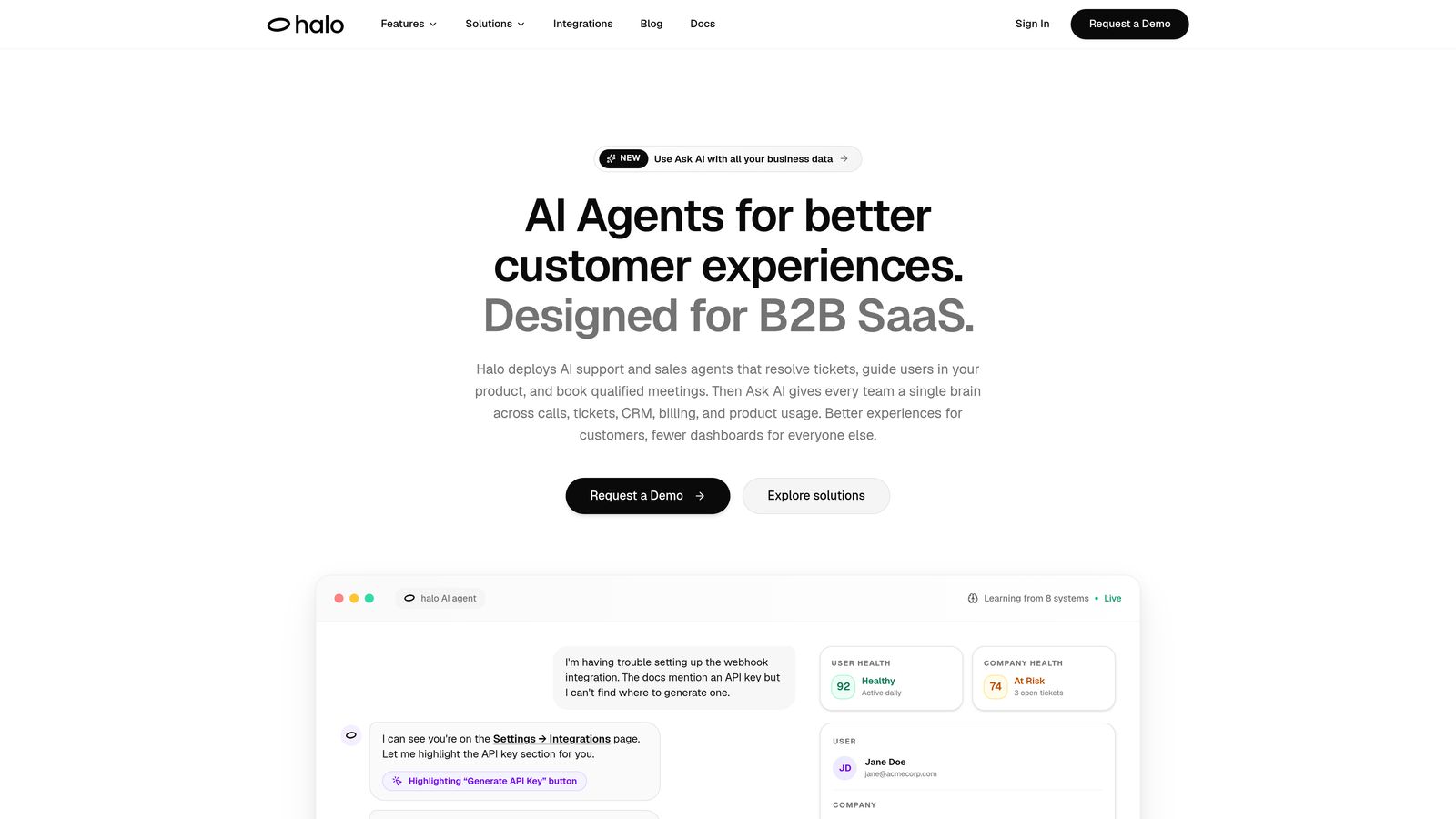
Halo AI is an AI-first enterprise support platform built specifically for B2B SaaS teams, deploying intelligent agents that resolve tickets, guide users through your product, and surface business intelligence from every interaction.
Where This Tool Shines
Halo's most distinctive capability is its page-aware architecture. The AI agent sees exactly what a user sees inside your product, enabling it to provide contextual, visual UI guidance rather than generic instructions. This is a meaningful step beyond traditional chat widgets that operate without any awareness of where a user is or what they're trying to do.
The platform also goes beyond pure ticket resolution. Halo's smart inbox layers business intelligence on top of support operations, surfacing customer health signals, revenue insights, and anomaly detection. Support data becomes a source of strategic information, not just a queue to clear.
Key Features
Page-Aware Chat Widget: The AI sees what users see in real time, enabling precise visual UI guidance and context-specific answers rather than generic responses.
Autonomous Ticket Resolution: Intelligent agents handle tickets end-to-end, with continuous learning from every resolved interaction to improve accuracy over time.
Auto Bug Ticket Creation: Converts support conversations into structured Linear tickets automatically, eliminating the manual handoff between support and engineering teams.
Smart Inbox with Business Intelligence: Surfaces customer health signals, revenue intelligence, and anomaly detection directly from support data, turning your inbox into a strategic asset.
Live Agent Handoff: Escalates complex issues to human agents while preserving full conversation context, so agents never start from scratch.
Deep Integration Stack: Connects natively with Linear, Slack, HubSpot, Intercom, Stripe, Zoom, PandaDoc, and Fathom.
Best For
Halo AI is purpose-built for B2B SaaS companies and product-led growth teams that want more than ticket deflection. If your team needs AI that integrates deeply with your product, engineering, and revenue stack while delivering intelligence beyond resolution rates, Halo is designed for exactly that use case.
Pricing
Custom pricing for enterprise teams. Contact Halo AI directly at haloagents.ai for a quote tailored to your team size and requirements.
2. Salesforce Einstein Service Cloud
Best for: Large enterprises already running on the Salesforce CRM ecosystem.
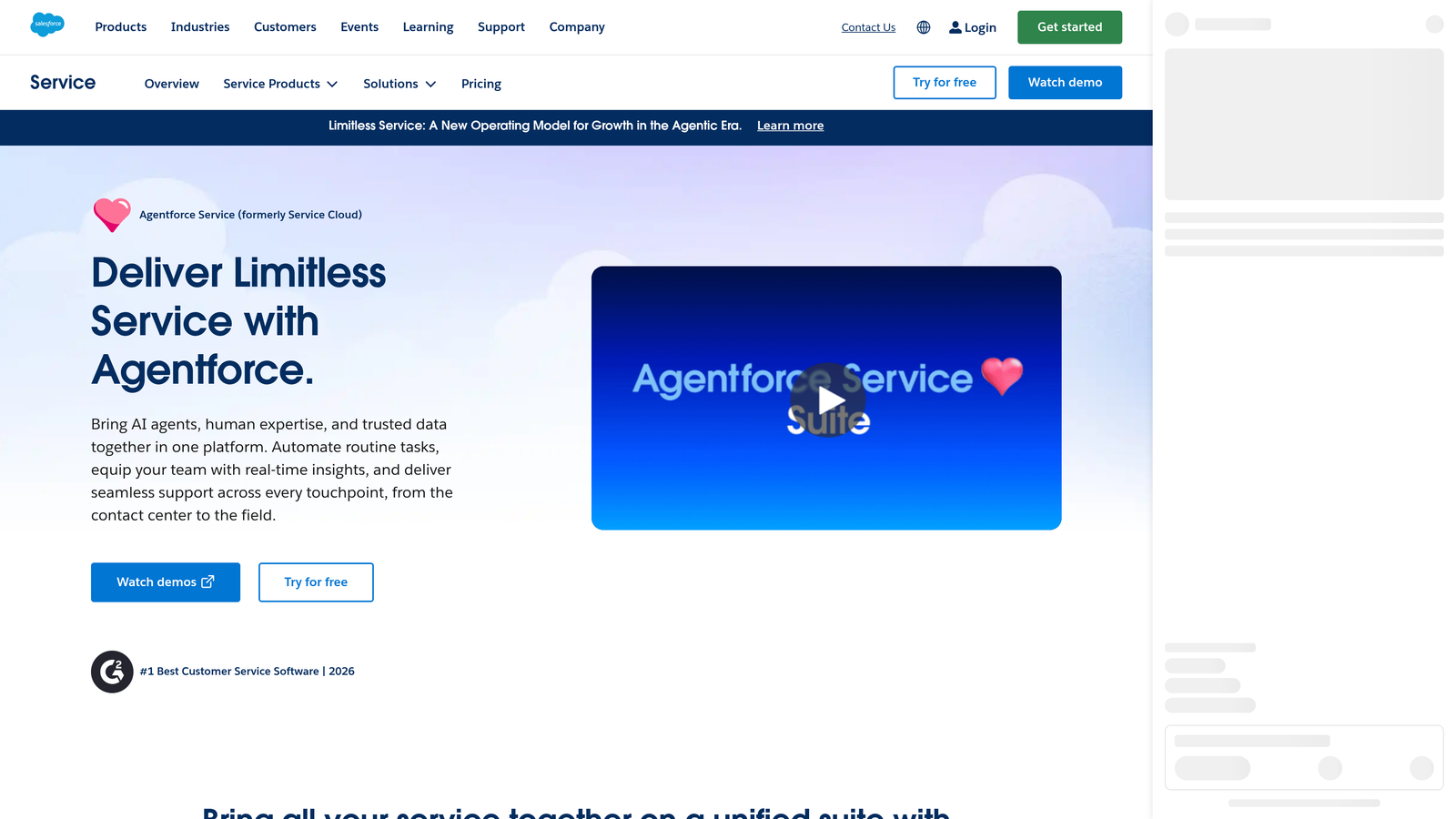
Salesforce Einstein Service Cloud is a mature enterprise service platform with deeply embedded AI through Einstein Copilot, offering case classification, agent assistance, and next-best-action recommendations native to Salesforce.
Where This Tool Shines
If your organization is already Salesforce-native, Einstein Service Cloud is the most natural path to AI-powered support. The integration between CRM data and support interactions is seamless: agents see full customer history, account health, and deal context inside every case. That depth of context is difficult to replicate with third-party tools.
Einstein Copilot adds genuine value for agents handling complex cases. Case summaries, knowledge article suggestions, and next-best-action recommendations reduce time-to-resolution and help agents navigate large knowledge bases more efficiently.
Key Features
Einstein Copilot: Provides agents with AI-generated case summaries, relevant knowledge suggestions, and next-best-action recommendations in real time.
AI-Powered Case Classification: Automatically classifies and routes incoming cases based on intent, priority, and customer context.
Native CRM Integration: Full Salesforce customer data surfaces in every support interaction, eliminating context-switching between systems.
Flow-Based Workflow Automation: Enables complex, multi-step enterprise process automation without custom code.
Omnichannel Routing: Manages support across email, chat, phone, and social from a single unified platform.
Best For
Enterprises with significant Salesforce investments and support teams that handle complex, high-value accounts where CRM context matters in every interaction. Less compelling for teams outside the Salesforce ecosystem.
Pricing
Service Cloud Enterprise starts at approximately $75/user/month. Einstein Copilot and AI add-ons are priced separately. Verify current pricing directly on the Salesforce website.
3. Zendesk AI
Best for: Teams with existing Zendesk infrastructure looking to add intelligent automation without a full migration.
Zendesk AI builds on Zendesk's mature ticketing infrastructure with intelligent triage, agent copilot capabilities, and multilingual automation, powered in part by its acquisition of conversational AI company Ultimate.
Where This Tool Shines
Zendesk AI's strongest argument is continuity. If your team has years of ticket data, macros, and workflows built in Zendesk, layering AI on top is far less disruptive than a platform migration. The intelligent triage capabilities are particularly well-developed: intent detection, language identification, and sentiment analysis work together to route tickets accurately before a human ever touches them.
The large Zendesk app marketplace also extends the platform's reach considerably. Teams with complex integration requirements can often find pre-built connectors rather than building custom solutions.
Key Features
Intelligent Triage: Detects intent, language, and sentiment automatically to route tickets to the right team or agent without manual intervention.
Agent Copilot: Surfaces suggested replies, ticket summaries, and macro recommendations to help agents resolve cases faster.
Multilingual AI Support: Handles support interactions across multiple languages out of the box, without separate configuration per language.
AI-Powered Self-Service: Connects to your knowledge base to deflect common queries before they reach the queue.
Extensive App Marketplace: Hundreds of pre-built integrations extend functionality across CRMs, analytics tools, and business systems.
Best For
Support teams already running on Zendesk who want meaningful AI capabilities without abandoning their existing infrastructure. Also suitable for enterprises prioritizing multilingual support at scale.
Pricing
Suite Professional starts at approximately $115/agent/month. Verify current pricing and AI add-on costs directly on the Zendesk website.
4. Intercom Fin AI
Best for: SaaS and product-led teams with high in-app chat volume seeking autonomous resolution at scale.
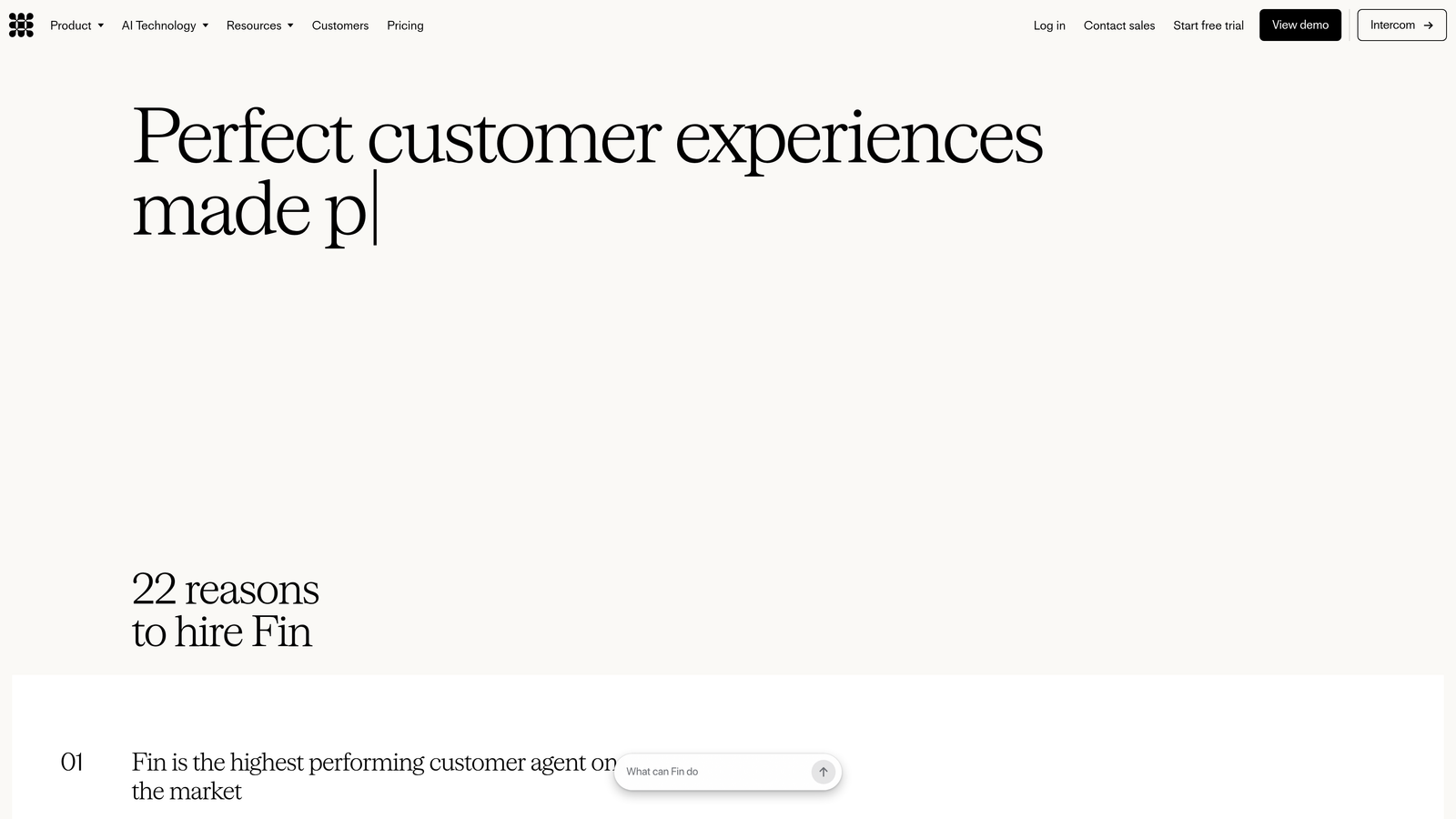
Intercom Fin is Intercom's GPT-powered AI agent designed to resolve a high proportion of inbound support queries autonomously, with smooth handoff to human agents and deep in-product messenger integration.
Where This Tool Shines
Fin's strength is its conversational quality. Trained on your knowledge base, it handles nuanced product questions in a way that feels natural rather than scripted. For SaaS companies where users expect in-app support that understands their context, Fin's messenger integration is a genuine differentiator.
The outcome-based pricing model is also worth noting. Paying per resolution rather than per seat aligns costs with actual value delivered, which can be appealing for teams with variable support volumes.
Key Features
GPT-Powered AI Agent: Trained on your knowledge base to handle product-specific queries with high conversational accuracy and context awareness.
Outcome-Based Pricing: Charged per resolution rather than per seat, aligning platform costs with actual support value delivered.
Seamless Human Handoff: Transfers conversations to human agents with full context preserved, eliminating the need for customers to repeat themselves.
In-Product Messenger: Deep integration with Intercom's messenger makes it a natural fit for SaaS products with in-app support as a core channel.
Resolution Rate Reporting: Conversation analytics surface Fin's resolution rates and help identify knowledge gaps for ongoing improvement.
Best For
Product-led SaaS teams where in-app support is the primary channel and autonomous resolution rate is the key metric. Less suited for enterprises with complex, multi-channel support operations beyond chat.
Pricing
Fin is charged per resolution at approximately $0.99/resolution. Intercom's overall pricing model has evolved; verify the current structure on the Intercom website.
5. ServiceNow Customer Service Management
Best for: IT-heavy enterprises needing support tickets to trigger cross-departmental workflows across ops, IT, and field service.
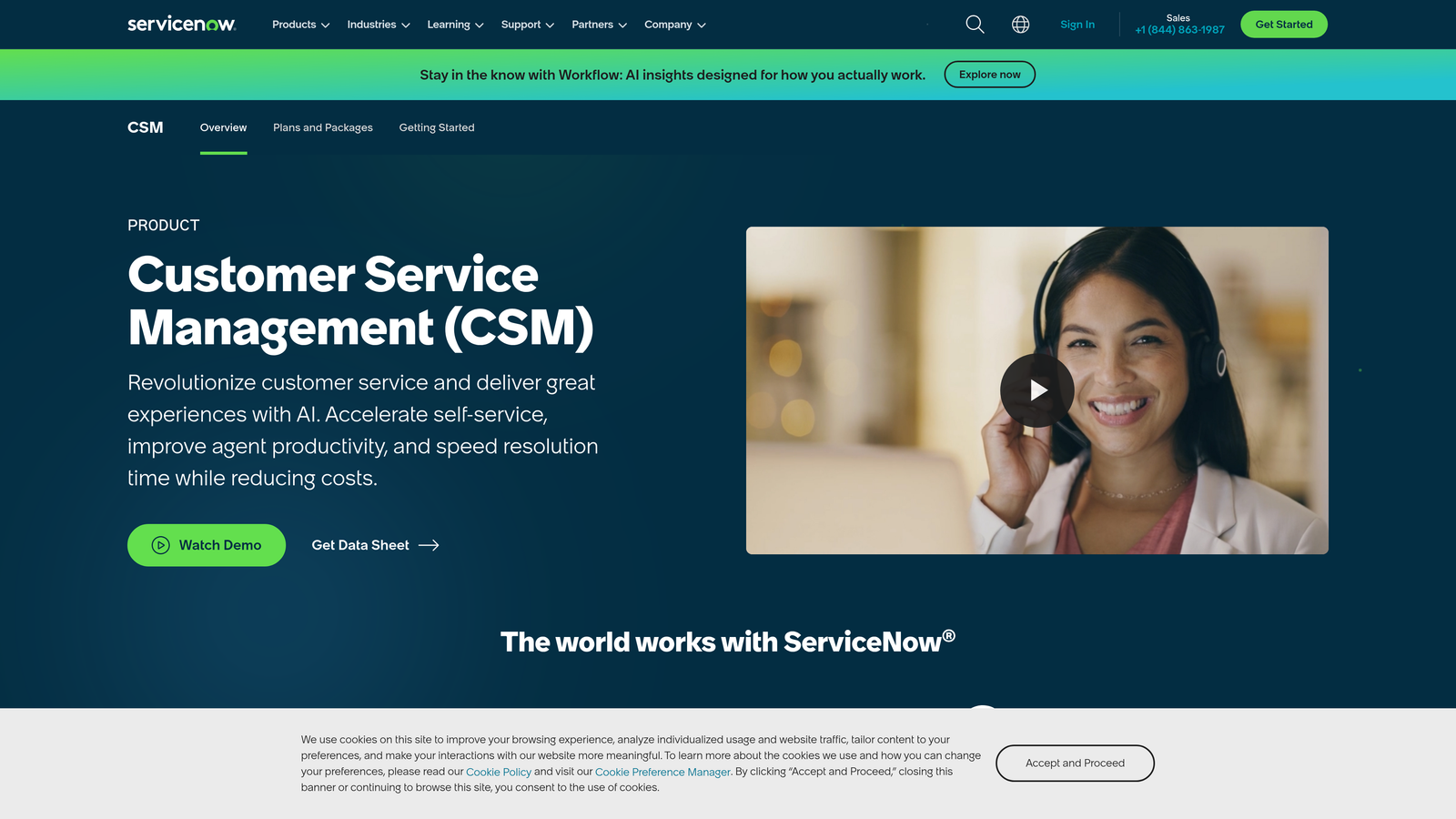
ServiceNow Customer Service Management connects customer support to IT, operations, and field service workflows, with Now Assist providing generative AI for case summarization and agent assistance.
Where This Tool Shines
ServiceNow's core advantage is workflow depth. When a customer support ticket needs to trigger an IT incident, a field service dispatch, or a compliance review, ServiceNow handles that cross-departmental orchestration natively. Most support platforms treat this as an edge case; for ServiceNow, it's a core design principle.
Now Assist, ServiceNow's generative AI layer, adds case summarization and agent assistance that reduces the cognitive load on agents handling complex, multi-system issues. It's particularly well-suited for industries like telecommunications, financial services, and healthcare where support frequently intersects with operations.
Key Features
Now Assist: Generative AI for case summaries, agent assistance, and self-service deflection across complex enterprise workflows.
Cross-Departmental Workflow Automation: Support tickets can trigger IT incidents, operations processes, and field service workflows without manual handoffs.
AI-Powered Case Routing: Intelligent triage routes cases based on type, priority, and required expertise across departments.
Self-Service Portal: Virtual agent capabilities deflect common queries through a customer-facing portal before they reach live agents.
Enterprise Compliance and Security: Built-in audit trails, RBAC controls, and enterprise-grade security posture for regulated industries.
Best For
Large enterprises in regulated industries or with complex IT and operations structures where support resolution requires coordination across multiple internal departments. Not designed for SMB or early-stage teams.
Pricing
Enterprise custom pricing only. Contact ServiceNow directly for quotes tailored to your organization's scale and requirements.
6. Freshdesk (Freddy AI)
Best for: Growing teams scaling from SMB to mid-market who need capable AI without enterprise-level pricing.
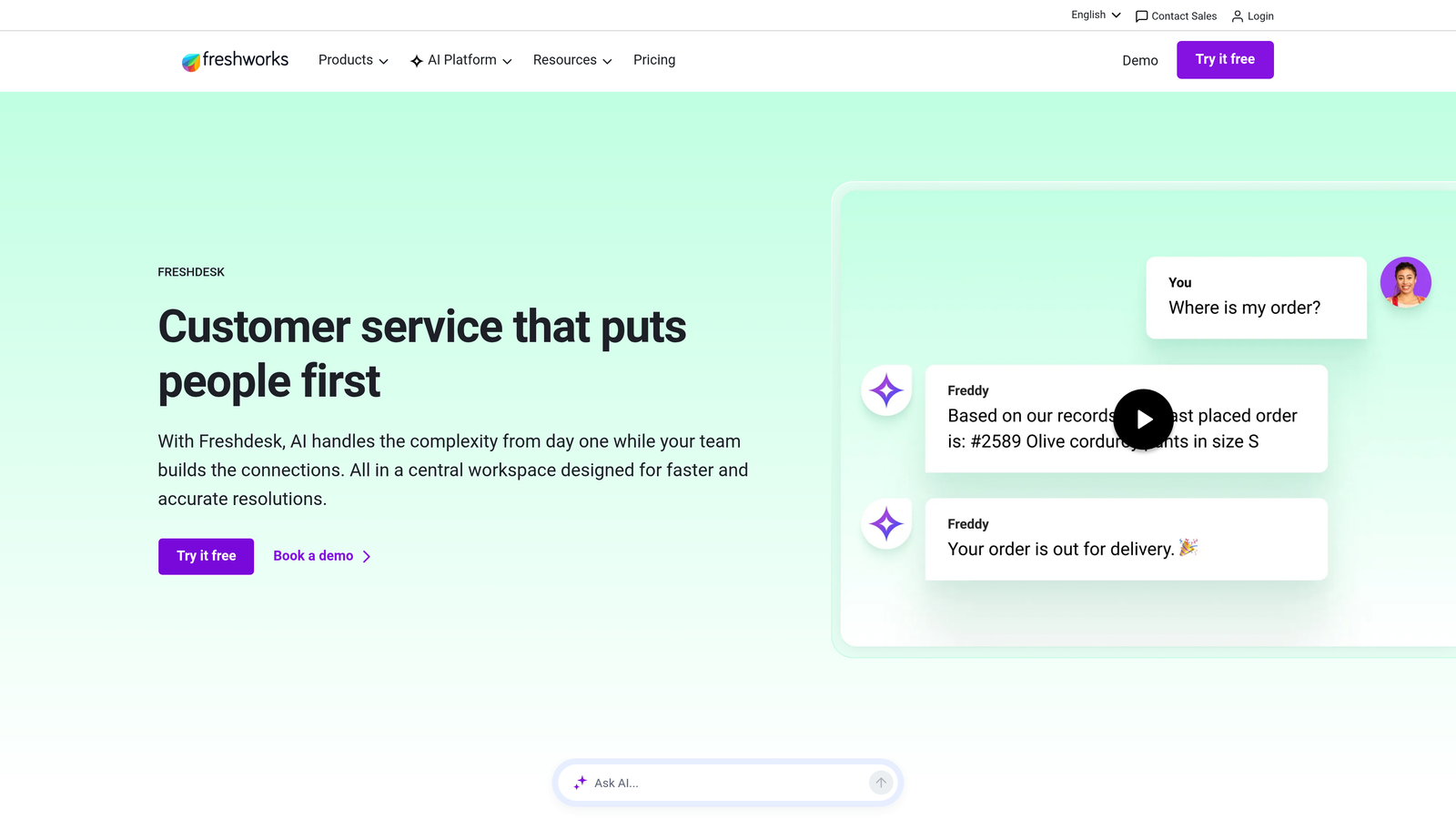
Freshdesk with Freddy AI adds ticket summarization, suggested replies, sentiment analysis, and self-service automation to a mature helpdesk platform at a price point accessible to teams that aren't yet at enterprise scale.
Where This Tool Shines
Freshdesk's value proposition is accessibility. The core helpdesk is solid, the free tier is genuinely useful for small teams, and Freddy AI's capabilities cover the most common automation needs without requiring a large implementation budget. For teams that have outgrown basic helpdesks but aren't ready for Salesforce or ServiceNow pricing, Freshdesk occupies a sensible middle ground.
Freddy Copilot and Freddy Self Service are modular add-ons, which means teams can start with agent-assist capabilities and add customer-facing automation as their volume grows.
Key Features
Freddy Copilot: Provides agents with suggested replies, ticket summaries, and sentiment detection to speed up resolution and reduce cognitive load.
Freddy Self Service: Customer-facing AI bot that deflects common queries before they reach the support queue.
Auto-Triage: Automatically categorizes and prioritizes incoming tickets based on content and intent.
Omnichannel Support: Manages email, chat, phone, and social interactions from a single platform.
Accessible Pricing Tiers: Free tier available with paid plans scaling incrementally, making it viable for teams at multiple growth stages.
Best For
Support teams scaling from SMB to mid-market that need solid AI capabilities without enterprise contract complexity. Also a good fit for teams that want to pilot AI-assisted support before committing to a larger platform investment.
Pricing
Free tier available. Paid plans start at approximately $15/agent/month, with Freddy AI add-ons priced separately. Verify current pricing on the Freshworks website.
7. Kustomer
Best for: High-volume support teams that need a full customer timeline across every channel in a single CRM-native view.
Kustomer is a CRM-native support platform that unifies the complete customer timeline across all channels, with AI-powered routing, conversation summaries, and proactive agent suggestions built into the core experience.
Where This Tool Shines
Kustomer's defining characteristic is its people-centric data model. Rather than organizing support around tickets, it organizes around customers: every interaction, purchase, return, and conversation is visible in a single timeline. Agents handling complex, multi-touch relationships have full context without switching between systems.
The AI layer adds routing intelligence and real-time conversation summaries that help agents pick up mid-conversation without losing momentum. For teams managing high volumes of relationship-intensive support, this combination of CRM depth and AI assistance is meaningful.
Key Features
Full Customer Timeline: Every interaction across all channels consolidated in a single, chronological customer view accessible to every agent.
AI-Powered Routing: Intelligent triage routes conversations based on customer history, intent, and agent expertise.
Automated Conversation Summaries: AI-generated summaries help agents quickly understand conversation history before responding.
Proactive Outreach: Triggers proactive customer outreach based on behavioral signals and customer health indicators.
Omnichannel Unification: Email, chat, voice, SMS, and social channels managed within the same customer-centric interface.
Best For
High-volume support teams in consumer or B2B contexts where relationship continuity and full customer context matter more than pure ticket deflection rates. Strong fit for teams that have outgrown traditional helpdesks but want CRM depth built into their support tooling.
Pricing
Enterprise custom pricing. Contact Kustomer directly for quotes based on team size and volume requirements.
8. Ada
Best for: Enterprises needing a no-code, action-capable AI agent that executes tasks rather than just answering questions.
Ada is a no-code AI agent builder that enables enterprises to deploy AI capable of executing transactions, updating records, and triggering workflows across integrated systems, not just responding to FAQs.
Where This Tool Shines
The distinction Ada draws is between AI that answers and AI that acts. Many platforms can retrieve information from a knowledge base and respond conversationally. Ada goes further: its agents can process requests, update records in connected systems, and trigger downstream workflows. For enterprises with transactional support use cases, that capability gap is significant.
The no-code builder also lowers the barrier to deployment. Enterprise teams without deep AI engineering resources can configure, customize, and deploy agents without relying on development cycles, which accelerates time-to-value considerably.
Key Features
No-Code Agent Builder: Configure and deploy AI agents without engineering resources, with strong brand customization controls throughout.
Action-Capable AI: Agents can execute tasks, update records, process requests, and trigger workflows in connected systems, not just retrieve answers.
Enterprise System Integrations: Connects with major CRMs, helpdesks, and enterprise platforms to enable end-to-end automation.
Multilingual and Omnichannel: Supports multiple languages and deploys across web, mobile, and messaging channels from a single configuration.
Enterprise Security: SOC 2 compliant with enterprise-grade access controls and audit capabilities.
Best For
Enterprises with transactional support workflows where AI needs to do more than answer questions, including processing requests, updating customer records, or triggering operations across integrated systems. Also well-suited for teams that need non-technical staff to manage and iterate on AI agents independently.
Pricing
Enterprise custom pricing. Contact Ada directly at ada.cx for a quote.
9. Gladly
Best for: Premium consumer brands prioritizing relationship quality and continuous conversation threads over traditional ticket management.
Gladly eliminates the traditional ticket model entirely in favor of people-centric, ongoing conversation threads, with an AI Sidekick assisting agents in real time and full channel unification in a single view.
Where This Tool Shines
Gladly's most radical design choice is removing the ticket entirely. Every customer has a single, continuous conversation thread that persists across every channel and every interaction over time. Agents see the complete relationship history, not a fragmented series of case numbers. For brands where the quality of the support relationship is itself a differentiator, this model changes the dynamic meaningfully.
The AI Sidekick assists agents in real time with suggested responses and knowledge retrieval, keeping resolution times low without sacrificing the relational quality that makes Gladly's model work. Brands like Crate & Barrel and REI have been cited publicly as Gladly customers, reflecting its fit for premium consumer contexts.
Key Features
People-Centric Conversation Model: No tickets; every customer has a single, continuous conversation thread that persists across all channels and all time.
AI Sidekick: Real-time agent assistance with suggested responses and knowledge retrieval to accelerate resolution without losing relational quality.
Radial Channel View: Email, chat, voice, SMS, and social unified in a single people-centric interface with no context-switching required.
Customer Lifetime Value Context: Surfaces customer value and history during every interaction to inform agent prioritization and tone.
Relationship-First Design: Platform architecture prioritizes conversation continuity and relationship quality over pure deflection metrics.
Best For
Premium consumer brands and retailers where support quality is a competitive differentiator and relationship continuity matters more than ticket deflection rates. Less suited for high-volume B2B SaaS teams where autonomous resolution and business intelligence are the primary requirements.
Pricing
Enterprise custom pricing. Contact Gladly directly at gladly.com for a quote.
Which Platform Is Right for Your Team?
The right choice depends heavily on your current stack, your primary use case, and how much you need AI to do beyond ticket deflection.
If you're a B2B SaaS or product-led team that needs AI-native support with business intelligence baked in, Halo AI is purpose-built for your stack. It's the only platform here that combines page-aware context, autonomous resolution, auto bug ticket creation, and revenue intelligence in a single AI-first architecture.
For Salesforce-native enterprises, Einstein Service Cloud is the natural fit. Teams with existing Zendesk infrastructure should look at Zendesk AI before committing to a migration. Intercom Fin is the strongest choice for product teams with heavy in-app chat volume. ServiceNow belongs in IT-heavy enterprises with complex cross-functional workflows. Freshdesk with Freddy AI is the best value option for growing teams scaling toward mid-market.
Kustomer and Gladly serve relationship-focused teams where customer context and conversation continuity are the priority. Ada stands apart as the go-to for enterprises that need no-code, action-capable AI agents that execute tasks rather than just answer questions.
The common thread across every top platform in 2026: AI that learns continuously, integrates deeply with your business stack, and handles resolution autonomously rather than just routing or keyword matching. Before committing, map your current ticket volume, integration requirements, and whether you need pure automation or business intelligence layered on top.
Explore our customer support automation strategy guide and automated customer support overview for more context on building the right foundation. Your support team shouldn't scale linearly with your customer base. Let AI agents handle routine tickets, guide users through your product, and surface business intelligence while your team focuses on complex issues that need a human touch. See Halo in action and discover how continuous learning transforms every interaction into smarter, faster support.