9 Best Enterprise AI Support Solutions Compared for 2026
This guide delivers a detailed Enterprise AI Support Solutions Comparison across nine leading platforms, evaluating autonomous resolution capability, integration depth, analytics sophistication, and scalability. Whether you're deploying AI support for the first time or replacing a legacy helpdesk, it provides the framework to match the right solution to your enterprise team's specific needs.
 Grant CooperFounder13 min read
Enterprise support teams are under more pressure than ever: higher ticket volumes, rising customer expectations, and headcount constraints that don't budge. AI support solutions have matured well beyond basic chatbots. Today's platforms can resolve tickets autonomously, surface business intelligence, and integrate deeply with your entire tech stack.
But with dozens of vendors competing for enterprise budgets, choosing the right platform is genuinely difficult. The market now divides into two broad categories: AI layered onto legacy helpdesks, and AI-native platforms built from the ground up for autonomous resolution. That distinction matters more than most buyers realize, because it affects latency, learning speed, and integration flexibility in ways that compound over time.
This guide compares leading enterprise AI support solutions across the dimensions that matter most: autonomous resolution capability, integration depth, analytics sophistication, learning model, and scalability. Whether you're evaluating your first AI support deployment or looking to replace a legacy helpdesk, this comparison will help you match the right platform to your team's specific needs. Tools are ordered by overall capability and fit for modern B2B teams.
1. Halo AI
Best for: B2B SaaS teams that need AI-native support with deep product and business context
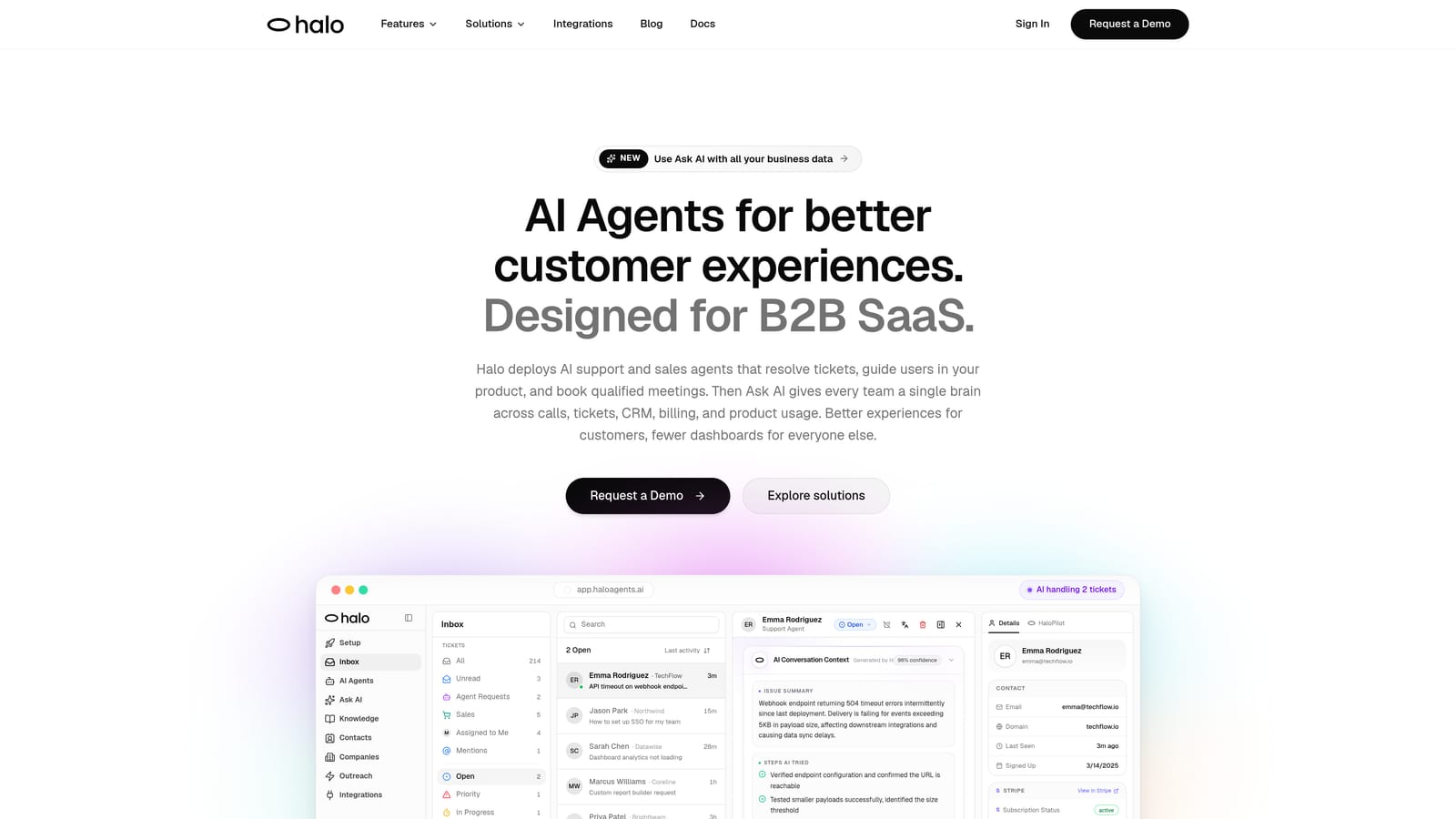
Halo AI is an AI-first customer support platform purpose-built for B2B SaaS teams that need more than a chatbot bolted onto a helpdesk.
Where This Tool Shines
What sets Halo apart from the field is its page-aware architecture. The AI agent understands exactly where a user is inside your product at the moment they ask a question, which means it can deliver contextually precise guidance rather than generic answers pulled from a knowledge base. This is a meaningful differentiator in SaaS environments where the same question means something very different on the billing page versus the onboarding flow.
Halo also takes a genuinely different approach to learning. Rather than requiring manual retraining cycles, the system continuously improves from every resolved ticket. Over time, your AI gets meaningfully smarter without your team having to orchestrate it. The smart inbox adds another dimension: it surfaces customer health signals, revenue anomalies, and churn indicators, turning your support queue into a source of business intelligence.
Key Features
Page-Aware Chat Widget: The AI sees what the user sees in your product, enabling context-specific guidance that generic helpdesk bots can't match.
Continuous Learning Engine: Every resolved ticket improves the model automatically, no manual retraining required.
Auto Bug Ticket Creation: Detected issues are automatically routed to Linear or your dev toolchain, closing the loop between support and engineering.
Smart Inbox with Business Intelligence: Surfaces customer health signals, revenue anomalies, and churn indicators alongside standard support metrics.
Live Agent Handoff: Complex issues escalate to human agents with full context transferred, so customers never have to repeat themselves.
Deep Integration Stack: Connects with Linear, Slack, HubSpot, Intercom, Stripe, Zoom, PandaDoc, and Fathom out of the box.
Best For
B2B SaaS companies that want an AI-first support layer, not a helpdesk add-on. Particularly well-suited for product teams that want support intelligence to feed back into engineering and revenue workflows, and for organizations that need support to scale without scaling headcount proportionally.
Pricing
Enterprise pricing available on request. Book a demo at haloagents.ai to discuss your team's specific needs and get a tailored quote.
2. Zendesk AI
Best for: Enterprises already deeply invested in the Zendesk ecosystem
Zendesk AI is a suite of generative AI capabilities layered onto Zendesk's established enterprise helpdesk platform.
Where This Tool Shines
Zendesk's core strength is its maturity. The platform has over a decade of enterprise adoption, which translates into a massive app marketplace, robust compliance certifications, and deep documentation. For enterprises already running significant Zendesk customizations, adding Zendesk AI is a natural extension rather than a platform migration.
The AI features cover intelligent triage, suggested replies, macro suggestions, and generative AI for knowledge base creation. These are solid capabilities, though they represent AI added to an existing system rather than an AI-native design. Teams evaluating Zendesk AI should weigh the convenience of staying in the ecosystem against the architectural limitations of a bolt-on approach.
Key Features
Intelligent Triage and Routing: Automatically classifies and routes incoming tickets based on intent and content.
AI-Generated Suggested Responses: Helps agents draft replies faster without replacing human judgment.
Generative AI for Knowledge Base: Drafts and improves help articles based on existing content and ticket patterns.
1,000+ App Marketplace Integrations: Extensive third-party connectivity for enterprises with complex tool stacks.
Enterprise Compliance: SOC 2, GDPR, and HIPAA certifications for regulated industries.
Best For
Enterprises with existing Zendesk deployments who want to layer AI capabilities without migrating platforms. Also a strong fit for regulated industries that require certified compliance controls and mature audit trails.
Pricing
AI features available on higher-tier Zendesk plans; enterprise pricing available on request directly from Zendesk.
3. Intercom Fin
Best for: SaaS companies with well-maintained help centers seeking high autonomous resolution rates
Intercom Fin is an LLM-powered AI agent that resolves customer queries directly from your help content, with a per-resolution pricing model that aligns cost with outcomes.
Where This Tool Shines
Fin's resolution quality is closely tied to the quality of your existing help center content. When your documentation is thorough and well-structured, Fin can resolve a meaningful share of incoming queries without human involvement. The per-resolution pricing model is appealing in principle: you pay for outcomes rather than seats.
Fin also benefits from tight integration with the broader Intercom workspace, including agent handoff, customer data, and reporting. For teams already using Intercom for customer communications, Fin adds AI resolution without requiring a separate platform to manage.
Key Features
LLM-Powered Resolution: Answers queries directly from help center and knowledge base content using large language models.
Fin Actions: Enables the AI to take steps within connected systems, moving beyond Q&A into transactional support.
Seamless Human Handoff: Escalates to agents within the Intercom workspace with full conversation context intact.
Omnichannel Coverage: Supports web, mobile, and email interactions from a single platform.
Resolution-Based Pricing: Charges per resolved conversation rather than per seat or per message.
Best For
SaaS companies already on Intercom with well-maintained help documentation. Less suited for teams with sparse knowledge bases or complex multi-system workflows that require deep backend integrations.
Pricing
Per-resolution fee in addition to the Intercom platform subscription; enterprise pricing available on request from Intercom.
4. Freshdesk Freddy AI
Best for: Teams already on the Freshworks product suite seeking integrated AI across support, CRM, and IT
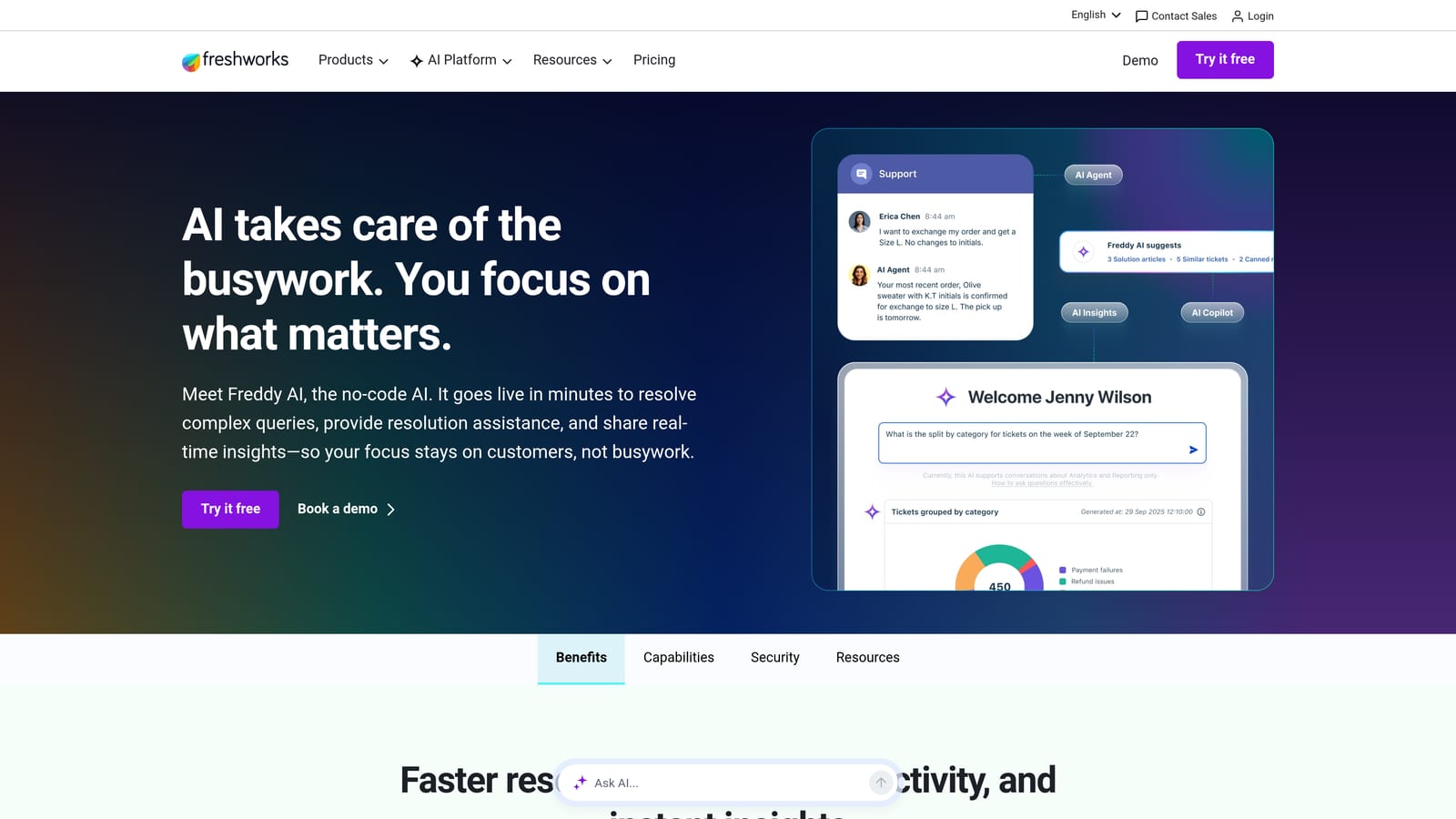
Freshdesk Freddy AI is Freshworks' AI layer spanning customer support, CRM, and IT service management products.
Where This Tool Shines
Freddy's value proposition is strongest for organizations already using Freshworks products across their customer-facing operations. Because Freddy spans Freshdesk, Freshsales, and Freshservice, teams can get consistent AI assistance across support, sales, and IT without managing separate AI vendors for each function.
For support specifically, Freddy covers the core use cases well: auto-triage, agent response suggestions, and analytics through Freddy Insights. Multi-language support is a practical advantage for enterprises serving global customer bases.
Key Features
Freddy Self Service: AI-powered deflection that resolves common queries before they reach agents.
Freddy Copilot: Real-time response suggestions and drafting assistance for live agents.
Freddy Insights: Analytics layer for trend detection, CSAT tracking, and identifying automation opportunities.
Cross-Suite Integration: Natively connected across Freshdesk, Freshsales, and Freshservice.
Multi-Language Support: Handles customer interactions across multiple languages for global teams.
Best For
Organizations already invested in the Freshworks ecosystem. Teams with complex multi-system integration needs outside of Freshworks may find the platform's connectivity more limited than AI-native alternatives.
Pricing
Freddy AI features are tiered by plan; full capability requires enterprise-tier Freshworks plans. Contact Freshworks for enterprise pricing.
5. Salesforce Agentforce
Best for: Salesforce-centric enterprises that need AI support agents with full CRM context
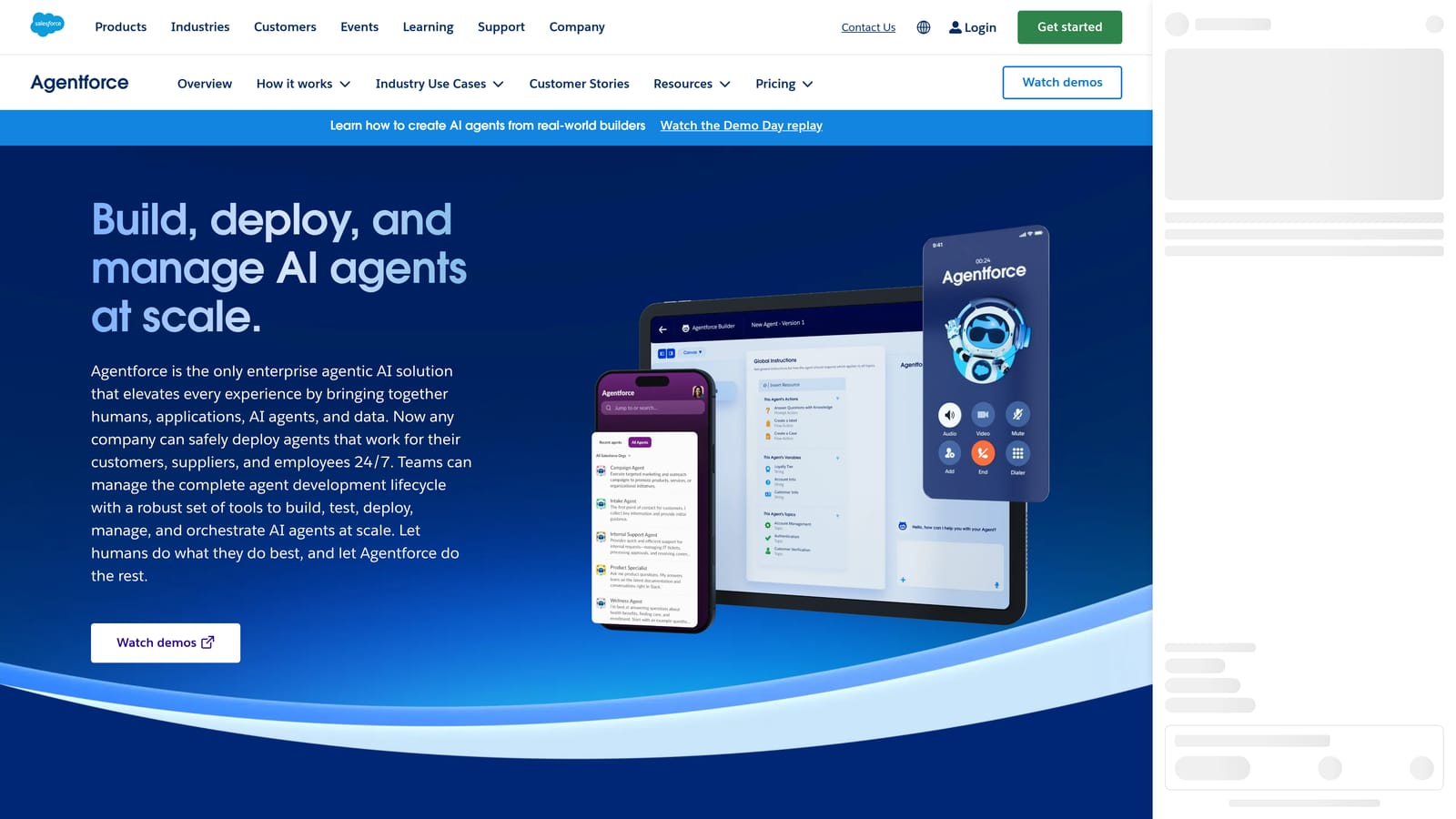
Salesforce Agentforce is Salesforce's autonomous AI agent platform built natively on the Salesforce Data Cloud, enabling deeply personalized support interactions informed by complete customer records.
Where This Tool Shines
The genuine differentiator here is data depth. Because Agentforce sits natively on Salesforce's Data Cloud, it can access full customer records, purchase history, case history, and relationship data at the moment of every support interaction. For enterprises where Salesforce is the system of record, that context richness is hard to replicate with an external AI tool.
Agentforce also enables autonomous agents that can take action across Salesforce workflows, not just answer questions. The Einstein Trust Layer addresses enterprise data governance concerns. The trade-off is implementation complexity: Agentforce deployments typically require significant Salesforce expertise and configuration investment.
Key Features
Native Salesforce Data Access: Draws on full CRM records, purchase history, and case data for every interaction.
Autonomous Action Agents: Can execute tasks and update records across Salesforce workflows, not just respond to queries.
Agent Builder: No-code interface for customizing agent behavior without developer involvement.
Omni-Channel Routing Integration: Works within Salesforce's existing routing and case management infrastructure.
Einstein Trust Layer: Enterprise-grade data governance controls for regulated industries and privacy requirements.
Best For
Enterprises where Salesforce is the central system of record and support teams need AI that's deeply informed by CRM data. Less practical for organizations not already on Salesforce, given implementation complexity and cost.
Pricing
Consumption-based model; enterprise contracts negotiated directly with Salesforce. Contact Salesforce for current pricing.
6. ServiceNow Now Assist
Best for: IT service management teams in regulated industries needing governance-first AI
ServiceNow Now Assist brings generative AI into ITSM, HRSD, and CSM workflows with strong governance controls designed for structured enterprise service management.
Where This Tool Shines
Now Assist is purpose-built for the ServiceNow ecosystem, which means it excels in structured service management scenarios: IT service desk, HR case management, and enterprise customer service management. The generative AI capabilities focus on case summarization, resolution suggestions, and knowledge article generation, which meaningfully reduce agent effort in high-volume ITSM environments.
The governance controls are a genuine strength for regulated industries. Data handling, audit trails, and compliance configurations are built into the platform rather than bolted on. Teams in financial services, healthcare, or government that already run ServiceNow will find Now Assist a natural extension.
Key Features
AI Case Summarization: Automatically summarizes case history so agents can get up to speed instantly.
Resolution Suggestions: Recommends resolution paths based on similar historical cases.
AI Knowledge Article Generation: Creates and improves knowledge base articles from case data.
Cross-Module Coverage: Available for ITSM, CSM, HRSD, and additional ServiceNow modules.
Skills Kit: Configuration interface for adjusting AI behavior without writing code.
Best For
Enterprises running ServiceNow for IT or enterprise service management, particularly in regulated industries. Not optimized for pure customer-facing SaaS support or teams without existing ServiceNow infrastructure.
Pricing
Enterprise licensing model; contact ServiceNow directly for current pricing and module-specific costs.
7. Kustomer AI
Best for: High-volume consumer brands needing omnichannel support with unified customer history
Kustomer is a CRM-native customer service platform with AI built into its omnichannel architecture, where every AI interaction draws from a unified customer timeline.
Where This Tool Shines
Kustomer's defining feature is its unified customer timeline. Every interaction across every channel, including chat, email, SMS, social, and voice, is stored in a single chronological view. When the AI makes routing decisions or generates responses, it draws from this complete history rather than just the current conversation. For high-volume consumer brands handling repeat customers, that context depth improves resolution quality meaningfully.
Proactive messaging capabilities allow teams to reach customers based on behavioral signals before issues escalate. Kustomer is owned by Meta, which brings both resource depth and some enterprise buyer considerations worth evaluating in your vendor assessment.
Key Features
Unified Customer Timeline: All channel interactions stored chronologically to inform every AI response and agent interaction.
AI-Powered Routing and Deflection: Classifies and routes tickets intelligently based on intent and customer history.
Proactive Messaging: Triggers outbound messages based on customer behavior signals to get ahead of issues.
True Omnichannel: Covers chat, email, SMS, social, and voice from a single platform.
KIQ Customer Assist: Self-service resolution module for deflecting common queries before they reach agents.
Best For
High-volume consumer brands and B2C companies that need unified omnichannel support with strong customer history context. Less optimized for B2B SaaS workflows that require deep product integration or developer toolchain connectivity.
Pricing
Enterprise plans; contact Kustomer directly for current pricing based on team size and channel requirements.
8. Ada
Best for: Enterprises that need AI agents capable of executing transactions, not just answering questions
Ada is a dedicated AI agent platform focused on action-oriented automation, where agents can execute API calls, process transactions, and update backend systems rather than simply responding to queries.
Where This Tool Shines
Ada's differentiator is its emphasis on action over conversation. While many AI support tools are fundamentally sophisticated answer machines, Ada's agents are built to do things: process a refund, update an account, trigger a workflow, retrieve real-time data from a backend system. For enterprises in telecom, financial services, or retail where support often requires taking action in core systems, this capability gap matters significantly.
The no-code Agent Builder makes Ada accessible to non-technical teams, which reduces the implementation burden for enterprises that don't want every AI configuration to require developer involvement. Broad channel coverage ensures consistent AI behavior across web, mobile, phone, and messaging.
Key Features
Action-Oriented AI Agents: Executes transactions, API calls, and backend updates rather than just answering questions.
No-Code Agent Builder: Non-technical teams can configure and adjust agent behavior without engineering support.
Multi-Step Reasoning Engine: Handles complex, multi-turn problem resolution that requires sequential logic.
Broad Channel Coverage: Consistent AI behavior across web, mobile, phone, and messaging channels.
Enterprise CRM and Helpdesk Integrations: Connects with major CRM and helpdesk platforms for data access and handoff.
Best For
Enterprises in telecom, financial services, and retail where support interactions regularly require taking action in backend systems. Ada's SaaS-specific toolchain integrations are less developed than platforms purpose-built for that segment.
Pricing
Enterprise pricing; contact Ada directly for a quote based on volume and integration requirements.
9. Forethought AI
Best for: Large agent teams seeking AI augmentation layered onto an existing helpdesk
Forethought AI specializes in AI-powered triage, routing, and agent assist designed to augment large support teams rather than replace existing helpdesk infrastructure.
Where This Tool Shines
Forethought takes a different strategic position from most platforms on this list. Rather than replacing your helpdesk or becoming your primary support platform, it layers intelligent AI capabilities on top of Zendesk, Salesforce, Freshdesk, and other established systems. For enterprises with significant helpdesk investments and large agent teams, this approach reduces migration risk while still delivering meaningful AI efficiency gains.
The Discover module is particularly useful for enterprises at the start of their AI journey: it analyzes your ticket data to identify which categories are best suited for automation, giving teams a data-driven roadmap for AI deployment rather than requiring them to guess where to start.
Key Features
Solve: AI deflection module that resolves tickets before they reach agents, reducing overall volume.
Triage: AI classification and routing with intent detection for accurate ticket assignment.
Assist: Real-time response suggestions and drafting help for agents handling live tickets.
Discover: Analytics module that identifies automation opportunities within your existing ticket data.
Helpdesk Integrations: Native connectivity with Zendesk, Salesforce, Freshdesk, and other major platforms.
Best For
Enterprises with large agent teams and complex routing logic who want meaningful AI augmentation without replacing their helpdesk. Also well-suited for teams that want to identify automation opportunities analytically before committing to broader AI deployment.
Pricing
Enterprise pricing; contact Forethought directly for details based on team size and helpdesk platform.
Which Platform Is Right for Your Team?
The right enterprise AI support solution depends less on feature lists and more on where your team sits today and where you need to go. Here's a practical way to think through the decision.
If you're a B2B SaaS team building AI-native support from the ground up: Halo AI is purpose-built for this scenario. Page-aware context, continuous learning, and integrations that span your entire SaaS toolchain, including Linear, Stripe, and HubSpot, make it the strongest fit for product-led companies that want support intelligence to flow back into engineering and revenue decisions.
If you're deeply invested in an existing platform ecosystem: Stay in your ecosystem and layer AI onto it. Zendesk AI for Zendesk-heavy teams, Freddy AI for Freshworks shops, Agentforce for Salesforce-centric enterprises, and Now Assist for ServiceNow ITSM environments all offer the path of least migration resistance.
If your support interactions require taking action in backend systems: Ada is built specifically for transactional AI, making it the strongest choice for telecom, financial services, and retail use cases where resolving a ticket means doing something in a core system, not just answering a question.
If you have a large agent team and want AI augmentation without a platform change: Forethought layers cleanly onto your existing helpdesk and gives you a data-driven roadmap for where to automate first. It's a low-risk entry point for enterprises that want to move deliberately.
If your help center documentation is strong and you're already on Intercom: Fin is a natural extension that adds autonomous resolution without requiring a separate platform to manage.
One principle applies across all of these decisions: the gap between AI-native platforms and AI-layered-onto-legacy systems compounds over time. AI-native architectures learn faster, integrate more flexibly, and surface intelligence that bolt-on approaches simply can't access. For teams planning a multi-year AI support strategy, that architectural distinction deserves serious weight in the evaluation.
Your support team shouldn't scale linearly with your customer base. Let AI agents handle routine tickets, guide users through your product, and surface business intelligence while your team focuses on complex issues that need a human touch. See Halo in action and discover how continuous learning transforms every interaction into smarter, faster support.