9 Best Enterprise Helpdesk AI Solutions in 2026
Enterprise support teams face rising ticket volumes and tightening headcount — legacy platforms simply can't keep up. This guide evaluates the nine best Enterprise Helpdesk AI Solutions of 2026, comparing automation depth, integration breadth, and scalability to help organizations find the right AI-native platform for their support operations.
 Matt PattoliFounder13 min read
Enterprise support teams are under more pressure than ever. Ticket volumes are climbing, headcount is tightening, and customers expect accurate answers around the clock. Legacy helpdesk platforms weren't built for this reality, and the gap between what those systems deliver and what modern support operations require is widening fast.
AI-native solutions are stepping in to close that gap, automating resolution, surfacing business intelligence, and routing complex issues to the right human at the right time. But not every "AI helpdesk" delivers the same depth. Some bolt AI onto existing workflows as an afterthought; others are built AI-first from the ground up, with automation at the core of every interaction.
This list covers nine enterprise-grade platforms worth evaluating in 2026, selected based on automation depth, integration breadth, scalability, and how well each handles the full support lifecycle from first contact to resolution. Whether you're replacing a legacy system or augmenting an existing stack, here are the top enterprise helpdesk AI solutions to consider.
1. Halo AI
Best for: B2B SaaS teams that want an AI-first support platform with deep business intelligence.
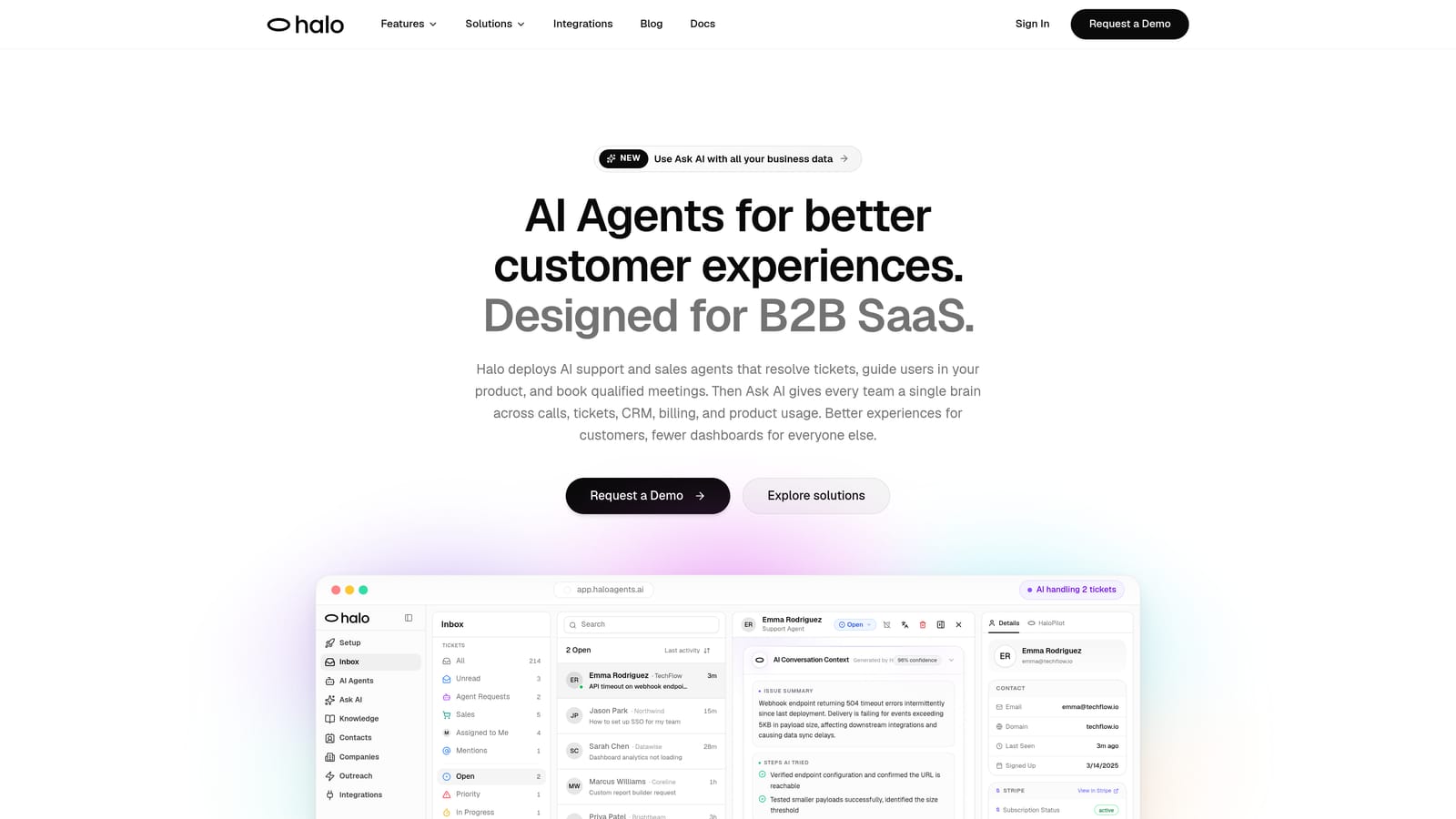
Halo AI is an AI-native customer support platform built specifically for B2B SaaS teams, resolving tickets autonomously, guiding users through your product with page-aware context, and surfacing business intelligence signals that go far beyond standard support metrics.
Where This Tool Shines
Halo's most distinctive capability is its page-aware chat widget. Unlike conventional chatbots that operate with no knowledge of where a user is in your product, Halo's AI sees what the user sees, enabling contextual, visual guidance that's actually relevant to the moment. This makes it particularly effective for resolving in-product confusion without escalating to a human agent.
The platform also stands apart in how it treats support data. Halo's smart inbox doesn't just manage tickets; it surfaces customer health signals, revenue anomalies, and support trends that give product and customer success teams actionable intelligence. Every resolved interaction feeds back into the system, making the AI progressively smarter over time.
Key Features
Intelligent AI Agents: Autonomously resolve support tickets and continuously learn from every interaction to improve resolution quality over time.
Page-Aware Chat Widget: The AI understands the user's current product context, enabling precise, visual UI guidance without requiring a human agent.
Smart Inbox with Business Intelligence: Surfaces customer health signals, revenue anomalies, and support trends alongside standard ticket management.
Auto Bug Ticket Creation: Automatically detects issues and routes bug tickets directly to Linear, reducing manual handoffs between support and engineering.
Live Agent Handoff: Escalates complex issues to human agents with full conversation context preserved, so nothing gets repeated or lost.
Deep Integrations: Connects to Slack, HubSpot, Intercom, Stripe, Zoom, PandaDoc, Fathom, and Linear for a unified view across your entire business stack.
Best For
Halo is purpose-built for B2B SaaS companies that want more than a ticketing layer with AI sprinkled on top. It's the right fit for product-led growth teams, customer success organizations, and support leaders who want autonomous resolution, continuous learning, and business intelligence from a single platform.
Pricing
Enterprise pricing is available on request. A demo is available at haloagents.ai.
2. Zendesk AI
Best for: Enterprise teams already invested in the Zendesk ecosystem seeking incremental AI capabilities.
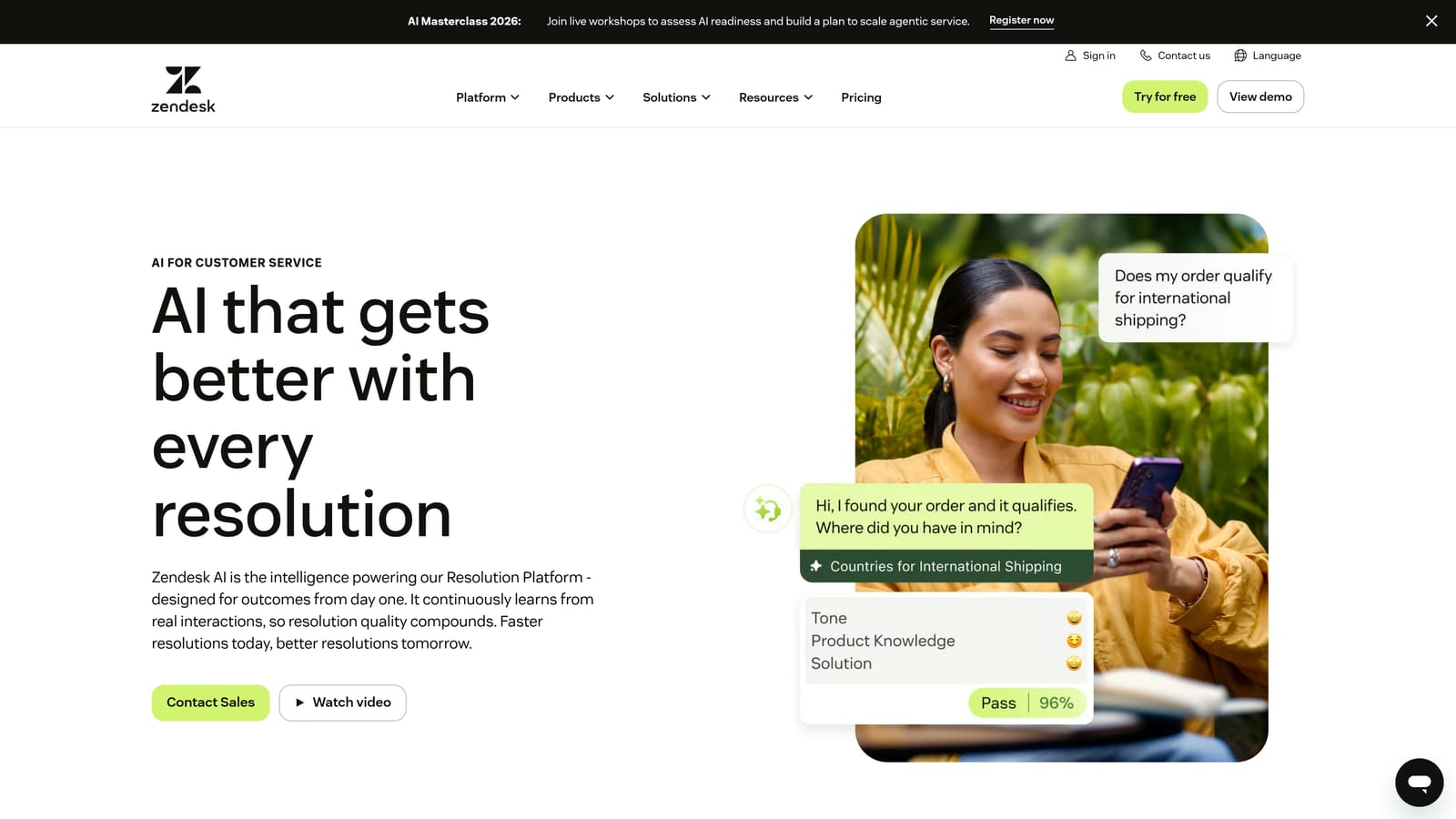
Zendesk AI is a mature enterprise helpdesk platform with AI capabilities layered across ticketing, agent assist, and self-service, designed to enhance existing Zendesk workflows rather than replace them.
Where This Tool Shines
Zendesk's greatest strength is its ecosystem maturity. If your team is already running on Zendesk Suite, the AI add-ons integrate cleanly into existing workflows without requiring a platform migration. The Agent Copilot feature provides suggested replies and next-best-action guidance that agents can adopt at their own pace.
The platform's breadth of third-party integrations and enterprise-grade security tooling also make it a low-risk choice for large organizations with complex compliance requirements. The trade-off is that AI feels additive rather than foundational, which can limit the depth of autonomous resolution.
Key Features
Intelligent Ticket Routing: AI-powered triage automatically categorizes and routes incoming tickets to the appropriate team or agent.
Agent Copilot: Provides suggested replies and next-best-action recommendations to help agents respond faster and more consistently.
AI-Generated Self-Service: Automatically generates answers from your knowledge base to deflect common queries before they become tickets.
Workforce Management and QA: Integrated tools for scheduling, quality assurance, and performance monitoring with AI-driven insights.
App Marketplace: Extensive third-party integrations with enterprise-grade security and compliance controls.
Best For
Teams already running on Zendesk Suite who want to add AI capabilities without migrating platforms. Also well-suited for large enterprises with complex compliance requirements and established support operations.
Pricing
Suite Professional starts around $115 per agent per month. AI add-ons are priced separately, and enterprise pricing is available on request.
3. Intercom Fin
Best for: SaaS teams using Intercom's in-app messenger who want to automate conversational support resolution.
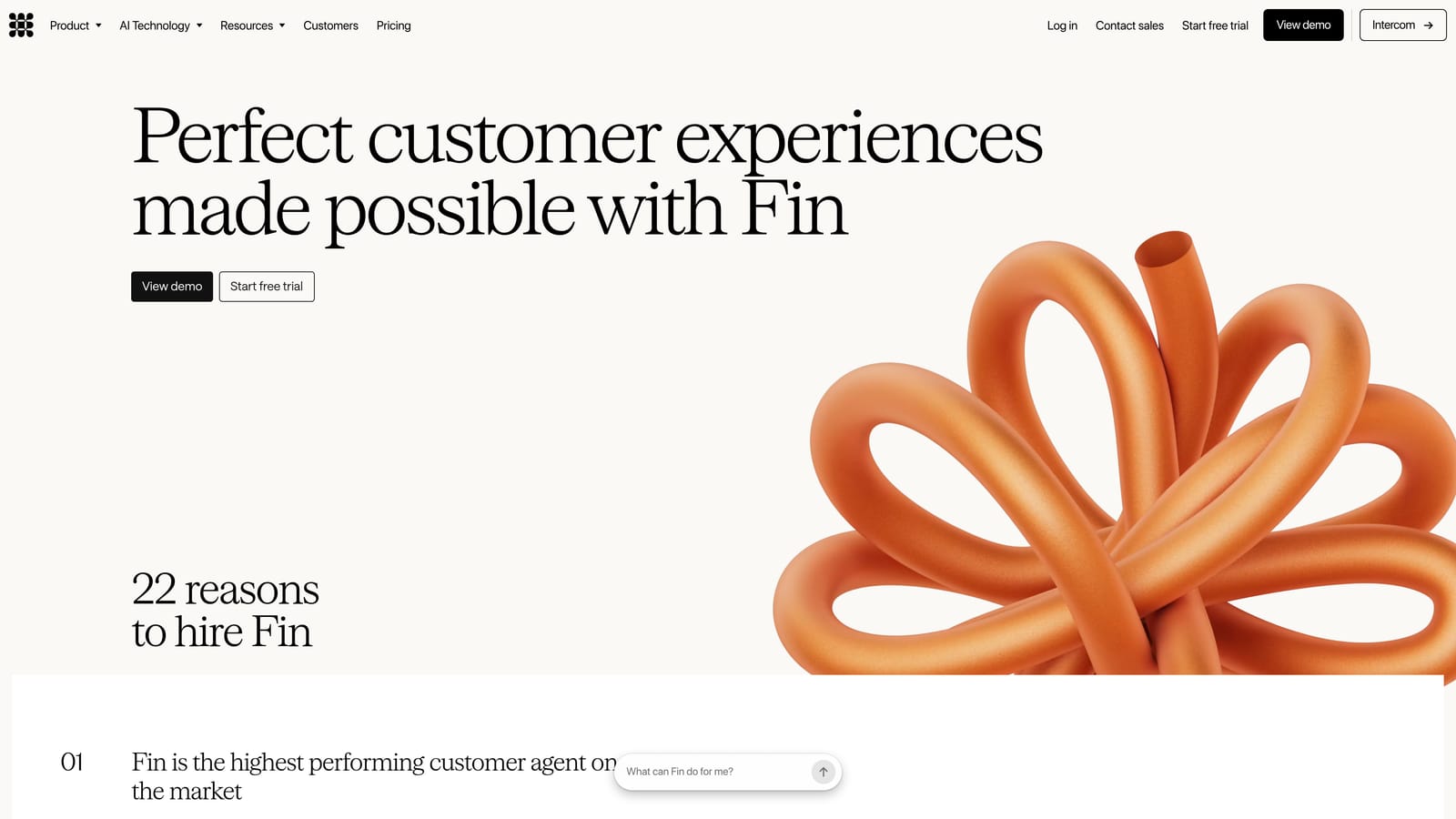
Intercom Fin is an LLM-powered AI agent designed for conversational support resolution, operating natively within Intercom's messenger experience to handle queries before they reach a human agent.
Where This Tool Shines
Fin's conversational resolution capability is genuinely strong for FAQ-style and in-product queries. It draws from your existing knowledge base and responds in a natural, contextually appropriate way, making it feel less like a bot and more like a knowledgeable first responder. The handoff to a human agent within the same conversation thread is seamless, preserving context throughout.
For teams already using Intercom as their primary in-app messaging layer, Fin is a natural extension rather than a new tool to adopt. The resolution rate reporting and AI performance analytics also give support leaders clear visibility into what's working.
Key Features
Fin AI Agent: Resolves queries conversationally using your existing knowledge base, handling a significant portion of inbound volume autonomously.
Seamless Human Handoff: Escalates to live agents within the same conversation thread, preserving full context without disruption.
Fin AI Copilot: Assists live agents with real-time answer suggestions during active conversations.
Multichannel Support: Operates across chat, email, and in-app messaging channels from a single platform.
Resolution Rate Analytics: Built-in reporting on AI performance, resolution rates, and areas where human intervention is most frequently needed.
Best For
SaaS companies already using Intercom for in-app messaging that want to automate a meaningful portion of support volume without switching platforms. Less suited for teams that don't use Intercom as their primary messaging layer.
Pricing
Fin AI Agent is priced per resolution. Intercom plans start around $39 per seat per month, with enterprise pricing available on request.
4. Freshdesk Freddy AI
Best for: Mid-market teams scaling toward enterprise needs who want accessible AI-augmented support.
Freshdesk Freddy AI is Freshworks' AI suite embedded across Freshdesk, offering agent copilot assistance, self-service automation, and predictive analytics for growing support operations.
Where This Tool Shines
Freddy AI's value proposition is accessibility. It delivers a meaningful range of AI capabilities at a price point that's significantly more approachable than Salesforce or Zendesk at the enterprise tier. The three-layer structure of Freddy Copilot for agents, Freddy Self Service for deflection, and Freddy Insights for analytics covers the core use cases without requiring separate platforms.
The native integration with Freshsales CRM is a practical advantage for teams that want unified customer context across sales and support without building custom integrations. It's not the deepest AI on this list, but it's well-rounded and cost-effective.
Key Features
Freddy Copilot: AI-assisted reply suggestions, ticket summarization, and tone adjustment to help agents respond faster and more professionally.
Freddy Self Service: Deflects common queries via AI-powered bots before tickets are created, reducing inbound volume.
Freddy Insights: Proactive analytics that surface support trends, anomalies, and performance signals for team leaders.
Omnichannel Coverage: Supports email, chat, phone, and social channels from a unified platform.
Native CRM Integration: Direct integration with Freshsales CRM for unified customer context across the full customer lifecycle.
Best For
Mid-market companies growing toward enterprise scale that want solid AI capabilities without the complexity or cost of Salesforce or Zendesk's enterprise tiers. Good fit for teams that also use Freshsales.
Pricing
Freddy AI Copilot is available as an add-on. Freshdesk Growth starts around $15 per agent per month, with enterprise plans available on request.
5. Salesforce Service Cloud Einstein
Best for: Enterprises with their entire customer record in Salesforce CRM who need deeply contextual AI-assisted support.
Salesforce Service Cloud Einstein is enterprise-grade AI support built natively into Service Cloud, leveraging the full Salesforce CRM data model to deliver highly contextual case resolution and agent assistance.
Where This Tool Shines
The core advantage here is data depth. When your entire customer record lives in Salesforce, Einstein AI can draw on a richer context than almost any other platform on this list: purchase history, open opportunities, account health, prior case history, and more. That context makes case summaries, next-best-action recommendations, and escalation predictions genuinely useful rather than generic.
Agentforce extends this further by enabling autonomous AI agents for self-service resolution across digital channels. For Salesforce-centric enterprises, this is a compelling native option. For teams not already on Salesforce, the implementation complexity and cost make it harder to justify.
Key Features
Einstein Copilot: AI assistant for agents that generates case summaries and next-best-action recommendations using full CRM context.
Agentforce: Autonomous AI agents for self-service resolution across digital channels, operating within the Salesforce ecosystem.
Unified CRM Data: Every AI response is informed by the complete Salesforce customer record, including sales, service, and marketing data.
Predictive CSAT and Escalation Risk: Identifies cases likely to result in dissatisfaction or escalation before they become critical.
Enterprise Compliance Tooling: Robust security, audit trails, and governance features built for regulated industries.
Best For
Large enterprises where Salesforce is the system of record for customer data. Organizations not already on Salesforce will find the implementation complexity and cost difficult to justify relative to other options on this list.
Pricing
Service Cloud Enterprise starts around $165 per user per month. Einstein AI features and Agentforce are priced separately, with full enterprise pricing available on request.
6. ServiceNow AI
Best for: Internal enterprise helpdesks managing IT, HR, and operations support at scale.
ServiceNow AI is an ITSM-native AI platform designed for internal enterprise helpdesks, with strong workflow automation, compliance capabilities, and generative AI features built for employee-facing support operations.
Where This Tool Shines
ServiceNow's strength is workflow depth. For organizations managing complex, multi-step service processes across IT, HR, and operations, the platform's ability to automate end-to-end workflows while maintaining full audit trails is difficult to match. Now Assist brings generative AI into that workflow layer, helping agents summarize cases, generate resolution notes, and receive contextual guidance.
The Virtual Agent capability handles employee self-service for common IT and HR requests, reducing ticket volume before it reaches a human agent. This is a purpose-built enterprise ITSM platform, not a customer-facing support tool, and it excels in that specific context.
Key Features
Now Assist: Generative AI for case summarization, resolution notes, and real-time agent guidance across service workflows.
Predictive Intelligence: Intelligent ticket categorization and routing based on historical patterns and machine learning.
Virtual Agent: Employee self-service bot for IT and HR requests, reducing inbound ticket volume.
Multi-Step Workflow Automation: Automates complex enterprise service processes across departments with full traceability.
Governance and Compliance Tooling: Comprehensive audit trails, compliance controls, and enterprise governance features.
Best For
Large enterprises managing internal IT, HR, and operations support at scale. Less suited for external customer-facing support; this is fundamentally an ITSM platform with AI capabilities layered in.
Pricing
Enterprise licensing model structured around platform tiers and user counts. Pricing is available on request.
7. Kustomer
Best for: High-volume B2C and e-commerce support operations that need a unified customer timeline.
Kustomer is a CRM-native helpdesk built around a unified customer timeline, with AI automation designed for high-volume consumer support environments where every agent interaction benefits from full customer history.
Where This Tool Shines
Kustomer's unified customer timeline is its most distinctive feature. Rather than viewing isolated tickets, agents see the complete history of every customer interaction across all channels in a single view. This context makes AI-powered intent detection and routing significantly more accurate, because the system understands not just what a customer is asking now, but the full arc of their relationship with the brand.
KustomerIQ brings machine learning into the workflow for suggested responses and auto-tagging, reducing manual effort for high-volume teams. It's particularly well-suited for consumer brands handling large numbers of transactional support requests.
Key Features
Unified Customer Timeline: Consolidates all customer interactions across every channel into a single, chronological view for agents.
AI-Powered Intent Detection: Automatically identifies customer intent and routes conversations to the appropriate team or bot.
KustomerIQ: Machine learning for suggested responses, auto-tagging, and workflow automation based on historical patterns.
Omnichannel Platform: Supports email, chat, social, SMS, and voice from a unified interface.
Proactive Workflow Automation: Triggers outreach and automated workflows based on customer behavior signals.
Best For
High-volume B2C brands and e-commerce operations where customer history depth is critical to support quality. Less commonly used in pure B2B SaaS environments where the ticket volume patterns differ significantly.
Pricing
Enterprise plan starts around $89 per user per month. Ultimate plan starts around $139 per user per month.
8. Gladly
Best for: Consumer brands that prioritize agent-customer relationships and want to move away from ticket-centric support.
Gladly is a people-centric enterprise support platform built around persistent conversations rather than ticket numbers, with AI-powered routing, summarization, and agent assistance designed for consumer-facing support teams.
Where This Tool Shines
Gladly's conversation-centric model is a genuine philosophical departure from traditional helpdesk design. There are no ticket numbers. Every customer has a persistent conversation history that any agent can pick up with full context, creating a fundamentally different support experience for both customers and agents. For consumer brands where relationships and brand perception matter, this model has real advantages.
Gladly Sidekick handles AI-powered self-service before conversations reach a human agent, while Hero AI provides real-time assistance during live interactions. The routing intelligence also considers agent skills and customer history to make better matches than simple queue-based systems.
Key Features
Conversation-Centric Model: No ticket numbers; persistent customer conversation history is accessible to any agent at any time.
Gladly Sidekick: AI agent for self-service resolution, handling queries before escalation to a human.
Intelligent Routing: Matches customers to the best-fit agent based on conversation history, skills, and context.
Hero AI: Real-time AI assistance for live agents during active customer conversations.
Unified Inbox: Voice, chat, email, SMS, and social managed from a single platform without channel switching.
Best For
Consumer brands and retail companies where agent-customer relationships and brand experience are central to support strategy. Less suited for B2B SaaS or internal enterprise IT support use cases.
Pricing
Hero (agent) plan starts around $150 per agent per month. Sidekick (AI) is priced per interaction. Enterprise pricing is available on request.
9. Capacity
Best for: Internal enterprise helpdesks focused on knowledge management and employee self-service automation.
Capacity is an AI-powered support automation platform built around knowledge management and workflow automation, with particular strength in employee-facing support for IT, HR, and operations teams.
Where This Tool Shines
Capacity's approach centers on making organizational knowledge accessible through AI. Its chatbot is trained on internal knowledge bases and can handle a wide range of employee self-service queries without human intervention. The knowledge base management layer goes further, using AI to surface content gaps and suggest improvements, which means the system gets more effective as it's used.
For enterprises that struggle with knowledge fragmentation across departments, Capacity provides a structured way to centralize and activate that knowledge through an AI layer. Its integrations with Salesforce, Zendesk, and Slack make it a practical addition to existing enterprise stacks rather than a replacement.
Key Features
AI Chatbot: Trained on internal knowledge bases to handle employee self-service queries across IT, HR, and operations.
Automated Helpdesk Workflows: Workflow automation for common internal support processes, reducing manual handling time.
Knowledge Base Management: AI-assisted content suggestions and gap detection to keep organizational knowledge current and complete.
Enterprise Integrations: Connects with Salesforce, Zendesk, Slack, and other common enterprise tools.
Escalation Paths: Routes complex queries to human agents with full conversation context preserved.
Best For
Enterprises managing internal support for IT, HR, and operations teams where knowledge accessibility and workflow automation are the primary challenges. Better known for employee-facing support than external customer-facing use cases.
Pricing
Growth plan starts around $49 per month. Enterprise pricing is available on request.
Matching the Right Tool to Your Team
The right enterprise helpdesk AI depends heavily on who you're supporting, what your existing stack looks like, and how much autonomous resolution you actually need. Here's a quick way to orient your evaluation.
If you're a B2B SaaS team that wants AI-first architecture with business intelligence: Halo AI is purpose-built for this. The page-aware context, continuous learning, and smart inbox intelligence go beyond what bolt-on AI can deliver.
If you're already on Zendesk or Salesforce and don't want to migrate: Zendesk AI and Salesforce Service Cloud Einstein are the natural paths forward. They add meaningful AI capability within ecosystems you've already invested in, with the trade-off that AI is additive rather than foundational.
If you use Intercom for in-app messaging: Fin is a logical extension. It automates a meaningful portion of conversational volume without requiring a platform change.
If you're managing internal IT, HR, or operations support: ServiceNow AI and Capacity are built for this. External customer support tools are the wrong fit for complex internal service workflows.
If you're a high-volume B2C or e-commerce brand: Kustomer and Gladly both excel here, with Kustomer offering strong CRM-native context and Gladly delivering a differentiated conversation-centric experience.
Your support team shouldn't scale linearly with your customer base. AI agents should handle routine tickets, guide users through your product, and surface business intelligence while your team focuses on the complex issues that genuinely need a human touch. See Halo in action and discover how continuous learning transforms every interaction into smarter, faster support.