9 Best Enterprise Support Automation Vendors in 2026
Enterprise support automation vendors are evaluated in this comprehensive 2026 guide, helping organizations tackle rising ticket volumes and customer expectations without proportionally scaling headcount. The list assesses nine leading platforms on automation depth, integration ecosystems, scalability, analytics, and AI-to-human handoff capabilities—covering solutions suited for both fast-growing SaaS teams and large global helpdesk operations.
 Matt PattoliFounder14 min read
Enterprise support teams face a genuine scaling challenge: ticket volumes grow faster than headcount budgets, and customers expect faster resolutions than ever. The answer for most organizations is support automation, but not all vendors are built for enterprise complexity. The best platforms go beyond basic chatbots to offer deep integrations, intelligent escalation, business intelligence, and the ability to handle nuanced, multi-step support interactions without human intervention.
This list covers the vendors best equipped for enterprise-grade deployments in 2026. We evaluated each on automation depth, integration ecosystem, scalability, analytics, and how well they handle the handoff between AI and human agents. Whether you're running a lean support team at a fast-scaling SaaS company or managing a global helpdesk operation, there's a vendor here built for your context.
For teams evaluating automated customer support options more broadly, our guide to automated customer support and AI helpdesk software provide useful framing before diving into vendor specifics.
1. Halo AI
Best for: SaaS and B2B product teams wanting AI-first support that learns and scales
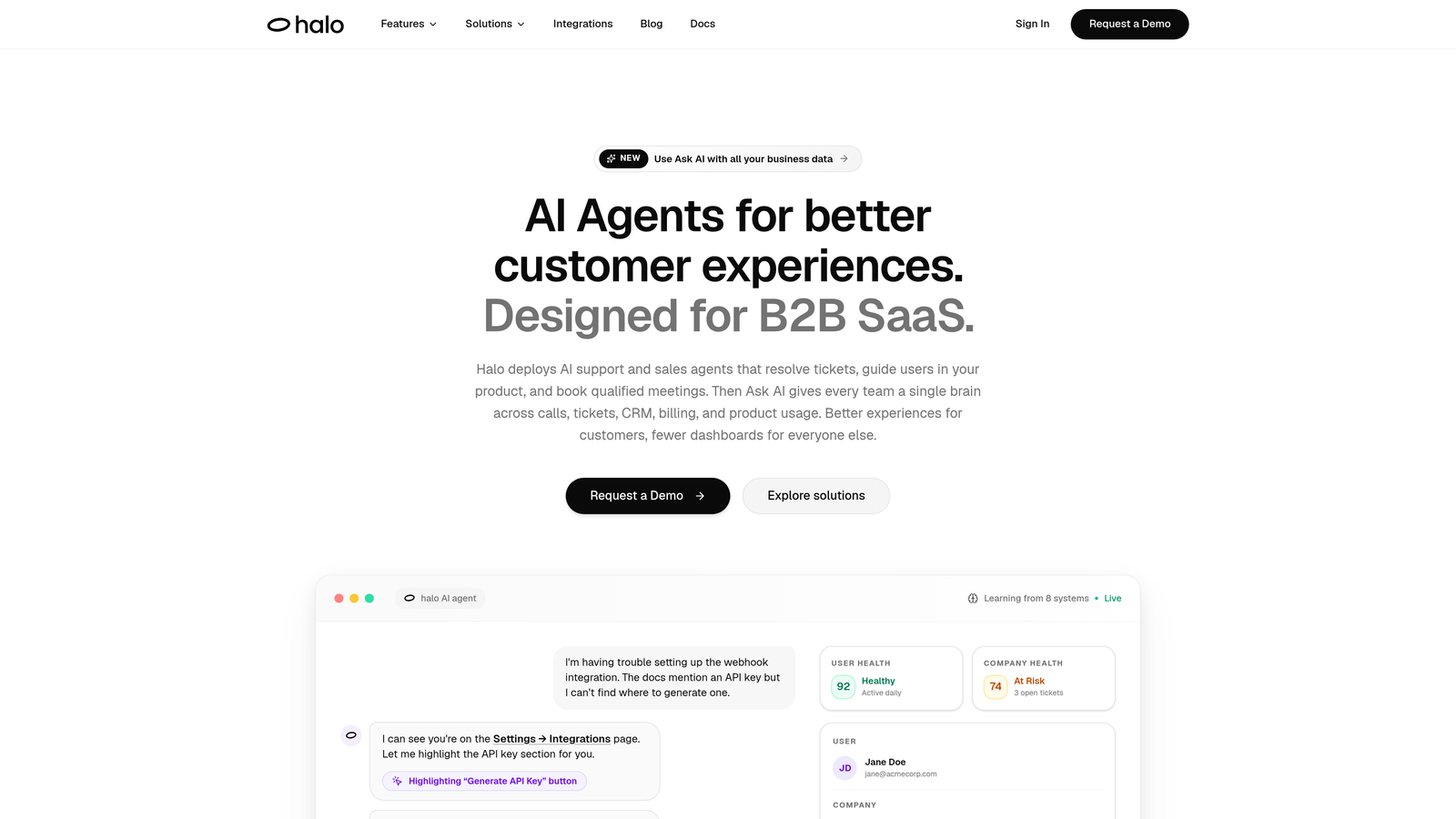
Halo AI is an AI-first customer support platform built to resolve tickets, guide users, and surface business intelligence without requiring a legacy helpdesk foundation.
Where This Tool Shines
What separates Halo from most vendors on this list is architectural intent. It wasn't built as a helpdesk that later added AI features. The entire platform is designed around AI agents as the primary resolution layer, with human escalation as the exception rather than the default.
The standout capability is page-aware context. Halo's agents understand what screen a user is currently on and can provide visual UI guidance specific to that moment. For SaaS products with complex onboarding or multi-step workflows, this means the AI can actually walk users through your product rather than just linking to a help article. Pair that with a continuous learning architecture that improves from every resolved interaction, and the system gets meaningfully smarter over time.
Key Features
Page-Aware AI Agents: The AI knows what screen the user is on and delivers contextual guidance and visual UI walkthroughs in real time.
Smart Inbox with Business Intelligence: Goes beyond ticket counts to surface customer health signals, revenue intelligence, and anomaly detection — turning support data into strategic insight.
Auto Bug Ticket Creation: Automatically generates bug reports and routes them directly to engineering tools like Linear, closing the loop between customer-reported issues and product teams.
Seamless Live Agent Handoff: When escalation is needed, full conversation context is preserved so human agents don't start from scratch.
Broad Integration Ecosystem: Connects with Slack, HubSpot, Intercom, Stripe, Zoom, PandaDoc, Fathom, and more, making it a genuine hub across the business stack rather than an isolated support tool.
Best For
Halo is the strongest fit for SaaS and B2B product teams that want support automation built around their product, not bolted onto a ticketing system. If your support team is also expected to surface product feedback, flag churn risk, and reduce engineering noise from duplicate bug reports, Halo's intelligence layer makes it uniquely suited for that workload.
Pricing
Contact for pricing, tailored to team size and usage volume. Given the platform's AI-first architecture and business intelligence capabilities, it's worth requesting a scoped demo before comparing against per-seat helpdesk pricing.
2. Zendesk
Best for: Enterprises needing proven omnichannel helpdesk infrastructure with layered AI
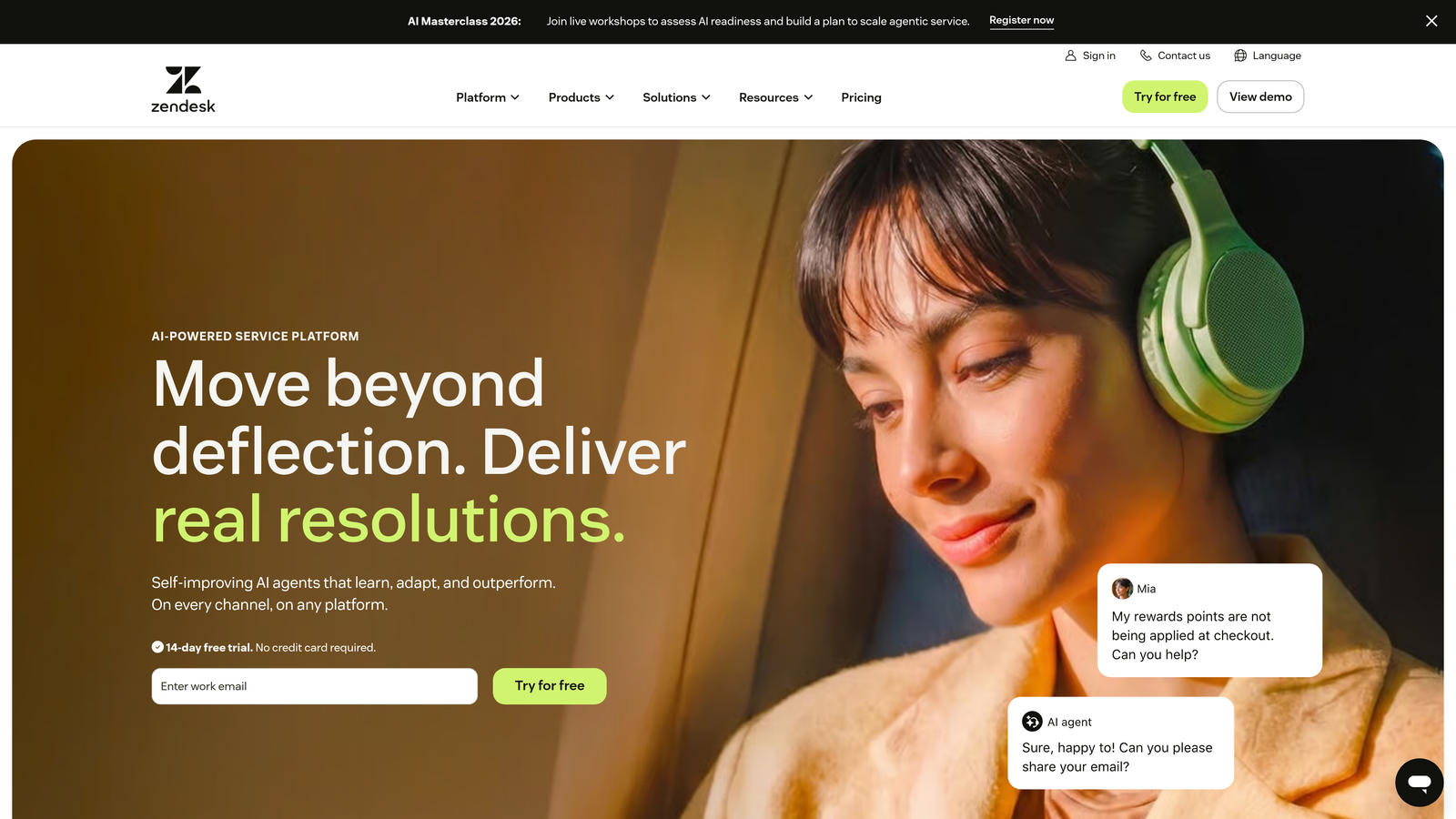
Zendesk is one of the most established enterprise helpdesk platforms, with AI features including intelligent triage, AI agents, and agent assist built on top of a mature ticketing infrastructure.
Where This Tool Shines
Zendesk's strength is its depth of infrastructure. Decades of enterprise deployments have produced a platform with robust SLA management, a large app marketplace, and omnichannel coverage that spans email, chat, voice, and social. For organizations that need reliable, well-documented support operations at scale, Zendesk provides a foundation that's hard to argue with.
The AI capabilities, developed through a partnership with OpenAI, have matured considerably. Zendesk AI agents handle Tier 1 resolution, while intelligent triage and macro suggestions help human agents work faster. It's a helpdesk-first model where AI enhances existing workflows rather than replacing them.
Key Features
Zendesk AI Agents: Automated Tier 1 resolution handling common customer questions before they reach a human agent.
Intelligent Triage and Macro Suggestions: AI-driven recommendations that help human agents categorize, prioritize, and respond to tickets more efficiently.
Large App Marketplace: Hundreds of integrations spanning CRM, ecommerce, analytics, and communication tools.
Enterprise-Grade SLA Management: Comprehensive reporting and compliance tools for organizations with formal service commitments.
Omnichannel Coverage: Unified support across email, chat, voice, and social from a single platform.
Best For
Enterprises with established support operations that want to add AI capabilities without migrating away from a proven ticketing infrastructure. Particularly strong for organizations with complex SLA requirements or large agent teams that need productivity tooling alongside automation.
Pricing
Suite plans start around $55 per agent per month; enterprise plans are priced on request and typically higher depending on volume and feature requirements.
3. Intercom
Best for: SaaS companies wanting conversational AI resolution with strong product analytics integration
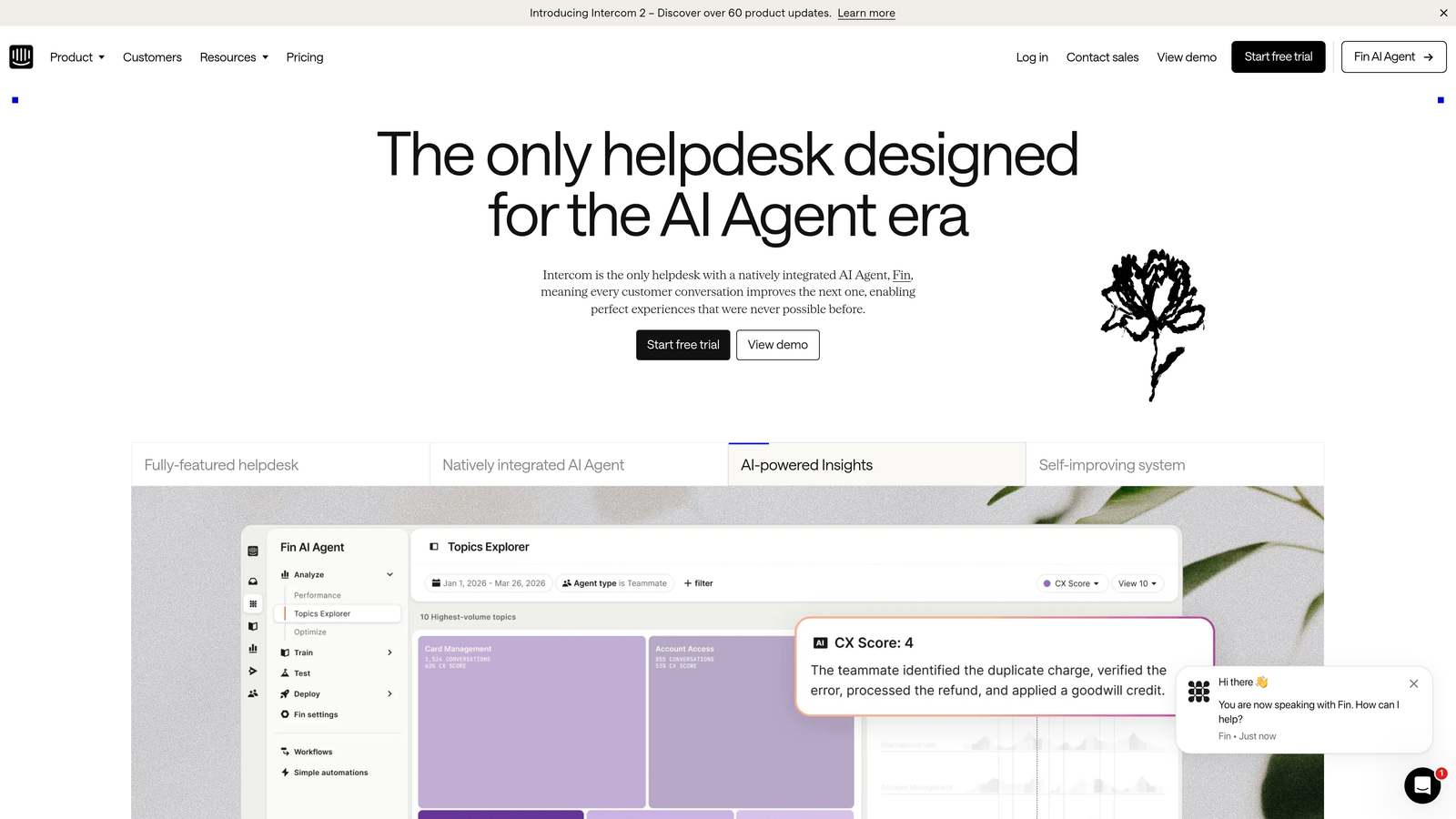
Intercom is a conversational support platform with Fin, a native AI agent built on large language models, designed to resolve customer questions and escalate seamlessly within the same interface.
Where This Tool Shines
Intercom's Fin AI agent is one of the more capable out-of-the-box resolution tools in the market. It handles multi-turn conversations, pulls from your existing help content, and escalates to human agents within the same chat interface without any visible handoff friction. For SaaS companies where the support experience is tightly connected to the product experience, this continuity matters.
The platform also has strong roots in proactive messaging and onboarding automation, which means it can engage users before they even submit a ticket. That combination of reactive resolution and proactive engagement gives it a broader surface area than most pure support tools.
Key Features
Fin AI Agent: Autonomous Tier 1 resolution using large language models, trained on your help content and capable of multi-turn conversations.
Unified Inbox: AI and human agent conversations in one interface, with seamless handoff and full context preserved.
Product Analytics Integration: Strong connection to customer data for context-aware support and personalized responses.
Proactive Messaging and Onboarding Automation: Engage users with targeted messages based on behavior, reducing inbound support volume before it starts.
Customizable Routing and Escalation Workflows: Flexible rules for directing conversations to the right team or agent based on topic, customer tier, or urgency.
Best For
SaaS companies that want AI resolution tightly integrated with product usage data and proactive customer engagement. Particularly effective for teams that view support and onboarding as connected rather than separate functions.
Pricing
Starts around $39 per seat per month; Fin AI resolution is priced per resolution, so total cost scales with automation volume.
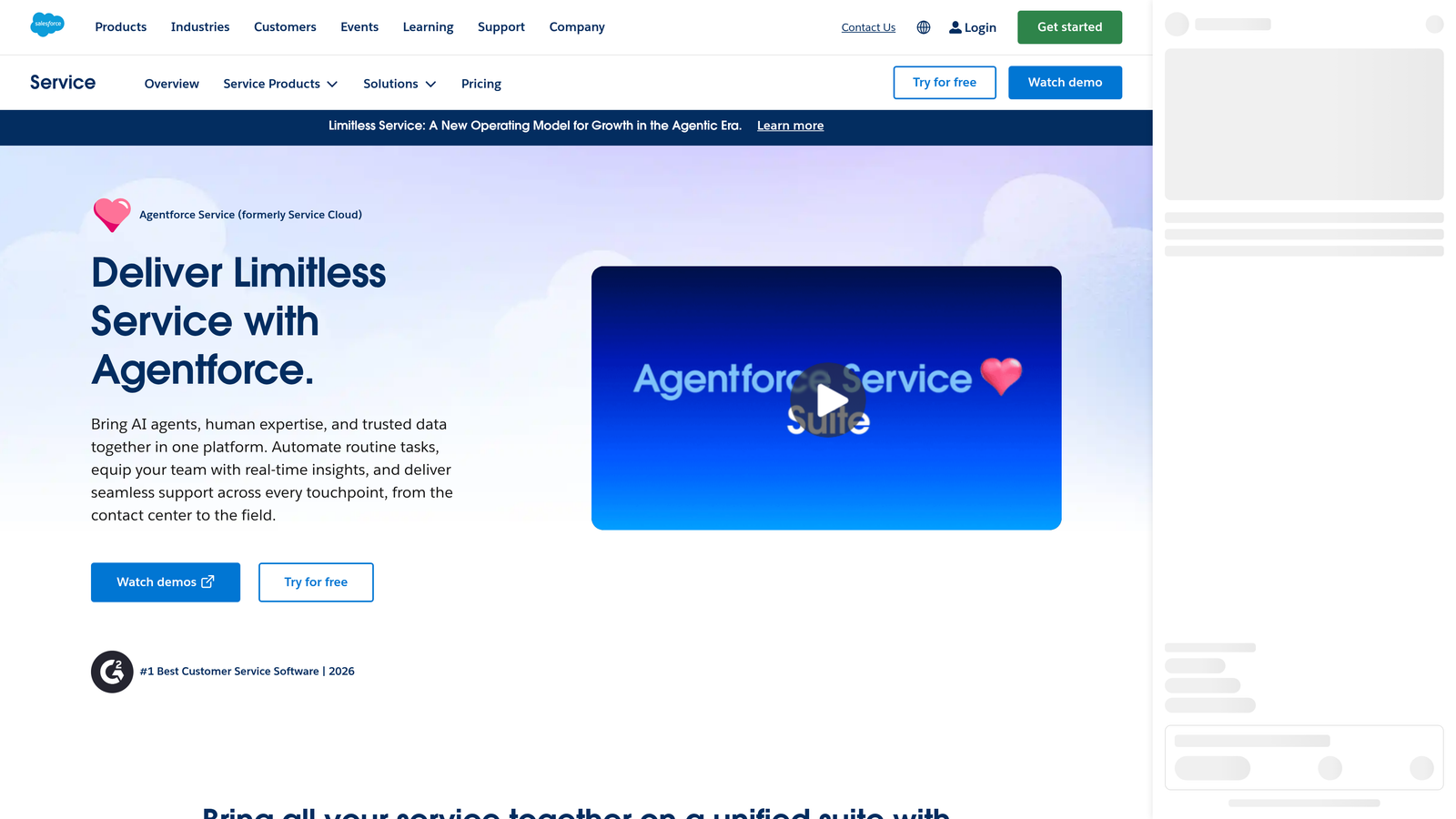
4. Salesforce Service Cloud
Best for: Enterprises deeply invested in the Salesforce ecosystem needing CRM-connected support
Salesforce Service Cloud is an enterprise CRM-connected support platform with Einstein AI embedded across case management, routing, and agent assist.
Where This Tool Shines
Service Cloud's primary advantage is its native connection to the broader Salesforce platform. For organizations where sales, service, and marketing data all live in Salesforce, the ability to pull full customer context into every support interaction is genuinely powerful. Einstein AI can surface next best actions based on CRM data that most standalone support tools simply don't have access to.
The cross-cloud automation potential is significant for large enterprises. Support cases can trigger workflows in Sales Cloud, Commerce Cloud, or Field Service, enabling coordinated responses that span departments. That depth of integration comes with implementation complexity and cost, but for the right organization it's a differentiated capability.
Key Features
Einstein AI: Case classification, next best action recommendations, and real-time agent assist powered by Salesforce's AI layer.
Deep Salesforce Integration: Native connection to CRM, Sales Cloud, and the full Salesforce platform for cross-cloud automation.
Omni-Channel Routing: Intelligent queue management that routes cases based on agent skills, availability, and case priority.
Self-Service Portals and Community Forums: Customer-facing knowledge bases and community tools to deflect volume before it reaches agents.
Cross-Cloud Automation: Support events can trigger workflows across the entire Salesforce ecosystem, connecting service outcomes to sales and operational processes.
Best For
Large enterprises already standardized on Salesforce that want support operations fully integrated with their CRM and sales data. Not the right fit for organizations outside the Salesforce ecosystem, where the implementation cost would outweigh the integration benefits.
Pricing
Enterprise plan starts around $165 per user per month; Unlimited plan is higher. Implementation and customization costs can add significantly to total cost of ownership.
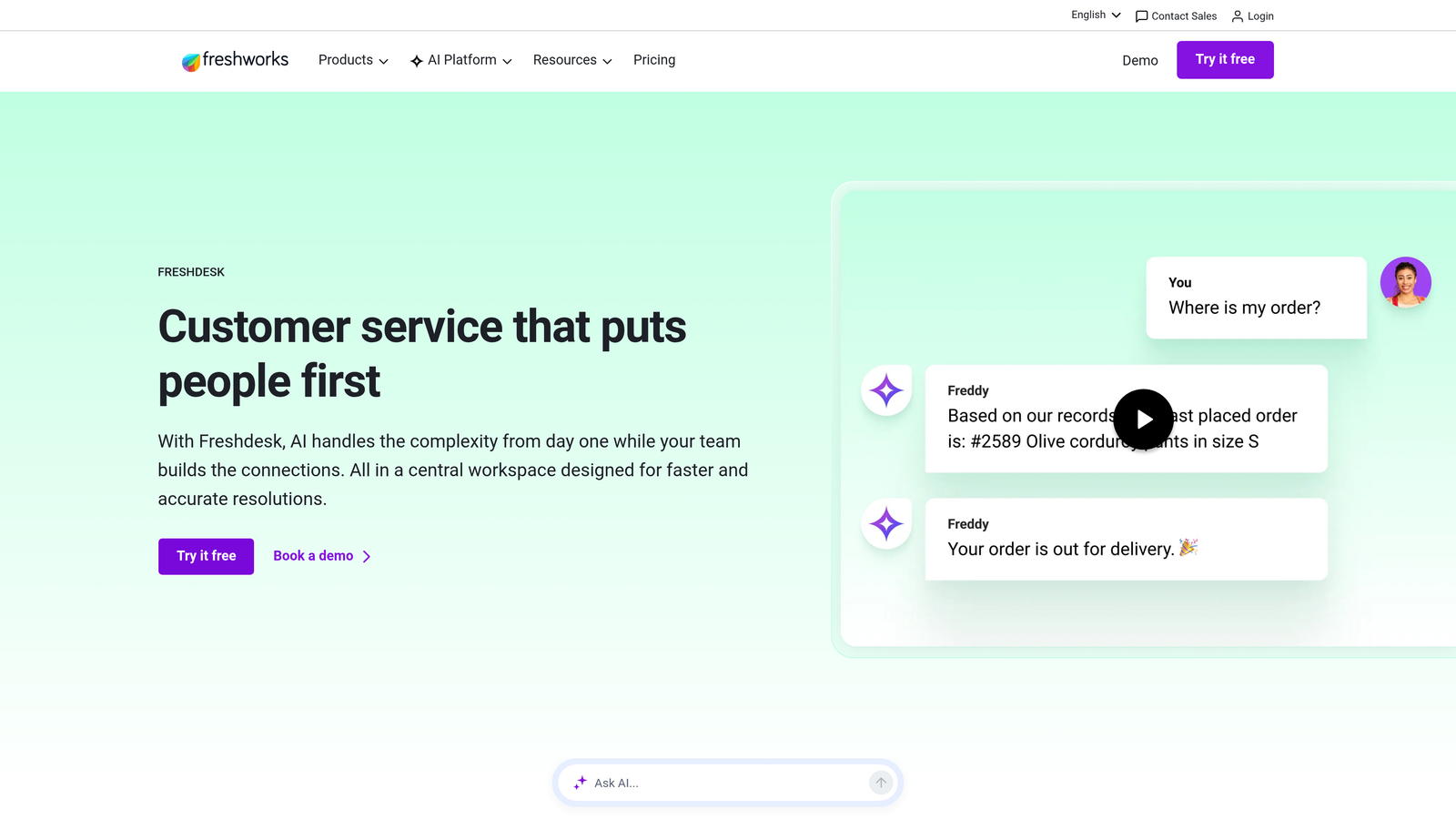
5. Freshdesk (Freshworks)
Best for: Mid-market teams scaling to enterprise wanting competitive pricing with solid AI features
Freshdesk is a mid-market to enterprise helpdesk platform with Freddy AI providing automation across ticket resolution, agent assist, and omnichannel customer engagement.
Where This Tool Shines
Freshdesk occupies a useful position in the market: more affordable than Zendesk or Service Cloud, but with enough enterprise features to handle meaningful scale. Freddy AI handles ticket categorization, routing, and resolution suggestions without requiring extensive configuration, which lowers the barrier to getting automation running quickly.
The native integration with Freshsales CRM and Freshchat gives teams that want a consolidated Freshworks stack a coherent experience across sales and support. For organizations that aren't ready to commit to Salesforce's price point but need more than a basic helpdesk, Freshdesk is a practical middle ground.
Key Features
Freddy AI: Automated ticket categorization, routing, and resolution suggestions built directly into the helpdesk workflow.
Freddy Self Service: AI-powered customer-facing deflection that answers questions before they become tickets.
Omnichannel Coverage: Unified support across email, chat, phone, social, and WhatsApp from a single platform.
Collision Detection and Team Collaboration: Prevents duplicate agent responses and facilitates internal coordination on complex cases.
Native Freshworks Integration: Connects seamlessly with Freshsales CRM and Freshchat for a consolidated customer engagement stack.
Best For
Growing companies transitioning from mid-market to enterprise that want solid AI automation without the implementation complexity or cost of Salesforce or ServiceNow. Also a strong fit for teams already using other Freshworks products.
Pricing
Growth plan from $15 per agent per month; Enterprise plan from $79 per agent per month, making it one of the more accessible options at enterprise scale.
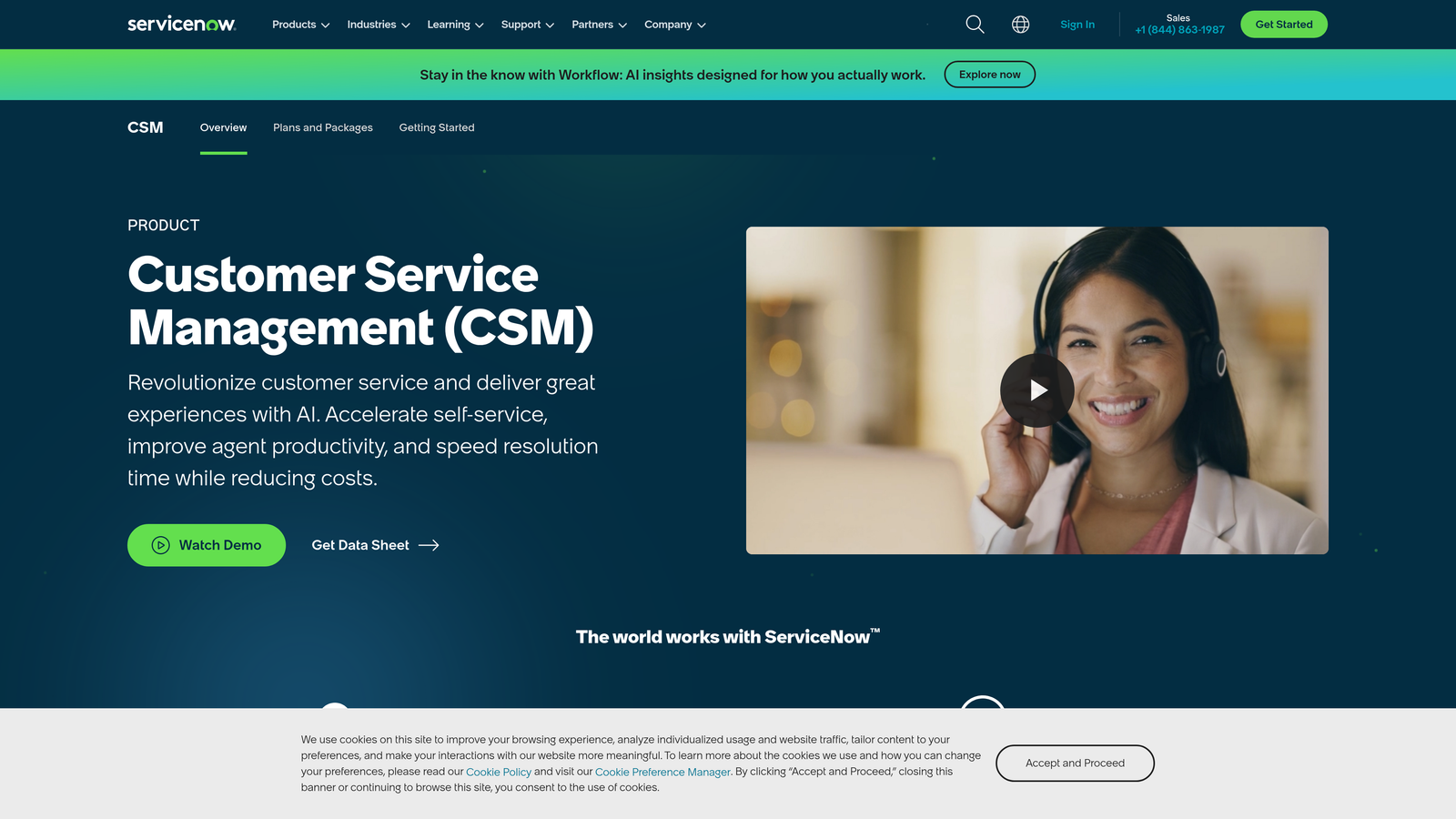
6. ServiceNow Customer Service Management
Best for: Large enterprises needing deep workflow automation connecting customer service to internal operations
ServiceNow Customer Service Management is an enterprise workflow automation platform extending its ITSM capabilities to external customer support.
Where This Tool Shines
ServiceNow CSM is in a category of its own when it comes to connecting customer-facing support to internal operational workflows. When a customer reports an issue, ServiceNow can automatically trigger internal processes, assign tasks to the right teams, manage asset records, and maintain full audit trails, all within the same platform that IT operations already uses.
This is particularly valuable for industries where customer issues have operational consequences: telecommunications, manufacturing, financial services, and enterprise software. The AI-powered virtual agent handles customer self-service, but the real differentiator is what happens behind the scenes when a case is created.
Key Features
AI-Powered Virtual Agent: Customer self-service automation that handles common requests and routes complex cases to the right team.
Deep Workflow Automation: Connects customer cases to internal operations, asset management, and fulfillment workflows automatically.
Case and Asset Management: Full audit trails and asset tracking tied directly to customer cases for regulated industries.
ITSM Infrastructure Integration: Leverages existing ServiceNow ITSM deployments, making it a natural extension for organizations already on the platform.
Proactive Customer Service: Triggers customer communications based on operational events, alerting customers to issues before they reach out.
Best For
Large enterprises with existing ServiceNow ITSM deployments that need to extend the same workflow rigor to customer-facing support. Not cost-effective for organizations starting from scratch or without existing ServiceNow infrastructure.
Pricing
Enterprise licensing priced on request. Total cost of ownership is typically high given implementation complexity, but organizations already on ServiceNow often find the incremental cost justified.
7. Kustomer
Best for: High-volume support operations that need a unified customer timeline across all channels
Kustomer is a CRM-first support platform that organizes support around the complete customer timeline rather than individual tickets, with AI automation built around customer context and history.
Where This Tool Shines
Kustomer's core philosophy is that support should be organized around customers, not tickets. Every interaction, regardless of channel, appears in a single chronological timeline for that customer. This means agents always have full context without switching between systems or searching through disconnected ticket threads.
The AI automation layer builds on this context richness. Workflows can be triggered by customer history, not just the current message, enabling more nuanced routing and resolution logic than ticket-centric platforms typically support. For high-volume operations where customer relationships matter, this context-first approach translates to meaningfully better agent and customer experiences.
Key Features
Unified Customer Timeline: All interactions across every channel consolidated into a single chronological view for each customer.
Context-Driven AI Automation: Workflows triggered by customer history and behavior patterns, not just the content of the current message.
Intelligent Routing: Routes conversations based on customer history, lifetime value, and agent skill matching.
Built-In CRM: Reduces the need for a separate CRM tool by maintaining customer records natively within the support platform.
Omnichannel Coverage: Email, chat, social, SMS, and voice all unified within the same customer timeline view.
Best For
High-volume support operations, particularly in ecommerce, consumer subscriptions, and B2C SaaS, where customer relationship history is critical context for every interaction. Teams that want CRM and support in one place rather than integrated separately.
Pricing
Enterprise plan starts around $89 per user per month; Ultimate plan is higher. The built-in CRM can offset the cost of a separate CRM tool for some teams.
8. Ada
Best for: Enterprises wanting AI automation layered in front of any existing helpdesk without platform migration
Ada is a dedicated AI automation platform designed to sit in front of any existing helpdesk, handling customer interactions autonomously before tickets reach human agents.
Where This Tool Shines
Ada's positioning is deliberately different from the helpdesk-first vendors on this list. Rather than asking you to migrate your support infrastructure, Ada layers on top of whatever helpdesk you're already running. If a customer question can be resolved autonomously, Ada handles it. If it can't, the conversation is handed off to your existing helpdesk with full context intact.
The no-code agent builder is a genuine differentiator for enterprise teams that can't afford engineering dependency for every automation update. Support operations managers can build, test, and deploy AI workflows without writing code, which dramatically reduces time-to-value and ongoing maintenance overhead.
Key Features
No-Code AI Agent Builder: Enterprise automation workflows built and maintained by support teams without engineering involvement.
Channel-Agnostic Deployment: Deploys across web, mobile, and messaging platforms from a single configuration.
Helpdesk Integration: Deep integration with Zendesk, Salesforce, and other major helpdesks for seamless handoff when escalation is needed.
Multilingual Support: Handles customer interactions in multiple languages, making it suitable for global enterprise deployments.
Automation Analytics: Detailed reporting on resolution rates, deflection volume, and automation performance by topic and channel.
Best For
Large enterprises with existing helpdesk investments that want to significantly increase automation depth without a platform migration. Particularly strong for organizations with global customer bases requiring multilingual support at scale.
Pricing
Enterprise pricing available on request. Ada works with custom quotes based on interaction volume and deployment scope.
9. Forethought
Best for: Zendesk and Salesforce shops wanting to add intelligent triage and resolution without switching platforms
Forethought is an AI platform focused on intelligent triage, routing, and resolution, designed to layer onto existing helpdesks rather than replace them.
Where This Tool Shines
Forethought takes a modular approach that's well-suited to enterprises with mature helpdesk deployments that need more intelligence, not a new platform. Its three core products, Solve, Triage, and Assist, can be deployed independently or together, letting teams add automation where the ROI is clearest without committing to a full-stack migration.
The predictive routing in Triage is particularly strong. Rather than routing tickets based on keyword matching or manual rules, it uses predicted intent and urgency to send tickets to the right queue before a human even reads them. For high-volume Zendesk or Salesforce environments where routing accuracy directly impacts resolution time, this is a meaningful capability improvement.
Key Features
Solve: AI agent for automated ticket resolution, handling common questions before they reach a human agent.
Triage: Predictive routing based on AI-predicted ticket intent and urgency, improving queue accuracy and first-contact resolution.
Assist: Real-time suggestions for human agents during live conversations, surfacing relevant knowledge and recommended responses.
Native Helpdesk Integration: Deep integration with Zendesk, Salesforce, ServiceNow, and Freshdesk without requiring platform migration.
Outcome-Triggered Automation: Workflows that activate based on AI-predicted ticket outcomes, enabling proactive case management.
Best For
Enterprises running Zendesk or Salesforce at high volume that want to improve automation depth and routing intelligence without switching platforms. Also a strong fit for teams that want to start with one capability, like triage, and expand over time.
Pricing
Contact for pricing. Forethought's modular structure means cost is scoped by which products (Solve, Triage, Assist) you deploy and at what volume.
Which Vendor Is Right for Your Enterprise?
The right enterprise support automation vendor depends on where you're starting from and where you need to go. If you're already deep in the Salesforce ecosystem, Service Cloud is a natural fit. If you need omnichannel coverage at scale with a proven infrastructure, Zendesk or Freshdesk offer well-tested foundations. If you want AI that sits on top of your existing stack without requiring a migration, Ada or Forethought are worth a close look.
For large enterprises where customer support is deeply connected to internal operations, ServiceNow CSM offers workflow depth that no other vendor on this list can match. And if customer relationship context is the core of your support model, Kustomer's timeline-first approach stands out.
But if you're a SaaS or B2B product team that wants an AI-first platform, one that doesn't just deflect tickets but actually understands your product, surfaces customer health signals, and gets smarter with every interaction, Halo AI is built specifically for that use case. It's not a helpdesk with AI bolted on. It's an AI support layer designed to resolve, guide, and learn from day one.
Before committing to any vendor, ask two questions: Does the AI actually understand context, or is it just keyword matching? And does the platform give you intelligence beyond ticket counts, things like customer health signals, revenue risk, and product friction? The vendors that answer yes to both are the ones worth shortlisting.
Your support team shouldn't scale linearly with your customer base. Let AI agents handle routine tickets, guide users through your product, and surface business intelligence while your team focuses on complex issues that need a human touch. See Halo in action and discover how continuous learning transforms every interaction into smarter, faster support.
For deeper evaluation frameworks, explore our resources on AI support agents and customer support automation benefits before finalizing your vendor shortlist.